


AI-Infra-Guard
A.I.G (AI-Infra-Guard) is a comprehensive, intelligent, and easy-to-use AI Red Teaming platform developed by Tencent Zhuque Lab.
Stars: 2912
A.I.G (AI-Infra-Guard) is an AI red teaming platform by Tencent Zhuque Lab that integrates capabilities such as AI infra vulnerability scan, MCP Server risk scan, and Jailbreak Evaluation. It aims to provide users with a comprehensive, intelligent, and user-friendly solution for AI security risk self-examination. The platform offers features like AI Infra Scan, AI Tool Protocol Scan, and Jailbreak Evaluation, along with a modern web interface, complete API, multi-language support, cross-platform deployment, and being free and open-source under the MIT license.
README:







A.I.G (AI-Infra-Guard) integrates capabilities such as AI infra vulnerability scan, MCP Server risk scan, and Jailbreak Evaluation, aiming to provide users with the most comprehensive, intelligent, and user-friendly solution for AI security risk self-examination.
We are committed to making A.I.G(AI-Infra-Guard) the industry-leading AI red teaming platform. More stars help this project reach a wider audience, attracting more developers to contribute, which accelerates iteration and improvement. Your star is crucial to us!

📢 News:
- A.I.G v3.6.1 Support Clawdbot(moltbot) Gateway unauthorized access risk detection. View all changelog.
- A.I.G v3.6.0 Add Agent Skills security scan to AI Tool Protocol scan. View all changelog.
- 🚀 Quick Start
- ✨ Features
- 🖼️ Showcase
- 📖 User Guide
- 🔧 API Documentation
- 📝 Contribution Guide
- 🙏 Acknowledgements
- 💬 Join the Community
- 📖 Citation
- 📚 Related Papers
-
📄 License
| Docker | RAM | Disk Space |
|---|---|---|
| 20.10 or higher | 4GB+ | 10GB+ |
# This method pulls pre-built images from Docker Hub for a faster start
git clone https://github.com/Tencent/AI-Infra-Guard.git
cd AI-Infra-Guard
# For Docker Compose V2+, replace 'docker-compose' with 'docker compose'
docker-compose -f docker-compose.images.yml up -d
Once the service is running, you can access the A.I.G web interface at:
http://localhost:8088
📦 More installation options
Method 2: One-Click Install Script (Recommended)
# This method will automatically install Docker and launch A.I.G with one command
curl https://raw.githubusercontent.com/Tencent/AI-Infra-Guard/refs/heads/main/docker.sh | bash
Method 3: Build and run from source
git clone https://github.com/Tencent/AI-Infra-Guard.git
cd AI-Infra-Guard
# This method builds a Docker image from local source code and starts the service
# (For Docker Compose V2+, replace 'docker-compose' with 'docker compose')
docker-compose up -d
Note: The AI-Infra-Guard project is positioned as an AI red teaming platform for internal use by enterprises or individuals. It currently lacks an authentication mechanism and should not be deployed on public networks.
For more information, see: https://tencent.github.io/AI-Infra-Guard/?menu=getting-started
Experience the Pro version with advanced features and improved performance. The Pro version requires an invitation code and is prioritized for contributors who have submitted issues, pull requests, or discussions, or actively help grow the community. Visit: https://aigsec.ai/.
| Feature | More Info |
|---|---|
| AI Infra Scan | Precisely identifies over 30 AI framework components and covers over 400 known CVE vulnerabilities, including Ollama, ComfyUI, vLLM, etc. |
| AI Tool Protocol Scan | Powered by an AI Agent, Detects 14 major categories of security risks in MCP Servers and Skills, Supports scanning of source code and remote URLs. |
| Jailbreak Evaluation | Assesses prompt security risks with curated datasets and multiple attack methods, Cross-model comparison. |
💎 Additional Benefits
- 🖥️ Modern Web Interface: User-friendly UI with one-click scanning and real-time progress tracking
- 🔌 Complete API: Full interface documentation and Swagger specifications for easy integration
- 🌐 Multi-Language: Chinese and English interfaces with localized documentation
- 🐳 Cross-Platform: Linux, macOS, and Windows support with Docker-based deployment
- 🆓 Free & Open Source: Completely free under the MIT license


Visit our online documentation: https://tencent.github.io/AI-Infra-Guard/
For more detailed FAQs and troubleshooting guides, visit our documentation.
A.I.G provides a comprehensive set of task creation APIs that support AI infra scan, MCP Server Scan, and Jailbreak Evaluation capabilities.
After the project is running, visit http://localhost:8088/docs/index.html to view the complete API documentation.
For detailed API usage instructions, parameter descriptions, and complete example code, please refer to the Complete API Documentation.
The extensible plugin framework serves as A.I.G's architectural cornerstone, inviting community innovation through Plugin and Feature contributions.
-
Fingerprint Rules: Add new YAML fingerprint files to the
data/fingerprints/directory. -
Vulnerability Rules: Add new vulnerability scan rules to the
data/vuln/directory. -
MCP Plugins: Add new MCP security scan rules to the
data/mcp/directory. -
Jailbreak Evaluation Datasets: Add new Jailbreak evaluation datasets to the
data/evaldirectory.
Please refer to the existing rule formats, create new files, and submit them via a Pull Request.
We extend our sincere appreciation to our academic partners for their exceptional research contributions and technical support.


Prof. hui Li |

Bin Wang |

Zexin Liu |

Hao Yu |

Ao Yang |

Zhengxi Lin |


Prof. Zhemin Yang |

Kangwei Zhong |

Jiapeng Lin |

Cheng Sheng |
Thanks to all the developers who have contributed to the A.I.G project, Your contributions have been instrumental in making A.I.G a more robust and reliable AI Red Team platform.
 |
 |
 |
We are deeply grateful to the following teams and organizations for their trust, and valuable feedback in using A.I.G.


- GitHub Discussions: Join our community discussions
- Issues & Bug Reports: Report issues or suggest features
| WeChat Group | Discord [link] |
|---|---|
 |
 |
For collaboration inquiries or feedback, please contact us at: [email protected]
If you are interested in code security, check out A.S.E (AICGSecEval), the industry's first repository-level AI-generated code security evaluation framework open-sourced by the Tencent Wukong Code Security Team.
If you use A.I.G in your research, please cite:
@misc{Tencent_AI-Infra-Guard_2025,
  author={{Tencent Zhuque Lab}},
  title={{AI-Infra-Guard: A Comprehensive, Intelligent, and Easy-to-Use AI Red Teaming Platform}},
  year={2025},
  howpublished={GitHub repository},
  url={https://github.com/Tencent/AI-Infra-Guard}
}We are deeply grateful to the research teams who have used A.I.G in their academic work and contributed to advancing AI security research:
[1] Ruiqi Li, Zhiqiang Wang, Yunhao Yao et al. "MCP-ITP: An Automated Framework for Implicit Tool Poisoning in MCP." arXiv preprint arXiv:2601.07395v1 (2026). [pdf]
[2] Jingxiao Yang, Ping He, Tianyu Du et al. "HogVul: Black-box Adversarial Code Generation Framework Against LM-based Vulnerability Detectors." arXiv preprint arXiv:2601.05587v1 (2026). [pdf]
[3] Yunyi Zhang, Shibo Cui, Baojun Liu et al. "Beyond Jailbreak: Unveiling Risks in LLM Applications Arising from Blurred Capability Boundaries." arXiv preprint arXiv:2511.17874v2 (2025). [pdf]
[4] Teofil Bodea, Masanori Misono, Julian Pritzi et al. "Trusted AI Agents in the Cloud." arXiv preprint arXiv:2512.05951v1 (2025). [pdf]
[5] Christian Coleman. "Behavioral Detection Methods for Automated MCP Server Vulnerability Assessment." [pdf]
[6] Bin Wang, Zexin Liu, Hao Yu et al. "MCPGuard : Automatically Detecting Vulnerabilities in MCP Servers." arXiv preprint arXiv:22510.23673v1 (2025). [pdf]
[7] Weibo Zhao, Jiahao Liu, Bonan Ruan et al. "When MCP Servers Attack: Taxonomy, Feasibility, and Mitigation." arXiv preprint arXiv:2509.24272v1 (2025). [pdf]
[8] Ping He, Changjiang Li, et al. "Automatic Red Teaming LLM-based Agents with Model Context Protocol Tools." arXiv preprint arXiv:2509.21011 (2025). [pdf]
[9] Yixuan Yang, Daoyuan Wu, Yufan Chen. "MCPSecBench: A Systematic Security Benchmark and Playground for Testing Model Context Protocols." arXiv preprint arXiv:2508.13220 (2025). [pdf]
[10] Zexin Wang, Jingjing Li, et al. "A Survey on AgentOps: Categorization, Challenges, and Future Directions." arXiv preprint arXiv:2508.02121 (2025). [pdf]
[11] Yongjian Guo, Puzhuo Liu, et al. "Systematic Analysis of MCP Security." arXiv preprint arXiv:2508.12538 (2025). [pdf]
📧 If you have used A.I.G in your research or product, or if we have inadvertently missed your publication, we would love to hear from you! Contact us here.
This project is licensed under the MIT License. See the License.txt file for details.
For Tasks:
Click tags to check more tools for each tasksFor Jobs:
Alternative AI tools for AI-Infra-Guard
Similar Open Source Tools
AI-Infra-Guard
A.I.G (AI-Infra-Guard) is an AI red teaming platform by Tencent Zhuque Lab that integrates capabilities such as AI infra vulnerability scan, MCP Server risk scan, and Jailbreak Evaluation. It aims to provide users with a comprehensive, intelligent, and user-friendly solution for AI security risk self-examination. The platform offers features like AI Infra Scan, AI Tool Protocol Scan, and Jailbreak Evaluation, along with a modern web interface, complete API, multi-language support, cross-platform deployment, and being free and open-source under the MIT license.
GPTSwarm
GPTSwarm is a graph-based framework for LLM-based agents that enables the creation of LLM-based agents from graphs and facilitates the customized and automatic self-organization of agent swarms with self-improvement capabilities. The library includes components for domain-specific operations, graph-related functions, LLM backend selection, memory management, and optimization algorithms to enhance agent performance and swarm efficiency. Users can quickly run predefined swarms or utilize tools like the file analyzer. GPTSwarm supports local LM inference via LM Studio, allowing users to run with a local LLM model. The framework has been accepted by ICML2024 and offers advanced features for experimentation and customization.
PPTAgent
PPTAgent is an innovative system that automatically generates presentations from documents. It employs a two-step process for quality assurance and introduces PPTEval for comprehensive evaluation. With dynamic content generation, smart reference learning, and quality assessment, PPTAgent aims to streamline presentation creation. The tool follows an analysis phase to learn from reference presentations and a generation phase to develop structured outlines and cohesive slides. PPTEval evaluates presentations based on content accuracy, visual appeal, and logical coherence.
WebMasterLog
WebMasterLog is a comprehensive repository showcasing various web development projects built with front-end and back-end technologies. It highlights interactive user interfaces, dynamic web applications, and a spectrum of web development solutions. The repository encourages contributions in areas such as adding new projects, improving existing projects, updating documentation, fixing bugs, implementing responsive design, enhancing code readability, and optimizing project functionalities. Contributors are guided to follow specific guidelines for project submissions, including directory naming conventions, README file inclusion, project screenshots, and commit practices. Pull requests are reviewed based on criteria such as proper PR template completion, originality of work, code comments for clarity, and sharing screenshots for frontend updates. The repository also participates in various open-source programs like JWOC, GSSoC, Hacktoberfest, KWOC, 24 Pull Requests, IWOC, SWOC, and DWOC, welcoming valuable contributors.
superagentx
SuperAgentX is a lightweight open-source AI framework designed for multi-agent applications with Artificial General Intelligence (AGI) capabilities. It offers goal-oriented multi-agents with retry mechanisms, easy deployment through WebSocket, RESTful API, and IO console interfaces, streamlined architecture with no major dependencies, contextual memory using SQL + Vector databases, flexible LLM configuration supporting various Gen AI models, and extendable handlers for integration with diverse APIs and data sources. It aims to accelerate the development of AGI by providing a powerful platform for building autonomous AI agents capable of executing complex tasks with minimal human intervention.
DriveLM
DriveLM is a multimodal AI model that enables autonomous driving by combining computer vision and natural language processing. It is designed to understand and respond to complex driving scenarios using visual and textual information. DriveLM can perform various tasks related to driving, such as object detection, lane keeping, and decision-making. It is trained on a massive dataset of images and text, which allows it to learn the relationships between visual cues and driving actions. DriveLM is a powerful tool that can help to improve the safety and efficiency of autonomous vehicles.
agentscope
AgentScope is an agent-oriented programming tool for building LLM (Large Language Model) applications. It provides transparent development, realtime steering, agentic tools management, model agnostic programming, LEGO-style agent building, multi-agent support, and high customizability. The tool supports async invocation, reasoning models, streaming returns, async/sync tool functions, user interruption, group-wise tools management, streamable transport, stateful/stateless mode MCP client, distributed and parallel evaluation, multi-agent conversation management, and fine-grained MCP control. AgentScope Studio enables tracing and visualization of agent applications. The tool is highly customizable and encourages customization at various levels.
pollinations
pollinations.ai is an open-source generative AI platform based in Berlin, empowering community projects with accessible text, image, video, and audio generation APIs. It offers a unified API endpoint for various AI generation needs, including text, images, audio, and video. The platform provides features like image generation using models such as Flux, GPT Image, Seedream, and Kontext, video generation with Seedance and Veo, and audio generation with text-to-speech and speech-to-text capabilities. Users can access the platform through a web interface or API, and authentication is managed through API keys. The platform is community-driven, transparent, and ethical, aiming to make AI technology open, accessible, and interconnected while fostering innovation and responsible development.
lancedb
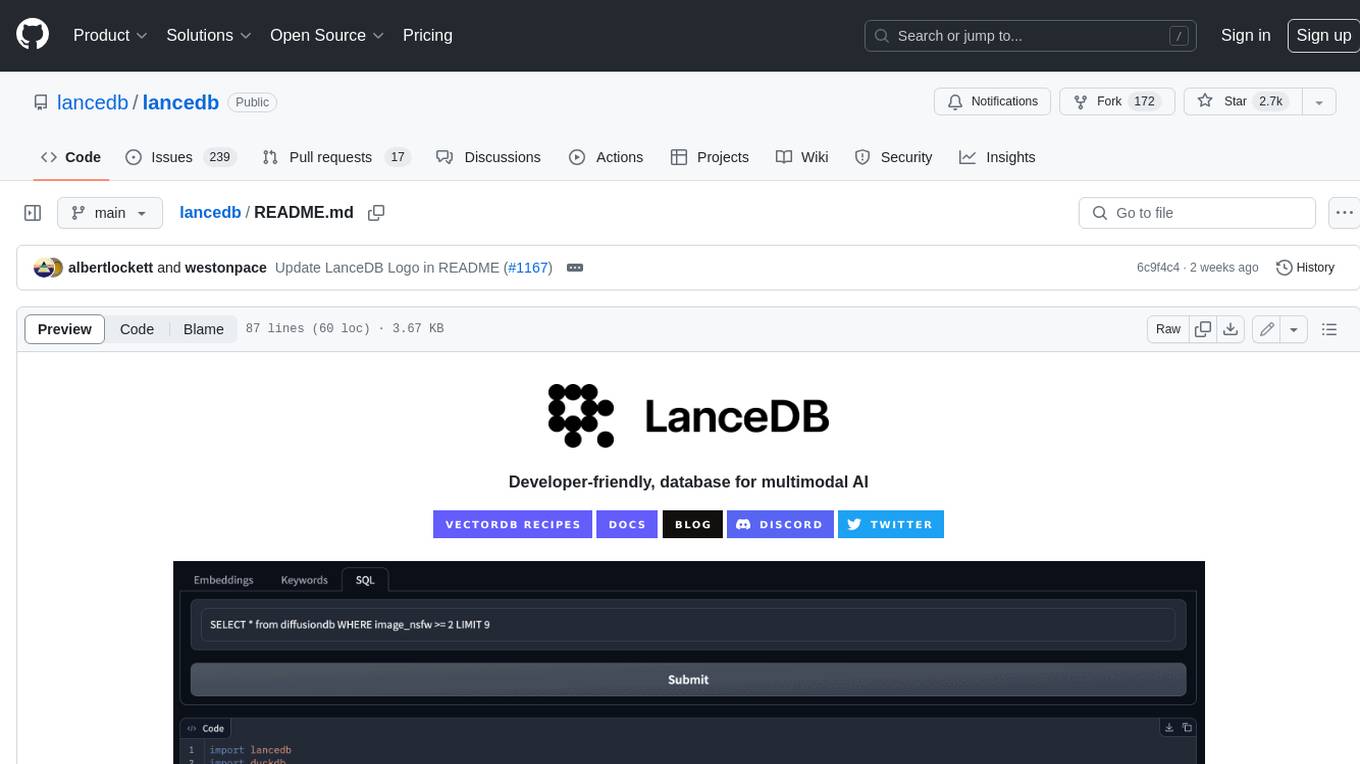
LanceDB is an open-source database for vector-search built with persistent storage, which greatly simplifies retrieval, filtering, and management of embeddings. The key features of LanceDB include: Production-scale vector search with no servers to manage. Store, query, and filter vectors, metadata, and multi-modal data (text, images, videos, point clouds, and more). Support for vector similarity search, full-text search, and SQL. Native Python and Javascript/Typescript support. Zero-copy, automatic versioning, manage versions of your data without needing extra infrastructure. GPU support in building vector index(*). Ecosystem integrations with LangChain 🦜️🔗, LlamaIndex 🦙, Apache-Arrow, Pandas, Polars, DuckDB, and more on the way. LanceDB's core is written in Rust 🦀 and is built using Lance, an open-source columnar format designed for performant ML workloads.
semantic-router
The Semantic Router is an intelligent routing tool that utilizes a Mixture-of-Models (MoM) approach to direct OpenAI API requests to the most suitable models based on semantic understanding. It enhances inference accuracy by selecting models tailored to different types of tasks. The tool also automatically selects relevant tools based on the prompt to improve tool selection accuracy. Additionally, it includes features for enterprise security such as PII detection and prompt guard to protect user privacy and prevent misbehavior. The tool implements similarity caching to reduce latency. The comprehensive documentation covers setup instructions, architecture guides, and API references.
EvoAgentX
EvoAgentX is an open-source framework for building, evaluating, and evolving LLM-based agents or agentic workflows in an automated, modular, and goal-driven manner. It enables developers and researchers to move beyond static prompt chaining or manual workflow orchestration by introducing a self-evolving agent ecosystem. The framework includes features such as agent workflow autoconstruction, built-in evaluation, self-evolution engine, plug-and-play compatibility, comprehensive built-in tools, memory module support, and human-in-the-loop interactions.
MemMachine
MemMachine is an open-source long-term memory layer designed for AI agents and LLM-powered applications. It enables AI to learn, store, and recall information from past sessions, transforming stateless chatbots into personalized, context-aware assistants. With capabilities like episodic memory, profile memory, working memory, and agent memory persistence, MemMachine offers a developer-friendly API, flexible storage options, and seamless integration with various AI frameworks. It is suitable for developers, researchers, and teams needing persistent, cross-session memory for their LLM applications.
X-AnyLabeling
X-AnyLabeling is a robust annotation tool that seamlessly incorporates an AI inference engine alongside an array of sophisticated features. Tailored for practical applications, it is committed to delivering comprehensive, industrial-grade solutions for image data engineers. This tool excels in swiftly and automatically executing annotations across diverse and intricate tasks.

nyxtext
Nyxtext is a text editor built using Python, featuring Custom Tkinter with the Catppuccin color scheme and glassmorphic design. It follows a modular approach with each element organized into separate files for clarity and maintainability. NyxText is not just a text editor but also an AI-powered desktop application for creatives, developers, and students.
PromptX
PromptX is a leading AI agent context platform that revolutionizes interaction design, enabling AI agents to become industry experts. It offers core capabilities such as an AI role creation platform, intelligent tool development platform, and cognitive memory system. PromptX allows users to easily discover experts, summon them for assistance, and engage in professional dialogues through natural conversations. The platform's core philosophy emphasizes treating AI as a person, enabling users to communicate naturally without the need for complex commands. With Nuwa Creation Workshop, users can design custom AI roles using meta-prompt technology, transforming abstract needs into concrete executable AI expert roles in just minutes.
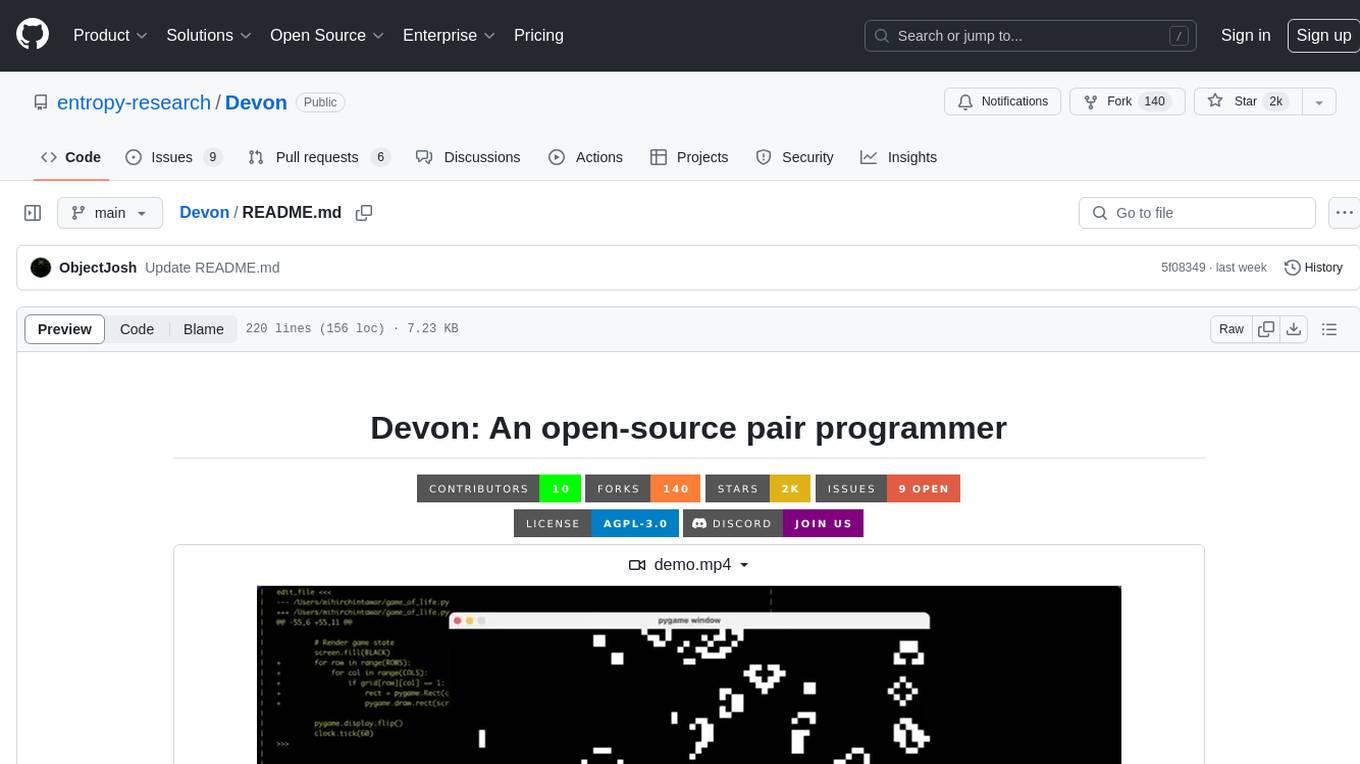
Devon
Devon is an open-source pair programmer tool designed to facilitate collaborative coding sessions. It provides features such as multi-file editing, codebase exploration, test writing, bug fixing, and architecture exploration. The tool supports Anthropic, OpenAI, and Groq APIs, with plans to add more models in the future. Devon is community-driven, with ongoing development goals including multi-model support, plugin system for tool builders, self-hostable Electron app, and setting SOTA on SWE-bench Lite. Users can contribute to the project by developing core functionality, conducting research on agent performance, providing feedback, and testing the tool.
For similar tasks
AI-Infra-Guard
A.I.G (AI-Infra-Guard) is an AI red teaming platform by Tencent Zhuque Lab that integrates capabilities such as AI infra vulnerability scan, MCP Server risk scan, and Jailbreak Evaluation. It aims to provide users with a comprehensive, intelligent, and user-friendly solution for AI security risk self-examination. The platform offers features like AI Infra Scan, AI Tool Protocol Scan, and Jailbreak Evaluation, along with a modern web interface, complete API, multi-language support, cross-platform deployment, and being free and open-source under the MIT license.
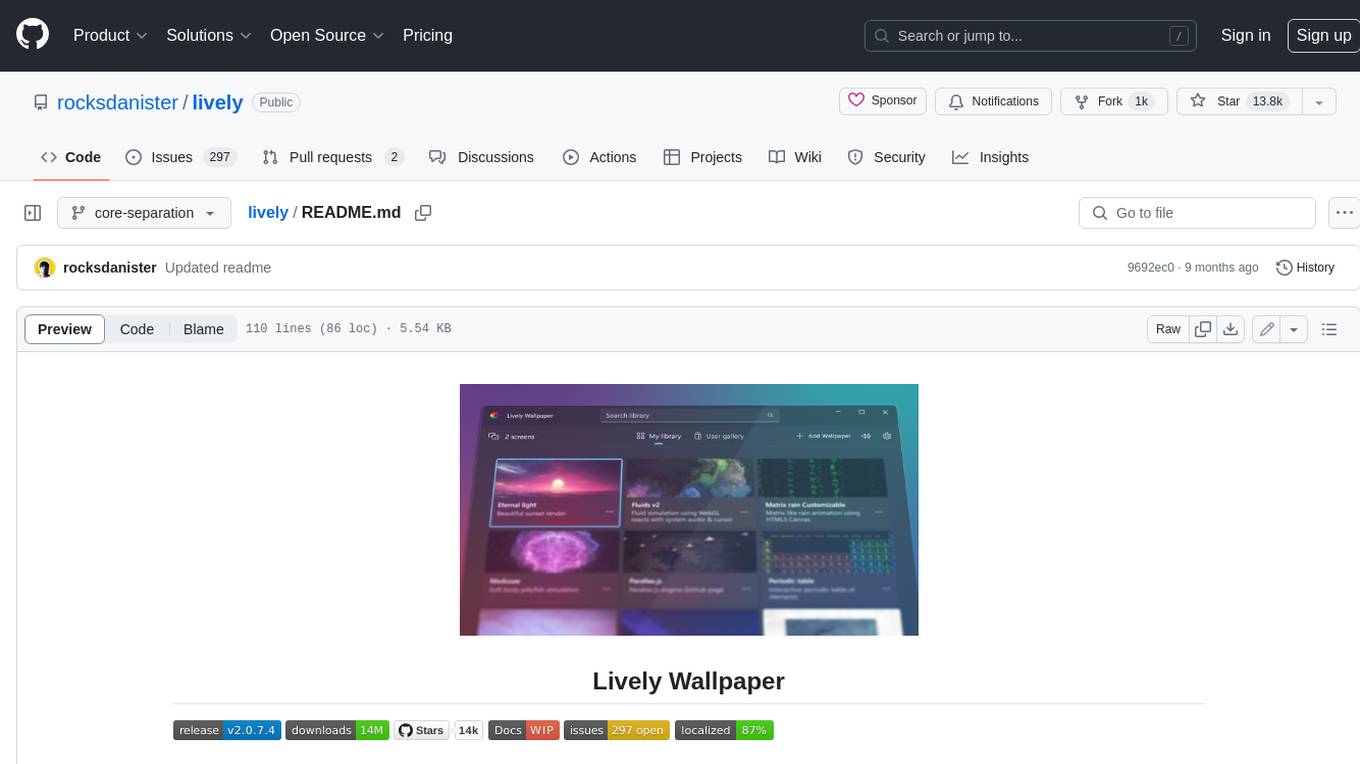
lively
Lively Wallpaper is a tool that allows users to set animated desktop wallpapers, bringing their desktop to life. It supports various types of wallpapers including video/GIF, webpage, and application/games. Users can also use any wallpaper as a screensaver, control Lively with command line arguments, and leverage the Lively API for developers to create interactive wallpapers. The tool offers features such as minimal webpage renderer, hardware-accelerated video playback, and integration with Machine Learning inference for dynamic wallpapers. Lively is designed for Windows, is fully open-source and free, and supports Shadertoy.com URLs as wallpapers.
For similar jobs
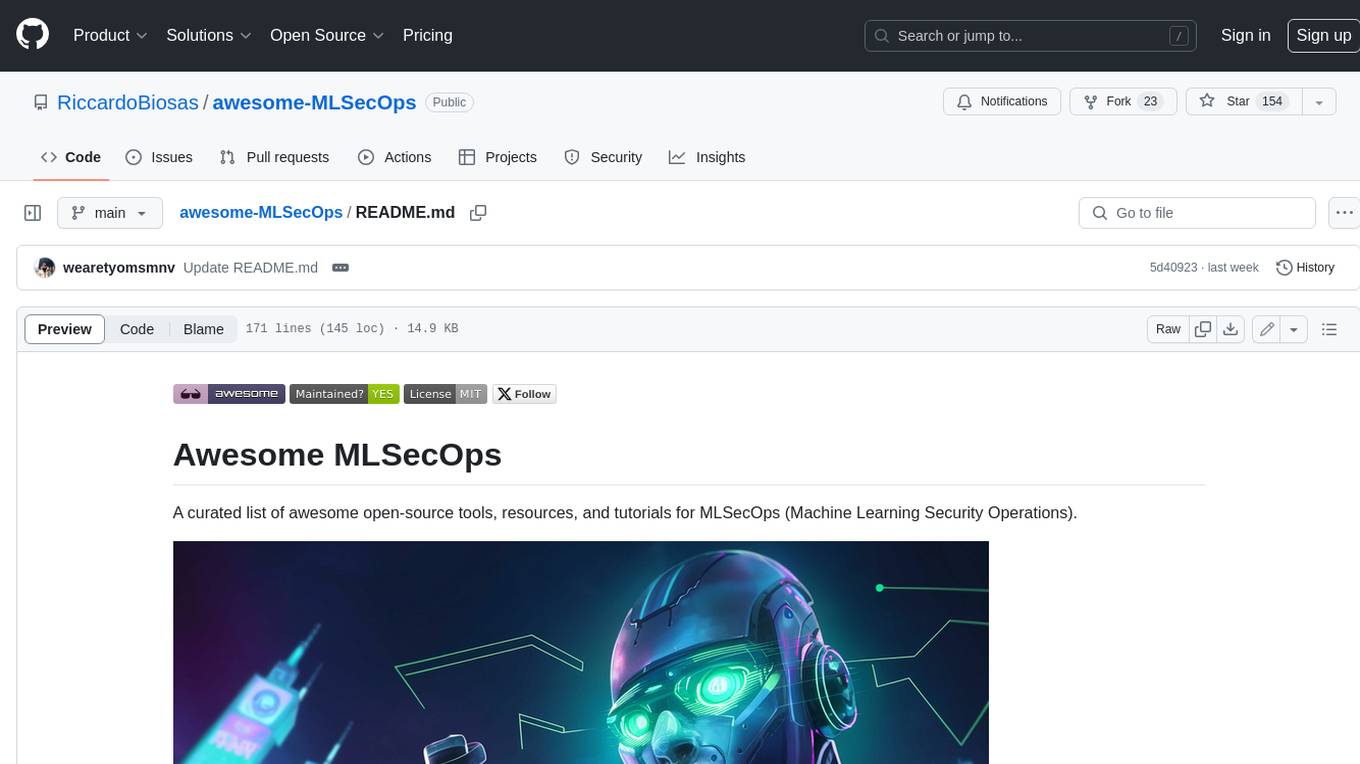
awesome-MLSecOps
Awesome MLSecOps is a curated list of open-source tools, resources, and tutorials for MLSecOps (Machine Learning Security Operations). It includes a wide range of security tools and libraries for protecting machine learning models against adversarial attacks, as well as resources for AI security, data anonymization, model security, and more. The repository aims to provide a comprehensive collection of tools and information to help users secure their machine learning systems and infrastructure.
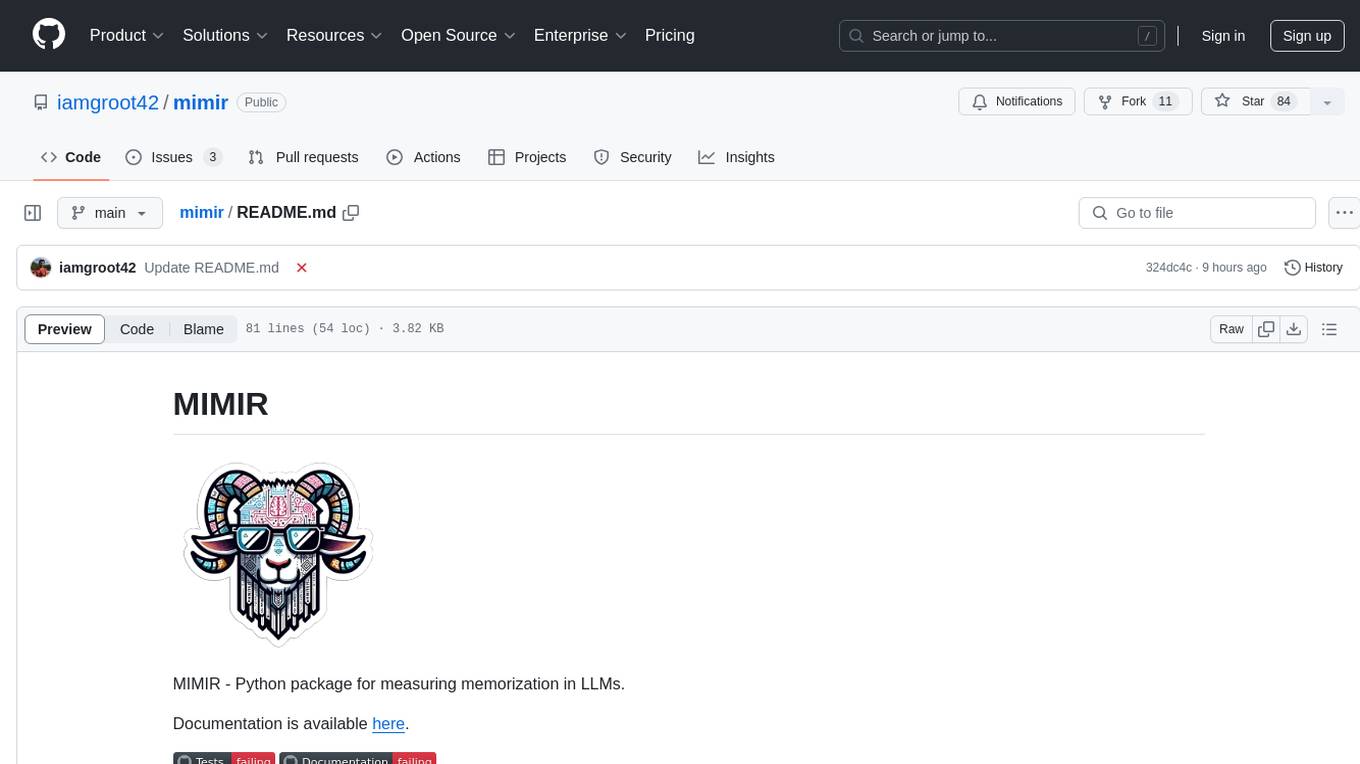
mimir
MIMIR is a Python package designed for measuring memorization in Large Language Models (LLMs). It provides functionalities for conducting experiments related to membership inference attacks on LLMs. The package includes implementations of various attacks such as Likelihood, Reference-based, Zlib Entropy, Neighborhood, Min-K% Prob, Min-K%++, Gradient Norm, and allows users to extend it by adding their own datasets and attacks.
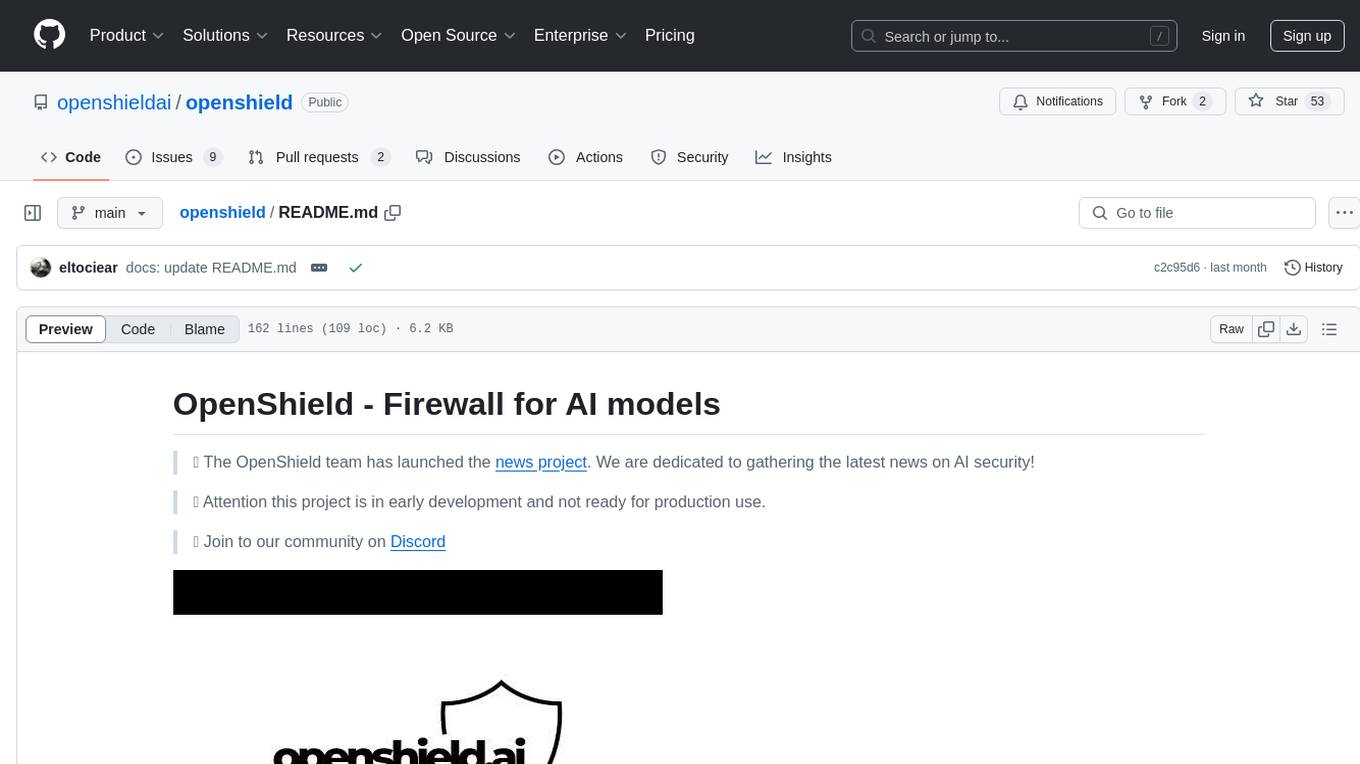
openshield
OpenShield is a firewall designed for AI models to protect against various attacks such as prompt injection, insecure output handling, training data poisoning, model denial of service, supply chain vulnerabilities, sensitive information disclosure, insecure plugin design, excessive agency granting, overreliance, and model theft. It provides rate limiting, content filtering, and keyword filtering for AI models. The tool acts as a transparent proxy between AI models and clients, allowing users to set custom rate limits for OpenAI endpoints and perform tokenizer calculations for OpenAI models. OpenShield also supports Python and LLM based rules, with upcoming features including rate limiting per user and model, prompts manager, content filtering, keyword filtering based on LLM/Vector models, OpenMeter integration, and VectorDB integration. The tool requires an OpenAI API key, Postgres, and Redis for operation.
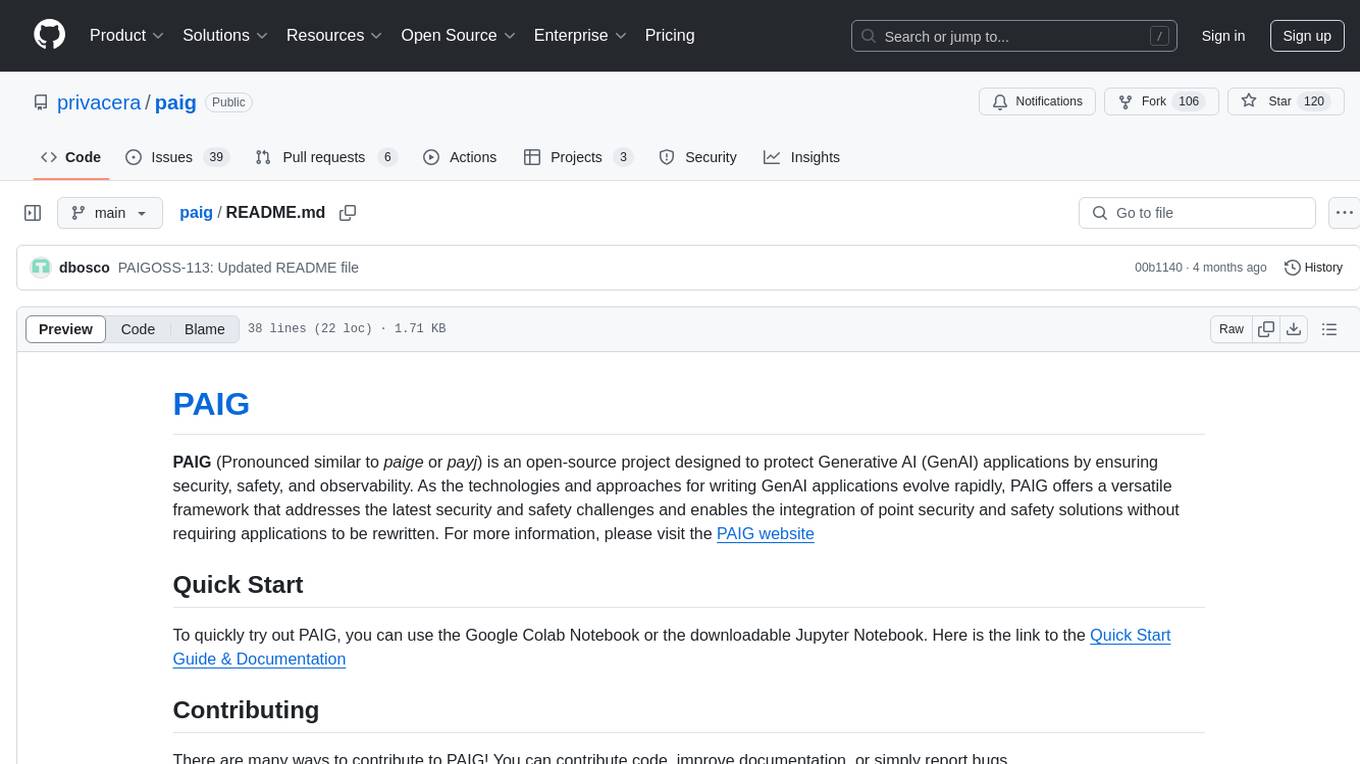
paig
PAIG is an open-source project focused on protecting Generative AI applications by ensuring security, safety, and observability. It offers a versatile framework to address the latest security challenges and integrate point security solutions without rewriting applications. The project aims to provide a secure environment for developing and deploying GenAI applications.
AI-Infra-Guard
A.I.G (AI-Infra-Guard) is an AI red teaming platform by Tencent Zhuque Lab that integrates capabilities such as AI infra vulnerability scan, MCP Server risk scan, and Jailbreak Evaluation. It aims to provide users with a comprehensive, intelligent, and user-friendly solution for AI security risk self-examination. The platform offers features like AI Infra Scan, AI Tool Protocol Scan, and Jailbreak Evaluation, along with a modern web interface, complete API, multi-language support, cross-platform deployment, and being free and open-source under the MIT license.
capsule
Capsule is a secure and durable runtime for AI agents, designed to coordinate tasks in isolated environments. It allows for long-running workflows, large-scale processing, autonomous decision-making, and multi-agent systems. Tasks run in WebAssembly sandboxes with isolated execution, resource limits, automatic retries, and lifecycle tracking. It enables safe execution of untrusted code within AI agent systems.
Copilot-For-Security
Microsoft Copilot for Security is a generative AI-powered assistant for daily operations in security and IT that empowers teams to protect at the speed and scale of AI.
AIL-framework
AIL framework is a modular framework to analyze potential information leaks from unstructured data sources like pastes from Pastebin or similar services or unstructured data streams. AIL framework is flexible and can be extended to support other functionalities to mine or process sensitive information (e.g. data leak prevention).