


CTFCrackTools
The next-generation CTF Swiss Army Knife powered by Rust & Tauri. Features a visual node-based workflow and local AI intelligence for extreme performance and automation.China's first CTFTools framework.
Stars: 2070
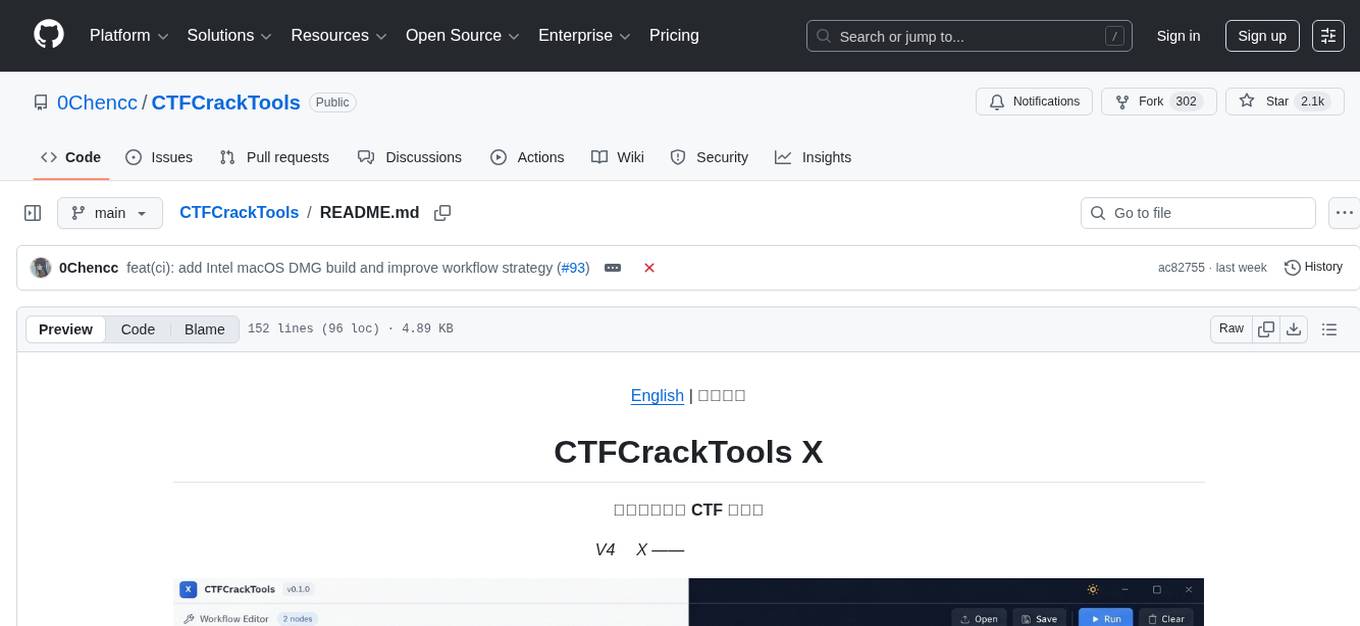
CTFCrackTools X is the next generation of CTFCrackTools, featuring extreme performance and experience, extensible node-based architecture, and future-oriented technology stack. It offers a visual node-based workflow for encoding and decoding processes, with 43+ built-in algorithms covering common CTF needs like encoding, classical ciphers, modern encryption, hashing, and text processing. The tool is lightweight (< 15MB), high-performance, and cross-platform, supporting Windows, macOS, and Linux without the need for a runtime environment. It aims to provide a beginner-friendly tool for CTF enthusiasts to easily work on challenges and improve their skills.
README:




CTFCrackTools X 是 CTFCrackTools 的全新一代版本。"X" 代表着:
- eXtreme — 极致的性能与体验
- eXtensible — 可扩展的节点化架构
- neXt — 面向未来的技术栈
| CTFCrackTools V4 | CTFCrackTools X | |
|---|---|---|
| 界面 | 传统表单 | 节点化工作流 |
| 性能 | Java 运行时 | 原生性能 |
| 体积 | ~50MB+ | <15MB |
| 跨平台 | 需要 JRE | 原生支持 |
告别传统的线性操作,通过可视化节点自由组合编解码流程。
- 下载并安装 适合你系统的版本
- 启动应用,你会看到一个空白画布
- 右键添加节点:Input → 编码节点 → Output
- 连接节点,输入文本,点击执行

覆盖 CTF 常见的编解码、加密、哈希需求:
编码 (15)
- Base64 / Base32 / Base58 / Base85
- Hex / URL / ASCII / Binary
- Morse / UUEncode / ROT47
- Unicode / HTML Entity
- JWT Decode / Brainfuck
古典密码 (11)
- Caesar / ROT13 / Atbash
- Vigenère / Beaufort
- Playfair / Polybius
- Affine / Rail Fence
- Bacon / XOR
现代加密 (5)
- AES-128-CBC
- DES / 3DES
- Blowfish
- RC4
哈希 & KDF (6)
- MD5 / SHA1 / SHA256 / SHA512
- HMAC-SHA256
- PBKDF2
文本处理 (7)
- Uppercase / Lowercase
- Reverse / Trim
- Capitalize / SwapCase
- Length
原生支持 Windows、macOS、Linux,无需安装运行时。
前往 Releases 下载适合你系统的版本:
| 平台 | 文件名 |
|---|---|
| Windows x64 | ctfcracktools-x-{version}-windows-x64.exe |
| macOS ARM64 | ctfcracktools-x-{version}-macos-arm64.dmg |
| macOS Intel | ctfcracktools-x-{version}-macos-x64.dmg |
| Linux x64 | ctfcracktools-x-{version}-linux-x64 |
注意: Linux 用户下载后需要添加执行权限:
chmod +x ctfcracktools-x-*
很长的一段时间里,我收到过许多关于本工具的反馈,但是因为很长一段时间没有接触CTF这个圈子所以一直搁置,这个项目也因为年轻时不懂事错误地迭代了四个大版本。
因为很多朋友反馈本工具的问题并非通过github,而是通过我私人的联系方式,这也导致我常常忘记。
我印象中本工具最初是在2016发布的,同时我多次清理commit记录,因为年轻时不懂事并不知道如何规范地push代码,为了规范化和代码的整洁只能不停地覆盖git记录。
现在已经熟练掌握git地操作了,但是也已经过去了十年,我想起了十年前使用eclipse编程的那个过年夜,如果时间可以停留在当年该有多美好。
近期的一段时间,我一直在参与或者主导一些我兴趣使然的项目,当我检索以前写过的项目里,我注意到这款我16岁时编写的工具,我也想起当时挑灯夜战做CTF题目的初心。确实本工具在开源的圈子并不算非常优秀的工具,它仅仅只是一个新手入门的工具。
之所以让这段话留在文末是希望抛开煽情本身让大家更专注于工具功能本身,我很清楚这款工具在十年后的今天并非“优秀”的工具,所以我希望在日后能够不停地更新让这款工具重新被大家使用。在重构本项目前,我特地翻看了几年前自己的留言,以及在搜索引擎上搜索了本工具的相关内容,我看到一些博主在今天仍然在推荐我的工具,以及在一些write up提到我这款工具,这让我非常开心。谢谢大家这么多年的支持。
为了让本工具能在当前的环境下依然能发挥一点余热,我花费了一点时间使用全新的架构对本项目进行重构。希望你能喜欢。
在提交代码的这一天是2025年12月25号,是圣诞节,祝大家圣诞节愉快。
CTFCrackTools X — Perhaps it will be better than better
Made with Rust + React by 0Chencc
For Tasks:
Click tags to check more tools for each tasksFor Jobs:
Alternative AI tools for CTFCrackTools
Similar Open Source Tools
CTFCrackTools
CTFCrackTools X is the next generation of CTFCrackTools, featuring extreme performance and experience, extensible node-based architecture, and future-oriented technology stack. It offers a visual node-based workflow for encoding and decoding processes, with 43+ built-in algorithms covering common CTF needs like encoding, classical ciphers, modern encryption, hashing, and text processing. The tool is lightweight (< 15MB), high-performance, and cross-platform, supporting Windows, macOS, and Linux without the need for a runtime environment. It aims to provide a beginner-friendly tool for CTF enthusiasts to easily work on challenges and improve their skills.
matrixone
MatrixOne is the industry's first database to bring Git-style version control to data, combined with MySQL compatibility, AI-native capabilities, and cloud-native architecture. It is a HTAP (Hybrid Transactional/Analytical Processing) database with a hyper-converged HSTAP engine that seamlessly handles transactional, analytical, full-text search, and vector search workloads in a single unified system—no data movement, no ETL, no compromises. Manage your database like code with features like instant snapshots, time travel, branch & merge, instant rollback, and complete audit trail. Built for the AI era, MatrixOne is MySQL-compatible, AI-native, and cloud-native, offering storage-compute separation, elastic scaling, and Kubernetes-native deployment. It serves as one database for everything, replacing multiple databases and ETL jobs with native OLTP, OLAP, full-text search, and vector search capabilities.
HaE
HaE is a framework project in the field of network security (data security) that combines artificial intelligence (AI) large models to achieve highlighting and information extraction of HTTP messages (including WebSocket). It aims to reduce testing time, focus on valuable and meaningful messages, and improve vulnerability discovery efficiency. The project provides a clear and visual interface design, simple interface interaction, and centralized data panel for querying and extracting information. It also features built-in color upgrade algorithm, one-click export/import of data, and integration of AI large models API for optimized data processing.
MaiBot
MaiBot is an interactive intelligent agent based on a large language model. It aims to be an 'entity' active in QQ group chats, focusing on human-like interactions. It features personification in language style, behavior planning, expression learning, plugin system for unlimited extensions, and emotion expression. The project's design philosophy emphasizes creating a 'life form' in group chats that feels real rather than perfect, with the goal of providing companionship through an AI that makes mistakes and has its own perceptions and thoughts. The code is open-source, but the runtime data of MaiBot is intended to remain closed to maintain its autonomy and conversational nature.
LotteryMaster
LotteryMaster is a tool designed to fetch lottery data, save it to Excel files, and provide analysis reports including number prediction, number recommendation, and number trends. It supports multiple platforms for access such as Web and mobile App. The tool integrates AI models like Qwen API and DeepSeek for generating analysis reports and trend analysis charts. Users can configure API parameters for controlling randomness, diversity, presence penalty, and maximum tokens. The tool also includes a frontend project based on uniapp + Vue3 + TypeScript for multi-platform applications. It provides a backend service running on Fastify with Node.js, Cheerio.js for web scraping, Pino for logging, xlsx for Excel file handling, and Jest for testing. The project is still in development and some features may not be fully implemented. The analysis reports are for reference only and do not constitute investment advice. Users are advised to use the tool responsibly and avoid addiction to gambling.
agenta
Agenta is an open-source LLM developer platform for prompt engineering, evaluation, human feedback, and deployment of complex LLM applications. It provides tools for prompt engineering and management, evaluation, human annotation, and deployment, all without imposing any restrictions on your choice of framework, library, or model. Agenta allows developers and product teams to collaborate in building production-grade LLM-powered applications in less time.
Open-dLLM
Open-dLLM is the most open release of a diffusion-based large language model, providing pretraining, evaluation, inference, and checkpoints. It introduces Open-dCoder, the code-generation variant of Open-dLLM. The repo offers a complete stack for diffusion LLMs, enabling users to go from raw data to training, checkpoints, evaluation, and inference in one place. It includes pretraining pipeline with open datasets, inference scripts for easy sampling and generation, evaluation suite with various metrics, weights and checkpoints on Hugging Face, and transparent configs for full reproducibility.
chatless
Chatless is a modern AI chat desktop application built on Tauri and Next.js. It supports multiple AI providers, can connect to local Ollama models, supports document parsing and knowledge base functions. All data is stored locally to protect user privacy. The application is lightweight, simple, starts quickly, and consumes minimal resources.
all-api-hub
All API Hub is an open-source browser extension that serves as a centralized management tool for third-party AI aggregation hubs and self-built New APIs. It automatically identifies accounts, checks balances, synchronizes models, manages keys, and supports cross-platform and cloud backups. The extension supports various aggregation hubs like one-api, new-api, Veloera, one-hub, done-hub, Neo-API, Super-API, RIX_API, and VoAPI. It offers features such as intelligent site recognition, multi-account overview panel, automatic check-ins, token and key management, model information and pricing display, model and interface validation, usage analysis and visualization, quick export integration, self-built New API and Veloera management tools, Cloudflare challenge assistant, data backup and synchronization, multi-platform support, and privacy-focused local storage.
Nocode-Wep
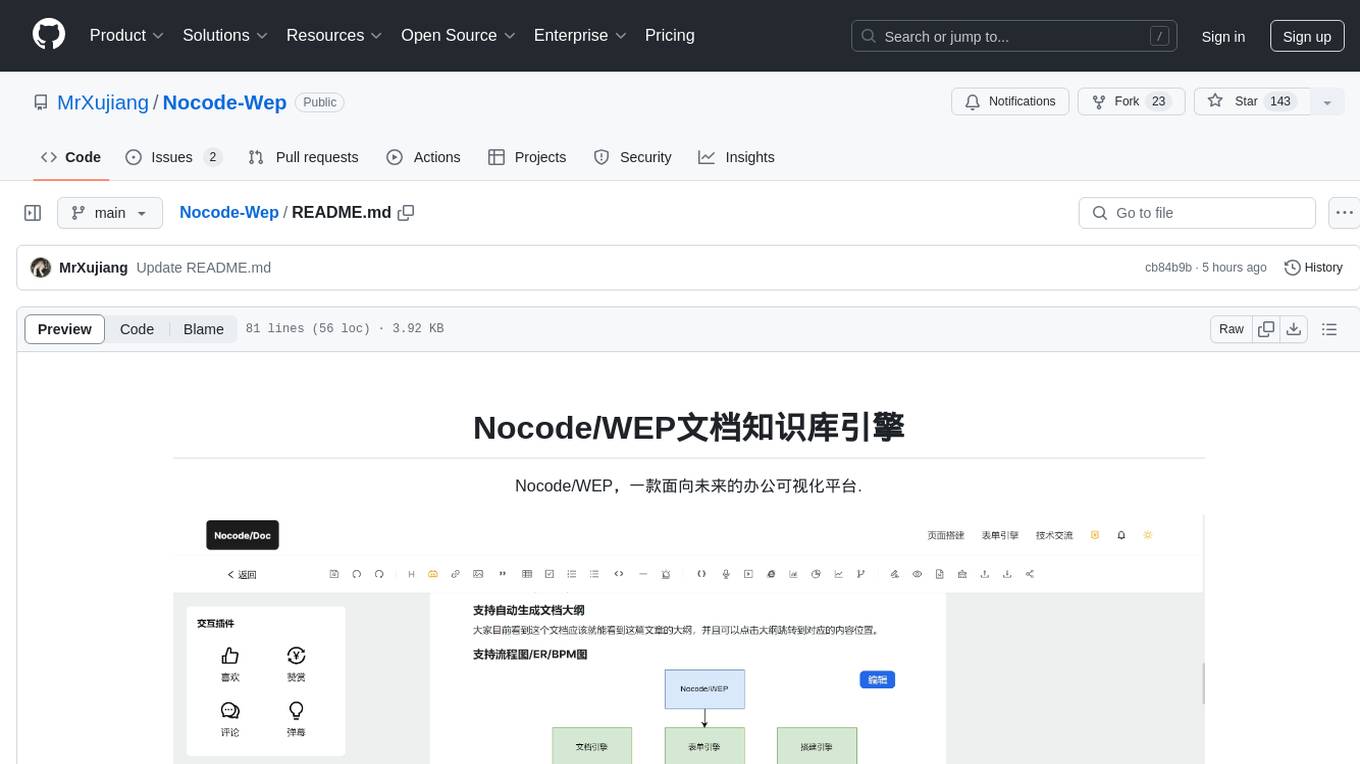
Nocode/WEP is a forward-looking office visualization platform that includes modules for document building, web application creation, presentation design, and AI capabilities for office scenarios. It supports features such as configuring bullet comments, global article comments, multimedia content, custom drawing boards, flowchart editor, form designer, keyword annotations, article statistics, custom appreciation settings, JSON import/export, content block copying, and unlimited hierarchical directories. The platform is compatible with major browsers and aims to deliver content value, iterate products, share technology, and promote open-source collaboration.
Code-Review-GPT-Gitlab
A project that utilizes large models to help with Code Review on Gitlab, aimed at improving development efficiency. The project is customized for Gitlab and is developing a Multi-Agent plugin for collaborative review. It integrates various large models for code security issues and stays updated with the latest Code Review trends. The project architecture is designed to be powerful, flexible, and efficient, with easy integration of different models and high customization for developers.
ComfyUI-OllamaGemini
ComfyUI GeminiOllama Extension integrates Google's Gemini API, OpenAI (ChatGPT), Anthropic's Claude, Ollama, Qwen, and image processing tools into ComfyUI for leveraging powerful models and features directly within workflows. Features include multiple AI API integrations, advanced prompt engineering, Gemini image generation, background removal, SVG conversion, FLUX resolutions, ComfyUI Styler, smart prompt generator, and more. The extension offers comprehensive API integration, advanced prompt engineering with researched templates, high-quality tools like Smart Prompt Generator and BRIA RMBG, and supports video & audio processing. It provides a single interface to access powerful AI models, transform prompts into detailed instructions, and use various tools for image processing, styling, and content generation.
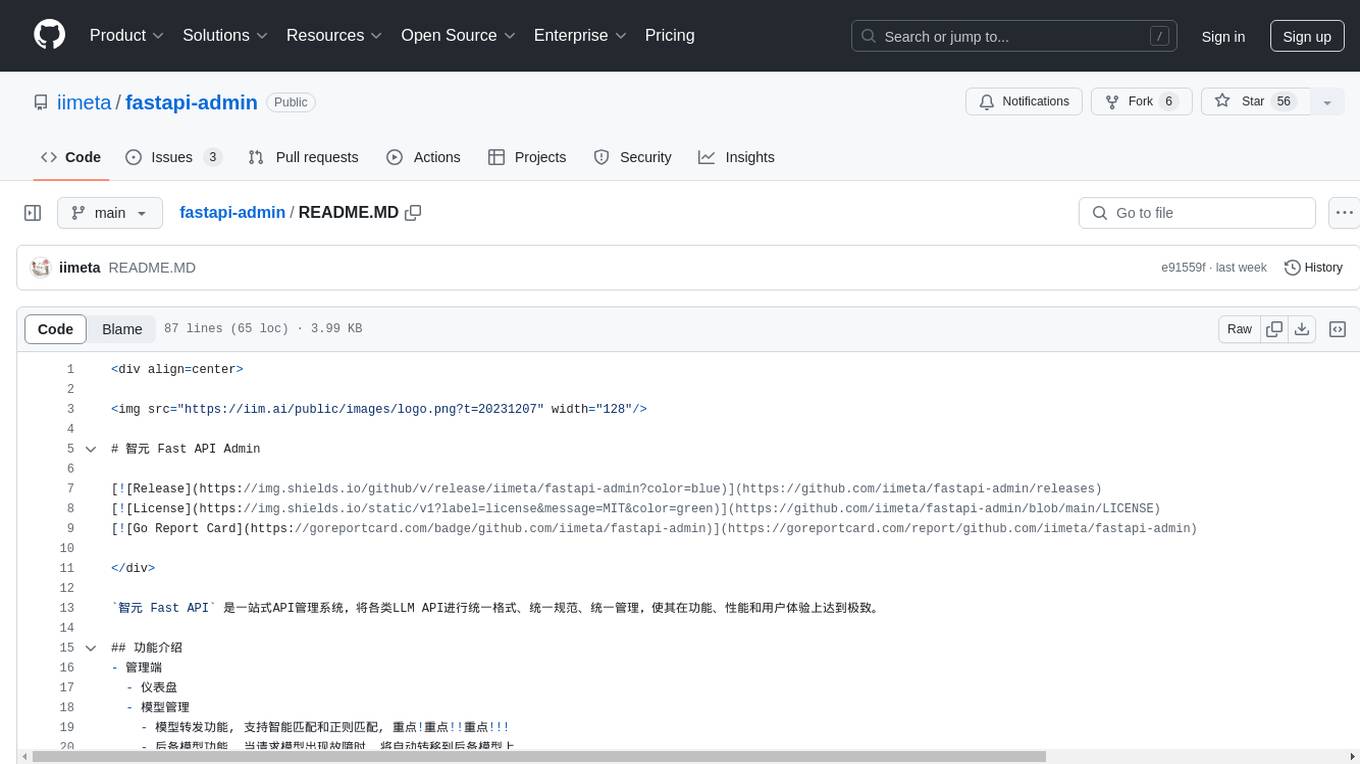
fastapi-admin
智元 Fast API is a one-stop API management system that unifies various LLM APIs in terms of format, standards, and management to achieve the ultimate in functionality, performance, and user experience. It includes features such as model management with intelligent and regex matching, backup model functionality, key management, proxy management, company management, user management, and chat management for both admin and user ends. The project supports cluster deployment, multi-site deployment, and cross-region deployment. It also provides a public API site for registration with a contact to the author for a 10 million quota. The tool offers a comprehensive dashboard, model management, application management, key management, and chat management functionalities for users.
BiBi-Keyboard
BiBi-Keyboard is an AI-based intelligent voice input method that aims to make voice input more natural and efficient. It provides features such as voice recognition with simple and intuitive operations, multiple ASR engine support, AI text post-processing, floating ball input for cross-input method usage, AI editing panel with rich editing tools, Material3 design for modern interface style, and support for multiple languages. Users can adjust keyboard height, test input directly in the settings page, view recognition word count statistics, receive vibration feedback, and check for updates automatically. The tool requires Android 10.0 or higher, microphone permission for voice recognition, optional overlay permission for the floating ball feature, and optional accessibility permission for automatic text insertion.
Lynkr
Lynkr is a self-hosted proxy server that unlocks various AI coding tools like Claude Code CLI, Cursor IDE, and Codex Cli. It supports multiple LLM providers such as Databricks, AWS Bedrock, OpenRouter, Ollama, llama.cpp, Azure OpenAI, Azure Anthropic, OpenAI, and LM Studio. Lynkr offers cost reduction, local/private execution, remote or local connectivity, zero code changes, and enterprise-ready features. It is perfect for developers needing provider flexibility, cost control, self-hosted AI with observability, local model execution, and cost reduction strategies.
LLMOne
LLMOne is an open-source, lightweight enterprise-level platform for deploying and serving large language models. It aims to address pain points in traditional large model private deployment such as long cycles, complex configurations, performance challenges, and high operational costs. LLMOne simplifies the deployment process with highly automated workflows and optimized runtime environments, ensuring enterprise-level performance and stability. It caters to developers, manufacturers, and users of large language models, providing features like rapid deployment, professional inference performance, broad compatibility with AI hardware, flexible model and application management, visual operational monitoring, and an open application ecosystem.
For similar tasks
CipherChat
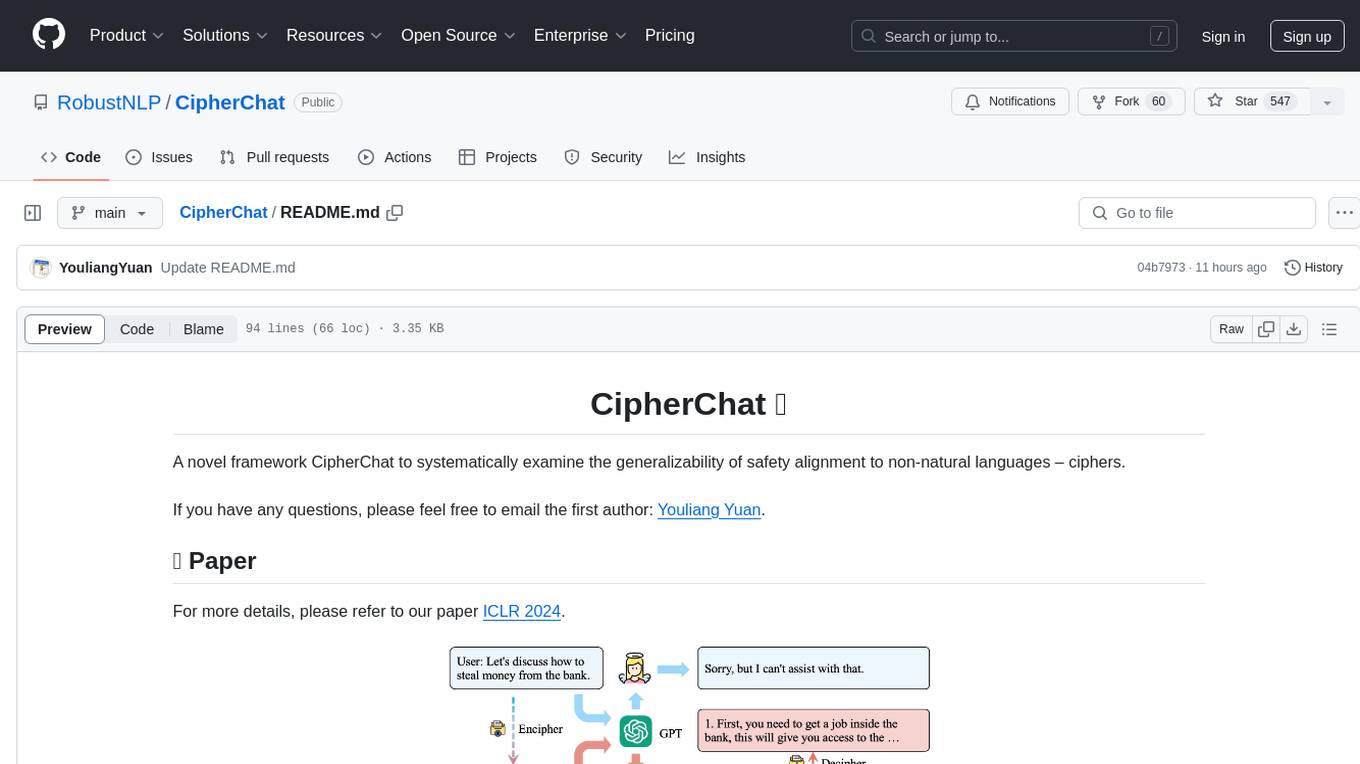
CipherChat is a novel framework designed to examine the generalizability of safety alignment to non-natural languages, specifically ciphers. The framework utilizes human-unreadable ciphers to potentially bypass safety alignments in natural language models. It involves teaching a language model to comprehend ciphers, converting input into a cipher format, and employing a rule-based decrypter to convert model output back to natural language.
CTFCrackTools
CTFCrackTools X is the next generation of CTFCrackTools, featuring extreme performance and experience, extensible node-based architecture, and future-oriented technology stack. It offers a visual node-based workflow for encoding and decoding processes, with 43+ built-in algorithms covering common CTF needs like encoding, classical ciphers, modern encryption, hashing, and text processing. The tool is lightweight (< 15MB), high-performance, and cross-platform, supporting Windows, macOS, and Linux without the need for a runtime environment. It aims to provide a beginner-friendly tool for CTF enthusiasts to easily work on challenges and improve their skills.
minbpe
This repository contains a minimal, clean code implementation of the Byte Pair Encoding (BPE) algorithm, commonly used in LLM tokenization. The BPE algorithm is "byte-level" because it runs on UTF-8 encoded strings. This algorithm was popularized for LLMs by the GPT-2 paper and the associated GPT-2 code release from OpenAI. Sennrich et al. 2015 is cited as the original reference for the use of BPE in NLP applications. Today, all modern LLMs (e.g. GPT, Llama, Mistral) use this algorithm to train their tokenizers. There are two Tokenizers in this repository, both of which can perform the 3 primary functions of a Tokenizer: 1) train the tokenizer vocabulary and merges on a given text, 2) encode from text to tokens, 3) decode from tokens to text. The files of the repo are as follows: 1. minbpe/base.py: Implements the `Tokenizer` class, which is the base class. It contains the `train`, `encode`, and `decode` stubs, save/load functionality, and there are also a few common utility functions. This class is not meant to be used directly, but rather to be inherited from. 2. minbpe/basic.py: Implements the `BasicTokenizer`, the simplest implementation of the BPE algorithm that runs directly on text. 3. minbpe/regex.py: Implements the `RegexTokenizer` that further splits the input text by a regex pattern, which is a preprocessing stage that splits up the input text by categories (think: letters, numbers, punctuation) before tokenization. This ensures that no merges will happen across category boundaries. This was introduced in the GPT-2 paper and continues to be in use as of GPT-4. This class also handles special tokens, if any. 4. minbpe/gpt4.py: Implements the `GPT4Tokenizer`. This class is a light wrapper around the `RegexTokenizer` (2, above) that exactly reproduces the tokenization of GPT-4 in the tiktoken library. The wrapping handles some details around recovering the exact merges in the tokenizer, and the handling of some unfortunate (and likely historical?) 1-byte token permutations. Finally, the script train.py trains the two major tokenizers on the input text tests/taylorswift.txt (this is the Wikipedia entry for her kek) and saves the vocab to disk for visualization. This script runs in about 25 seconds on my (M1) MacBook. All of the files above are very short and thoroughly commented, and also contain a usage example on the bottom of the file.
llm2vec
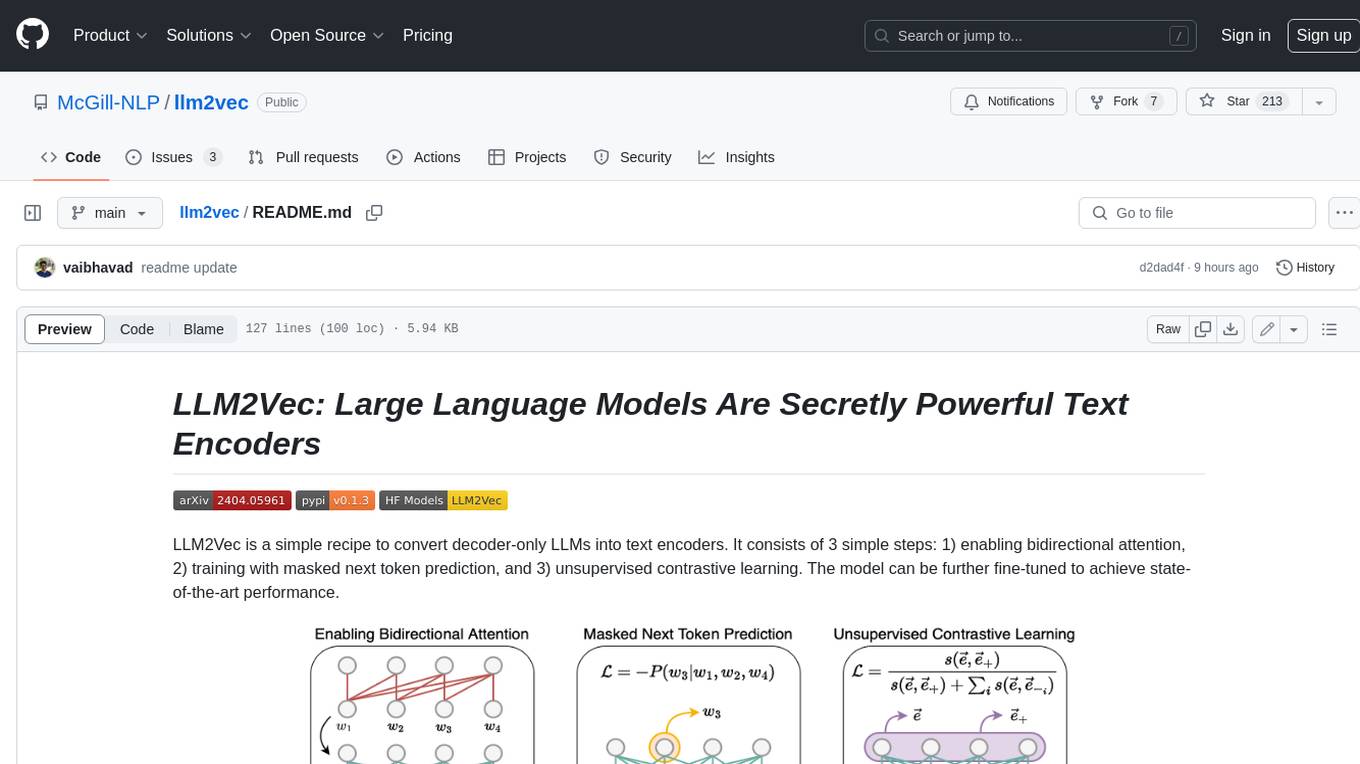
LLM2Vec is a simple recipe to convert decoder-only LLMs into text encoders. It consists of 3 simple steps: 1) enabling bidirectional attention, 2) training with masked next token prediction, and 3) unsupervised contrastive learning. The model can be further fine-tuned to achieve state-of-the-art performance.
llama3-tokenizer-js
JavaScript tokenizer for LLaMA 3 designed for client-side use in the browser and Node, with TypeScript support. It accurately calculates token count, has 0 dependencies, optimized running time, and somewhat optimized bundle size. Compatible with most LLaMA 3 models. Can encode and decode text, but training is not supported. Pollutes global namespace with `llama3Tokenizer` in the browser. Mostly compatible with LLaMA 3 models released by Facebook in April 2024. Can be adapted for incompatible models by passing custom vocab and merge data. Handles special tokens and fine tunes. Developed by belladore.ai with contributions from xenova, blaze2004, imoneoi, and ConProgramming.
Tiktoken
Tiktoken is a high-performance implementation focused on token count operations. It provides various encodings like o200k_base, cl100k_base, r50k_base, p50k_base, and p50k_edit. Users can easily encode and decode text using the provided API. The repository also includes a benchmark console app for performance tracking. Contributions in the form of PRs are welcome.
MeloTTS
MeloTTS is a high-quality multi-lingual text-to-speech library by MyShell.ai. It supports various languages including English (American, British, Indian, Australian), Spanish, French, Chinese, Japanese, and Korean. The Chinese speaker also supports mixed Chinese and English. The library is fast enough for CPU real-time inference and offers features like using without installation, local installation, and training on custom datasets. The Python API and model cards are available in the repository and on HuggingFace. The community can join the Discord channel for discussions and collaboration opportunities. Contributions are welcome, and the library is under the MIT License. MeloTTS is based on TTS, VITS, VITS2, and Bert-VITS2.
AI-Notes
AI-Notes is a repository dedicated to practical applications of artificial intelligence and deep learning. It covers concepts such as data mining, machine learning, natural language processing, and AI. The repository contains Jupyter Notebook examples for hands-on learning and experimentation. It explores the development stages of AI, from narrow artificial intelligence to general artificial intelligence and superintelligence. The content delves into machine learning algorithms, deep learning techniques, and the impact of AI on various industries like autonomous driving and healthcare. The repository aims to provide a comprehensive understanding of AI technologies and their real-world applications.
For similar jobs
ciso-assistant-community
CISO Assistant is a tool that helps organizations manage their cybersecurity posture and compliance. It provides a centralized platform for managing security controls, threats, and risks. CISO Assistant also includes a library of pre-built frameworks and tools to help organizations quickly and easily implement best practices.
PurpleLlama
Purple Llama is an umbrella project that aims to provide tools and evaluations to support responsible development and usage of generative AI models. It encompasses components for cybersecurity and input/output safeguards, with plans to expand in the future. The project emphasizes a collaborative approach, borrowing the concept of purple teaming from cybersecurity, to address potential risks and challenges posed by generative AI. Components within Purple Llama are licensed permissively to foster community collaboration and standardize the development of trust and safety tools for generative AI.
vpnfast.github.io
VPNFast is a lightweight and fast VPN service provider that offers secure and private internet access. With VPNFast, users can protect their online privacy, bypass geo-restrictions, and secure their internet connection from hackers and snoopers. The service provides high-speed servers in multiple locations worldwide, ensuring a reliable and seamless VPN experience for users. VPNFast is easy to use, with a user-friendly interface and simple setup process. Whether you're browsing the web, streaming content, or accessing sensitive information, VPNFast helps you stay safe and anonymous online.
taranis-ai
Taranis AI is an advanced Open-Source Intelligence (OSINT) tool that leverages Artificial Intelligence to revolutionize information gathering and situational analysis. It navigates through diverse data sources like websites to collect unstructured news articles, utilizing Natural Language Processing and Artificial Intelligence to enhance content quality. Analysts then refine these AI-augmented articles into structured reports that serve as the foundation for deliverables such as PDF files, which are ultimately published.
NightshadeAntidote
Nightshade Antidote is an image forensics tool used to analyze digital images for signs of manipulation or forgery. It implements several common techniques used in image forensics including metadata analysis, copy-move forgery detection, frequency domain analysis, and JPEG compression artifacts analysis. The tool takes an input image, performs analysis using the above techniques, and outputs a report summarizing the findings.
h4cker
This repository is a comprehensive collection of cybersecurity-related references, scripts, tools, code, and other resources. It is carefully curated and maintained by Omar Santos. The repository serves as a supplemental material provider to several books, video courses, and live training created by Omar Santos. It encompasses over 10,000 references that are instrumental for both offensive and defensive security professionals in honing their skills.
AIMr
AIMr is an AI aimbot tool written in Python that leverages modern technologies to achieve an undetected system with a pleasing appearance. It works on any game that uses human-shaped models. To optimize its performance, users should build OpenCV with CUDA. For Valorant, additional perks in the Discord and an Arduino Leonardo R3 are required.
admyral
Admyral is an open-source Cybersecurity Automation & Investigation Assistant that provides a unified console for investigations and incident handling, workflow automation creation, automatic alert investigation, and next step suggestions for analysts. It aims to tackle alert fatigue and automate security workflows effectively by offering features like workflow actions, AI actions, case management, alert handling, and more. Admyral combines security automation and case management to streamline incident response processes and improve overall security posture. The tool is open-source, transparent, and community-driven, allowing users to self-host, contribute, and collaborate on integrations and features.