


xln
0.1 - Q1 2026. DRAFT xln: a credit+collateral netting-account L2 for all EVM and future CBDC jurisdictions—unicast O(1) per hop, link-capped risk, local state, sovereign exits.
Stars: 101
XLN (Cross-Local Network) is a platform that enables instant off-chain settlement with on-chain finality. It combines Byzantine consensus, Bloomberg Terminal functionalities, and VR capabilities to run economic simulations in the browser without the need for a backend. The architecture includes layers for jurisdictions, entities, and accounts, with features like Solidity contracts, BFT consensus, and bilateral channels. The tool offers a panel system similar to Bloomberg Terminal for workspace organization and visualization, along with support for offline blockchain simulations in the browser and VR/Quest compatibility.
README:
Instant off-chain settlement with on-chain finality.
Byzantine consensus meets Bloomberg Terminal meets VR. Run complete economic simulations in your browser—no backend needed.
Core:
  /docs/                Philosophy, architecture, eternal specs
  /runtime/             Consensus engine (BFT entity + bilateral account state machines)
    /account-tx/        Account transaction handlers
    /entity-tx/         Entity transaction handlers
    /scenarios/         Economic simulations (ahb.ts, grid.ts, etc.)
    /evms/              EVM integrations (BrowserVM, remote)
  /jurisdictions/       Solidity contracts (Ethereum, Polygon, Arbitrum, ...)
  /frontend/            Main xln.finance app + 3D visualization
    /src/lib/components/   UI panels (Entity, Network, TimeMachine, etc.)
  /tests/               E2E tests (Playwright)

Dev:
  /scripts/             Utilities (playwright helpers, deployment, debug)
  /ai/                  AI integrations (STT server, telegram bot, council)
  bootstrap.sh          One-command setup
  CLAUDE.md             AI instructions
  .archive/             Old implementations (historical reference)

---

## 🚀 Quick Start

```bash
# Install + start everything
bun run dev

# Open browser
open http://localhost:8080
First run: ~2-3min (installs Foundry) After: ~10sec
Cross-Local Network enables entities to:
- Exchange value instantly off-chain (BFT consensus)
- Anchor final state on-chain (Ethereum, Polygon, Arbitrum)
- Run complete economic simulations in browser (BrowserVM - no backend!)
- Visualize in VR (Quest/Vision Pro compatible)
Think: Lightning Network + Byzantine consensus + Bloomberg Terminal + Blender.
- What: Solidity contracts managing reserves, collateral, settlements
-
Where:
/jurisdictions/contracts/ -
Contracts:
-
Depository.sol- ImplementsIDepository(future ERC standard) -
EntityProvider.sol- Entity registration + quorum verification
-
- Deploy: Ethereum, Polygon, Arbitrum, any EVM chain
- What: Distributed organizations with threshold signatures
- Flow: ADD_TX → PROPOSE → SIGN → COMMIT
-
Source:
/runtime/entity-consensus.ts - Deterministic: Nonce-based ordering, Merkle state roots
- What: Payment channels between entity pairs
- Perspective: Left/right with canonical ordering (entityA < entityB)
-
Source:
/runtime/account-consensus.ts - Settlement: Bilateral state verification with Merkle proofs
# Development
bun run dev              # Full stack (jurisdictions + runtime + frontend)
bun run check            # TypeScript + Svelte validation
bun run build            # Build runtime.js for browser

# Jurisdictions (Contracts)
bun run env:build        # Compile Solidity
bun run env:deploy       # Deploy to local network
bun run dev:reset        # Reset all networks + redeploy

# Frontend
cd frontend && bun run dev      # Vite dev server
cd frontend && bun run build    # Production build

# Testing
bunx playwright test            # E2E tests
bunx playwright test tests/ahb-smoke.spec.ts # AHB smoke testBloomberg Terminal-style workspace. Drag, dock, float, tab - full Chrome DevTools UX.
- 🌐 Graph3D - Force-directed network viz (WebGL/WebGPU toggle)
- 🏢 Entities - Live entity list (reserves, accounts, activity)
- 💰 Depository - On-chain J-state viewer (BrowserVM queries)
- 🎬 Architect - God-mode controls (5 modes: Explore/Build/Economy/Governance/Resolve)
- Default: 4-panel workspace
- Analyst: Graph3D + Depository + Console (research mode)
- Builder: Architect + Graph3D + Entities (creation mode)
- Embed: Graph3D only (for docs/blog posts)
Tech: Dockview (2.8k stars), Svelte reactivity, localStorage persistence
Source: /frontend/src/lib/components/ + /docs/xlnview.md
No localhost:8545. No cloud RPC. Pure browser.
- Engine: @ethereumjs/vm v10 (official Ethereum Foundation implementation)
- Deployed: Depository.sol + 500 prefunded entities
- Tokens: USDC (id=1), ETH (id=2)
- Reset: Refresh page = new universe
- Persistent: Optional IndexedDB (resume sessions)
Config: Genesis configs in runtime/evms/browser-evm.ts
Demo: Load any scenario (AHB, Grid) - BrowserVM deploys contracts automatically
- WebXR: Enabled by default (WebGL renderer)
- Offline: Simnet works without network (perfect for VR demos)
- Performance: 72fps in Quest 3
- Future: Hand tracking, voice commands, spatial UI
Root:
  readme.md              This file - project overview
  CLAUDE.md              AI assistant instructions
  changelog.md           Version history

/docs/
  ├── contributing/      How to develop on XLN
  │   ├── workflow.md           Daily commands (bun run dev, etc)
  │   ├── bug-prevention.md     Pre-commit checklist
  │   ├── agentic.md            AI autonomous execution (80% rule)
  │   └── adhd-format.md        Response formatting guide
  │
  ├── research/          Explorations & specifications
  │   ├── insurance/            Insurance layer designs
  │   │   ├── claude-analysis.md
  │   │   ├── codex-analysis.md
  │   │   └── gemini-analysis.md
  │   ├── depository-core.md    Contract logic summary
  │   └── rollups-position.md   XLN vs rollups comparison
  │
  ├── planning/          Active & historical planning
  │   ├── active/
  │   │   └── next.md           Current priority tasks
  │   ├── completed/            Finished refactors
  │   └── launch-checklist.md   Pre-launch verification
  │
  ├── about/             Philosophy & origin
  │   ├── homakov.md            Founder's vision
  │   └── repo-structure.md     Private vs public repos
  │
  ├── testing/           Test procedures
  │   └── ahb-demo.md           AHB demo steps
  │
  └── docs/              Core architecture (existing)
      ├── rjea.md               R→E→A→J flow explanation
      ├── xlnview.md            Panel architecture
      ├── flow.md               Transaction flow
      └── ...                   (eternal specs)
Quick links:
- New to XLN? Start with docs/about/homakov.md
- Want to contribute? Read docs/contributing/workflow.md
- Current priorities? Check docs/planning/active/next.md
- Architecture deep-dive? See docs/docs/rjea.md
- ✅ Repository restructure - Essence-driven naming (docs, runtime, jurisdictions, worlds)
- ✅ BrowserVM integration - Offline simnet with @ethereumjs/vm
- ✅ Panel workspace - Dockview-based Bloomberg Terminal UX
- ✅ WebGPU/WebGL switch - Runtime renderer toggle (future-proof)
- ✅ IDepository interface - Standardizable ERC for reserve management
- ✅ Depository - 69% smaller, self-contained (6.6KB vs 21KB)
Runtime: TypeScript + Bun Frontend: Svelte + Vite + Three.js Contracts: Solidity + Hardhat Blockchain: @ethereumjs/vm (simnet) → Hardhat (local) → Ethereum/L2s (prod) Panels: Dockview (2.8k⭐) Tests: Playwright
Browser-only simulation. Zero infrastructure.
- Engine: @ethereumjs/vm (in-browser blockchain)
- Contracts: Depository.sol (6.6KB, implements IDepository)
- State: 500 prefunded entities, USDC + ETH
- Reset: Refresh page = new universe
- Use: Scenario rehearsals, VR demos, tutorials
Base Sepolia. Multi-user coordination.
- Network: Base L2 Sepolia (chainId: 84532)
- Contracts: Full suite (EntityProvider, Depository, DeltaTransformer)
- RPC: https://sepolia.base.org
- Use: Integration testing, onboarding flows, load testing
Production deployment. Real value.
- Chains: Base L2 (primary), Ethereum L1 (bridge)
- Governance: Multi-sig + timelock
- Audits: Trail of Bits + OpenZeppelin
- Use: Live settlement network
Start here:
- docs/contributing/workflow.md - Daily dev commands
- docs/docs/xlnview.md - Panel architecture + BrowserVM
- docs/docs/rjea.md - R→E→A→J flow explanation
- simnet/readme.md - Offline blockchain setup
For deep dives: docs/docs/
License: AGPL-3.0 Status: Active development (2025) Website: xln.finance (coming soon)
For Tasks:
Click tags to check more tools for each tasksFor Jobs:
Alternative AI tools for xln
Similar Open Source Tools
xln
XLN (Cross-Local Network) is a platform that enables instant off-chain settlement with on-chain finality. It combines Byzantine consensus, Bloomberg Terminal functionalities, and VR capabilities to run economic simulations in the browser without the need for a backend. The architecture includes layers for jurisdictions, entities, and accounts, with features like Solidity contracts, BFT consensus, and bilateral channels. The tool offers a panel system similar to Bloomberg Terminal for workspace organization and visualization, along with support for offline blockchain simulations in the browser and VR/Quest compatibility.
mcp-memory-service
The MCP Memory Service is a universal memory service designed for AI assistants, providing semantic memory search and persistent storage. It works with various AI applications and offers fast local search using SQLite-vec and global distribution through Cloudflare. The service supports intelligent memory management, universal compatibility with AI tools, flexible storage options, and is production-ready with cross-platform support and secure connections. Users can store and recall memories, search by tags, check system health, and configure the service for Claude Desktop integration and environment variables.
Lynkr
Lynkr is a self-hosted proxy server that unlocks various AI coding tools like Claude Code CLI, Cursor IDE, and Codex Cli. It supports multiple LLM providers such as Databricks, AWS Bedrock, OpenRouter, Ollama, llama.cpp, Azure OpenAI, Azure Anthropic, OpenAI, and LM Studio. Lynkr offers cost reduction, local/private execution, remote or local connectivity, zero code changes, and enterprise-ready features. It is perfect for developers needing provider flexibility, cost control, self-hosted AI with observability, local model execution, and cost reduction strategies.
GitVizz
GitVizz is an AI-powered repository analysis tool that helps developers understand and navigate codebases quickly. It transforms complex code structures into interactive documentation, dependency graphs, and intelligent conversations. With features like interactive dependency graphs, AI-powered code conversations, advanced code visualization, and automatic documentation generation, GitVizz offers instant understanding and insights for any repository. The tool is built with modern technologies like Next.js, FastAPI, and OpenAI, making it scalable and efficient for analyzing large codebases. GitVizz also provides a standalone Python library for core code analysis and dependency graph generation, offering multi-language parsing, AST analysis, dependency graphs, visualizations, and extensibility for custom applications.
pluely
Pluely is a versatile and user-friendly tool for managing tasks and projects. It provides a simple interface for creating, organizing, and tracking tasks, making it easy to stay on top of your work. With features like task prioritization, due date reminders, and collaboration options, Pluely helps individuals and teams streamline their workflow and boost productivity. Whether you're a student juggling assignments, a professional managing multiple projects, or a team coordinating tasks, Pluely is the perfect solution to keep you organized and efficient.
ito
Ito is an intelligent voice assistant that provides seamless voice dictation to any application on your computer. It works in any app, offers global keyboard shortcuts, real-time transcription, and instant text insertion. It is smart and adaptive with features like custom dictionary, context awareness, multi-language support, and intelligent punctuation. Users can customize trigger keys, audio preferences, and privacy controls. It also offers data management features like a notes system, interaction history, cloud sync, and export capabilities. Ito is built as a modern Electron application with a multi-process architecture and utilizes technologies like React, TypeScript, Rust, gRPC, and AWS CDK.
structured-prompt-builder
A lightweight, browser-first tool for designing well-structured AI prompts with a clean UI, live previews, a local Prompt Library, and optional Gemini-powered prompt optimization. It supports structured fields like Role, Task, Audience, Style, Tone, Constraints, Steps, Inputs, and Few-shot examples. Users can copy/download prompts in Markdown, JSON, and YAML formats, and utilize model parameters like Temperature, Top-p, Max tokens, Presence & Frequency penalties. The tool also features a Local Prompt Library for saving, loading, duplicating, and deleting prompts, as well as a Gemini Optimizer for cleaning grammar/clarity without altering the schema. It offers dark/light friendly styles and a focused reading mode for long prompts.
aegra
Aegra is a self-hosted AI agent backend platform that provides LangGraph power without vendor lock-in. Built with FastAPI + PostgreSQL, it offers complete control over agent orchestration for teams looking to escape vendor lock-in, meet data sovereignty requirements, enable custom deployments, and optimize costs. Aegra is Agent Protocol compliant and perfect for teams seeking a free, self-hosted alternative to LangGraph Platform with zero lock-in, full control, and compatibility with existing LangGraph Client SDK.
AgriTech
AgriTech is an AI-powered smart agriculture platform designed to assist farmers with crop recommendations, yield prediction, plant disease detection, and community-driven collaboration—enabling sustainable and data-driven farming practices. It offers AI-driven decision support for modern agriculture, early-stage plant disease detection, crop yield forecasting using machine learning models, and a collaborative ecosystem for farmers and stakeholders. The platform includes features like crop recommendation, yield prediction, disease detection, an AI chatbot for platform guidance and agriculture support, a farmer community, and shopkeeper listings. AgriTech's AI chatbot provides comprehensive support for farmers with features like platform guidance, agriculture support, decision making, image analysis, and 24/7 support. The tech stack includes frontend technologies like HTML5, CSS3, JavaScript, backend technologies like Python (Flask) and optional Node.js, machine learning libraries like TensorFlow, Scikit-learn, OpenCV, and database & DevOps tools like MySQL, MongoDB, Firebase, Docker, and GitHub Actions.
astrsk
astrsk is a tool that pushes the boundaries of AI storytelling by offering advanced AI agents, customizable response formatting, and flexible prompt editing for immersive roleplaying experiences. It provides complete AI agent control, a visual flow editor for conversation flows, and ensures 100% local-first data storage. The tool is true cross-platform with support for various AI providers and modern technologies like React, TypeScript, and Tailwind CSS. Coming soon features include cross-device sync, enhanced session customization, and community features.
botserver
General Bots is a self-hosted AI automation platform and LLM conversational platform focused on convention over configuration and code-less approaches. It serves as the core API server handling LLM orchestration, business logic, database operations, and multi-channel communication. The platform offers features like multi-vendor LLM API, MCP + LLM Tools Generation, Semantic Caching, Web Automation Engine, Enterprise Data Connectors, and Git-like Version Control. It enforces a ZERO TOLERANCE POLICY for code quality and security, with strict guidelines for error handling, performance optimization, and code patterns. The project structure includes modules for core functionalities like Rhai BASIC interpreter, security, shared types, tasks, auto task system, file operations, learning system, and LLM assistance.
AutoAgents
AutoAgents is a cutting-edge multi-agent framework built in Rust that enables the creation of intelligent, autonomous agents powered by Large Language Models (LLMs) and Ractor. Designed for performance, safety, and scalability. AutoAgents provides a robust foundation for building complex AI systems that can reason, act, and collaborate. With AutoAgents you can create Cloud Native Agents, Edge Native Agents and Hybrid Models as well. It is so extensible that other ML Models can be used to create complex pipelines using Actor Framework.
template-repo
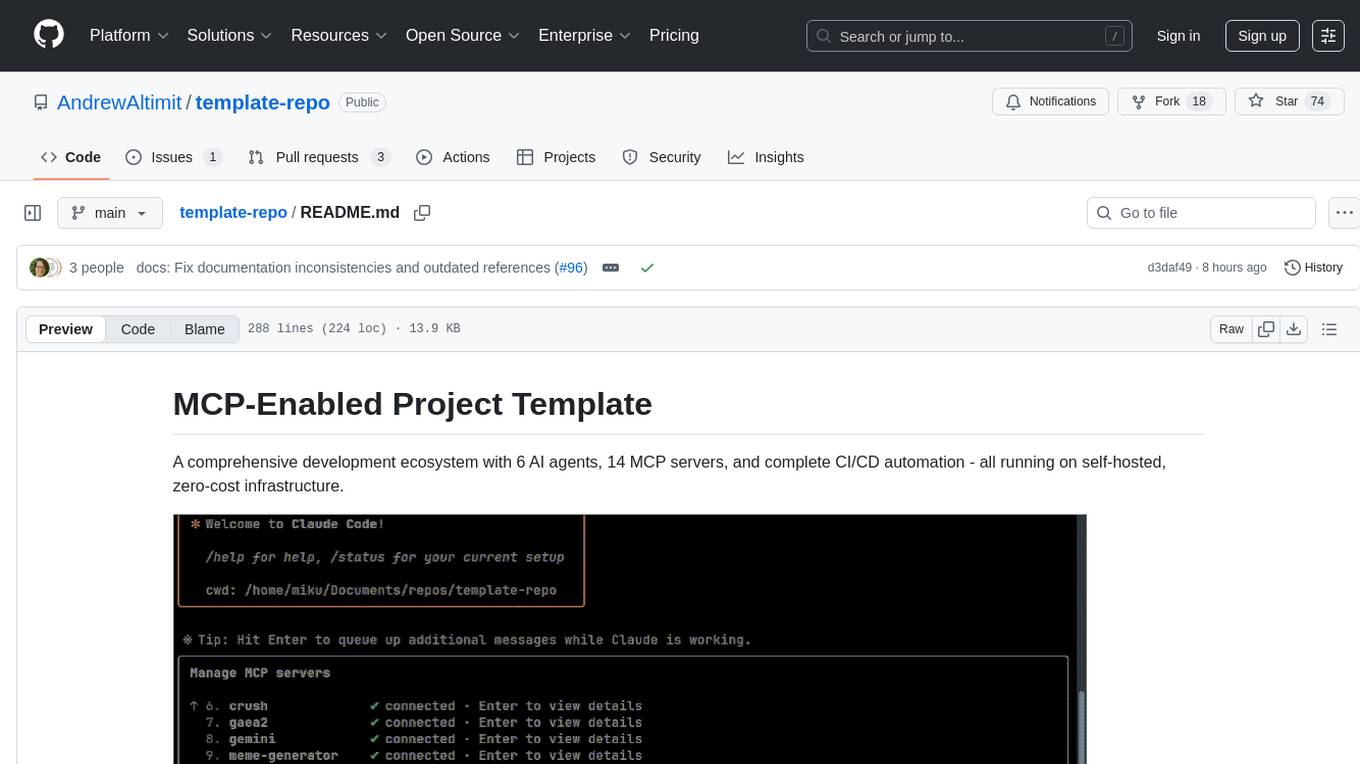
The template-repo is a comprehensive development ecosystem with 6 AI agents, 14 MCP servers, and complete CI/CD automation running on self-hosted, zero-cost infrastructure. It follows a container-first approach, with all tools and operations running in Docker containers, zero external dependencies, self-hosted infrastructure, single maintainer design, and modular MCP architecture. The repo provides AI agents for development and automation, features 14 MCP servers for various tasks, and includes security measures, safety training, and sleeper detection system. It offers features like video editing, terrain generation, 3D content creation, AI consultation, image generation, and more, with a focus on maximum portability and consistency.
timeline-studio
Timeline Studio is a next-generation professional video editor with AI integration that automates content creation for social media. It combines the power of desktop applications with the convenience of web interfaces. With 257 AI tools, GPU acceleration, plugin system, multi-language interface, and local processing, Timeline Studio offers complete video production automation. Users can create videos for various social media platforms like TikTok, YouTube, Vimeo, Telegram, and Instagram with optimized versions. The tool saves time, understands trends, provides professional quality, and allows for easy feature extension through plugins. Timeline Studio is open source, transparent, and offers significant time savings and quality improvements for video editing tasks.
retrace
Retrace is a local-first screen recording and search application for macOS, inspired by Rewind AI. It captures screen activity, extracts text via OCR, and makes everything searchable locally on-device. The project is in very early development, offering features like continuous screen capture, OCR text extraction, full-text search, timeline viewer, dashboard analytics, Rewind AI import, settings panel, global hotkeys, HEVC video encoding, search highlighting, privacy controls, and more. Built with a modular architecture, Retrace uses Swift 5.9+, SwiftUI, Vision framework, SQLite with FTS5, HEVC video encoding, CryptoKit for encryption, and more. Future releases will include features like audio transcription and semantic search. Retrace requires macOS 13.0+ (Apple Silicon required) and Xcode 15.0+ for building from source, with permissions for screen recording and accessibility. Contributions are welcome, and the project is licensed under the MIT License.
Callytics
Callytics is an advanced call analytics solution that leverages speech recognition and large language models (LLMs) technologies to analyze phone conversations from customer service and call centers. By processing both the audio and text of each call, it provides insights such as sentiment analysis, topic detection, conflict detection, profanity word detection, and summary. These cutting-edge techniques help businesses optimize customer interactions, identify areas for improvement, and enhance overall service quality. When an audio file is placed in the .data/input directory, the entire pipeline automatically starts running, and the resulting data is inserted into the database. This is only a v1.1.0 version; many new features will be added, models will be fine-tuned or trained from scratch, and various optimization efforts will be applied.
For similar tasks
xln
XLN (Cross-Local Network) is a platform that enables instant off-chain settlement with on-chain finality. It combines Byzantine consensus, Bloomberg Terminal functionalities, and VR capabilities to run economic simulations in the browser without the need for a backend. The architecture includes layers for jurisdictions, entities, and accounts, with features like Solidity contracts, BFT consensus, and bilateral channels. The tool offers a panel system similar to Bloomberg Terminal for workspace organization and visualization, along with support for offline blockchain simulations in the browser and VR/Quest compatibility.
For similar jobs
ethereum-etl-airflow
This repository contains Airflow DAGs for extracting, transforming, and loading (ETL) data from the Ethereum blockchain into BigQuery. The DAGs use the Google Cloud Platform (GCP) services, including BigQuery, Cloud Storage, and Cloud Composer, to automate the ETL process. The repository also includes scripts for setting up the GCP environment and running the DAGs locally.
airnode
Airnode is a fully-serverless oracle node that is designed specifically for API providers to operate their own oracles.
CHATPGT-MEV-BOT
The 𝓜𝓔𝓥-𝓑𝓞𝓣 is a revolutionary tool that empowers users to maximize their ETH earnings through advanced slippage techniques within the Ethereum ecosystem. Its user-centric design, optimized earning mechanism, and comprehensive security measures make it an indispensable tool for traders seeking to enhance their crypto trading strategies. With its current free access, there's no better time to explore the 𝓜𝓔𝓥-𝓑𝓞𝓣's capabilities and witness the transformative impact it can have on your crypto trading journey.
CortexTheseus
CortexTheseus is a full node implementation of the Cortex blockchain, written in C++. It provides a complete set of features for interacting with the Cortex network, including the ability to create and manage accounts, send and receive transactions, and participate in consensus. CortexTheseus is designed to be scalable, secure, and easy to use, making it an ideal choice for developers building applications on the Cortex blockchain.
CHATPGT-MEV-BOT-ETH
This tool is a bot that monitors the performance of MEV transactions on the Ethereum blockchain. It provides real-time data on MEV profitability, transaction volume, and network congestion. The bot can be used to identify profitable MEV opportunities and to track the performance of MEV strategies.
airdrop-checker
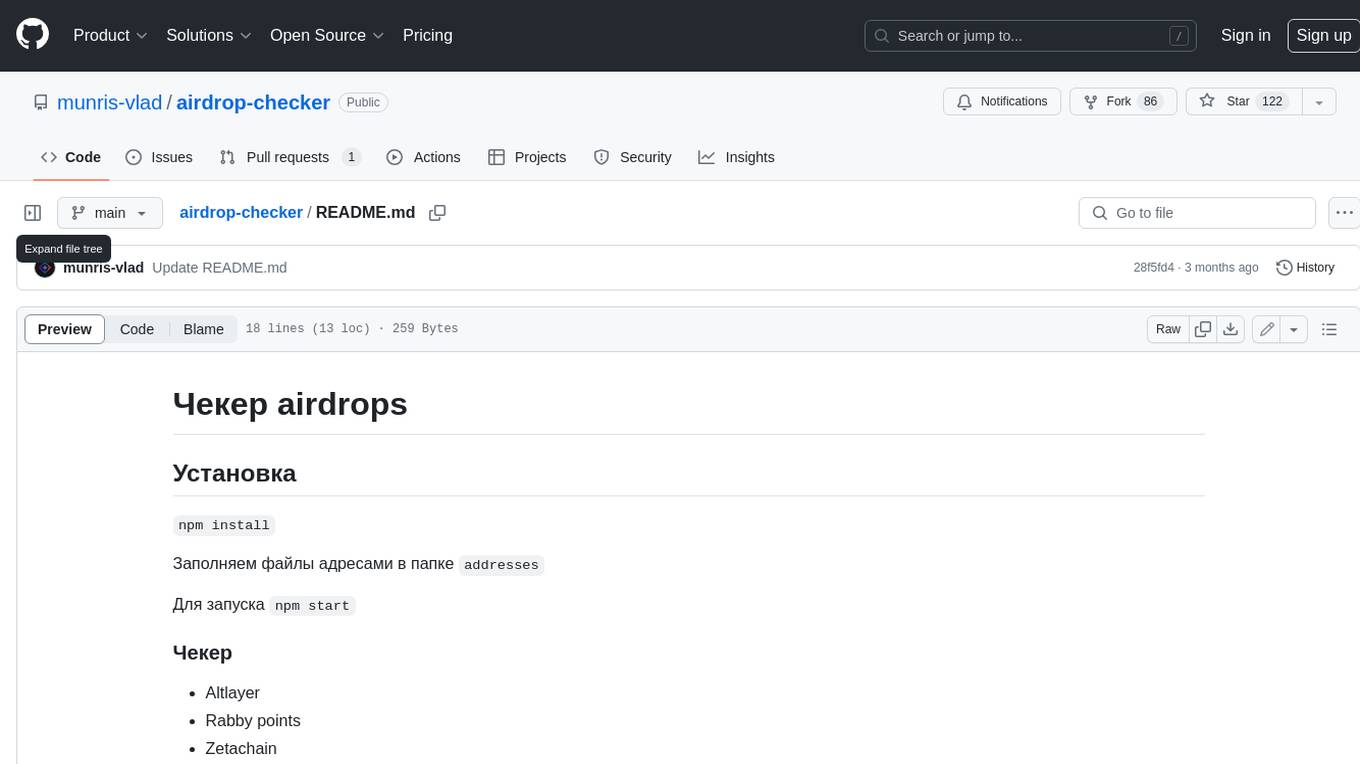
Airdrop-checker is a tool that helps you to check if you are eligible for any airdrops. It supports multiple airdrops, including Altlayer, Rabby points, Zetachain, Frame, Anoma, Dymension, and MEME. To use the tool, you need to install it using npm and then fill the addresses files in the addresses folder with your wallet addresses. Once you have done this, you can run the tool using npm start.
go-cyber
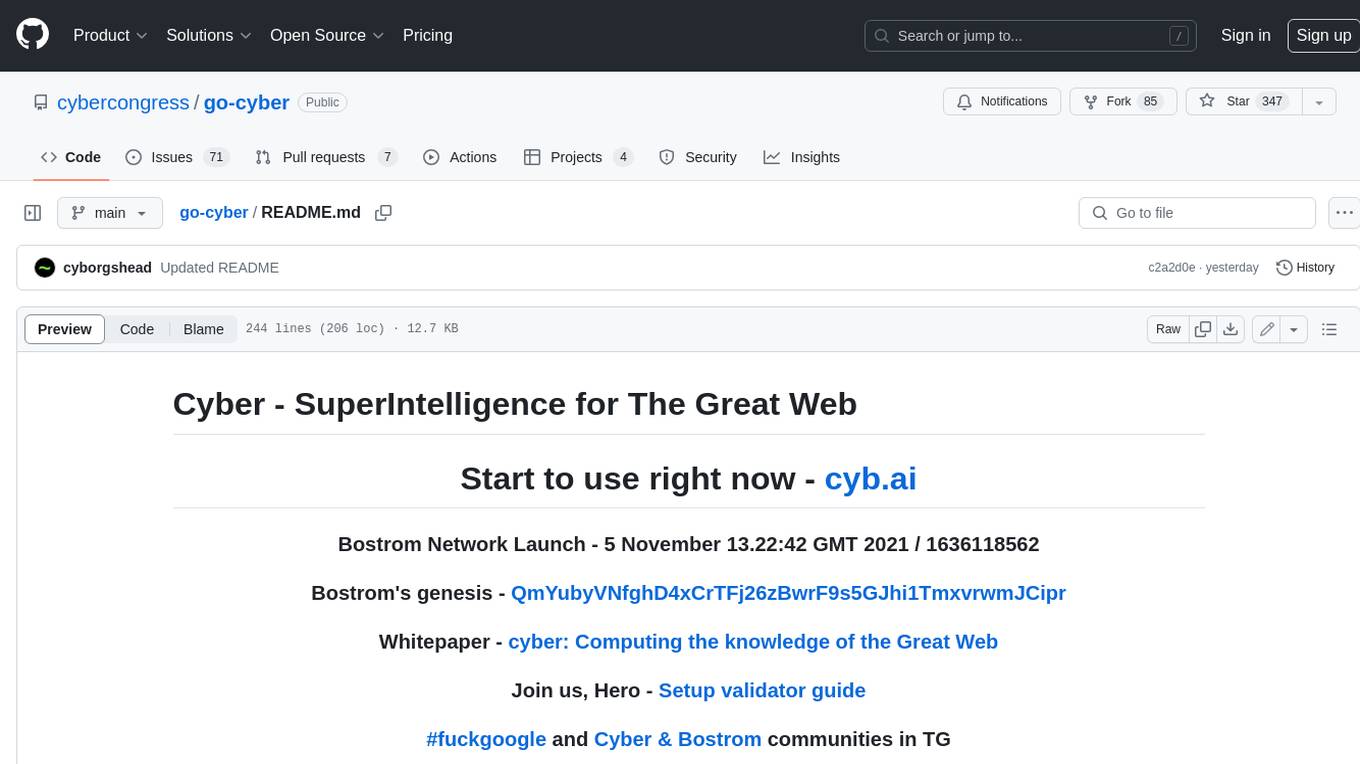
Cyber is a superintelligence protocol that aims to create a decentralized and censorship-resistant internet. It uses a novel consensus mechanism called CometBFT and a knowledge graph to store and process information. Cyber is designed to be scalable, secure, and efficient, and it has the potential to revolutionize the way we interact with the internet.
bittensor
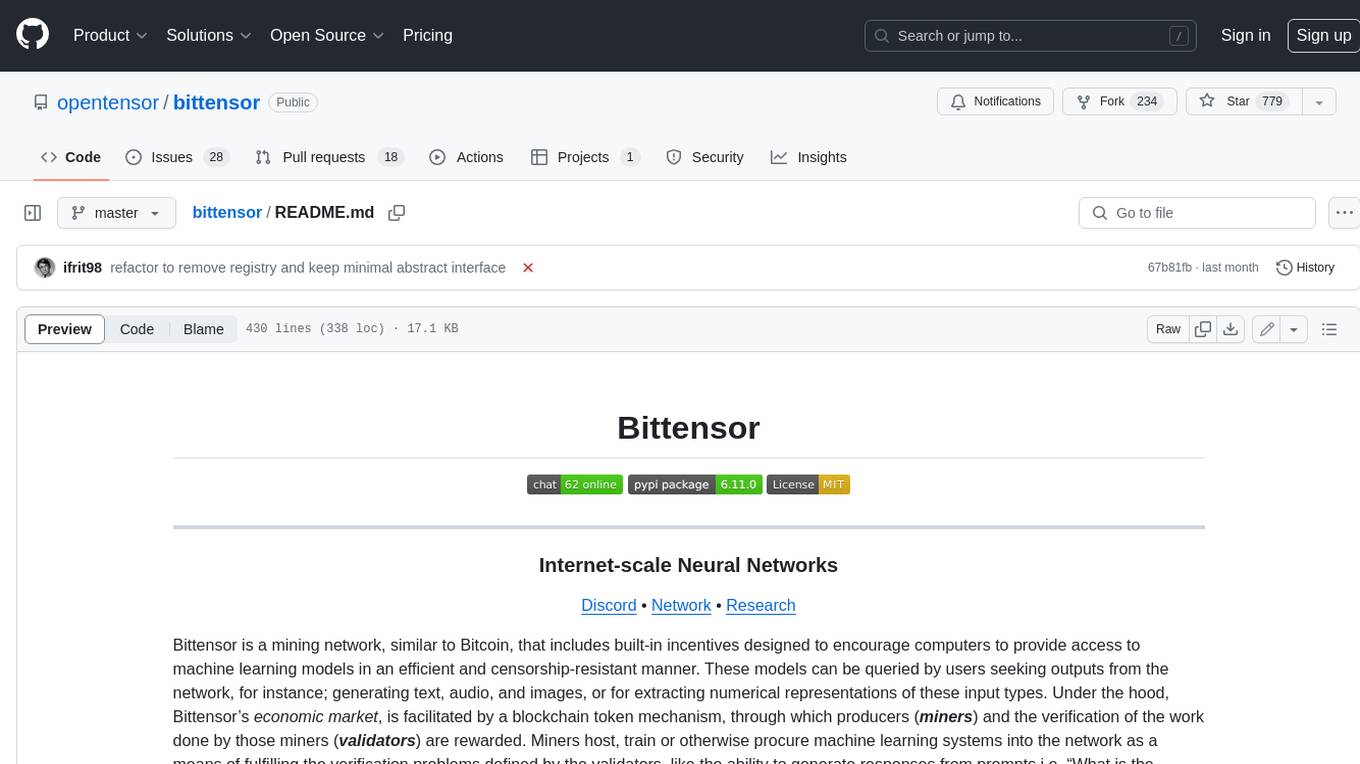
Bittensor is an internet-scale neural network that incentivizes computers to provide access to machine learning models in a decentralized and censorship-resistant manner. It operates through a token-based mechanism where miners host, train, and procure machine learning systems to fulfill verification problems defined by validators. The network rewards miners and validators for their contributions, ensuring continuous improvement in knowledge output. Bittensor allows anyone to participate, extract value, and govern the network without centralized control. It supports tasks such as generating text, audio, images, and extracting numerical representations.