


agent
AI agent expert in PostgreSQL
Stars: 864
Xata Agent is an open source tool designed to monitor PostgreSQL databases, identify issues, and provide recommendations for improvements. It acts as an AI expert, offering proactive suggestions for configuration tuning, troubleshooting performance issues, and common database problems. The tool is extensible, supports monitoring from cloud services like RDS & Aurora, and uses preset SQL commands to ensure database safety. Xata Agent can run troubleshooting statements, notify users of issues via Slack, and supports multiple AI models for enhanced functionality. It is actively used by the Xata team to manage Postgres databases efficiently.
README:





Xata Agent is an open source agent that monitors your database, finds root causes of issues, and suggests fixes and improvements. It's like having a new SRE hire in your team, one with extensive experience in Postgres.
Letting the agent introduce itself:
Hire me as your AI PostgreSQL expert. I can:
- watch logs & metrics for potential issues.
- proactively suggest configuration tuning for your database instance.
- troubleshoot performance issues and make indexing suggestions.
- troubleshoot common issues like high CPU, high memory usage, high connection count, etc.
- and help you vacuum (your Postgres DB, not your room).
More about me:
- I am open source and extensible.
- I can monitor logs & metrics from RDS & Aurora via Cloudwatch.
- I use preset SQL commands. I will never run destructive (even potentially destructive) commands against your database.
- I use a set of tools and playbooks to guide me and avoid hallucinations.
- I can run troubleshooting statements, like looking into pg_stat_statements, pg_locks, etc. to discover the source of a problem.
- I can notify you via Slack if something is wrong.
- I support multiple models from OpenAI, Anthropic, and Deepseek.
Past experience:
- I have been helping the Xata team monitor and operate tons of active Postgres databases.
Here is an under 4 minutes walkthrough of the agent in action:
https://github.com/user-attachments/assets/cdd2da8f-2d9d-4794-ada5-da161a8861fd
A youtube version of the demo is available here.
We provide docker images for the agent itself. The only other dependency is a Postgres database in which the agent will store its configuration, state, and history.
We provide a docker-compose file to start the agent and the Postgres database.
Edit the .env.production file in the root of the project. You need to set the PUBLIC_URL and the API key for at least OpenAI.
Start a local instance via docker compose:
docker compose upOpen the app at http://localhost:8080 (or the public URL you set in the .env.production file) and follow the onboarding steps.
We have a more detailed guide on how to deploy via docker-compose on an EC2 instance.
For authentication, you can use your own OAuth provider.
Go to the apps/dbagent directory and follow the instructions in the README.
The agent can be extended via the following mechanisms:
- Tools: These are functions that the agent can call to get information about the database. They are written in TypeScript, see this file for their description.
- Playbooks: These are sequences of steps that the agent can follow to troubleshoot an issue. They are simply written in english. The pre-defined playbooks are here.
- Integrations: For example, the AWS and Slack integrations. They contain configuration and UI widgets.
While it's still early days, we are using the agent ourself in our day-to-day operations work at Xata.
- Playbooks:
- [x] general monitoring
- [x] tune settings
- [x] investigate slow queries
- [x] investigate high CPU
- [x] investigate high memory
- [x] investigate high connection count
- [ ] investigate locks
- [ ] investigate vacuuming
- [x] Support for custom playbooks
- Other playbooks (please let us know)
- MCP integrations:
- [ ] Act as an MCP server for other agents
- [ ] Call the tools over the network via MCP
- Support for more cloud providers:
- [x] AWS RDS
- [x] AWS Aurora
- [x] Google Cloud SQL
- [ ] Azure Database for PostgreSQL
- [ ] Digital Ocean Managed Databases
- [ ] Other (please let us know)
- Notifications & integrations:
- [x] Simple Slack integration
- [ ] Slack integration as an AI agent (https://github.com/xataio/agent/pull/29)
- [ ] Discord integration
- [ ] Other (please let us know)
- Eval & testing:
- [x] Add eval testing for the interaction with LLMs
- Approval workflow:
- [ ] Add an approval workflow for the agent to run potentially dangerous statements
- [ ] Allow configuration of the tools that can be defined per monitoring schedule
While the Agent is by its nature primarily an open-source project that you self-host, we are also working on a cloud version. The advantage of the cloud version is that some integrations are easier to install. If you are interested in the cloud version, please sign up on the waitlist here.
For Tasks:
Click tags to check more tools for each tasksFor Jobs:
Alternative AI tools for agent
Similar Open Source Tools
agent
Xata Agent is an open source tool designed to monitor PostgreSQL databases, identify issues, and provide recommendations for improvements. It acts as an AI expert, offering proactive suggestions for configuration tuning, troubleshooting performance issues, and common database problems. The tool is extensible, supports monitoring from cloud services like RDS & Aurora, and uses preset SQL commands to ensure database safety. Xata Agent can run troubleshooting statements, notify users of issues via Slack, and supports multiple AI models for enhanced functionality. It is actively used by the Xata team to manage Postgres databases efficiently.
superflows
Superflows is an open-source alternative to OpenAI's Assistant API. It allows developers to easily add an AI assistant to their software products, enabling users to ask questions in natural language and receive answers or have tasks completed by making API calls. Superflows can analyze data, create plots, answer questions based on static knowledge, and even write code. It features a developer dashboard for configuration and testing, stateful streaming API, UI components, and support for multiple LLMs. Superflows can be set up in the cloud or self-hosted, and it provides comprehensive documentation and support.

Instrukt
Instrukt is a terminal-based AI integrated environment that allows users to create and instruct modular AI agents, generate document indexes for question-answering, and attach tools to any agent. It provides a platform for users to interact with AI agents in natural language and run them inside secure containers for performing tasks. The tool supports custom AI agents, chat with code and documents, tools customization, prompt console for quick interaction, LangChain ecosystem integration, secure containers for agent execution, and developer console for debugging and introspection. Instrukt aims to make AI accessible to everyone by providing tools that empower users without relying on external APIs and services.
Revornix
Revornix is an information management tool designed for the AI era. It allows users to conveniently integrate all visible information and generates comprehensive reports at specific times. The tool offers cross-platform availability, all-in-one content aggregation, document transformation & vectorized storage, native multi-tenancy, localization & open-source features, smart assistant & built-in MCP, seamless LLM integration, and multilingual & responsive experience for users.
letmedoit
LetMeDoIt AI is a virtual assistant designed to revolutionize the way you work. It goes beyond being a mere chatbot by offering a unique and powerful capability - the ability to execute commands and perform computing tasks on your behalf. With LetMeDoIt AI, you can access OpenAI ChatGPT-4, Google Gemini Pro, and Microsoft AutoGen, local LLMs, all in one place, to enhance your productivity.
ha-llmvision
LLM Vision is a Home Assistant integration that allows users to analyze images, videos, and camera feeds using multimodal LLMs. It supports providers such as OpenAI, Anthropic, Google Gemini, LocalAI, and Ollama. Users can input images and videos from camera entities or local files, with the option to downscale images for faster processing. The tool provides detailed instructions on setting up LLM Vision and each supported provider, along with usage examples and service call parameters.
Sentient
Sentient is a personal, private, and interactive AI companion developed by Existence. The project aims to build a completely private AI companion that is deeply personalized and context-aware of the user. It utilizes automation and privacy to create a true companion for humans. The tool is designed to remember information about the user and use it to respond to queries and perform various actions. Sentient features a local and private environment, MBTI personality test, integrations with LinkedIn, Reddit, and more, self-managed graph memory, web search capabilities, multi-chat functionality, and auto-updates for the app. The project is built using technologies like ElectronJS, Next.js, TailwindCSS, FastAPI, Neo4j, and various APIs.
nexent
Nexent is a powerful tool for analyzing and visualizing network traffic data. It provides comprehensive insights into network behavior, helping users to identify patterns, anomalies, and potential security threats. With its user-friendly interface and advanced features, Nexent is suitable for network administrators, cybersecurity professionals, and anyone looking to gain a deeper understanding of their network infrastructure.
llm-answer-engine
This repository contains the code and instructions needed to build a sophisticated answer engine that leverages the capabilities of Groq, Mistral AI's Mixtral, Langchain.JS, Brave Search, Serper API, and OpenAI. Designed to efficiently return sources, answers, images, videos, and follow-up questions based on user queries, this project is an ideal starting point for developers interested in natural language processing and search technologies.
hal-9100
This repository is now archived and the code is privately maintained. If you are interested in this infrastructure, please contact the maintainer directly.
gptme
GPTMe is a tool that allows users to interact with an LLM assistant directly in their terminal in a chat-style interface. The tool provides features for the assistant to run shell commands, execute code, read/write files, and more, making it suitable for various development and terminal-based tasks. It serves as a local alternative to ChatGPT's 'Code Interpreter,' offering flexibility and privacy when using a local model. GPTMe supports code execution, file manipulation, context passing, self-correction, and works with various AI models like GPT-4. It also includes a GitHub Bot for requesting changes and operates entirely in GitHub Actions. In progress features include handling long contexts intelligently, a web UI and API for conversations, web and desktop vision, and a tree-based conversation structure.
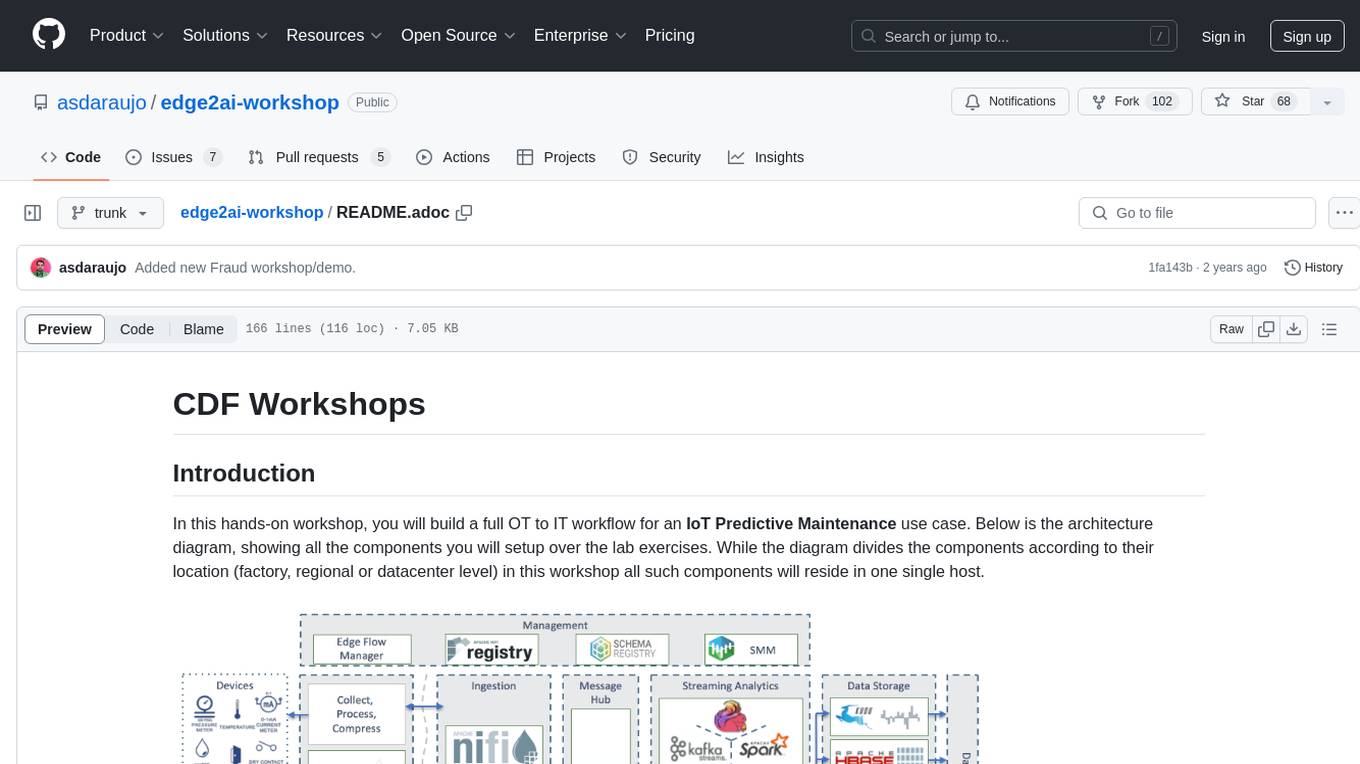
edge2ai-workshop
The edge2ai-workshop repository provides a hands-on workshop for building an IoT Predictive Maintenance workflow. It includes lab exercises for setting up components like NiFi, Streams Processing, Data Visualization, and more on a single host. The repository also covers use cases such as credit card fraud detection. Users can follow detailed instructions, prerequisites, and connectivity guidelines to connect to their cluster and explore various services. Additionally, troubleshooting tips are provided for common issues like MiNiFi not sending messages or CEM not picking up new NARs.
open-source-slack-ai
This repository provides a ready-to-run basic Slack AI solution that allows users to summarize threads and channels using OpenAI. Users can generate thread summaries, channel overviews, channel summaries since a specific time, and full channel summaries. The tool is powered by GPT-3.5-Turbo and an ensemble of NLP models. It requires Python 3.8 or higher, an OpenAI API key, Slack App with associated API tokens, Poetry package manager, and ngrok for local development. Users can customize channel and thread summaries, run tests with coverage using pytest, and contribute to the project for future enhancements.
dataline
DataLine is an AI-driven data analysis and visualization tool designed for technical and non-technical users to explore data quickly. It offers privacy-focused data storage on the user's device, supports various data sources, generates charts, executes queries, and facilitates report building. The tool aims to speed up data analysis tasks for businesses and individuals by providing a user-friendly interface and natural language querying capabilities.
burpference
Burpference is an open-source extension designed to capture in-scope HTTP requests and responses from Burp's proxy history and send them to a remote LLM API in JSON format. It automates response capture, integrates with APIs, optimizes resource usage, provides color-coded findings visualization, offers comprehensive logging, supports native Burp reporting, and allows flexible configuration. Users can customize system prompts, API keys, and remote hosts, and host models locally to prevent high inference costs. The tool is ideal for offensive web application engagements to surface findings and vulnerabilities.

DevDocs
DevDocs is a platform designed to simplify the process of digesting technical documentation for software engineers and developers. It automates the extraction and conversion of web content into markdown format, making it easier for users to access and understand the information. By crawling through child pages of a given URL, DevDocs provides a streamlined approach to gathering relevant data and integrating it into various tools for software development. The tool aims to save time and effort by eliminating the need for manual research and content extraction, ultimately enhancing productivity and efficiency in the development process.
For similar tasks
agent
Xata Agent is an open source tool designed to monitor PostgreSQL databases, identify issues, and provide recommendations for improvements. It acts as an AI expert, offering proactive suggestions for configuration tuning, troubleshooting performance issues, and common database problems. The tool is extensible, supports monitoring from cloud services like RDS & Aurora, and uses preset SQL commands to ensure database safety. Xata Agent can run troubleshooting statements, notify users of issues via Slack, and supports multiple AI models for enhanced functionality. It is actively used by the Xata team to manage Postgres databases efficiently.
parseable
Parseable is a full stack observability platform designed to ingest, analyze, and extract insights from various types of telemetry data. It can be run locally, in the cloud, or as a managed service. The platform offers features like high availability, smart cache, alerts, role-based access control, OAuth2 support, and OpenTelemetry integration. Users can easily ingest data, query logs, and access the dashboard to monitor and analyze data. Parseable provides a seamless experience for observability and monitoring tasks.
llmio
LLMIO is a Go-based LLM load balancing gateway that provides a unified REST API, weight scheduling, logging, and modern management interface for your LLM clients. It helps integrate different model capabilities from OpenAI, Anthropic, Gemini, and more in a single service. Features include unified API compatibility, weight scheduling with two strategies, visual management dashboard, rate and failure handling, and local persistence with SQLite. The tool supports multiple vendors' APIs and authentication methods, making it versatile for various AI model integrations.
For similar jobs
db2rest
DB2Rest is a modern low-code REST DATA API platform that simplifies the development of intelligent applications. It seamlessly integrates existing and new databases with language models (LMs/LLMs) and vector stores, enabling the rapid delivery of context-aware, reasoning applications without vendor lock-in.
mage-ai
Mage is an open-source data pipeline tool for transforming and integrating data. It offers an easy developer experience, engineering best practices built-in, and data as a first-class citizen. Mage makes it easy to build, preview, and launch data pipelines, and provides observability and scaling capabilities. It supports data integrations, streaming pipelines, and dbt integration.
airbyte
Airbyte is an open-source data integration platform that makes it easy to move data from any source to any destination. With Airbyte, you can build and manage data pipelines without writing any code. Airbyte provides a library of pre-built connectors that make it easy to connect to popular data sources and destinations. You can also create your own connectors using Airbyte's no-code Connector Builder or low-code CDK. Airbyte is used by data engineers and analysts at companies of all sizes to build and manage their data pipelines.
labelbox-python
Labelbox is a data-centric AI platform for enterprises to develop, optimize, and use AI to solve problems and power new products and services. Enterprises use Labelbox to curate data, generate high-quality human feedback data for computer vision and LLMs, evaluate model performance, and automate tasks by combining AI and human-centric workflows. The academic & research community uses Labelbox for cutting-edge AI research.
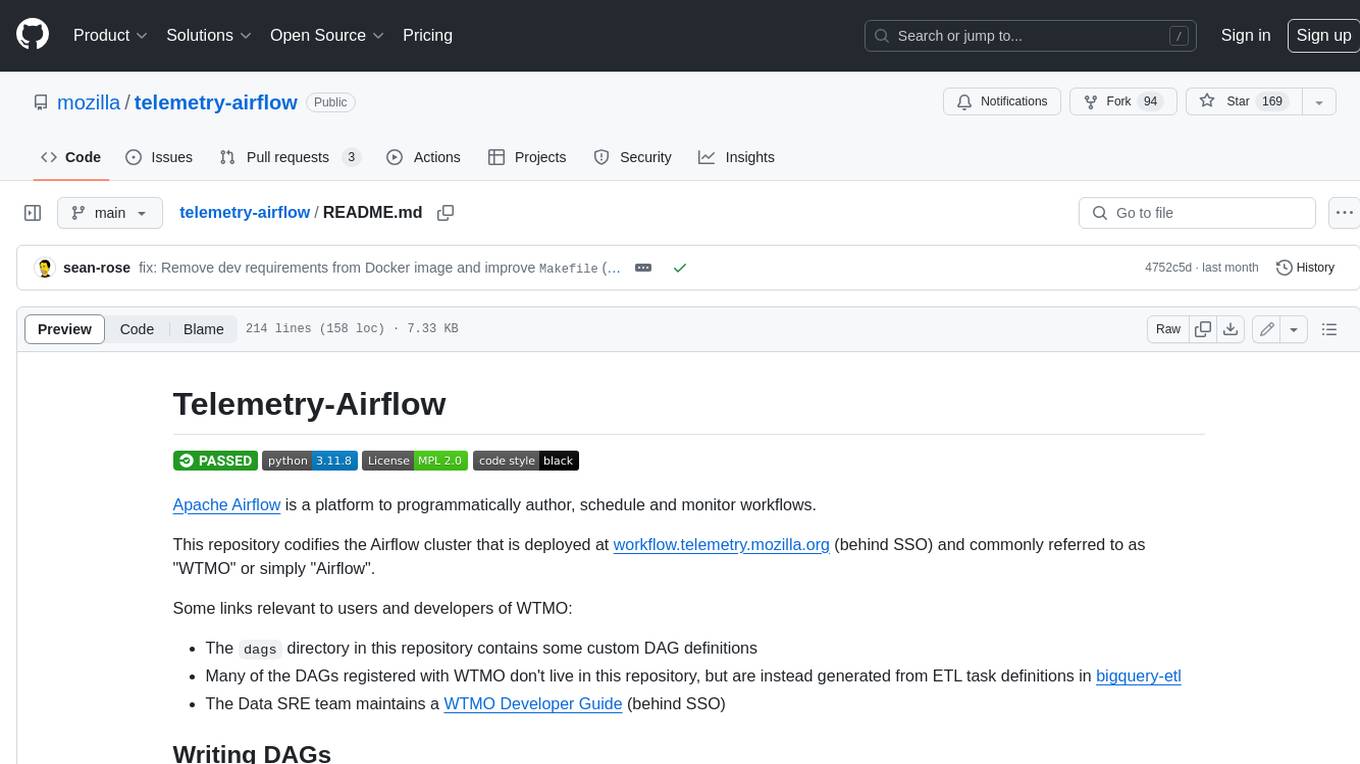
telemetry-airflow
This repository codifies the Airflow cluster that is deployed at workflow.telemetry.mozilla.org (behind SSO) and commonly referred to as "WTMO" or simply "Airflow". Some links relevant to users and developers of WTMO: * The `dags` directory in this repository contains some custom DAG definitions * Many of the DAGs registered with WTMO don't live in this repository, but are instead generated from ETL task definitions in bigquery-etl * The Data SRE team maintains a WTMO Developer Guide (behind SSO)

airflow
Apache Airflow (or simply Airflow) is a platform to programmatically author, schedule, and monitor workflows. When workflows are defined as code, they become more maintainable, versionable, testable, and collaborative. Use Airflow to author workflows as directed acyclic graphs (DAGs) of tasks. The Airflow scheduler executes your tasks on an array of workers while following the specified dependencies. Rich command line utilities make performing complex surgeries on DAGs a snap. The rich user interface makes it easy to visualize pipelines running in production, monitor progress, and troubleshoot issues when needed.
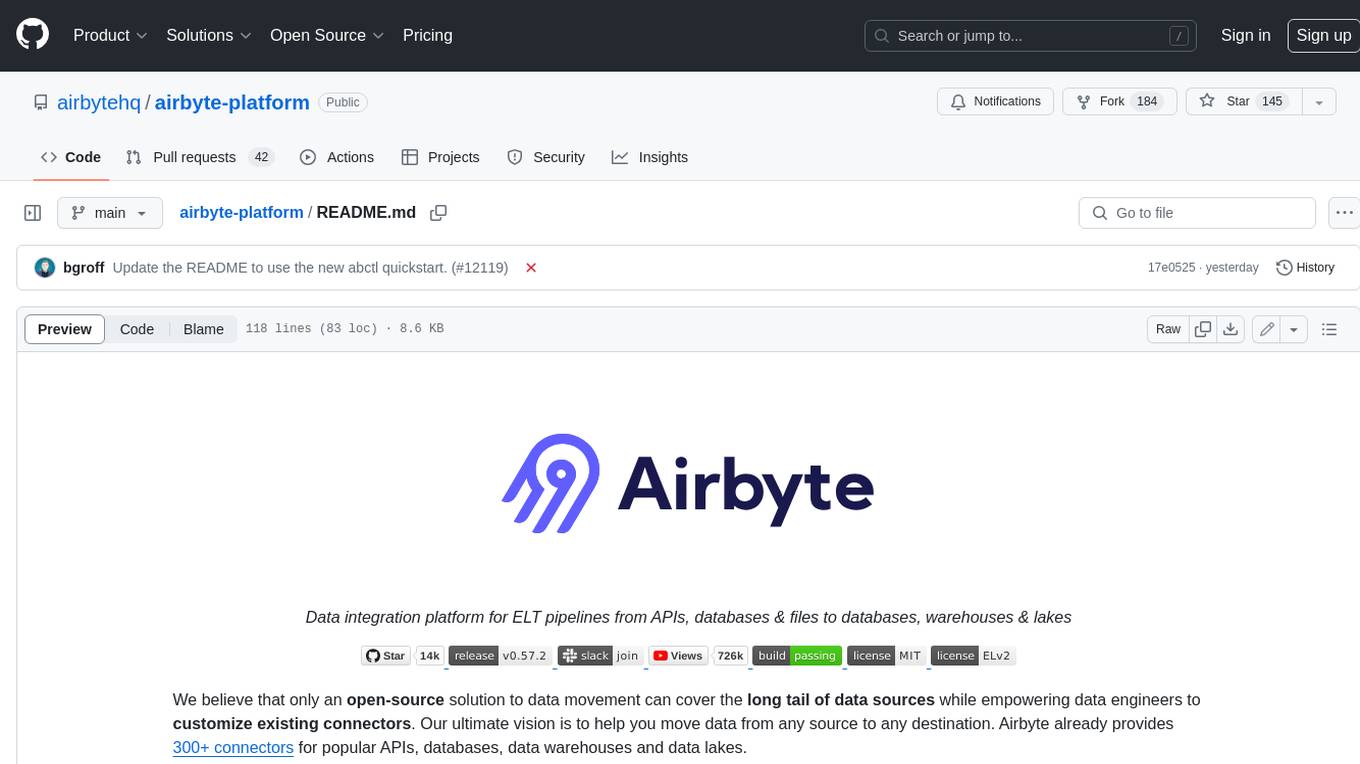
airbyte-platform
Airbyte is an open-source data integration platform that makes it easy to move data from any source to any destination. With Airbyte, you can build and manage data pipelines without writing any code. Airbyte provides a library of pre-built connectors that make it easy to connect to popular data sources and destinations. You can also create your own connectors using Airbyte's low-code Connector Development Kit (CDK). Airbyte is used by data engineers and analysts at companies of all sizes to move data for a variety of purposes, including data warehousing, data analysis, and machine learning.
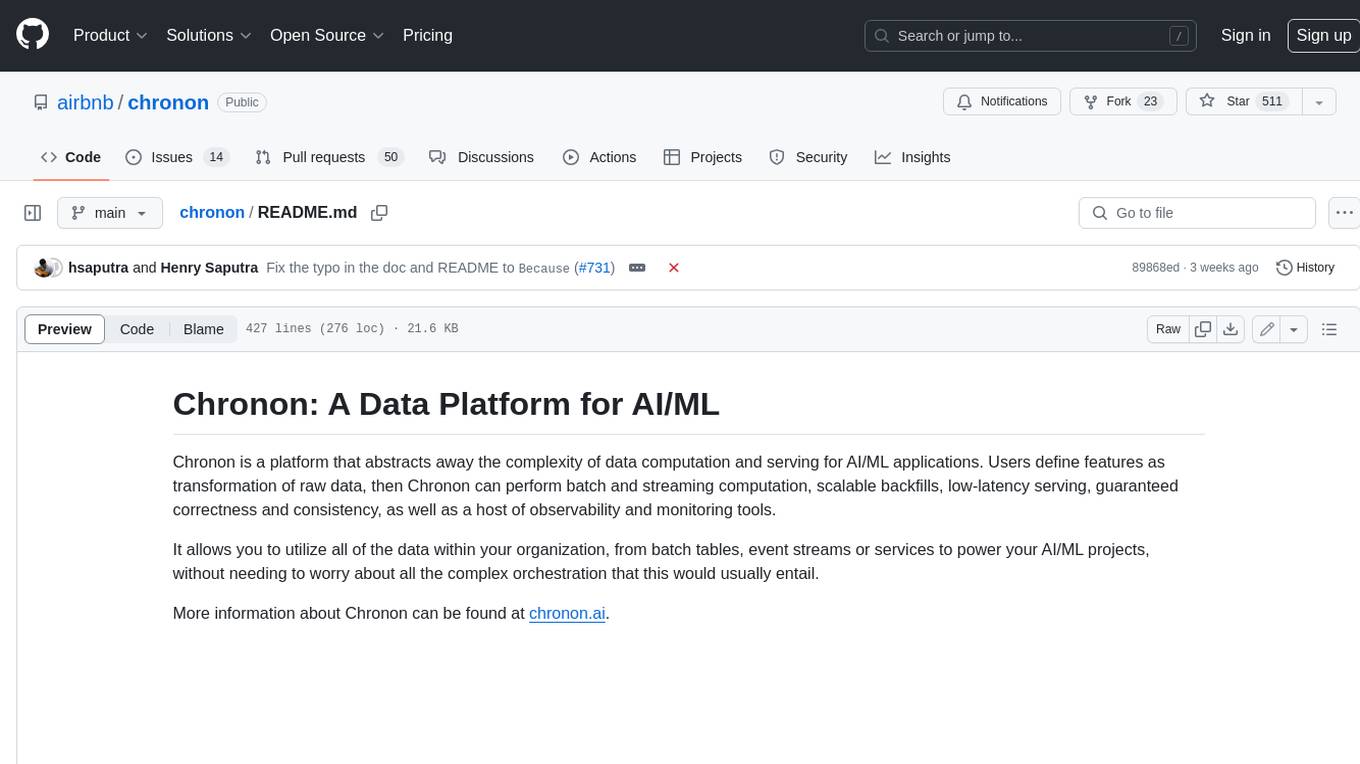
chronon
Chronon is a platform that simplifies and improves ML workflows by providing a central place to define features, ensuring point-in-time correctness for backfills, simplifying orchestration for batch and streaming pipelines, offering easy endpoints for feature fetching, and guaranteeing and measuring consistency. It offers benefits over other approaches by enabling the use of a broad set of data for training, handling large aggregations and other computationally intensive transformations, and abstracting away the infrastructure complexity of data plumbing.