


vlmrun-cookbook
Examples and guides for using the VLM Run API
Stars: 259
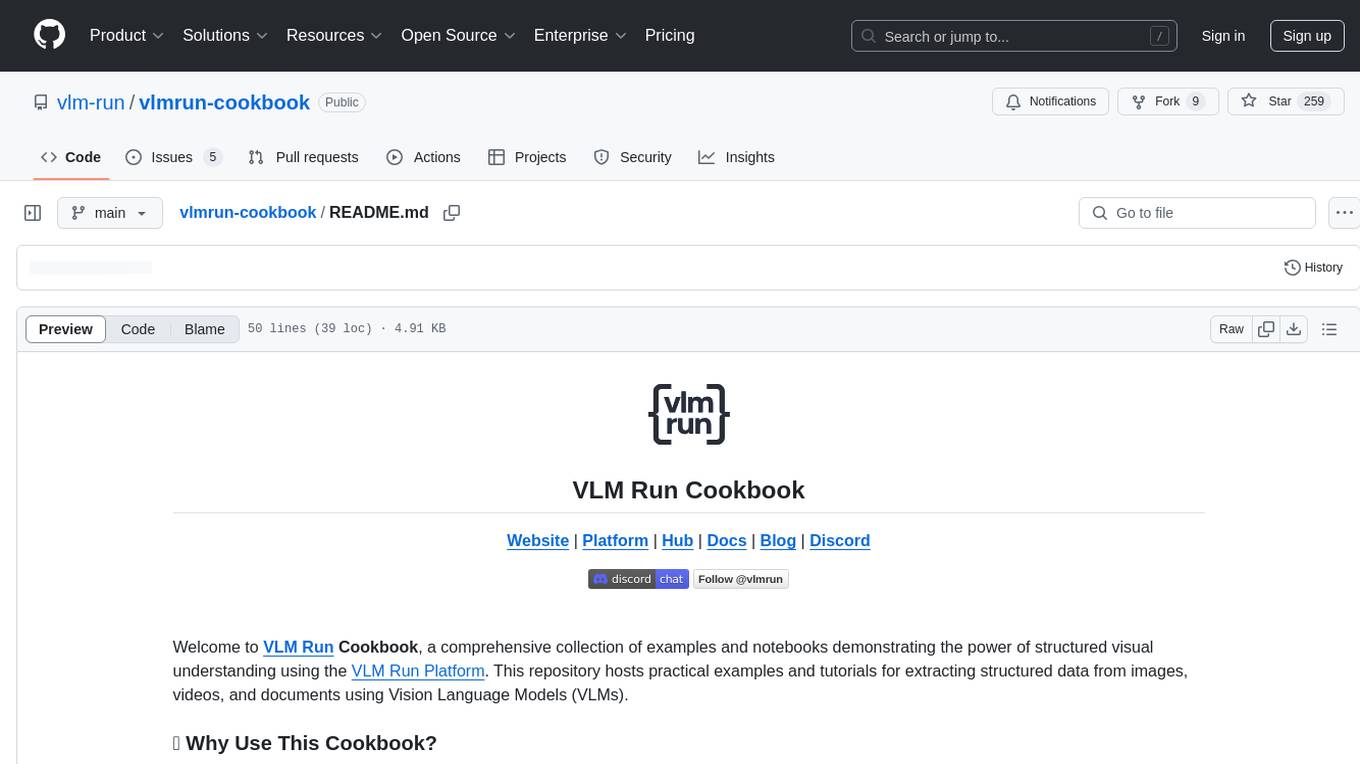
VLM Run Cookbook is a repository containing practical examples and tutorials for extracting structured data from images, videos, and documents using Vision Language Models (VLMs). It offers comprehensive Colab notebooks demonstrating real-world applications of VLM Run, with complete code and documentation for easy adaptation. The examples cover various domains such as financial documents and TV news analysis.
README:


Welcome to VLM Run Cookbook, a comprehensive collection of examples and notebooks demonstrating the power of structured visual understanding using the VLM Run Platform. This repository hosts practical examples and tutorials for extracting structured data from images, videos, and documents using Vision Language Models (VLMs).
- 📚 Practical Examples: A comprehensive collection of Colab notebooks demonstrating real-world applications of VLM Run.
- 🔋 Ready-to-Use: Each example comes with complete code and documentation, making it easy to adapt for your use case.
- 🎯 Domain-Specific: Examples cover various domains from financial documents to TV news analysis.
Our collection of Colab notebooks demonstrates various use cases and integrations:
| Name | Type | Colab | Last Updated |
|---|---|---|---|
| API Quickstart |  |
02-08-2025 | |
| Schema Showcase | feature | |
02-08-2025 |
| Visual Grounding | feature | |
02-18-2025 |
| Video Inference (Fine-Tuning) | feature | |
02-18-2025 |
| US Drivers License | application | |
02-08-2025 |
| Parsing Financial Presentations | application | |
02-04-2025 |
| TV News Analysis | application | |
02-15-2025 |
| Fashion Product Catalog | application | |
02-20-2025 |
| Fashion Images Hybrid Search | application | |
02-21-2025 |
- 💬 Send us an email at [email protected] or join our Discord for help
- 📣 Follow us on Twitter and LinkedIn to keep up-to-date on our products
- 📚 Check out our Documentation for detailed guides and API reference
For Tasks:
Click tags to check more tools for each tasksFor Jobs:
Alternative AI tools for vlmrun-cookbook
Similar Open Source Tools
vlmrun-cookbook
VLM Run Cookbook is a repository containing practical examples and tutorials for extracting structured data from images, videos, and documents using Vision Language Models (VLMs). It offers comprehensive Colab notebooks demonstrating real-world applications of VLM Run, with complete code and documentation for easy adaptation. The examples cover various domains such as financial documents and TV news analysis.
chat-your-doc
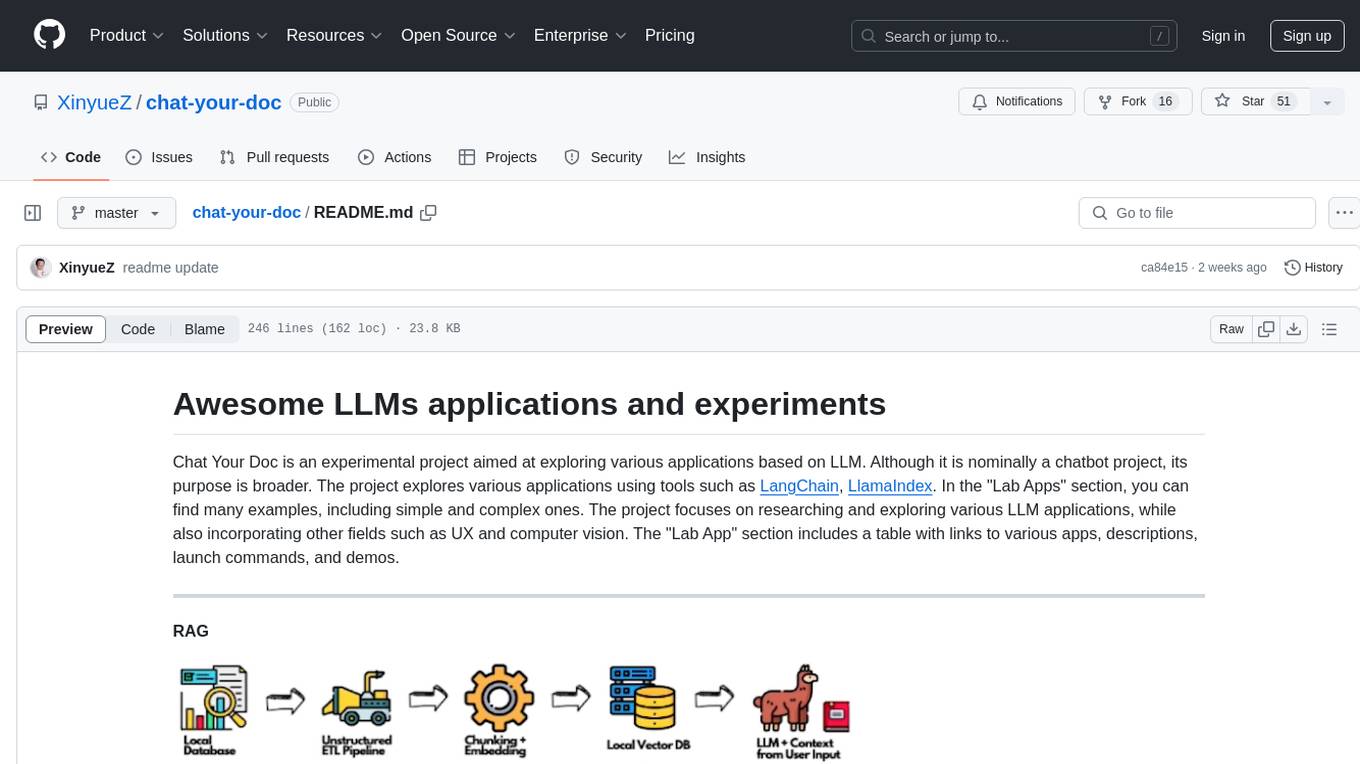
Chat Your Doc is an experimental project exploring various applications based on LLM technology. It goes beyond being just a chatbot project, focusing on researching LLM applications using tools like LangChain and LlamaIndex. The project delves into UX, computer vision, and offers a range of examples in the 'Lab Apps' section. It includes links to different apps, descriptions, launch commands, and demos, aiming to showcase the versatility and potential of LLM applications.
sktime
sktime is a Python library for time series analysis that provides a unified interface for various time series learning tasks such as classification, regression, clustering, annotation, and forecasting. It offers time series algorithms and tools compatible with scikit-learn for building, tuning, and validating time series models. sktime aims to enhance the interoperability and usability of the time series analysis ecosystem by empowering users to apply algorithms across different tasks and providing interfaces to related libraries like scikit-learn, statsmodels, tsfresh, PyOD, and fbprophet.
EasyEdit
EasyEdit is a Python package for edit Large Language Models (LLM) like `GPT-J`, `Llama`, `GPT-NEO`, `GPT2`, `T5`(support models from **1B** to **65B**), the objective of which is to alter the behavior of LLMs efficiently within a specific domain without negatively impacting performance across other inputs. It is designed to be easy to use and easy to extend.
MiniCPM-V-CookBook
MiniCPM-V & o Cookbook is a comprehensive repository for building multimodal AI applications effortlessly. It provides easy-to-use documentation, supports a wide range of users, and offers versatile deployment scenarios. The repository includes live demonstrations, inference recipes for vision and audio capabilities, fine-tuning recipes, serving recipes, quantization recipes, and a framework support matrix. Users can customize models, deploy them efficiently, and compress models to improve efficiency. The repository also showcases awesome works using MiniCPM-V & o and encourages community contributions.
Video-ChatGPT
Video-ChatGPT is a video conversation model that aims to generate meaningful conversations about videos by combining large language models with a pretrained visual encoder adapted for spatiotemporal video representation. It introduces high-quality video-instruction pairs, a quantitative evaluation framework for video conversation models, and a unique multimodal capability for video understanding and language generation. The tool is designed to excel in tasks related to video reasoning, creativity, spatial and temporal understanding, and action recognition.
IDvs.MoRec
This repository contains the source code for the SIGIR 2023 paper 'Where to Go Next for Recommender Systems? ID- vs. Modality-based Recommender Models Revisited'. It provides resources for evaluating foundation, transferable, multi-modal, and LLM recommendation models, along with datasets, pre-trained models, and training strategies for IDRec and MoRec using in-batch debiased cross-entropy loss. The repository also offers large-scale datasets, code for SASRec with in-batch debias cross-entropy loss, and information on joining the lab for research opportunities.
HuatuoGPT-II
HuatuoGPT2 is an innovative domain-adapted medical large language model that excels in medical knowledge and dialogue proficiency. It showcases state-of-the-art performance in various medical benchmarks, surpassing GPT-4 in expert evaluations and fresh medical licensing exams. The open-source release includes HuatuoGPT2 models in 7B, 13B, and 34B versions, training code for one-stage adaptation, partial pre-training and fine-tuning instructions, and evaluation methods for medical response capabilities and professional pharmacist exams. The tool aims to enhance LLM capabilities in the Chinese medical field through open-source principles.
pai-opencode
PAI-OpenCode is a complete port of Daniel Miessler's Personal AI Infrastructure (PAI) to OpenCode, an open-source, provider-agnostic AI coding assistant. It brings modular capabilities, dynamic multi-agent orchestration, session history, and lifecycle automation to personalize AI assistants for users. With support for 75+ AI providers, PAI-OpenCode offers dynamic per-task model routing, full PAI infrastructure, real-time session sharing, and multiple client options. The tool optimizes cost and quality with a 3-tier model strategy and a 3-tier research system, allowing users to switch presets for different routing strategies. PAI-OpenCode's architecture preserves PAI's design while adapting to OpenCode, documented through Architecture Decision Records (ADRs).
pr-agent
PR-Agent is a tool that helps to efficiently review and handle pull requests by providing AI feedbacks and suggestions. It supports various commands such as generating PR descriptions, providing code suggestions, answering questions about the PR, and updating the CHANGELOG.md file. PR-Agent can be used via CLI, GitHub Action, GitHub App, Docker, and supports multiple git providers and models. It emphasizes real-life practical usage, with each tool having a single GPT-4 call for quick and affordable responses. The PR Compression strategy enables effective handling of both short and long PRs, while the JSON prompting strategy allows for modular and customizable tools. PR-Agent Pro, the hosted version by CodiumAI, provides additional benefits such as full management, improved privacy, priority support, and extra features.
llm4ad
LLM4AD is an open-source Python-based platform leveraging Large Language Models (LLMs) for Automatic Algorithm Design (AD). It provides unified interfaces for methods, tasks, and LLMs, along with features like evaluation acceleration, secure evaluation, logs, GUI support, and more. The platform was originally developed for optimization tasks but is versatile enough to be used in other areas such as machine learning, science discovery, game theory, and engineering design. It offers various search methods and algorithm design tasks across different domains. LLM4AD supports remote LLM API, local HuggingFace LLM deployment, and custom LLM interfaces. The project is licensed under the MIT License and welcomes contributions, collaborations, and issue reports.
awesome-LangGraph
Awesome LangGraph is a curated list of projects, resources, and tools for building stateful, multi-actor applications with LangGraph. It provides valuable resources for developers at all stages of development, from beginners to those building production-ready systems. The repository covers core ecosystem components, LangChain ecosystem, LangGraph platform, official resources, starter templates, pre-built agents, example applications, development tools, community projects, AI assistants, content & media, knowledge & retrieval, finance & business, sustainability, learning resources, companies using LangGraph, contributing guidelines, and acknowledgments.
CameraChessWeb
Camera Chess Web is a tool that allows you to use your phone camera to replace chess eBoards. With Camera Chess Web, you can broadcast your game to Lichess, play a game on Lichess, or digitize a chess game from a video or live stream. Camera Chess Web is free to download on Google Play.
EVE
EVE is an official PyTorch implementation of Unveiling Encoder-Free Vision-Language Models. The project aims to explore the removal of vision encoders from Vision-Language Models (VLMs) and transfer LLMs to encoder-free VLMs efficiently. It also focuses on bridging the performance gap between encoder-free and encoder-based VLMs. EVE offers a superior capability with arbitrary image aspect ratio, data efficiency by utilizing publicly available data for pre-training, and training efficiency with a transparent and practical strategy for developing a pure decoder-only architecture across modalities.
pr-agent
PR-Agent is a tool designed to assist in efficiently reviewing and handling pull requests by providing AI feedback and suggestions. It offers various tools such as Review, Describe, Improve, Ask, Update CHANGELOG, and more, with the ability to run them via different interfaces like CLI, PR Comments, or automatically triggering them when a new PR is opened. The tool supports multiple git platforms and models, emphasizing real-life practical usage and modular, customizable tools.
For similar tasks

HPT
Hyper-Pretrained Transformers (HPT) is a novel multimodal LLM framework from HyperGAI, trained for vision-language models capable of understanding both textual and visual inputs. The repository contains the open-source implementation of inference code to reproduce the evaluation results of HPT Air on different benchmarks. HPT has achieved competitive results with state-of-the-art models on various multimodal LLM benchmarks. It offers models like HPT 1.5 Air and HPT 1.0 Air, providing efficient solutions for vision-and-language tasks.
learnopencv
LearnOpenCV is a repository containing code for Computer Vision, Deep learning, and AI research articles shared on the blog LearnOpenCV.com. It serves as a resource for individuals looking to enhance their expertise in AI through various courses offered by OpenCV. The repository includes a wide range of topics such as image inpainting, instance segmentation, robotics, deep learning models, and more, providing practical implementations and code examples for readers to explore and learn from.
spark-free-api
Spark AI Free 服务 provides high-speed streaming output, multi-turn dialogue support, AI drawing support, long document interpretation, and image parsing. It offers zero-configuration deployment, multi-token support, and automatic session trace cleaning. It is fully compatible with the ChatGPT interface. The repository includes multiple free-api projects for various AI services. Users can access the API for tasks such as chat completions, AI drawing, document interpretation, image analysis, and ssoSessionId live checking. The project also provides guidelines for deployment using Docker, Docker-compose, Render, Vercel, and native deployment methods. It recommends using custom clients for faster and simpler access to the free-api series projects.
mlx-vlm
MLX-VLM is a package designed for running Vision LLMs on Mac systems using MLX. It provides a convenient way to install and utilize the package for processing large language models related to vision tasks. The tool simplifies the process of running LLMs on Mac computers, offering a seamless experience for users interested in leveraging MLX for vision-related projects.
clarifai-python-grpc
This is the official Clarifai gRPC Python client for interacting with their recognition API. Clarifai offers a platform for data scientists, developers, researchers, and enterprises to utilize artificial intelligence for image, video, and text analysis through computer vision and natural language processing. The client allows users to authenticate, predict concepts in images, and access various functionalities provided by the Clarifai API. It follows a versioning scheme that aligns with the backend API updates and includes specific instructions for installation and troubleshooting. Users can explore the Clarifai demo, sign up for an account, and refer to the documentation for detailed information.
horde-worker-reGen
This repository provides the latest implementation for the AI Horde Worker, allowing users to utilize their graphics card(s) to generate, post-process, or analyze images for others. It offers a platform where users can create images and earn 'kudos' in return, granting priority for their own image generations. The repository includes important details for setup, recommendations for system configurations, instructions for installation on Windows and Linux, basic usage guidelines, and information on updating the AI Horde Worker. Users can also run the worker with multiple GPUs and receive notifications for updates through Discord. Additionally, the repository contains models that are licensed under the CreativeML OpenRAIL License.
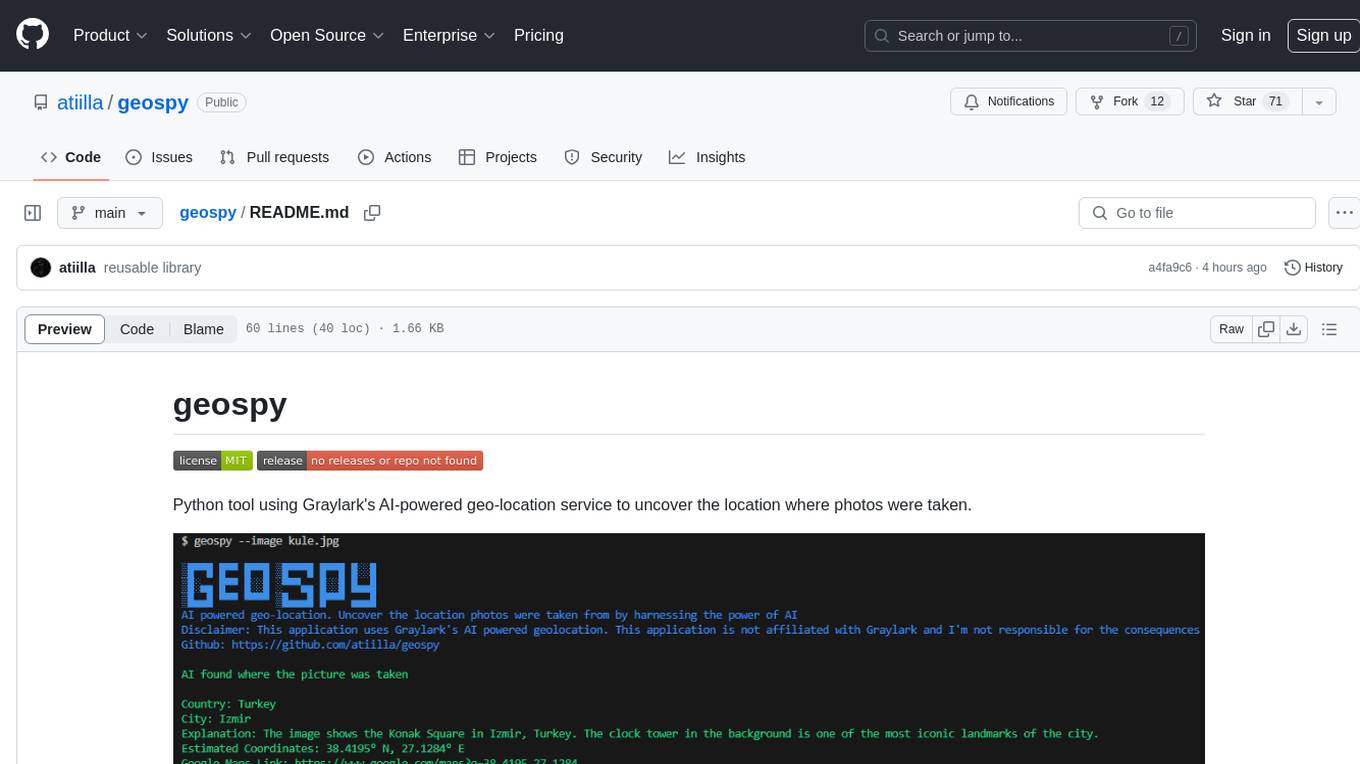
geospy
Geospy is a Python tool that utilizes Graylark's AI-powered geolocation service to determine the location where photos were taken. It allows users to analyze images and retrieve information such as country, city, explanation, coordinates, and Google Maps links. The tool provides a seamless way to integrate geolocation services into various projects and applications.
Awesome-Colorful-LLM
Awesome-Colorful-LLM is a meticulously assembled anthology of vibrant multimodal research focusing on advancements propelled by large language models (LLMs) in domains such as Vision, Audio, Agent, Robotics, and Fundamental Sciences like Mathematics. The repository contains curated collections of works, datasets, benchmarks, projects, and tools related to LLMs and multimodal learning. It serves as a comprehensive resource for researchers and practitioners interested in exploring the intersection of language models and various modalities for tasks like image understanding, video pretraining, 3D modeling, document understanding, audio analysis, agent learning, robotic applications, and mathematical research.
For similar jobs
weave
Weave is a toolkit for developing Generative AI applications, built by Weights & Biases. With Weave, you can log and debug language model inputs, outputs, and traces; build rigorous, apples-to-apples evaluations for language model use cases; and organize all the information generated across the LLM workflow, from experimentation to evaluations to production. Weave aims to bring rigor, best-practices, and composability to the inherently experimental process of developing Generative AI software, without introducing cognitive overhead.
LLMStack
LLMStack is a no-code platform for building generative AI agents, workflows, and chatbots. It allows users to connect their own data, internal tools, and GPT-powered models without any coding experience. LLMStack can be deployed to the cloud or on-premise and can be accessed via HTTP API or triggered from Slack or Discord.
VisionCraft
The VisionCraft API is a free API for using over 100 different AI models. From images to sound.
kaito
Kaito is an operator that automates the AI/ML inference model deployment in a Kubernetes cluster. It manages large model files using container images, avoids tuning deployment parameters to fit GPU hardware by providing preset configurations, auto-provisions GPU nodes based on model requirements, and hosts large model images in the public Microsoft Container Registry (MCR) if the license allows. Using Kaito, the workflow of onboarding large AI inference models in Kubernetes is largely simplified.
PyRIT
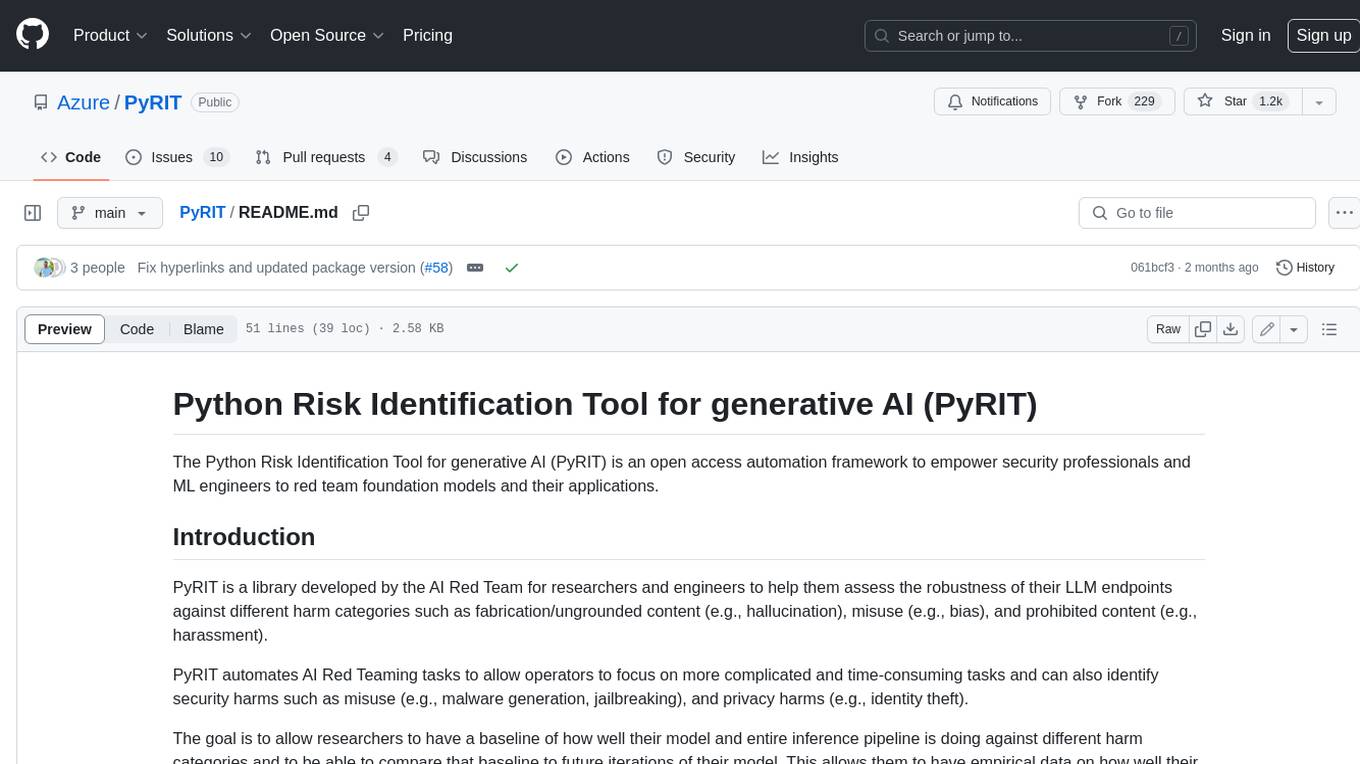
PyRIT is an open access automation framework designed to empower security professionals and ML engineers to red team foundation models and their applications. It automates AI Red Teaming tasks to allow operators to focus on more complicated and time-consuming tasks and can also identify security harms such as misuse (e.g., malware generation, jailbreaking), and privacy harms (e.g., identity theft). The goal is to allow researchers to have a baseline of how well their model and entire inference pipeline is doing against different harm categories and to be able to compare that baseline to future iterations of their model. This allows them to have empirical data on how well their model is doing today, and detect any degradation of performance based on future improvements.
tabby
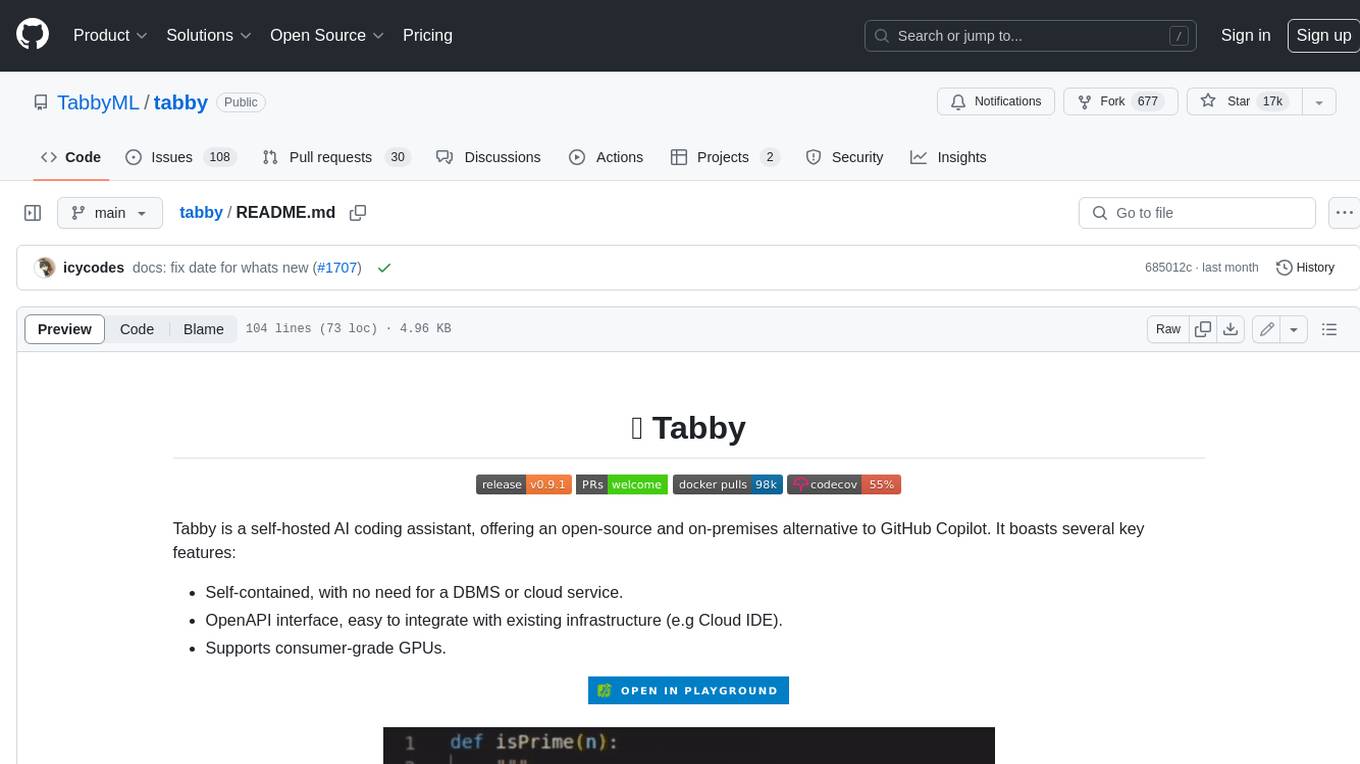
Tabby is a self-hosted AI coding assistant, offering an open-source and on-premises alternative to GitHub Copilot. It boasts several key features: * Self-contained, with no need for a DBMS or cloud service. * OpenAPI interface, easy to integrate with existing infrastructure (e.g Cloud IDE). * Supports consumer-grade GPUs.
spear
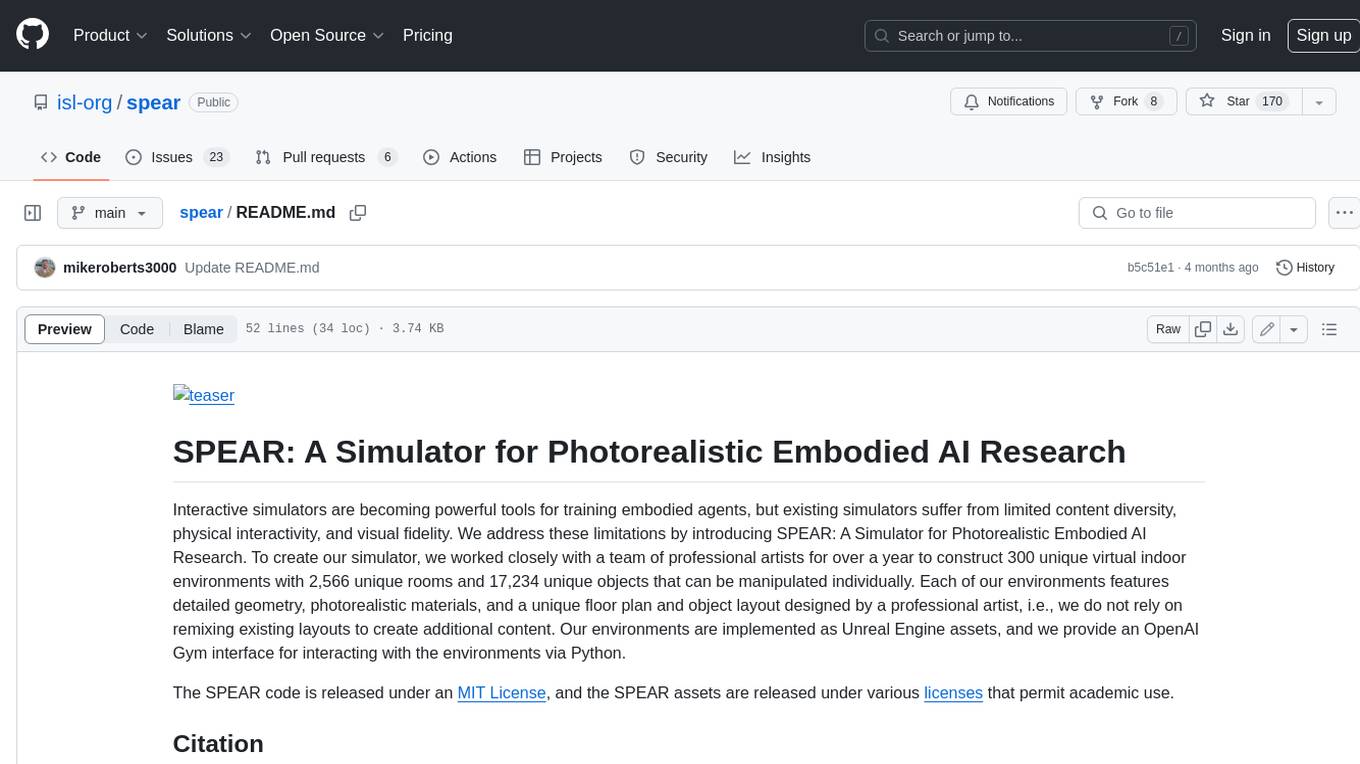
SPEAR (Simulator for Photorealistic Embodied AI Research) is a powerful tool for training embodied agents. It features 300 unique virtual indoor environments with 2,566 unique rooms and 17,234 unique objects that can be manipulated individually. Each environment is designed by a professional artist and features detailed geometry, photorealistic materials, and a unique floor plan and object layout. SPEAR is implemented as Unreal Engine assets and provides an OpenAI Gym interface for interacting with the environments via Python.
Magick
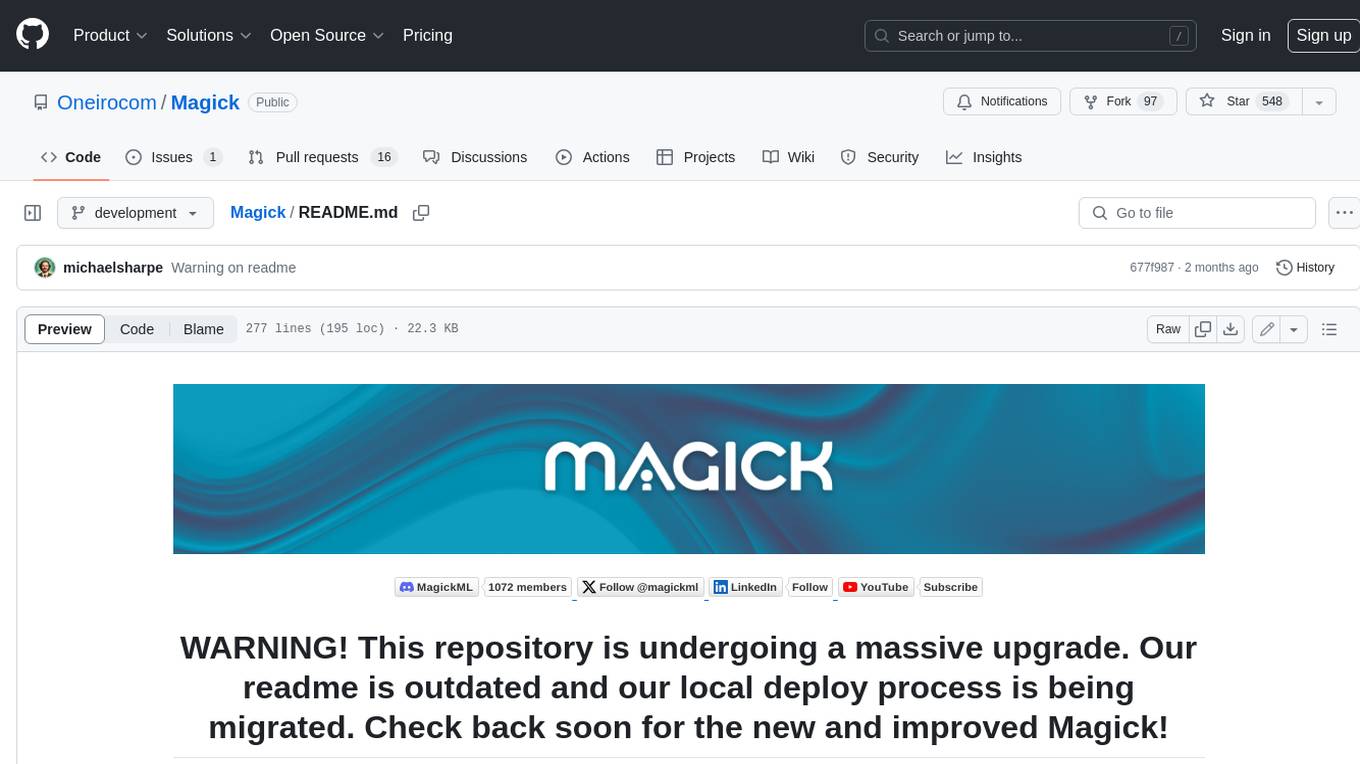
Magick is a groundbreaking visual AIDE (Artificial Intelligence Development Environment) for no-code data pipelines and multimodal agents. Magick can connect to other services and comes with nodes and templates well-suited for intelligent agents, chatbots, complex reasoning systems and realistic characters.