


ruby_llm-mcp
Full-featured MCP support for Ruby and RubyLLM—making it easy to build structured, composable LLM workflows in pure Ruby.
Stars: 213
RubyLLM::MCP is a Ruby client for the Model Context Protocol (MCP), designed to seamlessly integrate with RubyLLM. It provides a Ruby-first API for using MCP tools, resources, and prompts directly in RubyLLM chat workflows. The tool supports the stable MCP spec `2025-06-18` and offers draft spec `2026-01-26` compatibility. It includes features like notification and response handlers, OAuth 2.1 authentication support, integration paths for Rails apps and CLI flows, and straightforward integration for any Ruby app or Rails project using RubyLLM. The tool allows users to work with MCP tools, resources, and prompts over `stdio`, streamable HTTP, or SSE transports.
README:


MCP for Ruby and RubyLLM, as easy as possible.


RubyLLM::MCP is a Ruby client for the Model Context Protocol (MCP), built to work cleanly with RubyLLM. Aiming to be completely spec compliant.
Use MCP tools, resources, and prompts from your RubyLLM chats over stdio, streamable HTTP, or SSE.
Protocol support: Fully supports MCP spec 2025-06-18 (stable), with draft spec 2026-01-26 available.
Our goal is to be able to plug MCP into Ruby/RubyLLM apps as easily as possible.
RubyLLM::MCP gives you that:
- Ruby-first API for using MCP tools, resources, and prompts directly in RubyLLM chat workflows
- Stable protocol track by default (
2025-06-18), with opt-in draft track (2026-01-26) - Built-in notification and response handlers for real-time and interactive workflows
- MCP OAuth 2.1 authentication support (PKCE, dynamic registration, discovery, and automatic token refresh)
- OAuth setup paths for Rails apps (per-user connections) and browser-based CLI flows
- Straightforward integration for any Ruby app, background job, or Rails project using RubyLLM
# Basic setup
require "ruby_llm/mcp"

RubyLLM.configure do |config|
  config.openai_api_key = ENV.fetch("OPENAI_API_KEY")
end

client = RubyLLM::MCP.client(
  name: "filesystem",
  transport_type: :stdio,
  config: {
    command: "bunx",
    args: ["@modelcontextprotocol/server-filesystem", Dir.pwd]
  }
)

chat = RubyLLM.chat(model: "gpt-4.1-mini")
chat.with_tools(*client.tools)

puts chat.ask("Find Ruby files modified today and summarize what changed.")
# Resources
resource = client.resource("release_notes")
chat = RubyLLM.chat(model: "gpt-4.1-mini")
chat.with_resource(resource)
puts chat.ask("Summarize release notes for the team in 5 bullet points.")# Prompts
prompt = client.prompt("code_review")
chat = RubyLLM.chat(model: "gpt-4.1-mini")
response = chat.ask_prompt(
prompt,
arguments: {
language: "ruby",
focus: "security"
}
)
puts response# Handlers (response + notifications)
client.on_progress do |progress|
puts "Progress: #{progress.progress}% - #{progress.message}"
end
client.on_logging do |logging|
puts "[#{logging.level}] #{logging.message}"
end
chat = RubyLLM.chat(model: "gpt-4.1-mini")
chat.with_tools(*client.tools)
chat.ask("Run a repository scan and summarize risks.") do |chunk|
print chunk.content
end# OAuth setup (Rails and CLI)
# Rails: per-user OAuth client (after running rails generate ruby_llm:mcp:oauth:install User)
client = current_user.mcp_client
chat = RubyLLM.chat(model: "gpt-4.1-mini")
chat.with_tools(*client.tools)
puts chat.ask("What changed in my connected repos this week?")
# CLI: browser-based OAuth flow
cli_client = RubyLLM::MCP.client(
name: "oauth-server",
transport_type: :streamable,
start: false,
config: {
url: ENV.fetch("MCP_SERVER_URL"),
oauth: { scope: "mcp:read mcp:write" }
}
)
cli_client.oauth(type: :browser).authenticate
cli_client.start
puts RubyLLM.chat(model: "gpt-4.1-mini").with_tools(*cli_client.tools).ask("List my open tasks.")
cli_client.stop- Tools: Convert MCP tools into RubyLLM-compatible tools
- Resources: Work with resources and resource templates in chat context
- Prompts: Execute server prompts with typed arguments
-
Transports:
:stdio,:streamable, and:sse - Client capabilities: Sampling, roots, progress tracking, and elicitation
- Handlers: Built-in notification and response handlers for real-time and interactive workflows
- MCP Authentication: OAuth 2.1 support with PKCE, dynamic registration, discovery, and automatic token refresh
- OAuth setup paths: Rails per-user OAuth setup and browser-based OAuth for CLI tools
- Extensions: Global/per-client extension negotiation, including MCP Apps
- Multi-client support: Manage multiple MCP servers in one workflow
- Protocol control: Stable default with explicit draft opt-in
-
Adapters: Native
:ruby_llmadapter (full feature set) and optional:mcp_sdk
Add to your Gemfile:
gem "ruby_llm-mcp"Then run:
bundle installIf you want the official SDK adapter, also add:
gem "mcp", "~> 0.7"rails generate ruby_llm:mcp:installFor OAuth-based user connections:
rails generate ruby_llm:mcp:oauth:install UserOAuth quick example:
client = RubyLLM::MCP.client(
  name: "oauth-server",
  transport_type: :streamable,
  start: false,
  config: {
    url: ENV.fetch("MCP_SERVER_URL"),
    oauth: { scope: "mcp:read mcp:write" }
  }
)

client.oauth(type: :browser).authenticate
client.start

chat = RubyLLM.chat(model: "gpt-4.1-mini")
chat.with_tools(*client.tools)
puts chat.ask("What should I prioritize today?")

client.stop
Then use explicit connection blocks in jobs/controllers/services:
RubyLLM::MCP.establish_connection do |clients|
  chat = RubyLLM.chat(model: "gpt-4.1-mini")
  chat.with_tools(*clients.tools)
  chat.ask("Analyze this pull request and list risks.")
endIssues and pull requests are welcome at patvice/ruby_llm-mcp.
Released under the MIT License.
For Tasks:
Click tags to check more tools for each tasksFor Jobs:
Alternative AI tools for ruby_llm-mcp
Similar Open Source Tools
ruby_llm-mcp
RubyLLM::MCP is a Ruby client for the Model Context Protocol (MCP), designed to seamlessly integrate with RubyLLM. It provides a Ruby-first API for using MCP tools, resources, and prompts directly in RubyLLM chat workflows. The tool supports the stable MCP spec `2025-06-18` and offers draft spec `2026-01-26` compatibility. It includes features like notification and response handlers, OAuth 2.1 authentication support, integration paths for Rails apps and CLI flows, and straightforward integration for any Ruby app or Rails project using RubyLLM. The tool allows users to work with MCP tools, resources, and prompts over `stdio`, streamable HTTP, or SSE transports.
mcphub.nvim
MCPHub.nvim is a powerful Neovim plugin that integrates MCP (Model Context Protocol) servers into your workflow. It offers a centralized config file for managing servers and tools, with an intuitive UI for testing resources. Ideal for LLM integration, it provides programmatic API access and interactive testing through the `:MCPHub` command.
hyper-mcp
hyper-mcp is a fast and secure MCP server that extends its capabilities through WebAssembly plugins. It makes it easy to add AI capabilities to applications by allowing users to write plugins in any language that compiles to WebAssembly, distribute them via standard OCI registries, and run them anywhere from cloud to edge. The tool is built with a security-first mindset, offering sandboxed plugins, memory-safe execution, secure plugin distribution, and fine-grained access control for host functions. Users can deploy hyper-mcp anywhere, benefit from cross-platform compatibility, and prevent tool name collisions with the support tool name prefix feature.
open-edison
OpenEdison is a secure MCP control panel that connects AI to data/software with additional security controls to reduce data exfiltration risks. It helps address the lethal trifecta problem by providing visibility, monitoring potential threats, and alerting on data interactions. The tool offers features like data leak monitoring, controlled execution, easy configuration, visibility into agent interactions, a simple API, and Docker support. It integrates with LangGraph, LangChain, and plain Python agents for observability and policy enforcement. OpenEdison helps gain observability, control, and policy enforcement for AI interactions with systems of records, existing company software, and data to reduce risks of AI-caused data leakage.
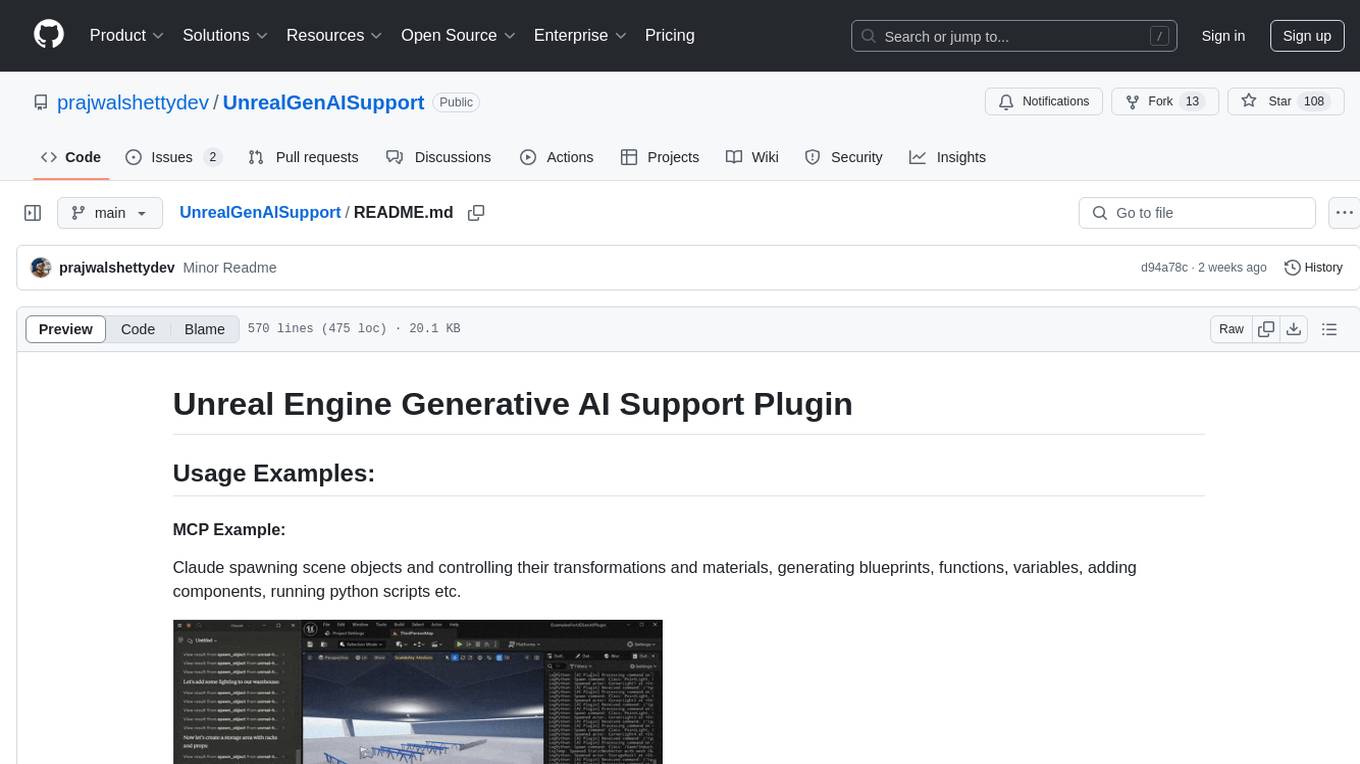
UnrealGenAISupport
The Unreal Engine Generative AI Support Plugin is a tool designed to integrate various cutting-edge LLM/GenAI models into Unreal Engine for game development. It aims to simplify the process of using AI models for game development tasks, such as controlling scene objects, generating blueprints, running Python scripts, and more. The plugin currently supports models from organizations like OpenAI, Anthropic, XAI, Google Gemini, Meta AI, Deepseek, and Baidu. It provides features like API support, model control, generative AI capabilities, UI generation, project file management, and more. The plugin is still under development but offers a promising solution for integrating AI models into game development workflows.
agent-sdk-go
Agent Go SDK is a powerful Go framework for building production-ready AI agents that seamlessly integrates memory management, tool execution, multi-LLM support, and enterprise features into a flexible, extensible architecture. It offers core capabilities like multi-model intelligence, modular tool ecosystem, advanced memory management, and MCP integration. The SDK is enterprise-ready with built-in guardrails, complete observability, and support for enterprise multi-tenancy. It provides a structured task framework, declarative configuration, and zero-effort bootstrapping for development experience. The SDK supports environment variables for configuration and includes features like creating agents with YAML configuration, auto-generating agent configurations, using MCP servers with an agent, and CLI tool for headless usage.
mcp-documentation-server
The mcp-documentation-server is a lightweight server application designed to serve documentation files for projects. It provides a simple and efficient way to host and access project documentation, making it easy for team members and stakeholders to find and reference important information. The server supports various file formats, such as markdown and HTML, and allows for easy navigation through the documentation. With mcp-documentation-server, teams can streamline their documentation process and ensure that project information is easily accessible to all involved parties.
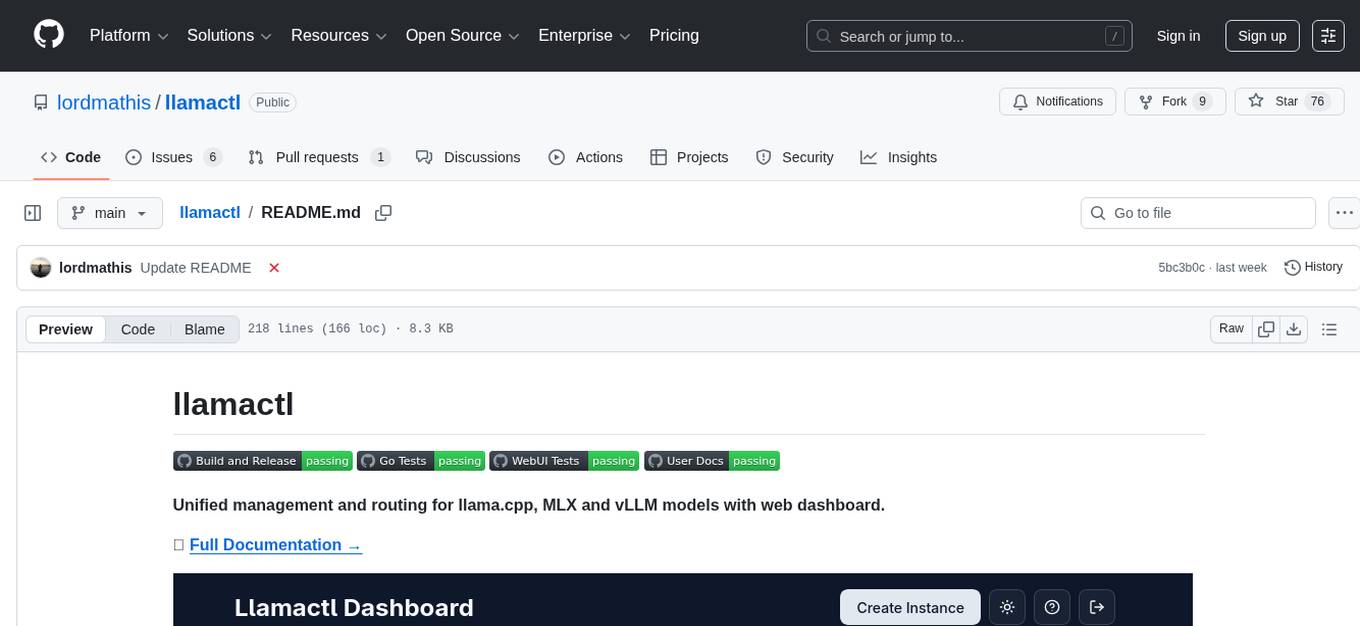
llamactl
llamactl is a tool for unified management and routing of llama.cpp, MLX, and vLLM models with a web dashboard. It offers easy model management with built-in model downloader, dynamic multi-model instances, smart resource management, and a modern React UI dashboard. It provides flexible integration with API compatibility for OpenAI chat completions and resources endpoints, multi-backend support, and Docker readiness. The tool supports distributed deployment with remote instances and central management. Users can quickly start by installing a backend, downloading llamactl, creating an instance, and starting inferencing.
matchlock
Matchlock is a CLI tool designed for running AI agents in isolated and disposable microVMs with network allowlisting and secret injection capabilities. It ensures that your secrets never enter the VM, providing a secure environment for AI agents to execute code without risking access to your machine. The tool offers features such as sealing the network to only allow traffic to specified hosts, injecting real credentials in-flight by the host, and providing a full Linux environment for the agent's operations while maintaining isolation from the host machine. Matchlock supports quick booting of Linux environments, sandbox lifecycle management, image building, and SDKs for Go and Python for embedding sandboxes in applications.
req_llm
ReqLLM is a Req-based library for LLM interactions, offering a unified interface to AI providers through a plugin-based architecture. It brings composability and middleware advantages to LLM interactions, with features like auto-synced providers/models, typed data structures, ergonomic helpers, streaming capabilities, usage & cost extraction, and a plugin-based provider system. Users can easily generate text, structured data, embeddings, and track usage costs. The tool supports various AI providers like Anthropic, OpenAI, Groq, Google, and xAI, and allows for easy addition of new providers. ReqLLM also provides API key management, detailed documentation, and a roadmap for future enhancements.
postman-mcp-server
The Postman MCP Server connects Postman to AI tools, enabling AI agents and assistants to access workspaces, manage collections and environments, evaluate APIs, and automate workflows through natural language interactions. It supports various tool configurations like Minimal, Full, and Code, catering to users with different needs. The server offers authentication via OAuth for the best developer experience and fastest setup. Use cases include API testing, code synchronization, collection management, workspace and environment management, automatic spec creation, and client code generation. Designed for developers integrating AI tools with Postman's context and features, supporting quick natural language queries to advanced agent workflows.
oxylabs-mcp
The Oxylabs MCP Server acts as a bridge between AI models and the web, providing clean, structured data from any site. It enables scraping of URLs, rendering JavaScript-heavy pages, content extraction for AI use, bypassing anti-scraping measures, and accessing geo-restricted web data from 195+ countries. The implementation utilizes the Model Context Protocol (MCP) to facilitate secure interactions between AI assistants and web content. Key features include scraping content from any site, automatic data cleaning and conversion, bypassing blocks and geo-restrictions, flexible setup with cross-platform support, and built-in error handling and request management.
Free-GPT4-WEB-API
FreeGPT4-WEB-API is a Python server that allows you to have a self-hosted GPT-4 Unlimited and Free WEB API, via the latest Bing's AI. It uses Flask and GPT4Free libraries. GPT4Free provides an interface to the Bing's GPT-4. The server can be configured by editing the `FreeGPT4_Server.py` file. You can change the server's port, host, and other settings. The only cookie needed for the Bing model is `_U`.
sdk-typescript
Strands Agents - TypeScript SDK is a lightweight and flexible SDK that takes a model-driven approach to building and running AI agents in TypeScript/JavaScript. It brings key features from the Python Strands framework to Node.js environments, enabling type-safe agent development for various applications. The SDK supports model agnostic development with first-class support for Amazon Bedrock and OpenAI, along with extensible architecture for custom providers. It also offers built-in MCP support, real-time response streaming, extensible hooks, and conversation management features. With tools for interaction with external systems and seamless integration with MCP servers, the SDK provides a comprehensive solution for developing AI agents.
aio-pika
Aio-pika is a wrapper around aiormq for asyncio and humans. It provides a completely asynchronous API, object-oriented API, transparent auto-reconnects with complete state recovery, Python 3.7+ compatibility, transparent publisher confirms support, transactions support, and complete type-hints coverage.
mcp-devtools
MCP DevTools is a high-performance server written in Go that replaces multiple Node.js and Python-based servers. It provides access to essential developer tools through a unified, modular interface. The server is efficient, with minimal memory footprint and fast response times. It offers a comprehensive tool suite for agentic coding, including 20+ essential developer agent tools. The tool registry allows for easy addition of new tools. The server supports multiple transport modes, including STDIO, HTTP, and SSE. It includes a security framework for multi-layered protection and a plugin system for adding new tools.
For similar tasks
ruby_llm-mcp
RubyLLM::MCP is a Ruby client for the Model Context Protocol (MCP), designed to seamlessly integrate with RubyLLM. It provides a Ruby-first API for using MCP tools, resources, and prompts directly in RubyLLM chat workflows. The tool supports the stable MCP spec `2025-06-18` and offers draft spec `2026-01-26` compatibility. It includes features like notification and response handlers, OAuth 2.1 authentication support, integration paths for Rails apps and CLI flows, and straightforward integration for any Ruby app or Rails project using RubyLLM. The tool allows users to work with MCP tools, resources, and prompts over `stdio`, streamable HTTP, or SSE transports.
pocketpal-ai
PocketPal AI is a versatile virtual assistant tool designed to streamline daily tasks and enhance productivity. It leverages artificial intelligence technology to provide personalized assistance in managing schedules, organizing information, setting reminders, and more. With its intuitive interface and smart features, PocketPal AI aims to simplify users' lives by automating routine activities and offering proactive suggestions for optimal time management and task prioritization.
For similar jobs
sweep
Sweep is an AI junior developer that turns bugs and feature requests into code changes. It automatically handles developer experience improvements like adding type hints and improving test coverage.
teams-ai
The Teams AI Library is a software development kit (SDK) that helps developers create bots that can interact with Teams and Microsoft 365 applications. It is built on top of the Bot Framework SDK and simplifies the process of developing bots that interact with Teams' artificial intelligence capabilities. The SDK is available for JavaScript/TypeScript, .NET, and Python.
ai-guide
This guide is dedicated to Large Language Models (LLMs) that you can run on your home computer. It assumes your PC is a lower-end, non-gaming setup.
classifai
Supercharge WordPress Content Workflows and Engagement with Artificial Intelligence. Tap into leading cloud-based services like OpenAI, Microsoft Azure AI, Google Gemini and IBM Watson to augment your WordPress-powered websites. Publish content faster while improving SEO performance and increasing audience engagement. ClassifAI integrates Artificial Intelligence and Machine Learning technologies to lighten your workload and eliminate tedious tasks, giving you more time to create original content that matters.
chatbot-ui
Chatbot UI is an open-source AI chat app that allows users to create and deploy their own AI chatbots. It is easy to use and can be customized to fit any need. Chatbot UI is perfect for businesses, developers, and anyone who wants to create a chatbot.
BricksLLM
BricksLLM is a cloud native AI gateway written in Go. Currently, it provides native support for OpenAI, Anthropic, Azure OpenAI and vLLM. BricksLLM aims to provide enterprise level infrastructure that can power any LLM production use cases. Here are some use cases for BricksLLM: * Set LLM usage limits for users on different pricing tiers * Track LLM usage on a per user and per organization basis * Block or redact requests containing PIIs * Improve LLM reliability with failovers, retries and caching * Distribute API keys with rate limits and cost limits for internal development/production use cases * Distribute API keys with rate limits and cost limits for students
uAgents
uAgents is a Python library developed by Fetch.ai that allows for the creation of autonomous AI agents. These agents can perform various tasks on a schedule or take action on various events. uAgents are easy to create and manage, and they are connected to a fast-growing network of other uAgents. They are also secure, with cryptographically secured messages and wallets.
griptape
Griptape is a modular Python framework for building AI-powered applications that securely connect to your enterprise data and APIs. It offers developers the ability to maintain control and flexibility at every step. Griptape's core components include Structures (Agents, Pipelines, and Workflows), Tasks, Tools, Memory (Conversation Memory, Task Memory, and Meta Memory), Drivers (Prompt and Embedding Drivers, Vector Store Drivers, Image Generation Drivers, Image Query Drivers, SQL Drivers, Web Scraper Drivers, and Conversation Memory Drivers), Engines (Query Engines, Extraction Engines, Summary Engines, Image Generation Engines, and Image Query Engines), and additional components (Rulesets, Loaders, Artifacts, Chunkers, and Tokenizers). Griptape enables developers to create AI-powered applications with ease and efficiency.