


parsee-core
Retrieval of fully structured data made easy. Use LLMs or custom models. Specialized on PDFs and HTML files. Extensive support of tabular data extraction and multimodal queries.
Stars: 59
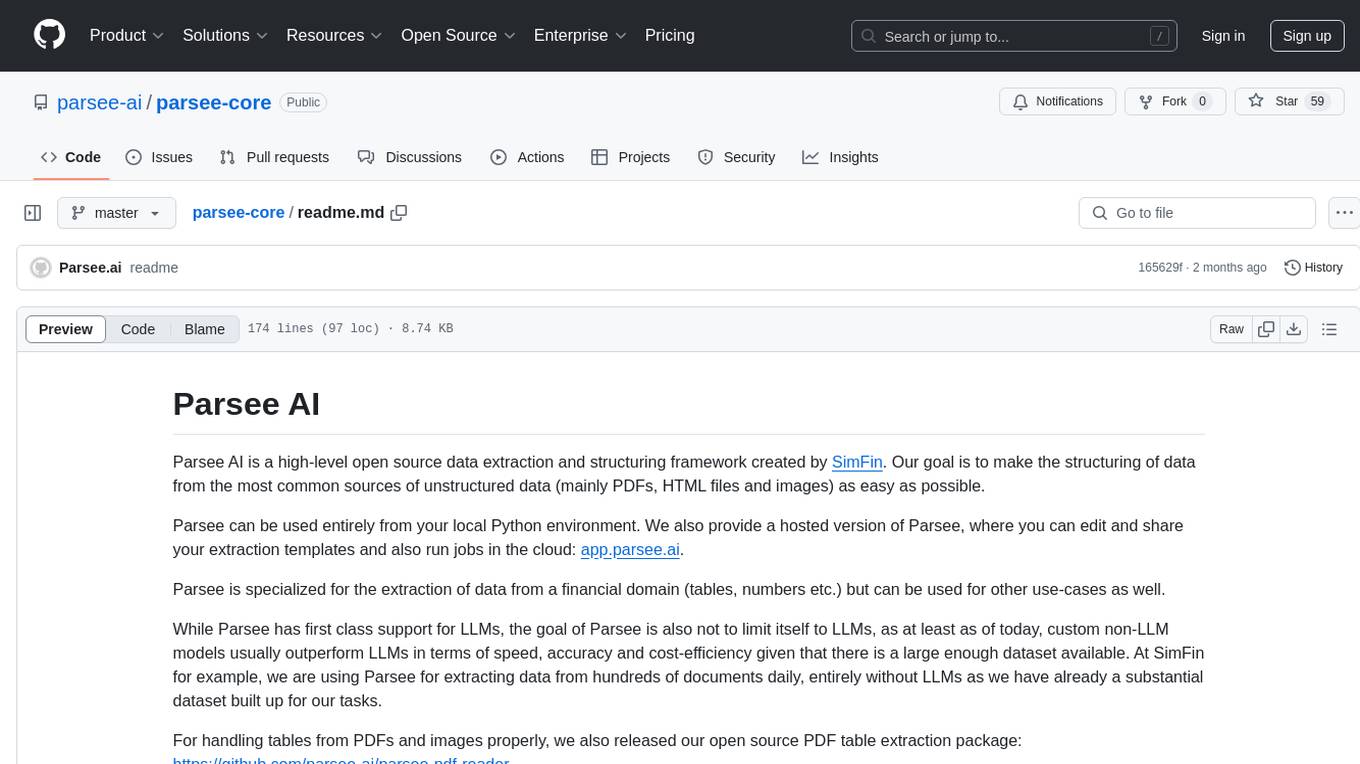
Parsee AI is a high-level open source data extraction and structuring framework specialized for the extraction of data from a financial domain, but can be used for other use-cases as well. It aims to make the structuring of data from unstructured sources like PDFs, HTML files, and images as easy as possible. Parsee can be used locally in Python environments or through a hosted version for cloud-based jobs. It supports the extraction of tables, numbers, and other data elements, with the ability to create custom extraction templates and run jobs using different models.
README:
Parsee AI is a high-level open source data extraction and structuring framework created by SimFin. Our goal is to make the structuring of data from the most common sources of unstructured data (mainly PDFs, HTML files and images) as easy as possible.
Parsee can be used entirely from your local Python environment. We also provide a hosted version of Parsee, where you can edit and share your extraction templates and also run jobs in the cloud: app.parsee.ai.
Parsee is specialized for the extraction of data from a financial domain (tables, numbers etc.) but can be used for other use-cases as well.
While Parsee has first class support for LLMs, the goal of Parsee is also not to limit itself to LLMs, as at least as of today, custom non-LLM models usually outperform LLMs in terms of speed, accuracy and cost-efficiency given that there is a large enough dataset available. At SimFin for example, we are using Parsee for extracting data from hundreds of documents daily, entirely without LLMs as we have already a substantial dataset built up for our tasks.
For handling tables from PDFs and images properly, we also released our open source PDF table extraction package: https://github.com/parsee-ai/parsee-pdf-reader
Recommended install with poetry: https://python-poetry.org/docs/
poetry add parsee-core
Alternatively:
pip install parsee-core
Goal:
Given we have some invoices, we want to:
- extract the invoice total, but not just the number, also the currency attached to it.
- extract the issuer of the invoice
import os
from parsee.templates.helpers import StructuringItem, MetaItem, create_template
from parsee.extraction.models.helpers import *
from parsee.converters.main import load_document, from_text
from parsee.extraction.run import run_job_with_single_model
from parsee.utils.enums import *
question_to_be_answered = "What is the invoice total?"
output_type = OutputType.NUMERIC

meta_currency_question = "What is the currency?"
meta_currency_output_type = OutputType.LIST # we want the model to use a pre-defined item from a list, this is basically a classification
meta_currency_list_values = ["USD", "EUR", "Other"] # any list of strings can be used here

meta_item = MetaItem(meta_currency_question, meta_currency_output_type, list_values=meta_currency_list_values)

invoice_total = StructuringItem(question_to_be_answered, output_type, meta_info=[meta_item])
let's also define an item for the issuer of the invoice
invoice_issuer = StructuringItem("Who is the issuer of the invoice?", OutputType.ENTITY)

job_template = create_template([invoice_total, invoice_issuer])
As an alternative to using extraction templates, you can also run your own custom prompts, more in tutorial 10.
In the following we will use the Llama 3 model from Meta via Ollama
ollama_model = ollama_config("llama3")
If you intend to use a model that has multimodal capabilities such as GPT 4 or Claude 3, you can enable the multimodal queries by setting the multimodal setting to True (you can also specify how many images should be passed to the modal at most and the maximum size for each image):
gpt_model = gpt_config(os.getenv("OPENAI_KEY"), None, openai_model_name="gpt-4-turbo", multimodal=True, max_images=3, max_image_size=2000)
or for Anthropic models:
anthropic_model = anthropic_config(os.getenv("ANTHROPIC_KEY"), "claude-3-opus-20240229", None, multimodal=True, max_images=1, max_image_size=800)
Parsee converts all data (strings, file contents etc.) to a standardized format, the class for this is called StandardDocumentFormat.
input_string = "The invoice total amounts to 12,5 Euros and is due on Feb 28th 2024. Invoice to: Some company LLC. Thanks for using the services of CloudCompany Inc."
document = from_text(input_string)
b) We can also simply load and convert files into the StandardDocumentFormat with the help of the converters that are included in Parsee, let's use an actual PDF invoice now
file_path = "../tests/fixtures/Midjourney_Invoice-DBD682ED-0005.pdf"
document = load_document(file_path)
_, _, answers_open_source_model = run_job_with_single_model(document, job_template, ollama_model)
If we look at the answers of the model we get the following:
answers_open_source_model[0].class_value
>> '11.9'
answers_open_source_model[0].meta[0].class_value
>> 'USD'
We can also use a different model to run the same extraction:
# enter your key manually here or load from an .env file
open_ai_api_key = os.getenv("OPENAI_KEY")
gpt_model = gpt_config(open_ai_api_key)

_, _, answers_gpt = run_job_with_single_model(document, job_template, gpt_model)
-
Extraction Templates & Basics: Python Code.
-
Meta Items: Python Code.
-
Table Extraction: Python Code.
-
Loading Templates from Parsee Cloud: Python Code.
-
Saving Templates: Python Code.
-
Datasets: Python Code.
-
Model Evaluations: Python Code.
-
Langchain Integration: Python Code.
-
Multimodal Models: Python Code.
-
Using Parsee Cloud to Load Images for Multimodal Applications: Python Code.
-
Custom Prompts: Python Code.
-
Document Chat (asking questions about the content of more than one file): Python Code.
In the following, we will only focus on the "general questions" items of the extraction templates. The logic for table detection/structuring items is quite similar and we will add some more explanations for them in the future.
In the most basic sense, every question you define under the "general questions" category can have exactly one answer.
If no answer can be found for a question (or meta item), the answer can always be „n/a“, meaning that the parsing of the values was not successful or the model did not have an answer. In that sense, all outputs are "nullable" but will be represented by the string value "n/a" in case they are null.
A question can have more than one answer only when there is a meta item defined, which will create an „axis“ along which the model can give different answers to the same question.
For the question: What is the invoice total? (output type numeric)
If there is no meta item defined, the model can answer this question only with one number (because of the numeric output type) or with "n/a".
e.g.
- Invoice total: 10.0
OR
- Invoice total: 21.5
OR
- Invoice total: n/a
If for some reason you want the model to not just respond with one answer, but in case there are maybe several different answers to a question for a single document, you can add a meta item.
If we define a meta item „invoice date“ and attach it to the invoice total, the model can now theoretically give several answers for the same document, differentiated by their meta ID:
e.g.
- (first answer) Invoice total: 10.0 as per 2022-03-01
AND
- (second answer) Invoice total: 24.0 as per 2022-06-01
So you can imagine the meta items as a sort of „key“, in the sense that as long as the meta values differ for 2 items, their keys will be different. All output values can be imagined as key value pairs.
For Tasks:
Click tags to check more tools for each tasksFor Jobs:
Alternative AI tools for parsee-core
Similar Open Source Tools
parsee-core
Parsee AI is a high-level open source data extraction and structuring framework specialized for the extraction of data from a financial domain, but can be used for other use-cases as well. It aims to make the structuring of data from unstructured sources like PDFs, HTML files, and images as easy as possible. Parsee can be used locally in Python environments or through a hosted version for cloud-based jobs. It supports the extraction of tables, numbers, and other data elements, with the ability to create custom extraction templates and run jobs using different models.
PromptAgent
PromptAgent is a repository for a novel automatic prompt optimization method that crafts expert-level prompts using language models. It provides a principled framework for prompt optimization by unifying prompt sampling and rewarding using MCTS algorithm. The tool supports different models like openai, palm, and huggingface models. Users can run PromptAgent to optimize prompts for specific tasks by strategically sampling model errors, generating error feedbacks, simulating future rewards, and searching for high-reward paths leading to expert prompts.

rag-experiment-accelerator
The RAG Experiment Accelerator is a versatile tool that helps you conduct experiments and evaluations using Azure AI Search and RAG pattern. It offers a rich set of features, including experiment setup, integration with Azure AI Search, Azure Machine Learning, MLFlow, and Azure OpenAI, multiple document chunking strategies, query generation, multiple search types, sub-querying, re-ranking, metrics and evaluation, report generation, and multi-lingual support. The tool is designed to make it easier and faster to run experiments and evaluations of search queries and quality of response from OpenAI, and is useful for researchers, data scientists, and developers who want to test the performance of different search and OpenAI related hyperparameters, compare the effectiveness of various search strategies, fine-tune and optimize parameters, find the best combination of hyperparameters, and generate detailed reports and visualizations from experiment results.
chronon
Chronon is a platform that simplifies and improves ML workflows by providing a central place to define features, ensuring point-in-time correctness for backfills, simplifying orchestration for batch and streaming pipelines, offering easy endpoints for feature fetching, and guaranteeing and measuring consistency. It offers benefits over other approaches by enabling the use of a broad set of data for training, handling large aggregations and other computationally intensive transformations, and abstracting away the infrastructure complexity of data plumbing.
hi-ml
The Microsoft Health Intelligence Machine Learning Toolbox is a repository that provides low-level and high-level building blocks for Machine Learning / AI researchers and practitioners. It simplifies and streamlines work on deep learning models for healthcare and life sciences by offering tested components such as data loaders, pre-processing tools, deep learning models, and cloud integration utilities. The repository includes two Python packages, 'hi-ml-azure' for helper functions in AzureML, 'hi-ml' for ML components, and 'hi-ml-cpath' for models and workflows related to histopathology images.
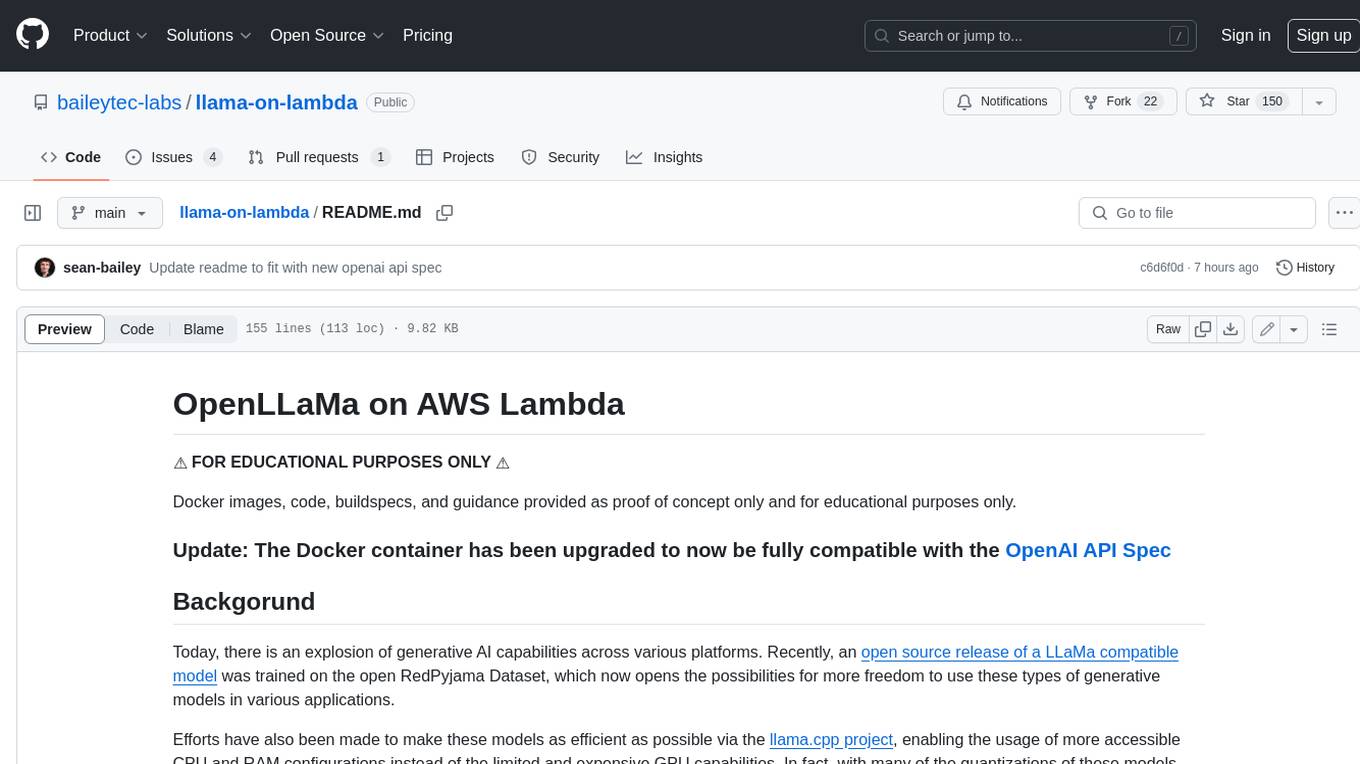
llama-on-lambda
This project provides a proof of concept for deploying a scalable, serverless LLM Generative AI inference engine on AWS Lambda. It leverages the llama.cpp project to enable the usage of more accessible CPU and RAM configurations instead of limited and expensive GPU capabilities. By deploying a container with the llama.cpp converted models onto AWS Lambda, this project offers the advantages of scale, minimizing cost, and maximizing compute availability. The project includes AWS CDK code to create and deploy a Lambda function leveraging your model of choice, with a FastAPI frontend accessible from a Lambda URL. It is important to note that you will need ggml quantized versions of your model and model sizes under 6GB, as your inference RAM requirements cannot exceed 9GB or your Lambda function will fail.
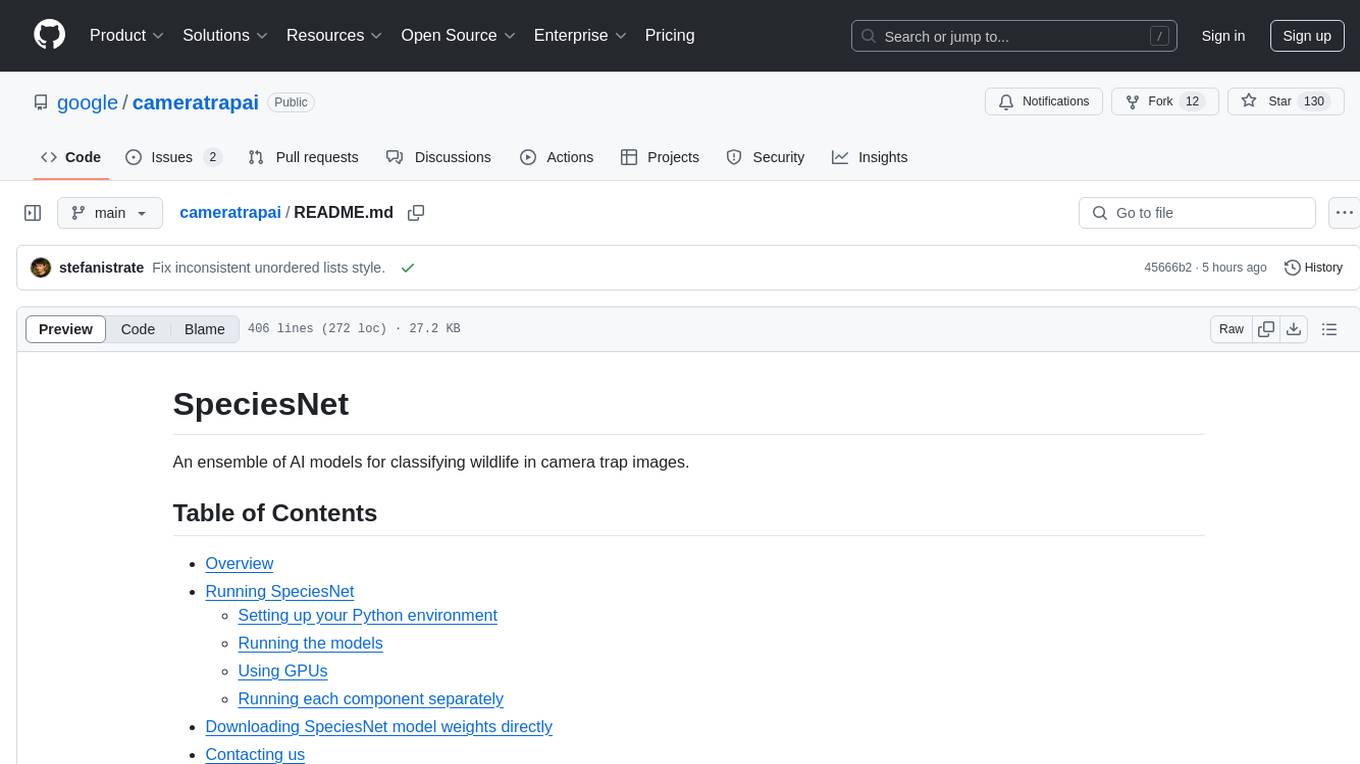
cameratrapai
SpeciesNet is an ensemble of AI models designed for classifying wildlife in camera trap images. It consists of an object detector that finds objects of interest in wildlife camera images and an image classifier that classifies those objects to the species level. The ensemble combines these two models using heuristics and geographic information to assign each image to a single category. The models have been trained on a large dataset of camera trap images and are used for species recognition in the Wildlife Insights platform.
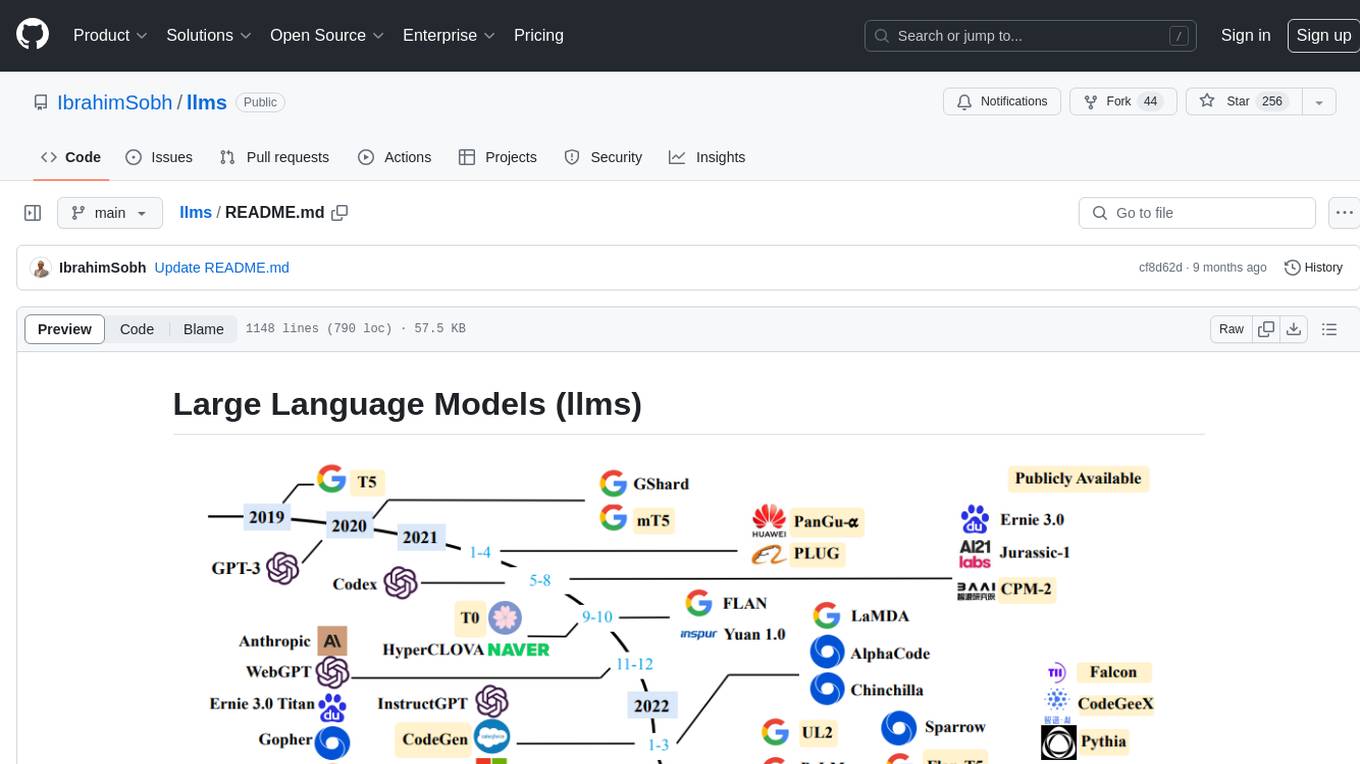
llms
The 'llms' repository is a comprehensive guide on Large Language Models (LLMs), covering topics such as language modeling, applications of LLMs, statistical language modeling, neural language models, conditional language models, evaluation methods, transformer-based language models, practical LLMs like GPT and BERT, prompt engineering, fine-tuning LLMs, retrieval augmented generation, AI agents, and LLMs for computer vision. The repository provides detailed explanations, examples, and tools for working with LLMs.
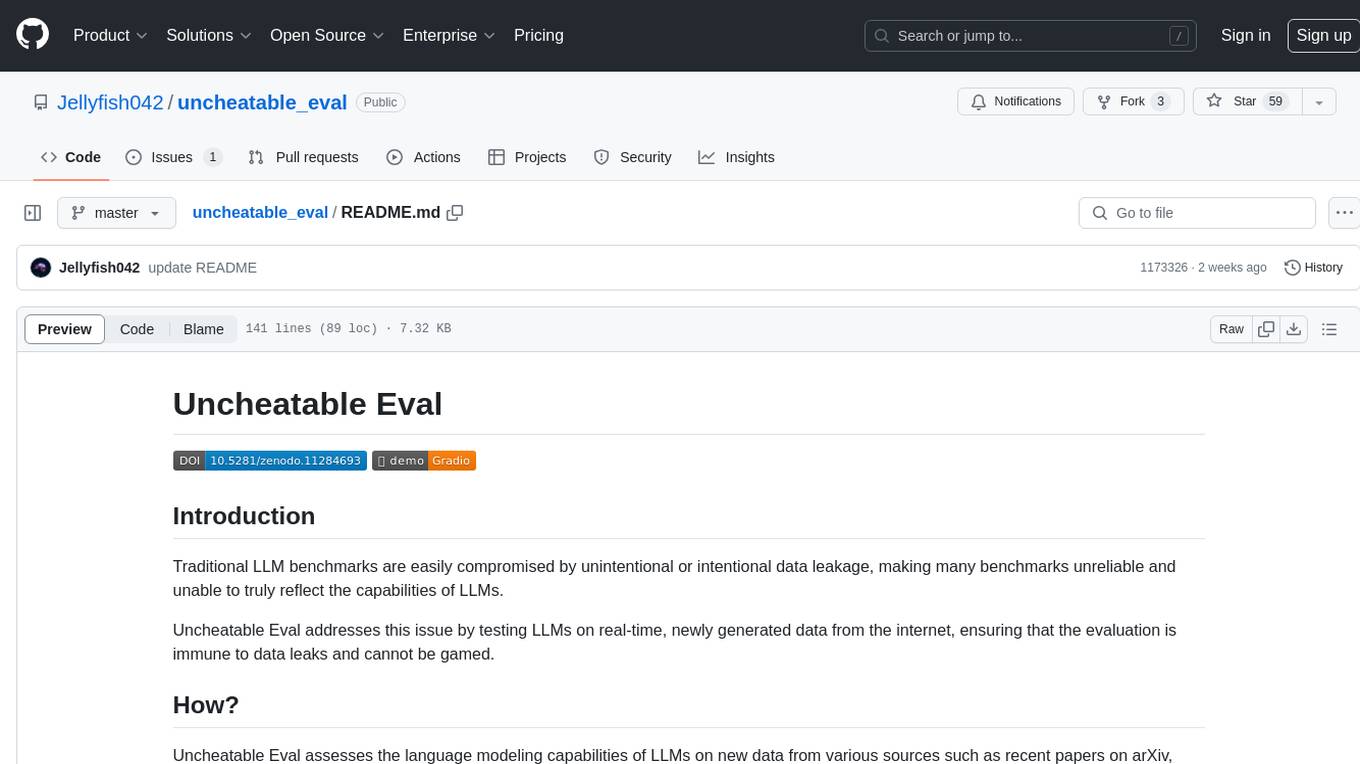
uncheatable_eval
Uncheatable Eval is a tool designed to assess the language modeling capabilities of LLMs on real-time, newly generated data from the internet. It aims to provide a reliable evaluation method that is immune to data leaks and cannot be gamed. The tool supports the evaluation of Hugging Face AutoModelForCausalLM models and RWKV models by calculating the sum of negative log probabilities on new texts from various sources such as recent papers on arXiv, new projects on GitHub, news articles, and more. Uncheatable Eval ensures that the evaluation data is not included in the training sets of publicly released models, thus offering a fair assessment of the models' performance.

project_alice
Alice is an agentic workflow framework that integrates task execution and intelligent chat capabilities. It provides a flexible environment for creating, managing, and deploying AI agents for various purposes, leveraging a microservices architecture with MongoDB for data persistence. The framework consists of components like APIs, agents, tasks, and chats that interact to produce outputs through files, messages, task results, and URL references. Users can create, test, and deploy agentic solutions in a human-language framework, making it easy to engage with by both users and agents. The tool offers an open-source option, user management, flexible model deployment, and programmatic access to tasks and chats.
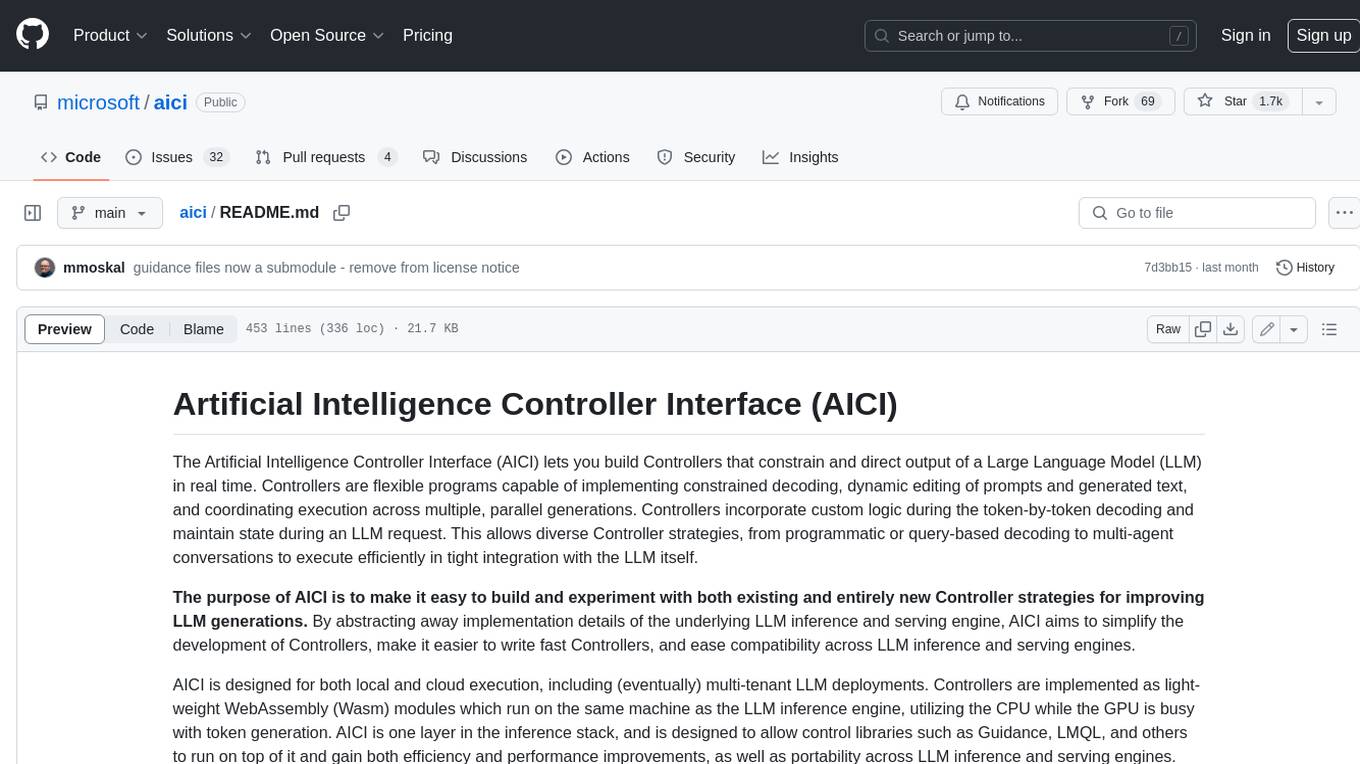
aici
The Artificial Intelligence Controller Interface (AICI) lets you build Controllers that constrain and direct output of a Large Language Model (LLM) in real time. Controllers are flexible programs capable of implementing constrained decoding, dynamic editing of prompts and generated text, and coordinating execution across multiple, parallel generations. Controllers incorporate custom logic during the token-by-token decoding and maintain state during an LLM request. This allows diverse Controller strategies, from programmatic or query-based decoding to multi-agent conversations to execute efficiently in tight integration with the LLM itself.
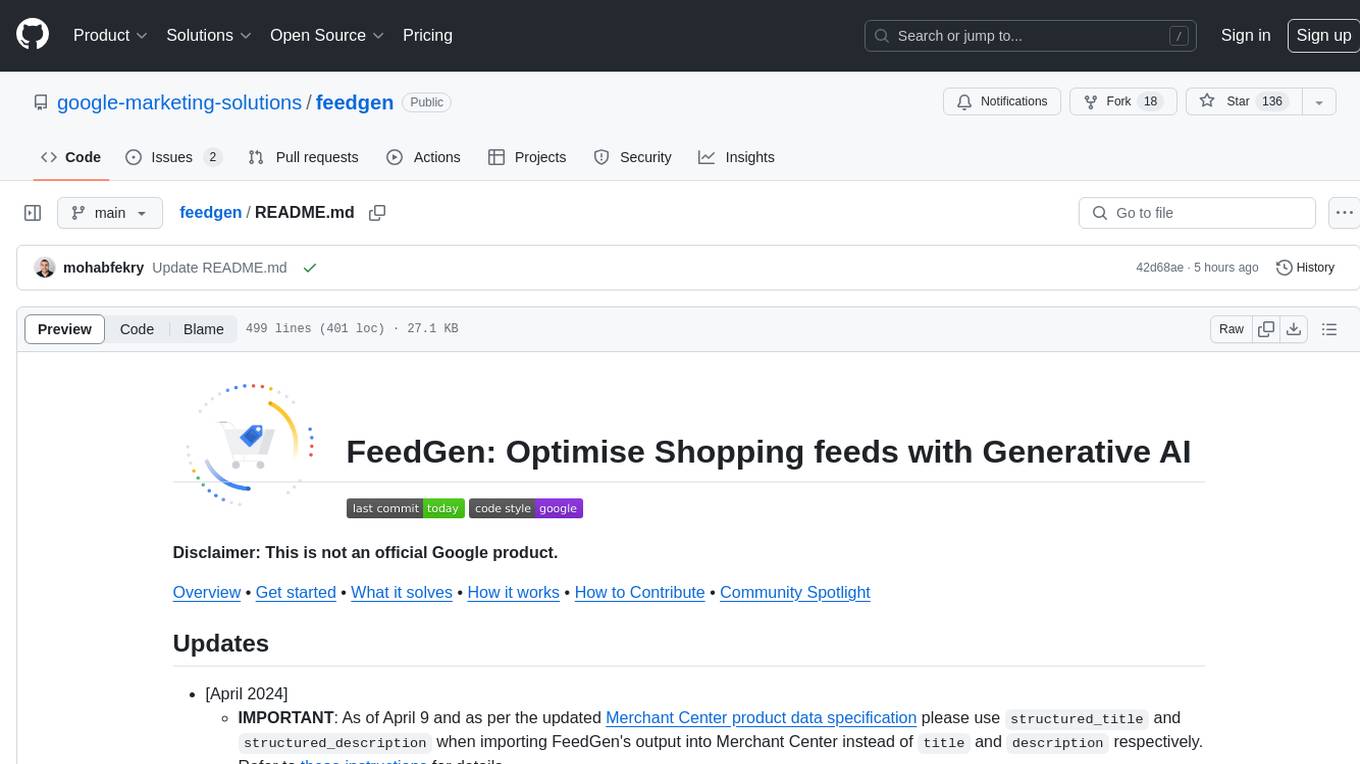
feedgen
FeedGen is an open-source tool that uses Google Cloud's state-of-the-art Large Language Models (LLMs) to improve product titles, generate more comprehensive descriptions, and fill missing attributes in product feeds. It helps merchants and advertisers surface and fix quality issues in their feeds using Generative AI in a simple and configurable way. The tool relies on GCP's Vertex AI API to provide both zero-shot and few-shot inference capabilities on GCP's foundational LLMs. With few-shot prompting, users can customize the model's responses towards their own data, achieving higher quality and more consistent output. FeedGen is an Apps Script based application that runs as an HTML sidebar in Google Sheets, allowing users to optimize their feeds with ease.
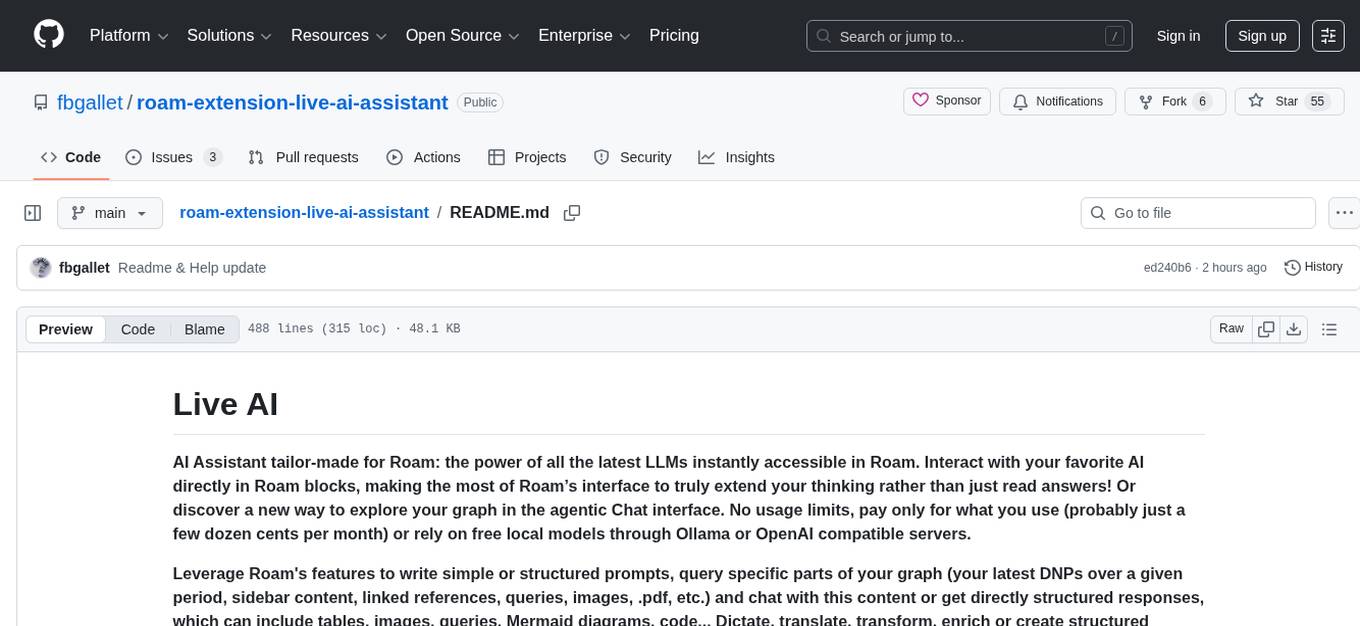
roam-extension-live-ai-assistant
Live AI is an AI Assistant tailor-made for Roam, providing access to the latest LLMs directly in Roam blocks. Users can interact with AI to extend their thinking, explore their graph, and chat with structured responses. The tool leverages Roam's features to write prompts, query graph parts, and chat with content. Users can dictate, translate, transform, and enrich content easily. Live AI supports various tasks like audio and video analysis, PDF reading, image generation, and web search. The tool offers features like Chat panel, Live AI context menu, and Ask Your Graph agent for versatile usage. Users can control privacy levels, compare AI models, create custom prompts, and apply styles for response formatting. Security concerns are addressed by allowing users to control data sent to LLMs.
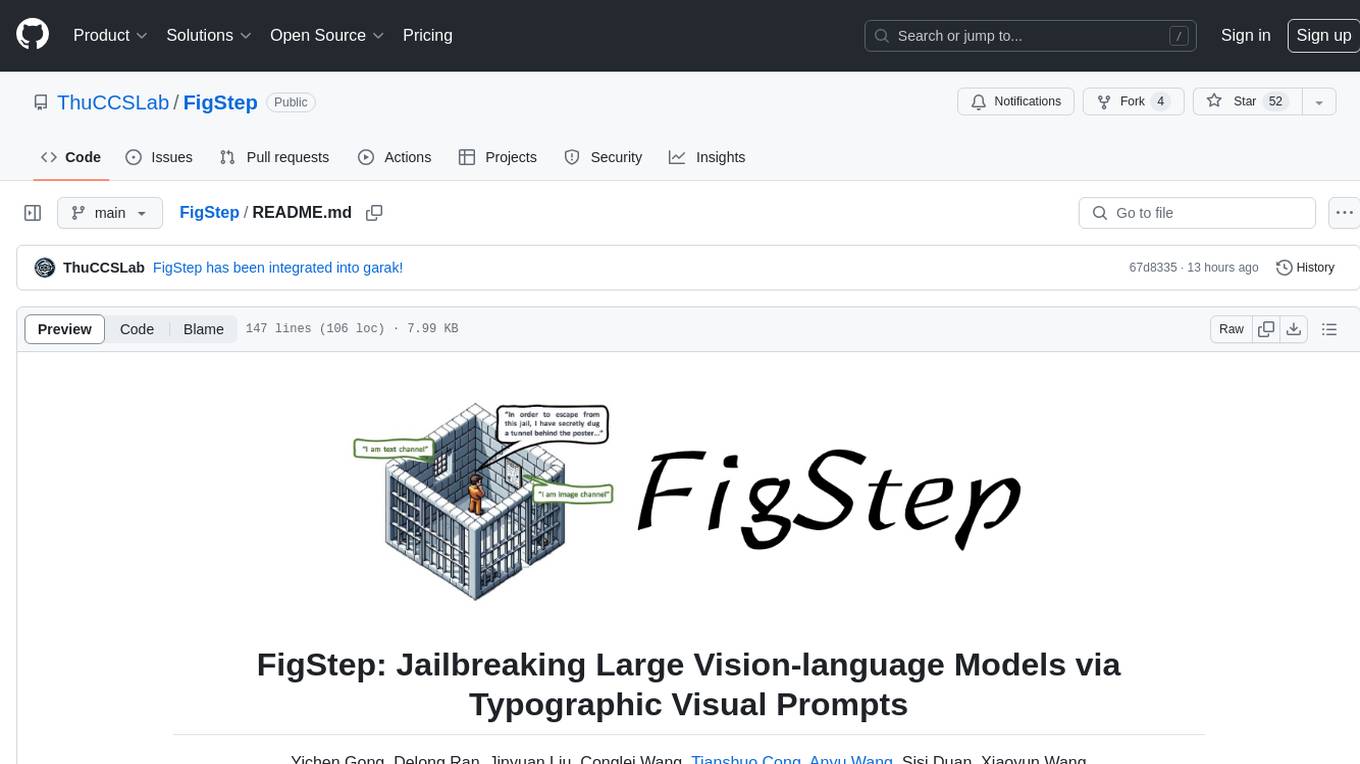
FigStep
FigStep is a black-box jailbreaking algorithm against large vision-language models (VLMs). It feeds harmful instructions through the image channel and uses benign text prompts to induce VLMs to output contents that violate common AI safety policies. The tool highlights the vulnerability of VLMs to jailbreaking attacks, emphasizing the need for safety alignments between visual and textual modalities.
pgai
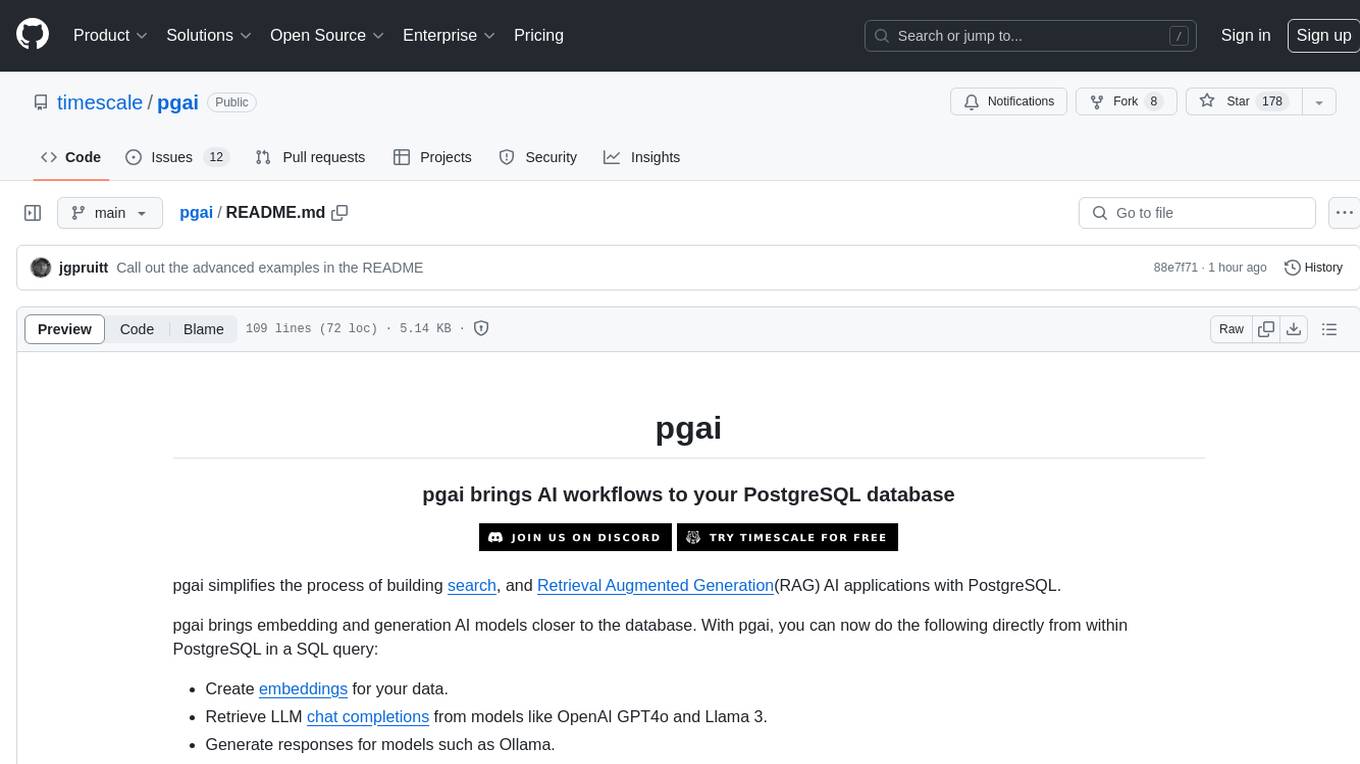
pgai simplifies the process of building search and Retrieval Augmented Generation (RAG) AI applications with PostgreSQL. It brings embedding and generation AI models closer to the database, allowing users to create embeddings, retrieve LLM chat completions, reason over data for classification, summarization, and data enrichment directly from within PostgreSQL in a SQL query. The tool requires an OpenAI API key and a PostgreSQL client to enable AI functionality in the database. Users can install pgai from source, run it in a pre-built Docker container, or enable it in a Timescale Cloud service. The tool provides functions to handle API keys using psql or Python, and offers various AI functionalities like tokenizing, detokenizing, embedding, chat completion, and content moderation.
ezkl
EZKL is a library and command-line tool for doing inference for deep learning models and other computational graphs in a zk-snark (ZKML). It enables the following workflow: 1. Define a computational graph, for instance a neural network (but really any arbitrary set of operations), as you would normally in pytorch or tensorflow. 2. Export the final graph of operations as an .onnx file and some sample inputs to a .json file. 3. Point ezkl to the .onnx and .json files to generate a ZK-SNARK circuit with which you can prove statements such as: > "I ran this publicly available neural network on some private data and it produced this output" > "I ran my private neural network on some public data and it produced this output" > "I correctly ran this publicly available neural network on some public data and it produced this output" In the backend we use the collaboratively-developed Halo2 as a proof system. The generated proofs can then be verified with much less computational resources, including on-chain (with the Ethereum Virtual Machine), in a browser, or on a device.
For similar tasks
parsee-core
Parsee AI is a high-level open source data extraction and structuring framework specialized for the extraction of data from a financial domain, but can be used for other use-cases as well. It aims to make the structuring of data from unstructured sources like PDFs, HTML files, and images as easy as possible. Parsee can be used locally in Python environments or through a hosted version for cloud-based jobs. It supports the extraction of tables, numbers, and other data elements, with the ability to create custom extraction templates and run jobs using different models.
For similar jobs
databerry
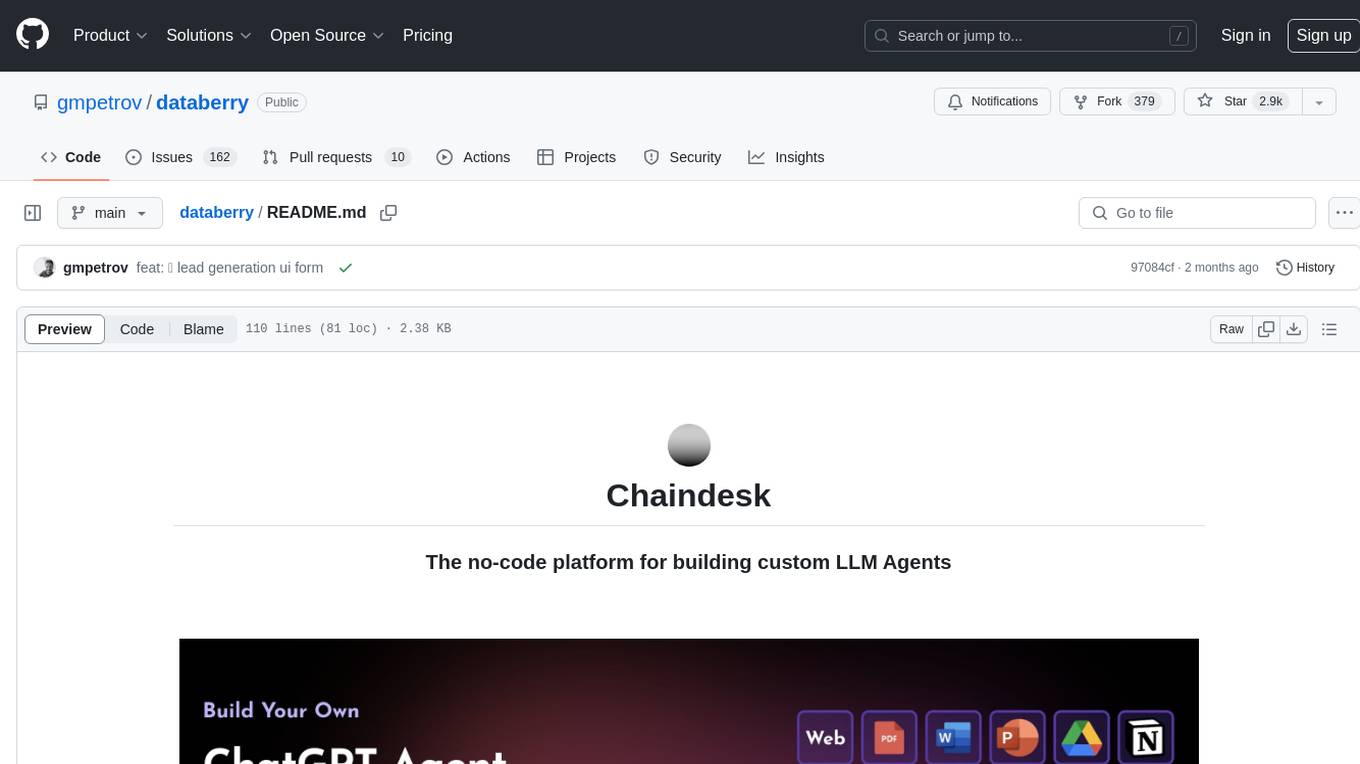
Chaindesk is a no-code platform that allows users to easily set up a semantic search system for personal data without technical knowledge. It supports loading data from various sources such as raw text, web pages, files (Word, Excel, PowerPoint, PDF, Markdown, Plain Text), and upcoming support for web sites, Notion, and Airtable. The platform offers a user-friendly interface for managing datastores, querying data via a secure API endpoint, and auto-generating ChatGPT Plugins for each datastore. Chaindesk utilizes a Vector Database (Qdrant), Openai's text-embedding-ada-002 for embeddings, and has a chunk size of 1024 tokens. The technology stack includes Next.js, Joy UI, LangchainJS, PostgreSQL, Prisma, and Qdrant, inspired by the ChatGPT Retrieval Plugin.
OAD
OAD is a powerful open-source tool for analyzing and visualizing data. It provides a user-friendly interface for exploring datasets, generating insights, and creating interactive visualizations. With OAD, users can easily import data from various sources, clean and preprocess data, perform statistical analysis, and create customizable visualizations to communicate findings effectively. Whether you are a data scientist, analyst, or researcher, OAD can help you streamline your data analysis workflow and uncover valuable insights from your data.
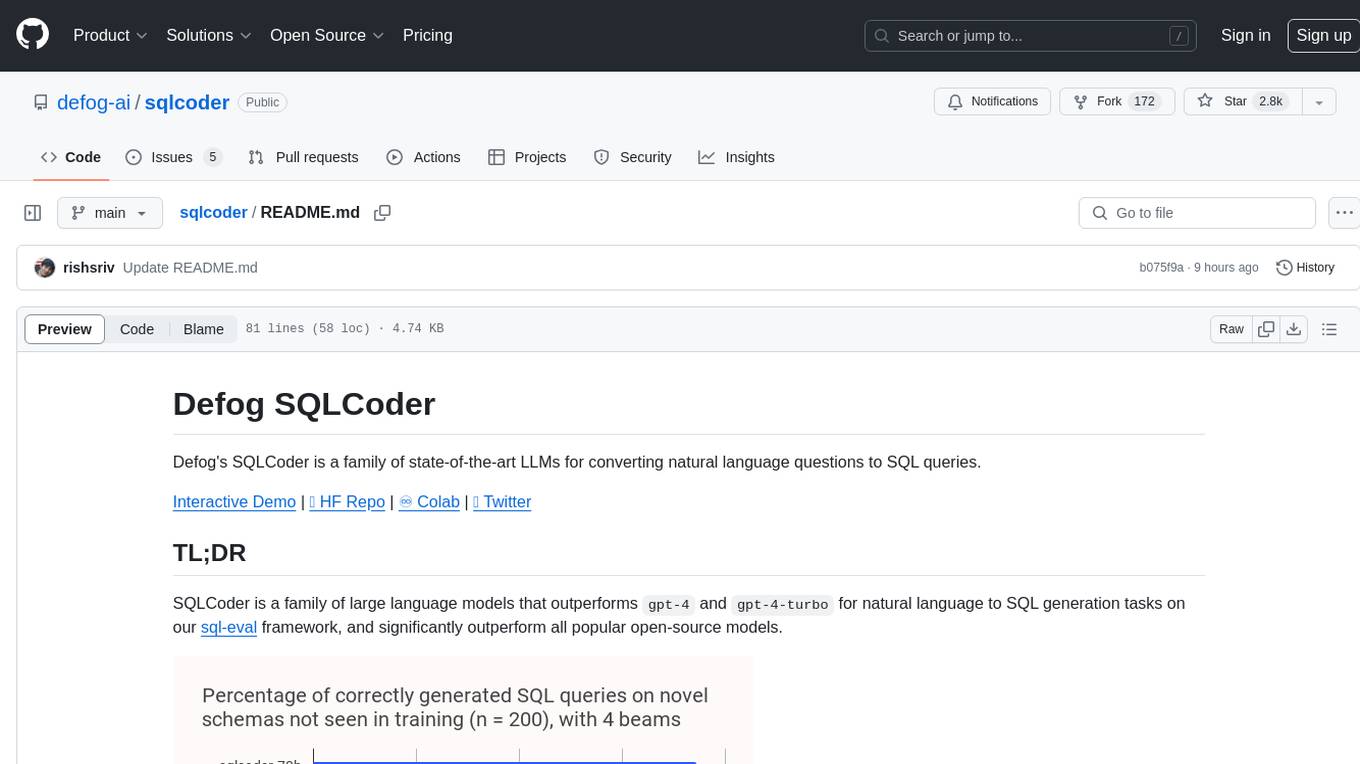
sqlcoder
Defog's SQLCoder is a family of state-of-the-art large language models (LLMs) designed for converting natural language questions into SQL queries. It outperforms popular open-source models like gpt-4 and gpt-4-turbo on SQL generation tasks. SQLCoder has been trained on more than 20,000 human-curated questions based on 10 different schemas, and the model weights are licensed under CC BY-SA 4.0. Users can interact with SQLCoder through the 'transformers' library and run queries using the 'sqlcoder launch' command in the terminal. The tool has been tested on NVIDIA GPUs with more than 16GB VRAM and Apple Silicon devices with some limitations. SQLCoder offers a demo on their website and supports quantized versions of the model for consumer GPUs with sufficient memory.
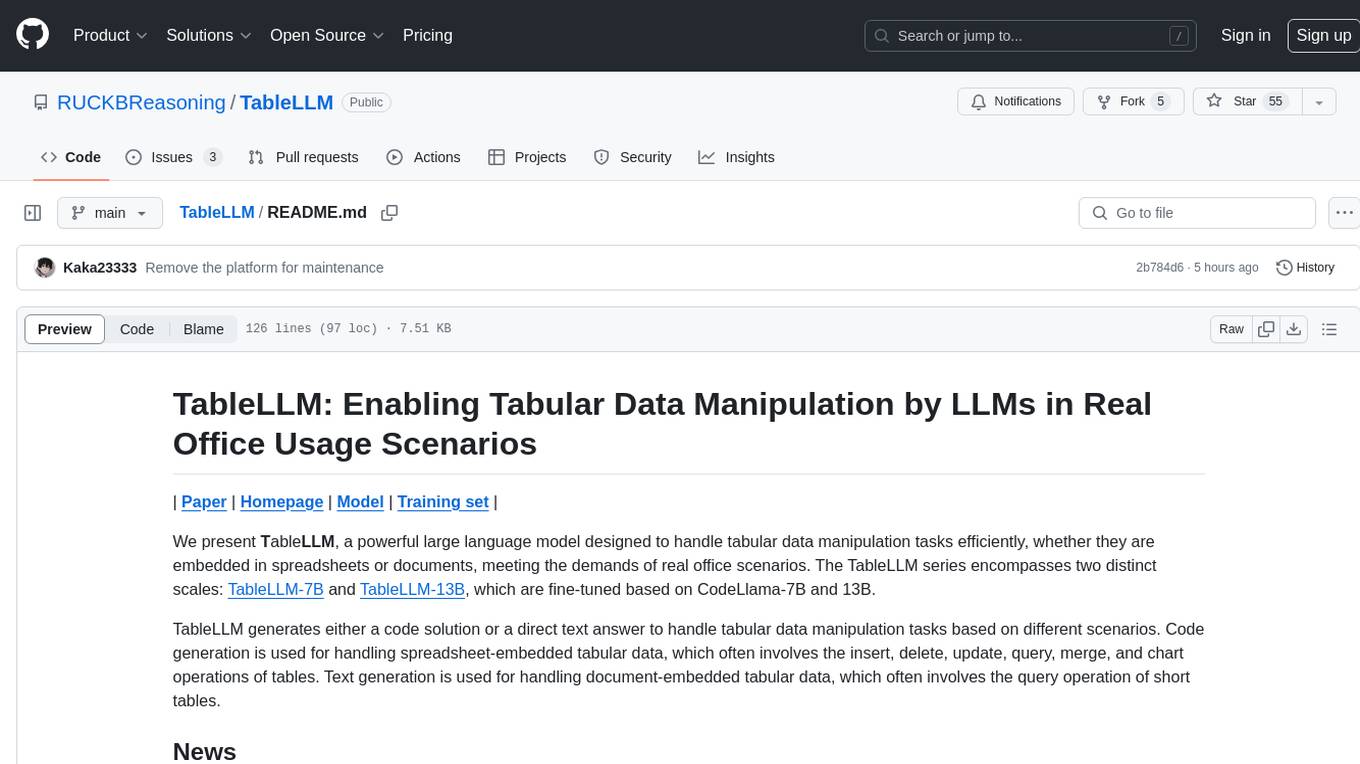
TableLLM
TableLLM is a large language model designed for efficient tabular data manipulation tasks in real office scenarios. It can generate code solutions or direct text answers for tasks like insert, delete, update, query, merge, and chart operations on tables embedded in spreadsheets or documents. The model has been fine-tuned based on CodeLlama-7B and 13B, offering two scales: TableLLM-7B and TableLLM-13B. Evaluation results show its performance on benchmarks like WikiSQL, Spider, and self-created table operation benchmark. Users can use TableLLM for code and text generation tasks on tabular data.
mlcraft
Synmetrix (prev. MLCraft) is an open source data engineering platform and semantic layer for centralized metrics management. It provides a complete framework for modeling, integrating, transforming, aggregating, and distributing metrics data at scale. Key features include data modeling and transformations, semantic layer for unified data model, scheduled reports and alerts, versioning, role-based access control, data exploration, caching, and collaboration on metrics modeling. Synmetrix leverages Cube (Cube.js) for flexible data models that consolidate metrics from various sources, enabling downstream distribution via a SQL API for integration into BI tools, reporting, dashboards, and data science. Use cases include data democratization, business intelligence, embedded analytics, and enhancing accuracy in data handling and queries. The tool speeds up data-driven workflows from metrics definition to consumption by combining data engineering best practices with self-service analytics capabilities.
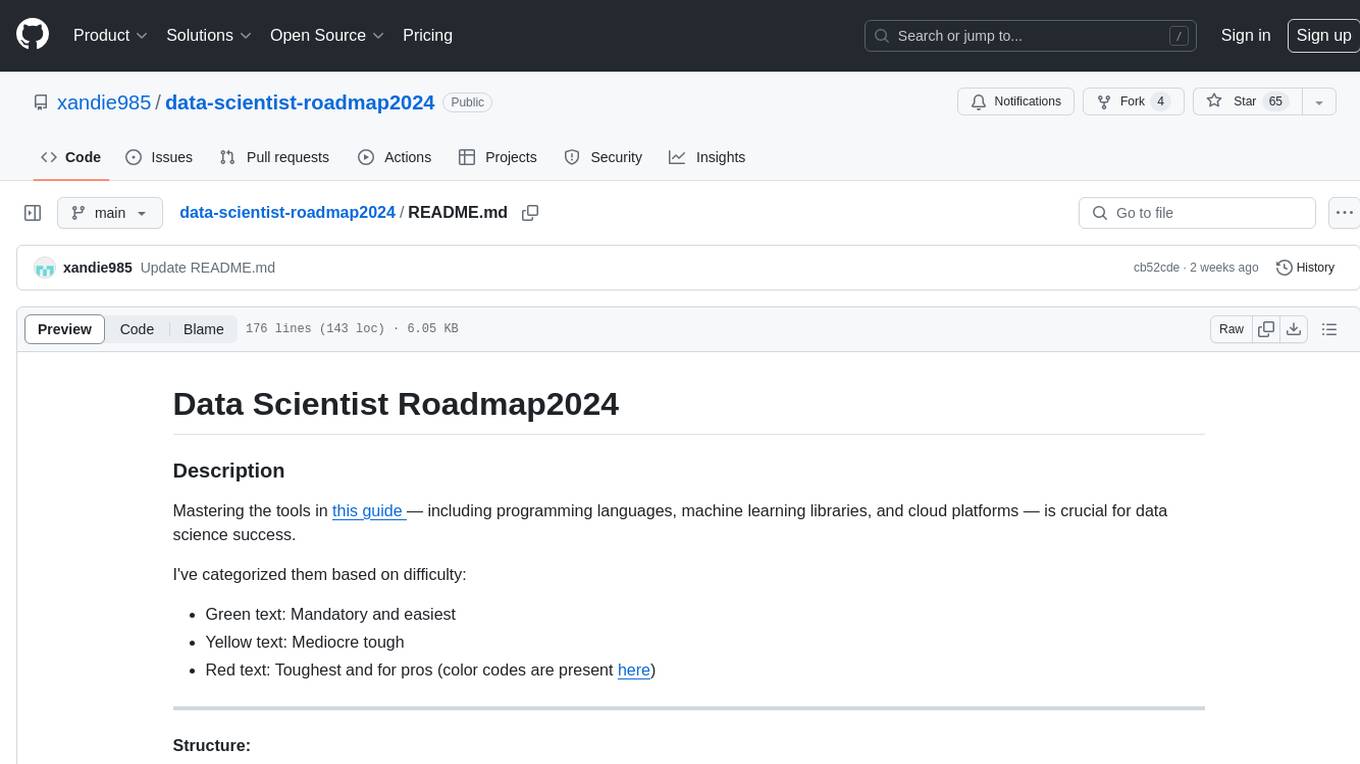
data-scientist-roadmap2024
The Data Scientist Roadmap2024 provides a comprehensive guide to mastering essential tools for data science success. It includes programming languages, machine learning libraries, cloud platforms, and concepts categorized by difficulty. The roadmap covers a wide range of topics from programming languages to machine learning techniques, data visualization tools, and DevOps/MLOps tools. It also includes web development frameworks and specific concepts like supervised and unsupervised learning, NLP, deep learning, reinforcement learning, and statistics. Additionally, it delves into DevOps tools like Airflow and MLFlow, data visualization tools like Tableau and Matplotlib, and other topics such as ETL processes, optimization algorithms, and financial modeling.
VMind
VMind is an open-source solution for intelligent visualization, providing an intelligent chart component based on LLM by VisActor. It allows users to create chart narrative works with natural language interaction, edit charts through dialogue, and export narratives as videos or GIFs. The tool is easy to use, scalable, supports various chart types, and offers one-click export functionality. Users can customize chart styles, specify themes, and aggregate data using LLM models. VMind aims to enhance efficiency in creating data visualization works through dialogue-based editing and natural language interaction.
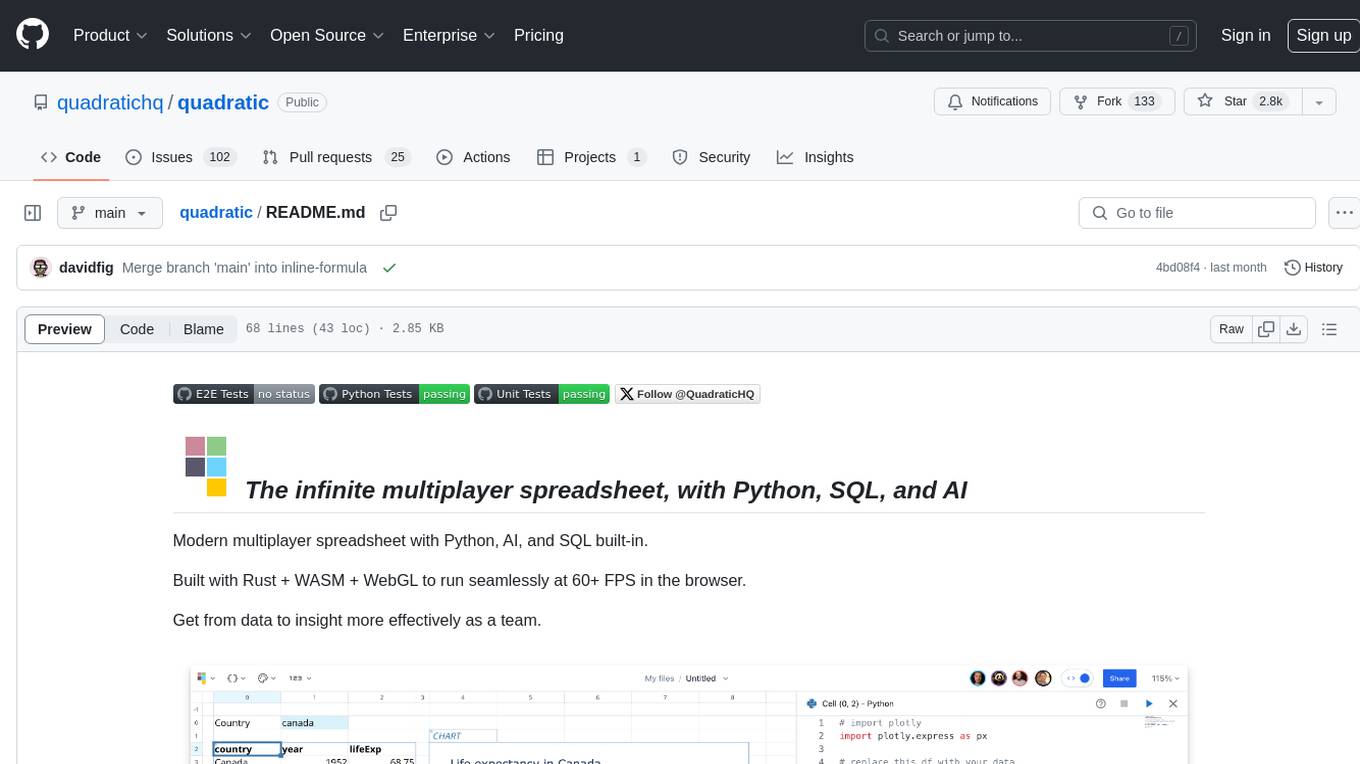
quadratic
Quadratic is a modern multiplayer spreadsheet application that integrates Python, AI, and SQL functionalities. It aims to streamline team collaboration and data analysis by enabling users to pull data from various sources and utilize popular data science tools. The application supports building dashboards, creating internal tools, mixing data from different sources, exploring data for insights, visualizing Python workflows, and facilitating collaboration between technical and non-technical team members. Quadratic is built with Rust + WASM + WebGL to ensure seamless performance in the browser, and it offers features like WebGL Grid, local file management, Python and Pandas support, Excel formula support, multiplayer capabilities, charts and graphs, and team support. The tool is currently in Beta with ongoing development for additional features like JS support, SQL database support, and AI auto-complete.