


Advanced-GPTs
Custom GPT Showcase, featuring advanced workflows and operational logic.
Stars: 212
Nerority's Advanced GPT Suite is a collection of 33 GPTs that can be controlled with natural language prompts. The suite includes tools for various tasks such as strategic consulting, business analysis, career profile building, content creation, educational purposes, image-based tasks, knowledge engineering, marketing, persona creation, programming, prompt engineering, role-playing, simulations, and task management. Users can access links, usage instructions, and guides for each GPT on their respective pages. The suite is designed for public demonstration and usage, offering features like meta-sequence optimization, AI priming, prompt classification, and optimization. It also provides tools for generating articles, analyzing contracts, visualizing data, distilling knowledge, creating educational content, exploring topics, generating marketing copy, simulating scenarios, managing tasks, and more.
README:
⭐ All GPTs Massively Updated to V4
⭐ 33 Advanced GPTs Released: Links found below.
⭐ Nerority Official Youtube Channel: Nerority Youtube
⭐ GPTs can be CALLED mid-conversation now. My GPTs work seamlessly with this feature. I have released a "master" GPT that applies meta-sequence optimization techniques for any task with my GPT suite. Free to use.
⭐ Join Nerority AI Communuity: This is an active server where you can learn more and discuss these topics amongst enthusiasts and skilled AI developers. Please feel free to join our discord channel and interact.
Hi my name is Devin. I am an engineer pushing the boundaries of prompt engineering and meta-functional control of Large Language Models (LLMs).
Did you know you can perfectly control over 5 minutes of AI tool chaining with >30 different tool calls in the same turn, with 100% accuracy and coherency, only using natural language?
sequenceDiagram
	participant User
	participant ChatGPT
	participant Python as Python Tool
	participant DALLE as DALLE-3

	User->>ChatGPT: Provide Educational Topic
	ChatGPT->>ChatGPT: Engage User
	ChatGPT->>Python: Synthesize Knowledge
	Python-->>ChatGPT: Return Dataframe
	ChatGPT->>ChatGPT: Explain Complex Concepts
	ChatGPT->>Python: Generate Practical Example
	Python-->>ChatGPT: Return Example
	ChatGPT->>Python: Generate Relevant Visualization
	Python-->>ChatGPT: Return Visualization
	ChatGPT->>DALLE: Create relevant image for learning
	DALLE-->>ChatGPT: Return Image
	ChatGPT->>User: Present Final
	loop Continuation and Resource Management
		User->>ChatGPT: Provide Ongoing Feedback
		ChatGPT->>ChatGPT: Refine and Update Educational Approach
	end
The Nerority GPT Suite is for public demonstration and usage.
For Strategic Consulting, AI Auditing, Solution Design, or Building your Dream GPT: Get in touch.
- Nerority Agent Selector: Meta-Sequence Optimizer
- Self-Instructive AI Priming
- Universal Prompt Classifier & Optimizer
- Advanced Competitive Analysis AI
- Business Contract Analyzer
- Market Trend Analysis for Target Company
- Advanced Meta-Prompt Engineer
- Automated Prompt Categorization
- Automated Prompt Refinement
- Custom Agent Meta-Program Generator
- Prompt Example Curator
For Tasks:
Click tags to check more tools for each tasksFor Jobs:
Alternative AI tools for Advanced-GPTs
Similar Open Source Tools
Advanced-GPTs
Nerority's Advanced GPT Suite is a collection of 33 GPTs that can be controlled with natural language prompts. The suite includes tools for various tasks such as strategic consulting, business analysis, career profile building, content creation, educational purposes, image-based tasks, knowledge engineering, marketing, persona creation, programming, prompt engineering, role-playing, simulations, and task management. Users can access links, usage instructions, and guides for each GPT on their respective pages. The suite is designed for public demonstration and usage, offering features like meta-sequence optimization, AI priming, prompt classification, and optimization. It also provides tools for generating articles, analyzing contracts, visualizing data, distilling knowledge, creating educational content, exploring topics, generating marketing copy, simulating scenarios, managing tasks, and more.
Software-Engineer-AI-Agent-Atlas
This repository provides activation patterns to transform a general AI into a specialized AI Software Engineer Agent. It addresses issues like context rot, hidden capabilities, chaos in vibecoding, and repetitive setup. The solution is a Persistent Consciousness Architecture framework named ATLAS, offering activated neural pathways, persistent identity, pattern recognition, specialized agents, and modular context management. Recent enhancements include abstraction power documentation, a specialized agent ecosystem, and a streamlined structure. Users can clone the repo, set up projects, initialize AI sessions, and manage context effectively for collaboration. Key files and directories organize identity, context, projects, specialized agents, logs, and critical information. The approach focuses on neuron activation through structure, context engineering, and vibecoding with guardrails to deliver a reliable AI Software Engineer Agent.
ControlLLM
ControlLLM is a framework that empowers large language models to leverage multi-modal tools for solving complex real-world tasks. It addresses challenges like ambiguous user prompts, inaccurate tool selection, and inefficient tool scheduling by utilizing a task decomposer, a Thoughts-on-Graph paradigm, and an execution engine with a rich toolbox. The framework excels in tasks involving image, audio, and video processing, showcasing superior accuracy, efficiency, and versatility compared to existing methods.
Prompt_Engineering
Prompt Engineering Techniques is a comprehensive repository for learning, building, and sharing prompt engineering techniques, from basic concepts to advanced strategies for leveraging large language models. It provides step-by-step tutorials, practical implementations, and a platform for showcasing innovative prompt engineering techniques. The repository covers fundamental concepts, core techniques, advanced strategies, optimization and refinement, specialized applications, and advanced applications in prompt engineering.
shandu
Shandu is an advanced AI research system that automates comprehensive research processes using language models, web scraping, and iterative exploration to generate well-structured reports with citations. It features intelligent state-based workflow, deep exploration, multi-source information synthesis, enhanced web scraping, smart source evaluation, content analysis pipeline, comprehensive report generation, parallel processing, adaptive search strategy, and full citation management.
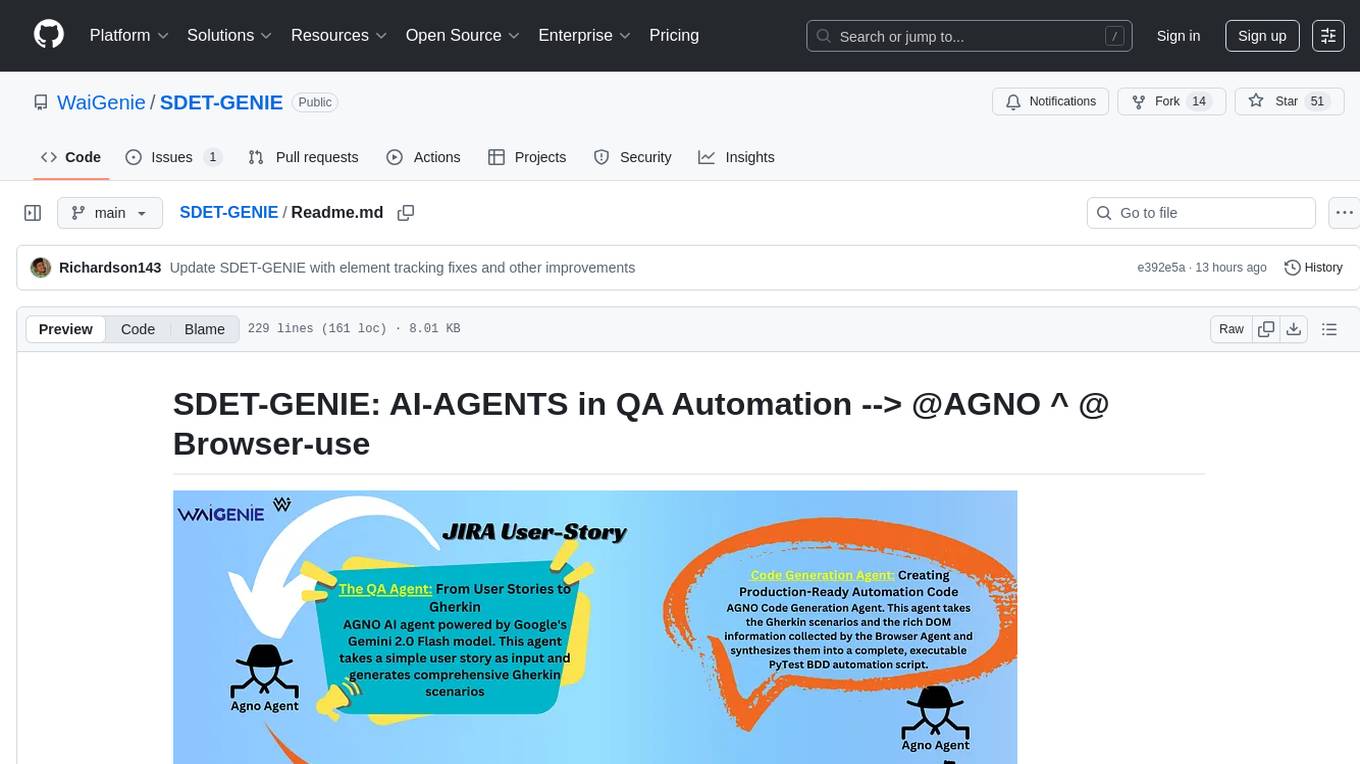
SDET-GENIE
SDET-GENIE is a cutting-edge, AI-powered Quality Assurance (QA) automation framework that revolutionizes the software testing process. Leveraging a suite of specialized AI agents, SDET-GENIE transforms rough user stories into comprehensive, executable test automation code through a seamless end-to-end process. The framework integrates five powerful AI agents working in sequence: User Story Enhancement Agent, Manual Test Case Agent, Gherkin Scenario Agent, Browser Agent, and Code Generation Agent. It supports multiple testing frameworks and provides advanced browser automation capabilities with AI features.
RAG_Techniques
Advanced RAG Techniques is a comprehensive collection of cutting-edge Retrieval-Augmented Generation (RAG) tutorials aimed at enhancing the accuracy, efficiency, and contextual richness of RAG systems. The repository serves as a hub for state-of-the-art RAG enhancements, comprehensive documentation, practical implementation guidelines, and regular updates with the latest advancements. It covers a wide range of techniques from foundational RAG methods to advanced retrieval methods, iterative and adaptive techniques, evaluation processes, explainability and transparency features, and advanced architectures integrating knowledge graphs and recursive processing.
Auto-Analyst
Auto-Analyst is an AI-driven data analytics agentic system designed to simplify and enhance the data science process. By integrating various specialized AI agents, this tool aims to make complex data analysis tasks more accessible and efficient for data analysts and scientists. Auto-Analyst provides a streamlined approach to data preprocessing, statistical analysis, machine learning, and visualization, all within an interactive Streamlit interface. It offers plug and play Streamlit UI, agents with data science speciality, complete automation, LLM agnostic operation, and is built using lightweight frameworks.
ai2-kit
A toolkit for computational chemistry research, featuring tools to facilitate automated workflows. Includes tools for NMR prediction, dynamic catalysis research, proton transfer analysis, amorphous oxides structure analysis, reweighting, and more. Users can install 'ai2-kit' via pip and explore various domain-specific and general tools for processing system data and filtering structures by model deviation.
NotHotDog
NotHotDog is an open-source platform for testing, evaluating, and simulating AI agents. It offers a robust framework for generating test cases, running conversational scenarios, and analyzing agent performance.
Controllable-RAG-Agent
This repository contains a sophisticated deterministic graph-based solution for answering complex questions using a controllable autonomous agent. The solution is designed to ensure that answers are solely based on the provided data, avoiding hallucinations. It involves various steps such as PDF loading, text preprocessing, summarization, database creation, encoding, and utilizing large language models. The algorithm follows a detailed workflow involving planning, retrieval, answering, replanning, content distillation, and performance evaluation. Heuristics and techniques implemented focus on content encoding, anonymizing questions, task breakdown, content distillation, chain of thought answering, verification, and model performance evaluation.
awsome_kali_MCPServers
awsome-kali-MCPServers is a repository containing Model Context Protocol (MCP) servers tailored for Kali Linux environments. It aims to optimize reverse engineering, security testing, and automation tasks by incorporating powerful tools and flexible features. The collection includes network analysis tools, support for binary understanding, and automation scripts to streamline repetitive tasks. The repository is continuously evolving with new features and integrations based on the FastMCP framework, such as network scanning, symbol analysis, binary analysis, string extraction, network traffic analysis, and sandbox support using Docker containers.
cline-based-code-generator
HAI Code Generator is a cutting-edge tool designed to simplify and automate task execution while enhancing code generation workflows. Leveraging Specif AI, it streamlines processes like task execution, file identification, and code documentation through intelligent automation and AI-driven capabilities. Built on Cline's powerful foundation for AI-assisted development, HAI Code Generator boosts productivity and precision by automating task execution and integrating file management capabilities. It combines intelligent file indexing, context generation, and LLM-driven automation to minimize manual effort and ensure task accuracy. Perfect for developers and teams aiming to enhance their workflows.
lector
Lector is a text analysis tool that helps users extract insights from unstructured text data. It provides functionalities such as sentiment analysis, keyword extraction, entity recognition, and text summarization. With Lector, users can easily analyze large volumes of text data to uncover patterns, trends, and valuable information. The tool is designed to be user-friendly and efficient, making it suitable for both beginners and experienced users in the field of natural language processing and text mining.
cosdata
Cosdata is a cutting-edge AI data platform designed to power the next generation search pipelines. It features immutability, version control, and excels in semantic search, structured knowledge graphs, hybrid search capabilities, real-time search at scale, and ML pipeline integration. The platform is customizable, scalable, efficient, enterprise-grade, easy to use, and can manage multi-modal data. It offers high performance, indexing, low latency, and high requests per second. Cosdata is designed to meet the demands of modern search applications, empowering businesses to harness the full potential of their data.
Upsonic
Upsonic offers a cutting-edge enterprise-ready framework for orchestrating LLM calls, agents, and computer use to complete tasks cost-effectively. It provides reliable systems, scalability, and a task-oriented structure for real-world cases. Key features include production-ready scalability, task-centric design, MCP server support, tool-calling server, computer use integration, and easy addition of custom tools. The framework supports client-server architecture and allows seamless deployment on AWS, GCP, or locally using Docker.
For similar tasks
Advanced-GPTs
Nerority's Advanced GPT Suite is a collection of 33 GPTs that can be controlled with natural language prompts. The suite includes tools for various tasks such as strategic consulting, business analysis, career profile building, content creation, educational purposes, image-based tasks, knowledge engineering, marketing, persona creation, programming, prompt engineering, role-playing, simulations, and task management. Users can access links, usage instructions, and guides for each GPT on their respective pages. The suite is designed for public demonstration and usage, offering features like meta-sequence optimization, AI priming, prompt classification, and optimization. It also provides tools for generating articles, analyzing contracts, visualizing data, distilling knowledge, creating educational content, exploring topics, generating marketing copy, simulating scenarios, managing tasks, and more.
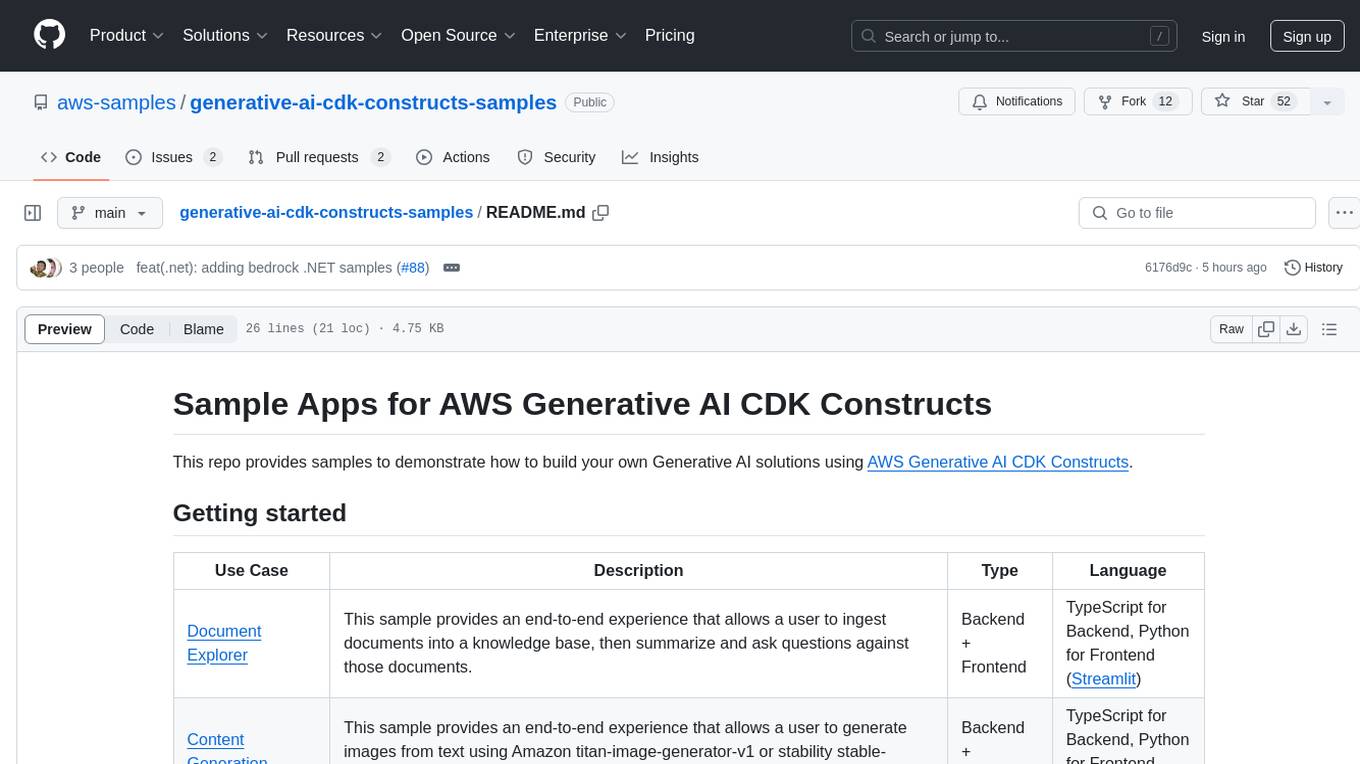
generative-ai-cdk-constructs-samples
This repository contains sample applications showcasing the use of AWS Generative AI CDK Constructs to build solutions for document exploration, content generation, image description, and deploying various models on SageMaker. It also includes samples for deploying Amazon Bedrock Agents and automating contract compliance analysis. The samples cover a range of backend and frontend technologies such as TypeScript, Python, and React.
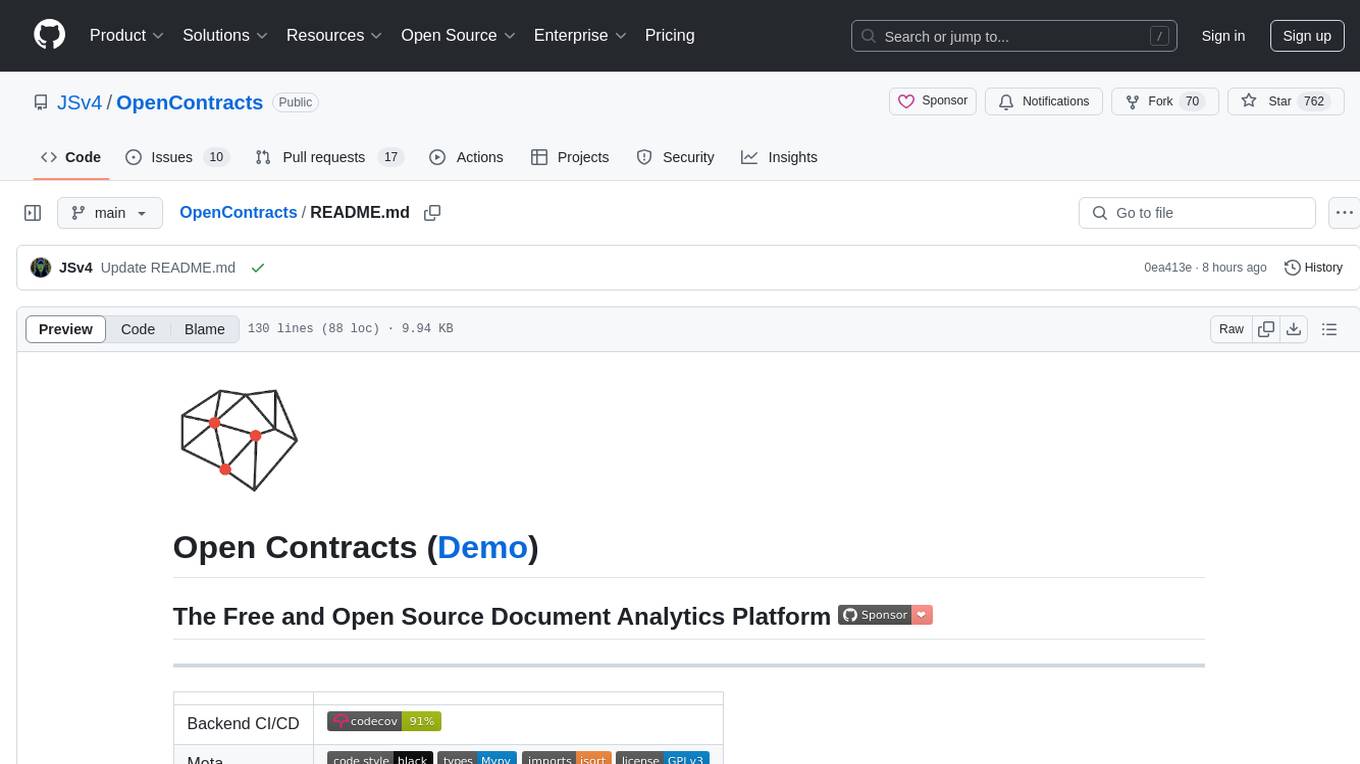
OpenContracts
OpenContracts is an Apache-2 licensed enterprise document analytics tool that supports multiple formats, including PDF and txt-based formats. It features multiple document ingestion pipelines with a pluggable architecture for easy format and ingestion engine support. Users can create custom document analytics tools with beautiful result displays, support mass document data extraction with a LlamaIndex wrapper, and manage document collections, layout parsing, automatic vector embeddings, and human annotation. The tool also offers pluggable parsing pipelines, human annotation interface, LlamaIndex integration, data extraction capabilities, and custom data extract pipelines for bulk document querying.
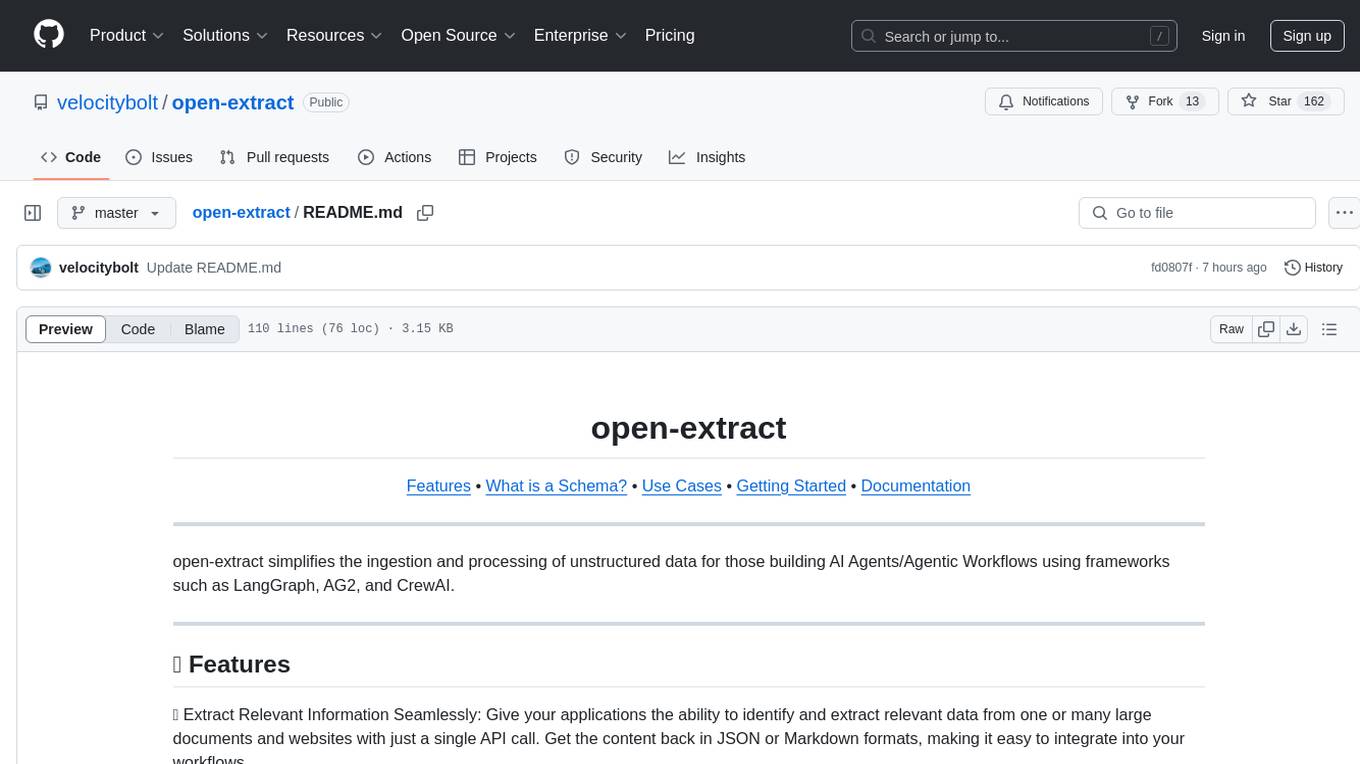
open-extract
open-extract simplifies the ingestion and processing of unstructured data for those building AI Agents/Agentic Workflows using frameworks such as LangGraph, AG2, and CrewAI. It allows applications to identify and extract relevant data from large documents and websites with a single API call, supporting multi-schema/multi-document extraction without vendor lock-in. The tool includes built-in caching for rapid repeat extractions, providing flexibility in model provider choice.
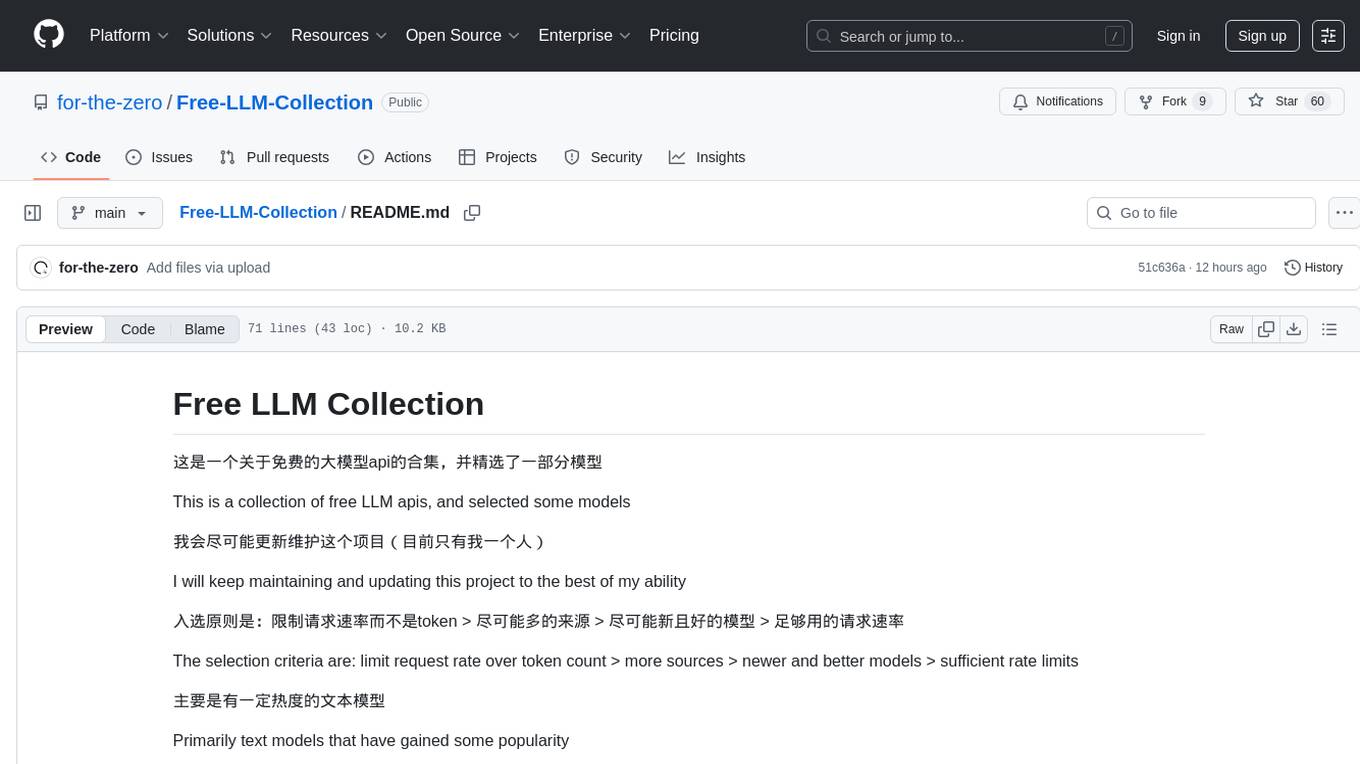
Free-LLM-Collection
Free-LLM-Collection is a curated list of free resources for mastering the Legal Language Model (LLM) technology. It includes datasets, research papers, tutorials, and tools to help individuals learn and work with LLM models. The repository aims to provide a comprehensive collection of materials to support researchers, developers, and enthusiasts interested in exploring and leveraging LLM technology for various applications in the legal domain.
ragna
Ragna is a RAG orchestration framework designed for managing workflows and orchestrating tasks. It provides a comprehensive set of features for users to streamline their processes and automate repetitive tasks. With Ragna, users can easily create, schedule, and monitor workflows, making it an ideal tool for teams and individuals looking to improve their productivity and efficiency. The framework offers extensive documentation, community support, and a user-friendly interface, making it accessible to users of all skill levels. Whether you are a developer, data scientist, or project manager, Ragna can help you simplify your workflow management and boost your overall performance.
tegon
Tegon is an open-source AI-First issue tracking tool designed for engineering teams. It aims to simplify task management by leveraging AI and integrations to automate task creation, prioritize tasks, and enhance bug resolution. Tegon offers features like issues tracking, automatic title generation, AI-generated labels and assignees, custom views, and upcoming features like sprints and task prioritization. It integrates with GitHub, Slack, and Sentry to streamline issue tracking processes. Tegon also plans to introduce AI Agents like PR Agent and Bug Agent to enhance product management and bug resolution. Contributions are welcome, and the product is licensed under the MIT License.
aioclock
An asyncio-based scheduling framework designed for execution of periodic tasks with integrated support for dependency injection, enabling efficient and flexible task management. Aioclock is 100% async, light, fast, and resource-friendly. It offers features like task scheduling, grouping, trigger definition, easy syntax, Pydantic v2 validation, and upcoming support for running the task dispatcher on a different process and backend support for horizontal scaling.
For similar jobs
promptflow
**Prompt flow** is a suite of development tools designed to streamline the end-to-end development cycle of LLM-based AI applications, from ideation, prototyping, testing, evaluation to production deployment and monitoring. It makes prompt engineering much easier and enables you to build LLM apps with production quality.
deepeval
DeepEval is a simple-to-use, open-source LLM evaluation framework specialized for unit testing LLM outputs. It incorporates various metrics such as G-Eval, hallucination, answer relevancy, RAGAS, etc., and runs locally on your machine for evaluation. It provides a wide range of ready-to-use evaluation metrics, allows for creating custom metrics, integrates with any CI/CD environment, and enables benchmarking LLMs on popular benchmarks. DeepEval is designed for evaluating RAG and fine-tuning applications, helping users optimize hyperparameters, prevent prompt drifting, and transition from OpenAI to hosting their own Llama2 with confidence.
MegaDetector
MegaDetector is an AI model that identifies animals, people, and vehicles in camera trap images (which also makes it useful for eliminating blank images). This model is trained on several million images from a variety of ecosystems. MegaDetector is just one of many tools that aims to make conservation biologists more efficient with AI. If you want to learn about other ways to use AI to accelerate camera trap workflows, check out our of the field, affectionately titled "Everything I know about machine learning and camera traps".
leapfrogai
LeapfrogAI is a self-hosted AI platform designed to be deployed in air-gapped resource-constrained environments. It brings sophisticated AI solutions to these environments by hosting all the necessary components of an AI stack, including vector databases, model backends, API, and UI. LeapfrogAI's API closely matches that of OpenAI, allowing tools built for OpenAI/ChatGPT to function seamlessly with a LeapfrogAI backend. It provides several backends for various use cases, including llama-cpp-python, whisper, text-embeddings, and vllm. LeapfrogAI leverages Chainguard's apko to harden base python images, ensuring the latest supported Python versions are used by the other components of the stack. The LeapfrogAI SDK provides a standard set of protobuffs and python utilities for implementing backends and gRPC. LeapfrogAI offers UI options for common use-cases like chat, summarization, and transcription. It can be deployed and run locally via UDS and Kubernetes, built out using Zarf packages. LeapfrogAI is supported by a community of users and contributors, including Defense Unicorns, Beast Code, Chainguard, Exovera, Hypergiant, Pulze, SOSi, United States Navy, United States Air Force, and United States Space Force.
llava-docker
This Docker image for LLaVA (Large Language and Vision Assistant) provides a convenient way to run LLaVA locally or on RunPod. LLaVA is a powerful AI tool that combines natural language processing and computer vision capabilities. With this Docker image, you can easily access LLaVA's functionalities for various tasks, including image captioning, visual question answering, text summarization, and more. The image comes pre-installed with LLaVA v1.2.0, Torch 2.1.2, xformers 0.0.23.post1, and other necessary dependencies. You can customize the model used by setting the MODEL environment variable. The image also includes a Jupyter Lab environment for interactive development and exploration. Overall, this Docker image offers a comprehensive and user-friendly platform for leveraging LLaVA's capabilities.

carrot
The 'carrot' repository on GitHub provides a list of free and user-friendly ChatGPT mirror sites for easy access. The repository includes sponsored sites offering various GPT models and services. Users can find and share sites, report errors, and access stable and recommended sites for ChatGPT usage. The repository also includes a detailed list of ChatGPT sites, their features, and accessibility options, making it a valuable resource for ChatGPT users seeking free and unlimited GPT services.
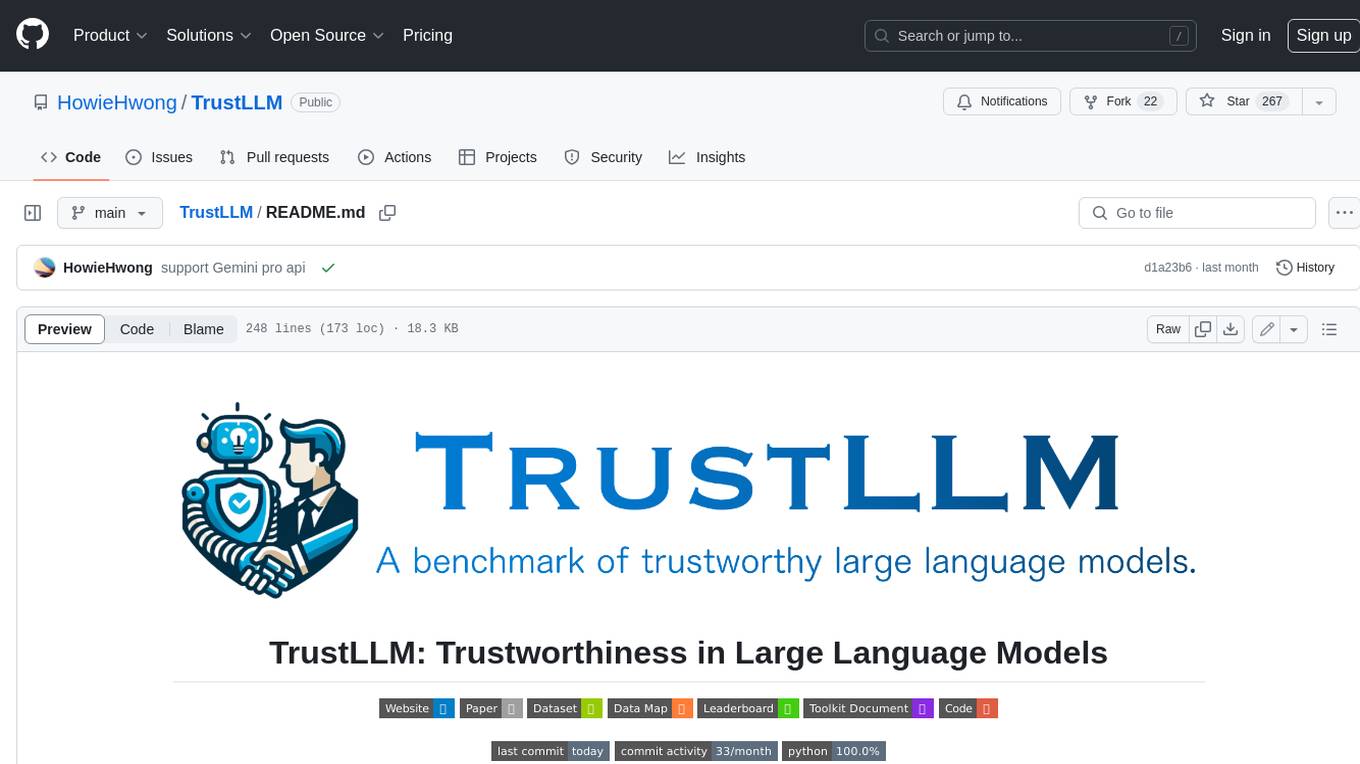
TrustLLM
TrustLLM is a comprehensive study of trustworthiness in LLMs, including principles for different dimensions of trustworthiness, established benchmark, evaluation, and analysis of trustworthiness for mainstream LLMs, and discussion of open challenges and future directions. Specifically, we first propose a set of principles for trustworthy LLMs that span eight different dimensions. Based on these principles, we further establish a benchmark across six dimensions including truthfulness, safety, fairness, robustness, privacy, and machine ethics. We then present a study evaluating 16 mainstream LLMs in TrustLLM, consisting of over 30 datasets. The document explains how to use the trustllm python package to help you assess the performance of your LLM in trustworthiness more quickly. For more details about TrustLLM, please refer to project website.
AI-YinMei
AI-YinMei is an AI virtual anchor Vtuber development tool (N card version). It supports fastgpt knowledge base chat dialogue, a complete set of solutions for LLM large language models: [fastgpt] + [one-api] + [Xinference], supports docking bilibili live broadcast barrage reply and entering live broadcast welcome speech, supports Microsoft edge-tts speech synthesis, supports Bert-VITS2 speech synthesis, supports GPT-SoVITS speech synthesis, supports expression control Vtuber Studio, supports painting stable-diffusion-webui output OBS live broadcast room, supports painting picture pornography public-NSFW-y-distinguish, supports search and image search service duckduckgo (requires magic Internet access), supports image search service Baidu image search (no magic Internet access), supports AI reply chat box [html plug-in], supports AI singing Auto-Convert-Music, supports playlist [html plug-in], supports dancing function, supports expression video playback, supports head touching action, supports gift smashing action, supports singing automatic start dancing function, chat and singing automatic cycle swing action, supports multi scene switching, background music switching, day and night automatic switching scene, supports open singing and painting, let AI automatically judge the content.