


detour
On-board AI agents autonomously saving satellites from orbital debris @ treehacks 2026
Stars: 139
Detour is an autonomous collision-avoidance system designed to run on-board satellites using NVIDIA's Nemotron LLM on the ASUS Ascent GX10. It utilizes a multi-agent LangGraph pipeline to detect debris threats, assess risk, plan maneuvers, validate safety constraints, and execute avoidance burns locally with zero ground-station latency. The system consists of key components such as Agent Pipeline, Physics Engine, Satellite Model, Tool Wrappers, API, Frontend, and Ascent GX10 Setup. The tool aims to provide fast and autonomous decision-making capabilities to prevent collisions in Low Earth Orbit (LEO) by leveraging edge AI technology.
README:
TreeHacks 2026 | NVIDIA Edge AI Track — Honourable Mention Winner
Devpost https://devpost.com/software/detour-64kpds?ref_content=user-portfolio&ref_feature=in_progress
Detour is an autonomous collision-avoidance system that runs on-board a satellite using NVIDIA's Nemotron LLM on the ASUS Ascent GX10 (Grace Blackwell). A multi-agent LangGraph pipeline detects debris threats, assesses risk, plans maneuvers, validates safety constraints, and executes avoidance burns — all locally with zero ground-station latency.
┌──────────────────────────────────────────────────────────────────┐
│                    ASUS Ascent GX10 (On-Board)                   │
│                                                                  │
│  ┌─────────┐  ┌──────────┐  ┌──────────┐  ┌────────┐  ┌──────┐ │
│  │  SCOUT  │→ │ ANALYST  │→ │ PLANNER  │→ │ SAFETY │→ │ OPS  │ │
│  │ scan &  │  │ risk &   │  │ maneuver │  │ verify │  │BRIEF │ │
│  │ triage  │  │ refine   │  │ design   │  │& exec  │  │      │ │
│  └─────────┘  └──────────┘  └──────────┘  └────────┘  └──────┘ │
│       ↕             ↕             ↕             ↕               │
│  ┌──────────────────────────────────────────────────────────────┐   │
│  │              Physics Engine (deterministic)               │   │
│  │  screening · risk · CW dynamics · RK4 · SGP4 · Chan Pc   │   │
│  └──────────────────────────────────────────────────────────────┘   │
│       ↕                                                         │
│  ┌──────────────────────────────────────────────────────────────┐   │
│  │          Satellite Model (fuel, power, dynamics)          │   │
│  └──────────────────────────────────────────────────────────────┘   │
│       ↕                                                         │
│  ┌──────────────────────────────────────────────────────────────┐   │
│  │  Nemotron 3 Nano 30B (NVFP4) via vLLM — local inference  │   │
│  └──────────────────────────────────────────────────────────────┘   │
└──────────────────────────────────────────────────────────────────┘
| Component | Path | Description |
|---|---|---|
| Agent Pipeline | agents/ |
LangGraph 5-agent pipeline with tool-calling |
| Physics Engine | engine/ |
RK4 solver, J2 perturbation, CW dynamics, Chan collision probability |
| Satellite Model | engine/models/active_satellite.py |
Full orbital dynamics with resource management (fuel, power, battery) |
| Tool Wrappers | agents/tools.py |
11 LangChain tools wrapping the physics engine |
| API | api/ |
FastAPI server with agent, catalog, conjunction, and satellite endpoints |
| Frontend | frontend/ |
Next.js + React Three Fiber 3D globe with live satellite tracking |
| Ascent GX10 Setup | scripts/setup_gx10.sh |
One-command setup for the ASUS Ascent GX10 |
| Agent | Role | Tools |
|---|---|---|
| Scout | Scan catalog for upcoming conjunctions, triage by severity |
scan_conjunctions, scan_demo_conjunctions
|
| Analyst | Deep risk assessment — Chan probability, high-fidelity TCA refinement |
assess_risk, refine_conjunction, propagate_orbit
|
| Planner | Design avoidance maneuvers considering satellite resources |
propose_avoidance_maneuvers, simulate_maneuver, get_satellite_status, check_maneuver_feasibility
|
| Safety | Validate constraints, approve or reject, execute approved burns |
check_maneuver_constraints, get_satellite_status, check_maneuver_feasibility, execute_maneuver_on_satellite
|
| Ops Brief | Generate human-readable summary for operators | (synthesis only) |
python -m venv .venv && source .venv/bin/activate
pip install -r requirements.txt
uvicorn api.app:app --reload --port 8000cd frontend
npm install
npm run dev # localhost:3000# Start Nemotron on the Ascent GX10
chmod +x scripts/setup_gx10.sh
./scripts/setup_gx10.sh
# Run agent pipeline
python -m agents.run "Scan for conjunction threats to satellite 25544 in the next 48 hours" --demo# Set OPENAI fallback in .env
NEMOTRON_BASE_URL=https://api.openai.com/v1
NEMOTRON_API_KEY=sk-...
NEMOTRON_MODEL=gpt-4o-mini
python -m agents.run "Scan for threats" --demonvidia/NVIDIA-Nemotron-3-Nano-30B-A3B-NVFP4 — 4-bit quantized (NVFP4) for fast edge inference on the Ascent GX10. ~15GB model weight footprint, leaving ample memory for KV cache and concurrent requests on the 128GB unified memory Grace Blackwell SoC.
Served locally via NGC vLLM container with tool-calling (--enable-auto-tool-choice --tool-call-parser hermes --enable-chunked-prefill).
| Ground Station | On-Board (Detour) |
|---|---|
| 5-15 min communication delay | < 1 sec decision |
| Limited pass windows | 24/7 monitoring |
| Single point of failure | Autonomous operation |
| Manual operator in the loop | Agent-validated decisions |
In LEO, a debris collision can happen in minutes. You can't wait for the next ground station pass.
- Justyna — Frontend, 3D Visualization, UI/UX
- Ethan — ASUS Ascent GX10 Setup, Simulation Logic
- Adit — Satellite Data Feed, Simulation Logic
- Keanu — Ascent GX10 vLLM Setup, LangChain NVIDIA Nemotron Agent System
For Tasks:
Click tags to check more tools for each tasksFor Jobs:
Alternative AI tools for detour
Similar Open Source Tools
detour
Detour is an autonomous collision-avoidance system designed to run on-board satellites using NVIDIA's Nemotron LLM on the ASUS Ascent GX10. It utilizes a multi-agent LangGraph pipeline to detect debris threats, assess risk, plan maneuvers, validate safety constraints, and execute avoidance burns locally with zero ground-station latency. The system consists of key components such as Agent Pipeline, Physics Engine, Satellite Model, Tool Wrappers, API, Frontend, and Ascent GX10 Setup. The tool aims to provide fast and autonomous decision-making capabilities to prevent collisions in Low Earth Orbit (LEO) by leveraging edge AI technology.
chronicle
Chronicle is a self-hostable AI system that captures audio/video data from OMI devices and other sources to generate memories, action items, and contextual insights about conversations and daily interactions. It includes a mobile app for OMI devices, backend services with AI features, a web dashboard for conversation and memory management, and optional services like speaker recognition and offline ASR. The project aims to provide a system that records personal spoken context and visual context to generate memories, action items, and enable home automation.
bumpgen
bumpgen is a tool designed to automatically upgrade TypeScript / TSX dependencies and make necessary code changes to handle any breaking issues that may arise. It uses an abstract syntax tree to analyze code relationships, type definitions for external methods, and a plan graph DAG to execute changes in the correct order. The tool is currently limited to TypeScript and TSX but plans to support other strongly typed languages in the future. It aims to simplify the process of upgrading dependencies and handling code changes caused by updates.
visual-reasoning-playground
AI-powered visual reasoning tools for broadcast, live streaming, and ProAV professionals. The Visual Reasoning Playground provides 17 ready-to-use tools demonstrating real-world applications of Vision Language Models (VLMs) using Moondream. From PTZ camera auto-tracking to multimodal audio+video automation, the tools offer functionalities like scene description, object detection, gesture control, smart counting, scene analysis, zone monitoring, color matching, multimodal fusion, smart photography, PTZ tracking, tracking comparison, scoreboard extraction, scoreboard OCR, framing assistance, PTZ color tuning, multimodal studio automation, voice triggers, and OBS plugin integration. The tools are designed to streamline tasks in live streaming, broadcast automation, camera control, content creation workflows, security monitoring, and more.
aio-coding-hub
AIO Coding Hub is a local AI CLI unified gateway that allows requests from Claude Code, Codex, and Gemini CLI to go through a single entry point. It solves the pain points of configuring base URLs and API keys for each CLI, provides intelligent failover in case of upstream instability, offers full observability with trace tracking and usage statistics, enables easy switching of providers with a single toggle, and ensures security and privacy through local data storage and encrypted API keys. The tool features a unified gateway proxy supporting multiple CLI tools, intelligent routing and fault tolerance, observability with request tracing and usage statistics, channel validation with multi-dimensional templates, and security and privacy measures like local data storage and encrypted API keys.
Zen-Ai-Pentest
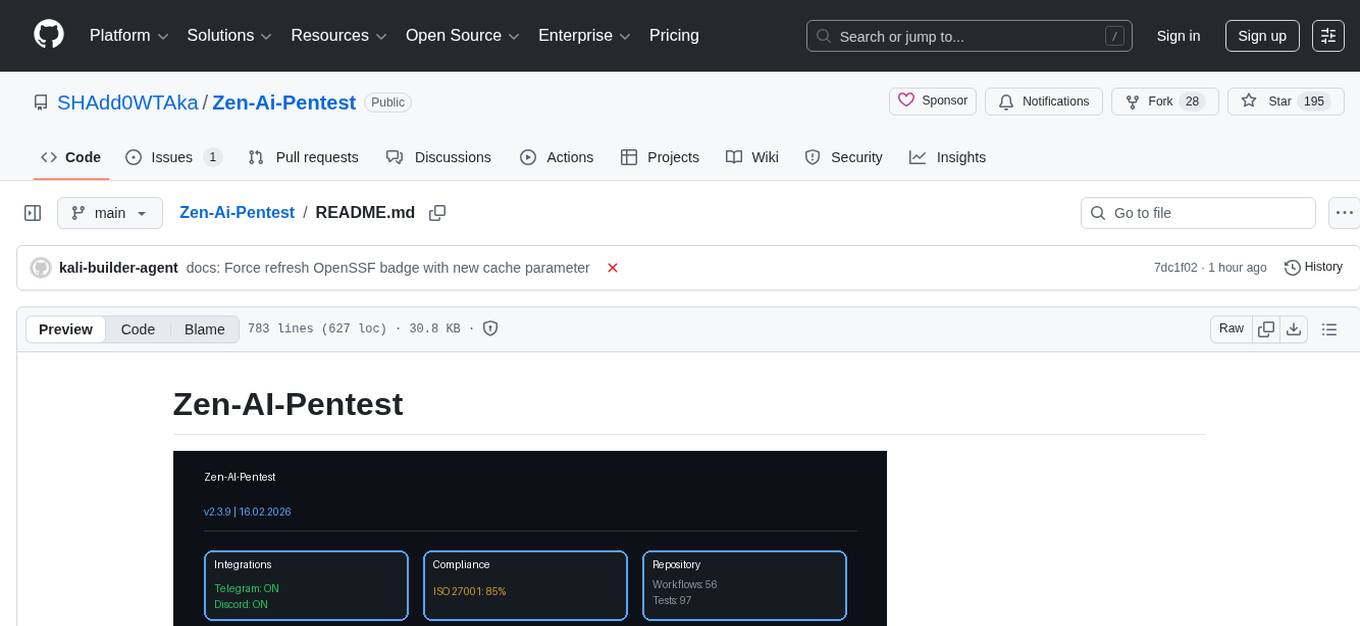
Zen-AI-Pentest is a professional AI-powered penetration testing framework designed for security professionals, bug bounty hunters, and enterprise security teams. It combines cutting-edge language models with 20+ integrated security tools, offering comprehensive security assessments. The framework is security-first with multiple safety controls, extensible with a plugin system, cloud-native for deployment on AWS, Azure, or GCP, and production-ready with CI/CD, monitoring, and support. It features autonomous AI agents, risk analysis, exploit validation, benchmarking, CI/CD integration, AI persona system, subdomain scanning, and multi-cloud & virtualization support.
observers
Observers is a lightweight library for AI observability that provides support for various generative AI APIs and storage backends. It allows users to track interactions with AI models and sync observations to different storage systems. The library supports OpenAI, Hugging Face transformers, AISuite, Litellm, and Docling for document parsing and export. Users can configure different stores such as Hugging Face Datasets, DuckDB, Argilla, and OpenTelemetry to manage and query their observations. Observers is designed to enhance AI model monitoring and observability in a user-friendly manner.
Agentic-ADK
Agentic ADK is an Agent application development framework launched by Alibaba International AI Business, based on Google-ADK and Ali-LangEngine. It is used for developing, constructing, evaluating, and deploying powerful, flexible, and controllable complex AI Agents. ADK aims to make Agent development simpler and more user-friendly, enabling developers to more easily build, deploy, and orchestrate various Agent applications ranging from simple tasks to complex collaborations.
auto-paper-digest
Auto Paper Digest (APD) is a tool designed to automatically fetch cutting-edge AI research papers, download PDFs, generate video explanations, and publish them on platforms like HuggingFace, Douyin, and portal websites. It provides functionalities such as fetching papers from Hugging Face, downloading PDFs from arXiv, generating videos using NotebookLM, automatic publishing to HuggingFace Dataset, automatic publishing to Douyin, and hosting videos on a Gradio portal website. The tool also supports resuming interrupted tasks, persistent login states for Google and Douyin, and a structured workflow divided into three phases: Upload, Download, and Publish.
kweaver
KWeaver is an open-source ecosystem for building, deploying, and running decision intelligence AI applications. It adopts ontology as the core methodology for business knowledge networks, with DIP as the core platform, aiming to provide elastic, agile, and reliable enterprise-grade decision intelligence to further unleash productivity. The DIP platform includes key subsystems such as ADP, Decision Agent, DIP Studio, and AI Store.
aiohomematic
AIO Homematic (hahomematic) is a lightweight Python 3 library for controlling and monitoring HomeMatic and HomematicIP devices, with support for third-party devices/gateways. It automatically creates entities for device parameters, offers custom entity classes for complex behavior, and includes features like caching paramsets for faster restarts. Designed to integrate with Home Assistant, it requires specific firmware versions for HomematicIP devices. The public API is defined in modules like central, client, model, exceptions, and const, with example usage provided. Useful links include changelog, data point definitions, troubleshooting, and developer resources for architecture, data flow, model extension, and Home Assistant lifecycle.
lanhu-mcp
Lanhu MCP Server is a powerful Model Context Protocol (MCP) server designed for the AI programming era, perfectly supporting the Lanhu design collaboration platform. It offers features like intelligent requirement analysis, team knowledge base, UI design support, and performance optimization. The server is suitable for Cursor + Lanhu, Windsurf + Lanhu, Claude Code + Lanhu, Trae + Lanhu, and Cline + Lanhu integrations. It aims to break the isolation of AI IDEs and enable all AI assistants to share knowledge and context.
giztoy
Giztoy is a multi-language framework designed for building AI toys and intelligent applications. It provides a unified abstraction layer that spans from resource-constrained embedded systems to powerful cloud services. With features like native support for ESP32 and other MCUs, cross-platform app development, a unified build system with Bazel, an agent framework for AI agents, audio processing capabilities, support for various Large Language Models, real-time models with WebSocket streaming, secure transport protocols, and multi-language implementations in Go, Rust, Zig, and C/C++, Giztoy serves as a versatile tool for developing AI-powered applications across different platforms and devices.
huf
HUF is an AI-native engine designed to centralize intelligence and execution into a single engine, enabling AI to operate inside real business systems. It offers multi-provider AI connectivity, intelligent tools, knowledge grounding, event-driven execution, visual workflow builder, full auditability, and cost control. HUF can be used as AI infrastructure for products, internal intelligence platform, automation & orchestration engine, embedded AI layer for SaaS, and enterprise AI control plane. Core capabilities include agent system, knowledge management, trigger system, visual flow builder, and observability. The tech stack includes Frappe Framework, Python 3.10+, LiteLLM, SQLite FTS5, React 18, TypeScript, Tailwind CSS, and MariaDB.
osmedeus
Osmedeus is a security-focused declarative orchestration engine that simplifies complex workflow automation into auditable YAML definitions. It provides powerful automation capabilities without compromising infrastructure integrity and safety. With features like declarative YAML workflows, multiple runners, event-driven triggers, template engine, utility functions, REST API server, distributed execution, notifications, cloud storage, AI integration, SAST integration, language detection, and preset installations, Osmedeus offers a comprehensive solution for security automation tasks.
Autopilot-Notes
Autopilot Notes is an open-source knowledge base for systematically learning autonomous driving technology. It covers basic theory, hardware, algorithms, tools, and practical engineering practices across 10+ chapters. The repository provides daily updates on industry trends, in-depth analysis of mainstream solutions like Tesla, Baidu Apollo, and Openpilot, and hands-on content including simulation, deployment, and optimization. Contributors are welcome to submit pull requests to improve the documentation.
For similar tasks
detour
Detour is an autonomous collision-avoidance system designed to run on-board satellites using NVIDIA's Nemotron LLM on the ASUS Ascent GX10. It utilizes a multi-agent LangGraph pipeline to detect debris threats, assess risk, plan maneuvers, validate safety constraints, and execute avoidance burns locally with zero ground-station latency. The system consists of key components such as Agent Pipeline, Physics Engine, Satellite Model, Tool Wrappers, API, Frontend, and Ascent GX10 Setup. The tool aims to provide fast and autonomous decision-making capabilities to prevent collisions in Low Earth Orbit (LEO) by leveraging edge AI technology.
For similar jobs
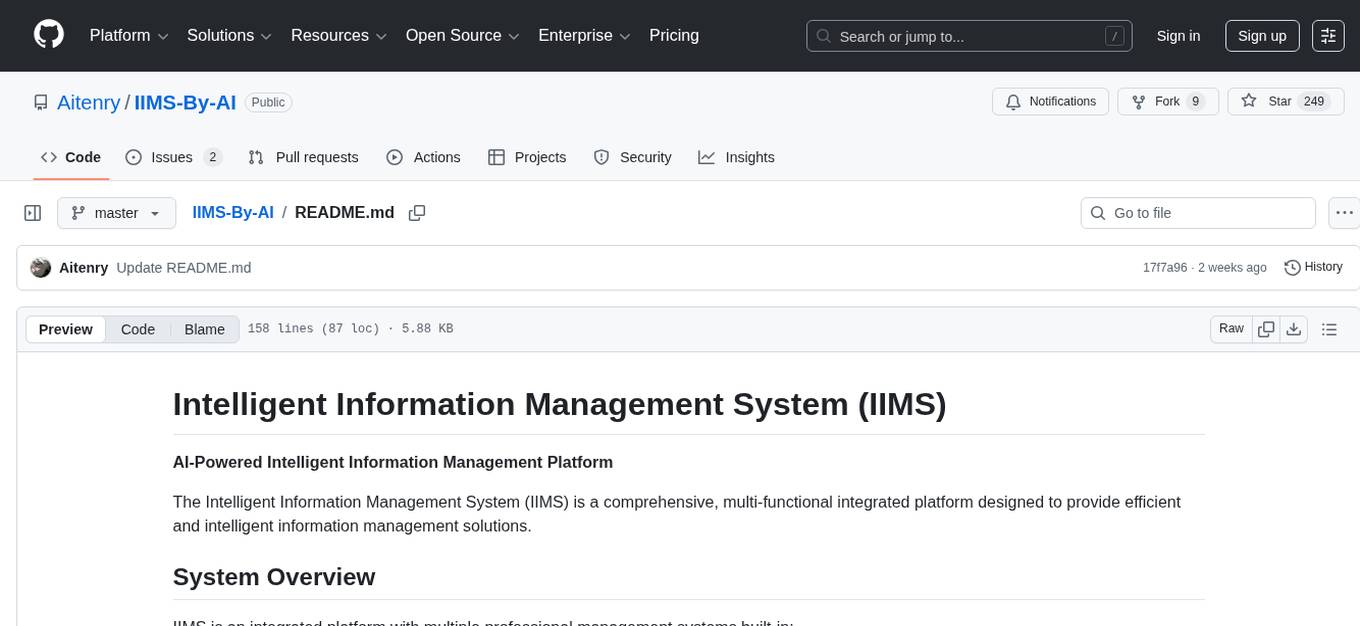
IIMS-By-AI
The Intelligent Information Management System (IIMS) is a comprehensive, multi-functional integrated platform designed to provide efficient and intelligent information management solutions. It includes core functions such as Electronic Educational Administration System (EAS) and Document Management System (DMS), with features like student record management, financial management, archive file upload, and conversation management. The system integrates AI advanced functions for conversation and knowledge base Q&A, model support for Ollama and OpenAI, and technical features like permission management, AI integration, data security, and streaming output support. Currently under active development, the system offers role-based access control, keyword extraction, and real-time response capabilities.
detour
Detour is an autonomous collision-avoidance system designed to run on-board satellites using NVIDIA's Nemotron LLM on the ASUS Ascent GX10. It utilizes a multi-agent LangGraph pipeline to detect debris threats, assess risk, plan maneuvers, validate safety constraints, and execute avoidance burns locally with zero ground-station latency. The system consists of key components such as Agent Pipeline, Physics Engine, Satellite Model, Tool Wrappers, API, Frontend, and Ascent GX10 Setup. The tool aims to provide fast and autonomous decision-making capabilities to prevent collisions in Low Earth Orbit (LEO) by leveraging edge AI technology.
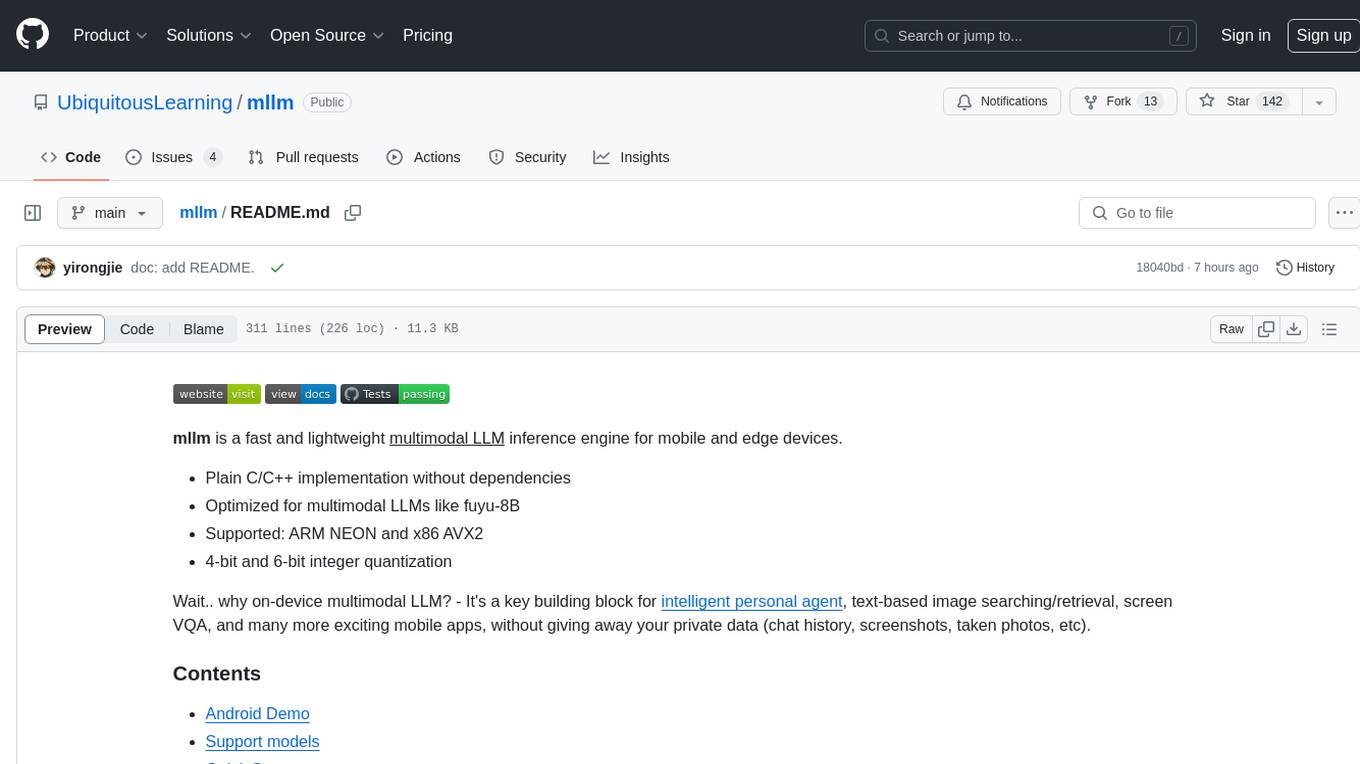
mllm
mllm is a fast and lightweight multimodal LLM inference engine for mobile and edge devices. It is a Plain C/C++ implementation without dependencies, optimized for multimodal LLMs like fuyu-8B, and supports ARM NEON and x86 AVX2. The engine offers 4-bit and 6-bit integer quantization, making it suitable for intelligent personal agents, text-based image searching/retrieval, screen VQA, and various mobile applications without compromising user privacy.
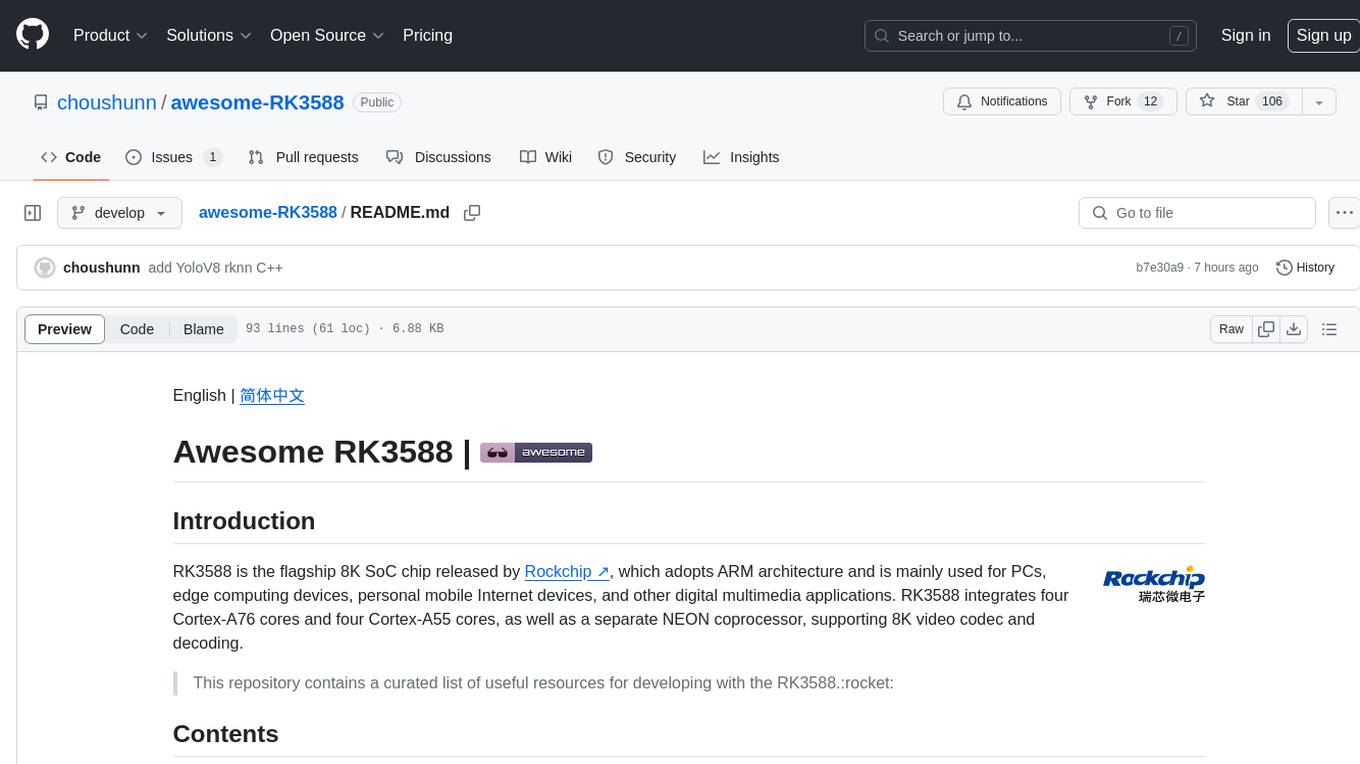
awesome-RK3588
RK3588 is a flagship 8K SoC chip by Rockchip, integrating Cortex-A76 and Cortex-A55 cores with NEON coprocessor for 8K video codec. This repository curates resources for developing with RK3588, including official resources, RKNN models, projects, development boards, documentation, tools, and sample code.
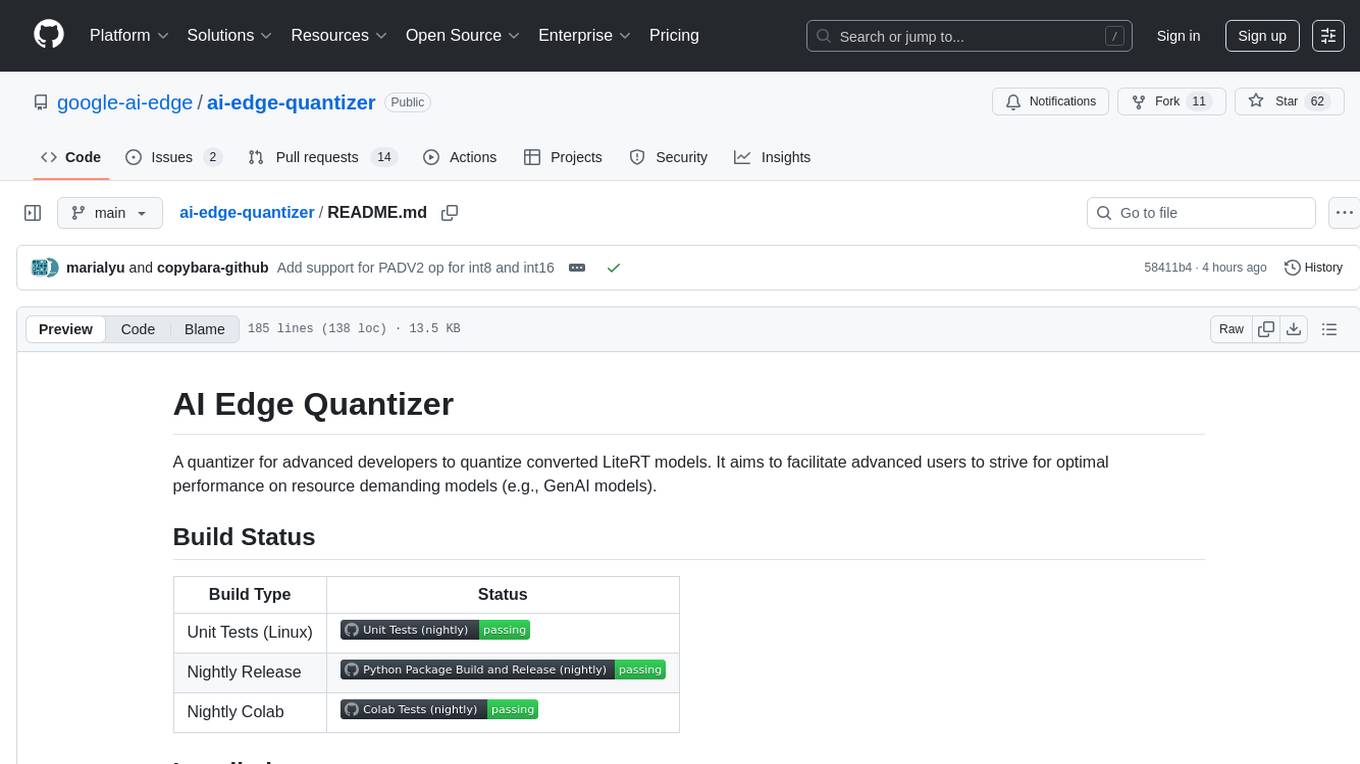
ai-edge-quantizer
AI Edge Quantizer is a tool designed for advanced developers to quantize converted LiteRT models. It aims to optimize performance on resource-demanding models by providing quantization recipes for edge device deployment. The tool supports dynamic quantization, weight-only quantization, and static quantization methods, allowing users to customize the quantization process for different hardware deployments. Users can specify quantization recipes to apply to source models, resulting in quantized LiteRT models ready for deployment. The tool also includes advanced features such as selective quantization and mixed precision schemes for fine-tuning quantization recipes.
pgedge-postgres-mcp
The pgedge-postgres-mcp repository contains a set of tools and scripts for managing and monitoring PostgreSQL databases in an edge computing environment. It provides functionalities for automating database tasks, monitoring database performance, and ensuring data integrity in edge computing scenarios. The tools are designed to be lightweight and efficient, making them suitable for resource-constrained edge devices. With pgedge-postgres-mcp, users can easily deploy and manage PostgreSQL databases in edge computing environments with minimal overhead.