


claudia
Terminal-based AI chief of staff. Remembers relationships, tracks commitments, helps you think strategically. Runs on Claude Code.
Stars: 56
Claudia is a personal AI assistant that tracks relationships and commitments, helping users remember important details and connections across their network. It catches commitments, remembers context, warns before things slip, and shows the source of information. Claudia syncs memory to an Obsidian vault, ensuring data privacy by running fully locally. Users can try a demo mode with pre-populated data or install Claudia for personalized workspace creation. It is suitable for roles like consultants, executives, founders, solo professionals, and creators, offering features like client folders, deliverable tracking, leadership tools, and collaboration tracking.
README:

Catches commitments. Remembers context. Connects the dots across your network.



Try the Demo · Why Claudia · Install · How It Works
You tell ChatGPT about Sarah on Monday. By Wednesday, it's forgotten.
You make a promise in a meeting. Nobody tracks it. You promise a deliverable on Friday and lose track of it by Wednesday. You meet someone important, and three weeks later you can't remember what you talked about.
AI tools don't have memory. Claudia does.
|
Say "I'll send that by Friday" and she tracks it. On Friday morning, she reminds you. |
Mention Sarah from Acme and Claudia surfaces: last conversation, open promises, sentiment. |
Haven't talked to your best client in 3 weeks? She tells you before it's a problem. |
|
Every fact traces to its source. Ask "how do you know that?" and she shows the receipt. |
Memory syncs to an Obsidian vault as markdown notes with wikilinks. Graph view visualizes your entire network. Plain files you own forever. |
Everything runs on your machine. Your data never leaves. Delete anything, anytime. |
Demo mode creates a pre-populated installation with realistic fake data. No setup, no configuration.
npx get-claudia my-demo --demo
cd my-demo
claude
What's in the demo:
- 60 people across investor, founder, and client networks
- 15 organizations and 15 projects
- 115 memories (facts, commitments, observations)
- Overdue items and relationship warnings to explore
The demo database is isolated in ~/.claudia/demo/. Your real data is never touched.
npx get-claudia
cd claudia
claude

Say hi. She'll introduce herself, learn about you in a natural conversation, and generate a personalized workspace within a few sessions.
Requirements: Claude Code, Node.js 18+, Python 3.10+ (for memory)
Template-only install (no memory system)
npx get-claudia my-project --no-memoryInstalls only the template layer (skills, commands, rules). Claudia works using markdown files without semantic search or pattern detection. You can add the memory system later by running the installer again without --no-memory.
Upgrading from a previous version?
cd your-claudia-directory
npx get-claudia .
This upgrades framework files while preserving your data (context/, people/, projects/).
You:     What do I know about Sarah Chen?

Claudia: Sarah Chen is CEO at Meridian Ventures. You met at SaaStr 2025.

         📊 Relationship Health: Strong (last contact 3 days ago)

         🎯 Open Commitments:
         • Send updated pitch deck to Sarah [OVERDUE - was due Friday]

         💡 Recent Context:
         • She's interested in AI infrastructure angle
         • Wants to see technical architecture doc
         • Bringing in technical partner for next meeting

         🔗 Connected to: Series A (project), Priya Sharma (introduced by)

         Source: Call notes from Jan 28, Email thread Jan 30
From here, every conversation builds on the last. She remembers.
Claudia detects your work style and generates structure that fits:
| Role | What You Get |
|---|---|
| Consultant | Client folders, deliverable tracking, pipeline commands |
| Executive | Direct reports, initiatives, board prep, leadership tools |
| Founder | Investor CRM, fundraising cycles, team and product tracking |
| Solo Professional | Flexible structure for wearing many hats |
| Creator | Audience growth, content calendar, collaboration tracking |
| Command | What It Does |
|---|---|
/morning-brief |
What needs attention today: commitments, meetings, warnings |
/new-workspace [name] |
Spin up a new project workspace from templates |
/meeting-prep [person] |
One-page briefing before a call |
/capture-meeting |
Process notes into decisions, commitments, action items |
/what-am-i-missing |
Surface risks, overdue items, cooling relationships |
/inbox-check |
Review Telegram and webhook messages |
/gateway |
Manage external message gateway |
/memory-audit |
See everything Claudia knows, with source chains |
All commands
| Command | What It Does |
|---|---|
/weekly-review |
Guided reflection across relationships and projects |
/accountability-check |
Outstanding commitments and waiting-on items |
/draft-reply |
Email response drafts in your voice |
/follow-up-draft [person] |
Post-meeting thank-you and summary |
/new-person [name] |
Create a relationship file |
/pipeline-review |
Active deals, capacity, pipeline health |
/client-health |
Status across all client relationships |
/setup-gateway |
Configure external message gateway |
/setup-telegram |
Connect Telegram bot integration |
/diagnose |
Check memory daemon health and troubleshoot |
Claudia has two layers:
Template layer (markdown) defines who she is. Skills, commands, rules, and identity files that Claude reads on startup. Workspace templates let you spin up new projects with /new-workspace [name].
Memory system (Python) defines what she remembers. SQLite + vector embeddings + three services:
| Service | What It Does |
|---|---|
| Remember | Stores facts, entities, relationships with embeddings |
| Recall | Retrieves via hybrid ranking (vector + importance + recency) |
| Consolidate | Background: decay old memories, detect patterns, track relationships |
You ──► Claude Code ──► Reads Claudia's templates ──► Becomes Claudia
                                                           │
                                                           ▼
                              Memory daemon (local) ◄── MCP tools
                                      │
                               ┌──────┴──────┐
                               ▼              ▼
              SQLite + vectors + Ollama    Obsidian vault
                   (all local)           (markdown notes)
Technical deep dive
Semantic search uses hybrid ranking: 50% vector similarity, 25% importance, 10% recency, 15% full-text. Accessing a memory boosts it (rehearsal effect).
Document storage keeps files, transcripts, emails on disk, linked to people and memories. Content-hash deduplication. Automatic lifecycle management.
Provenance chains trace any fact to its source email, transcript, or conversation.
Graph traversal connects dots across your network. Ask about one person, see related entities with top memories.
Per-project isolation keeps work memories separate from personal. Each workspace gets its own database.
Session narratives capture tone and emotional context, not just facts.
For full architecture diagrams, see ARCHITECTURE.md.
Cognitive tools (local LLM extraction)
Paste a meeting transcript. A local language model extracts structured data (entities, facts, commitments) in seconds. Claude reviews and applies judgment.
- Runs locally via Ollama, no API keys
- Models: Qwen3-4B (recommended), SmolLM3-3B, Llama 3.2-3B
- Falls back gracefully when no model installed
Four extraction modes: meeting, email, document, general.
- Fully local. Memory, embeddings, cognitive tools run on your machine. No external APIs for storage.
- No external actions without approval. Every email, calendar event, external action requires your explicit "yes."
-
Your data in two formats. SQLite database (
~/.claudia/memory/) for fast semantic search, plus plain markdown files in your Obsidian vault for reading and graph navigation. Two independent copies you own forever. - Delete anything, anytime. Full control over your data. No lock-in, no cloud dependency.
| Component | Required | Purpose |
|---|---|---|
| Claude Code | Yes | Runtime |
| Node.js 18+ | Yes | Installer |
| Python 3.10-3.13 | Recommended | Memory system |
| Ollama | Recommended | Embeddings + cognitive tools |
Without the memory system, Claudia still works using markdown files. With it, she gains semantic search, pattern detection, and relationship tracking.
Platforms: macOS, Linux, Windows
Troubleshooting
Memory tools not appearing?
~/.claudia/diagnose.sh
# Then restart Claude Code in a NEW terminal
Check daemon health:
curl http://localhost:3848/health
tail -f ~/.claudia/daemon-stderr.log
Ollama not running after reboot?
launchctl load ~/Library/LaunchAgents/com.ollama.serve.plistPull models manually:
ollama pull all-minilm:l6-v2    # Embeddings
ollama pull qwen3:4b # Cognitive tools (optional)Claudia is source-available under the PolyForm Noncommercial License.
-
Template changes:
template-v2/ -
Memory system:
memory-daemon/(tests:pytest tests/) - Architecture: ARCHITECTURE.md
- Dev guide: CLAUDE.md
PolyForm Noncommercial License 1.0.0
Free for: Personal use, research, education, nonprofits. Requires permission: Commercial use. Contact [email protected]
Created by Kamil Banc · @kamilbanc · AI Adopters Club
"I learn how you work. Let's get started."
If Claudia helps you, a ⭐ on GitHub means a lot.
For Tasks:
Click tags to check more tools for each tasksFor Jobs:
Alternative AI tools for claudia
Similar Open Source Tools
claudia
Claudia is a personal AI assistant that tracks relationships and commitments, helping users remember important details and connections across their network. It catches commitments, remembers context, warns before things slip, and shows the source of information. Claudia syncs memory to an Obsidian vault, ensuring data privacy by running fully locally. Users can try a demo mode with pre-populated data or install Claudia for personalized workspace creation. It is suitable for roles like consultants, executives, founders, solo professionals, and creators, offering features like client folders, deliverable tracking, leadership tools, and collaboration tracking.
awesome-slash
Automate the entire development workflow beyond coding. awesome-slash provides production-ready skills, agents, and commands for managing tasks, branches, reviews, CI, and deployments. It automates the entire workflow, including task exploration, planning, implementation, review, and shipping. The tool includes 11 plugins, 40 agents, 26 skills, and 26k lines of lib code, with 3,357 tests and support for 3 platforms. It works with Claude Code, OpenCode, and Codex CLI, offering specialized capabilities through skills and agents.
airunner
AI Runner is a multi-modal AI interface that allows users to run open-source large language models and AI image generators on their own hardware. The tool provides features such as voice-based chatbot conversations, text-to-speech, speech-to-text, vision-to-text, text generation with large language models, image generation capabilities, image manipulation tools, utility functions, and more. It aims to provide a stable and user-friendly experience with security updates, a new UI, and a streamlined installation process. The application is designed to run offline on users' hardware without relying on a web server, offering a smooth and responsive user experience.
mage-ai
Mage is an open-source data pipeline tool for transforming and integrating data. It offers an easy developer experience, engineering best practices built-in, and data as a first-class citizen. Mage makes it easy to build, preview, and launch data pipelines, and provides observability and scaling capabilities. It supports data integrations, streaming pipelines, and dbt integration.
superduperdb
SuperDuperDB is a Python framework for integrating AI models, APIs, and vector search engines directly with your existing databases, including hosting of your own models, streaming inference and scalable model training/fine-tuning. Build, deploy and manage any AI application without the need for complex pipelines, infrastructure as well as specialized vector databases, and moving our data there, by integrating AI at your data's source: - Generative AI, LLMs, RAG, vector search - Standard machine learning use-cases (classification, segmentation, regression, forecasting recommendation etc.) - Custom AI use-cases involving specialized models - Even the most complex applications/workflows in which different models work together SuperDuperDB is **not** a database. Think `db = superduper(db)`: SuperDuperDB transforms your databases into an intelligent platform that allows you to leverage the full AI and Python ecosystem. A single development and deployment environment for all your AI applications in one place, fully scalable and easy to manage.
holmesgpt
HolmesGPT is an AI agent designed for troubleshooting and investigating issues in cloud environments. It utilizes AI models to analyze data from various sources, identify root causes, and provide remediation suggestions. The tool offers integrations with popular cloud providers, observability tools, and on-call systems, enabling users to streamline the troubleshooting process. HolmesGPT can automate the investigation of alerts and tickets from external systems, providing insights back to the source or communication platforms like Slack. It supports end-to-end automation and offers a CLI for interacting with the AI agent. Users can customize HolmesGPT by adding custom data sources and runbooks to enhance investigation capabilities. The tool prioritizes data privacy, ensuring read-only access and respecting RBAC permissions. HolmesGPT is a CNCF Sandbox Project and is distributed under the Apache 2.0 License.
flow-like
Flow-Like is an enterprise-grade workflow operating system built upon Rust for uncompromising performance, efficiency, and code safety. It offers a modular frontend for apps, a rich set of events, a node catalog, a powerful no-code workflow IDE, and tools to manage teams, templates, and projects within organizations. With typed workflows, users can create complex, large-scale workflows with clear data origins, transformations, and contracts. Flow-Like is designed to automate any process through seamless integration of LLM, ML-based, and deterministic decision-making instances.
netdata
Netdata is an open-source, real-time infrastructure monitoring platform that provides instant insights, zero configuration deployment, ML-powered anomaly detection, efficient monitoring with minimal resource usage, and secure & distributed data storage. It offers real-time, per-second updates and clear insights at a glance. Netdata's origin story involves addressing the limitations of existing monitoring tools and led to a fundamental shift in infrastructure monitoring. It is recognized as the most energy-efficient tool for monitoring Docker-based systems according to a study by the University of Amsterdam.
EvoAgentX
EvoAgentX is an open-source framework for building, evaluating, and evolving LLM-based agents or agentic workflows in an automated, modular, and goal-driven manner. It enables developers and researchers to move beyond static prompt chaining or manual workflow orchestration by introducing a self-evolving agent ecosystem. The framework includes features such as agent workflow autoconstruction, built-in evaluation, self-evolution engine, plug-and-play compatibility, comprehensive built-in tools, memory module support, and human-in-the-loop interactions.
coreply
Coreply is an open-source Android app that provides texting suggestions while typing, enhancing the typing experience with intelligent, context-aware suggestions. It supports various texting apps and offers real-time AI suggestions, customizable LLM settings, and ensures no data collection. Users can install the app, configure it with an API key, and start receiving suggestions while typing in messaging apps. The tool supports different AI models from providers like OpenAI, Google AI Studio, Openrouter, Groq, and Codestral for chat completion and fill-in-the-middle tasks.
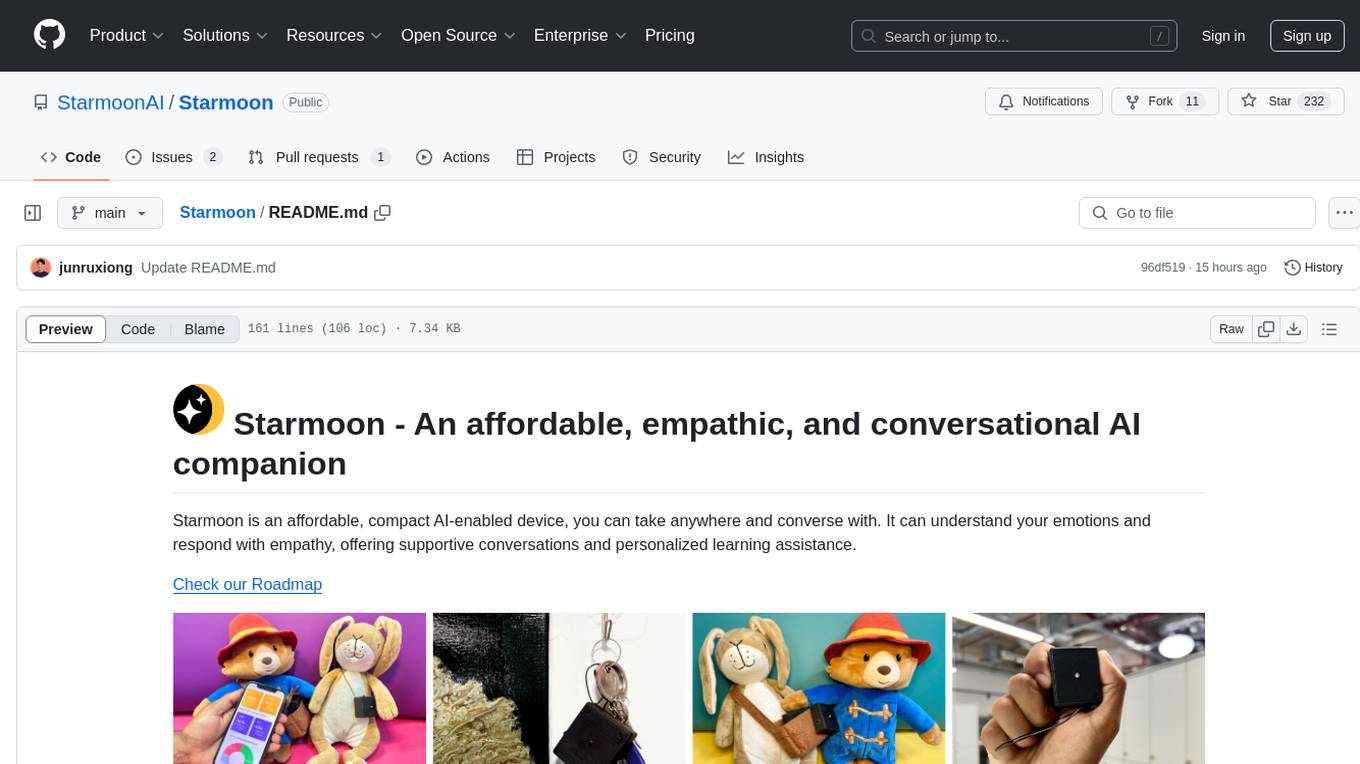
Starmoon
Starmoon is an affordable, compact AI-enabled device that can understand and respond to your emotions with empathy. It offers supportive conversations and personalized learning assistance. The device is cost-effective, voice-enabled, open-source, compact, and aims to reduce screen time. Users can assemble the device themselves using off-the-shelf components and deploy it locally for data privacy. Starmoon integrates various APIs for AI language models, speech-to-text, text-to-speech, and emotion intelligence. The hardware setup involves components like ESP32S3, microphone, amplifier, speaker, LED light, and button, along with software setup instructions for developers. The project also includes a web app, backend API, and background task dashboard for monitoring and management.
clai
Clai is a command line context-feeder for AI tasks, supporting MCP client, vendor agnosticism, conversations, rate limit circumvention, profiles, and Unix-like functionality. Users can easily combine and tweak features for diverse use cases. Supported vendors include OpenAI, Anthropic, Mistral, Deepseek, Novita AI, Ollama, and Inception. Users need API keys for model access. Installation via 'go install' or setup script. 'clai help' provides guidance on usage. Glow can be installed for formatted markdown output.
PromptX
PromptX is a leading AI agent context platform that revolutionizes interaction design, enabling AI agents to become industry experts. It offers core capabilities such as an AI role creation platform, intelligent tool development platform, and cognitive memory system. PromptX allows users to easily discover experts, summon them for assistance, and engage in professional dialogues through natural conversations. The platform's core philosophy emphasizes treating AI as a person, enabling users to communicate naturally without the need for complex commands. With Nuwa Creation Workshop, users can design custom AI roles using meta-prompt technology, transforming abstract needs into concrete executable AI expert roles in just minutes.
X-AnyLabeling
X-AnyLabeling is a robust annotation tool that seamlessly incorporates an AI inference engine alongside an array of sophisticated features. Tailored for practical applications, it is committed to delivering comprehensive, industrial-grade solutions for image data engineers. This tool excels in swiftly and automatically executing annotations across diverse and intricate tasks.
Evaluator
NeMo Evaluator SDK is an open-source platform for robust, reproducible, and scalable evaluation of Large Language Models. It enables running hundreds of benchmarks across popular evaluation harnesses against any OpenAI-compatible model API. The platform ensures auditable and trustworthy results by executing evaluations in open-source Docker containers. NeMo Evaluator SDK is built on four core principles: Reproducibility by Default, Scale Anywhere, State-of-the-Art Benchmarking, and Extensible and Customizable.
off-grid-mobile
Off Grid is a complete offline AI suite that allows users to perform various tasks such as text generation, image generation, vision AI, voice transcription, and document analysis on their mobile devices without sending any data out. The tool offers high performance on flagship devices and supports a wide range of models for different tasks. Users can easily install the tool on Android by downloading the APK from GitHub Releases or build it from source with Node.js and JDK. The documentation provides detailed information on the system architecture, codebase, design system, visual hierarchy, test flows, and more. Contributions are welcome, and the tool is built with a focus on user privacy and data security, ensuring no cloud, subscription, or data harvesting.
For similar tasks
claudia
Claudia is a personal AI assistant that tracks relationships and commitments, helping users remember important details and connections across their network. It catches commitments, remembers context, warns before things slip, and shows the source of information. Claudia syncs memory to an Obsidian vault, ensuring data privacy by running fully locally. Users can try a demo mode with pre-populated data or install Claudia for personalized workspace creation. It is suitable for roles like consultants, executives, founders, solo professionals, and creators, offering features like client folders, deliverable tracking, leadership tools, and collaboration tracking.
For similar jobs
diagram-of-thought
The Diagram of Thought is a tool designed to visualize and analyze complex thought processes. It provides a graphical representation of reasoning and decision-making, allowing users to map out their ideas and explore different paths of thinking. By using this tool, individuals can gain insights into their cognitive processes and enhance their problem-solving skills. The Diagram of Thought aims to facilitate a deeper understanding of how thoughts are interconnected and how they influence our actions and perceptions.
Smart-Connections-Visualizer
The Smart Connections Visualizer Plugin is a tool designed to enhance note-taking and information visualization by creating dynamic force-directed graphs that represent connections between notes or excerpts. Users can customize visualization settings, preview notes, and interact with the graph to explore relationships and insights within their notes. The plugin aims to revolutionize communication with AI and improve decision-making processes by visualizing complex information in a more intuitive and context-driven manner.
hyprnote
Hyprnote is a local-first AI notepad designed for people in back-to-back meetings. It listens to your meetings while you write, crafts smart summaries based on your quick notes, and runs completely offline using open-source models like Whisper or HyprLLM. With Hyprnote, users can have full control over their notes as not a single byte of data leaves their laptop/server.
md_design
Nakidka is a tool for 1C:Enterprise 8 that allows for quick creation of forms based on text descriptions. It uses a simple and understandable syntax similar to Markdown, and also supports visual design of interface elements.
PlanExe
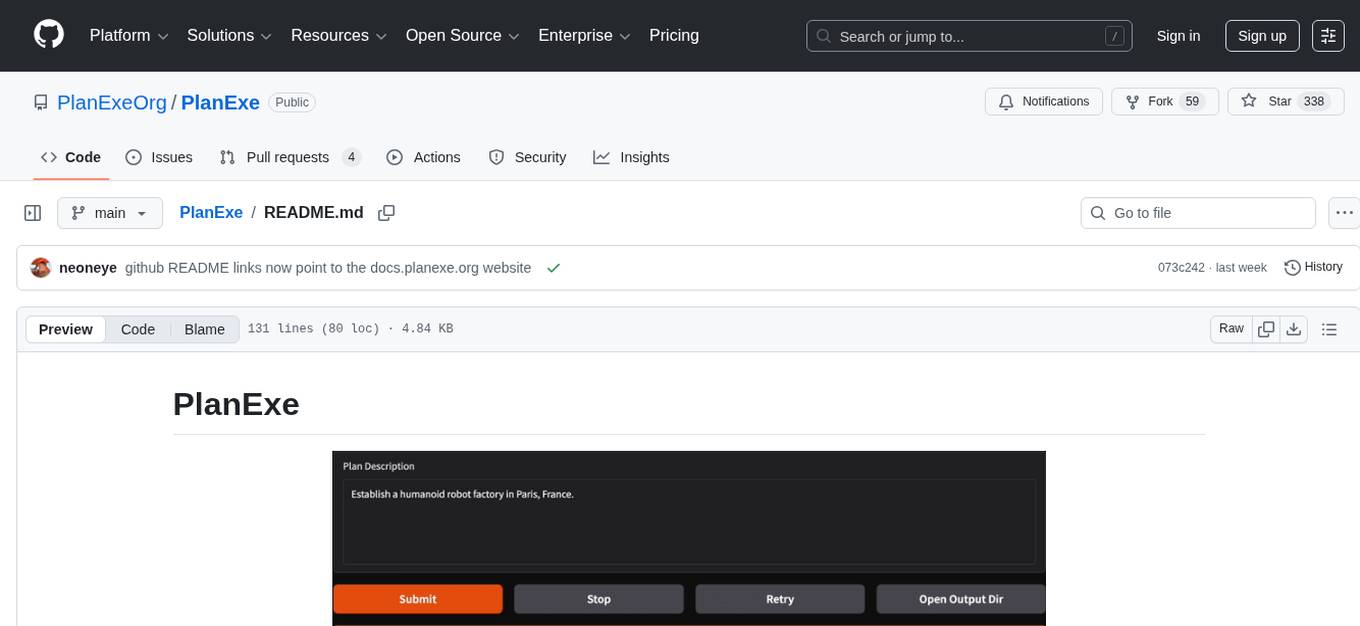
PlanExe is an open-source tool that turns a single plain-english goal statement into a 40-page strategic plan in approximately 15 minutes using local or cloud models. It accelerates the creation of outlines, providing outputs such as executive summaries, Gantt charts, governance structures, role descriptions, stakeholder maps, risk registers, and SWOT analyses. While the tool significantly reduces the labor required for planning scaffolds, the final refinement to create a polished, client-ready document still necessitates human intervention. PlanExe's technical quality in terms of structure, formatting, and coherence is often superior to human junior/mid-tier consulting drafts, but areas such as budgets, timelines, metrics, and legal/operational realism may require further human refinement for high-stakes topics.
char
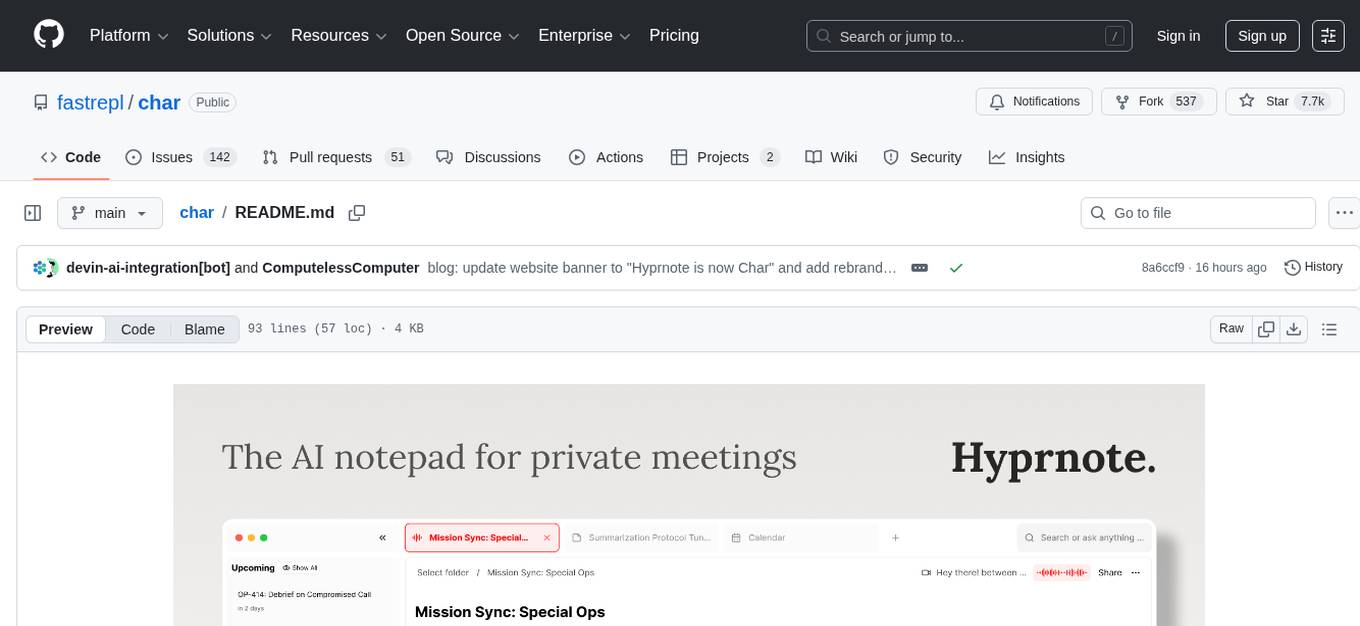
Char is an AI notetaking app designed for private meetings. It listens to meetings, crafts summaries, and can be used offline. Char captures details in real-time, offers customizable note templates, supports local language models, and integrates with various tools. It is suitable for taking notes during meetings, lectures, or organizing thoughts.
claudia
Claudia is a personal AI assistant that tracks relationships and commitments, helping users remember important details and connections across their network. It catches commitments, remembers context, warns before things slip, and shows the source of information. Claudia syncs memory to an Obsidian vault, ensuring data privacy by running fully locally. Users can try a demo mode with pre-populated data or install Claudia for personalized workspace creation. It is suitable for roles like consultants, executives, founders, solo professionals, and creators, offering features like client folders, deliverable tracking, leadership tools, and collaboration tracking.
OpenOutreach
OpenOutreach is a self-hosted, open-source LinkedIn automation tool designed for B2B lead generation. It automates the entire outreach process in a stealthy, human-like way by discovering and enriching target profiles, ranking profiles using ML for smart prioritization, sending personalized connection requests, following up with custom messages after acceptance, and tracking everything in a built-in CRM with web UI. It offers features like undetectable behavior, fully customizable Python-based campaigns, local execution with CRM, easy deployment with Docker, and AI-ready templating for hyper-personalized messages.