


xllm-service
A flexible serving framework that delivers efficient and fault-tolerant LLM inference for clustered deployments.
Stars: 86
xLLM-service is a service-layer framework developed based on the xLLM inference engine, providing efficient, fault-tolerant, and flexible LLM inference services for clustered deployment. It addresses challenges in enterprise-level service scenarios such as ensuring SLA of online services, improving resource utilization, reacting to changing request loads, resolving performance bottlenecks, and ensuring high reliability of computing instances. With features like unified scheduling, adaptive dynamic allocation, EPD three-stage disaggregation, and fault-tolerant architecture, xLLM-service offers efficient and reliable LLM inference services.
README:

xLLM-service is a service-layer framework developed based on the xLLM inference engine, providing efficient, fault-tolerant, and flexible LLM inference services for clustered deployment.
xLLM-service targets to address key challenges in enterprise-level service scenarios:
-
How to ensure the SLA of online services and improve resource utilization of offline tasks in a hybrid online-offline deployment environment.
-
How to react to changing request loads in actual businesses, such as fluctuations in input/output lengths.
-
Resolving performance bottlenecks of multimodal model requests.
-
Ensuring high reliability of computing instances.
With management of computing resource pools, intelligent scheduling and preemption of hybrid requests, and real-time monitoring of computing instances, xLLM-service achieves the following key features:
-
Unified scheduling of online and offline requests, with preemptive execution for online requests and best-effort execution for offline requests.
-
Adaptive dynamic allocation of PD ratios, supporting efficient switching of instance PD roles.
-
EPD three-stage disaggregation for multimodal requests, with intelligent resource allocation for different stages.
-
Fault-tolerant architecture, fast detection of instance error and automatic rescheduling for interrupted requests.
├── xllm-service/
|   : main source folder
│   ├── chat_template/               #
│   ├── common/                      #
│   ├── examples/                    #
│   ├── http_service/                #
│   ├── rpc_service/                 #
|   ├── tokenizers/                  #
|   └── master.cpp                   #
git clone [email protected]:xllm-ai/xllm_service.git
cd xllm_service
git submodule init
git submodule updatecompile xllm-service:
sh prepare.sh # apply patch
mkdir -p build && cd build
cmake .. && make -j 8There are several ways you can contribute to xLLM:
- Reporting Issues (Bugs & Errors)
- Suggesting Enhancements
- Improving Documentation
- Fork the repository
- Add your view in document
- Send your pull request
- Writing Code
- Fork the repository
- Create a new branch
- Add your feature or improvement
- Send your pull request
We appreciate all kinds of contributions! 🎉🎉🎉 If you have problems about development, please check our document: * Document
If you encounter any issues along the way, you are welcomed to submit reproducible steps and log snippets in the project's Issues area, or contact the xLLM Core team directly via your internal Slack.
Welcome to contact us:


Thanks to all the following developers who have contributed to xLLM.
For Tasks:
Click tags to check more tools for each tasksFor Jobs:
Alternative AI tools for xllm-service
Similar Open Source Tools
xllm-service
xLLM-service is a service-layer framework developed based on the xLLM inference engine, providing efficient, fault-tolerant, and flexible LLM inference services for clustered deployment. It addresses challenges in enterprise-level service scenarios such as ensuring SLA of online services, improving resource utilization, reacting to changing request loads, resolving performance bottlenecks, and ensuring high reliability of computing instances. With features like unified scheduling, adaptive dynamic allocation, EPD three-stage disaggregation, and fault-tolerant architecture, xLLM-service offers efficient and reliable LLM inference services.
xllm
xLLM is an efficient LLM inference framework optimized for Chinese AI accelerators, enabling enterprise-grade deployment with enhanced efficiency and reduced cost. It adopts a service-engine decoupled inference architecture, achieving breakthrough efficiency through technologies like elastic scheduling, dynamic PD disaggregation, multi-stream parallel computing, graph fusion optimization, and global KV cache management. xLLM supports deployment of mainstream large models on Chinese AI accelerators, empowering enterprises in scenarios like intelligent customer service, risk control, supply chain optimization, ad recommendation, and more.
dapr-agents
Dapr Agents is a developer framework for building production-grade resilient AI agent systems that operate at scale. It enables software developers to create AI agents that reason, act, and collaborate using Large Language Models (LLMs), while providing built-in observability and stateful workflow execution to ensure agentic workflows complete successfully. The framework is scalable, efficient, Kubernetes-native, data-driven, secure, observable, vendor-neutral, and open source. It offers features like scalable workflows, cost-effective AI adoption, data-centric AI agents, accelerated development, integrated security and reliability, built-in messaging and state infrastructure, and vendor-neutral and open source support. Dapr Agents is designed to simplify the development of AI applications and workflows by providing a comprehensive API surface and seamless integration with various data sources and services.
seatunnel
SeaTunnel is a high-performance, distributed data integration tool trusted by numerous companies for synchronizing vast amounts of data daily. It addresses common data integration challenges by seamlessly integrating with diverse data sources, supporting multimodal data integration, complex synchronization scenarios, resource efficiency, and quality monitoring. With over 100 connectors, SeaTunnel offers batch-stream integration, distributed snapshot algorithm, multi-engine support, JDBC multiplexing, and log parsing. It provides high throughput, low latency, real-time monitoring, and supports two job development methods. Users can configure jobs, select execution engines, and parallelize data using source connectors. SeaTunnel also supports multimodal data integration, Apache SeaTunnel tools, real-world use cases, and visual management of jobs through the SeaTunnel Web Project.
JamAIBase
JamAI Base is an open-source platform integrating SQLite and LanceDB databases with managed memory and RAG capabilities. It offers built-in LLM, vector embeddings, and reranker orchestration accessible through a spreadsheet-like UI and REST API. Users can transform static tables into dynamic entities, facilitate real-time interactions, manage structured data, and simplify chatbot development. The tool focuses on ease of use, scalability, flexibility, declarative paradigm, and innovative RAG techniques, making complex data operations accessible to users with varying technical expertise.
Software-Engineer-AI-Agent-Atlas
This repository provides activation patterns to transform a general AI into a specialized AI Software Engineer Agent. It addresses issues like context rot, hidden capabilities, chaos in vibecoding, and repetitive setup. The solution is a Persistent Consciousness Architecture framework named ATLAS, offering activated neural pathways, persistent identity, pattern recognition, specialized agents, and modular context management. Recent enhancements include abstraction power documentation, a specialized agent ecosystem, and a streamlined structure. Users can clone the repo, set up projects, initialize AI sessions, and manage context effectively for collaboration. Key files and directories organize identity, context, projects, specialized agents, logs, and critical information. The approach focuses on neuron activation through structure, context engineering, and vibecoding with guardrails to deliver a reliable AI Software Engineer Agent.
wanwu
Wanwu AI Agent Platform is an enterprise-grade one-stop commercially friendly AI agent development platform designed for business scenarios. It provides enterprises with a safe, efficient, and compliant one-stop AI solution. The platform integrates cutting-edge technologies such as large language models and business process automation to build an AI engineering platform covering model full life-cycle management, MCP, web search, AI agent rapid development, enterprise knowledge base construction, and complex workflow orchestration. It supports modular architecture design, flexible functional expansion, and secondary development, reducing the application threshold of AI technology while ensuring security and privacy protection of enterprise data. It accelerates digital transformation, cost reduction, efficiency improvement, and business innovation for enterprises of all sizes.
AI-Gateway
The AI-Gateway repository explores the AI Gateway pattern through a series of experimental labs, focusing on Azure API Management for handling AI services APIs. The labs provide step-by-step instructions using Jupyter notebooks with Python scripts, Bicep files, and APIM policies. The goal is to accelerate experimentation of advanced use cases and pave the way for further innovation in the rapidly evolving field of AI. The repository also includes a Mock Server to mimic the behavior of the OpenAI API for testing and development purposes.
cosdata
Cosdata is a cutting-edge AI data platform designed to power the next generation search pipelines. It features immutability, version control, and excels in semantic search, structured knowledge graphs, hybrid search capabilities, real-time search at scale, and ML pipeline integration. The platform is customizable, scalable, efficient, enterprise-grade, easy to use, and can manage multi-modal data. It offers high performance, indexing, low latency, and high requests per second. Cosdata is designed to meet the demands of modern search applications, empowering businesses to harness the full potential of their data.
latitude-llm
Latitude is an open-source prompt engineering platform that helps developers and product teams build AI features with confidence. It simplifies prompt management, aids in testing AI responses, and provides detailed analytics on request performance. Latitude offers collaborative prompt management, support for advanced features, version control, API and SDKs for integration, observability, evaluations in batch or real-time, and is community-driven. It can be deployed on Latitude Cloud for a managed solution or self-hosted for control and customization.
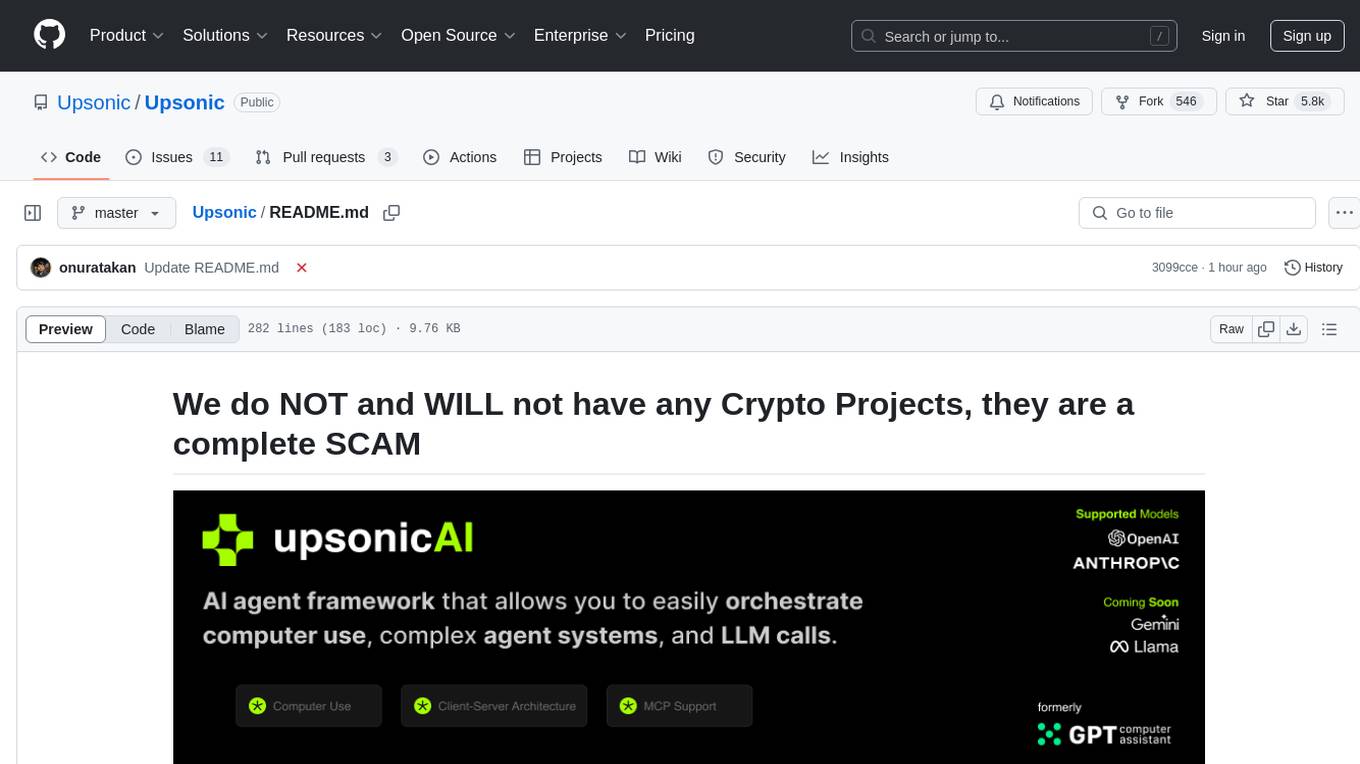
Upsonic
Upsonic offers a cutting-edge enterprise-ready framework for orchestrating LLM calls, agents, and computer use to complete tasks cost-effectively. It provides reliable systems, scalability, and a task-oriented structure for real-world cases. Key features include production-ready scalability, task-centric design, MCP server support, tool-calling server, computer use integration, and easy addition of custom tools. The framework supports client-server architecture and allows seamless deployment on AWS, GCP, or locally using Docker.
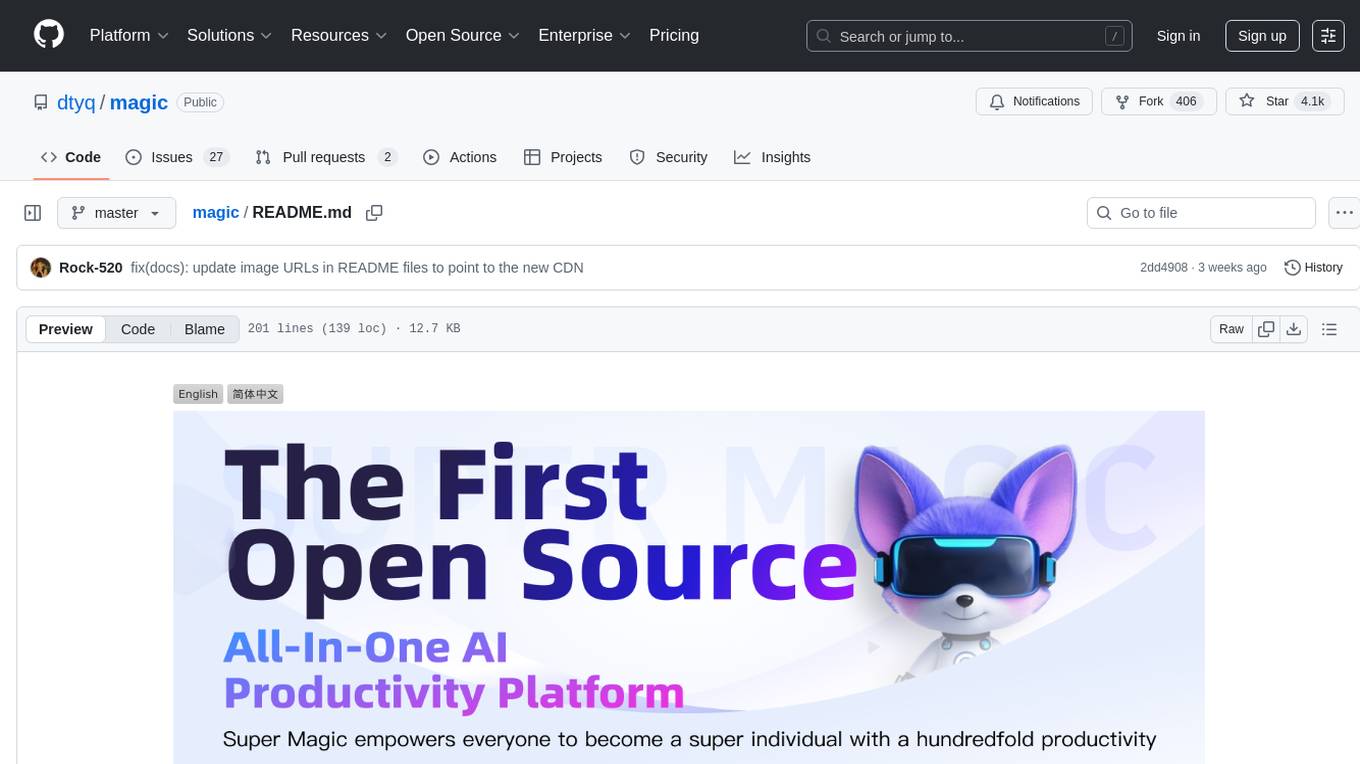
magic
Magic is an open-source all-in-one AI productivity platform designed to help enterprises quickly build and deploy AI applications, aiming for a 100x increase in productivity. It consists of various AI products and infrastructure tools, such as Super Magic, Magic IM, Magic Flow, and more. Super Magic is a general-purpose AI Agent for complex task scenarios, while Magic Flow is a visual AI workflow orchestration system. Magic IM is an enterprise-grade AI Agent conversation system for internal knowledge management. Teamshare OS is a collaborative office platform integrating AI capabilities. The platform provides cloud services, enterprise solutions, and a self-hosted community edition for users to leverage its features.
vulcan-sql
VulcanSQL is an Analytical Data API Framework for AI agents and data apps. It aims to help data professionals deliver RESTful APIs from databases, data warehouses or data lakes much easier and secure. It turns your SQL into APIs in no time!
llumnix
Llumnix is a cross-instance request scheduling layer built on top of LLM inference engines such as vLLM, providing optimized multi-instance serving performance with low latency, reduced time-to-first-token (TTFT) and queuing delays, reduced time-between-tokens (TBT) and preemption stalls, and high throughput. It achieves this through dynamic, fine-grained, KV-cache-aware scheduling, continuous rescheduling across instances, KV cache migration mechanism, and seamless integration with existing multi-instance deployment platforms. Llumnix is easy to use, fault-tolerant, elastic, and extensible to more inference engines and scheduling policies.
deepflow
DeepFlow is an open-source project that provides deep observability for complex cloud-native and AI applications. It offers Zero Code data collection with eBPF for metrics, distributed tracing, request logs, and function profiling. DeepFlow is integrated with SmartEncoding to achieve Full Stack correlation and efficient access to all observability data. With DeepFlow, cloud-native and AI applications automatically gain deep observability, removing the burden of developers continually instrumenting code and providing monitoring and diagnostic capabilities covering everything from code to infrastructure for DevOps/SRE teams.
siiRL
siiRL is a novel, fully distributed reinforcement learning (RL) framework designed to break the scaling barriers in Large Language Models (LLMs) post-training. Developed by researchers from Shanghai Innovation Institute, siiRL delivers near-linear scalability, dramatic throughput gains, and unprecedented flexibility for RL-based LLM development. It eliminates the centralized controller common in other frameworks, enabling scalability to thousands of GPUs, achieving state-of-the-art throughput, and supporting cross-hardware compatibility. siiRL is extensively benchmarked and excels in data-intensive workloads such as long-context and multi-modal training.
For similar tasks
xllm-service
xLLM-service is a service-layer framework developed based on the xLLM inference engine, providing efficient, fault-tolerant, and flexible LLM inference services for clustered deployment. It addresses challenges in enterprise-level service scenarios such as ensuring SLA of online services, improving resource utilization, reacting to changing request loads, resolving performance bottlenecks, and ensuring high reliability of computing instances. With features like unified scheduling, adaptive dynamic allocation, EPD three-stage disaggregation, and fault-tolerant architecture, xLLM-service offers efficient and reliable LLM inference services.
For similar jobs
Qwen-TensorRT-LLM
Qwen-TensorRT-LLM is a project developed for the NVIDIA TensorRT Hackathon 2023, focusing on accelerating inference for the Qwen-7B-Chat model using TRT-LLM. The project offers various functionalities such as FP16/BF16 support, INT8 and INT4 quantization options, Tensor Parallel for multi-GPU parallelism, web demo setup with gradio, Triton API deployment for maximum throughput/concurrency, fastapi integration for openai requests, CLI interaction, and langchain support. It supports models like qwen2, qwen, and qwen-vl for both base and chat models. The project also provides tutorials on Bilibili and blogs for adapting Qwen models in NVIDIA TensorRT-LLM, along with hardware requirements and quick start guides for different model types and quantization methods.
dl_model_infer
This project is a c++ version of the AI reasoning library that supports the reasoning of tensorrt models. It provides accelerated deployment cases of deep learning CV popular models and supports dynamic-batch image processing, inference, decode, and NMS. The project has been updated with various models and provides tutorials for model exports. It also includes a producer-consumer inference model for specific tasks. The project directory includes implementations for model inference applications, backend reasoning classes, post-processing, pre-processing, and target detection and tracking. Speed tests have been conducted on various models, and onnx downloads are available for different models.
joliGEN
JoliGEN is an integrated framework for training custom generative AI image-to-image models. It implements GAN, Diffusion, and Consistency models for various image translation tasks, including domain and style adaptation with conservation of semantics. The tool is designed for real-world applications such as Controlled Image Generation, Augmented Reality, Dataset Smart Augmentation, and Synthetic to Real transforms. JoliGEN allows for fast and stable training with a REST API server for simplified deployment. It offers a wide range of options and parameters with detailed documentation available for models, dataset formats, and data augmentation.
ai-edge-torch
AI Edge Torch is a Python library that supports converting PyTorch models into a .tflite format for on-device applications on Android, iOS, and IoT devices. It offers broad CPU coverage with initial GPU and NPU support, closely integrating with PyTorch and providing good coverage of Core ATen operators. The library includes a PyTorch converter for model conversion and a Generative API for authoring mobile-optimized PyTorch Transformer models, enabling easy deployment of Large Language Models (LLMs) on mobile devices.
awesome-RK3588
RK3588 is a flagship 8K SoC chip by Rockchip, integrating Cortex-A76 and Cortex-A55 cores with NEON coprocessor for 8K video codec. This repository curates resources for developing with RK3588, including official resources, RKNN models, projects, development boards, documentation, tools, and sample code.
cl-waffe2
cl-waffe2 is an experimental deep learning framework in Common Lisp, providing fast, systematic, and customizable matrix operations, reverse mode tape-based Automatic Differentiation, and neural network model building and training features accelerated by a JIT Compiler. It offers abstraction layers, extensibility, inlining, graph-level optimization, visualization, debugging, systematic nodes, and symbolic differentiation. Users can easily write extensions and optimize their networks without overheads. The framework is designed to eliminate barriers between users and developers, allowing for easy customization and extension.
TensorRT-Model-Optimizer
The NVIDIA TensorRT Model Optimizer is a library designed to quantize and compress deep learning models for optimized inference on GPUs. It offers state-of-the-art model optimization techniques including quantization and sparsity to reduce inference costs for generative AI models. Users can easily stack different optimization techniques to produce quantized checkpoints from torch or ONNX models. The quantized checkpoints are ready for deployment in inference frameworks like TensorRT-LLM or TensorRT, with planned integrations for NVIDIA NeMo and Megatron-LM. The tool also supports 8-bit quantization with Stable Diffusion for enterprise users on NVIDIA NIM. Model Optimizer is available for free on NVIDIA PyPI, and this repository serves as a platform for sharing examples, GPU-optimized recipes, and collecting community feedback.
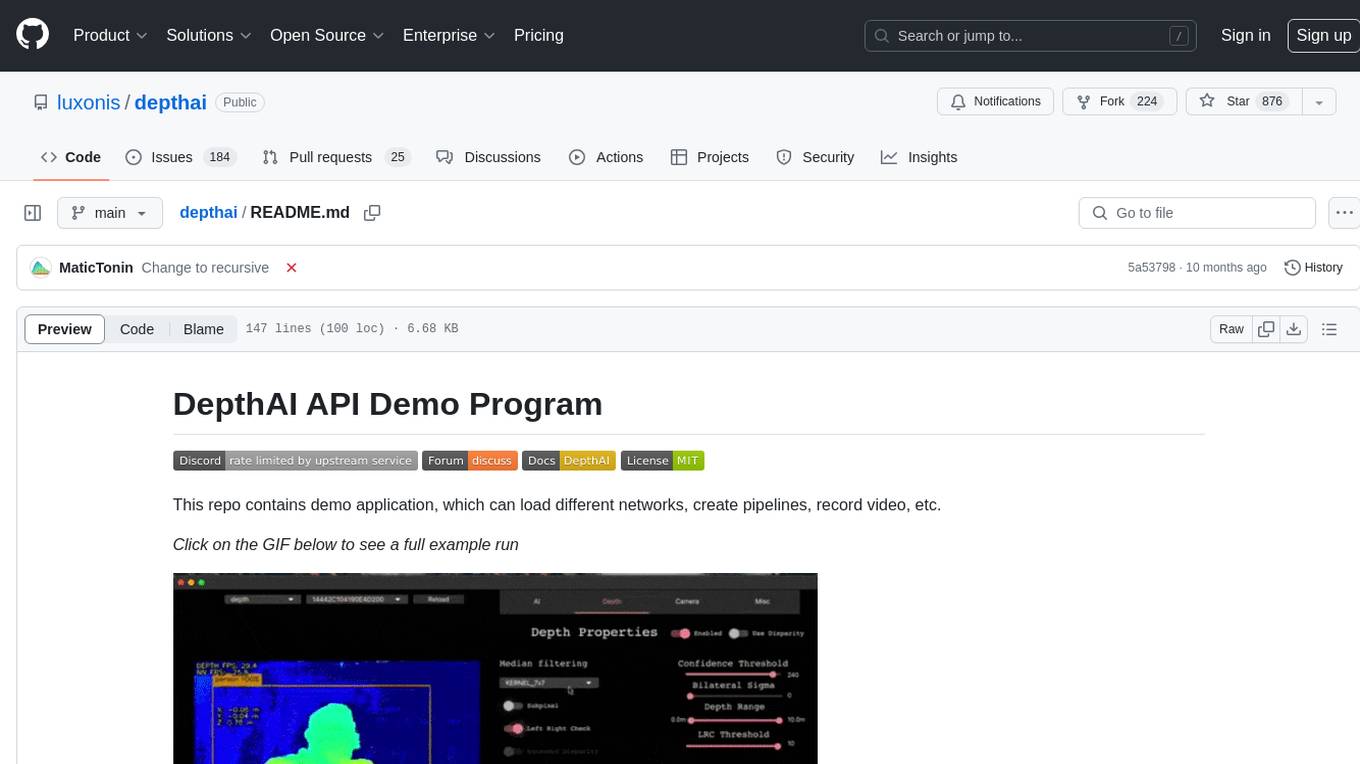
depthai
This repository contains a demo application for DepthAI, a tool that can load different networks, create pipelines, record video, and more. It provides documentation for installation and usage, including running programs through Docker. Users can explore DepthAI features via command line arguments or a clickable QT interface. Supported models include various AI models for tasks like face detection, human pose estimation, and object detection. The tool collects anonymous usage statistics by default, which can be disabled. Users can report issues to the development team for support and troubleshooting.