


gorse
AI powered open source recommender system engine supports classical/LLM rankers and multimodal content via embedding
Stars: 9358
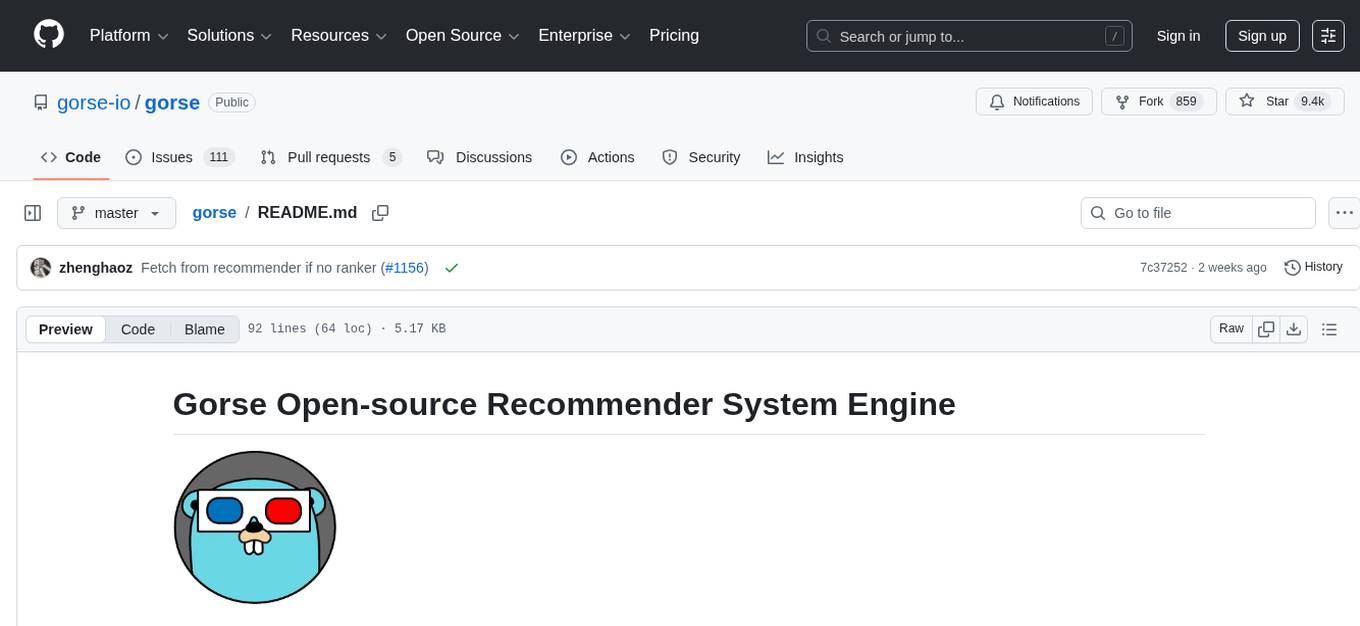
Gorse is an AI-powered open-source recommender system engine written in Go. It aims to be a universal recommender system that can be integrated into various online services quickly. Gorse supports multi-source recommendations, multimodal content, classical and LLM-based recommenders, GUI dashboard, and RESTful APIs. It provides a playground mode for beginners to set up a recommender system for GitHub repositories easily. The system architecture includes a master node, worker nodes, and server nodes for training, recommendation, and API exposure. Gorse is suitable for developers looking to implement personalized recommendation systems efficiently.
README:






Gorse is an AI powered open-source recommender system written in Go. Gorse aims to be a universal open-source recommender system that can be quickly integrated into a wide variety of online services. By importing items, users, and interaction data into Gorse, the system will automatically train models to generate recommendations for each user. Project features are as follows.

- Multi-source: Recommend items from latest, user-to-user, item-to-item, collaborative filtering and etc.
- Multimodal: Support multimodal content (text, image, videos, etc.) via embedding.
- AI-powered: Support both classical recommenders and LLM-based recommenders.
- GUI Dashboard: Provide GUI dashboard for recommendation pipeline editing, system monitoring, and data management.
- RESTful APIs: Expose RESTful APIs for data CRUD and recommendation requests.
The playground mode has been prepared for beginners. Just set up a recommender system for GitHub repositories by the following commands.
docker run -p 8088:8088 zhenghaoz/gorse-in-one --playgroundThe playground mode will download data from GitRec and import it into Gorse. The dashboard is available at http://localhost:8088.

After the "Generate item-to-item recommendation" task is completed on the "Tasks" page, try to insert several feedbacks into Gorse. Suppose Bob is a developer who interested in LLM related repositories. We insert his star feedback to Gorse.
read -d '' JSON << EOF
[
    { \"FeedbackType\": \"star\", \"UserId\": \"bob\", \"ItemId\": \"ollama:ollama\", \"Value\": 1.0, \"Timestamp\": \"2022-02-24\" },
    { \"FeedbackType\": \"star\", \"UserId\": \"bob\", \"ItemId\": \"huggingface:transformers\", \"Value\": 1.0, \"Timestamp\": \"2022-02-25\" },
    { \"FeedbackType\": \"star\", \"UserId\": \"bob\", \"ItemId\": \"rasbt:llms-from-scratch\", \"Value\": 1.0, \"Timestamp\": \"2022-02-26\" },
    { \"FeedbackType\": \"star\", \"UserId\": \"bob\", \"ItemId\": \"vllm-project:vllm\", \"Value\": 1.0, \"Timestamp\": \"2022-02-27\" },
    { \"FeedbackType\": \"star\", \"UserId\": \"bob\", \"ItemId\": \"hiyouga:llama-factory\", \"Value\": 1.0, \"Timestamp\": \"2022-02-28\" }
]
EOF

curl -X POST http://127.0.0.1:8088/api/feedback \
   -H 'Content-Type: application/json' \
   -d "$JSON"
Then, fetch 10 recommended items from Gorse. We can find that LLM-related repositories are recommended for Bob.
curl http://127.0.0.1:8088/api/recommend/bob?n=10For more information:
- Read official documents
- Visit playground of Gorse dashboard
- Explore live demo, a recommender system for GitHub repositories
- Discuss on Discord or GitHub Discussion
Gorse is a single-node training and distributed prediction recommender system. Gorse stores data in MySQL, MongoDB, Postgres, or ClickHouse, with intermediate results cached in Redis, MySQL, MongoDB and Postgres.
- The cluster consists of a master node, multiple worker nodes, and server nodes.
- The master node is responsible for model training, non-personalized recommendation, configuration management, and membership management.
- The server node is responsible for exposing the RESTful APIs and online real-time recommendations.
- Worker nodes are responsible for offline recommendations for each user.
In addition, the administrator can perform system monitoring, data import and export, and system status checking via the dashboard on the master node.

Any contribution is appreciated: report a bug, give advice or create a pull request. Read CONTRIBUTING.md for more information.
gorse is inspired by the following projects:
For Tasks:
Click tags to check more tools for each tasksFor Jobs:
Alternative AI tools for gorse
Similar Open Source Tools
gorse
Gorse is an AI-powered open-source recommender system engine written in Go. It aims to be a universal recommender system that can be integrated into various online services quickly. Gorse supports multi-source recommendations, multimodal content, classical and LLM-based recommenders, GUI dashboard, and RESTful APIs. It provides a playground mode for beginners to set up a recommender system for GitHub repositories easily. The system architecture includes a master node, worker nodes, and server nodes for training, recommendation, and API exposure. Gorse is suitable for developers looking to implement personalized recommendation systems efficiently.
mlflow
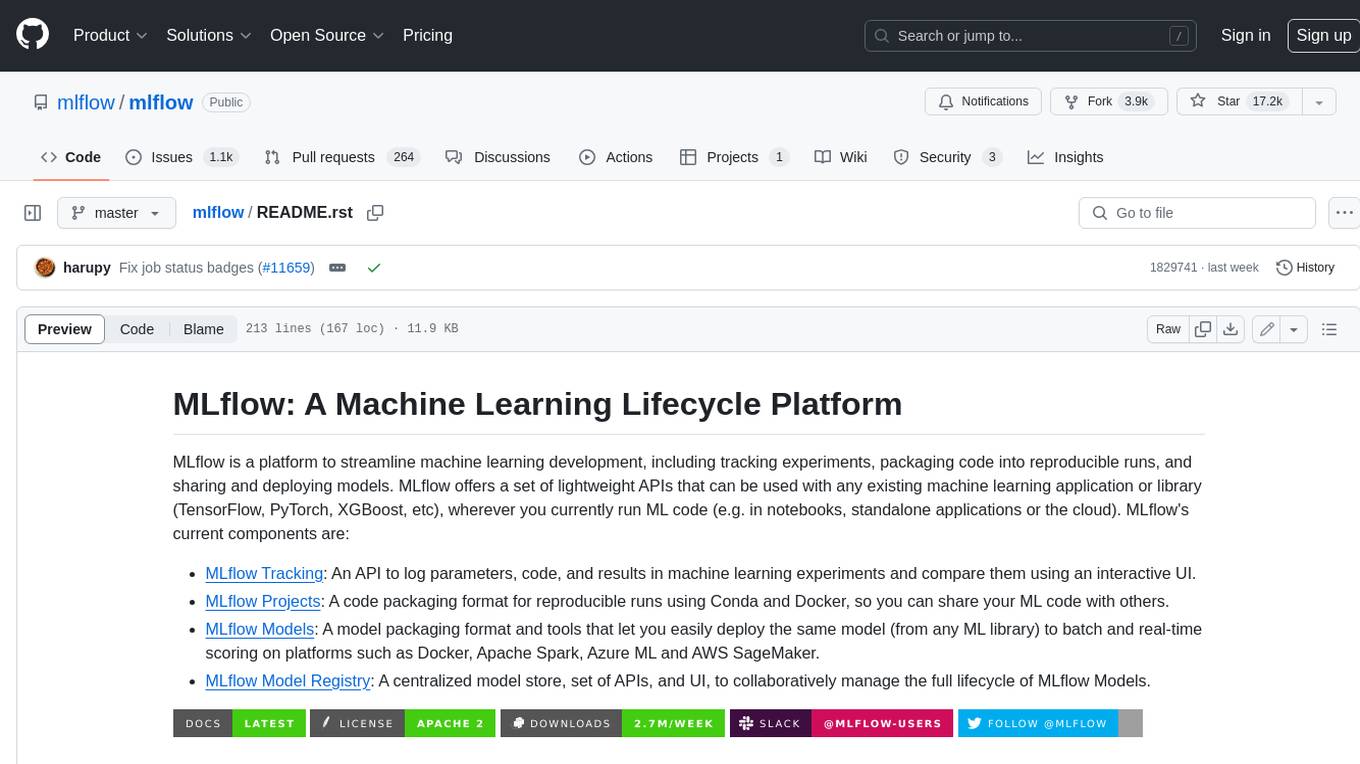
MLflow is a platform to streamline machine learning development, including tracking experiments, packaging code into reproducible runs, and sharing and deploying models. MLflow offers a set of lightweight APIs that can be used with any existing machine learning application or library (TensorFlow, PyTorch, XGBoost, etc), wherever you currently run ML code (e.g. in notebooks, standalone applications or the cloud). MLflow's current components are:
* `MLflow Tracking
sdialog
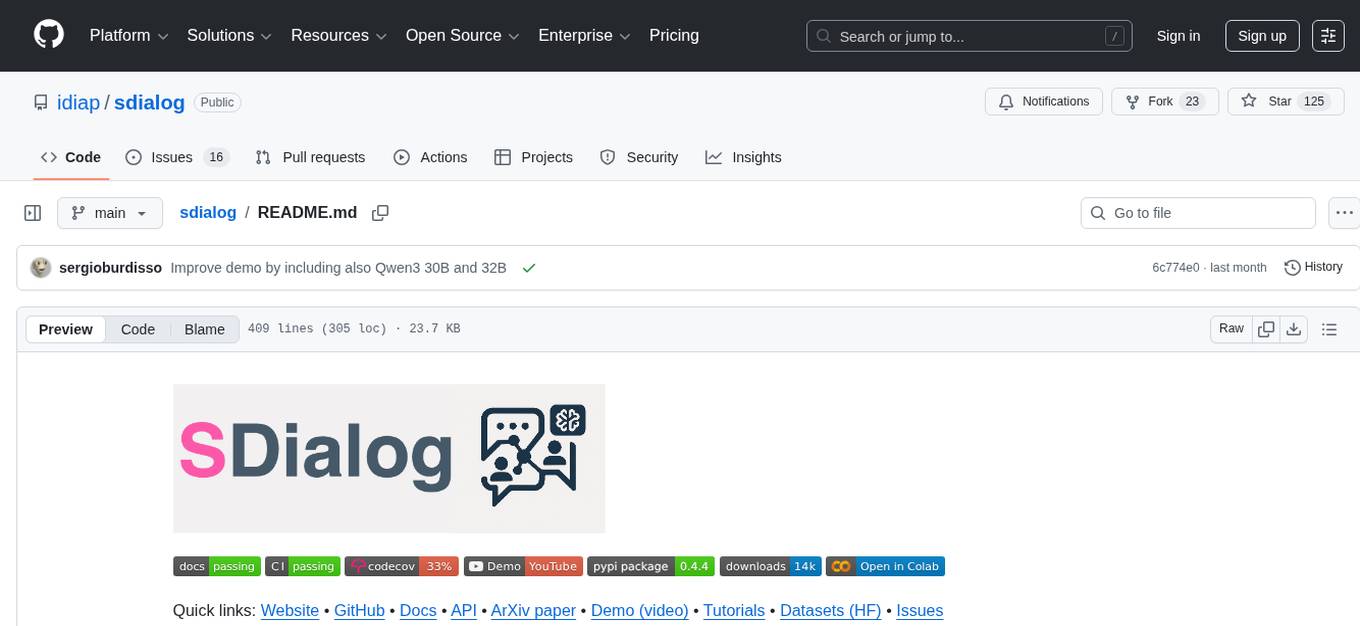
SDialog is an MIT-licensed open-source toolkit for building, simulating, and evaluating LLM-based conversational agents end-to-end. It aims to bridge agent construction, user simulation, dialog generation, and evaluation in a single reproducible workflow, enabling the generation of reliable, controllable dialog systems or data at scale. The toolkit standardizes a Dialog schema, offers persona-driven multi-agent simulation with LLMs, provides composable orchestration for precise control over behavior and flow, includes built-in evaluation metrics, and offers mechanistic interpretability. It allows for easy creation of user-defined components and interoperability across various AI platforms.
bee-agent-framework
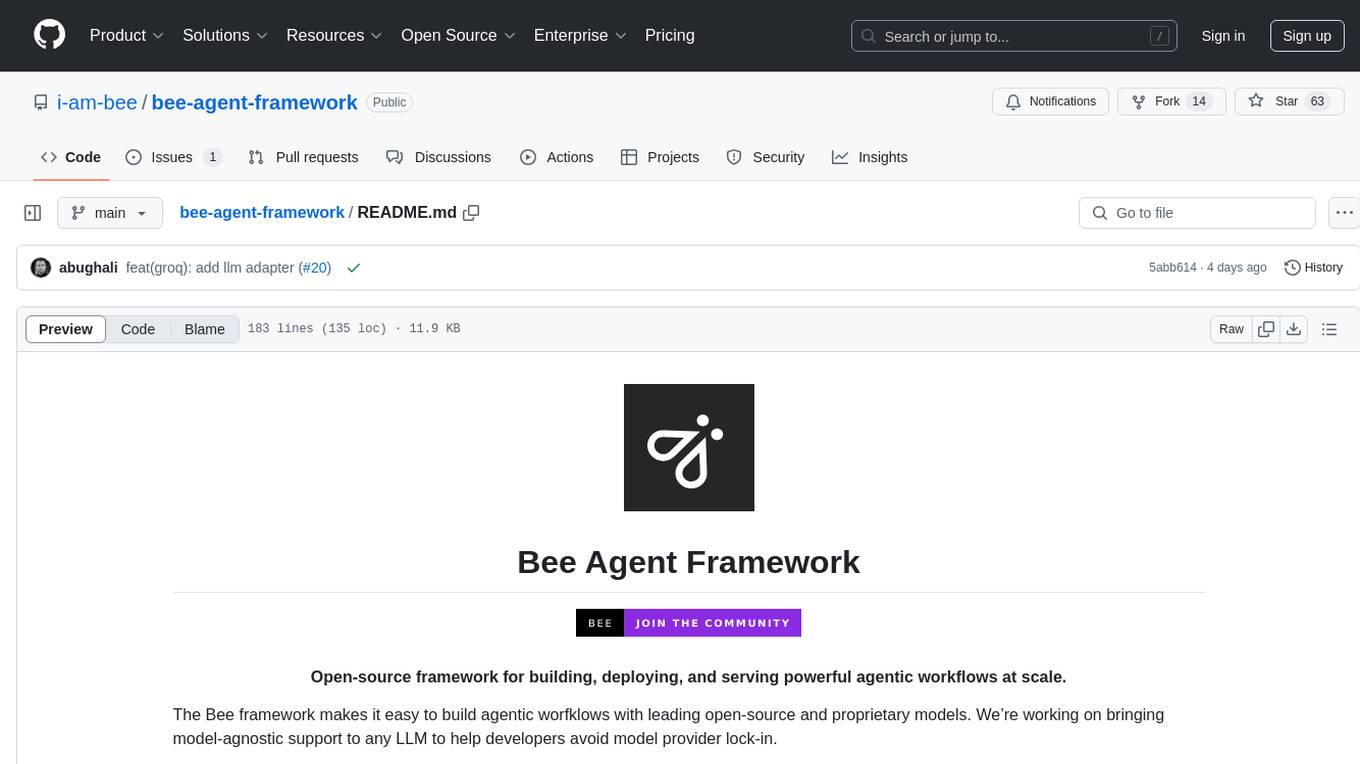
The Bee Agent Framework is an open-source tool for building, deploying, and serving powerful agentic workflows at scale. It provides AI agents, tools for creating workflows in Javascript/Python, a code interpreter, memory optimization strategies, serialization for pausing/resuming workflows, traceability features, production-level control, and upcoming features like model-agnostic support and a chat UI. The framework offers various modules for agents, llms, memory, tools, caching, errors, adapters, logging, serialization, and more, with a roadmap including MLFlow integration, JSON support, structured outputs, chat client, base agent improvements, guardrails, and evaluation.
agentica
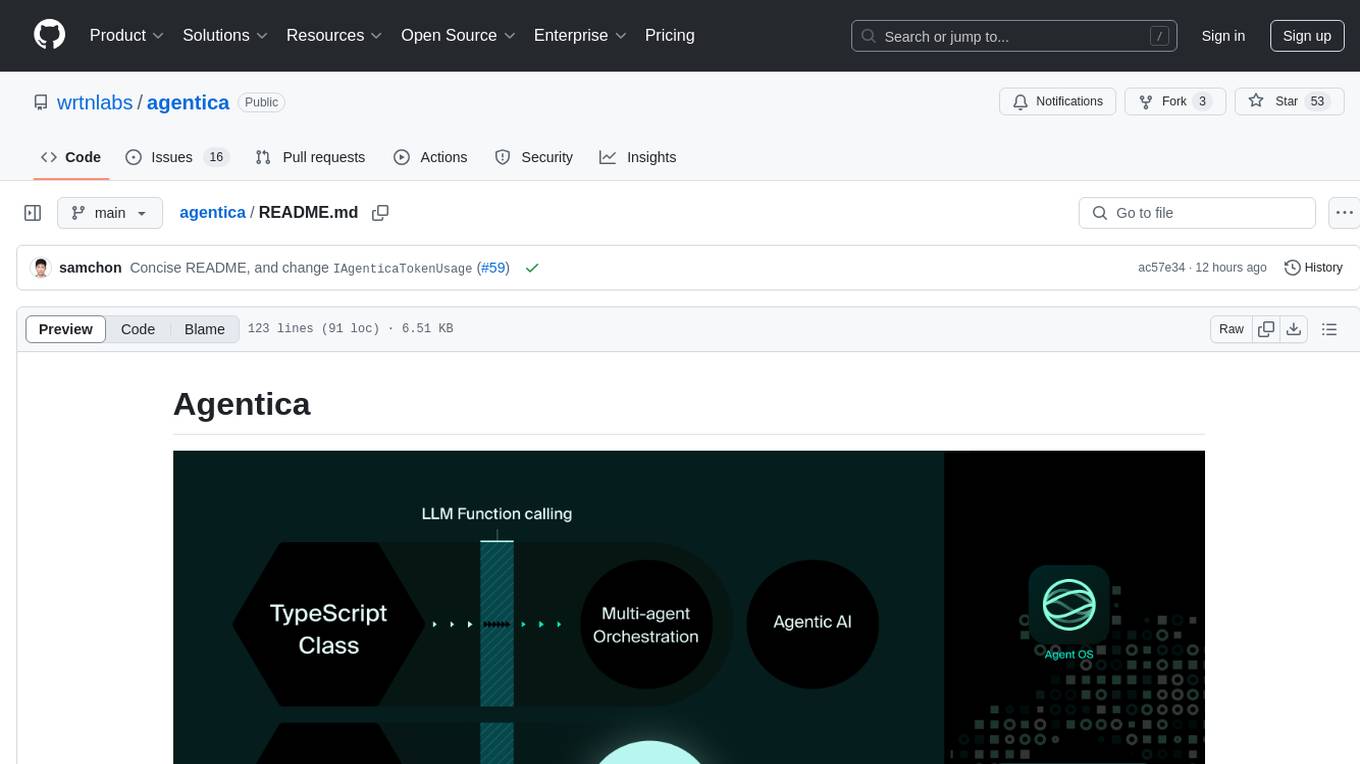
Agentica is a specialized Agentic AI library focused on LLM Function Calling. Users can provide Swagger/OpenAPI documents or TypeScript class types to Agentica for seamless functionality. The library simplifies AI development by handling various tasks effortlessly.

refact-lsp
Refact Agent is a small executable written in Rust as part of the Refact Agent project. It lives inside your IDE to keep AST and VecDB indexes up to date, supporting connection graphs between definitions and usages in popular programming languages. It functions as an LSP server, offering code completion, chat functionality, and integration with various tools like browsers, databases, and debuggers. Users can interact with it through a Text UI in the command line.
chainlit
Chainlit is an open-source async Python framework which allows developers to build scalable Conversational AI or agentic applications. It enables users to create ChatGPT-like applications, embedded chatbots, custom frontends, and API endpoints. The framework provides features such as multi-modal chats, chain of thought visualization, data persistence, human feedback, and an in-context prompt playground. Chainlit is compatible with various Python programs and libraries, including LangChain, Llama Index, Autogen, OpenAI Assistant, and Haystack. It offers a range of examples and a cookbook to showcase its capabilities and inspire users. Chainlit welcomes contributions and is licensed under the Apache 2.0 license.
mcp-agent
mcp-agent is a simple, composable framework designed to build agents using the Model Context Protocol. It handles the lifecycle of MCP server connections and implements patterns for building production-ready AI agents in a composable way. The framework also includes OpenAI's Swarm pattern for multi-agent orchestration in a model-agnostic manner, making it the simplest way to build robust agent applications. It is purpose-built for the shared protocol MCP, lightweight, and closer to an agent pattern library than a framework. mcp-agent allows developers to focus on the core business logic of their AI applications by handling mechanics such as server connections, working with LLMs, and supporting external signals like human input.
SynapseML
SynapseML (previously known as MMLSpark) is an open-source library that simplifies the creation of massively scalable machine learning (ML) pipelines. It provides simple, composable, and distributed APIs for various machine learning tasks such as text analytics, vision, anomaly detection, and more. Built on Apache Spark, SynapseML allows seamless integration of models into existing workflows. It supports training and evaluation on single-node, multi-node, and resizable clusters, enabling scalability without resource wastage. Compatible with Python, R, Scala, Java, and .NET, SynapseML abstracts over different data sources for easy experimentation. Requires Scala 2.12, Spark 3.4+, and Python 3.8+.
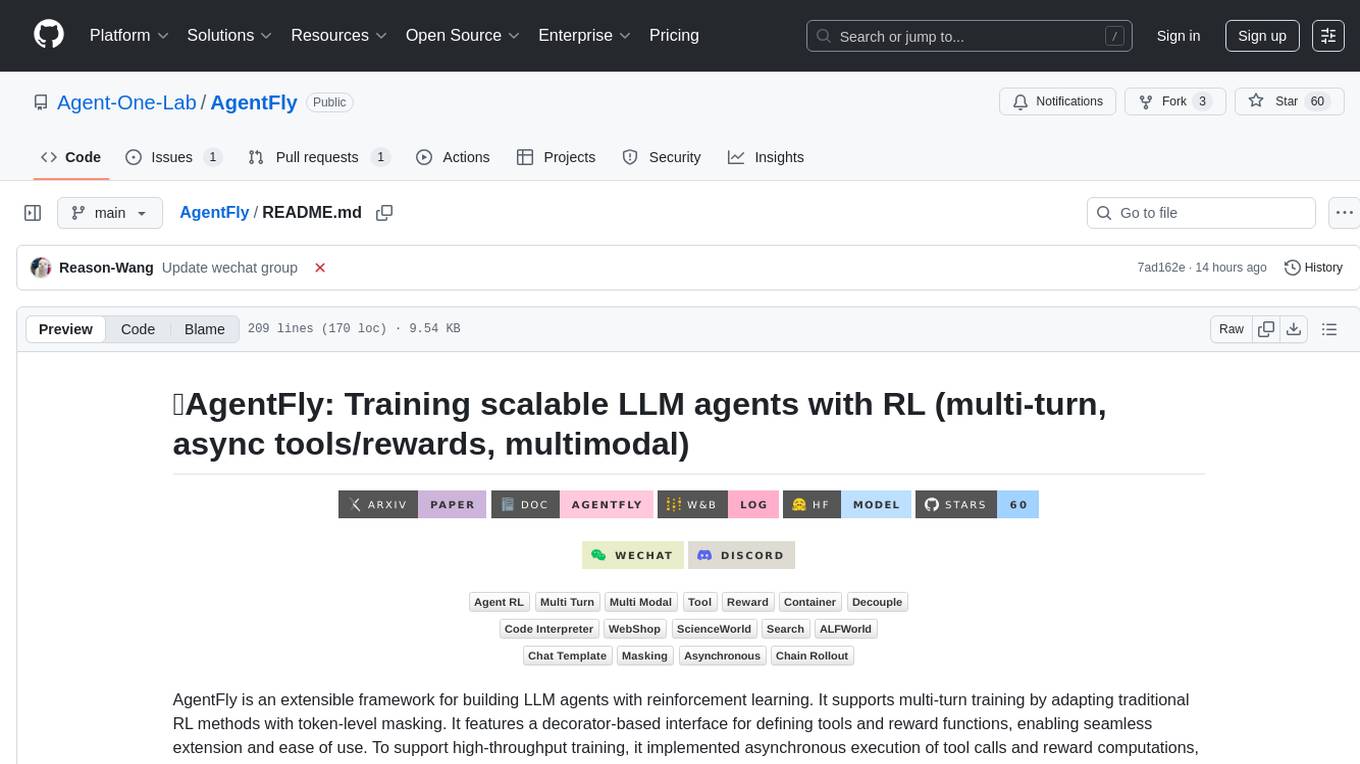
AgentFly
AgentFly is an extensible framework for building LLM agents with reinforcement learning. It supports multi-turn training by adapting traditional RL methods with token-level masking. It features a decorator-based interface for defining tools and reward functions, enabling seamless extension and ease of use. To support high-throughput training, it implemented asynchronous execution of tool calls and reward computations, and designed a centralized resource management system for scalable environment coordination. A suite of prebuilt tools and environments are provided.
lmnr
Laminar is an all-in-one open-source platform designed for engineering AI products. It allows users to trace, evaluate, label, and analyze LLM data efficiently. The platform offers features such as automatic tracing of common AI frameworks and SDKs, local and online evaluations, simple UI for data labeling, dataset management, and scalability with gRPC communication. Laminar is built with a modern open-source stack including RabbitMQ, Postgres, Clickhouse, and Qdrant for semantic similarity search. It provides fast and beautiful dashboards for traces, evaluations, and labels, making it a comprehensive tool for AI product development.
MetaAgent
MetaAgent is a multi-agent collaboration platform designed to build, manage, and deploy multi-modal AI agents without the need for coding. Users can easily create AI agents by editing a yml file or using the provided UI. The platform supports features such as building LLM-based AI agents, multi-modal interactions with users using texts, audios, images, and videos, creating a company of agents for complex tasks like drawing comics, vector database and knowledge embeddings, and upcoming features like UI for creating and using AI agents, fine-tuning, and RLHF. The tool simplifies the process of creating and deploying AI agents for various tasks.
modelscope-agent
ModelScope-Agent is a customizable and scalable Agent framework. A single agent has abilities such as role-playing, LLM calling, tool usage, planning, and memory. It mainly has the following characteristics: - **Simple Agent Implementation Process**: Simply specify the role instruction, LLM name, and tool name list to implement an Agent application. The framework automatically arranges workflows for tool usage, planning, and memory. - **Rich models and tools**: The framework is equipped with rich LLM interfaces, such as Dashscope and Modelscope model interfaces, OpenAI model interfaces, etc. Built in rich tools, such as **code interpreter**, **weather query**, **text to image**, **web browsing**, etc., make it easy to customize exclusive agents. - **Unified interface and high scalability**: The framework has clear tools and LLM registration mechanism, making it convenient for users to expand more diverse Agent applications. - **Low coupling**: Developers can easily use built-in tools, LLM, memory, and other components without the need to bind higher-level agents.
lunary
Lunary is an open-source observability and prompt platform for Large Language Models (LLMs). It provides a suite of features to help AI developers take their applications into production, including analytics, monitoring, prompt templates, fine-tuning dataset creation, chat and feedback tracking, and evaluations. Lunary is designed to be usable with any model, not just OpenAI, and is easy to integrate and self-host.
incubator-kie-optaplanner
A fast, easy-to-use, open source AI constraint solver for software developers. OptaPlanner is a powerful tool that helps developers solve complex optimization problems by providing a constraint satisfaction solver. It allows users to model and solve planning and scheduling problems efficiently, improving decision-making processes and resource allocation. With OptaPlanner, developers can easily integrate optimization capabilities into their applications, leading to better performance and cost-effectiveness.
cognee
Cognee is an open-source framework designed for creating self-improving deterministic outputs for Large Language Models (LLMs) using graphs, LLMs, and vector retrieval. It provides a platform for AI engineers to enhance their models and generate more accurate results. Users can leverage Cognee to add new information, utilize LLMs for knowledge creation, and query the system for relevant knowledge. The tool supports various LLM providers and offers flexibility in adding different data types, such as text files or directories. Cognee aims to streamline the process of working with LLMs and improving AI models for better performance and efficiency.
For similar tasks
gorse
Gorse is an AI-powered open-source recommender system engine written in Go. It aims to be a universal recommender system that can be integrated into various online services quickly. Gorse supports multi-source recommendations, multimodal content, classical and LLM-based recommenders, GUI dashboard, and RESTful APIs. It provides a playground mode for beginners to set up a recommender system for GitHub repositories easily. The system architecture includes a master node, worker nodes, and server nodes for training, recommendation, and API exposure. Gorse is suitable for developers looking to implement personalized recommendation systems efficiently.
trieve
Trieve is an advanced relevance API for hybrid search, recommendations, and RAG. It offers a range of features including self-hosting, semantic dense vector search, typo tolerant full-text/neural search, sub-sentence highlighting, recommendations, convenient RAG API routes, the ability to bring your own models, hybrid search with cross-encoder re-ranking, recency biasing, tunable popularity-based ranking, filtering, duplicate detection, and grouping. Trieve is designed to be flexible and customizable, allowing users to tailor it to their specific needs. It is also easy to use, with a simple API and well-documented features.
CoLLM
CoLLM is a novel method that integrates collaborative information into Large Language Models (LLMs) for recommendation. It converts recommendation data into language prompts, encodes them with both textual and collaborative information, and uses a two-step tuning method to train the model. The method incorporates user/item ID fields in prompts and employs a conventional collaborative model to generate user/item representations. CoLLM is built upon MiniGPT-4 and utilizes pretrained Vicuna weights for training.
media-stack
media-stack is a self-hosted media ecosystem that combines media management, streaming, AI-powered recommendations, and VPN. It includes tools like Radarr for movie management, Sonarr for TV show management, Prowlarr for torrent indexing, qBittorrent for downloading media, Jellyseerr for media requests, Jellyfin for media streaming, and Recommendarr for AI-powered recommendations. The stack can be deployed with or without a VPN and offers detailed configuration steps for each tool.
Genkit
Genkit is an open-source framework for building full-stack AI-powered applications, used in production by Google's Firebase. It provides SDKs for JavaScript/TypeScript (Stable), Go (Beta), and Python (Alpha) with unified interface for integrating AI models from providers like Google, OpenAI, Anthropic, Ollama. Rapidly build chatbots, automations, and recommendation systems using streamlined APIs for multimodal content, structured outputs, tool calling, and agentic workflows. Genkit simplifies AI integration with open-source SDK, unified APIs, and offers text and image generation, structured data generation, tool calling, prompt templating, persisted chat interfaces, AI workflows, and AI-powered data retrieval (RAG).
For similar jobs
sweep
Sweep is an AI junior developer that turns bugs and feature requests into code changes. It automatically handles developer experience improvements like adding type hints and improving test coverage.
teams-ai
The Teams AI Library is a software development kit (SDK) that helps developers create bots that can interact with Teams and Microsoft 365 applications. It is built on top of the Bot Framework SDK and simplifies the process of developing bots that interact with Teams' artificial intelligence capabilities. The SDK is available for JavaScript/TypeScript, .NET, and Python.
ai-guide
This guide is dedicated to Large Language Models (LLMs) that you can run on your home computer. It assumes your PC is a lower-end, non-gaming setup.
classifai
Supercharge WordPress Content Workflows and Engagement with Artificial Intelligence. Tap into leading cloud-based services like OpenAI, Microsoft Azure AI, Google Gemini and IBM Watson to augment your WordPress-powered websites. Publish content faster while improving SEO performance and increasing audience engagement. ClassifAI integrates Artificial Intelligence and Machine Learning technologies to lighten your workload and eliminate tedious tasks, giving you more time to create original content that matters.
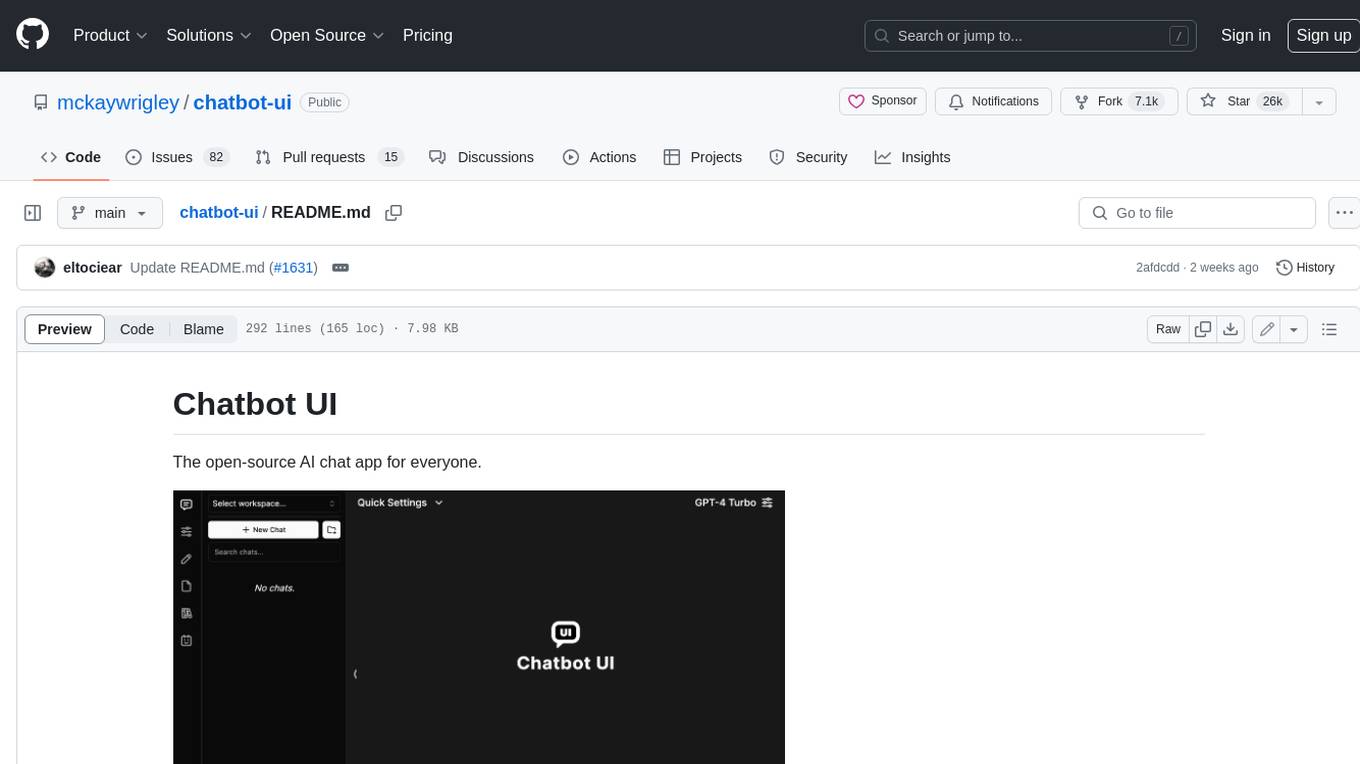
chatbot-ui
Chatbot UI is an open-source AI chat app that allows users to create and deploy their own AI chatbots. It is easy to use and can be customized to fit any need. Chatbot UI is perfect for businesses, developers, and anyone who wants to create a chatbot.
BricksLLM
BricksLLM is a cloud native AI gateway written in Go. Currently, it provides native support for OpenAI, Anthropic, Azure OpenAI and vLLM. BricksLLM aims to provide enterprise level infrastructure that can power any LLM production use cases. Here are some use cases for BricksLLM: * Set LLM usage limits for users on different pricing tiers * Track LLM usage on a per user and per organization basis * Block or redact requests containing PIIs * Improve LLM reliability with failovers, retries and caching * Distribute API keys with rate limits and cost limits for internal development/production use cases * Distribute API keys with rate limits and cost limits for students
uAgents
uAgents is a Python library developed by Fetch.ai that allows for the creation of autonomous AI agents. These agents can perform various tasks on a schedule or take action on various events. uAgents are easy to create and manage, and they are connected to a fast-growing network of other uAgents. They are also secure, with cryptographically secured messages and wallets.
griptape
Griptape is a modular Python framework for building AI-powered applications that securely connect to your enterprise data and APIs. It offers developers the ability to maintain control and flexibility at every step. Griptape's core components include Structures (Agents, Pipelines, and Workflows), Tasks, Tools, Memory (Conversation Memory, Task Memory, and Meta Memory), Drivers (Prompt and Embedding Drivers, Vector Store Drivers, Image Generation Drivers, Image Query Drivers, SQL Drivers, Web Scraper Drivers, and Conversation Memory Drivers), Engines (Query Engines, Extraction Engines, Summary Engines, Image Generation Engines, and Image Query Engines), and additional components (Rulesets, Loaders, Artifacts, Chunkers, and Tokenizers). Griptape enables developers to create AI-powered applications with ease and efficiency.