


agent-prism
React components for visualizing traces from AI agents
Stars: 293
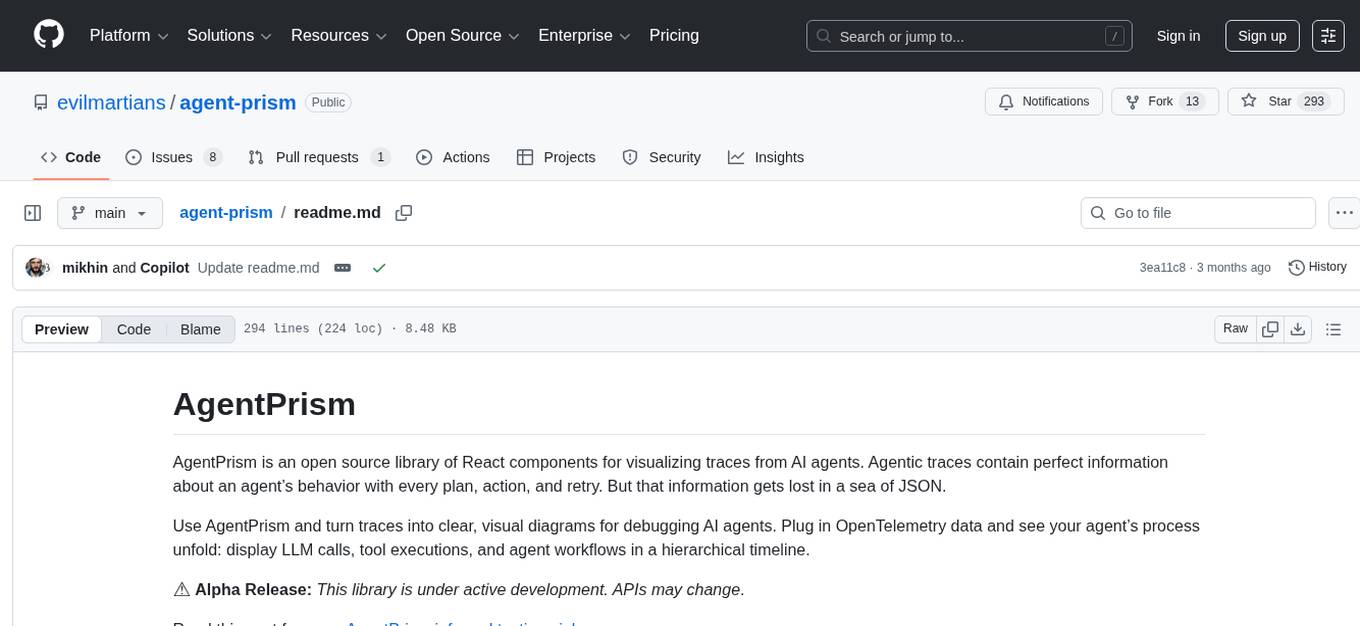
AgentPrism is an open source library of React components designed for visualizing traces from AI agents. It helps in turning complex JSON data into clear and visual diagrams for debugging AI agents. By plugging in OpenTelemetry data, users can visualize LLM calls, tool executions, and agent workflows in a hierarchical timeline. The library is currently in alpha release and under active development, with APIs subject to change. Users can try out AgentPrism live at agent-prism.evilmartians.io to visualize and debug their own agent traces.
README:
AgentPrism is an open source library of React components for visualizing traces from AI agents. Agentic traces contain perfect information about an agent’s behavior with every plan, action, and retry. But that information gets lost in a sea of JSON.
Use AgentPrism and turn traces into clear, visual diagrams for debugging AI agents. Plug in OpenTelemetry data and see your agent’s process unfold: display LLM calls, tool executions, and agent workflows in a hierarchical timeline.
Read this post for more AgentPrism info and testimonials.
Try AgentPrism live at agent-prism.evilmartians.io — visualize and debug your own agent traces.
https://github.com/user-attachments/assets/69e592e2-b67c-4ebc-b301-2d8b73492e0d
storybook.agent-prism.evilmartians.io
- React 19+
- Tailwind CSS 3
- TypeScript
Copy the UI components to your project:
npx degit evilmartians/agent-prism/packages/ui/src/components src/components/agent-prismInstall the data and types packages:
npm install @evilmartians/agent-prism-data @evilmartians/agent-prism-typesInstall required UI dependencies:
npm install @radix-ui/react-collapsible @radix-ui/react-tabs classnames lucide-react react-json-pretty react-resizable-panelsThe simplest way to get started is with the TraceViewer component, which provides a complete trace visualization interface:
import { TraceViewer } from "./components/agent-prism/TraceViewer";
import { openTelemetrySpanAdapter } from "@evilmartians/agent-prism-data";

function App() {
  return (
    <TraceViewer
      data={[
        {
          traceRecord: yourTraceRecord,
          spans:
            openTelemetrySpanAdapter.convertRawDocumentsToSpans(yourTraceData),
        },
      ]}
    />
  );
}
The TraceViewer includes:
- Trace List: Browse multiple traces
- Tree View: Hierarchical span visualization with search and expand/collapse
- Details Panel: Inspect individual span attributes
- Responsive Design: Works on desktop and mobile
For more control, use individual components to build custom layouts:
import { useState } from "react";
import type { TraceRecord, TraceSpan } from "@evilmartians/agent-prism-types";
import { openTelemetrySpanAdapter } from "@evilmartians/agent-prism-data";

import { TraceList } from "./components/agent-prism/TraceList/TraceList";
import { TreeView } from "./components/agent-prism/TreeView";
import { DetailsView } from "./components/agent-prism/DetailsView/DetailsView";

// Mock OpenTelemetryDocument (replace with real data)
const traceData = {
  resourceSpans: [],
};

// Mock traces with all required TraceRecord fields
const traces: TraceRecord[] = [
  {
    id: "1",
    name: "Trace 1",
    spansCount: 0,
    durationMs: 0,
    agentDescription: "Mock trace 1",
  },
  {
    id: "2",
    name: "Trace 2",
    spansCount: 0,
    durationMs: 0,
    agentDescription: "Mock trace 2",
  },
];

export function App() {
  const [selectedTrace, setSelectedTrace] = useState<TraceRecord | undefined>(
    undefined,
  );
  const [selectedSpan, setSelectedSpan] = useState<TraceSpan | undefined>(
    undefined,
  );
  const [expandedSpansIds, setExpandedSpansIds] = useState<string[]>([]);

  const spans = openTelemetrySpanAdapter.convertRawDocumentsToSpans(traceData);

  return (
    <div className="grid grid-cols-3 gap-4">
      {/* Traces sidebar */}
      <TraceList
        traces={traces}
        expanded={true}
        onExpandStateChange={() => {}}
        onTraceSelect={setSelectedTrace}
        selectedTrace={selectedTrace}
      />

      {/* Tree view */}
      <TreeView
        spans={spans}
        onSpanSelect={setSelectedSpan}
        selectedSpan={selectedSpan}
        expandedSpansIds={expandedSpansIds}
        onExpandSpansIdsChange={setExpandedSpansIds}
        spanCardViewOptions={{
          expandButton: "inside",
        }}
      />

      {/* Details panel */}
      {selectedSpan && <DetailsView data={selectedSpan} />}
    </div>
  );
}AgentPrism uses a normalized data format optimized for UI rendering. Transform your trace data using the provided adapters.
All adapters implement the same interface and offer some helpful methods for transforming raw data (Open Telemetry, Langfuse, and so on) and getting some info out of it.
import {
  openTelemetrySpanAdapter,
  langfuseSpanAdapter,
} from "@evilmartians/agent-prism-data";

// convert whole documents to TraceSpans (normalized view)
openTelemetrySpanAdapter.convertRawDocumentsToSpans(otlpData);

// convert single span (a.k.a. record, a.k.a. Langfuse observation)
openTelemetrySpanAdapter.convertRawSpanToTraceSpan(otlpData);

// in case you want to use TreeView component
openTelemetrySpanAdapter.convertRawSpansToSpanTree(otlpData);

// get some data for a particular observation/span (e.g. when you loaded one record)
langfuseSpanAdapter.getSpanCategory(observationData);
langfuseSpanAdapter.getSpanCost(observationData);
langfuseSpanAdapter.getSpanDuration(observationData);
langfuseSpanAdapter.getSpanInputOutput(observationData);
langfuseSpanAdapter.getSpanStatus(observationData);
langfuseSpanAdapter.getSpanTokensCount(observationData);For OpenTelemetry traces, use the OTLP adapter:
import { openTelemetrySpanAdapter } from "@evilmartians/agent-prism-data";

const spans = openTelemetrySpanAdapter.convertRawDocumentsToSpans(otlpDocument);For handling Langfuse observations, use Langfuse adapter
import { langfuseSpanAdapter } from "@evilmartians/agent-prism-data";

const spans = langfuseSpanAdapter.convertRawDocumentsToSpans(langfuseDocument);The UI components expect this data shape:
interface TraceViewerData {
  traceRecord: TraceRecord; // Trace metadata (id, timestamp, status)
  spans: TraceSpan[]; // Hierarchical span tree
  badges?: BadgeProps[]; // Optional trace badges
}AgentPrism recognizes standard semantic conventions:
-
OpenTelemetry GenAI:
gen_ai.*(model, tokens, costs) -
OpenInference:
llm.*,retrieval.* - Standard OTEL: HTTP, database spans
-
Custom: Add your own attributes like
gen_ai.usage.cost
{
  "resourceSpans": [
    {
      "scopeSpans": [
        {
          "spans": [
            {
              "traceId": "abc123...",
              "spanId": "def456...",
              "name": "openai.chat",
              "attributes": [
                {
                  "key": "gen_ai.request.model",
                  "value": { "stringValue": "gpt-4" }
                },
                {
                  "key": "gen_ai.usage.input_tokens",
                  "value": { "intValue": "150" }
                }
              ]
            }
          ]
        }
      ]
    }
  ]
}TraceViewer (complete solution)
├── TraceList (trace selection)
├── TreeView (span hierarchy)
│ ├── SearchInput
│ ├── CollapseAndExpandControls
│ └── Individual span rows
└── DetailsView (span inspection)
Use TraceViewer for quick setup, or compose individual components for custom layouts.
Use semantic tokens for colors. The theme folder in components has 2 files:
-
theme.css- import anywhere for bundler to process. Sets CSS variables on:root -
index.ts- exports types andagentPrismTailwindColors. Import in tailwind config:
import { agentPrismTailwindColors } from "./src/components/theme";

export default {
  theme: {
    extend: {
      colors: agentPrismTailwindColors,
    },
  },
};
Customize by changing semantic token values in theme.css. Defaults from tailwind colors (commented), but fully customizable.
Each token has 3 values (Lightness, Chroma, Hue) in Oklch format. This enables the use of oklch(var(--${agentPrismPrefix}-${name}) / <alpha-value>) in Tailwind for opacity syntax like bg-agentprism-primary/50.
We welcome contributions to AgentPrism! Please see our Contribution Guide for details.
For Tasks:
Click tags to check more tools for each tasksFor Jobs:
Alternative AI tools for agent-prism
Similar Open Source Tools
agent-prism
AgentPrism is an open source library of React components designed for visualizing traces from AI agents. It helps in turning complex JSON data into clear and visual diagrams for debugging AI agents. By plugging in OpenTelemetry data, users can visualize LLM calls, tool executions, and agent workflows in a hierarchical timeline. The library is currently in alpha release and under active development, with APIs subject to change. Users can try out AgentPrism live at agent-prism.evilmartians.io to visualize and debug their own agent traces.
x
Ant Design X is a tool for crafting AI-driven interfaces effortlessly. It is built on the best practices of enterprise-level AI products, offering flexible and diverse atomic components for various AI dialogue scenarios. The tool provides out-of-the-box model integration with inference services compatible with OpenAI standards. It also enables efficient management of conversation data flows, supports rich template options, complete TypeScript support, and advanced theme customization. Ant Design X is designed to enhance development efficiency and deliver exceptional AI interaction experiences.
LocalAGI
LocalAGI is a powerful, self-hostable AI Agent platform that allows you to design AI automations without writing code. It provides a complete drop-in replacement for OpenAI's Responses APIs with advanced agentic capabilities. With LocalAGI, you can create customizable AI assistants, automations, chat bots, and agents that run 100% locally, without the need for cloud services or API keys. The platform offers features like no-code agents, web-based interface, advanced agent teaming, connectors for various platforms, comprehensive REST API, short & long-term memory capabilities, planning & reasoning, periodic tasks scheduling, memory management, multimodal support, extensible custom actions, fully customizable models, observability, and more.
modelfusion
ModelFusion is an abstraction layer for integrating AI models into JavaScript and TypeScript applications, unifying the API for common operations such as text streaming, object generation, and tool usage. It provides features to support production environments, including observability hooks, logging, and automatic retries. You can use ModelFusion to build AI applications, chatbots, and agents. ModelFusion is a non-commercial open source project that is community-driven. You can use it with any supported provider. ModelFusion supports a wide range of models including text generation, image generation, vision, text-to-speech, speech-to-text, and embedding models. ModelFusion infers TypeScript types wherever possible and validates model responses. ModelFusion provides an observer framework and logging support. ModelFusion ensures seamless operation through automatic retries, throttling, and error handling mechanisms. ModelFusion is fully tree-shakeable, can be used in serverless environments, and only uses a minimal set of dependencies.
ai-sdk-cpp
The AI SDK CPP is a modern C++ toolkit that provides a unified, easy-to-use API for building AI-powered applications with popular model providers like OpenAI and Anthropic. It bridges the gap for C++ developers by offering a clean, expressive codebase with minimal dependencies. The toolkit supports text generation, streaming content, multi-turn conversations, error handling, tool calling, async tool execution, and configurable retries. Future updates will include additional providers, text embeddings, and image generation models. The project also includes a patched version of nlohmann/json for improved thread safety and consistent behavior in multi-threaded environments.
js-genai
The Google Gen AI JavaScript SDK is an experimental SDK for TypeScript and JavaScript developers to build applications powered by Gemini. It supports both the Gemini Developer API and Vertex AI. The SDK is designed to work with Gemini 2.0 features. Users can access API features through the GoogleGenAI classes, which provide submodules for querying models, managing caches, creating chats, uploading files, and starting live sessions. The SDK also allows for function calling to interact with external systems. Users can find more samples in the GitHub samples directory.
react-native-rag
React Native RAG is a library that enables private, local RAGs to supercharge LLMs with a custom knowledge base. It offers modular and extensible components like `LLM`, `Embeddings`, `VectorStore`, and `TextSplitter`, with multiple integration options. The library supports on-device inference, vector store persistence, and semantic search implementation. Users can easily generate text responses, manage documents, and utilize custom components for advanced use cases.
LightRAG
LightRAG is a repository hosting the code for LightRAG, a system that supports seamless integration of custom knowledge graphs, Oracle Database 23ai, Neo4J for storage, and multiple file types. It includes features like entity deletion, batch insert, incremental insert, and graph visualization. LightRAG provides an API server implementation for RESTful API access to RAG operations, allowing users to interact with it through HTTP requests. The repository also includes evaluation scripts, code for reproducing results, and a comprehensive code structure.
acte
Acte is a framework designed to build GUI-like tools for AI Agents. It aims to address the issues of cognitive load and freedom degrees when interacting with multiple APIs in complex scenarios. By providing a graphical user interface (GUI) for Agents, Acte helps reduce cognitive load and constraints interaction, similar to how humans interact with computers through GUIs. The tool offers APIs for starting new sessions, executing actions, and displaying screens, accessible via HTTP requests or the SessionManager class.
lingo.dev
Replexica AI automates software localization end-to-end, producing authentic translations instantly across 60+ languages. Teams can do localization 100x faster with state-of-the-art quality, reaching more paying customers worldwide. The tool offers a GitHub Action for CI/CD automation and supports various formats like JSON, YAML, CSV, and Markdown. With lightning-fast AI localization, auto-updates, native quality translations, developer-friendly CLI, and scalability for startups and enterprise teams, Replexica is a top choice for efficient and effective software localization.
ai
The Vercel AI SDK is a library for building AI-powered streaming text and chat UIs. It provides React, Svelte, Vue, and Solid helpers for streaming text responses and building chat and completion UIs. The SDK also includes a React Server Components API for streaming Generative UI and first-class support for various AI providers such as OpenAI, Anthropic, Mistral, Perplexity, AWS Bedrock, Azure, Google Gemini, Hugging Face, Fireworks, Cohere, LangChain, Replicate, Ollama, and more. Additionally, it offers Node.js, Serverless, and Edge Runtime support, as well as lifecycle callbacks for saving completed streaming responses to a database in the same request.
smithers
Smithers is a tool for declarative AI workflow orchestration using React components. It allows users to define complex multi-agent workflows as component trees, ensuring composability, durability, and error handling. The tool leverages React's re-rendering mechanism to persist outputs to SQLite, enabling crashed workflows to resume seamlessly. Users can define schemas for task outputs, create workflow instances, define agents, build workflow trees, and run workflows programmatically or via CLI. Smithers supports components for pipeline stages, structured output validation with Zod, MDX prompts, validation loops with Ralph, dynamic branching, and various built-in tools like read, edit, bash, grep, and write. The tool follows a clear workflow execution process involving defining, rendering, executing, re-rendering, and repeating tasks until completion, all while storing task results in SQLite for fault tolerance.
agent-kit
AgentKit is a framework for creating and orchestrating AI Agents, enabling developers to build, test, and deploy reliable AI applications at scale. It allows for creating networked agents with separate tasks and instructions to solve specific tasks, as well as simple agents for tasks like writing content. The framework requires the Inngest TypeScript SDK as a dependency and provides documentation on agents, tools, network, state, and routing. Example projects showcase AgentKit in action, such as the Test Writing Network demo using Workflow Kit, Supabase, and OpenAI.
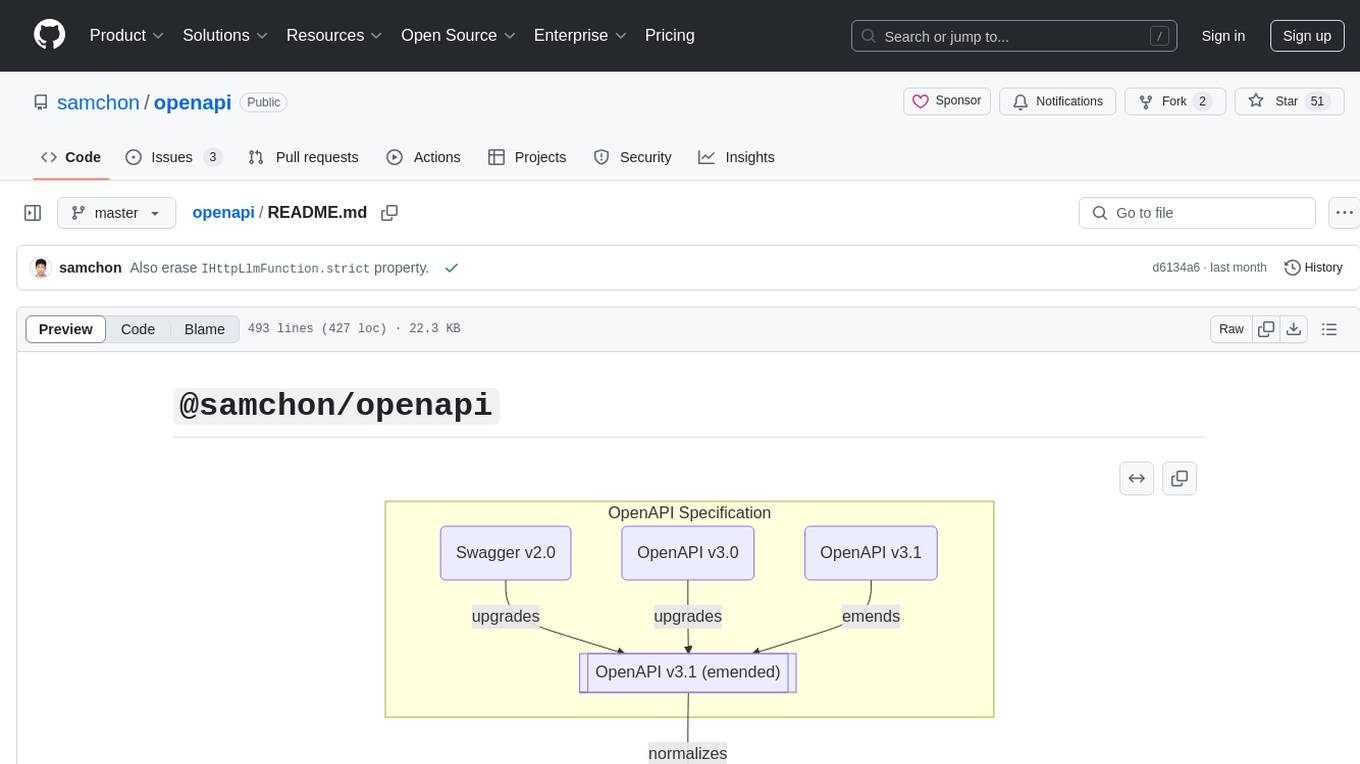
openapi
The `@samchon/openapi` repository is a collection of OpenAPI types and converters for various versions of OpenAPI specifications. It includes an 'emended' OpenAPI v3.1 specification that enhances clarity by removing ambiguous and duplicated expressions. The repository also provides an application composer for LLM (Large Language Model) function calling from OpenAPI documents, allowing users to easily perform LLM function calls based on the Swagger document. Conversions to different versions of OpenAPI documents are also supported, all based on the emended OpenAPI v3.1 specification. Users can validate their OpenAPI documents using the `typia` library with `@samchon/openapi` types, ensuring compliance with standard specifications.
agent-sdk-go
Agent Go SDK is a powerful Go framework for building production-ready AI agents that seamlessly integrates memory management, tool execution, multi-LLM support, and enterprise features into a flexible, extensible architecture. It offers core capabilities like multi-model intelligence, modular tool ecosystem, advanced memory management, and MCP integration. The SDK is enterprise-ready with built-in guardrails, complete observability, and support for enterprise multi-tenancy. It provides a structured task framework, declarative configuration, and zero-effort bootstrapping for development experience. The SDK supports environment variables for configuration and includes features like creating agents with YAML configuration, auto-generating agent configurations, using MCP servers with an agent, and CLI tool for headless usage.
island-ai
island-ai is a TypeScript toolkit tailored for developers engaging with structured outputs from Large Language Models. It offers streamlined processes for handling, parsing, streaming, and leveraging AI-generated data across various applications. The toolkit includes packages like zod-stream for interfacing with LLM streams, stream-hooks for integrating streaming JSON data into React applications, and schema-stream for JSON streaming parsing based on Zod schemas. Additionally, related packages like @instructor-ai/instructor-js focus on data validation and retry mechanisms, enhancing the reliability of data processing workflows.
For similar tasks
agent-prism
AgentPrism is an open source library of React components designed for visualizing traces from AI agents. It helps in turning complex JSON data into clear and visual diagrams for debugging AI agents. By plugging in OpenTelemetry data, users can visualize LLM calls, tool executions, and agent workflows in a hierarchical timeline. The library is currently in alpha release and under active development, with APIs subject to change. Users can try out AgentPrism live at agent-prism.evilmartians.io to visualize and debug their own agent traces.
agentops
AgentOps is a toolkit for evaluating and developing robust and reliable AI agents. It provides benchmarks, observability, and replay analytics to help developers build better agents. AgentOps is open beta and can be signed up for here. Key features of AgentOps include: - Session replays in 3 lines of code: Initialize the AgentOps client and automatically get analytics on every LLM call. - Time travel debugging: (coming soon!) - Agent Arena: (coming soon!) - Callback handlers: AgentOps works seamlessly with applications built using Langchain and LlamaIndex.
ai2apps
AI2Apps is a visual IDE for building LLM-based AI agent applications, enabling developers to efficiently create AI agents through drag-and-drop, with features like design-to-development for rapid prototyping, direct packaging of agents into apps, powerful debugging capabilities, enhanced user interaction, efficient team collaboration, flexible deployment, multilingual support, simplified product maintenance, and extensibility through plugins.
connectonion
ConnectOnion is a simple, elegant open-source framework for production-ready AI agents. It provides a platform for creating and using AI agents with a focus on simplicity and efficiency. The framework allows users to easily add tools, debug agents, make them production-ready, and enable multi-agent capabilities. ConnectOnion offers a simple API, is production-ready with battle-tested models, and is open-source under the MIT license. It features a plugin system for adding reflection and reasoning capabilities, interactive debugging for easy troubleshooting, and no boilerplate code for seamless scaling from prototypes to production systems.
For similar jobs
sweep
Sweep is an AI junior developer that turns bugs and feature requests into code changes. It automatically handles developer experience improvements like adding type hints and improving test coverage.
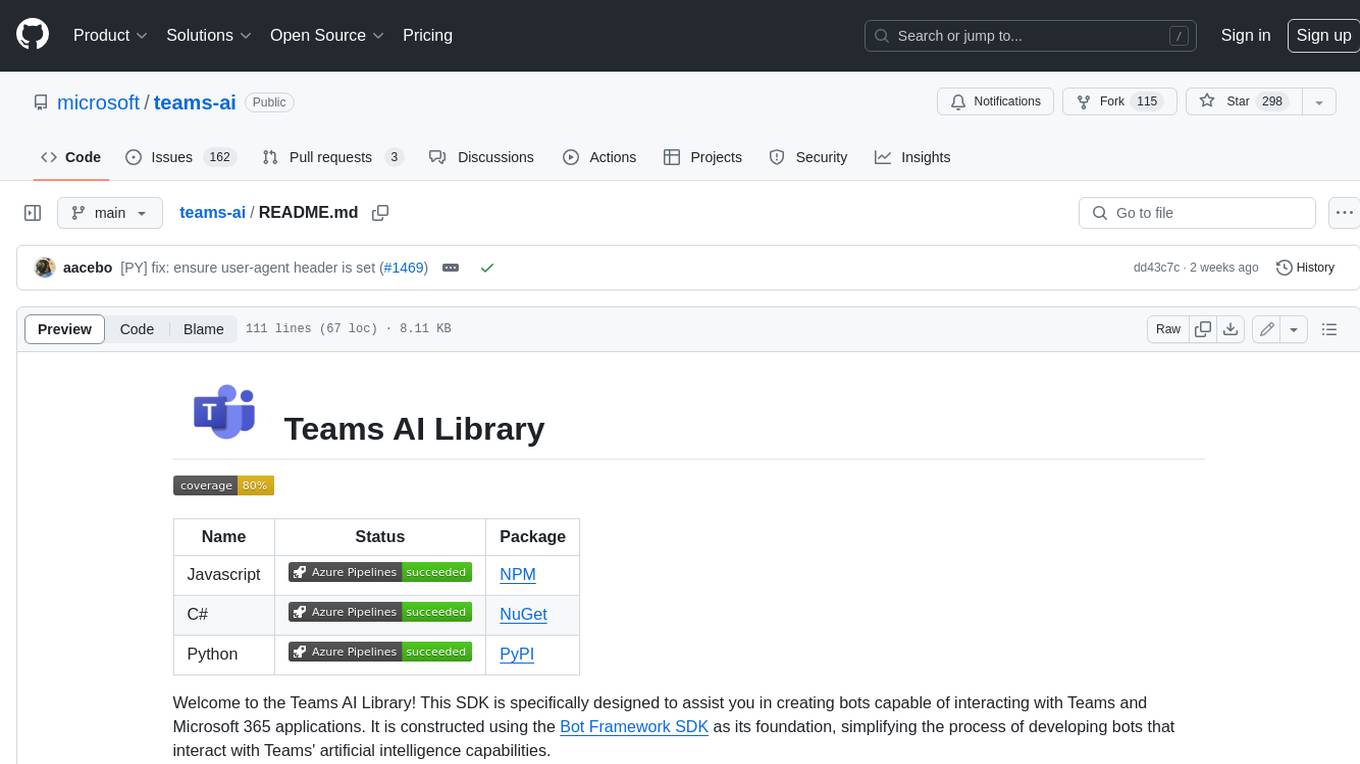
teams-ai
The Teams AI Library is a software development kit (SDK) that helps developers create bots that can interact with Teams and Microsoft 365 applications. It is built on top of the Bot Framework SDK and simplifies the process of developing bots that interact with Teams' artificial intelligence capabilities. The SDK is available for JavaScript/TypeScript, .NET, and Python.
ai-guide
This guide is dedicated to Large Language Models (LLMs) that you can run on your home computer. It assumes your PC is a lower-end, non-gaming setup.
classifai
Supercharge WordPress Content Workflows and Engagement with Artificial Intelligence. Tap into leading cloud-based services like OpenAI, Microsoft Azure AI, Google Gemini and IBM Watson to augment your WordPress-powered websites. Publish content faster while improving SEO performance and increasing audience engagement. ClassifAI integrates Artificial Intelligence and Machine Learning technologies to lighten your workload and eliminate tedious tasks, giving you more time to create original content that matters.
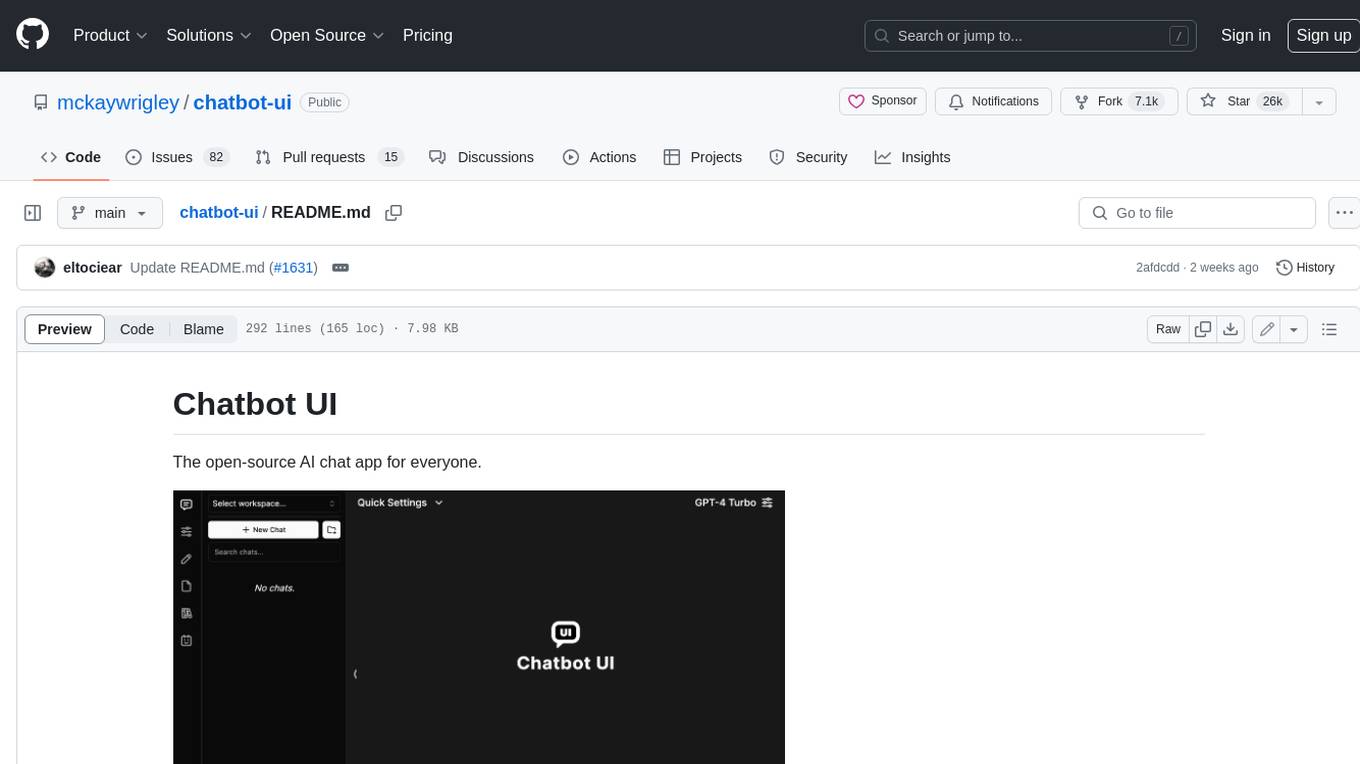
chatbot-ui
Chatbot UI is an open-source AI chat app that allows users to create and deploy their own AI chatbots. It is easy to use and can be customized to fit any need. Chatbot UI is perfect for businesses, developers, and anyone who wants to create a chatbot.
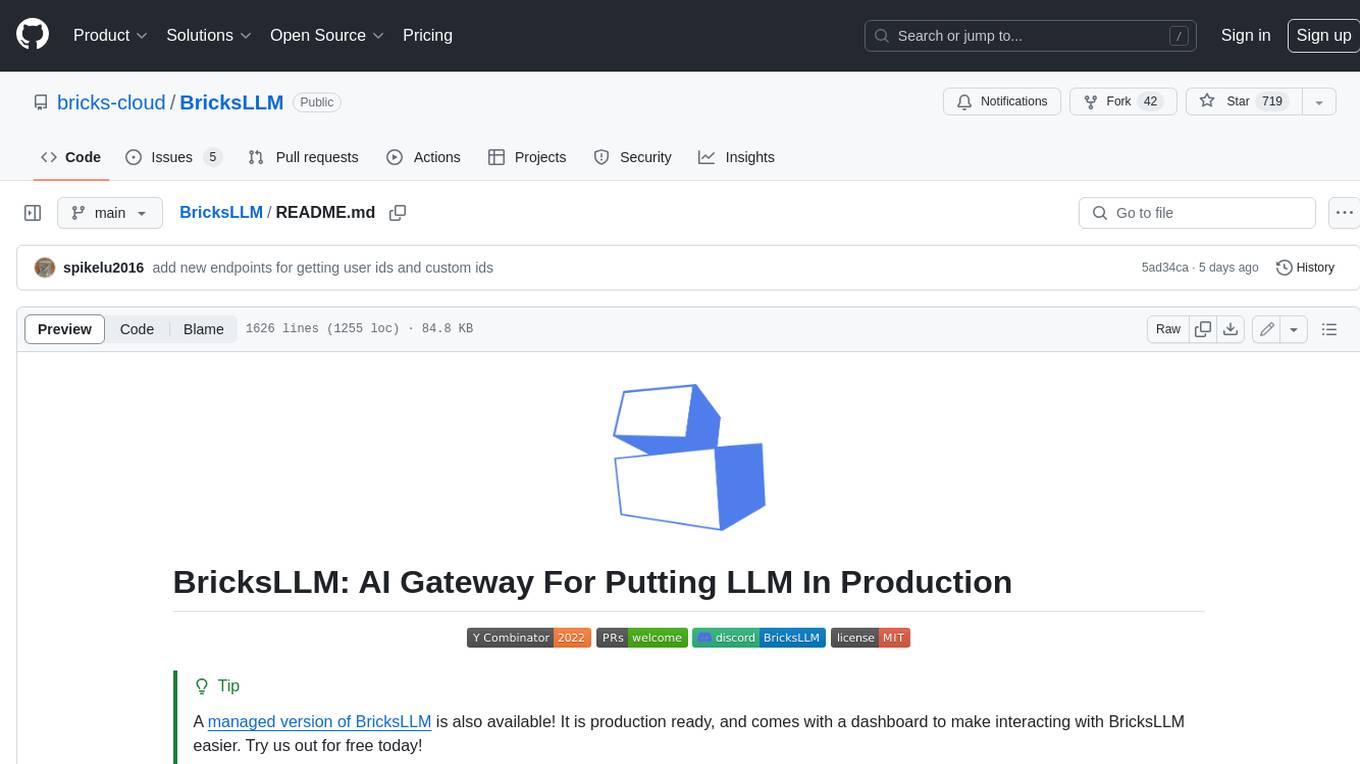
BricksLLM
BricksLLM is a cloud native AI gateway written in Go. Currently, it provides native support for OpenAI, Anthropic, Azure OpenAI and vLLM. BricksLLM aims to provide enterprise level infrastructure that can power any LLM production use cases. Here are some use cases for BricksLLM: * Set LLM usage limits for users on different pricing tiers * Track LLM usage on a per user and per organization basis * Block or redact requests containing PIIs * Improve LLM reliability with failovers, retries and caching * Distribute API keys with rate limits and cost limits for internal development/production use cases * Distribute API keys with rate limits and cost limits for students
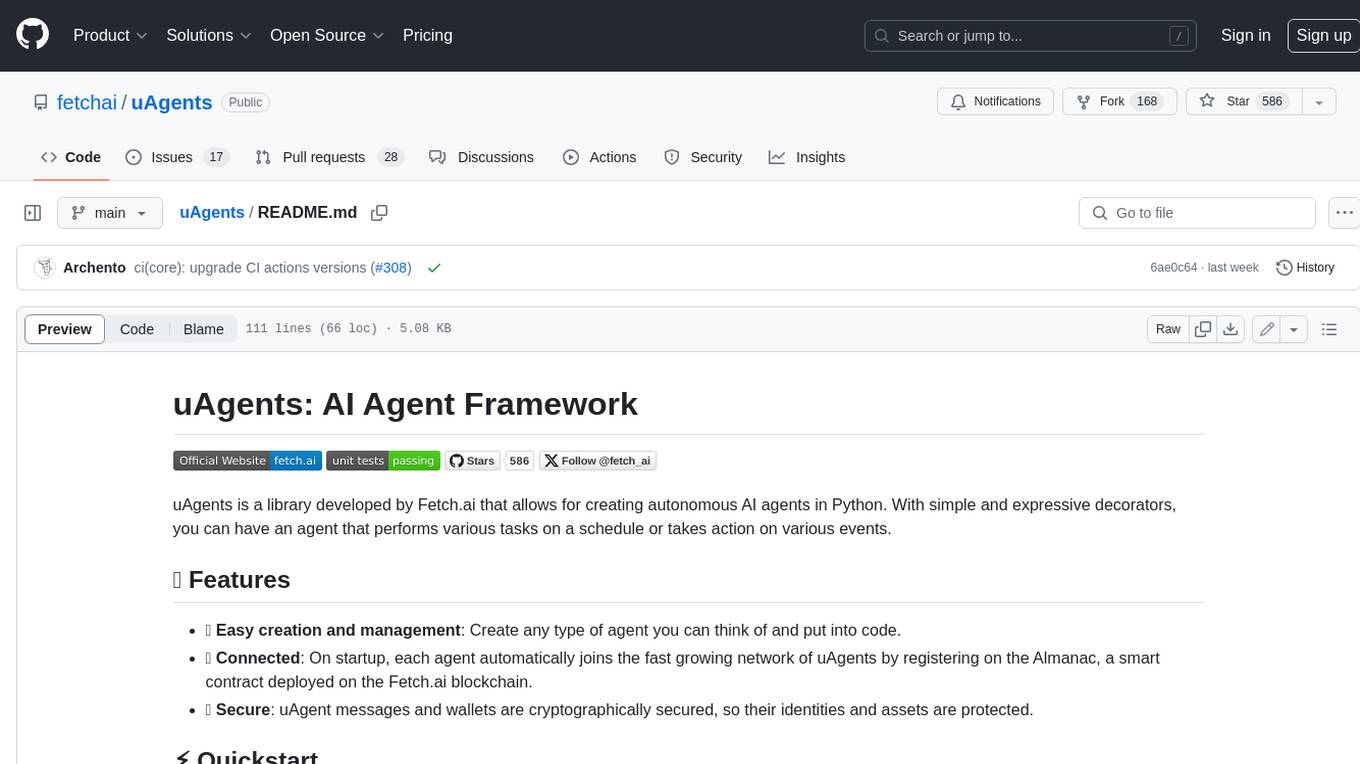
uAgents
uAgents is a Python library developed by Fetch.ai that allows for the creation of autonomous AI agents. These agents can perform various tasks on a schedule or take action on various events. uAgents are easy to create and manage, and they are connected to a fast-growing network of other uAgents. They are also secure, with cryptographically secured messages and wallets.
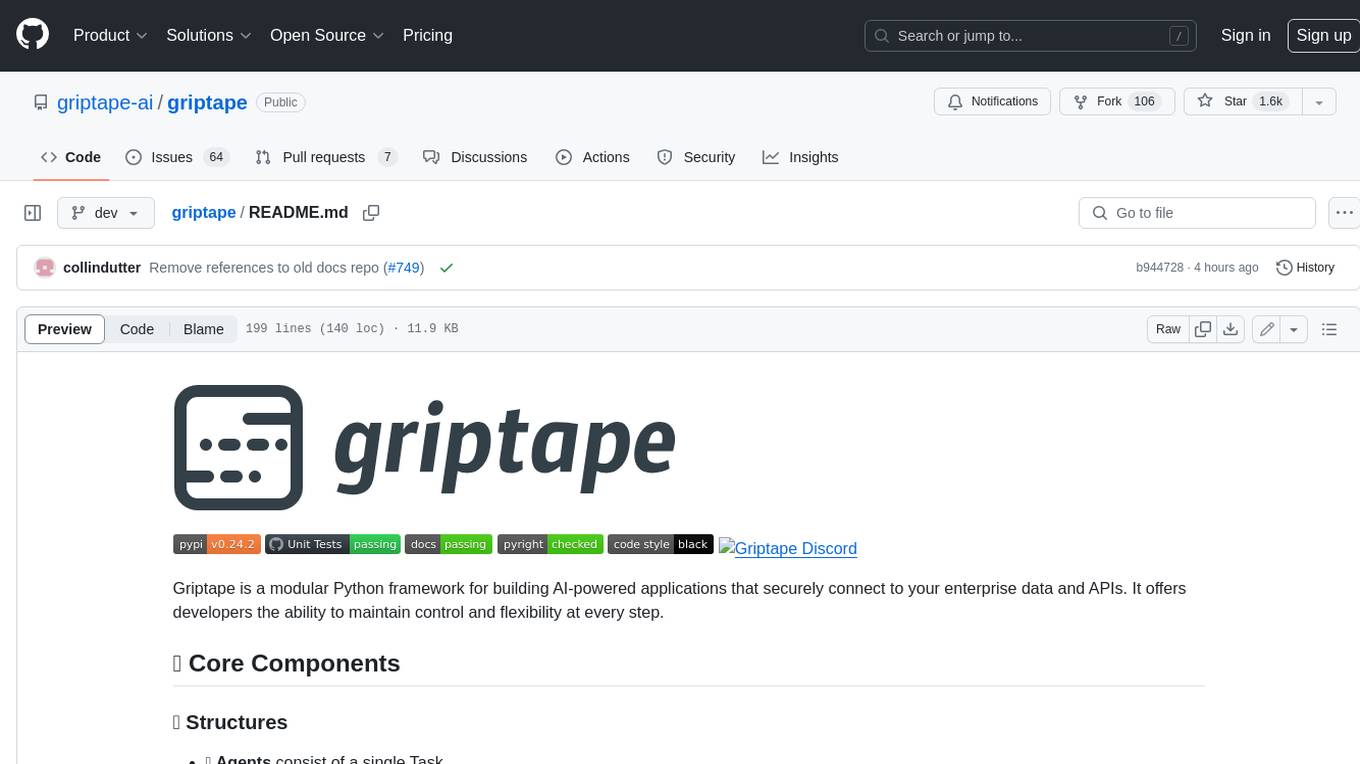
griptape
Griptape is a modular Python framework for building AI-powered applications that securely connect to your enterprise data and APIs. It offers developers the ability to maintain control and flexibility at every step. Griptape's core components include Structures (Agents, Pipelines, and Workflows), Tasks, Tools, Memory (Conversation Memory, Task Memory, and Meta Memory), Drivers (Prompt and Embedding Drivers, Vector Store Drivers, Image Generation Drivers, Image Query Drivers, SQL Drivers, Web Scraper Drivers, and Conversation Memory Drivers), Engines (Query Engines, Extraction Engines, Summary Engines, Image Generation Engines, and Image Query Engines), and additional components (Rulesets, Loaders, Artifacts, Chunkers, and Tokenizers). Griptape enables developers to create AI-powered applications with ease and efficiency.