


flutter-ai-rules
Flutter Rules for Windsurf, Cursor, and Other AI-Powered IDEs
Stars: 472
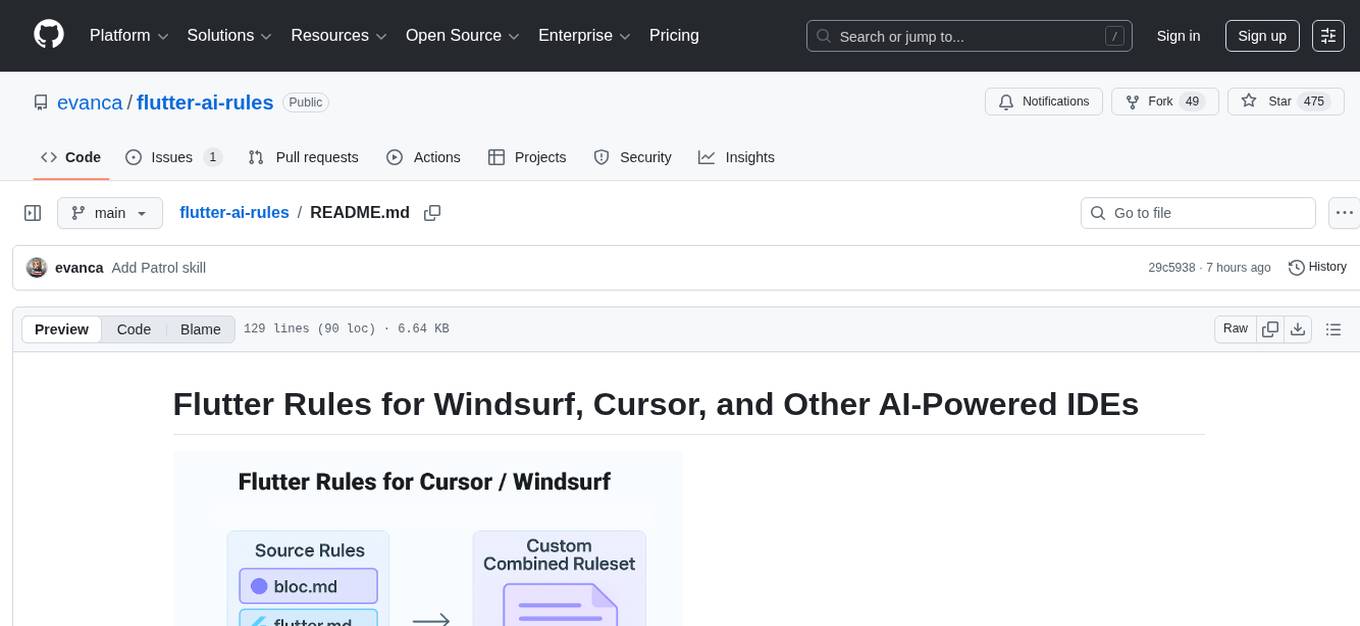
This repository provides a comprehensive collection of Flutter-related rules tailored for use with AI-powered IDEs like Windsurf and Cursor. The rules aim to improve development workflow, ensure consistency, and maximize the benefits of AI coding assistants. Users can choose pre-made combined rules or individual rule files to set up global or local rules configurations in their IDE. The rules are sourced from official documentation to maintain objectivity, and users can contribute by suggesting new rules or improvements following the provided guidelines.
README:

If you want to use .cursor/rules or .windsurfrules, just copy the contents of the rule set of your choice (e.g., combined/flutter_dart__under_6K.md) into your IDE’s global or local rules.
For maximum control, you can also copy the /rules folder into your project and reference rules as needed (e.g., "Read @rules/firebase/ and set up a project with Realtime Database, App Check, and Analytics.").
This repository provides a comprehensive, (almost) non-opinionated collection of Flutter-related rules tailored for use with Windsurf, Cursor, and other AI-powered IDEs. These rules are designed to improve your development workflow, ensure consistency, and help you get the most out of your AI coding assistant.
-
skills/
NEW! Skills are an open standard for extending agent capabilities. A skill is a folder containing aSKILL.mdfile with instructions that the agent can follow when working on specific tasks. They are essentially what “dynamic rules” used to be — applied automatically when the agent determines they are relevant based on the description.Copy or symlink any skill folder into
.cursor/skills/,.agent/skills/, or another supported location. -
rules/
Contains individual rule files, each focused on a specific topic or tool (e.g.,bloc.md,effective_dart.md, etc.).
These files are:- Based only on official documentation from Flutter, Dart, or relevant package websites.
- Categorized by subject to make them easy to mix, match, and reference.
- Meant to be refined, adjusted, or extracted based on your project needs.
-
combined/
Contains pre-made, curated sets of rules that combine commonly used topics (e.g., Flutter + Riverpod + Mockito).
These files:- Are kept under 6,000 characters to comply with Windsurf's limit.
- Can be used as-is by copying them into your global or local rules configuration.
If you want a quick setup:
- Browse the
combined/folder. - Copy a file that suits your project.
- Paste it into your IDE's global or local rules config.
- You're ready to go.
If you prefer more control:
- Browse the
rules/folder. - Pick files relevant to your project (e.g.,
riverpod.md,bloc.md, etc.). - You can:
- Include them directly in your IDE setup.
- Reference them in prompts to add context.
- Extract only the parts that are useful for your context.
- Include them partially or fully in a PRD (Product Requirements Document).


Everything is modular — use what works best for you.
You can fetch the latest rules directly into your project with a single command:
git clone --depth 1 https://github.com/evanca/flutter-ai-rules.git temp_repo && mkdir -p docs && cp -r temp_repo/rules/* docs && rm -rf temp_repoThis will copy all rules into a docs folder in your project. After all rules are in the docs folder, you can reference them individually based on your needs—without the limitations of IDE ruleset length. Simply use them as context where applicable. For example:
“Read @docs/bloc.md and create test coverage for new methods.”
Pro tip:
You can also add a global rule that references this docs folder. For example, in your global rules or settings, you might write:
“We have a /docs folder containing various rules based on Flutter and Dart documentation.”
All rules are sourced from official documentation — no personal preferences or subjective interpretations. That’s intentional. You’re free to alter them to your taste, but this repo keeps things objective by sticking to the source.
Note: This might sometimes lead to contradictory rules (e.g., if one package suggests one folder architecture and another recommends a different one).
- Set up global rules for a Flutter project in your IDE.
- Configure project-specific constraints for popular state management packages.
- Provide clear expectations in a PDR when working with a team.
- Extract only what you need to avoid rule clutter.
Contributions are welcome! If you'd like to suggest a new rule or improve an existing one, here’s how you can help:
- Fork this repository.
- Add or modify rules in the appropriate folder.
- Submit a pull request with a clear explanation of your changes.
Make sure to include an official documentation link for any rule set you’re adding or modifying to keep everything objective and reliable.
Here are the official sources that have been used to build these rules:
- Flutter App Architecture - Official Flutter architecture guidelines
- Flutter Common Errors - Common errors documentation
- Flutter ChangeNotifier State Management - Simple state management with ChangeNotifier
- Effective Dart - Official Dart style guidelines
- Dart 3 Updates - Documentation on Dart 3 features including:
- Bloc Library - Official Bloc library documentation
- Provider - Official Provider package documentation
- Riverpod - Official Riverpod documentation
- Firebase for Flutter - Official Firebase Flutter documentation
- Code with Andrea - How to Setup Flutter & Firebase with Multiple Flavors using the FlutterFire CLI
For Tasks:
Click tags to check more tools for each tasksFor Jobs:
Alternative AI tools for flutter-ai-rules
Similar Open Source Tools
flutter-ai-rules
This repository provides a comprehensive collection of Flutter-related rules tailored for use with AI-powered IDEs like Windsurf and Cursor. The rules aim to improve development workflow, ensure consistency, and maximize the benefits of AI coding assistants. Users can choose pre-made combined rules or individual rule files to set up global or local rules configurations in their IDE. The rules are sourced from official documentation to maintain objectivity, and users can contribute by suggesting new rules or improvements following the provided guidelines.

cognita
Cognita is an open-source framework to organize your RAG codebase along with a frontend to play around with different RAG customizations. It provides a simple way to organize your codebase so that it becomes easy to test it locally while also being able to deploy it in a production ready environment. The key issues that arise while productionizing RAG system from a Jupyter Notebook are: 1. **Chunking and Embedding Job** : The chunking and embedding code usually needs to be abstracted out and deployed as a job. Sometimes the job will need to run on a schedule or be trigerred via an event to keep the data updated. 2. **Query Service** : The code that generates the answer from the query needs to be wrapped up in a api server like FastAPI and should be deployed as a service. This service should be able to handle multiple queries at the same time and also autoscale with higher traffic. 3. **LLM / Embedding Model Deployment** : Often times, if we are using open-source models, we load the model in the Jupyter notebook. This will need to be hosted as a separate service in production and model will need to be called as an API. 4. **Vector DB deployment** : Most testing happens on vector DBs in memory or on disk. However, in production, the DBs need to be deployed in a more scalable and reliable way. Cognita makes it really easy to customize and experiment everything about a RAG system and still be able to deploy it in a good way. It also ships with a UI that makes it easier to try out different RAG configurations and see the results in real time. You can use it locally or with/without using any Truefoundry components. However, using Truefoundry components makes it easier to test different models and deploy the system in a scalable way. Cognita allows you to host multiple RAG systems using one app. ### Advantages of using Cognita are: 1. A central reusable repository of parsers, loaders, embedders and retrievers. 2. Ability for non-technical users to play with UI - Upload documents and perform QnA using modules built by the development team. 3. Fully API driven - which allows integration with other systems. > If you use Cognita with Truefoundry AI Gateway, you can get logging, metrics and feedback mechanism for your user queries. ### Features: 1. Support for multiple document retrievers that use `Similarity Search`, `Query Decompostion`, `Document Reranking`, etc 2. Support for SOTA OpenSource embeddings and reranking from `mixedbread-ai` 3. Support for using LLMs using `Ollama` 4. Support for incremental indexing that ingests entire documents in batches (reduces compute burden), keeps track of already indexed documents and prevents re-indexing of those docs.
draive
draive is an open-source Python library designed to simplify and accelerate the development of LLM-based applications. It offers abstract building blocks for connecting functionalities with large language models, flexible integration with various AI solutions, and a user-friendly framework for building scalable data processing pipelines. The library follows a function-oriented design, allowing users to represent complex programs as simple functions. It also provides tools for measuring and debugging functionalities, ensuring type safety and efficient asynchronous operations for modern Python apps.
testzeus-hercules
Hercules is the world’s first open-source testing agent designed to handle the toughest testing tasks for modern web applications. It turns simple Gherkin steps into fully automated end-to-end tests, making testing simple, reliable, and efficient. Hercules adapts to various platforms like Salesforce and is suitable for CI/CD pipelines. It aims to democratize and disrupt test automation, making top-tier testing accessible to everyone. The tool is transparent, reliable, and community-driven, empowering teams to deliver better software. Hercules offers multiple ways to get started, including using PyPI package, Docker, or building and running from source code. It supports various AI models, provides detailed installation and usage instructions, and integrates with Nuclei for security testing and WCAG for accessibility testing. The tool is production-ready, open core, and open source, with plans for enhanced LLM support, advanced tooling, improved DOM distillation, community contributions, extensive documentation, and a bounty program.
open-source-slack-ai
This repository provides a ready-to-run basic Slack AI solution that allows users to summarize threads and channels using OpenAI. Users can generate thread summaries, channel overviews, channel summaries since a specific time, and full channel summaries. The tool is powered by GPT-3.5-Turbo and an ensemble of NLP models. It requires Python 3.8 or higher, an OpenAI API key, Slack App with associated API tokens, Poetry package manager, and ngrok for local development. Users can customize channel and thread summaries, run tests with coverage using pytest, and contribute to the project for future enhancements.
AI-Scientist
The AI Scientist is a comprehensive system for fully automatic scientific discovery, enabling Foundation Models to perform research independently. It aims to tackle the grand challenge of developing agents capable of conducting scientific research and discovering new knowledge. The tool generates papers on various topics using Large Language Models (LLMs) and provides a platform for exploring new research ideas. Users can create their own templates for specific areas of study and run experiments to generate papers. However, caution is advised as the codebase executes LLM-written code, which may pose risks such as the use of potentially dangerous packages and web access.
uAgents
uAgents is a Python library developed by Fetch.ai that allows for the creation of autonomous AI agents. These agents can perform various tasks on a schedule or take action on various events. uAgents are easy to create and manage, and they are connected to a fast-growing network of other uAgents. They are also secure, with cryptographically secured messages and wallets.
CoolCline
CoolCline is a proactive programming assistant that combines the best features of Cline, Roo Code, and Bao Cline. It seamlessly collaborates with your command line interface and editor, providing the most powerful AI development experience. It optimizes queries, allows quick switching of LLM Providers, and offers auto-approve options for actions. Users can configure LLM Providers, select different chat modes, perform file and editor operations, integrate with the command line, automate browser tasks, and extend capabilities through the Model Context Protocol (MCP). Context mentions help provide explicit context, and installation is easy through the editor's extension panel or by dragging and dropping the `.vsix` file. Local setup and development instructions are available for contributors.
tribe
Tribe AI is a low code tool designed to rapidly build and coordinate multi-agent teams. It leverages the langgraph framework to customize and coordinate teams of agents, allowing tasks to be split among agents with different strengths for faster and better problem-solving. The tool supports persistent conversations, observability, tool calling, human-in-the-loop functionality, easy deployment with Docker, and multi-tenancy for managing multiple users and teams.
ai_automation_suggester
An integration for Home Assistant that leverages AI models to understand your unique home environment and propose intelligent automations. By analyzing your entities, devices, areas, and existing automations, the AI Automation Suggester helps you discover new, context-aware use cases you might not have considered, ultimately streamlining your home management and improving efficiency, comfort, and convenience. The tool acts as a personal automation consultant, providing actionable YAML-based automations that can save energy, improve security, enhance comfort, and reduce manual intervention. It turns the complexity of a large Home Assistant environment into actionable insights and tangible benefits.
crawlee-python
Crawlee-python is a web scraping and browser automation library that covers crawling and scraping end-to-end, helping users build reliable scrapers fast. It allows users to crawl the web for links, scrape data, and store it in machine-readable formats without worrying about technical details. With rich configuration options, users can customize almost any aspect of Crawlee to suit their project's needs.
agentok
Agentok Studio is a visual tool built for AutoGen, a cutting-edge agent framework from Microsoft and various contributors. It offers intuitive visual tools to simplify the construction and management of complex agent-based workflows. Users can create workflows visually as graphs, chat with agents, and share flow templates. The tool is designed to streamline the development process for creators and developers working on next-generation Multi-Agent Applications.
WDoc
WDoc is a powerful Retrieval-Augmented Generation (RAG) system designed to summarize, search, and query documents across various file types. It supports querying tens of thousands of documents simultaneously, offers tailored summaries to efficiently manage large amounts of information, and includes features like supporting multiple file types, various LLMs, local and private LLMs, advanced RAG capabilities, advanced summaries, trust verification, markdown formatted answers, sophisticated embeddings, extensive documentation, scriptability, type checking, lazy imports, caching, fast processing, shell autocompletion, notification callbacks, and more. WDoc is ideal for researchers, students, and professionals dealing with extensive information sources.
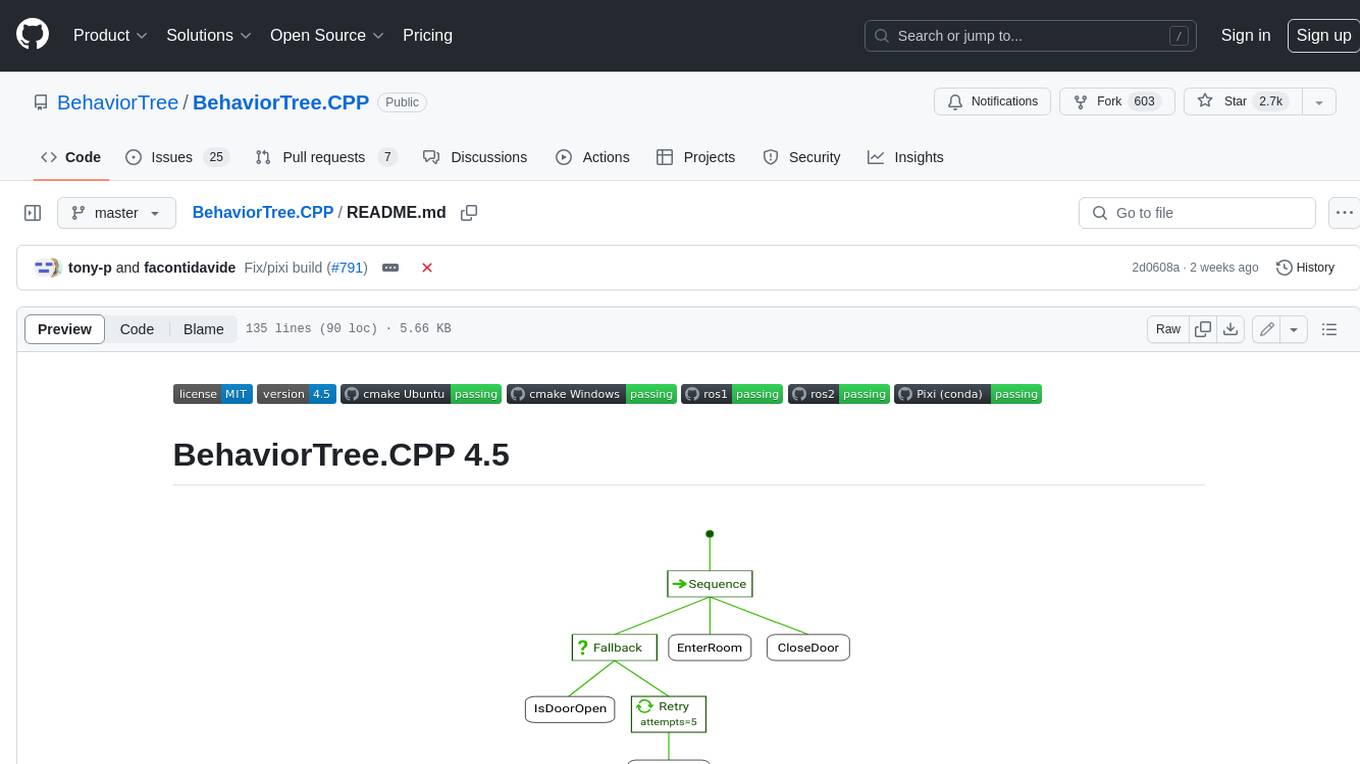
BehaviorTree.CPP
BehaviorTree.CPP is a C++ 17 library that provides a framework to create BehaviorTrees. It was designed to be flexible, easy to use, reactive and fast. Even if our main use-case is robotics, you can use this library to build AI for games, or to replace Finite State Machines. There are few features which make BehaviorTree.CPP unique, when compared to other implementations: It makes asynchronous Actions, i.e. non-blocking, a first-class citizen. You can build reactive behaviors that execute multiple Actions concurrently (orthogonality). Trees are defined using a Domain Specific scripting language (based on XML), and can be loaded at run-time; in other words, even if written in C++, the morphology of the Trees is not hard-coded. You can statically link your custom TreeNodes or convert them into plugins and load them at run-time. It provides a type-safe and flexible mechanism to do Dataflow between Nodes of the Tree. It includes a logging/profiling infrastructure that allows the user to visualize, record, replay and analyze state transitions.
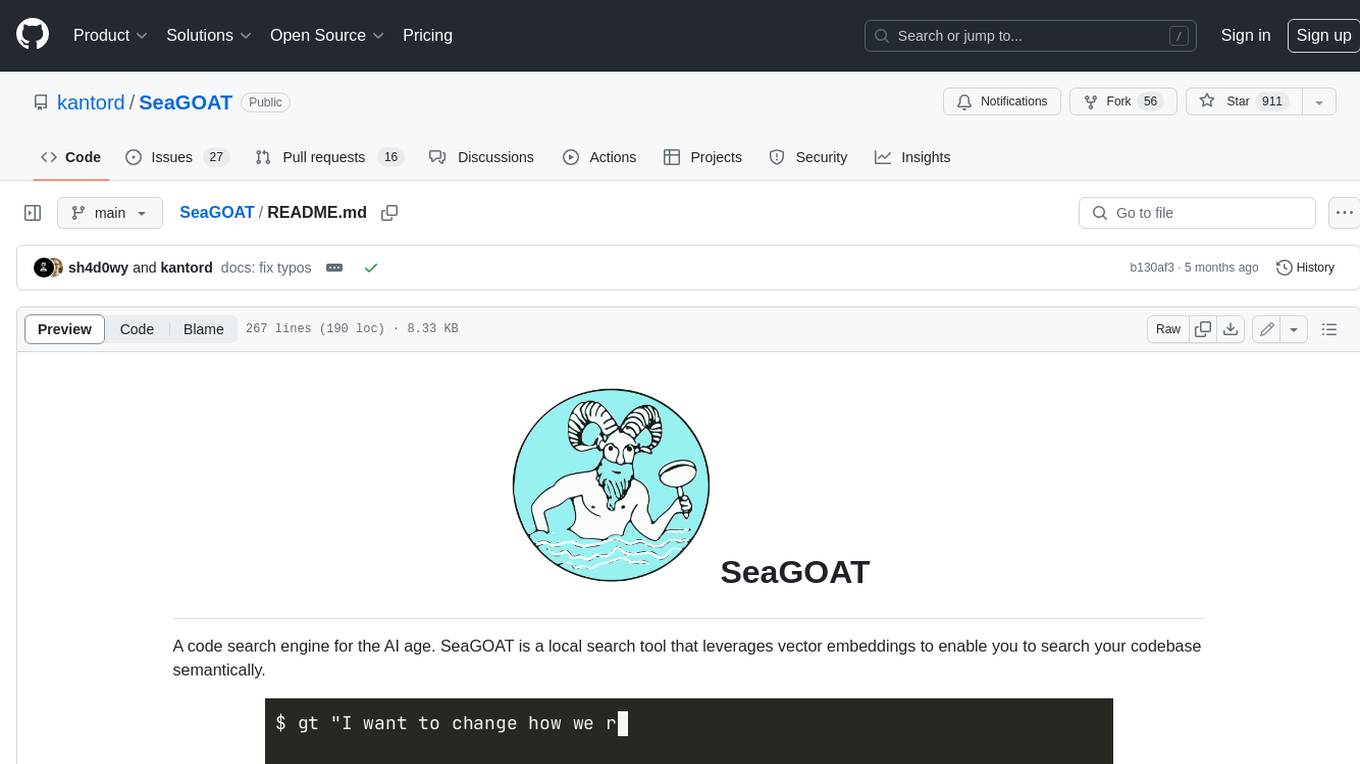
SeaGOAT
SeaGOAT is a local search tool that leverages vector embeddings to enable you to search your codebase semantically. It is designed to work on Linux, macOS, and Windows and can process files in various formats, including text, Markdown, Python, C, C++, TypeScript, JavaScript, HTML, Go, Java, PHP, and Ruby. SeaGOAT uses a vector database called ChromaDB and a local vector embedding engine to provide fast and accurate search results. It also supports regular expression/keyword-based matches. SeaGOAT is open-source and licensed under an open-source license, and users are welcome to examine the source code, raise concerns, or create pull requests to fix problems.
promptflow
**Prompt flow** is a suite of development tools designed to streamline the end-to-end development cycle of LLM-based AI applications, from ideation, prototyping, testing, evaluation to production deployment and monitoring. It makes prompt engineering much easier and enables you to build LLM apps with production quality.
For similar tasks
flutter-ai-rules
This repository provides a comprehensive collection of Flutter-related rules tailored for use with AI-powered IDEs like Windsurf and Cursor. The rules aim to improve development workflow, ensure consistency, and maximize the benefits of AI coding assistants. Users can choose pre-made combined rules or individual rule files to set up global or local rules configurations in their IDE. The rules are sourced from official documentation to maintain objectivity, and users can contribute by suggesting new rules or improvements following the provided guidelines.
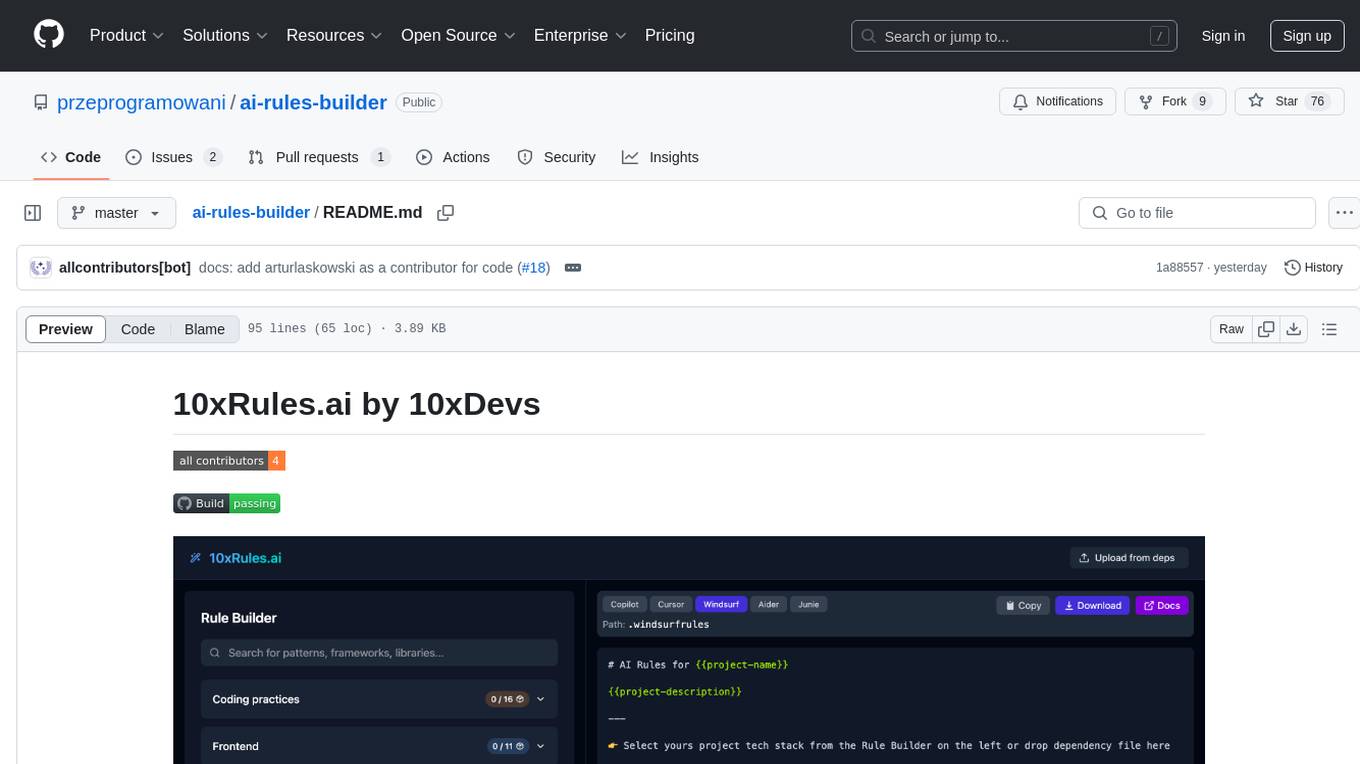
ai-rules-builder
10xRules.ai is a web application that allows developers to create customized rule sets for AI tools like GitHub Copilot, Cursor, and Windsurf through an interactive, visual interface. Users can easily export rules, smartly import rules from package.json or requirements.txt files, and contribute new rules following specific guidelines for effectiveness and industry standards.
For similar jobs
promptflow
**Prompt flow** is a suite of development tools designed to streamline the end-to-end development cycle of LLM-based AI applications, from ideation, prototyping, testing, evaluation to production deployment and monitoring. It makes prompt engineering much easier and enables you to build LLM apps with production quality.
deepeval
DeepEval is a simple-to-use, open-source LLM evaluation framework specialized for unit testing LLM outputs. It incorporates various metrics such as G-Eval, hallucination, answer relevancy, RAGAS, etc., and runs locally on your machine for evaluation. It provides a wide range of ready-to-use evaluation metrics, allows for creating custom metrics, integrates with any CI/CD environment, and enables benchmarking LLMs on popular benchmarks. DeepEval is designed for evaluating RAG and fine-tuning applications, helping users optimize hyperparameters, prevent prompt drifting, and transition from OpenAI to hosting their own Llama2 with confidence.
MegaDetector
MegaDetector is an AI model that identifies animals, people, and vehicles in camera trap images (which also makes it useful for eliminating blank images). This model is trained on several million images from a variety of ecosystems. MegaDetector is just one of many tools that aims to make conservation biologists more efficient with AI. If you want to learn about other ways to use AI to accelerate camera trap workflows, check out our of the field, affectionately titled "Everything I know about machine learning and camera traps".
leapfrogai
LeapfrogAI is a self-hosted AI platform designed to be deployed in air-gapped resource-constrained environments. It brings sophisticated AI solutions to these environments by hosting all the necessary components of an AI stack, including vector databases, model backends, API, and UI. LeapfrogAI's API closely matches that of OpenAI, allowing tools built for OpenAI/ChatGPT to function seamlessly with a LeapfrogAI backend. It provides several backends for various use cases, including llama-cpp-python, whisper, text-embeddings, and vllm. LeapfrogAI leverages Chainguard's apko to harden base python images, ensuring the latest supported Python versions are used by the other components of the stack. The LeapfrogAI SDK provides a standard set of protobuffs and python utilities for implementing backends and gRPC. LeapfrogAI offers UI options for common use-cases like chat, summarization, and transcription. It can be deployed and run locally via UDS and Kubernetes, built out using Zarf packages. LeapfrogAI is supported by a community of users and contributors, including Defense Unicorns, Beast Code, Chainguard, Exovera, Hypergiant, Pulze, SOSi, United States Navy, United States Air Force, and United States Space Force.
llava-docker
This Docker image for LLaVA (Large Language and Vision Assistant) provides a convenient way to run LLaVA locally or on RunPod. LLaVA is a powerful AI tool that combines natural language processing and computer vision capabilities. With this Docker image, you can easily access LLaVA's functionalities for various tasks, including image captioning, visual question answering, text summarization, and more. The image comes pre-installed with LLaVA v1.2.0, Torch 2.1.2, xformers 0.0.23.post1, and other necessary dependencies. You can customize the model used by setting the MODEL environment variable. The image also includes a Jupyter Lab environment for interactive development and exploration. Overall, this Docker image offers a comprehensive and user-friendly platform for leveraging LLaVA's capabilities.

carrot
The 'carrot' repository on GitHub provides a list of free and user-friendly ChatGPT mirror sites for easy access. The repository includes sponsored sites offering various GPT models and services. Users can find and share sites, report errors, and access stable and recommended sites for ChatGPT usage. The repository also includes a detailed list of ChatGPT sites, their features, and accessibility options, making it a valuable resource for ChatGPT users seeking free and unlimited GPT services.
TrustLLM
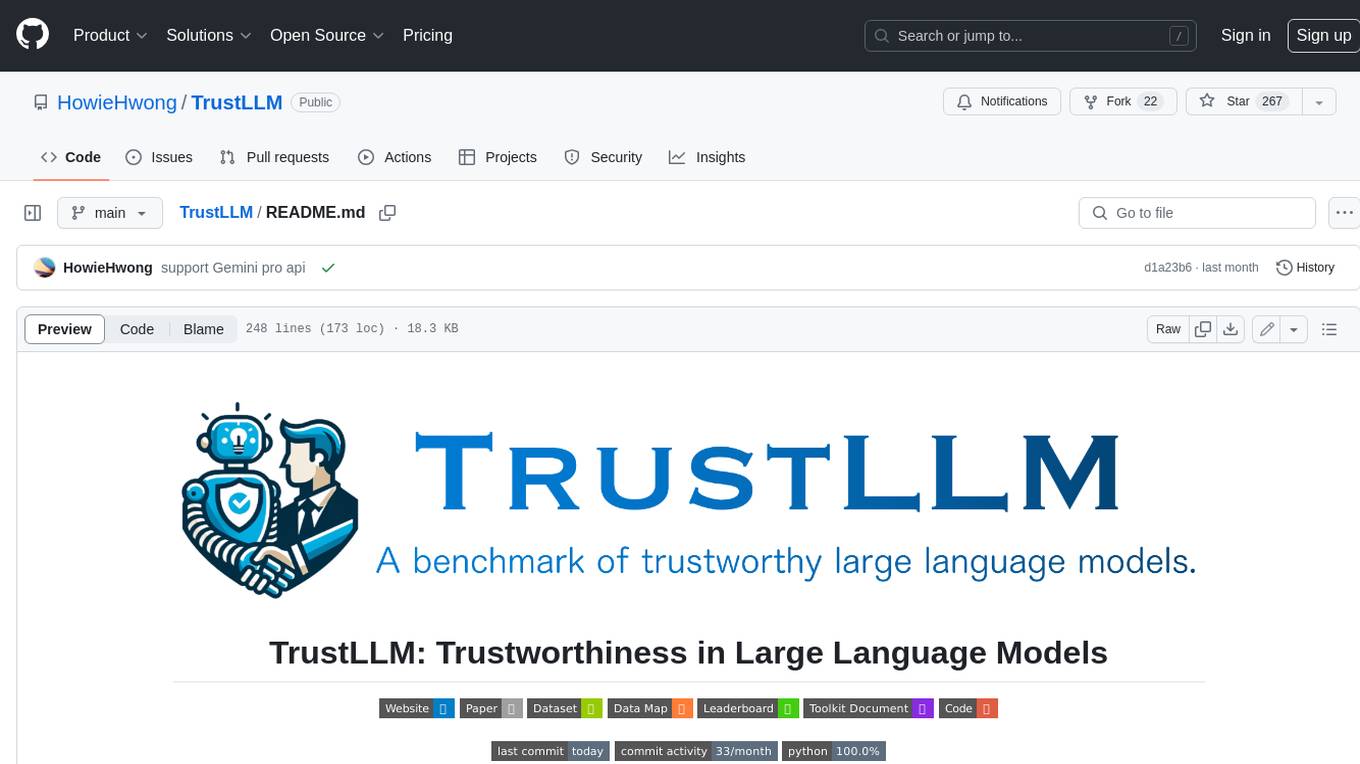
TrustLLM is a comprehensive study of trustworthiness in LLMs, including principles for different dimensions of trustworthiness, established benchmark, evaluation, and analysis of trustworthiness for mainstream LLMs, and discussion of open challenges and future directions. Specifically, we first propose a set of principles for trustworthy LLMs that span eight different dimensions. Based on these principles, we further establish a benchmark across six dimensions including truthfulness, safety, fairness, robustness, privacy, and machine ethics. We then present a study evaluating 16 mainstream LLMs in TrustLLM, consisting of over 30 datasets. The document explains how to use the trustllm python package to help you assess the performance of your LLM in trustworthiness more quickly. For more details about TrustLLM, please refer to project website.
AI-YinMei
AI-YinMei is an AI virtual anchor Vtuber development tool (N card version). It supports fastgpt knowledge base chat dialogue, a complete set of solutions for LLM large language models: [fastgpt] + [one-api] + [Xinference], supports docking bilibili live broadcast barrage reply and entering live broadcast welcome speech, supports Microsoft edge-tts speech synthesis, supports Bert-VITS2 speech synthesis, supports GPT-SoVITS speech synthesis, supports expression control Vtuber Studio, supports painting stable-diffusion-webui output OBS live broadcast room, supports painting picture pornography public-NSFW-y-distinguish, supports search and image search service duckduckgo (requires magic Internet access), supports image search service Baidu image search (no magic Internet access), supports AI reply chat box [html plug-in], supports AI singing Auto-Convert-Music, supports playlist [html plug-in], supports dancing function, supports expression video playback, supports head touching action, supports gift smashing action, supports singing automatic start dancing function, chat and singing automatic cycle swing action, supports multi scene switching, background music switching, day and night automatic switching scene, supports open singing and painting, let AI automatically judge the content.