


dreamfactory
DreamFactory is a secure, self-hosted enterprise data access platform that provides governed API access to any data source, connecting enterprise applications and on-prem LLMs with role-based access and identity passthrough.
Stars: 1735
DreamFactory is a self-hosted platform that provides governed API access to any data source for enterprise apps and local LLMs. It is a secure enterprise data access platform built on top of the Laravel framework, offering role-based access control, identity passthrough, and customization of API behavior using PHP, Python, and NodeJS scripting languages. DreamFactory allows users to generate powerful APIs for SQL and NoSQL databases, files, email, and push notifications in seconds, while ensuring security with features like user management, SSO authentication, OAuth, and Active Directory integration.
README:
DreamFactory is a self-hosted platform providing governed API access to any data source for enterprise apps and local LLMs.
Getting Started Guide ∙ Try Online ∙ Contribute ∙ Community Support ∙ Docs








- Platform Overview
- Installation Options
- DreamFactory's Cloud Playground
- Documentation
- Support Options
- Commercial Licenses
- Feedback
DreamFactory is a secure, self-hosted enterprise data access platform that provides governed API access to any data source, connecting enterprise applications and on-prem LLMs with role-based access and identity passthrough.
DreamFactory is built on top of the Laravel framework, and includes a convenient web-based administration client. So what can you do with DreamFactory?
- Generate powerful, reusable, documented APIs for SQL and NoSQL databases, files, email, push notifications and more in seconds.
- Use the PHP, Python, and NodeJS scripting languages to easily customize API behavior at any endpoint, for both API requests and API responses.
- Secure every API endpoint with user management, SSO authentication, role-based access control, OAuth and Active Directory integration.
- Install DreamFactory and all of the required dependencies in less than 5 minutes using our installers for CentOS/RHEL, Debian, Fedora, and Ubuntu.
- Docker provides a Docker compose image or you can build your own.
- NPX Installer: Our Node NPX installer can have you up and running in minutes, and even includes optional installation of our MCP server and a PostgreSQL test database filled with realistic data.
- Our Helm chart provides a convenient way to install DreamFactory within your Kubernetes cluster.
- Raspberry Pi allows you to configure DreamFactory on everybody's favorite tiny computer.
Contact us for more information if you're interested in a feature complete version (whether hosted in our cloud environment or on-premise). Or just spin up a playground instance right now!
Start testing for free with our cloud playground now by creating a DreamFactory instance here.
Learn more about DreamFactory's many features by reading our Getting Started Guide. Additional platform documentation can be found on the DreamFactory wiki.
 |
 |
 |
|---|---|---|
Ask and answer StackOverflow questions with the dreamfactory tag
|
Check out our Docs, Wiki, and Guide for various examples and tutorials | Tweet to @dfsoftwareinc or with the #dreamfactory hashtag
|
In need of official technical support? Desire access to REST API wrappers for SQL Server, Oracle, SOAP, or Snowflake? Require API limiting and/or auditing? Looking to extend the capabilites of your existing APIs? Schedule a demo with our team!
Feedback is welcome on our forum or in the form of pull requests and/or issues. Contributions should follow the strategy outlined in "Contributing to a project".
For Tasks:
Click tags to check more tools for each tasksFor Jobs:
Alternative AI tools for dreamfactory
Similar Open Source Tools
dreamfactory
DreamFactory is a self-hosted platform that provides governed API access to any data source for enterprise apps and local LLMs. It is a secure enterprise data access platform built on top of the Laravel framework, offering role-based access control, identity passthrough, and customization of API behavior using PHP, Python, and NodeJS scripting languages. DreamFactory allows users to generate powerful APIs for SQL and NoSQL databases, files, email, and push notifications in seconds, while ensuring security with features like user management, SSO authentication, OAuth, and Active Directory integration.
buildel
Buildel is an AI automation platform that empowers users to create versatile workflows without writing code. It supports multiple providers and interfaces, offers pre-built use cases, and allows users to bring their own API keys. Ideal for AI-powered document retrieval, conversational interfaces, and data integration. Users can get started at app.buildel.ai or run Buildel locally with Node.js, Elixir/Erlang, Docker, Git, and JQ installed. Join the community on Discord for support and discussions.

DocsGPT
DocsGPT is an open-source documentation assistant powered by GPT models. It simplifies the process of searching for information in project documentation by allowing developers to ask questions and receive accurate answers. With DocsGPT, users can say goodbye to manual searches and quickly find the information they need. The tool aims to revolutionize project documentation experiences and offers features like live previews, Discord community, guides, and contribution opportunities. It consists of a Flask app, Chrome extension, similarity search index creation script, and a frontend built with Vite and React. Users can quickly get started with DocsGPT by following the provided setup instructions and can contribute to its development by following the guidelines in the CONTRIBUTING.md file. The project follows a Code of Conduct to ensure a harassment-free community environment for all participants. DocsGPT is licensed under MIT and is built with LangChain.
toolhive-studio
ToolHive Studio is an experimental project under active development and testing, providing an easy way to discover, deploy, and manage Model Context Protocol (MCP) servers securely. Users can launch any MCP server in a locked-down container with just a few clicks, eliminating manual setup, security concerns, and runtime issues. The tool ensures instant deployment, default security measures, cross-platform compatibility, and seamless integration with popular clients like GitHub Copilot, Cursor, and Claude Code.
devopness
Devopness is a tool that simplifies the management of cloud applications and multi-cloud infrastructure for both AI agents and humans. It provides role-based access control, permission management, cost control, and visibility into DevOps and CI/CD workflows. The tool allows provisioning and deployment to major cloud providers like AWS, Azure, DigitalOcean, and GCP. Devopness aims to make software deployment and cloud infrastructure management accessible and affordable to all involved in software projects.
baserow
Baserow is a secure, open-source platform that allows users to build databases, applications, automations, and AI agents without writing any code. With enterprise-grade security compliance and both cloud and self-hosted deployment options, Baserow empowers teams to structure data, automate processes, create internal tools, and build custom dashboards. It features a spreadsheet database hybrid, AI Assistant for natural language database creation, GDPR, HIPAA, and SOC 2 Type II compliance, and seamless integration with existing tools. Baserow is API-first, extensible, and uses frameworks like Django, Vue.js, and PostgreSQL.
taipy
Taipy is an open-source Python library for easy, end-to-end application development, featuring what-if analyses, smart pipeline execution, built-in scheduling, and deployment tools.
dify
Dify is an open-source LLM app development platform that combines AI workflow, RAG pipeline, agent capabilities, model management, observability features, and more. It allows users to quickly go from prototype to production. Key features include: 1. Workflow: Build and test powerful AI workflows on a visual canvas. 2. Comprehensive model support: Seamless integration with hundreds of proprietary / open-source LLMs from dozens of inference providers and self-hosted solutions. 3. Prompt IDE: Intuitive interface for crafting prompts, comparing model performance, and adding additional features. 4. RAG Pipeline: Extensive RAG capabilities that cover everything from document ingestion to retrieval. 5. Agent capabilities: Define agents based on LLM Function Calling or ReAct, and add pre-built or custom tools. 6. LLMOps: Monitor and analyze application logs and performance over time. 7. Backend-as-a-Service: All of Dify's offerings come with corresponding APIs for easy integration into your own business logic.
appwrite
Appwrite is a best-in-class, developer-first platform that provides everything needed to create scalable, stable, and production-ready software quickly. It is an end-to-end platform for building Web, Mobile, Native, or Backend apps, packaged as Docker microservices. Appwrite abstracts the complexity of building modern apps and allows users to build secure, full-stack applications faster. It offers features like user authentication, database management, storage, file management, image manipulation, Cloud Functions, messaging, and more services.
connery-sdk
Connery SDK is an open-source NPM package that provides an SDK and CLI for developing plugins and actions. The SDK offers a JavaScript API to define plugins and actions, which are then packaged into a plugin server with a standardized REST API. This enables automation in the development process and simplifies handling authorization, input validation, and logging. Users can focus on the logic of their actions while the standardized API allows various clients to interact with actions uniformly. Actions can communicate with external APIs, databases, or services, making it versatile for creating AI plugins and actions.
kong
Kong, or Kong API Gateway, is a cloud-native, platform-agnostic, scalable API Gateway distinguished for its high performance and extensibility via plugins. It also provides advanced AI capabilities with multi-LLM support. By providing functionality for proxying, routing, load balancing, health checking, authentication (and more), Kong serves as the central layer for orchestrating microservices or conventional API traffic with ease. Kong runs natively on Kubernetes thanks to its official Kubernetes Ingress Controller.
airavata
Apache Airavata is a software framework for executing and managing computational jobs on distributed computing resources. It supports local clusters, supercomputers, national grids, academic and commercial clouds. Airavata utilizes service-oriented computing, distributed messaging, and workflow composition. It includes a server package with an API, client SDKs, and a general-purpose UI implementation called Apache Airavata Django Portal.
Revornix
Revornix is an information management tool designed for the AI era. It allows users to conveniently integrate all visible information and generates comprehensive reports at specific times. The tool offers cross-platform availability, all-in-one content aggregation, document transformation & vectorized storage, native multi-tenancy, localization & open-source features, smart assistant & built-in MCP, seamless LLM integration, and multilingual & responsive experience for users.
superglue
superglue is an AI-powered tool builder that abstracts away authentication, documentation handling, and data mapping between systems. It self-heals tools by auto-repairing failures due to API changes. Users can build lightweight data syncing tools, migrate SQL procedures to REST API calls, and create enterprise GPT tools. Interfaces include a web application, superglue SDK for CRUD functionality, and MCP Server for discoverability and execution of pre-built tools. Detailed documentation is available at docs.superglue.cloud.
kubesphere
KubeSphere is a distributed operating system for cloud-native application management, using Kubernetes as its kernel. It provides a plug-and-play architecture, allowing third-party applications to be seamlessly integrated into its ecosystem. KubeSphere is also a multi-tenant container platform with full-stack automated IT operation and streamlined DevOps workflows. It provides developer-friendly wizard web UI, helping enterprises to build out a more robust and feature-rich platform, which includes most common functionalities needed for enterprise Kubernetes strategy.
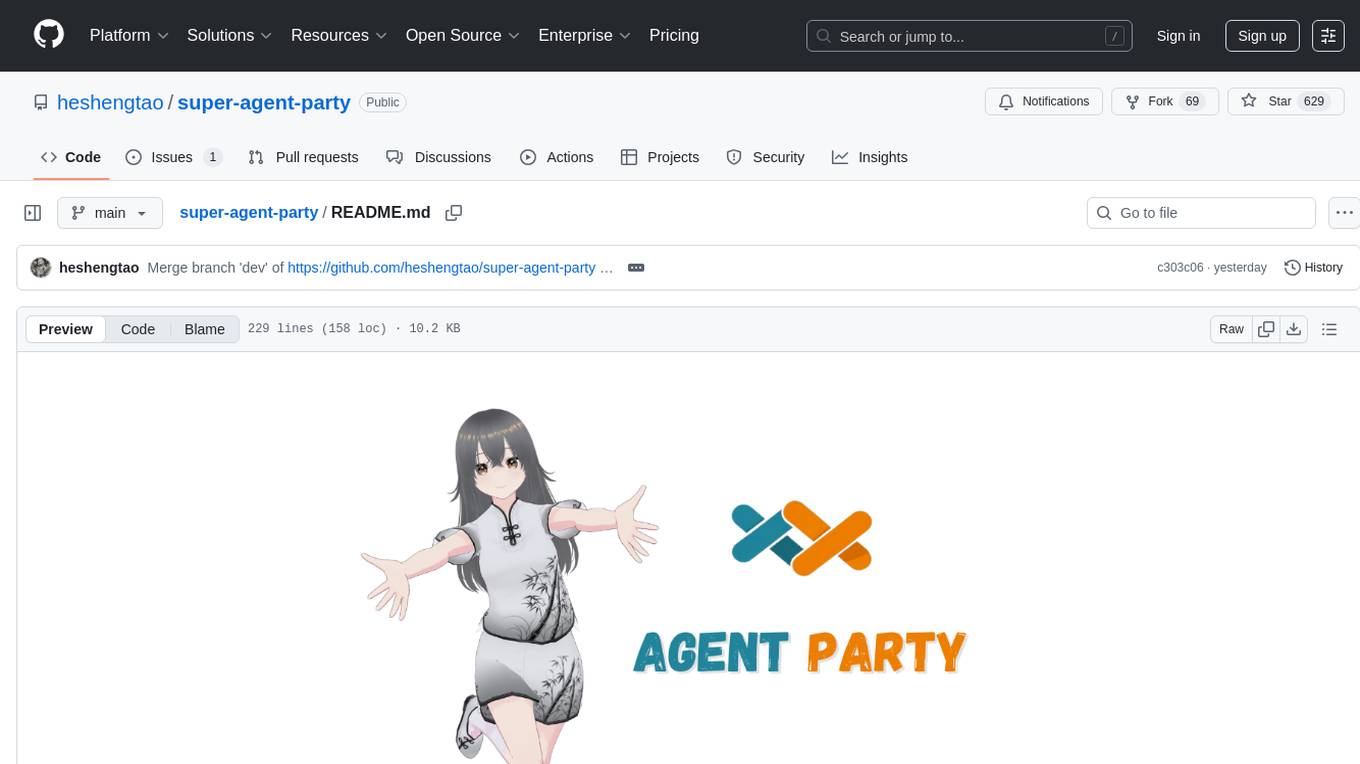
super-agent-party
A 3D AI desktop companion with endless possibilities! This repository provides a platform for enhancing the LLM API without code modification, supporting seamless integration of various functionalities such as knowledge bases, real-time networking, multimodal capabilities, automation, and deep thinking control. It offers one-click deployment to multiple terminals, ecological tool interconnection, standardized interface opening, and compatibility across all platforms. Users can deploy the tool on Windows, macOS, Linux, or Docker, and access features like intelligent agent deployment, VRM desktop pets, Tavern character cards, QQ bot deployment, and developer-friendly interfaces. The tool supports multi-service providers, extensive tool integration, and ComfyUI workflows. Hardware requirements are minimal, making it suitable for various deployment scenarios.
For similar tasks
dreamfactory
DreamFactory is a self-hosted platform that provides governed API access to any data source for enterprise apps and local LLMs. It is a secure enterprise data access platform built on top of the Laravel framework, offering role-based access control, identity passthrough, and customization of API behavior using PHP, Python, and NodeJS scripting languages. DreamFactory allows users to generate powerful APIs for SQL and NoSQL databases, files, email, and push notifications in seconds, while ensuring security with features like user management, SSO authentication, OAuth, and Active Directory integration.
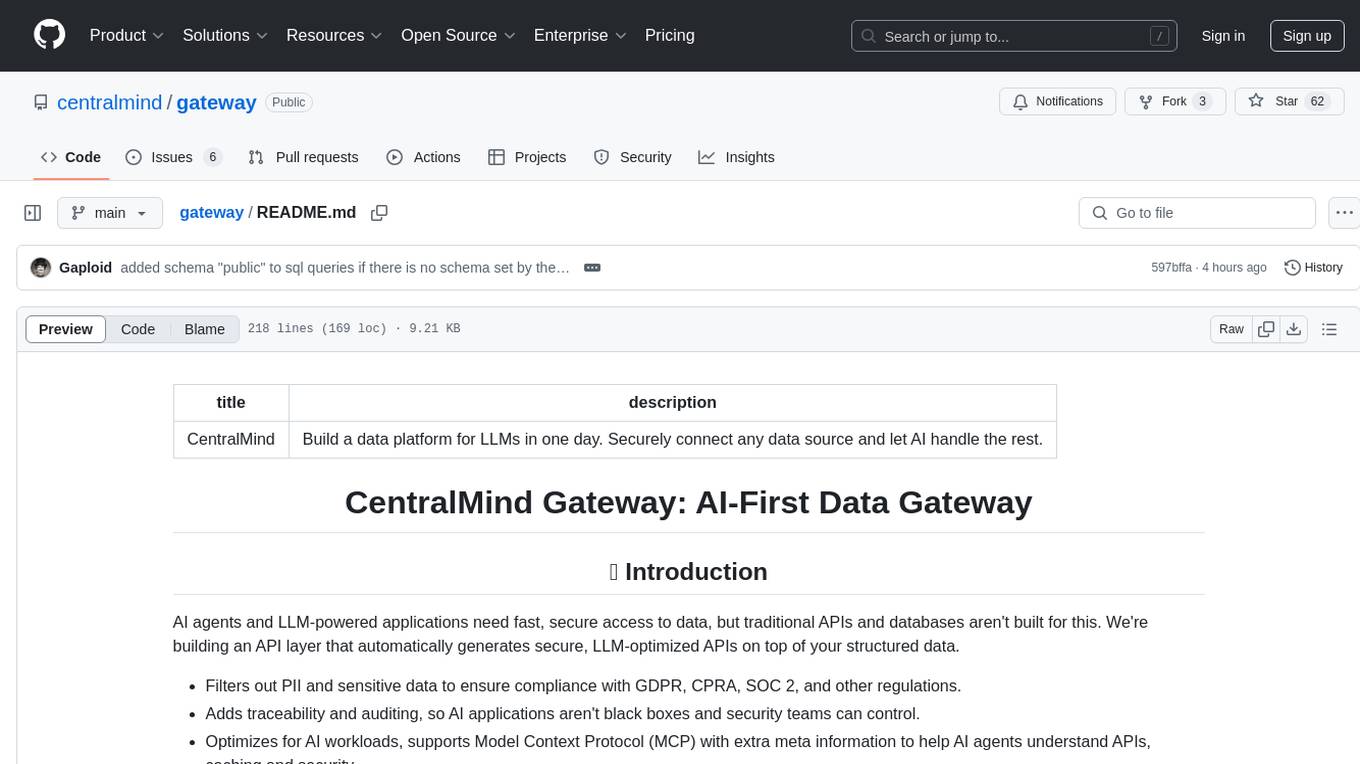
gateway
CentralMind Gateway is an AI-first data gateway that securely connects any data source and automatically generates secure, LLM-optimized APIs. It filters out sensitive data, adds traceability, and optimizes for AI workloads. Suitable for companies deploying AI agents for customer support and analytics.
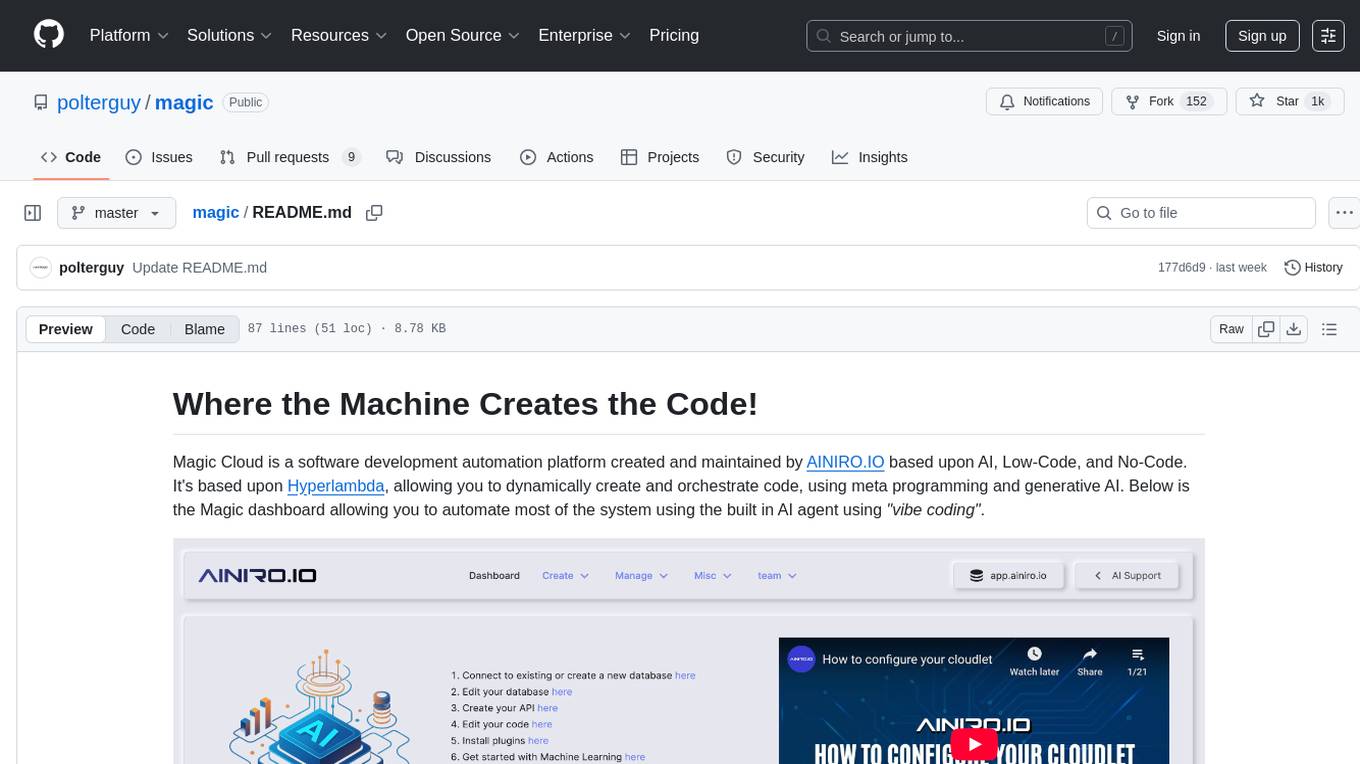
magic
Magic Cloud is a software development automation platform based on AI, Low-Code, and No-Code. It allows dynamic code creation and orchestration using Hyperlambda, generative AI, and meta programming. The platform includes features like CRUD generation, No-Code AI, Hyperlambda programming language, AI agents creation, and various components for software development. Magic is suitable for backend development, AI-related tasks, and creating AI chatbots. It offers high-level programming capabilities, productivity gains, and reduced technical debt.
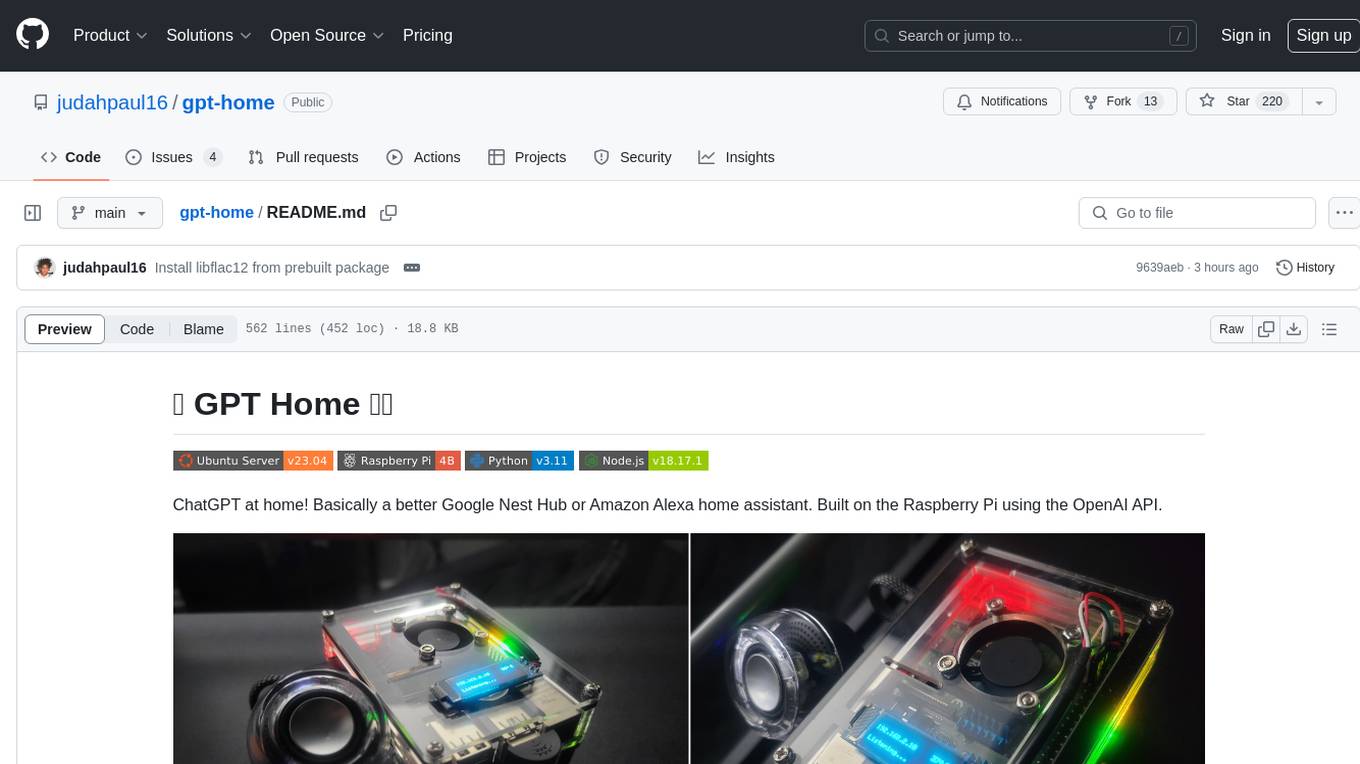
gpt-home
GPT Home is a project that allows users to build their own home assistant using Raspberry Pi and OpenAI API. It serves as a guide for setting up a smart home assistant similar to Google Nest Hub or Amazon Alexa. The project integrates various components like OpenAI, Spotify, Philips Hue, and OpenWeatherMap to provide a personalized home assistant experience. Users can follow the detailed instructions provided to build their own version of the home assistant on Raspberry Pi, with optional components for customization. The project also includes system configurations, dependencies installation, and setup scripts for easy deployment. Overall, GPT Home offers a DIY solution for creating a smart home assistant using Raspberry Pi and OpenAI technology.
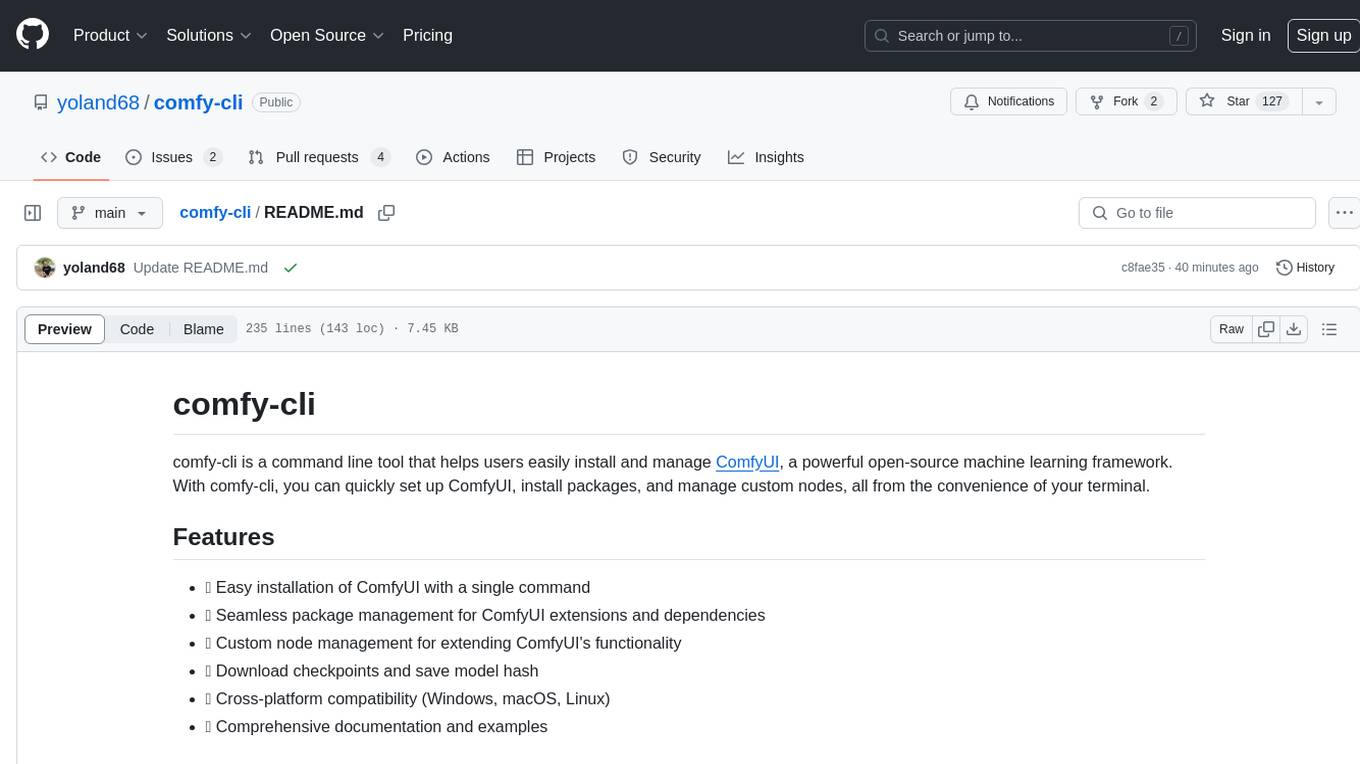
comfy-cli
comfy-cli is a command line tool designed to simplify the installation and management of ComfyUI, an open-source machine learning framework. It allows users to easily set up ComfyUI, install packages, manage custom nodes, download checkpoints, and ensure cross-platform compatibility. The tool provides comprehensive documentation and examples to aid users in utilizing ComfyUI efficiently.
crewAI-tools
The crewAI Tools repository provides a guide for setting up tools for crewAI agents, enabling the creation of custom tools to enhance AI solutions. Tools play a crucial role in improving agent functionality. The guide explains how to equip agents with a range of tools and how to create new tools. Tools are designed to return strings for generating responses. There are two main methods for creating tools: subclassing BaseTool and using the tool decorator. Contributions to the toolset are encouraged, and the development setup includes steps for installing dependencies, activating the virtual environment, setting up pre-commit hooks, running tests, static type checking, packaging, and local installation. Enhance AI agent capabilities with advanced tooling.
aipan-netdisk-search
Aipan-Netdisk-Search is a free and open-source web project for searching netdisk resources. It utilizes third-party APIs with IP access restrictions, suggesting self-deployment. The project can be easily deployed on Vercel and provides instructions for manual deployment. Users can clone the project, install dependencies, run it in the browser, and access it at localhost:3001. The project also includes documentation for deploying on personal servers using NUXT.JS. Additionally, there are options for donations and communication via WeChat.
Agently-Daily-News-Collector
Agently Daily News Collector is an open-source project showcasing a workflow powered by the Agent ly AI application development framework. It allows users to generate news collections on various topics by inputting the field topic. The AI agents automatically perform the necessary tasks to generate a high-quality news collection saved in a markdown file. Users can edit settings in the YAML file, install Python and required packages, input their topic idea, and wait for the news collection to be generated. The process involves tasks like outlining, searching, summarizing, and preparing column data. The project dependencies include Agently AI Development Framework, duckduckgo-search, BeautifulSoup4, and PyYAM.
For similar jobs
google.aip.dev
API Improvement Proposals (AIPs) are design documents that provide high-level, concise documentation for API development at Google. The goal of AIPs is to serve as the source of truth for API-related documentation and to facilitate discussion and consensus among API teams. AIPs are similar to Python's enhancement proposals (PEPs) and are organized into different areas within Google to accommodate historical differences in customs, styles, and guidance.
kong
Kong, or Kong API Gateway, is a cloud-native, platform-agnostic, scalable API Gateway distinguished for its high performance and extensibility via plugins. It also provides advanced AI capabilities with multi-LLM support. By providing functionality for proxying, routing, load balancing, health checking, authentication (and more), Kong serves as the central layer for orchestrating microservices or conventional API traffic with ease. Kong runs natively on Kubernetes thanks to its official Kubernetes Ingress Controller.
speakeasy
Speakeasy is a tool that helps developers create production-quality SDKs, Terraform providers, documentation, and more from OpenAPI specifications. It supports a wide range of languages, including Go, Python, TypeScript, Java, and C#, and provides features such as automatic maintenance, type safety, and fault tolerance. Speakeasy also integrates with popular package managers like npm, PyPI, Maven, and Terraform Registry for easy distribution.
apicat
ApiCat is an API documentation management tool that is fully compatible with the OpenAPI specification. With ApiCat, you can freely and efficiently manage your APIs. It integrates the capabilities of LLM, which not only helps you automatically generate API documentation and data models but also creates corresponding test cases based on the API content. Using ApiCat, you can quickly accomplish anything outside of coding, allowing you to focus your energy on the code itself.
aiohttp-pydantic
Aiohttp pydantic is an aiohttp view to easily parse and validate requests. You define using function annotations what your methods for handling HTTP verbs expect, and Aiohttp pydantic parses the HTTP request for you, validates the data, and injects the parameters you want. It provides features like query string, request body, URL path, and HTTP headers validation, as well as Open API Specification generation.
ain
Ain is a terminal HTTP API client designed for scripting input and processing output via pipes. It allows flexible organization of APIs using files and folders, supports shell-scripts and executables for common tasks, handles url-encoding, and enables sharing the resulting curl, wget, or httpie command-line. Users can put things that change in environment variables or .env-files, and pipe the API output for further processing. Ain targets users who work with many APIs using a simple file format and uses curl, wget, or httpie to make the actual calls.
OllamaKit
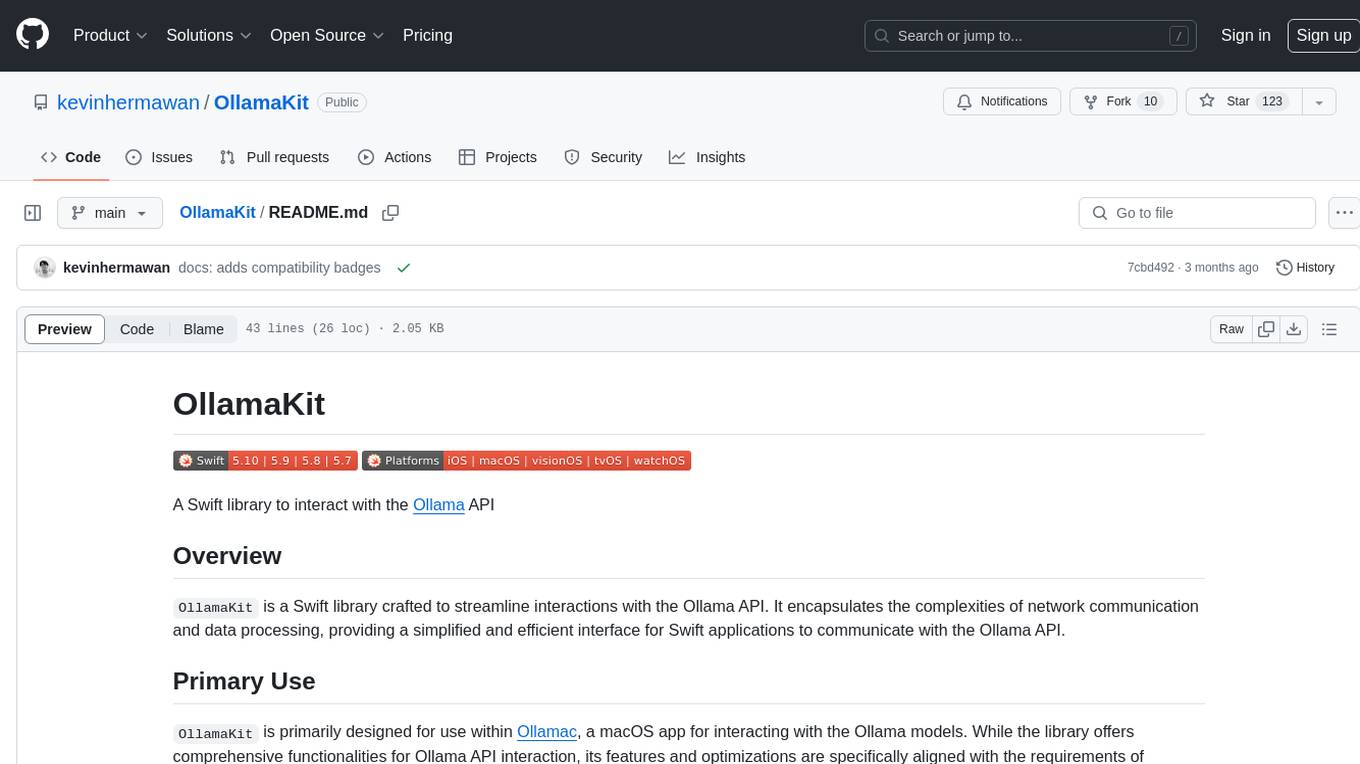
OllamaKit is a Swift library designed to simplify interactions with the Ollama API. It handles network communication and data processing, offering an efficient interface for Swift applications to communicate with the Ollama API. The library is optimized for use within Ollamac, a macOS app for interacting with Ollama models.
ollama4j
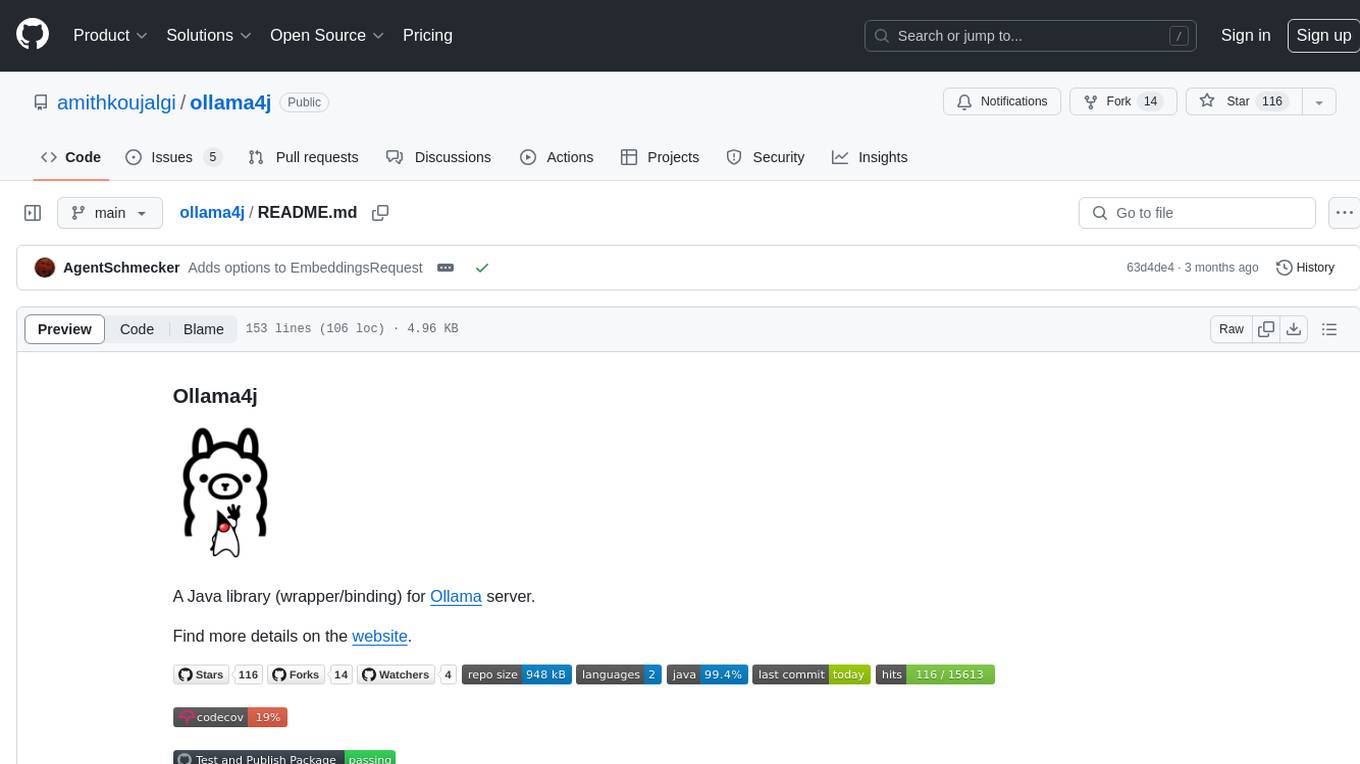
Ollama4j is a Java library that serves as a wrapper or binding for the Ollama server. It facilitates communication with the Ollama server and provides models for deployment. The tool requires Java 11 or higher and can be installed locally or via Docker. Users can integrate Ollama4j into Maven projects by adding the specified dependency. The tool offers API specifications and supports various development tasks such as building, running unit tests, and integration tests. Releases are automated through GitHub Actions CI workflow. Areas of improvement include adhering to Java naming conventions, updating deprecated code, implementing logging, using lombok, and enhancing request body creation. Contributions to the project are encouraged, whether reporting bugs, suggesting enhancements, or contributing code.