


toolhive-studio
ToolHive is an application that allows you to install, manage and run MCP servers and connect them to AI agents
Stars: 109
ToolHive Studio is an experimental project under active development and testing, providing an easy way to discover, deploy, and manage Model Context Protocol (MCP) servers securely. Users can launch any MCP server in a locked-down container with just a few clicks, eliminating manual setup, security concerns, and runtime issues. The tool ensures instant deployment, default security measures, cross-platform compatibility, and seamless integration with popular clients like GitHub Copilot, Cursor, and Claude Code.
README:






[!NOTE] This is an experimental project that is under active development and testing. Features may change without notice.
Run any Model Context Protocol (MCP) server — securely, instantly, anywhere.
ToolHive is the easiest way to discover, deploy, and manage MCP servers. Launch any MCP server in a locked-down container with just a few clicks. No manual setup, no security headaches, no runtime hassles.

- 🚀 Quickstart - install ToolHive and run your first MCP server
- 📚 Documentation - learn more about ToolHive's features
- 💬 Discord community - connect with the ToolHive community, ask questions, and share your experiences
- 🛠️ Developer guide - build, test, and contribute to the ToolHive UI
|

|
To get started with ToolHive, download the latest release from the website and follow the quickstart guide.
Under the hood, ToolHive runs each MCP server in its own secure container and exposes an HTTP/SSE proxy that MCP clients connect to.

For more advanced use cases, ToolHive is also available as a command-line tool which can be used standalone or side-by-side with the ToolHive UI and as a Kubernetes Operator. Learn more in the ToolHive documentation.
ToolHive uses Sentry for error tracking and performance monitoring to help us identify and fix issues, improve stability, and enhance the user experience. This telemetry is enabled by default but completely optional.
- Error reports and crash logs
- Performance metrics
- Usage patterns
You can easily disable telemetry at any time:
- Open ToolHive
- Go to Settings (gear icon in the top navigation)
- Find the Telemetry section
- Toggle off telemetry collection
|
We welcome contributions and feedback from the community! If you have ideas, suggestions, or want to get involved, check out our contributing guide or open an issue. Join us in making ToolHive even better! |

|
This project is licensed under the Apache 2.0 License.
For Tasks:
Click tags to check more tools for each tasksFor Jobs:
Alternative AI tools for toolhive-studio
Similar Open Source Tools
For similar tasks
toolhive-studio
ToolHive Studio is an experimental project under active development and testing, providing an easy way to discover, deploy, and manage Model Context Protocol (MCP) servers securely. Users can launch any MCP server in a locked-down container with just a few clicks, eliminating manual setup, security concerns, and runtime issues. The tool ensures instant deployment, default security measures, cross-platform compatibility, and seamless integration with popular clients like GitHub Copilot, Cursor, and Claude Code.
AppFlowy-Cloud
AppFlowy Cloud is a secure user authentication, file storage, and real-time WebSocket communication tool written in Rust. It is part of the AppFlowy ecosystem, providing an efficient and collaborative user experience. The tool offers deployment guides, development setup with Rust and Docker, debugging tips for components like PostgreSQL, Redis, Minio, and Portainer, and guidelines for contributing to the project.
toolhive
ToolHive is a tool designed to simplify and secure Model Context Protocol (MCP) servers. It allows users to easily discover, deploy, and manage MCP servers by launching them in isolated containers with minimal setup and security concerns. The tool offers instant deployment, secure default settings, compatibility with Docker and Kubernetes, seamless integration with popular clients, and availability as a GUI desktop app, CLI, and Kubernetes Operator.
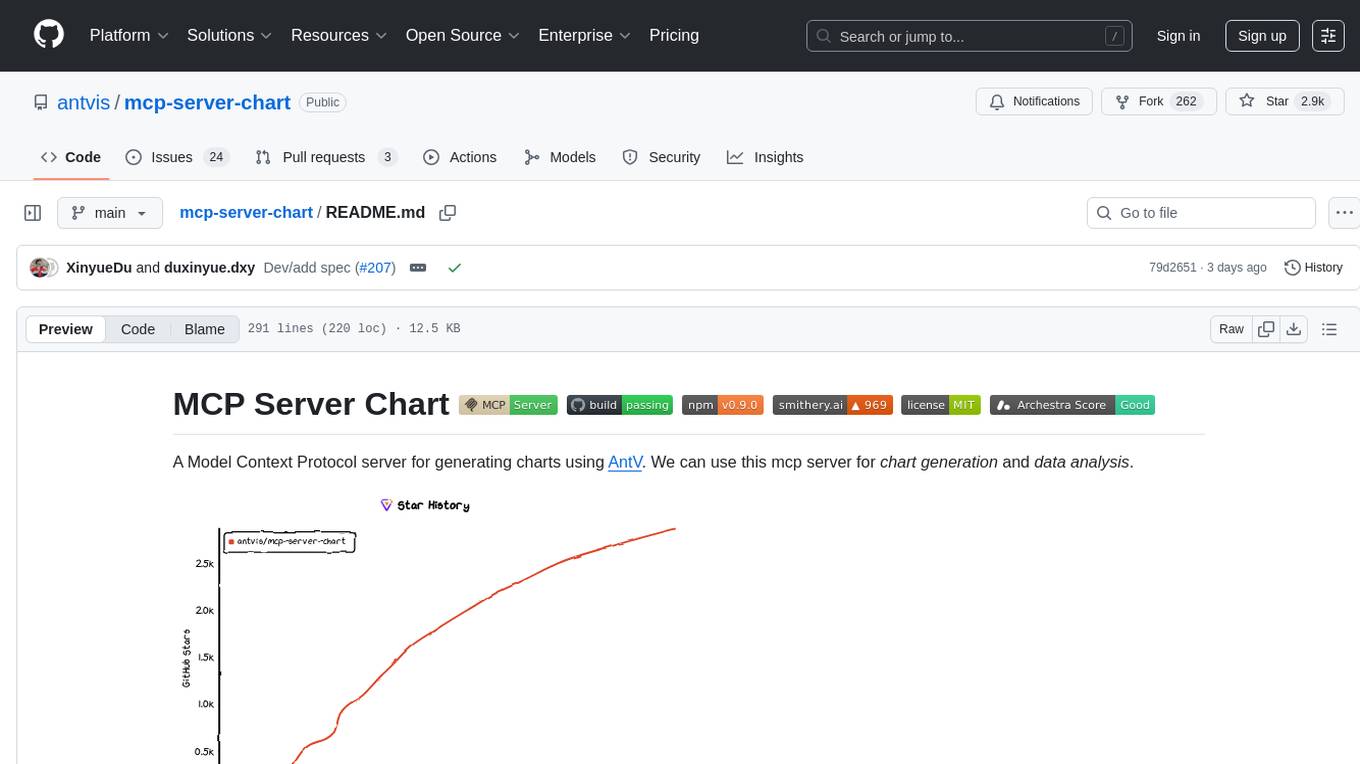
mcp-server-chart
mcp-server-chart is a Helm chart for deploying a Minecraft server on Kubernetes. It simplifies the process of setting up and managing a Minecraft server in a Kubernetes environment. The chart includes configurations for specifying server settings, resource limits, and persistent storage options. With mcp-server-chart, users can easily deploy and scale Minecraft servers on Kubernetes clusters, ensuring high availability and performance for multiplayer gaming experiences.
HMusic
HMusic is an intelligent music player that supports Xiaomi AI speakers. It offers dual modes: xiaomusic server mode and Xiaomi IoT direct connection mode. Users can choose between these modes based on their preferences and needs. The direct connection mode is suitable for regular users who want a plug-and-play experience, while the xiaomusic mode is ideal for users with NAS/servers who require advanced features like a local music library, playlists, and progress control. The tool provides functionalities such as music search, playback, and volume control, catering to a wide range of music enthusiasts.
aiodocker
Aiodocker is a simple Docker HTTP API wrapper written with asyncio and aiohttp. It provides asynchronous bindings for interacting with Docker containers and images. Users can easily manage Docker resources using async functions and methods. The library offers features such as listing images and containers, creating and running containers, and accessing container logs. Aiodocker is designed to work seamlessly with Python's asyncio framework, making it suitable for building asynchronous Docker management applications.
cheat-sheet-pdf
The Cheat-Sheet Collection for DevOps, Engineers, IT professionals, and more is a curated list of cheat sheets for various tools and technologies commonly used in the software development and IT industry. It includes cheat sheets for Nginx, Docker, Ansible, Python, Go (Golang), Git, Regular Expressions (Regex), PowerShell, VIM, Jenkins, CI/CD, Kubernetes, Linux, Redis, Slack, Puppet, Google Cloud Developer, AI, Neural Networks, Machine Learning, Deep Learning & Data Science, PostgreSQL, Ajax, AWS, Infrastructure as Code (IaC), System Design, and Cyber Security.
libmodal
libmodal is a cross-language client SDK for Modal, providing lightweight alternatives to the Modal Python Library. It allows users to start Sandboxes, call Modal Functions, and manage containers. The SDK supports JavaScript and Go languages, with similar features and APIs for each. Users can interact with Modal from any project by authenticating with Modal and adding the SDK to their application. The repository aims to add more features over time while keeping behavior consistent across languages.
For similar jobs
minio
MinIO is a High Performance Object Storage released under GNU Affero General Public License v3.0. It is API compatible with Amazon S3 cloud storage service. Use MinIO to build high performance infrastructure for machine learning, analytics and application data workloads.
ai-on-gke
This repository contains assets related to AI/ML workloads on Google Kubernetes Engine (GKE). Run optimized AI/ML workloads with Google Kubernetes Engine (GKE) platform orchestration capabilities. A robust AI/ML platform considers the following layers: Infrastructure orchestration that support GPUs and TPUs for training and serving workloads at scale Flexible integration with distributed computing and data processing frameworks Support for multiple teams on the same infrastructure to maximize utilization of resources
kong
Kong, or Kong API Gateway, is a cloud-native, platform-agnostic, scalable API Gateway distinguished for its high performance and extensibility via plugins. It also provides advanced AI capabilities with multi-LLM support. By providing functionality for proxying, routing, load balancing, health checking, authentication (and more), Kong serves as the central layer for orchestrating microservices or conventional API traffic with ease. Kong runs natively on Kubernetes thanks to its official Kubernetes Ingress Controller.
AI-in-a-Box
AI-in-a-Box is a curated collection of solution accelerators that can help engineers establish their AI/ML environments and solutions rapidly and with minimal friction, while maintaining the highest standards of quality and efficiency. It provides essential guidance on the responsible use of AI and LLM technologies, specific security guidance for Generative AI (GenAI) applications, and best practices for scaling OpenAI applications within Azure. The available accelerators include: Azure ML Operationalization in-a-box, Edge AI in-a-box, Doc Intelligence in-a-box, Image and Video Analysis in-a-box, Cognitive Services Landing Zone in-a-box, Semantic Kernel Bot in-a-box, NLP to SQL in-a-box, Assistants API in-a-box, and Assistants API Bot in-a-box.
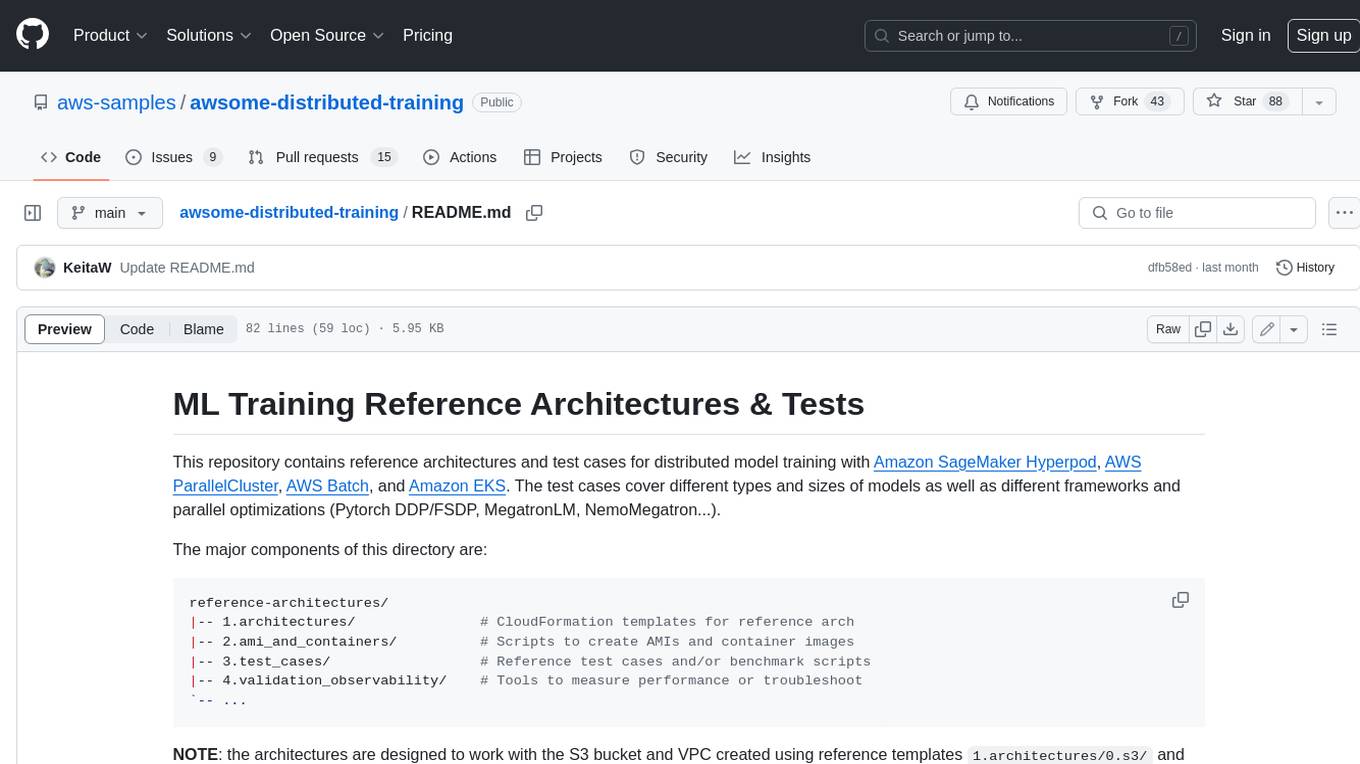
awsome-distributed-training
This repository contains reference architectures and test cases for distributed model training with Amazon SageMaker Hyperpod, AWS ParallelCluster, AWS Batch, and Amazon EKS. The test cases cover different types and sizes of models as well as different frameworks and parallel optimizations (Pytorch DDP/FSDP, MegatronLM, NemoMegatron...).
generative-ai-cdk-constructs
The AWS Generative AI Constructs Library is an open-source extension of the AWS Cloud Development Kit (AWS CDK) that provides multi-service, well-architected patterns for quickly defining solutions in code to create predictable and repeatable infrastructure, called constructs. The goal of AWS Generative AI CDK Constructs is to help developers build generative AI solutions using pattern-based definitions for their architecture. The patterns defined in AWS Generative AI CDK Constructs are high level, multi-service abstractions of AWS CDK constructs that have default configurations based on well-architected best practices. The library is organized into logical modules using object-oriented techniques to create each architectural pattern model.
model_server
OpenVINO™ Model Server (OVMS) is a high-performance system for serving models. Implemented in C++ for scalability and optimized for deployment on Intel architectures, the model server uses the same architecture and API as TensorFlow Serving and KServe while applying OpenVINO for inference execution. Inference service is provided via gRPC or REST API, making deploying new algorithms and AI experiments easy.
dify-helm
Deploy langgenius/dify, an LLM based chat bot app on kubernetes with helm chart.