


hello-agents
📚 《从零开始构建智能体》——从零开始的智能体原理与实践教程
Stars: 19895
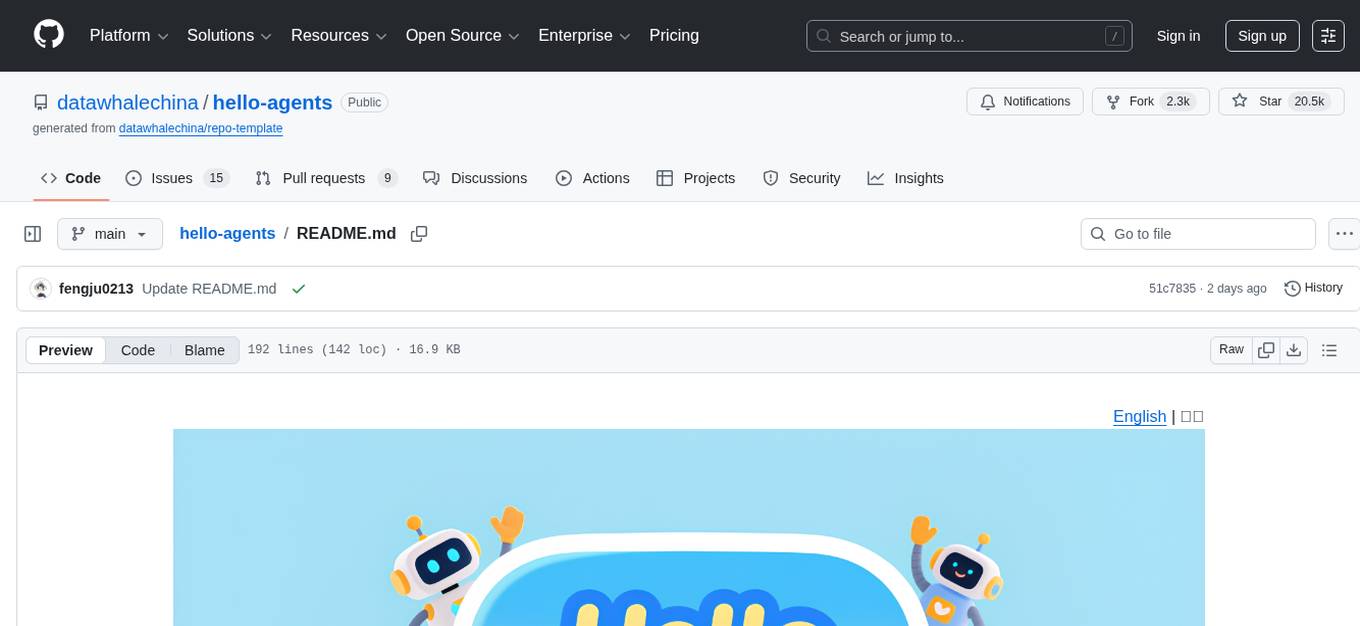
Hello-Agents is a comprehensive tutorial on building intelligent agent systems, covering both theoretical foundations and practical applications. The tutorial aims to guide users in understanding and building AI-native agents, diving deep into core principles, architectures, and paradigms of intelligent agents. Users will learn to develop their own multi-agent applications from scratch, gaining hands-on experience with popular low-code platforms and agent frameworks. The tutorial also covers advanced topics such as memory systems, context engineering, communication protocols, and model training. By the end of the tutorial, users will have the skills to develop real-world projects like intelligent travel assistants and cyber towns.
README:





如果说 2024 年是"百模大战"的元年,那么 2025 年无疑开启了"Agent 元年"。技术的焦点正从训练更大的基础模型,转向构建更聪明的智能体应用。然而,当前系统性、重实践的教程却极度匮乏。为此,我们发起了 Hello-Agents 项目,希望能为社区提供一本从零开始、理论与实战并重的智能体系统构建指南。
Hello-Agents 是 Datawhale 社区的系统性智能体学习教程。如今 Agent 构建主要分为两派,一派是 Dify,Coze,n8n 这类软件工程类 Agent,其本质是流程驱动的软件开发,LLM 作为数据处理的后端;另一派则是 AI 原生的 Agent,即真正以 AI 驱动的 Agent。本教程旨在带领大家深入理解并构建后者——真正的 AI Native Agent。教程将带领你穿透框架表象,从智能体的核心原理出发,深入其核心架构,理解其经典范式,并最终亲手构建起属于自己的多智能体应用。我们相信,最好的学习方式就是动手实践。希望这本教程能成为你探索智能体世界的起点,能够从一名大语言模型的"使用者",蜕变为一名智能体系统的"构建者"。
🌐 点击这里开始在线阅读 - 无需下载,随时随地学习
如果您希望在本地阅读或贡献内容,请参考下方的学习指南。
- 📖 Datawhale 开源免费 完全免费学习本项目所有内容,与社区共同成长
- 🔍 理解核心原理 深入理解智能体的概念、历史与经典范式
- 🏗️ 亲手实现 掌握热门低代码平台和智能体代码框架的使用
- 🛠️ 自研框架HelloAgents 基于 Openai 原生 API 从零构建一个自己的智能体框架
- ⚙️ 掌握高级技能 一步步实现上下文工程、Memory、协议、评估等系统性技术
- 🤝 模型训练 掌握 Agentic RL,从 SFT 到 GRPO 的全流程实战训练 LLM
- 🚀 驱动真实案例 实战开发智能旅行助手、赛博小镇等综合项目
- 📖 求职面试 学习智能体求职相关面试问题
| 章节 | 关键内容 | 状态 |
|---|---|---|
| 前言 | 项目的缘起、背景及读者建议 | ✅ |
| 第一部分:智能体与语言模型基础 | ||
| 第一章 初识智能体 | 智能体定义、类型、范式与应用 | ✅ |
| 第二章 智能体发展史 | 从符号主义到 LLM 驱动的智能体演进 | ✅ |
| 第三章 大语言模型基础 | Transformer、提示、主流 LLM 及其局限 | ✅ |
| 第二部分:构建你的大语言模型智能体 | ||
| 第四章 智能体经典范式构建 | 手把手实现 ReAct、Plan-and-Solve、Reflection | ✅ |
| 第五章 基于低代码平台的智能体搭建 | 了解 Coze、Dify、n8n 等低代码智能体平台使用 | ✅ |
| 第六章 框架开发实践 | AutoGen、AgentScope、LangGraph 等主流框架应用 | ✅ |
| 第七章 构建你的Agent框架 | 从 0 开始构建智能体框架 | ✅ |
| 第三部分:高级知识扩展 | ||
| 第八章 记忆与检索 | 记忆系统,RAG,存储 | ✅ |
| 第九章 上下文工程 | 持续交互的"情境理解" | ✅ |
| 第十章 智能体通信协议 | MCP、A2A、ANP 等协议解析 | ✅ |
| 第十一章 Agentic-RL | 从 SFT 到 GRPO 的 LLM 训练实战 | ✅ |
| 第十二章 智能体性能评估 | 核心指标、基准测试与评估框架 | ✅ |
| 第四部分:综合案例进阶 | ||
| 第十三章 智能旅行助手 | MCP 与多智能体协作的真实世界应用 | ✅ |
| 第十四章 自动化深度研究智能体 | DeepResearch Agent 复现与解析 | ✅ |
| 第十五章 构建赛博小镇 | Agent 与游戏的结合,模拟社会动态 | ✅ |
| 第五部分:毕业设计及未来展望 | ||
| 第十六章 毕业设计 | 构建属于你的完整多智能体应用 | ✅ |
欢迎大家将在学习 Hello-Agents 或 Agent 相关技术中的独到见解、实践总结,以 PR 的形式贡献到社区精选。如果是独立于正文的内容,也可以投稿至 Extra-Chapter!期待你的第一次贡献!
| 社区精选 | 内容总结 |
|---|---|
| 00-共创毕业设计 | 社区共创毕业设计项目 |
| 01-Agent面试题总结 | Agent 岗位相关面试问题 |
| 01-Agent面试题答案 | 相关面试问题答案 |
| 02-上下文工程内容补充 | 上下文工程内容扩展 |
| 03-Dify智能体创建保姆级教程 | Dify智能体创建保姆级教程 |
| 04-Hello-agents课程常见问题 | Datawhale课程常见问题 |
| 05-Agent Skills与MCP对比解读 | Agent Skills与MCP技术对比 |
| 06-GUI Agent科普与实战 | GUI Agent科普与多场景实战 |
| 07-环境配置 | 环境配置 |
本 Hello-Agents PDF 教程完全开源免费。为防止各类营销号加水印后贩卖给多智能体系统初学者,我们特地在 PDF 文件中预先添加了不影响阅读的 Datawhale 开源标志水印,敬请谅解~
Hello-Agents PDF : https://github.com/datawhalechina/hello-agents/releases/tag/V1.0.0
Hello-Agents PDF 国内下载地址 : https://www.datawhale.cn/learn/summary/239
欢迎你,未来的智能系统构建者!在开启这段激动人心的旅程之前,请允许我们给你一些清晰的指引。
本项目内容兼顾理论与实战,旨在帮助你系统性地掌握从单个智能体到多智能体系统的设计与开发全流程。因此,尤其适合有一定编程基础的 AI 开发者、软件工程师、在校学生 以及对前沿 AI 技术抱有浓厚兴趣的 自学者。在学习本项目之前,我们希望你具备基础的 Python 编程能力,并对大语言模型有基本的概念性了解(例如,知道如何通过 API 调用一个 LLM)。项目的重点是应用与构建,因此你无需具备深厚的算法或模型训练背景。
项目分为五大部分,每一部分都是通往下一阶段的坚实阶梯:
-
第一部分:智能体与语言模型基础(第一章~第三章),我们将从智能体的定义、类型与发展历史讲起,为你梳理"智能体"这一概念的来龙去脉。随后,我们会快速巩固大语言模型的核心知识,为你的实践之旅打下坚实的理论地基。
-
第二部分:构建你的大语言模型智能体(第四章~第七章),这是你动手实践的起点。你将亲手实现 ReAct 等经典范式,体验 Coze 等低代码平台的便捷,并掌握 Langgraph 等主流框架的应用。最终,我们还会带你从零开始构建一个属于自己的智能体框架,让你兼具“用轮子”与“造轮子”的能力。
-
第三部分:高级知识扩展(第八章~第十二章),在这一部分,你的智能体将“学会”思考与协作。我们将使用第二部分的自研框架,深入探索记忆与检索、上下文工程、Agent 训练等核心技术,并学习多智能体间的通信协议。最终,你将掌握评估智能体系统性能的专业方法。
-
第四部分:综合案例进阶(第十三章~第十五章),这里是理论与实践的交汇点。你将把所学融会贯通,亲手打造智能旅行助手、自动化深度研究智能体,乃至一个模拟社会动态的赛博小镇,在真实有趣的项目中淬炼你的构建能力。
-
第五部分:毕业设计及未来展望(第十六章),在旅程的终点,你将迎来一个毕业设计,构建一个完整的、属于你自己的多智能体应用,全面检验你的学习成果。我们还将与你一同展望智能体的未来,探索激动人心的前沿方向。
智能体是一个飞速发展且极度依赖实践的领域。为了获得最佳的学习效果,我们在项目的code文件夹内提供了配套的全部代码,强烈建议你将理论与实践相结合。请务必亲手运行、调试甚至修改项目里提供的每一份代码。欢迎你随时关注 Datawhale 以及其他 Agent 相关社区,当遇到问题时,你可以随时在本项目的 issue 区提问。
现在,准备好进入智能体的奇妙世界了吗?让我们即刻启程!
- 视频课程陆续放出(将会更加细致,实践课带领大家从设计思路到实施,授人以鱼也授人以渔)
- 完善HelloAgents框架,开展Dev分支继续维护,兼容学习版本。
- 2W Star更新下一版PDF,感谢大家助力!
我们是一个开放的开源社区,欢迎任何形式的贡献!
- 🐛 报告 Bug - 发现内容或代码问题,请提交 Issue
- 💡 提出建议 - 对项目有好想法,欢迎发起讨论
- 📝 完善内容 - 帮助改进教程,提交你的 Pull Request
- ✍️ 分享实践 - 在"社区贡献精选"中分享你的学习笔记和项目
- 陈思州-项目负责人 (Datawhale 成员, 全文写作和校对)
- 孙韬-联合发起者 (Datawhale 成员, 第九章内容和校对)
- 姜舒凡-联合发起者(Datawhale 成员, 章节习题设计和校对)
- 黄佩林-Datawhale意向成员 (Agent 开发工程师, 第五章内容贡献者)
- 曾鑫民-Agent工程师 (牛客科技, 第十四章案例开发)
- 朱信忠-指导专家 (Datawhale首席科学家-浙江师范大学杭州人工智能研究院教授)
- WH (内容贡献者)
- 周奥杰-DW贡献者团队 (西安交通大学, Extra02 内容贡献)
- 张宸旭-个人开发者(帝国理工学院, Extra03 内容贡献)
- 黄宏晗-DW贡献者团队 (深圳大学, Extra04 内容贡献)
- 感谢 @Sm1les 对本项目的帮助与支持
- 感谢所有为本项目做出贡献的开发者们 ❤️

扫描二维码加入读者交流群,与更多学习者交流讨论

⭐ 如果这个项目对你有帮助,请给我们一个 Star!

扫描二维码关注 Datawhale 公众号,获取更多优质开源内容
本作品采用知识共享署名-非商业性使用-相同方式共享 4.0 国际许可协议进行许可。
For Tasks:
Click tags to check more tools for each tasksFor Jobs:
Alternative AI tools for hello-agents
Similar Open Source Tools
hello-agents
Hello-Agents is a comprehensive tutorial on building intelligent agent systems, covering both theoretical foundations and practical applications. The tutorial aims to guide users in understanding and building AI-native agents, diving deep into core principles, architectures, and paradigms of intelligent agents. Users will learn to develop their own multi-agent applications from scratch, gaining hands-on experience with popular low-code platforms and agent frameworks. The tutorial also covers advanced topics such as memory systems, context engineering, communication protocols, and model training. By the end of the tutorial, users will have the skills to develop real-world projects like intelligent travel assistants and cyber towns.
nndeploy
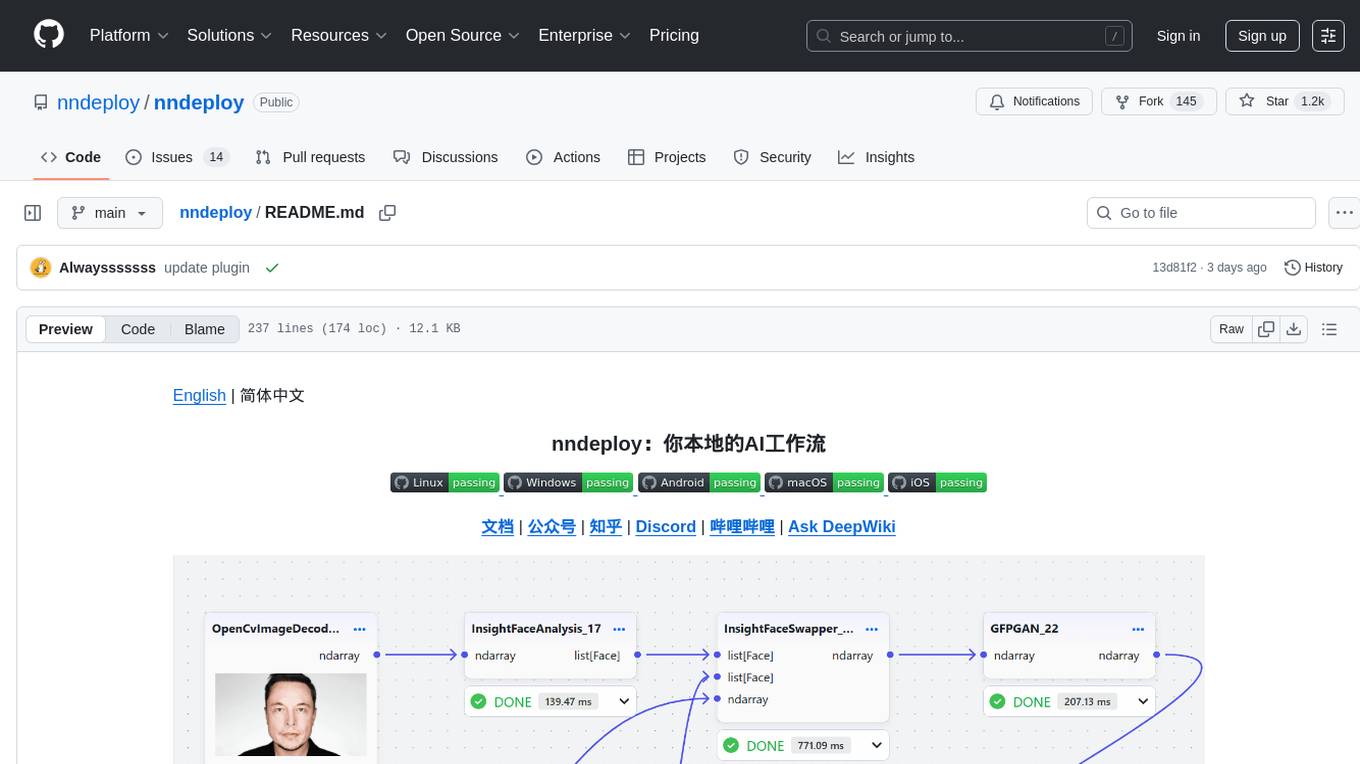
nndeploy is a tool that allows you to quickly build your visual AI workflow without the need for frontend technology. It provides ready-to-use algorithm nodes for non-AI programmers, including large language models, Stable Diffusion, object detection, image segmentation, etc. The workflow can be exported as a JSON configuration file, supporting Python/C++ API for direct loading and running, deployment on cloud servers, desktops, mobile devices, edge devices, and more. The framework includes mainstream high-performance inference engines and deep optimization strategies to help you transform your workflow into enterprise-level production applications.
prisma-ai
Prisma-AI is an open-source tool designed to assist users in their job search process by addressing common challenges such as lack of project highlights, mismatched resumes, difficulty in learning, and lack of answers in interview experiences. The tool utilizes AI to analyze user experiences, generate actionable project highlights, customize resumes for specific job positions, provide study materials for efficient learning, and offer structured interview answers. It also features a user-friendly interface for easy deployment and supports continuous improvement through user feedback and collaboration.
llms-from-scratch-cn
This repository provides a detailed tutorial on how to build your own large language model (LLM) from scratch. It includes all the code necessary to create a GPT-like LLM, covering the encoding, pre-training, and fine-tuning processes. The tutorial is written in a clear and concise style, with plenty of examples and illustrations to help you understand the concepts involved. It is suitable for developers and researchers with some programming experience who are interested in learning more about LLMs and how to build them.

ChatGPT-Next-Web-Pro
ChatGPT-Next-Web-Pro is a tool that provides an enhanced version of ChatGPT-Next-Web with additional features and functionalities. It offers complete ChatGPT-Next-Web functionality, file uploading and storage capabilities, drawing and video support, multi-modal support, reverse model support, knowledge base integration, translation, customizations, and more. The tool can be deployed with or without a backend, allowing users to interact with AI models, manage accounts, create models, manage API keys, handle orders, manage memberships, and more. It supports various cloud services like Aliyun OSS, Tencent COS, and Minio for file storage, and integrates with external APIs like Azure, Google Gemini Pro, and Luma. The tool also provides options for customizing website titles, subtitles, icons, and plugin buttons, and offers features like voice input, file uploading, real-time token count display, and more.
MindChat
MindChat is a psychological large language model designed to help individuals relieve psychological stress and solve mental confusion, ultimately improving mental health. It aims to provide a relaxed and open conversation environment for users to build trust and understanding. MindChat offers privacy, warmth, safety, timely, and convenient conversation settings to help users overcome difficulties and challenges, achieve self-growth, and development. The tool is suitable for both work and personal life scenarios, providing comprehensive psychological support and therapeutic assistance to users while strictly protecting user privacy. It combines psychological knowledge with artificial intelligence technology to contribute to a healthier, more inclusive, and equal society.
ai-app
The 'ai-app' repository is a comprehensive collection of tools and resources related to artificial intelligence, focusing on topics such as server environment setup, PyCharm and Anaconda installation, large model deployment and training, Transformer principles, RAG technology, vector databases, AI image, voice, and music generation, and AI Agent frameworks. It also includes practical guides and tutorials on implementing various AI applications. The repository serves as a valuable resource for individuals interested in exploring different aspects of AI technology.
UltraRAG
The UltraRAG framework is a researcher and developer-friendly RAG system solution that simplifies the process from data construction to model fine-tuning in domain adaptation. It introduces an automated knowledge adaptation technology system, supporting no-code programming, one-click synthesis and fine-tuning, multidimensional evaluation, and research-friendly exploration work integration. The architecture consists of Frontend, Service, and Backend components, offering flexibility in customization and optimization. Performance evaluation in the legal field shows improved results compared to VanillaRAG, with specific metrics provided. The repository is licensed under Apache-2.0 and encourages citation for support.
Qbot
Qbot is an AI-oriented automated quantitative investment platform that supports diverse machine learning modeling paradigms, including supervised learning, market dynamics modeling, and reinforcement learning. It provides a full closed-loop process from data acquisition, strategy development, backtesting, simulation trading to live trading. The platform emphasizes AI strategies such as machine learning, reinforcement learning, and deep learning, combined with multi-factor models to enhance returns. Users with some Python knowledge and trading experience can easily utilize the platform to address trading pain points and gaps in the market.
DeepAudit
DeepAudit is an AI audit team accessible to everyone, making vulnerability discovery within reach. It is a next-generation code security audit platform based on Multi-Agent collaborative architecture. It simulates the thinking mode of security experts, achieving deep code understanding, vulnerability discovery, and automated sandbox PoC verification through multiple intelligent agents (Orchestrator, Recon, Analysis, Verification). DeepAudit aims to address the three major pain points of traditional SAST tools: high false positive rate, blind spots in business logic, and lack of verification means. Users only need to import the project, and DeepAudit automatically starts working: identifying the technology stack, analyzing potential risks, generating scripts, sandbox verification, and generating reports, ultimately outputting a professional audit report. The core concept is to let AI attack like a hacker and defend like an expert.
AstrBot
AstrBot is a powerful and versatile tool that leverages the capabilities of large language models (LLMs) like GPT-3, GPT-3.5, and GPT-4 to enhance communication and automate tasks. It seamlessly integrates with popular messaging platforms such as QQ, QQ Channel, and Telegram, enabling users to harness the power of AI within their daily conversations and workflows.
agentkit-samples
AgentKit Samples is a repository containing a series of examples and tutorials to help users understand, implement, and integrate various functionalities of AgentKit into their applications. The platform offers a complete solution for building, deploying, and maintaining AI agents, significantly reducing the complexity of developing intelligent applications. The repository provides different levels of examples and tutorials, including basic tutorials for understanding AgentKit's concepts and use cases, as well as more complex examples for experienced developers.
BlueLM
BlueLM is a large-scale pre-trained language model developed by vivo AI Global Research Institute, featuring 7B base and chat models. It includes high-quality training data with a token scale of 26 trillion, supporting both Chinese and English languages. BlueLM-7B-Chat excels in C-Eval and CMMLU evaluations, providing strong competition among open-source models of similar size. The models support 32K long texts for better context understanding while maintaining base capabilities. BlueLM welcomes developers for academic research and commercial applications.
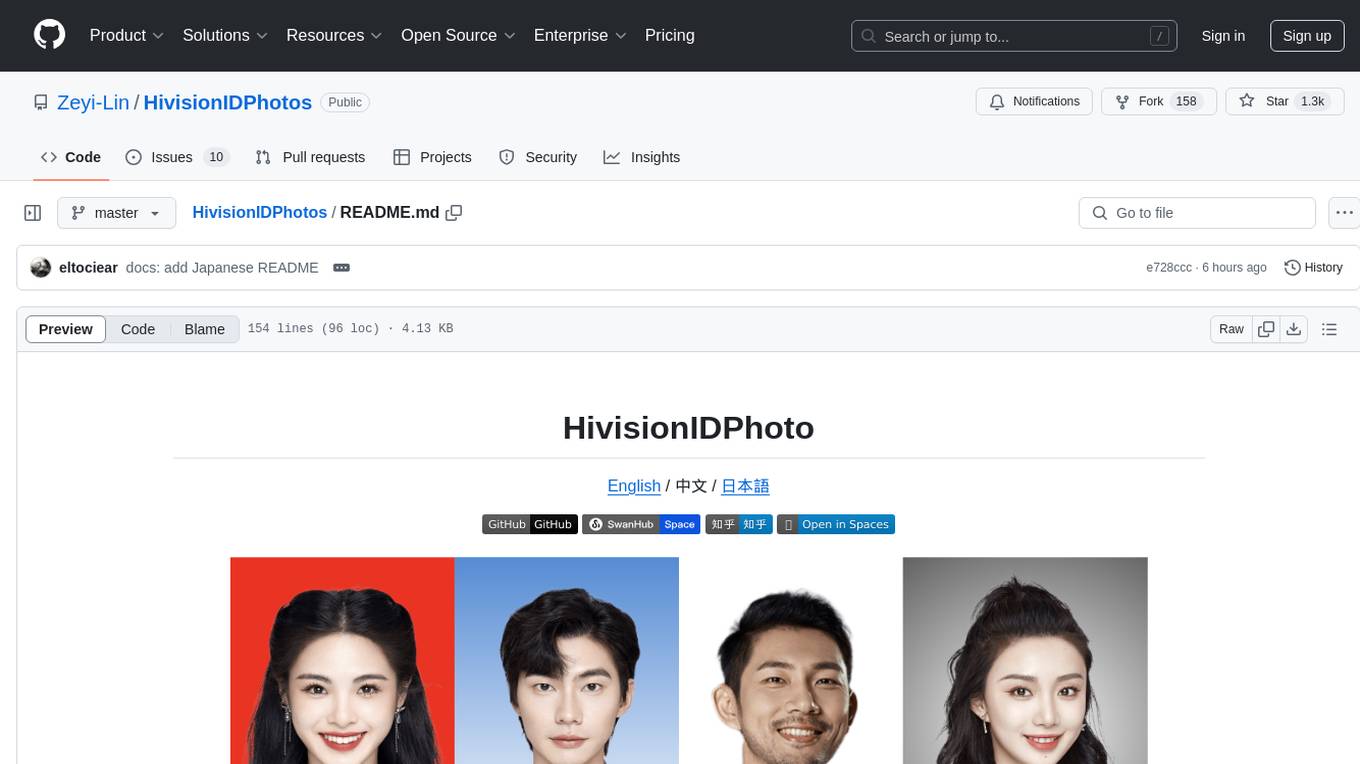
HivisionIDPhotos
HivisionIDPhoto is a practical algorithm for intelligent ID photo creation. It utilizes a comprehensive model workflow to recognize, cut out, and generate ID photos for various user photo scenarios. The tool offers lightweight cutting, standard ID photo generation based on different size specifications, six-inch layout photo generation, beauty enhancement (waiting), and intelligent outfit swapping (waiting). It aims to solve emergency ID photo creation issues.
Feishu-MCP
Feishu-MCP is a server that provides access, editing, and structured processing capabilities for Feishu documents for Cursor, Windsurf, Cline, and other AI-driven coding tools, based on the Model Context Protocol server. This project enables AI coding tools to directly access and understand the structured content of Feishu documents, significantly improving the intelligence and efficiency of document processing. It covers the real usage process of Feishu documents, allowing efficient utilization of document resources, including folder directory retrieval, content retrieval and understanding, smart creation and editing, efficient search and retrieval, and more. It enhances the intelligent access, editing, and searching of Feishu documents in daily usage, improving content processing efficiency and experience.
DISC-LawLLM
DISC-LawLLM is a legal domain large model that aims to provide professional, intelligent, and comprehensive **legal services** to users. It is developed and open-sourced by the Data Intelligence and Social Computing Lab (Fudan-DISC) at Fudan University.
For similar tasks
MiniAgents
MiniAgents is an open-source Python framework designed to simplify the creation of multi-agent AI systems. It offers a parallelism and async-first design, allowing users to focus on building intelligent agents while handling concurrency challenges. The framework, built on asyncio, supports LLM-based applications with immutable messages and seamless asynchronous token and message streaming between agents.
AutoAgents
AutoAgents is a cutting-edge multi-agent framework built in Rust that enables the creation of intelligent, autonomous agents powered by Large Language Models (LLMs) and Ractor. Designed for performance, safety, and scalability. AutoAgents provides a robust foundation for building complex AI systems that can reason, act, and collaborate. With AutoAgents you can create Cloud Native Agents, Edge Native Agents and Hybrid Models as well. It is so extensible that other ML Models can be used to create complex pipelines using Actor Framework.
trpc-agent-go
A powerful Go framework for building intelligent agent systems with large language models (LLMs), hierarchical planners, memory, telemetry, and a rich tool ecosystem. tRPC-Agent-Go enables the creation of autonomous or semi-autonomous agents that reason, call tools, collaborate with sub-agents, and maintain long-term state. The framework provides detailed documentation, examples, and tools for accelerating the development of AI applications.
hello-agents
Hello-Agents is a comprehensive tutorial on building intelligent agent systems, covering both theoretical foundations and practical applications. The tutorial aims to guide users in understanding and building AI-native agents, diving deep into core principles, architectures, and paradigms of intelligent agents. Users will learn to develop their own multi-agent applications from scratch, gaining hands-on experience with popular low-code platforms and agent frameworks. The tutorial also covers advanced topics such as memory systems, context engineering, communication protocols, and model training. By the end of the tutorial, users will have the skills to develop real-world projects like intelligent travel assistants and cyber towns.
EverMemOS
EverMemOS is an AI memory system that enables AI to not only remember past events but also understand the meaning behind memories and use them to guide decisions. It achieves 93% reasoning accuracy on the LoCoMo benchmark by providing long-term memory capabilities for conversational AI agents through structured extraction, intelligent retrieval, and progressive profile building. The tool is production-ready with support for Milvus vector DB, Elasticsearch, MongoDB, and Redis, and offers easy integration via a simple REST API. Users can store and retrieve memories using Python code and benefit from features like multi-modal memory storage, smart retrieval mechanisms, and advanced techniques for memory management.

zep-python
Zep is an open-source platform for building and deploying large language model (LLM) applications. It provides a suite of tools and services that make it easy to integrate LLMs into your applications, including chat history memory, embedding, vector search, and data enrichment. Zep is designed to be scalable, reliable, and easy to use, making it a great choice for developers who want to build LLM-powered applications quickly and easily.
AI-in-a-Box
AI-in-a-Box is a curated collection of solution accelerators that can help engineers establish their AI/ML environments and solutions rapidly and with minimal friction, while maintaining the highest standards of quality and efficiency. It provides essential guidance on the responsible use of AI and LLM technologies, specific security guidance for Generative AI (GenAI) applications, and best practices for scaling OpenAI applications within Azure. The available accelerators include: Azure ML Operationalization in-a-box, Edge AI in-a-box, Doc Intelligence in-a-box, Image and Video Analysis in-a-box, Cognitive Services Landing Zone in-a-box, Semantic Kernel Bot in-a-box, NLP to SQL in-a-box, Assistants API in-a-box, and Assistants API Bot in-a-box.
E2B
E2B Sandbox is a secure sandboxed cloud environment made for AI agents and AI apps. Sandboxes allow AI agents and apps to have long running cloud secure environments. In these environments, large language models can use the same tools as humans do. For example: * Cloud browsers * GitHub repositories and CLIs * Coding tools like linters, autocomplete, "go-to defintion" * Running LLM generated code * Audio & video editing The E2B sandbox can be connected to any LLM and any AI agent or app.
For similar jobs
promptflow
**Prompt flow** is a suite of development tools designed to streamline the end-to-end development cycle of LLM-based AI applications, from ideation, prototyping, testing, evaluation to production deployment and monitoring. It makes prompt engineering much easier and enables you to build LLM apps with production quality.
deepeval
DeepEval is a simple-to-use, open-source LLM evaluation framework specialized for unit testing LLM outputs. It incorporates various metrics such as G-Eval, hallucination, answer relevancy, RAGAS, etc., and runs locally on your machine for evaluation. It provides a wide range of ready-to-use evaluation metrics, allows for creating custom metrics, integrates with any CI/CD environment, and enables benchmarking LLMs on popular benchmarks. DeepEval is designed for evaluating RAG and fine-tuning applications, helping users optimize hyperparameters, prevent prompt drifting, and transition from OpenAI to hosting their own Llama2 with confidence.
MegaDetector
MegaDetector is an AI model that identifies animals, people, and vehicles in camera trap images (which also makes it useful for eliminating blank images). This model is trained on several million images from a variety of ecosystems. MegaDetector is just one of many tools that aims to make conservation biologists more efficient with AI. If you want to learn about other ways to use AI to accelerate camera trap workflows, check out our of the field, affectionately titled "Everything I know about machine learning and camera traps".
leapfrogai
LeapfrogAI is a self-hosted AI platform designed to be deployed in air-gapped resource-constrained environments. It brings sophisticated AI solutions to these environments by hosting all the necessary components of an AI stack, including vector databases, model backends, API, and UI. LeapfrogAI's API closely matches that of OpenAI, allowing tools built for OpenAI/ChatGPT to function seamlessly with a LeapfrogAI backend. It provides several backends for various use cases, including llama-cpp-python, whisper, text-embeddings, and vllm. LeapfrogAI leverages Chainguard's apko to harden base python images, ensuring the latest supported Python versions are used by the other components of the stack. The LeapfrogAI SDK provides a standard set of protobuffs and python utilities for implementing backends and gRPC. LeapfrogAI offers UI options for common use-cases like chat, summarization, and transcription. It can be deployed and run locally via UDS and Kubernetes, built out using Zarf packages. LeapfrogAI is supported by a community of users and contributors, including Defense Unicorns, Beast Code, Chainguard, Exovera, Hypergiant, Pulze, SOSi, United States Navy, United States Air Force, and United States Space Force.
llava-docker
This Docker image for LLaVA (Large Language and Vision Assistant) provides a convenient way to run LLaVA locally or on RunPod. LLaVA is a powerful AI tool that combines natural language processing and computer vision capabilities. With this Docker image, you can easily access LLaVA's functionalities for various tasks, including image captioning, visual question answering, text summarization, and more. The image comes pre-installed with LLaVA v1.2.0, Torch 2.1.2, xformers 0.0.23.post1, and other necessary dependencies. You can customize the model used by setting the MODEL environment variable. The image also includes a Jupyter Lab environment for interactive development and exploration. Overall, this Docker image offers a comprehensive and user-friendly platform for leveraging LLaVA's capabilities.

carrot
The 'carrot' repository on GitHub provides a list of free and user-friendly ChatGPT mirror sites for easy access. The repository includes sponsored sites offering various GPT models and services. Users can find and share sites, report errors, and access stable and recommended sites for ChatGPT usage. The repository also includes a detailed list of ChatGPT sites, their features, and accessibility options, making it a valuable resource for ChatGPT users seeking free and unlimited GPT services.
TrustLLM
TrustLLM is a comprehensive study of trustworthiness in LLMs, including principles for different dimensions of trustworthiness, established benchmark, evaluation, and analysis of trustworthiness for mainstream LLMs, and discussion of open challenges and future directions. Specifically, we first propose a set of principles for trustworthy LLMs that span eight different dimensions. Based on these principles, we further establish a benchmark across six dimensions including truthfulness, safety, fairness, robustness, privacy, and machine ethics. We then present a study evaluating 16 mainstream LLMs in TrustLLM, consisting of over 30 datasets. The document explains how to use the trustllm python package to help you assess the performance of your LLM in trustworthiness more quickly. For more details about TrustLLM, please refer to project website.
AI-YinMei
AI-YinMei is an AI virtual anchor Vtuber development tool (N card version). It supports fastgpt knowledge base chat dialogue, a complete set of solutions for LLM large language models: [fastgpt] + [one-api] + [Xinference], supports docking bilibili live broadcast barrage reply and entering live broadcast welcome speech, supports Microsoft edge-tts speech synthesis, supports Bert-VITS2 speech synthesis, supports GPT-SoVITS speech synthesis, supports expression control Vtuber Studio, supports painting stable-diffusion-webui output OBS live broadcast room, supports painting picture pornography public-NSFW-y-distinguish, supports search and image search service duckduckgo (requires magic Internet access), supports image search service Baidu image search (no magic Internet access), supports AI reply chat box [html plug-in], supports AI singing Auto-Convert-Music, supports playlist [html plug-in], supports dancing function, supports expression video playback, supports head touching action, supports gift smashing action, supports singing automatic start dancing function, chat and singing automatic cycle swing action, supports multi scene switching, background music switching, day and night automatic switching scene, supports open singing and painting, let AI automatically judge the content.