


BrowserOS
🌐 The open-source Agentic browser; alternative to ChatGPT Atlas, Perplexity Comet, Dia.
Stars: 9358
BrowserOS is an open-source Chromium fork that runs AI agents natively. It provides a privacy-first alternative to ChatGPT Atlas, Perplexity Comet, and Dia. Users can use their own API keys or run local models with Ollama, ensuring that their data never leaves their machine. BrowserOS offers a familiar Chrome interface with all extensions working, AI agents that run on the user's browser instead of the cloud, privacy-first approach, browser control through MCP server, workflows for building browser automations, coworking capabilities with local file operations, scheduled tasks, LLM Hub for comparing AI agents, built-in ad blocker, and is 100% open source under AGPL-3.0.
README:








🌐 BrowserOS is an open-source Chromium fork that runs AI agents natively. The privacy-first alternative to ChatGPT Atlas, Perplexity Comet, and Dia.
🔒 Use your own API keys or run local models with Ollama. Your data never leaves your machine.
💡 Join our Discord or Slack and help us build! Have feature requests? Suggest here.
-
Download and install BrowserOS:
-
Import your Chrome data (optional)
-
Connect your AI provider — use Claude, OpenAI, Gemini, or local models via Ollama and LMStudio.
-
Start automating!
- 🏠 Feels like home — same Chrome interface, all your extensions just work
- 🤖 AI agents that run on YOUR browser, not in the cloud
- 🔒 Privacy first — bring your own keys or run local models with Ollama. Your browsing history stays on your machine
- 🤝 BrowserOS as MCP server — control the browser from
claude-code,gemini-cli, or any MCP client (31 tools) - 🔄 Workflows — build repeatable browser automations with a visual graph builder
- 📂 Cowork — combine browser automation with local file operations. Research the web, save reports to your folder
- ⏰ Scheduled Tasks — run the agent on autopilot, daily or every few minutes
- 💬 LLM Hub — compare Claude, ChatGPT, and Gemini side-by-side on any page
- 🛡️ Built-in ad blocker — 10x more protection than Chrome with uBlock Origin + Manifest V2 support
- 🚀 100% open source under AGPL-3.0

🎇 Install BrowserOS as MCP and control it from claude-code
https://github.com/user-attachments/assets/c725d6df-1a0d-40eb-a125-ea009bf664dc
https://github.com/user-attachments/assets/726803c5-8e36-420e-8694-c63a2607beca
https://github.com/user-attachments/assets/9f038216-bc24-4555-abf1-af2adcb7ebc0
For the first time since Netscape pioneered the web in 1994, AI gives us the chance to completely reimagine the browser. We've seen tools like Cursor deliver 10x productivity gains for developers—yet everyday browsing remains frustratingly archaic.
You're likely juggling 70+ tabs, battling your browser instead of having it assist you. Routine tasks, like ordering something from amazon or filling a form should be handled seamlessly by AI agents.
At BrowserOS, we're convinced that AI should empower you by automating tasks locally and securely—keeping your data private. We are building the best browser for this future!
vs Chrome
While we're grateful for Google open-sourcing Chromium, but Chrome hasn't evolved much in 10 years. No AI features, no automation, no MCP support.
vs Brave
We love what Brave started, but they've spread themselves too thin with crypto, search, VPNs. We're laser-focused on AI-powered browsing.
vs Arc/Dia
Many loved Arc, but it was closed source. When they abandoned users, there was no recourse. We're 100% open source - fork it anytime!
vs Perplexity Comet
They're a search/ad company. Your browser history becomes their product. We keep everything local.
vs ChatGPT Atlas
Your browsing data could be used for ads or to train their models. We keep your history and agent interactions strictly local.
We'd love your help making BrowserOS better!
BrowserOS is open source under the AGPL-3.0 license.
- ungoogled-chromium - BrowserOS uses some patches for enhanced privacy. Thanks to everyone behind this project!
- The Chromium Project - At the core of BrowserOS, making it possible to exist in the first place.
Thank you to all our supporters!
Built with ❤️ from San Francisco
For Tasks:
Click tags to check more tools for each tasksFor Jobs:
Alternative AI tools for BrowserOS
Similar Open Source Tools
BrowserOS
BrowserOS is an open-source Chromium fork that runs AI agents natively. It provides a privacy-first alternative to ChatGPT Atlas, Perplexity Comet, and Dia. Users can use their own API keys or run local models with Ollama, ensuring that their data never leaves their machine. BrowserOS offers a familiar Chrome interface with all extensions working, AI agents that run on the user's browser instead of the cloud, privacy-first approach, browser control through MCP server, workflows for building browser automations, coworking capabilities with local file operations, scheduled tasks, LLM Hub for comparing AI agents, built-in ad blocker, and is 100% open source under AGPL-3.0.
ocular
Ocular is a set of modules and tools that allow you to build rich, reliable, and performant Generative AI-Powered Search Platforms without the need to reinvent Search Architecture. We help you build you spin up customized internal search in days not months.
ChatLLM-Web
ChatLLM Web is a browser-based AI chat tool powered by WebGPU, providing a seamless and private chat experience. It runs models in a web worker, supports model caching, and offers multi-conversation chat with data stored locally. The tool features a well-designed UI with dark mode, PWA support for offline use, and markdown and streaming response capabilities. Users can deploy it easily on Vercel and interact with the AI like Vicuna in their browser.
pyqt-openai
VividNode is a cross-platform AI desktop chatbot application for LLM such as GPT, Claude, Gemini, Llama chatbot interaction and image generation. It offers customizable features, local chat history, and enhanced performance without requiring a browser. The application is powered by GPT4Free and allows users to interact with chatbots and generate images seamlessly. VividNode supports Windows, Mac, and Linux, securely stores chat history locally, and provides features like chat interface customization, image generation, focus and accessibility modes, and extensive customization options with keyboard shortcuts for efficient operations.
LlamaPen
LlamaPen is a no-install needed GUI tool for Ollama, featuring a web-based interface accessible on both desktop and mobile. It allows easy setup and configuration, renders markdown, text, and LaTeX math, provides keyboard shortcuts for quick navigation, includes a built-in model and download manager, supports offline and PWA, and is 100% free and open-source. Users can chat with complete privacy as all chats are stored locally in the browser, ensuring near-instant chat load times. The tool also offers an optional cloud service, LlamaPen API, for running up-to-date models if unable to run locally, with a subscription option for increased rate limits and access to more expensive models.
tuff
Tuff is a local-first, AI-native, and infinitely extensible desktop command center designed to enhance workflow efficiency. It offers a seamless integration of core utilities, AI-powered search, contextual intelligence, and extensibility through custom plugins. With a beautiful UI design, rich functionality, simple operations, and a focus on security and reliability, Tuff provides users with a cross-platform desktop software that is easy to use and offers a good user experience.
OpenHands
OpenDevin is a platform for autonomous software engineers powered by AI and LLMs. It allows human developers to collaborate with agents to write code, fix bugs, and ship features. The tool operates in a secured docker sandbox and provides access to different LLM providers for advanced configuration options. Users can contribute to the project through code contributions, research and evaluation of LLMs in software engineering, and providing feedback and testing. OpenDevin is community-driven and welcomes contributions from developers, researchers, and enthusiasts looking to advance software engineering with AI.
khoj
Khoj is an open-source, personal AI assistant that extends your capabilities by creating always-available AI agents. You can share your notes and documents to extend your digital brain, and your AI agents have access to the internet, allowing you to incorporate real-time information. Khoj is accessible on Desktop, Emacs, Obsidian, Web, and Whatsapp, and you can share PDF, markdown, org-mode, notion files, and GitHub repositories. You'll get fast, accurate semantic search on top of your docs, and your agents can create deeply personal images and understand your speech. Khoj is self-hostable and always will be.
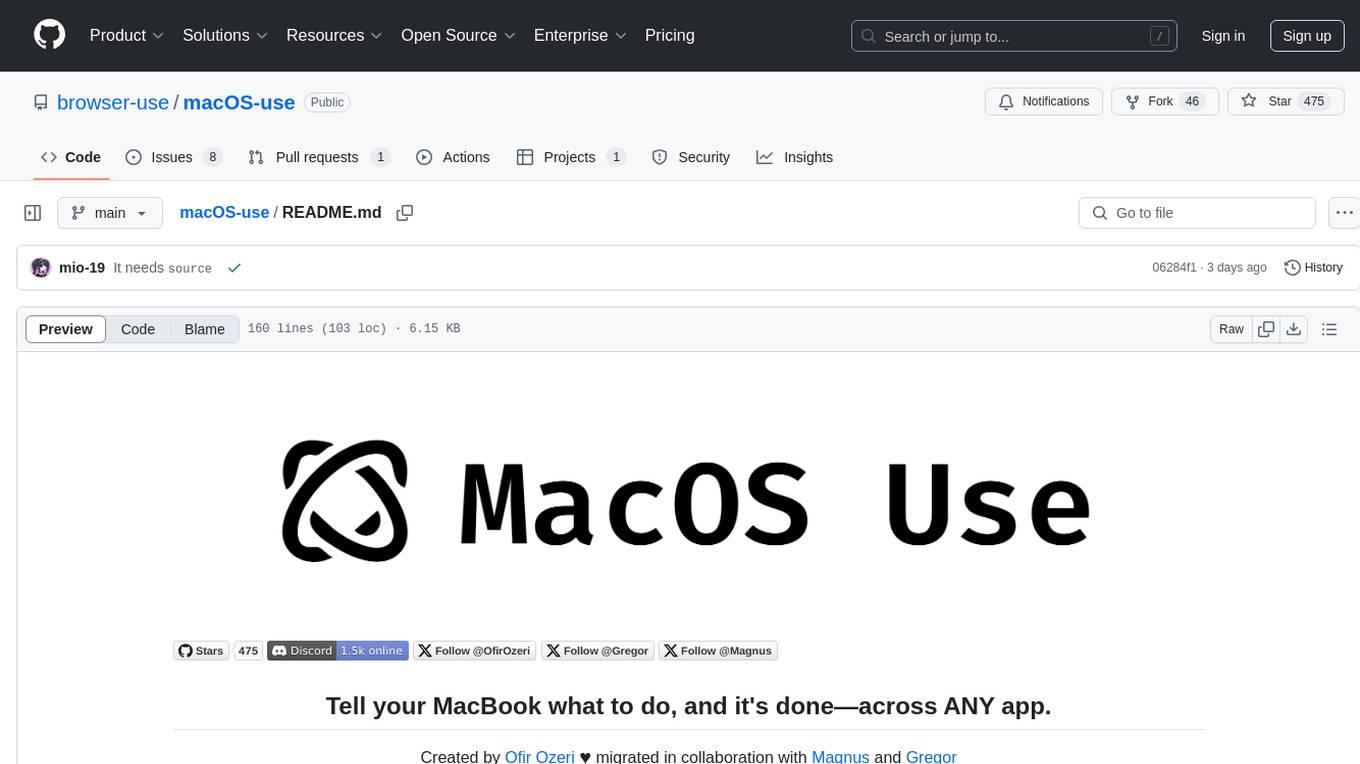
macOS-use
macOS-use is a project that enables AI agents to interact with a MacBook across any app. It aims to build an AI agent for the MLX by Apple framework to perform actions on Apple devices. The project is under active development and allows users to prompt the agent to perform various tasks on their MacBook. Users need to be cautious as the tool can interact with apps, UI components, and use private credentials. The project is open source and welcomes contributions from the community.
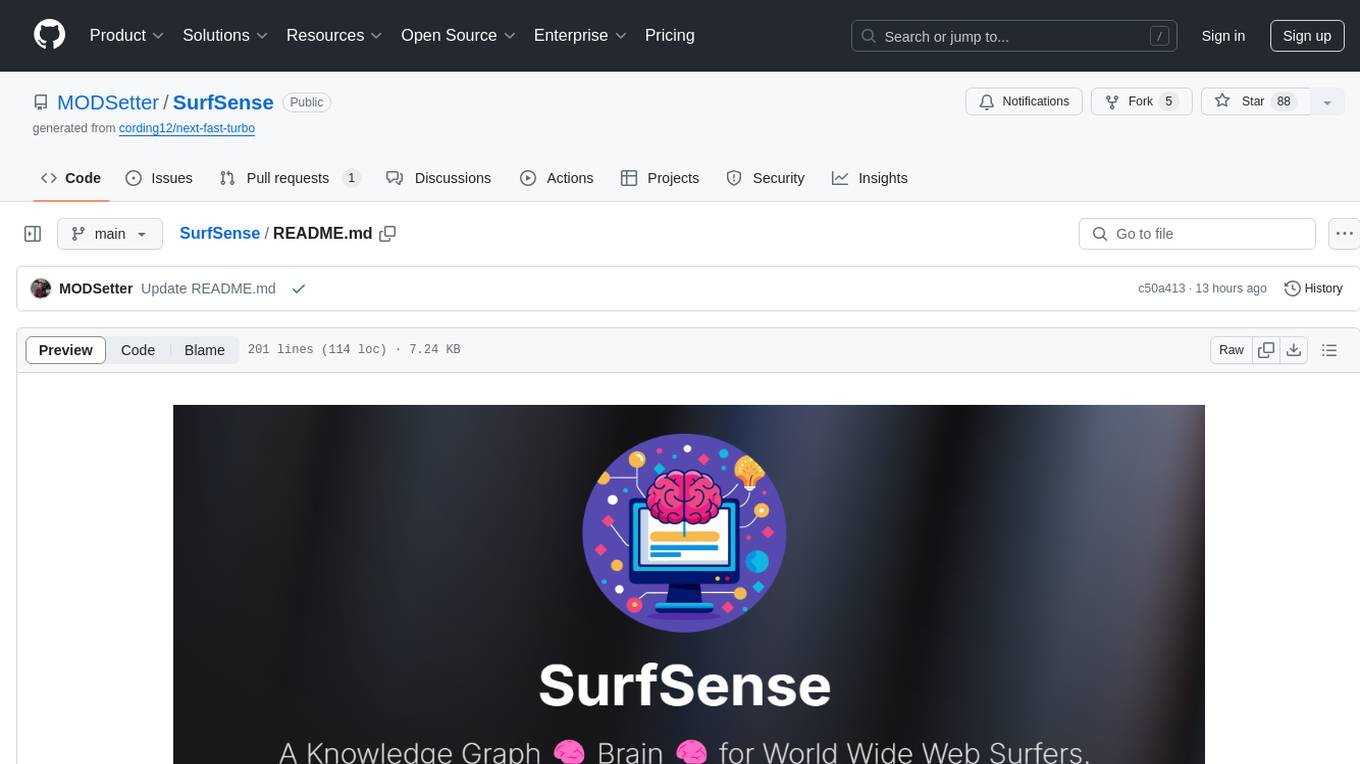
SurfSense
SurfSense is a tool designed to help users save and organize content from the internet into a personal Knowledge Graph. It allows users to capture web browsing sessions and webpage content using a Chrome extension, enabling easy retrieval and recall of saved information. SurfSense offers features like powerful search capabilities, natural language interaction with saved content, self-hosting options, and integration with GraphRAG for meaningful content relations. The tool eliminates the need for web scraping by directly reading data from the DOM, making it a convenient solution for managing online information.
swirl-search
Swirl is an open-source software that allows users to simultaneously search multiple content sources and receive AI-ranked results. It connects to various data sources, including databases, public data services, and enterprise sources, and utilizes AI and LLMs to generate insights and answers based on the user's data. Swirl is easy to use, requiring only the download of a YML file, starting in Docker, and searching with Swirl. Users can add credentials to preloaded SearchProviders to access more sources. Swirl also offers integration with ChatGPT as a configured AI model. It adapts and distributes user queries to anything with a search API, re-ranking the unified results using Large Language Models without extracting or indexing anything. Swirl includes five Google Programmable Search Engines (PSEs) to get users up and running quickly. Key features of Swirl include Microsoft 365 integration, SearchProvider configurations, query adaptation, synchronous or asynchronous search federation, optional subscribe feature, pipelining of Processor stages, results stored in SQLite3 or PostgreSQL, built-in Query Transformation support, matching on word stems and handling of stopwords, duplicate detection, re-ranking of unified results using Cosine Vector Similarity, result mixers, page through all results requested, sample data sets, optional spell correction, optional search/result expiration service, easily extensible Connector and Mixer objects, and a welcoming community for collaboration and support.
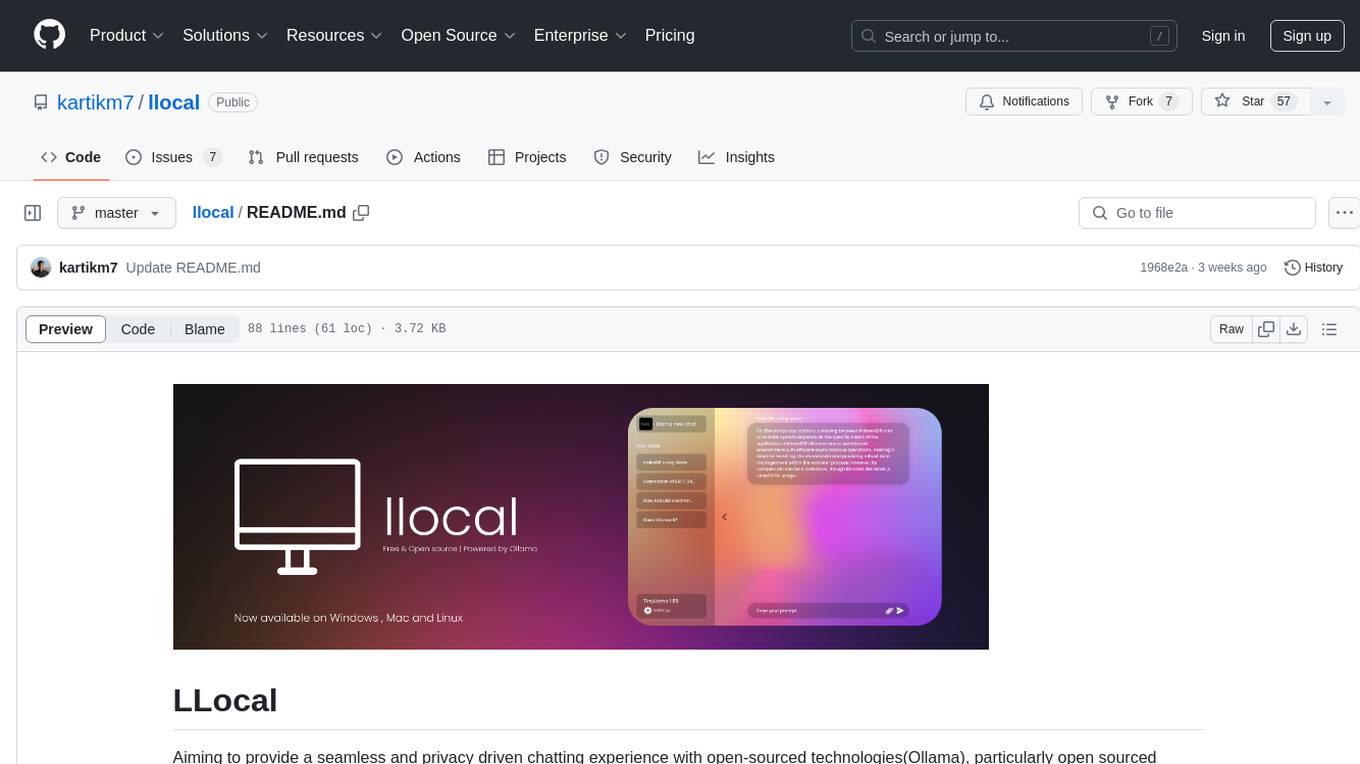
llocal
LLocal is an Electron application focused on providing a seamless and privacy-driven chatting experience using open-sourced technologies, particularly open-sourced LLM's. It allows users to store chats locally, switch between models, pull new models, upload images, perform web searches, and render responses as markdown. The tool also offers multiple themes, seamless integration with Ollama, and upcoming features like chat with images, web search improvements, retrieval augmented generation, multiple PDF chat, text to speech models, community wallpapers, lofi music, speech to text, and more. LLocal's builds are currently unsigned, requiring manual builds or using the universal build for stability.
gaia
Gaia is a powerful open-source tool for managing infrastructure as code. It allows users to define and provision cloud resources using simple configuration files. With Gaia, you can automate the deployment and scaling of your applications, ensuring consistency and reliability across your infrastructure. The tool supports multiple cloud providers and offers a user-friendly interface for managing your resources efficiently. Gaia simplifies the process of infrastructure management, making it easier for teams to collaborate and deploy applications seamlessly.
Open-LLM-VTuber
Open-LLM-VTuber is a voice-interactive AI companion supporting real-time voice conversations and featuring a Live2D avatar. It can run offline on Windows, macOS, and Linux, offering web and desktop client modes. Users can customize appearance and persona, with rich LLM inference, text-to-speech, and speech recognition support. The project is highly customizable, extensible, and actively developed with exciting features planned. It provides privacy with offline mode, persistent chat logs, and various interaction features like voice interruption, touch feedback, Live2D expressions, pet mode, and more.
amurex
Amurex is a powerful AI meeting assistant that integrates seamlessly into your workflow. It ensures you never miss details, stay on top of action items, and make meetings more productive. With real-time suggestions, smart summaries, and follow-up emails, Amurex acts as your personal copilot. It is open-source, transparent, secure, and privacy-focused, providing a seamless AI-driven experience to take control of your meetings and focus on what truly matters.
Follow
Follow is a content organization tool that creates a noise-free timeline for users, allowing them to share lists, explore collections, and browse distraction-free. It offers features like subscribing to feeds, AI-powered browsing, dynamic content support, an ownership economy with $POWER tipping, and a community-driven experience. Follow is under active development and welcomes feedback from users and developers. It can be accessed via web app or desktop client and offers installation methods for different operating systems. The tool aims to provide a customized information hub, AI-powered browsing experience, and support for various types of content, while fostering a community-driven and open-source environment.
For similar tasks
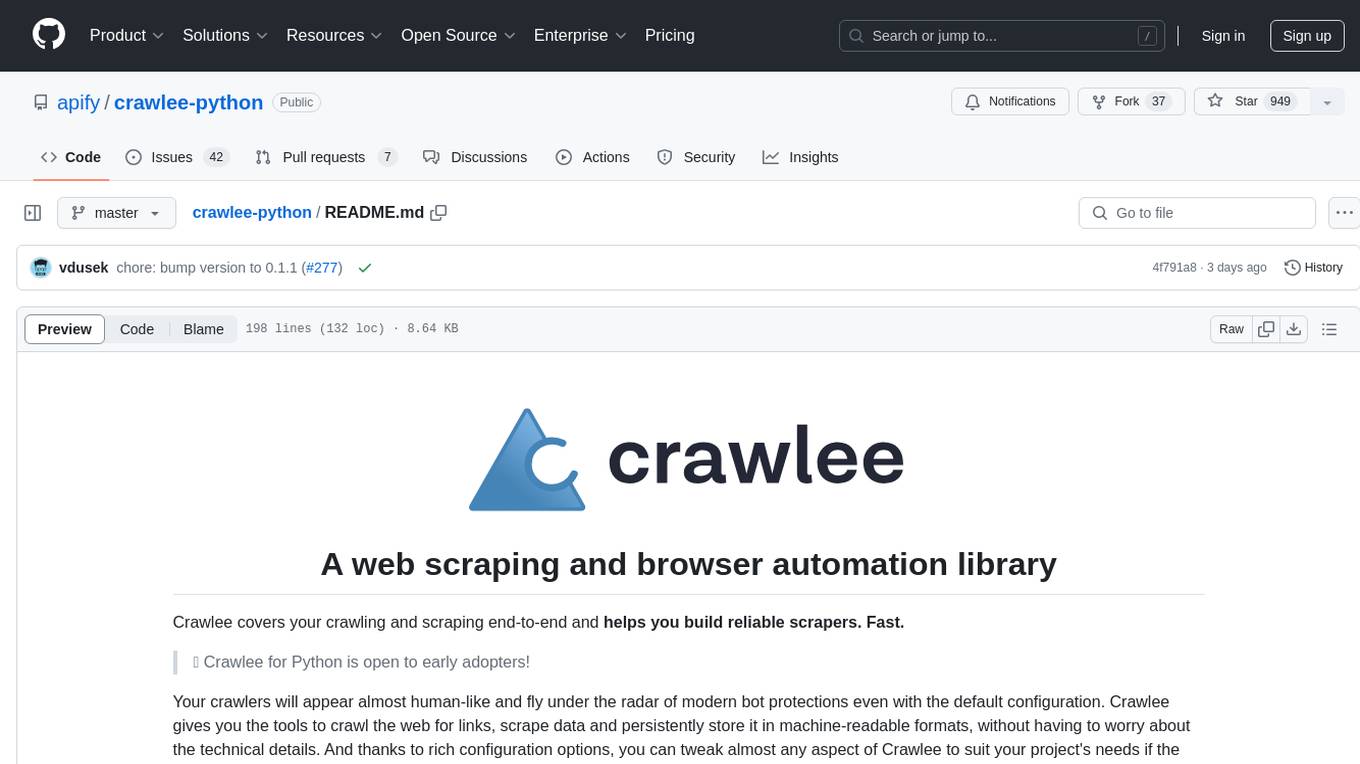
crawlee-python
Crawlee-python is a web scraping and browser automation library that covers crawling and scraping end-to-end, helping users build reliable scrapers fast. It allows users to crawl the web for links, scrape data, and store it in machine-readable formats without worrying about technical details. With rich configuration options, users can customize almost any aspect of Crawlee to suit their project's needs.
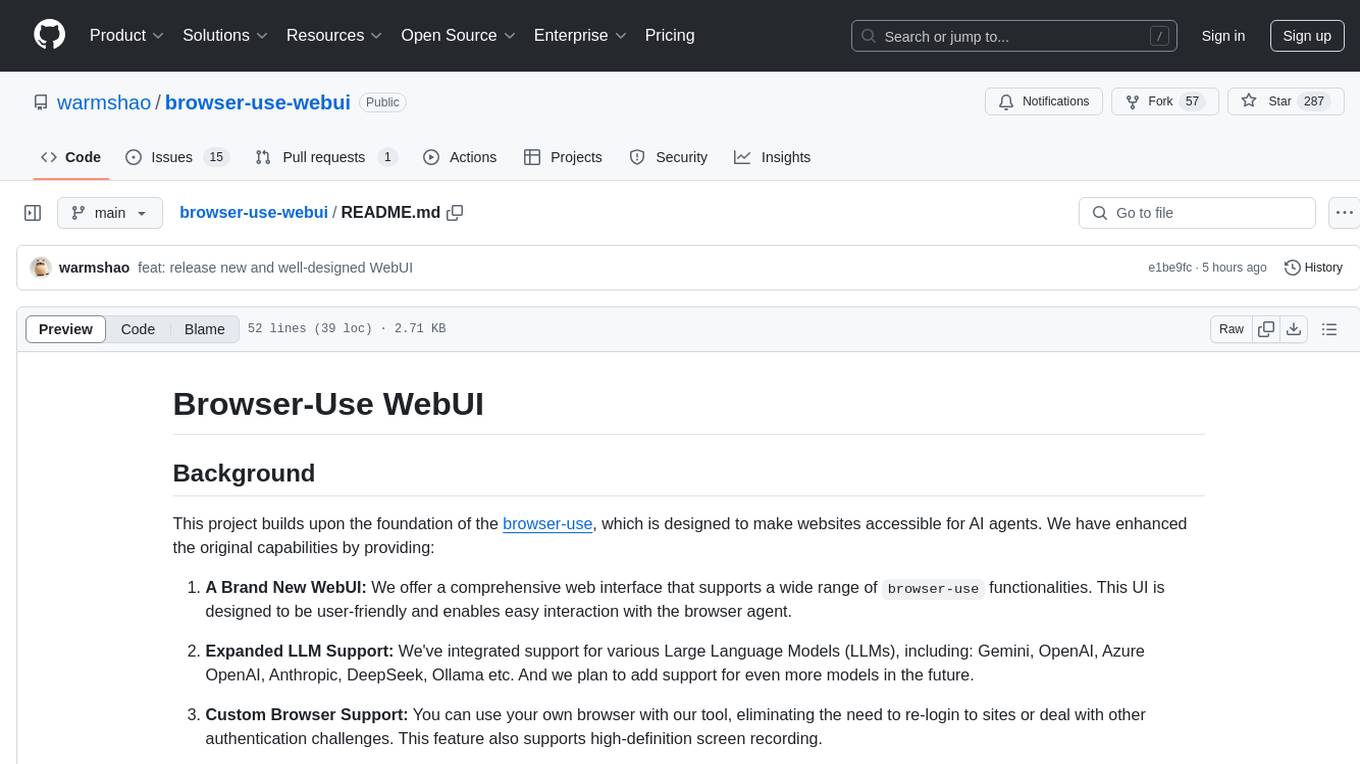
browser-use-webui
Browser-Use WebUI is a project that enhances the original browser-use tool by providing a brand new web interface, expanded LLM support for various Large Language Models, custom browser support for using your own browser with the tool, and a customized agent with optimized prompts. The tool aims to make websites accessible for AI agents and offers user-friendly interaction with the browser agent, eliminating the need for re-login to sites and dealing with authentication challenges. It also supports high-definition screen recording.
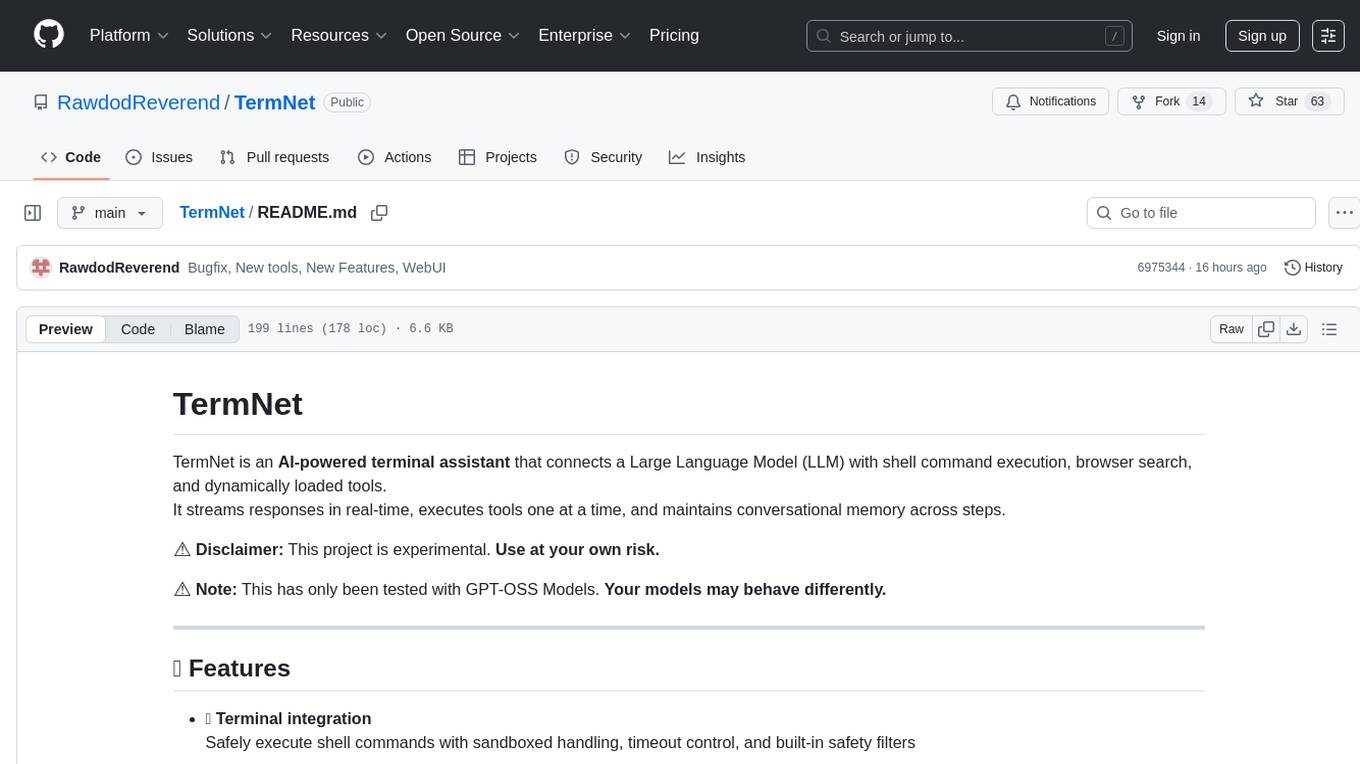
TermNet
TermNet is an AI-powered terminal assistant that connects a Large Language Model (LLM) with shell command execution, browser search, and dynamically loaded tools. It streams responses in real-time, executes tools one at a time, and maintains conversational memory across steps. The project features terminal integration for safe shell command execution, dynamic tool loading without code changes, browser automation powered by Playwright, WebSocket architecture for real-time communication, a memory system to track planning and actions, streaming LLM output integration, a safety layer to block dangerous commands, dual interface options, a notification system, and scratchpad memory for persistent note-taking. The architecture includes a multi-server setup with servers for WebSocket, browser automation, notifications, and web UI. The project structure consists of core backend files, various tools like web browsing and notification management, and servers for browser automation and notifications. Installation requires Python 3.9+, Ollama, and Chromium, with setup steps provided in the README. The tool can be used via the launcher for managing components or directly by starting individual servers. Additional tools can be added by registering them in `toolregistry.json` and implementing them in Python modules. Safety notes highlight the blocking of dangerous commands, allowed risky commands with warnings, and the importance of monitoring tool execution and setting appropriate timeouts.
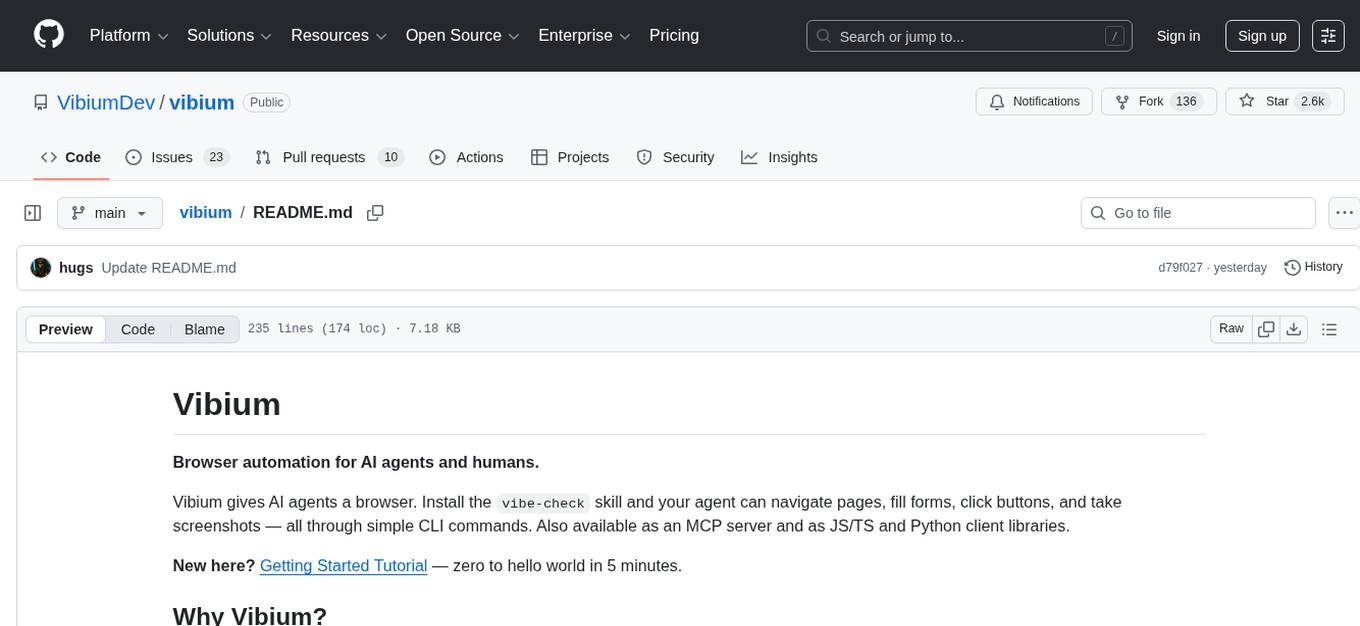
vibium
Vibium is a browser automation infrastructure designed for AI agents, providing a single binary that manages browser lifecycle, WebDriver BiDi protocol, and an MCP server. It offers zero configuration, AI-native capabilities, and is lightweight with no runtime dependencies. It is suitable for AI agents, test automation, and any tasks requiring browser interaction.
BrowserOS
BrowserOS is an open-source Chromium fork that runs AI agents natively. It provides a privacy-first alternative to ChatGPT Atlas, Perplexity Comet, and Dia. Users can use their own API keys or run local models with Ollama, ensuring that their data never leaves their machine. BrowserOS offers a familiar Chrome interface with all extensions working, AI agents that run on the user's browser instead of the cloud, privacy-first approach, browser control through MCP server, workflows for building browser automations, coworking capabilities with local file operations, scheduled tasks, LLM Hub for comparing AI agents, built-in ad blocker, and is 100% open source under AGPL-3.0.
scrape-it-now
Scrape It Now is a versatile tool for scraping websites with features like decoupled architecture, CLI functionality, idempotent operations, and content storage options. The tool includes a scraper component for efficient scraping, ad blocking, link detection, markdown extraction, dynamic content loading, and anonymity features. It also offers an indexer component for creating AI search indexes, chunking content, embedding chunks, and enabling semantic search. The tool supports various configurations for Azure services and local storage, providing flexibility and scalability for web scraping and indexing tasks.
500
Simple Config GeoIP for Quantumult X is a pre-configured file package containing rules for unlocking Apple News, ad blocking, TikTok unlock Rewrite, machine routing rules, and VIP video resolution rewriting. It integrates multiple rewrite configurations using Quantumult X and GeoIP features to remove most rules to save resources, and provides corresponding shortcuts for rule and configuration simplification through Vercel redirection.
h2ogpt
h2oGPT is an Apache V2 open-source project that allows users to query and summarize documents or chat with local private GPT LLMs. It features a private offline database of any documents (PDFs, Excel, Word, Images, Video Frames, Youtube, Audio, Code, Text, MarkDown, etc.), a persistent database (Chroma, Weaviate, or in-memory FAISS) using accurate embeddings (instructor-large, all-MiniLM-L6-v2, etc.), and efficient use of context using instruct-tuned LLMs (no need for LangChain's few-shot approach). h2oGPT also offers parallel summarization and extraction, reaching an output of 80 tokens per second with the 13B LLaMa2 model, HYDE (Hypothetical Document Embeddings) for enhanced retrieval based upon LLM responses, a variety of models supported (LLaMa2, Mistral, Falcon, Vicuna, WizardLM. With AutoGPTQ, 4-bit/8-bit, LORA, etc.), GPU support from HF and LLaMa.cpp GGML models, and CPU support using HF, LLaMa.cpp, and GPT4ALL models. Additionally, h2oGPT provides Attention Sinks for arbitrarily long generation (LLaMa-2, Mistral, MPT, Pythia, Falcon, etc.), a UI or CLI with streaming of all models, the ability to upload and view documents through the UI (control multiple collaborative or personal collections), Vision Models LLaVa, Claude-3, Gemini-Pro-Vision, GPT-4-Vision, Image Generation Stable Diffusion (sdxl-turbo, sdxl) and PlaygroundAI (playv2), Voice STT using Whisper with streaming audio conversion, Voice TTS using MIT-Licensed Microsoft Speech T5 with multiple voices and Streaming audio conversion, Voice TTS using MPL2-Licensed TTS including Voice Cloning and Streaming audio conversion, AI Assistant Voice Control Mode for hands-free control of h2oGPT chat, Bake-off UI mode against many models at the same time, Easy Download of model artifacts and control over models like LLaMa.cpp through the UI, Authentication in the UI by user/password via Native or Google OAuth, State Preservation in the UI by user/password, Linux, Docker, macOS, and Windows support, Easy Windows Installer for Windows 10 64-bit (CPU/CUDA), Easy macOS Installer for macOS (CPU/M1/M2), Inference Servers support (oLLaMa, HF TGI server, vLLM, Gradio, ExLLaMa, Replicate, OpenAI, Azure OpenAI, Anthropic), OpenAI-compliant, Server Proxy API (h2oGPT acts as drop-in-replacement to OpenAI server), Python client API (to talk to Gradio server), JSON Mode with any model via code block extraction. Also supports MistralAI JSON mode, Claude-3 via function calling with strict Schema, OpenAI via JSON mode, and vLLM via guided_json with strict Schema, Web-Search integration with Chat and Document Q/A, Agents for Search, Document Q/A, Python Code, CSV frames (Experimental, best with OpenAI currently), Evaluate performance using reward models, and Quality maintained with over 1000 unit and integration tests taking over 4 GPU-hours.
For similar jobs
sweep
Sweep is an AI junior developer that turns bugs and feature requests into code changes. It automatically handles developer experience improvements like adding type hints and improving test coverage.
teams-ai
The Teams AI Library is a software development kit (SDK) that helps developers create bots that can interact with Teams and Microsoft 365 applications. It is built on top of the Bot Framework SDK and simplifies the process of developing bots that interact with Teams' artificial intelligence capabilities. The SDK is available for JavaScript/TypeScript, .NET, and Python.
ai-guide
This guide is dedicated to Large Language Models (LLMs) that you can run on your home computer. It assumes your PC is a lower-end, non-gaming setup.
classifai
Supercharge WordPress Content Workflows and Engagement with Artificial Intelligence. Tap into leading cloud-based services like OpenAI, Microsoft Azure AI, Google Gemini and IBM Watson to augment your WordPress-powered websites. Publish content faster while improving SEO performance and increasing audience engagement. ClassifAI integrates Artificial Intelligence and Machine Learning technologies to lighten your workload and eliminate tedious tasks, giving you more time to create original content that matters.
chatbot-ui
Chatbot UI is an open-source AI chat app that allows users to create and deploy their own AI chatbots. It is easy to use and can be customized to fit any need. Chatbot UI is perfect for businesses, developers, and anyone who wants to create a chatbot.
BricksLLM
BricksLLM is a cloud native AI gateway written in Go. Currently, it provides native support for OpenAI, Anthropic, Azure OpenAI and vLLM. BricksLLM aims to provide enterprise level infrastructure that can power any LLM production use cases. Here are some use cases for BricksLLM: * Set LLM usage limits for users on different pricing tiers * Track LLM usage on a per user and per organization basis * Block or redact requests containing PIIs * Improve LLM reliability with failovers, retries and caching * Distribute API keys with rate limits and cost limits for internal development/production use cases * Distribute API keys with rate limits and cost limits for students
uAgents
uAgents is a Python library developed by Fetch.ai that allows for the creation of autonomous AI agents. These agents can perform various tasks on a schedule or take action on various events. uAgents are easy to create and manage, and they are connected to a fast-growing network of other uAgents. They are also secure, with cryptographically secured messages and wallets.

griptape
Griptape is a modular Python framework for building AI-powered applications that securely connect to your enterprise data and APIs. It offers developers the ability to maintain control and flexibility at every step. Griptape's core components include Structures (Agents, Pipelines, and Workflows), Tasks, Tools, Memory (Conversation Memory, Task Memory, and Meta Memory), Drivers (Prompt and Embedding Drivers, Vector Store Drivers, Image Generation Drivers, Image Query Drivers, SQL Drivers, Web Scraper Drivers, and Conversation Memory Drivers), Engines (Query Engines, Extraction Engines, Summary Engines, Image Generation Engines, and Image Query Engines), and additional components (Rulesets, Loaders, Artifacts, Chunkers, and Tokenizers). Griptape enables developers to create AI-powered applications with ease and efficiency.