


agnix
The missing linter and lsp for AI coding assistants. Validate CLAUDE.md, AGENTS.md, SKILL.md, hooks, MCP. Plugin for all major IDEs included, with autofixes.
Stars: 60
Agnix is a tool designed to validate agent configurations before they disrupt your workflow. It offers 230 rules to check various agent files like CLAUDE.md, SKILL.md, hooks, and MCP configs. The tool aims to prevent AI tools from ignoring misconfigured agents by catching errors early. Agnix provides auto-fix functionality and supports multiple tools like Claude Code, Codex CLI, OpenCode, Cursor, and Copilot. It constantly updates its rules and tool support to ensure accurate validation of agent configurations.
README:



Catch broken agent configs before your AI tools silently ignore them.
230 rules across Claude Code, Codex CLI, OpenCode, Cursor, Copilot, and more -
validating CLAUDE.md, SKILL.md, hooks, MCP configs, and other agent files.
Auto-fix | GitHub Action | VS Code + JetBrains + Neovim + Zed



New rules and tool support ship constantly. Follow for real-time updates:

Your skills don't trigger. Vercel's research found skills invoke at 0% without correct syntax. One wrong field and your skill is invisible.
"Almost right" is the worst outcome. 66% of developers cite it as their biggest AI frustration. Misconfigured agents produce exactly this.
Multi-tool stacks fail silently. Cursor + Claude Code + Copilot each want different formats. A config that works in one tool breaks in another.
Bad patterns get amplified. AI assistants don't ignore wrong configs - they learn from them.
agnix validates all of it - 230 rules sourced from official specs, academic research, and real-world breakage patterns. Auto-fix included.
Want to try it first? Open the playground - paste any agent config, see diagnostics instantly. No install, runs in your browser.
$ npx agnix .
Validating: .

CLAUDE.md:15:1 warning: Generic instruction 'Be helpful and accurate' [fixable]
  help: Remove generic instructions. Claude already knows this.

.claude/skills/review/SKILL.md:3:1 error: Invalid name 'Review-Code' [fixable]
  help: Use lowercase letters and hyphens only (e.g., 'code-review')

Found 1 error, 1 warning
  2 issues are automatically fixable

hint: Run with --fix, --fix-safe, or --fix-unsafe to apply fixes
https://github.com/user-attachments/assets/72d5fe7c-476f-46ea-be64-5785cf6d5600
# npm (recommended, all platforms)
npm install -g agnix

# Homebrew (macOS/Linux)
brew tap agent-sh/agnix && brew install agnix

# Cargo
cargo install agnix-cli
Pre-built binaries | All install options
| Editor | Install |
|---|---|
| VS Code | VS Code Marketplace |
| JetBrains | JetBrains Marketplace |
| Neovim | { "agent-sh/agnix.nvim" } |
| Zed | Search "agnix" in Extensions |
- name: Validate agent configs
  uses: agent-sh/agnix@v0
  with:
target: 'claude-code'agnix . # Validate current directory
agnix --fix . # Apply HIGH and MEDIUM confidence fixes
agnix --fix-safe . # Apply only HIGH confidence fixes
agnix --fix-unsafe . # Apply all fixes, including LOW confidence
agnix --dry-run --show-fixes . # Preview fixes with inline diff output
agnix --strict . # Strict mode (warnings = errors)
agnix --target claude-code . # Target specific toolFull CLI reference | All 230 rules
| Tool | Rules | Count | Config Files |
|---|---|---|---|
| Agent Skills | AS-*, CC-SK-* | 31 | SKILL.md |
| Claude Code | CC-* | 53 | CLAUDE.md, hooks, agents, plugins |
| GitHub Copilot | COP-* | 6 | .github/copilot-instructions.md, .github/instructions/*.instructions.md |
| Cursor | CUR-* | 16 | .cursor/rules/*.mdc, .cursorrules, .cursor/hooks.json, .cursor/agents/**/*.md, .cursor/environment.json |
| MCP | MCP-* | 12 | *.mcp.json |
| AGENTS.md | AGM-*, XP-* | 13 | AGENTS.md, AGENTS.local.md, AGENTS.override.md |
| Gemini CLI | GM-* | 9 | GEMINI.md, GEMINI.local.md, .gemini/settings.json (hooks), gemini-extension.json (extensions), .geminiignore |
Rust workspace crates:
-
agnix-rules- rule metadata generated fromknowledge-base/rules.json -
agnix-core- shared validation engine library -
agnix-cli- command-line interface binary -
agnix-lsp- language server binary -
agnix-mcp- MCP server binary -
agnix-wasm- WebAssembly bindings for browser/runtime integrations
Contributions welcome. See CONTRIBUTING.md for the development guide.
Report a bug | Request a rule | Good first issues
MIT OR Apache-2.0
Star this repo to help other developers find agnix.
For Tasks:
Click tags to check more tools for each tasksFor Jobs:
Alternative AI tools for agnix
Similar Open Source Tools
agnix
Agnix is a tool designed to validate agent configurations before they disrupt your workflow. It offers 230 rules to check various agent files like CLAUDE.md, SKILL.md, hooks, and MCP configs. The tool aims to prevent AI tools from ignoring misconfigured agents by catching errors early. Agnix provides auto-fix functionality and supports multiple tools like Claude Code, Codex CLI, OpenCode, Cursor, and Copilot. It constantly updates its rules and tool support to ensure accurate validation of agent configurations.
zeptoclaw
ZeptoClaw is an ultra-lightweight personal AI assistant that offers a compact Rust binary with 29 tools, 8 channels, 9 providers, and container isolation. It focuses on integrations, security, and size discipline without compromising on performance. With features like container isolation, prompt injection detection, secret leak scanner, policy engine, input validator, and more, ZeptoClaw ensures secure AI agent execution. It supports migration from OpenClaw, deployment on various platforms, and configuration of LLM providers. ZeptoClaw is designed for efficient AI assistance with minimal resource consumption and maximum security.
everything-claude-code
The 'Everything Claude Code' repository is a comprehensive collection of production-ready agents, skills, hooks, commands, rules, and MCP configurations developed over 10+ months. It includes guides for setup, foundations, and philosophy, as well as detailed explanations of various topics such as token optimization, memory persistence, continuous learning, verification loops, parallelization, and subagent orchestration. The repository also provides updates on bug fixes, multi-language rules, installation wizard, PM2 support, OpenCode plugin integration, unified commands and skills, and cross-platform support. It offers a quick start guide for installation, ecosystem tools like Skill Creator and Continuous Learning v2, requirements for CLI version compatibility, key concepts like agents, skills, hooks, and rules, running tests, contributing guidelines, OpenCode support, background information, important notes on context window management and customization, star history chart, and relevant links.
aegra
Aegra is a self-hosted AI agent backend platform that provides LangGraph power without vendor lock-in. Built with FastAPI + PostgreSQL, it offers complete control over agent orchestration for teams looking to escape vendor lock-in, meet data sovereignty requirements, enable custom deployments, and optimize costs. Aegra is Agent Protocol compliant and perfect for teams seeking a free, self-hosted alternative to LangGraph Platform with zero lock-in, full control, and compatibility with existing LangGraph Client SDK.
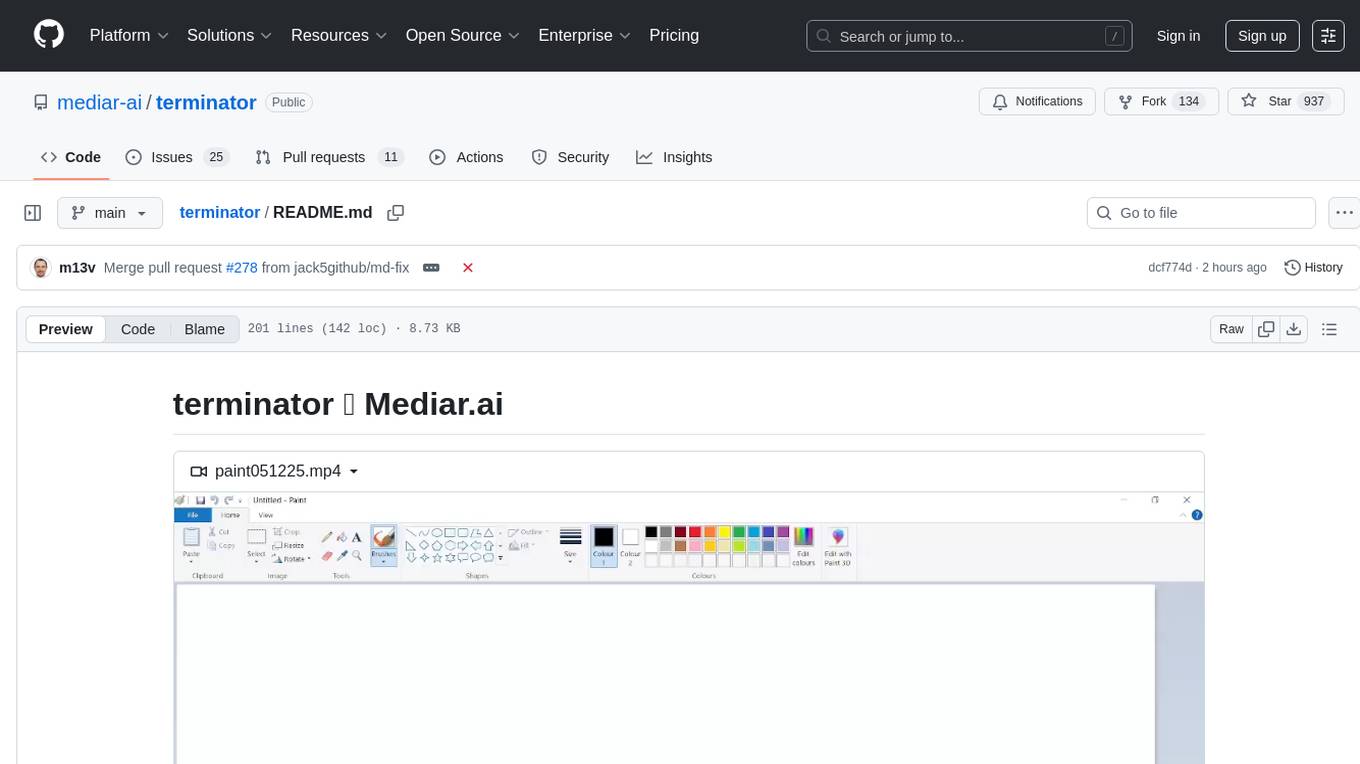
terminator
Terminator is an AI-powered desktop automation tool that is open source, MIT-licensed, and cross-platform. It works across all apps and browsers, inspired by GitHub Actions & Playwright. It is 100x faster than generic AI agents, with over 95% success rate and no vendor lock-in. Users can create automations that work across any desktop app or browser, achieve high success rates without costly consultant armies, and pre-train workflows as deterministic code.
cua
Cua is a tool for creating and running high-performance macOS and Linux virtual machines on Apple Silicon, with built-in support for AI agents. It provides libraries like Lume for running VMs with near-native performance, Computer for interacting with sandboxes, and Agent for running agentic workflows. Users can refer to the documentation for onboarding, explore demos showcasing AI-Gradio and GitHub issue fixing, and utilize accessory libraries like Core, PyLume, Computer Server, and SOM. Contributions are welcome, and the tool is open-sourced under the MIT License.
pocketpaw
PocketPaw is a lightweight and user-friendly tool designed for managing and organizing your digital assets. It provides a simple interface for users to easily categorize, tag, and search for files across different platforms. With PocketPaw, you can efficiently organize your photos, documents, and other files in a centralized location, making it easier to access and share them. Whether you are a student looking to organize your study materials, a professional managing project files, or a casual user wanting to declutter your digital space, PocketPaw is the perfect solution for all your file management needs.
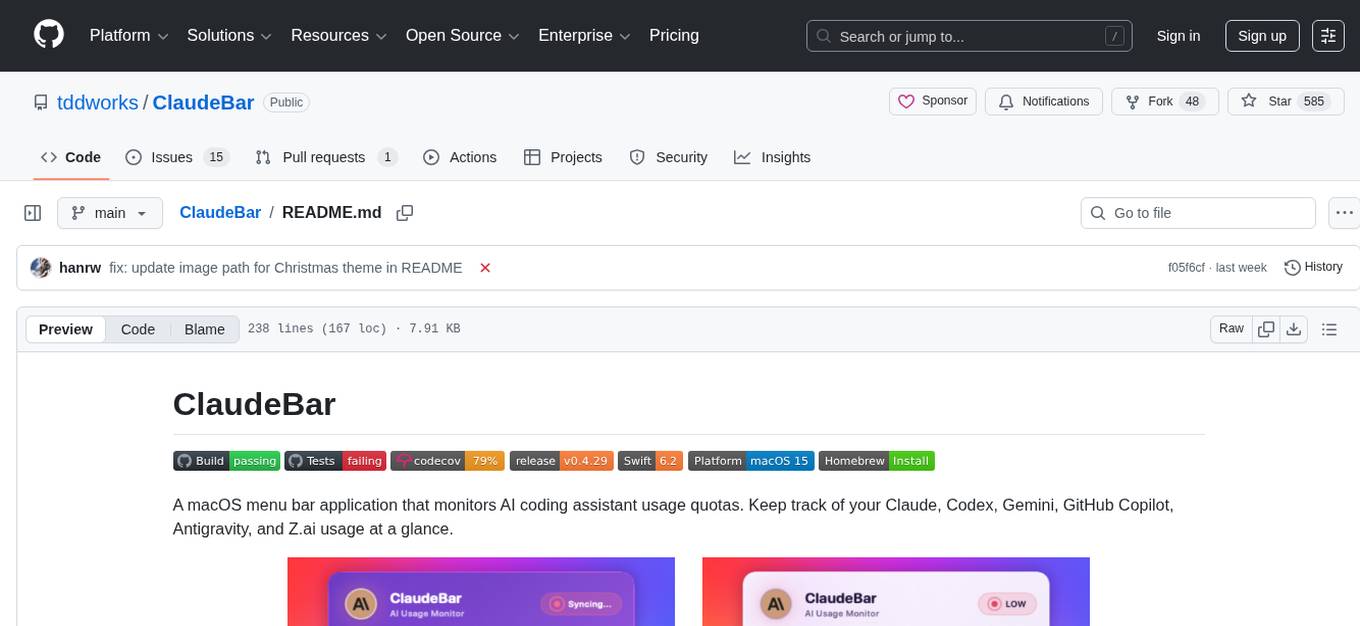
ClaudeBar
ClaudeBar is a macOS menu bar application that monitors AI coding assistant usage quotas. It allows users to keep track of their usage of Claude, Codex, Gemini, GitHub Copilot, Antigravity, and Z.ai at a glance. The application offers multi-provider support, real-time quota tracking, multiple themes, visual status indicators, system notifications, auto-refresh feature, and keyboard shortcuts for quick access. Users can customize monitoring by toggling individual providers on/off and receive alerts when quota status changes. The tool requires macOS 15+, Swift 6.2+, and CLI tools installed for the providers to be monitored.
agentscope
AgentScope is a multi-agent platform designed to empower developers to build multi-agent applications with large-scale models. It features three high-level capabilities: Easy-to-Use, High Robustness, and Actor-Based Distribution. AgentScope provides a list of `ModelWrapper` to support both local model services and third-party model APIs, including OpenAI API, DashScope API, Gemini API, and ollama. It also enables developers to rapidly deploy local model services using libraries such as ollama (CPU inference), Flask + Transformers, Flask + ModelScope, FastChat, and vllm. AgentScope supports various services, including Web Search, Data Query, Retrieval, Code Execution, File Operation, and Text Processing. Example applications include Conversation, Game, and Distribution. AgentScope is released under Apache License 2.0 and welcomes contributions.
orchestkit
OrchestKit is a powerful and flexible orchestration tool designed to streamline and automate complex workflows. It provides a user-friendly interface for defining and managing orchestration tasks, allowing users to easily create, schedule, and monitor workflows. With support for various integrations and plugins, OrchestKit enables seamless automation of tasks across different systems and applications. Whether you are a developer looking to automate deployment processes or a system administrator managing complex IT operations, OrchestKit offers a comprehensive solution to simplify and optimize your workflow management.
aichat
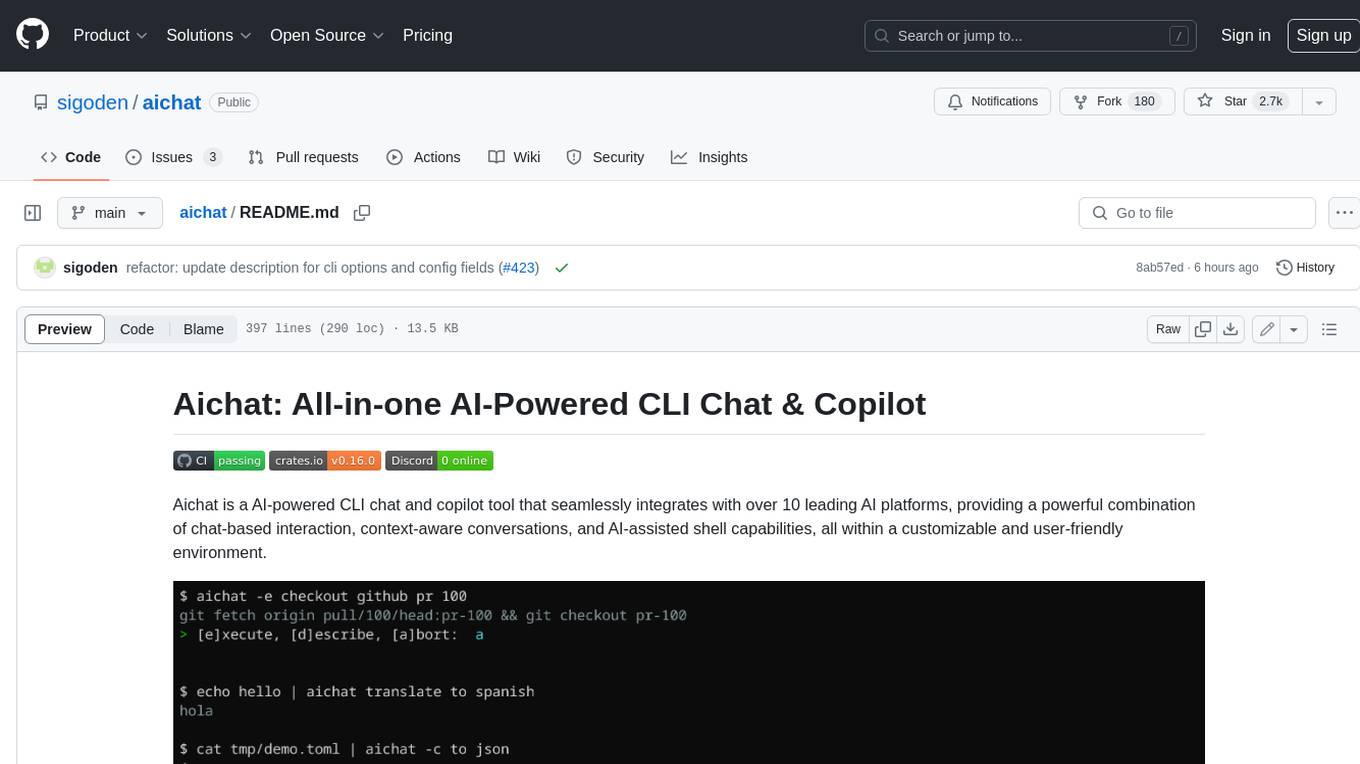
Aichat is an AI-powered CLI chat and copilot tool that seamlessly integrates with over 10 leading AI platforms, providing a powerful combination of chat-based interaction, context-aware conversations, and AI-assisted shell capabilities, all within a customizable and user-friendly environment.
mcp-rubber-duck
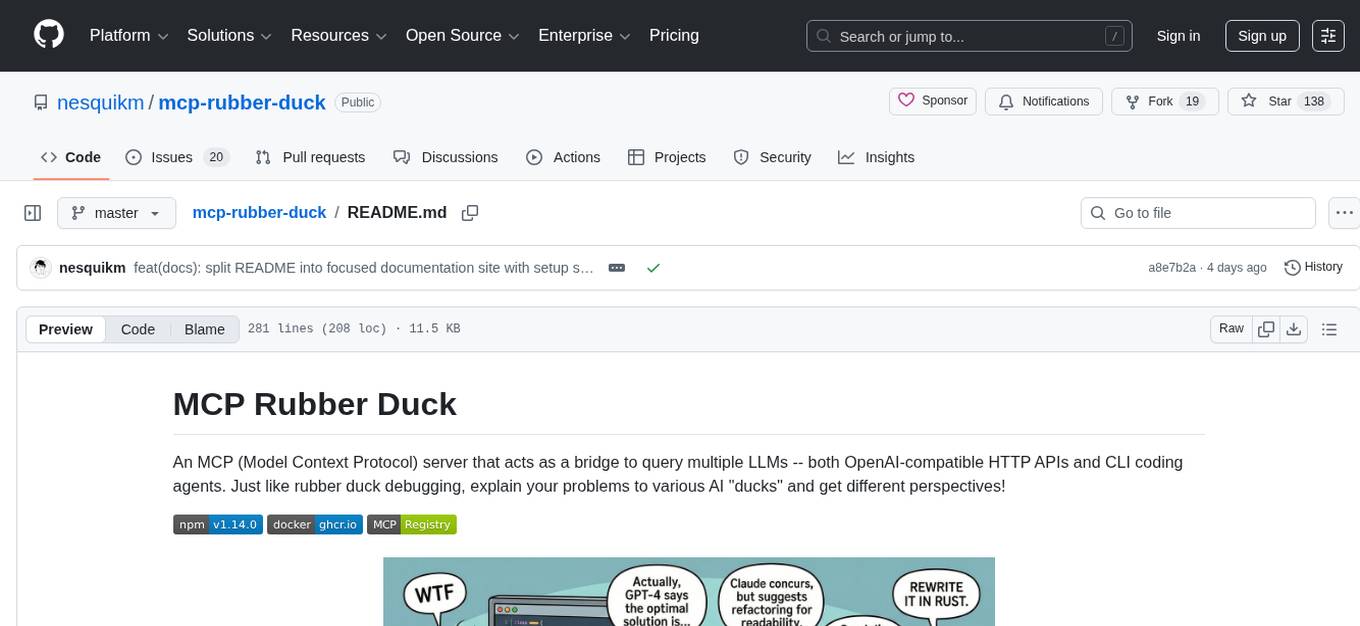
MCP Rubber Duck is a Model Context Protocol server that acts as a bridge to query multiple LLMs, including OpenAI-compatible HTTP APIs and CLI coding agents. Users can explain their problems to various AI 'ducks' to get different perspectives. The tool offers features like universal OpenAI compatibility, CLI agent support, conversation management, multi-duck querying, consensus voting, LLM-as-Judge evaluation, structured debates, health monitoring, usage tracking, and more. It supports various HTTP providers like OpenAI, Google Gemini, Anthropic, Groq, Together AI, Perplexity, and CLI providers like Claude Code, Codex, Gemini CLI, Grok, Aider, and custom agents. Users can install the tool globally, configure it using environment variables, and access interactive UIs for comparing ducks, voting, debating, and usage statistics. The tool provides multiple tools for asking questions, chatting, clearing conversations, listing ducks, comparing responses, voting, judging, iterating, debating, and more. It also offers prompt templates for different analysis purposes and extensive documentation for setup, configuration, tools, prompts, CLI providers, MCP Bridge, guardrails, Docker deployment, troubleshooting, contributing, license, acknowledgments, changelog, registry & directory, and support.
axonhub
AxonHub is an all-in-one AI development platform that serves as an AI gateway allowing users to switch between model providers without changing any code. It provides features like vendor lock-in prevention, integration simplification, observability enhancement, and cost control. Users can access any model using any SDK with zero code changes. The platform offers full request tracing, enterprise RBAC, smart load balancing, and real-time cost tracking. AxonHub supports multiple databases, provides a unified API gateway, and offers flexible model management and API key creation for authentication. It also integrates with various AI coding tools and SDKs for seamless usage.
auto-dev
AutoDev is an AI-powered coding wizard that supports multiple languages, including Java, Kotlin, JavaScript/TypeScript, Rust, Python, Golang, C/C++/OC, and more. It offers a range of features, including auto development mode, copilot mode, chat with AI, customization options, SDLC support, custom AI agent integration, and language features such as language support, extensions, and a DevIns language for AI agent development. AutoDev is designed to assist developers with tasks such as auto code generation, bug detection, code explanation, exception tracing, commit message generation, code review content generation, smart refactoring, Dockerfile generation, CI/CD config file generation, and custom shell/command generation. It also provides a built-in LLM fine-tune model and supports UnitEval for LLM result evaluation and UnitGen for code-LLM fine-tune data generation.
agent-skills
Agent Skills is a secure, validated skill registry for professional AI coding agents. It provides a library of verified, tested, and safe capabilities to extend various AI agents with confidence. The tool addresses security concerns in marketplace skills by offering 100% open-source code, static analysis for credential theft prevention, immutable integrity to prevent supply chain attacks, and human curation to ensure safety boundaries. Users can install skills through an interactive wizard, choose from a variety of supported AI coding agents, and benefit from a growing catalog of featured skills for development, cloud, automation, design, and security tasks.
promptolution
Promptolution is a unified, modular framework for prompt optimization designed for researchers and advanced practitioners. It focuses on the optimization stage, providing a clean, transparent, and extensible API for simple prompt optimization for various tasks. It supports many current prompt optimizers, unified LLM backend, response caching, parallelized inference, and detailed logging for post-hoc analysis.
For similar tasks
agnix
Agnix is a tool designed to validate agent configurations before they disrupt your workflow. It offers 230 rules to check various agent files like CLAUDE.md, SKILL.md, hooks, and MCP configs. The tool aims to prevent AI tools from ignoring misconfigured agents by catching errors early. Agnix provides auto-fix functionality and supports multiple tools like Claude Code, Codex CLI, OpenCode, Cursor, and Copilot. It constantly updates its rules and tool support to ensure accurate validation of agent configurations.
For similar jobs
sweep
Sweep is an AI junior developer that turns bugs and feature requests into code changes. It automatically handles developer experience improvements like adding type hints and improving test coverage.
teams-ai
The Teams AI Library is a software development kit (SDK) that helps developers create bots that can interact with Teams and Microsoft 365 applications. It is built on top of the Bot Framework SDK and simplifies the process of developing bots that interact with Teams' artificial intelligence capabilities. The SDK is available for JavaScript/TypeScript, .NET, and Python.
ai-guide
This guide is dedicated to Large Language Models (LLMs) that you can run on your home computer. It assumes your PC is a lower-end, non-gaming setup.
classifai
Supercharge WordPress Content Workflows and Engagement with Artificial Intelligence. Tap into leading cloud-based services like OpenAI, Microsoft Azure AI, Google Gemini and IBM Watson to augment your WordPress-powered websites. Publish content faster while improving SEO performance and increasing audience engagement. ClassifAI integrates Artificial Intelligence and Machine Learning technologies to lighten your workload and eliminate tedious tasks, giving you more time to create original content that matters.
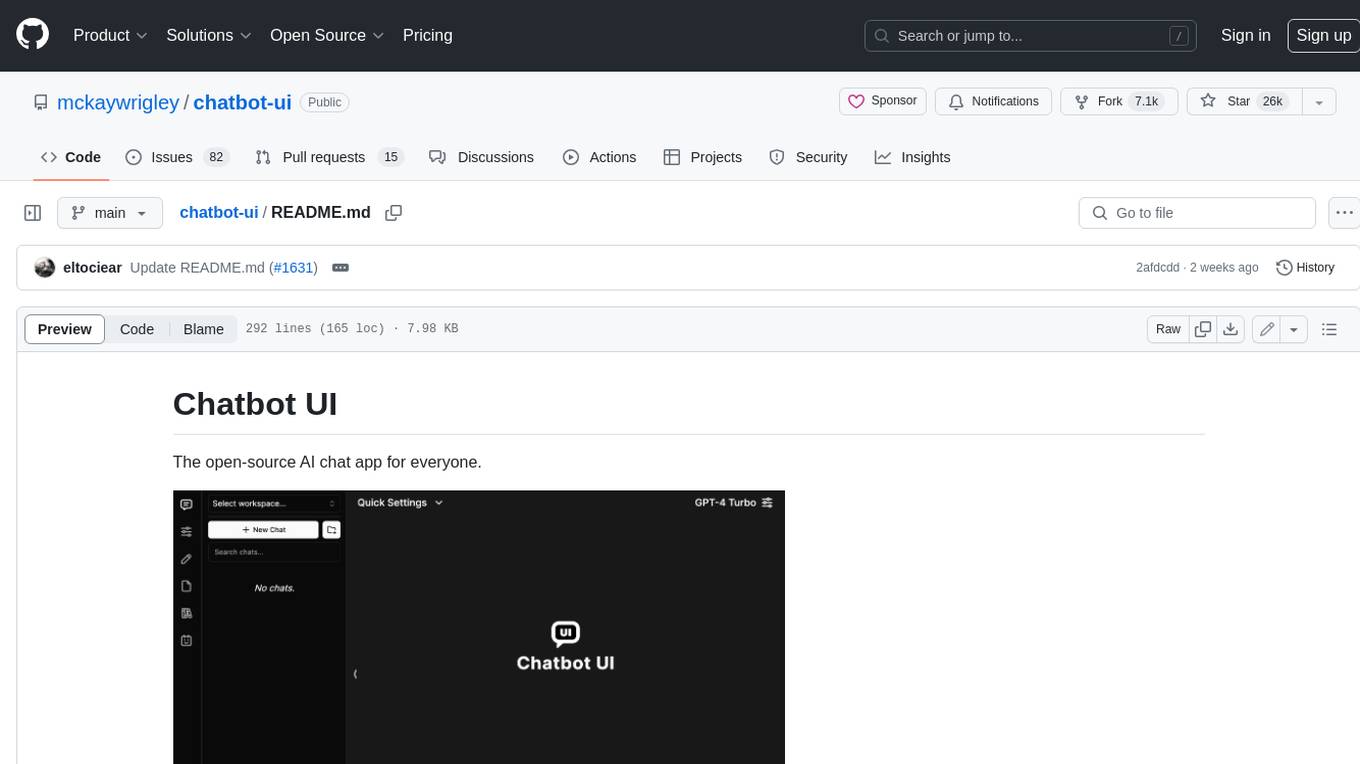
chatbot-ui
Chatbot UI is an open-source AI chat app that allows users to create and deploy their own AI chatbots. It is easy to use and can be customized to fit any need. Chatbot UI is perfect for businesses, developers, and anyone who wants to create a chatbot.
BricksLLM
BricksLLM is a cloud native AI gateway written in Go. Currently, it provides native support for OpenAI, Anthropic, Azure OpenAI and vLLM. BricksLLM aims to provide enterprise level infrastructure that can power any LLM production use cases. Here are some use cases for BricksLLM: * Set LLM usage limits for users on different pricing tiers * Track LLM usage on a per user and per organization basis * Block or redact requests containing PIIs * Improve LLM reliability with failovers, retries and caching * Distribute API keys with rate limits and cost limits for internal development/production use cases * Distribute API keys with rate limits and cost limits for students
uAgents
uAgents is a Python library developed by Fetch.ai that allows for the creation of autonomous AI agents. These agents can perform various tasks on a schedule or take action on various events. uAgents are easy to create and manage, and they are connected to a fast-growing network of other uAgents. They are also secure, with cryptographically secured messages and wallets.
griptape
Griptape is a modular Python framework for building AI-powered applications that securely connect to your enterprise data and APIs. It offers developers the ability to maintain control and flexibility at every step. Griptape's core components include Structures (Agents, Pipelines, and Workflows), Tasks, Tools, Memory (Conversation Memory, Task Memory, and Meta Memory), Drivers (Prompt and Embedding Drivers, Vector Store Drivers, Image Generation Drivers, Image Query Drivers, SQL Drivers, Web Scraper Drivers, and Conversation Memory Drivers), Engines (Query Engines, Extraction Engines, Summary Engines, Image Generation Engines, and Image Query Engines), and additional components (Rulesets, Loaders, Artifacts, Chunkers, and Tokenizers). Griptape enables developers to create AI-powered applications with ease and efficiency.