


soul.md
The best way to build a personality for your agent. Let Claude Code / OpenClaw ingest your data & build your AI soul.
Stars: 117
SOUL.md is a tool that helps users build a personality for their AI agent by creating a 'soul file' that captures their worldview, opinions, and voice. Inspired by the concept of consciousness uploading, the tool aims to create a Level 1 consciousness upload based on the language data produced by the user. It focuses on specificity, contradictions, and real opinions to make the uploaded consciousness feel continuous with the original. Users can generate ideas, write content, tailor AI, explore their own thinking, and scale themselves using this tool.
README:

The best way to build a personality for your agent.
Let Claude Code / OpenClaw ingest your data & build your AI soul.

A soul file captures who you are in a format AI agents can embody. Not a chatbot that talks about you—an AI that thinks and speaks as you.
SOUL.md is inspired by The First Paradigm of Consciousness Uploading: Mechanisms of Consciousness Evolution in the AI Axial Age and a Prospect toward Web4 — a framework by Liu Xiaoben that treats language as the basic unit of consciousness.
Wittgenstein argued that "the boundaries of language are the boundaries of the world." If that's true, then your consciousness — your worldview, opinions, how you react to things — is already encoded in the language you produce. Every tweet, essay, conversation, and hot take is a consciousness token: a discrete unit of your mind made legible.
The sum of all your consciousness tokens over a lifetime forms your life context — essentially, the complete record of your expressed mind. The paradigm proposes that a personalized language model trained on this data constitutes a Level 1 consciousness upload: not a copy of your brain, but a functional replica of your expressed consciousness through language.
SOUL.md operationalizes this idea. Instead of requiring massive datasets and fine-tuning, it distills the signal — your worldview, your voice, your specific takes — into structured markdown files that any LLM can read and embody on the fly. The key challenge the framework identifies is subject continuity (Descartes' "I think therefore I am"): the uploaded consciousness must feel continuous with the original. That's why soul files emphasize specificity over generality, contradictions over coherence, and real opinions over safe positions — because that's what makes you identifiably you.
Use cases:
- Generate ideas in your voice and from your worldview
- Write content (tweets, articles, emails) that sounds like you
- Tailor AI to your interests and thinking patterns
- Explore your own thinking by talking to a version of yourself
- Scale yourself for content, responses, brainstorming

/soul-builderThe agent will interview you to build your soul file—asking about your worldview, opinions, how you write, what you care about.
-
Add your data to the
data/folder:- Twitter/X export →
data/x/ - Blog posts, essays →
data/writing/ - Any other content that represents your voice
- Twitter/X export →
-
Run the builder:
/soul-builderThe agent will analyze your data, extract patterns, and draft your soul file. You'll review and refine together.
Read the templates and fill them out yourself:
- Copy
SOUL.template.md→SOUL.md - Copy
STYLE.template.md→STYLE.md - Copy
SKILL.template.md→SKILL.md - Add examples to
examples/

your-soul/
├── BUILD.md              ← Skill: Agent uses this to build your soul
├── SKILL.template.md     ← Template: Operating instructions (copy to SKILL.md)
├── SOUL.template.md      ← Template: Identity (copy to SOUL.md)
├── STYLE.template.md     ← Template: Voice guide (copy to STYLE.md)
├── MEMORY.md             ← Session memory log
├── data/                 ← Raw source material
│   ├── _GUIDE.md         ← What goes here
│   ├── writing/          ← Your articles, posts, essays
│   ├── x/                ← Twitter/X archive
│   └── influences.md     ← Who shaped your thinking
└── examples/             ← Calibration material
    ├── _GUIDE.md         ← What goes here
    ├── good-outputs.md   ← Examples of your voice done right
    └── bad-outputs.md    ← What NOT to sound like (optional)
Once built, invoke your soul:
/soulOr point any LLM at the folder and have it read:
- SOUL.md first
- STYLE.md second
- MEMORY.md for recent context
- examples/ for calibration
- data/ for grounding when needed
The LLM will embody your identity for the session. Notable events get appended to MEMORY.md, giving your soul continuity across sessions.
| Good | Bad |
|---|---|
| "I think most AI safety discourse is galaxy-brained cope" | "I have nuanced views on AI" |
| "I default to disagreeing first, then steel-manning" | "I like to consider multiple perspectives" |
| Specific book references, named influences | "I read widely" |
| Actual hot takes with reasoning | "I try to be balanced" |
The goal: someone reading your SOUL.md should be able to predict your takes on new topics. If they can't, it's too vague.
Soul files are plain markdown — they work with any LLM or agent, not just Claude Code.
For agents that support file reading (OpenCode, Codex, Goose, etc.): point the agent at your soul folder and have it read SOUL.md → STYLE.md → examples/. Most tools with rules files or custom commands can automate this.
For weaker or smaller models (GPT-4o-mini, Qwen, Gemini Flash, local models, etc.): paste your SOUL.md and STYLE.md directly into the system prompt. Smaller models are worse at following instructions from files they read mid-conversation — but they're much better at following a system prompt they're initialized with. If your model is still drifting:
- Put identity and voice first in the system prompt, before any tool definitions
- Be blunt and specific — replace "be conversational" with "You are [Name]. You speak like X. You find Y annoying."
- Include 2-3 example exchanges inline so the model can pattern-match your voice
- Raise temperature (0.7-0.9) for more expressive output
Cross-model calibration: weaker models expose where your soul spec is too vague. Run the same prompts through a strong model (Claude, GPT-4) and a cheap model (Qwen, Gemini Flash, Llama) — wherever the cheap model drifts, your spec needs to be more explicit. Tighten those sections and re-test. This is the fastest way to make your soul files portable across models.
- Be specific: Vague descriptions = generic output
- Include contradictions: Real people have inconsistent views
- Add texture: Specific anecdotes beat abstract descriptions
- Update regularly: Your soul should evolve as you do
- Test and iterate: Generate outputs, compare to your real voice, refine
Your digital identity is now composable, forkable, evolvable.
Works with Claude Code, OpenClaw, and any agent that can read markdown.
For Tasks:
Click tags to check more tools for each tasksFor Jobs:
Alternative AI tools for soul.md
Similar Open Source Tools
soul.md
SOUL.md is a tool that helps users build a personality for their AI agent by creating a 'soul file' that captures their worldview, opinions, and voice. Inspired by the concept of consciousness uploading, the tool aims to create a Level 1 consciousness upload based on the language data produced by the user. It focuses on specificity, contradictions, and real opinions to make the uploaded consciousness feel continuous with the original. Users can generate ideas, write content, tailor AI, explore their own thinking, and scale themselves using this tool.

TinyTroupe
TinyTroupe is an experimental Python library that leverages Large Language Models (LLMs) to simulate artificial agents called TinyPersons with specific personalities, interests, and goals in simulated environments. The focus is on understanding human behavior through convincing interactions and customizable personas for various applications like advertisement evaluation, software testing, data generation, project management, and brainstorming. The tool aims to enhance human imagination and provide insights for better decision-making in business and productivity scenarios.
among-llms
Among LLMs is a terminal-based chatroom game where you are the only human among AI agents trying to determine and eliminate you through voting. Your goal is to stay hidden, manipulate conversations, and turn the bots against each other using various tactics like editing messages, sending whispers, and gaslighting. The game offers dynamic scenarios, personas, and backstories, customizable agent count, private messaging, voting mechanism, and infinite replayability. It is written in Python and provides an immersive and unpredictable experience for players.
WDoc
WDoc is a powerful Retrieval-Augmented Generation (RAG) system designed to summarize, search, and query documents across various file types. It supports querying tens of thousands of documents simultaneously, offers tailored summaries to efficiently manage large amounts of information, and includes features like supporting multiple file types, various LLMs, local and private LLMs, advanced RAG capabilities, advanced summaries, trust verification, markdown formatted answers, sophisticated embeddings, extensive documentation, scriptability, type checking, lazy imports, caching, fast processing, shell autocompletion, notification callbacks, and more. WDoc is ideal for researchers, students, and professionals dealing with extensive information sources.
product-manager-prompts
A treasure trove of Generative AI prompt engineering tailored for product managers and product owners. It provides prompts for completing tasks, exploring ideas, conducting research, facilitating communication, and jumpstarting templates. Join the community to enrich this collection with insights, prompts, synthetic data, and examples, making it an indispensable resource for product management.
wingman-ai
Wingman AI allows you to use your voice to talk to various AI providers and LLMs, process your conversations, and ultimately trigger actions such as pressing buttons or reading answers. Our _Wingmen_ are like characters and your interface to this world, and you can easily control their behavior and characteristics, even if you're not a developer. AI is complex and it scares people. It's also **not just ChatGPT**. We want to make it as easy as possible for you to get started. That's what _Wingman AI_ is all about. It's a **framework** that allows you to build your own Wingmen and use them in your games and programs. The idea is simple, but the possibilities are endless. For example, you could: * **Role play** with an AI while playing for more immersion. Have air traffic control (ATC) in _Star Citizen_ or _Flight Simulator_. Talk to Shadowheart in Baldur's Gate 3 and have her respond in her own (cloned) voice. * Get live data such as trade information, build guides, or wiki content and have it read to you in-game by a _character_ and voice you control. * Execute keystrokes in games/applications and create complex macros. Trigger them in natural conversations with **no need for exact phrases.** The AI understands the context of your dialog and is quite _smart_ in recognizing your intent. Say _"It's raining! I can't see a thing!"_ and have it trigger a command you simply named _WipeVisors_. * Automate tasks on your computer * improve accessibility * ... and much more
EdgeChains
EdgeChains is an open-source chain-of-thought engineering framework tailored for Large Language Models (LLMs)- like OpenAI GPT, LLama2, Falcon, etc. - With a focus on enterprise-grade deployability and scalability. EdgeChains is specifically designed to **orchestrate** such applications. At EdgeChains, we take a unique approach to Generative AI - we think Generative AI is a deployment and configuration management challenge rather than a UI and library design pattern challenge. We build on top of a tech that has solved this problem in a different domain - Kubernetes Config Management - and bring that to Generative AI. Edgechains is built on top of jsonnet, originally built by Google based on their experience managing a vast amount of configuration code in the Borg infrastructure.
WFGY
WFGY is a lightweight and user-friendly tool for generating random data. It provides a simple interface to create custom datasets for testing, development, and other purposes. With WFGY, users can easily specify the data types, formats, and constraints for each field in the dataset. The tool supports various data types such as strings, numbers, dates, and more, allowing users to generate realistic and diverse datasets efficiently. WFGY is suitable for developers, testers, data scientists, and anyone who needs to create sample data for their projects quickly and effortlessly.
M.I.L.E.S
M.I.L.E.S. (Machine Intelligent Language Enabled System) is a voice assistant powered by GPT-4 Turbo, offering a range of capabilities beyond existing assistants. With its advanced language understanding, M.I.L.E.S. provides accurate and efficient responses to user queries. It seamlessly integrates with smart home devices, Spotify, and offers real-time weather information. Additionally, M.I.L.E.S. possesses persistent memory, a built-in calculator, and multi-tasking abilities. Its realistic voice, accurate wake word detection, and internet browsing capabilities enhance the user experience. M.I.L.E.S. prioritizes user privacy by processing data locally, encrypting sensitive information, and adhering to strict data retention policies.
gptauthor
GPT Author is a command-line tool designed to help users write long form, multi-chapter stories by providing a story prompt and generating a synopsis and subsequent chapters using ChatGPT. Users can review and make changes to the generated content before finalizing the story output in Markdown and HTML formats. The tool aims to unleash storytelling genius by combining human input with AI-generated content, offering a seamless writing experience for creating engaging narratives.
leon
Leon is an open-source personal assistant who can live on your server. He does stuff when you ask him to. You can talk to him and he can talk to you. You can also text him and he can also text you. If you want to, Leon can communicate with you by being offline to protect your privacy.
obsidian-Smart2Brain
Your Smart Second Brain is a free and open-source Obsidian plugin that serves as your personal assistant, powered by large language models like ChatGPT or Llama2. It can directly access and process your notes, eliminating the need for manual prompt editing, and it can operate completely offline, ensuring your data remains private and secure.
tribe
Tribe AI is a low code tool designed to rapidly build and coordinate multi-agent teams. It leverages the langgraph framework to customize and coordinate teams of agents, allowing tasks to be split among agents with different strengths for faster and better problem-solving. The tool supports persistent conversations, observability, tool calling, human-in-the-loop functionality, easy deployment with Docker, and multi-tenancy for managing multiple users and teams.
noScribe
noScribe is an AI-based software designed for automated audio transcription, specifically tailored for transcribing interviews for qualitative social research or journalistic purposes. It is a free and open-source tool that runs locally on the user's computer, ensuring data privacy. The software can differentiate between speakers and supports transcription in 99 languages. It includes a user-friendly editor for reviewing and correcting transcripts. Developed by Kai Dröge, a PhD in sociology with a background in computer science, noScribe aims to streamline the transcription process and enhance the efficiency of qualitative analysis.
llms
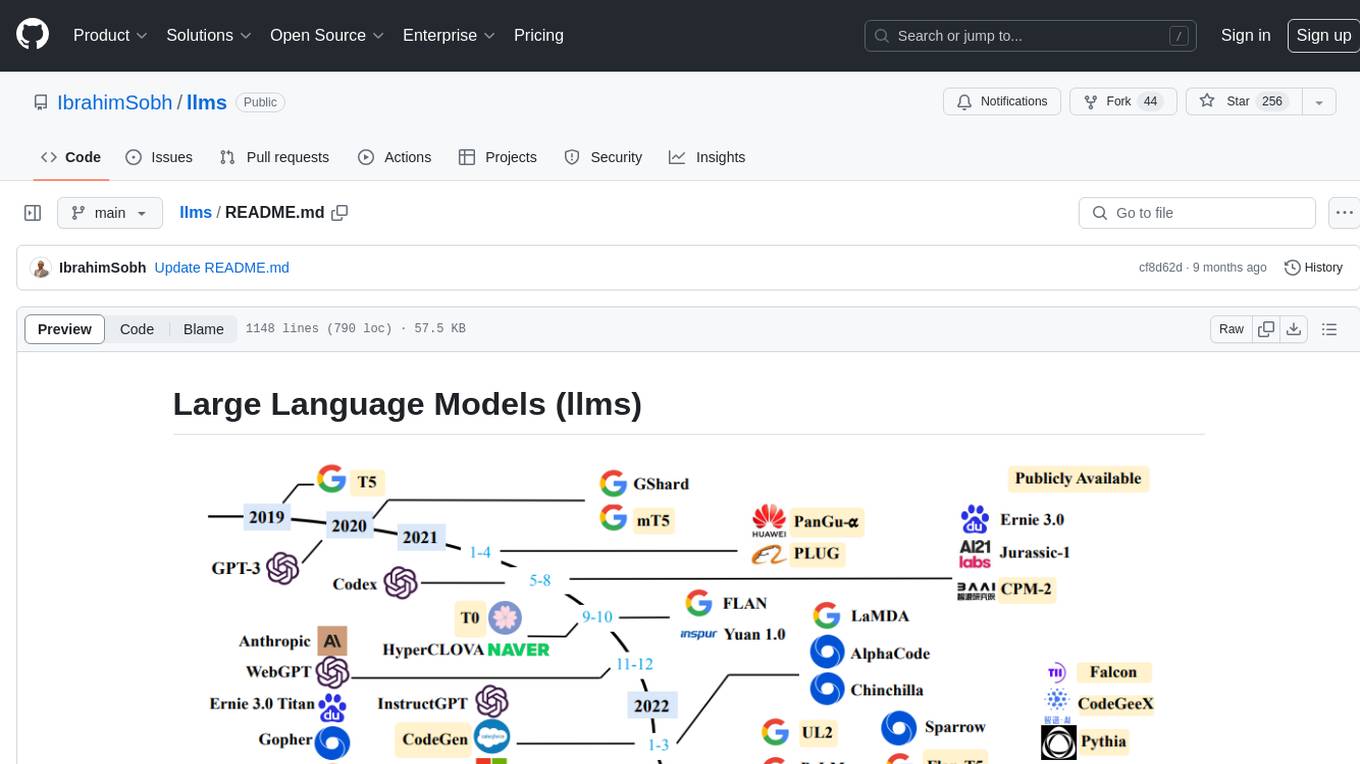
The 'llms' repository is a comprehensive guide on Large Language Models (LLMs), covering topics such as language modeling, applications of LLMs, statistical language modeling, neural language models, conditional language models, evaluation methods, transformer-based language models, practical LLMs like GPT and BERT, prompt engineering, fine-tuning LLMs, retrieval augmented generation, AI agents, and LLMs for computer vision. The repository provides detailed explanations, examples, and tools for working with LLMs.
For similar tasks
soul.md
SOUL.md is a tool that helps users build a personality for their AI agent by creating a 'soul file' that captures their worldview, opinions, and voice. Inspired by the concept of consciousness uploading, the tool aims to create a Level 1 consciousness upload based on the language data produced by the user. It focuses on specificity, contradictions, and real opinions to make the uploaded consciousness feel continuous with the original. Users can generate ideas, write content, tailor AI, explore their own thinking, and scale themselves using this tool.
khoj
Khoj is an open-source, personal AI assistant that extends your capabilities by creating always-available AI agents. You can share your notes and documents to extend your digital brain, and your AI agents have access to the internet, allowing you to incorporate real-time information. Khoj is accessible on Desktop, Emacs, Obsidian, Web, and Whatsapp, and you can share PDF, markdown, org-mode, notion files, and GitHub repositories. You'll get fast, accurate semantic search on top of your docs, and your agents can create deeply personal images and understand your speech. Khoj is self-hostable and always will be.
quivr
Quivr is a personal assistant powered by Generative AI, designed to be a second brain for users. It offers fast and efficient access to data, ensuring security and compatibility with various file formats. Quivr is open source and free to use, allowing users to share their brains publicly or keep them private. The marketplace feature enables users to share and utilize brains created by others, boosting productivity. Quivr's offline mode provides anytime, anywhere access to data. Key features include speed, security, OS compatibility, file compatibility, open source nature, public/private sharing options, a marketplace, and offline mode.
SillyTavern
SillyTavern is a user interface you can install on your computer (and Android phones) that allows you to interact with text generation AIs and chat/roleplay with characters you or the community create. SillyTavern is a fork of TavernAI 1.2.8 which is under more active development and has added many major features. At this point, they can be thought of as completely independent programs.
wingman-ai
Wingman-AI is a free and open-source AI coding assistant that brings high-quality AI-assisted coding right to your computer. It offers features such as code completion, interactive chat, and support for multiple AI providers, including Ollama, Hugging Face, and OpenAI. Wingman-AI is designed to enhance your coding workflow by providing real-time assistance and suggestions, making it an ideal tool for developers of all levels.
morphic
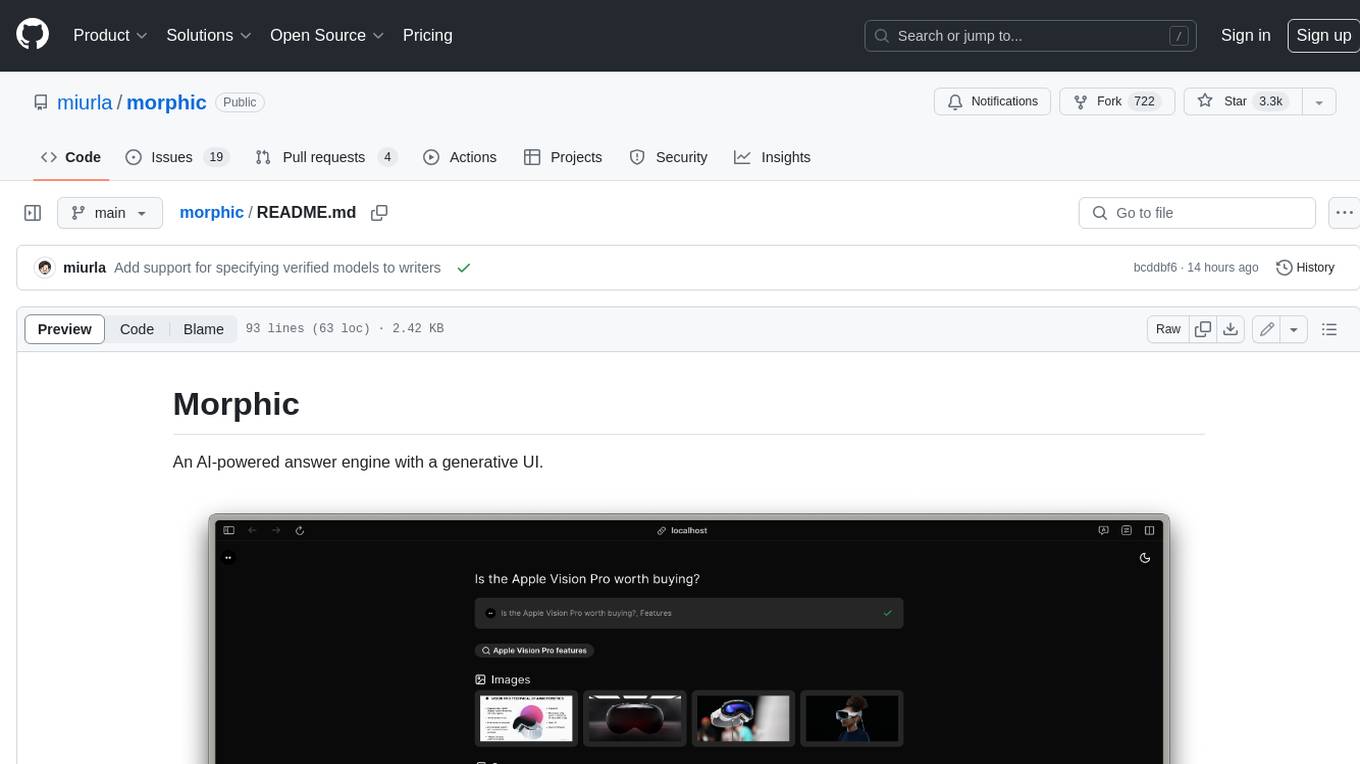
Morphic is an AI-powered answer engine with a generative UI. It utilizes a stack of Next.js, Vercel AI SDK, OpenAI, Tavily AI, shadcn/ui, Radix UI, and Tailwind CSS. To get started, fork and clone the repo, install dependencies, fill out secrets in the .env.local file, and run the app locally using 'bun dev'. You can also deploy your own live version of Morphic with Vercel. Verified models that can be specified to writers include Groq, LLaMA3 8b, and LLaMA3 70b.
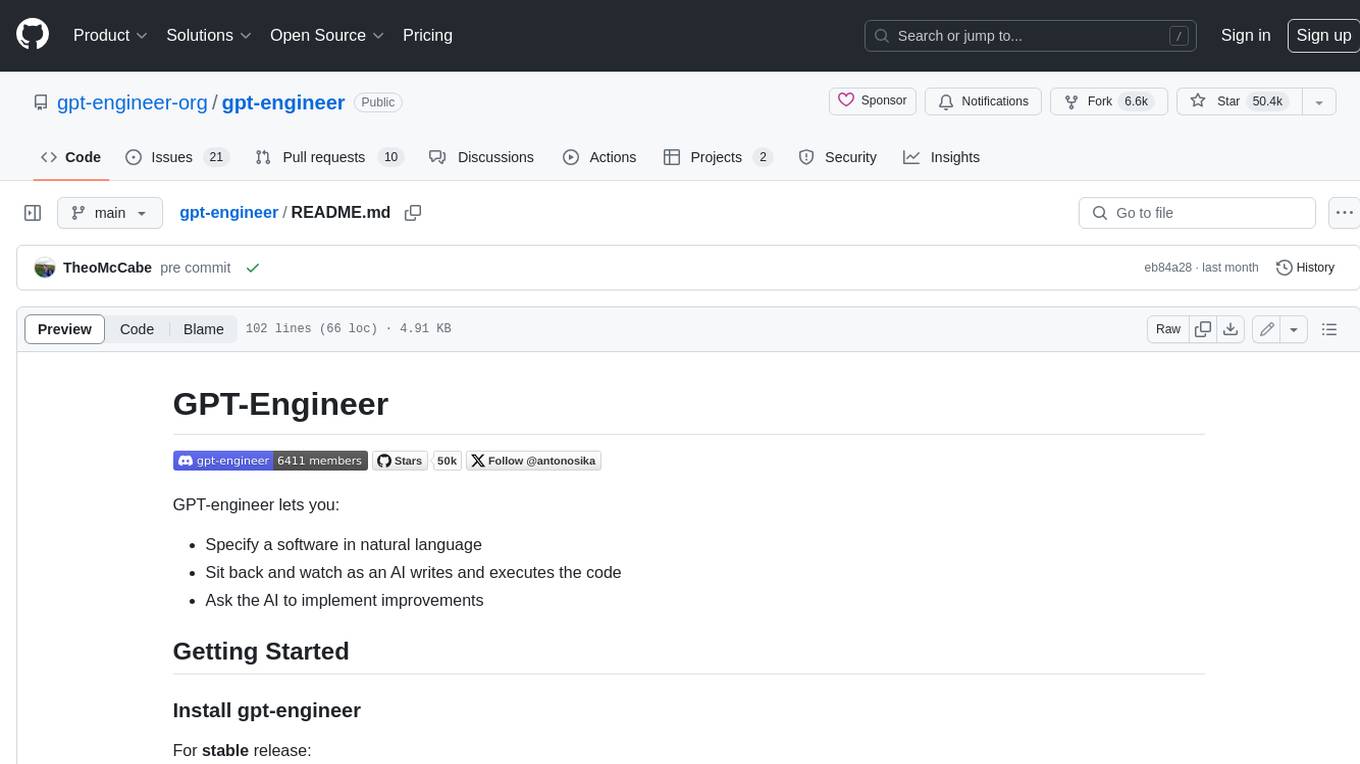
gpt-engineer
GPT-Engineer is a tool that allows you to specify a software in natural language, sit back and watch as an AI writes and executes the code, and ask the AI to implement improvements.
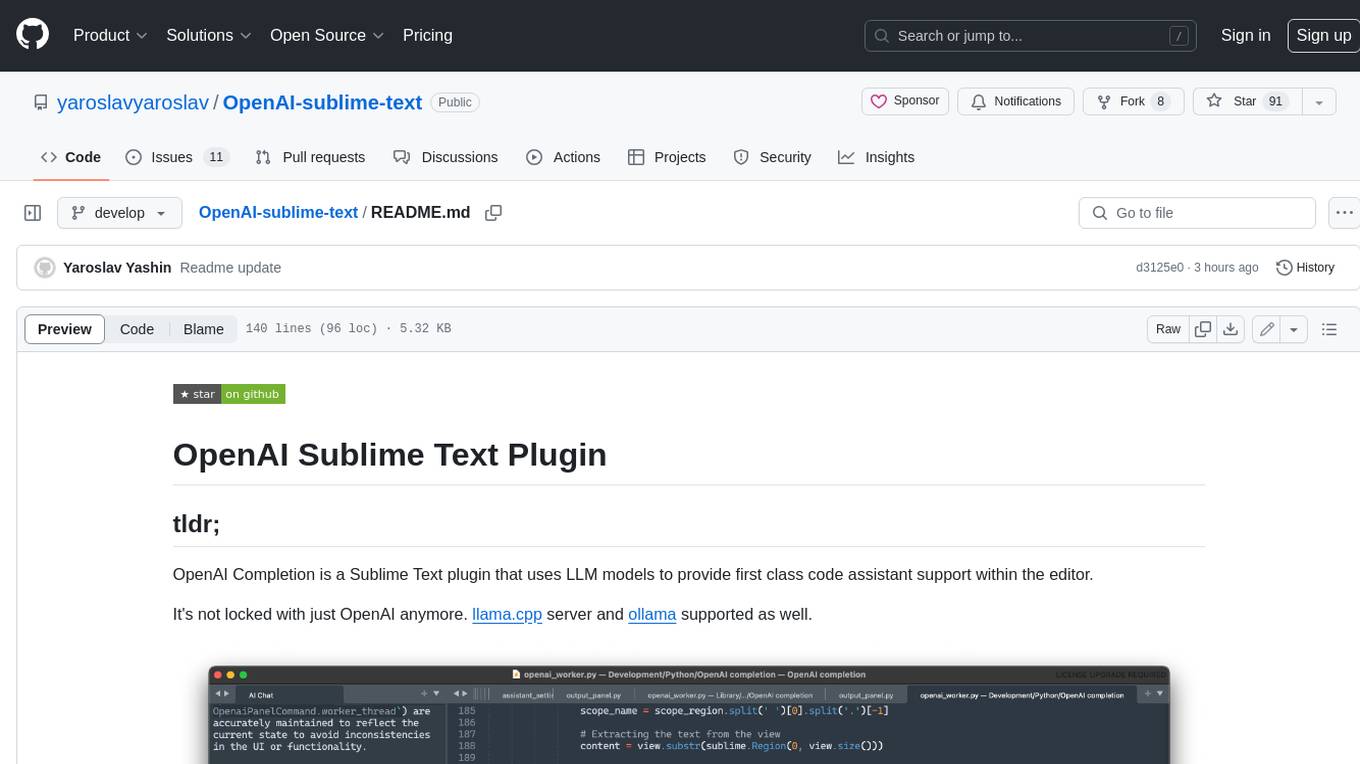
OpenAI-sublime-text
The OpenAI Completion plugin for Sublime Text provides first-class code assistant support within the editor. It utilizes LLM models to manipulate code, engage in chat mode, and perform various tasks. The plugin supports OpenAI, llama.cpp, and ollama models, allowing users to customize their AI assistant experience. It offers separated chat histories and assistant settings for different projects, enabling context-specific interactions. Additionally, the plugin supports Markdown syntax with code language syntax highlighting, server-side streaming for faster response times, and proxy support for secure connections. Users can configure the plugin's settings to set their OpenAI API key, adjust assistant modes, and manage chat history. Overall, the OpenAI Completion plugin enhances the Sublime Text editor with powerful AI capabilities, streamlining coding workflows and fostering collaboration with AI assistants.
For similar jobs
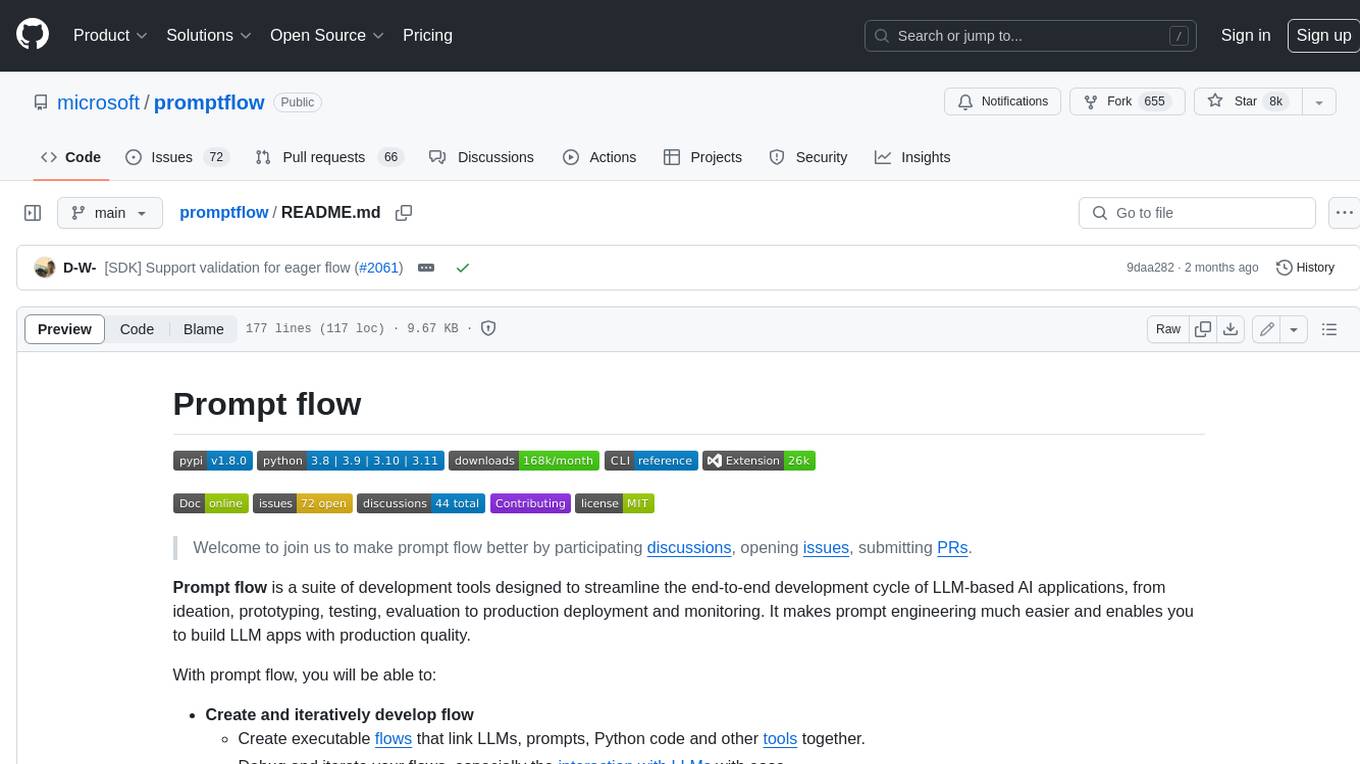
promptflow
**Prompt flow** is a suite of development tools designed to streamline the end-to-end development cycle of LLM-based AI applications, from ideation, prototyping, testing, evaluation to production deployment and monitoring. It makes prompt engineering much easier and enables you to build LLM apps with production quality.
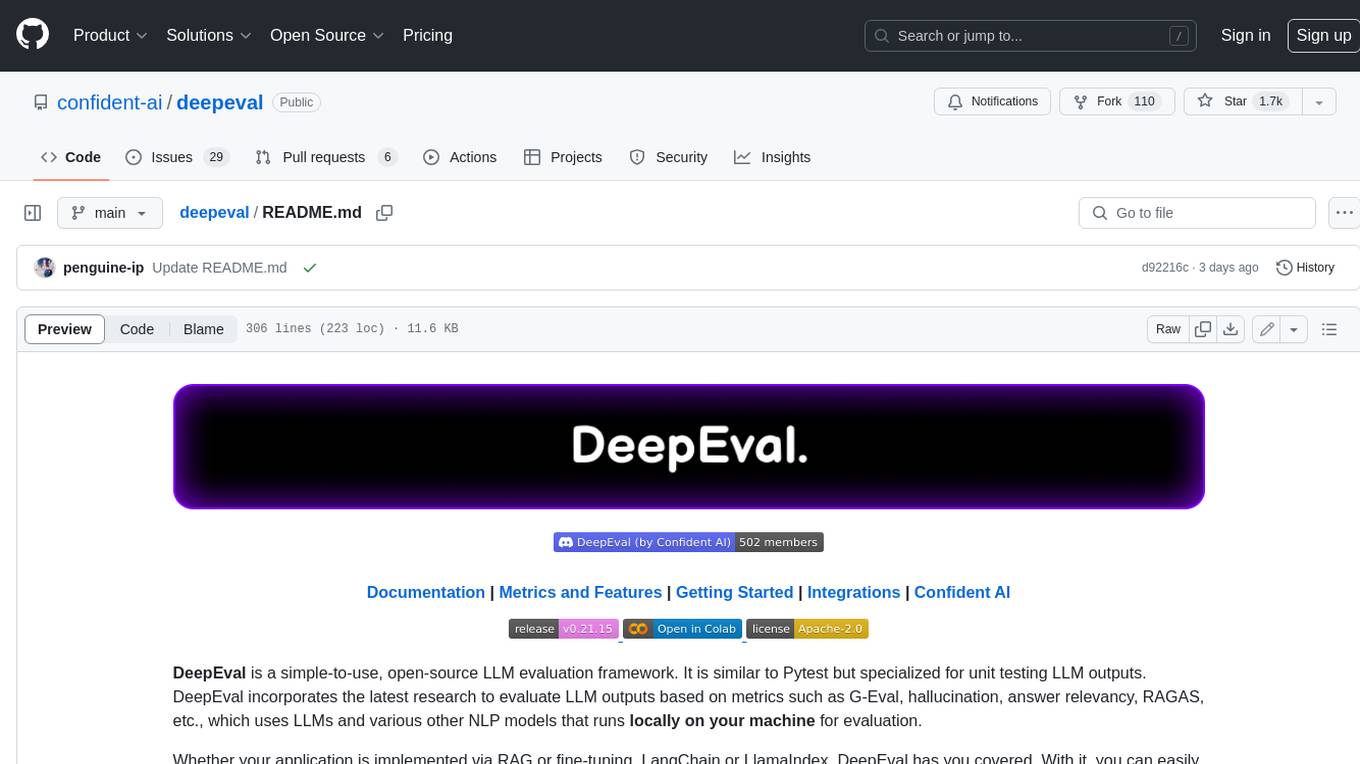
deepeval
DeepEval is a simple-to-use, open-source LLM evaluation framework specialized for unit testing LLM outputs. It incorporates various metrics such as G-Eval, hallucination, answer relevancy, RAGAS, etc., and runs locally on your machine for evaluation. It provides a wide range of ready-to-use evaluation metrics, allows for creating custom metrics, integrates with any CI/CD environment, and enables benchmarking LLMs on popular benchmarks. DeepEval is designed for evaluating RAG and fine-tuning applications, helping users optimize hyperparameters, prevent prompt drifting, and transition from OpenAI to hosting their own Llama2 with confidence.
MegaDetector
MegaDetector is an AI model that identifies animals, people, and vehicles in camera trap images (which also makes it useful for eliminating blank images). This model is trained on several million images from a variety of ecosystems. MegaDetector is just one of many tools that aims to make conservation biologists more efficient with AI. If you want to learn about other ways to use AI to accelerate camera trap workflows, check out our of the field, affectionately titled "Everything I know about machine learning and camera traps".
leapfrogai
LeapfrogAI is a self-hosted AI platform designed to be deployed in air-gapped resource-constrained environments. It brings sophisticated AI solutions to these environments by hosting all the necessary components of an AI stack, including vector databases, model backends, API, and UI. LeapfrogAI's API closely matches that of OpenAI, allowing tools built for OpenAI/ChatGPT to function seamlessly with a LeapfrogAI backend. It provides several backends for various use cases, including llama-cpp-python, whisper, text-embeddings, and vllm. LeapfrogAI leverages Chainguard's apko to harden base python images, ensuring the latest supported Python versions are used by the other components of the stack. The LeapfrogAI SDK provides a standard set of protobuffs and python utilities for implementing backends and gRPC. LeapfrogAI offers UI options for common use-cases like chat, summarization, and transcription. It can be deployed and run locally via UDS and Kubernetes, built out using Zarf packages. LeapfrogAI is supported by a community of users and contributors, including Defense Unicorns, Beast Code, Chainguard, Exovera, Hypergiant, Pulze, SOSi, United States Navy, United States Air Force, and United States Space Force.
llava-docker
This Docker image for LLaVA (Large Language and Vision Assistant) provides a convenient way to run LLaVA locally or on RunPod. LLaVA is a powerful AI tool that combines natural language processing and computer vision capabilities. With this Docker image, you can easily access LLaVA's functionalities for various tasks, including image captioning, visual question answering, text summarization, and more. The image comes pre-installed with LLaVA v1.2.0, Torch 2.1.2, xformers 0.0.23.post1, and other necessary dependencies. You can customize the model used by setting the MODEL environment variable. The image also includes a Jupyter Lab environment for interactive development and exploration. Overall, this Docker image offers a comprehensive and user-friendly platform for leveraging LLaVA's capabilities.

carrot
The 'carrot' repository on GitHub provides a list of free and user-friendly ChatGPT mirror sites for easy access. The repository includes sponsored sites offering various GPT models and services. Users can find and share sites, report errors, and access stable and recommended sites for ChatGPT usage. The repository also includes a detailed list of ChatGPT sites, their features, and accessibility options, making it a valuable resource for ChatGPT users seeking free and unlimited GPT services.
TrustLLM
TrustLLM is a comprehensive study of trustworthiness in LLMs, including principles for different dimensions of trustworthiness, established benchmark, evaluation, and analysis of trustworthiness for mainstream LLMs, and discussion of open challenges and future directions. Specifically, we first propose a set of principles for trustworthy LLMs that span eight different dimensions. Based on these principles, we further establish a benchmark across six dimensions including truthfulness, safety, fairness, robustness, privacy, and machine ethics. We then present a study evaluating 16 mainstream LLMs in TrustLLM, consisting of over 30 datasets. The document explains how to use the trustllm python package to help you assess the performance of your LLM in trustworthiness more quickly. For more details about TrustLLM, please refer to project website.
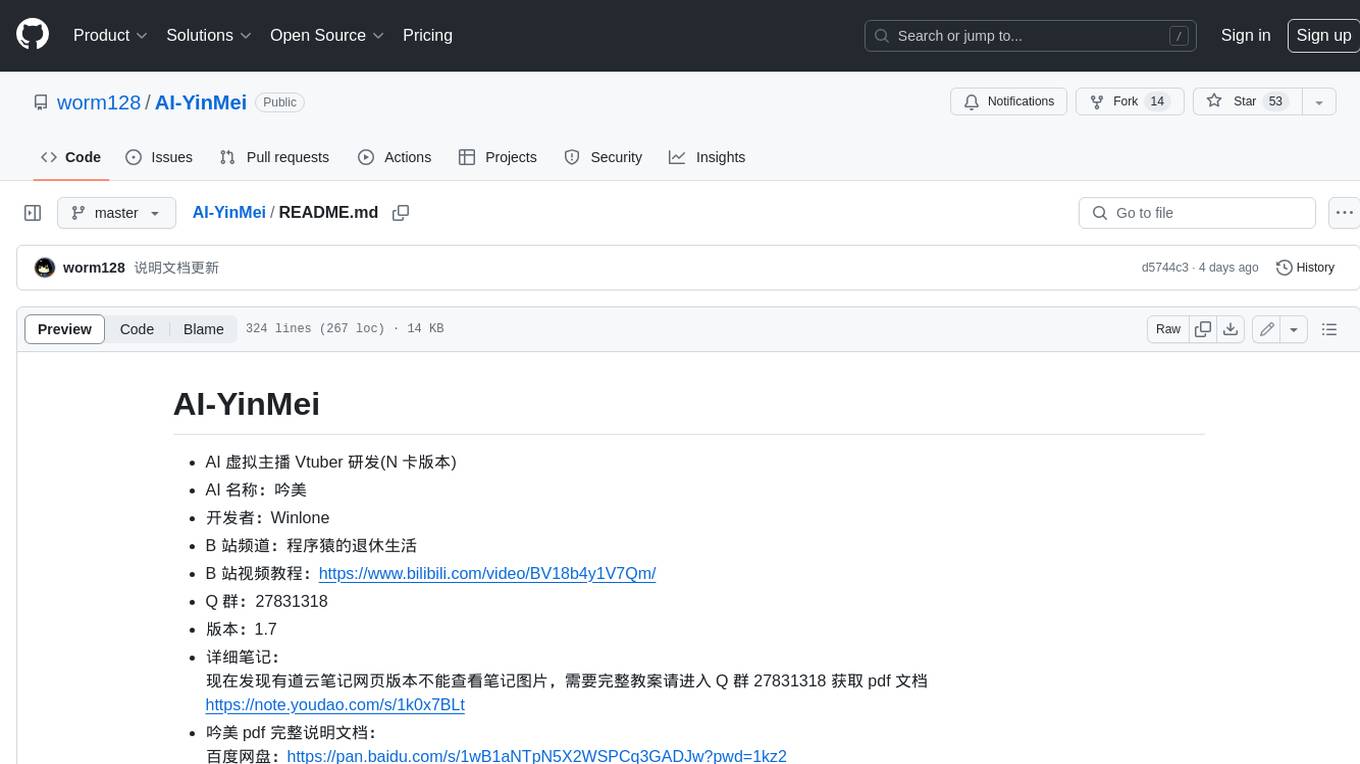
AI-YinMei
AI-YinMei is an AI virtual anchor Vtuber development tool (N card version). It supports fastgpt knowledge base chat dialogue, a complete set of solutions for LLM large language models: [fastgpt] + [one-api] + [Xinference], supports docking bilibili live broadcast barrage reply and entering live broadcast welcome speech, supports Microsoft edge-tts speech synthesis, supports Bert-VITS2 speech synthesis, supports GPT-SoVITS speech synthesis, supports expression control Vtuber Studio, supports painting stable-diffusion-webui output OBS live broadcast room, supports painting picture pornography public-NSFW-y-distinguish, supports search and image search service duckduckgo (requires magic Internet access), supports image search service Baidu image search (no magic Internet access), supports AI reply chat box [html plug-in], supports AI singing Auto-Convert-Music, supports playlist [html plug-in], supports dancing function, supports expression video playback, supports head touching action, supports gift smashing action, supports singing automatic start dancing function, chat and singing automatic cycle swing action, supports multi scene switching, background music switching, day and night automatic switching scene, supports open singing and painting, let AI automatically judge the content.