


Paper-Replications
A repository consisting of paper/architecture replications of classic/SOTA AI/ML papers in pytorch
Stars: 108
Paper-Replications is a repository dedicated to replicating classic and state-of-the-art AI/ML papers and architectures from scratch using PyTorch. It serves as a valuable resource for researchers and enthusiasts looking to understand and implement cutting-edge algorithms in the field of artificial intelligence and machine learning.
README:
A repository consisting of paper/architecture replications of classic/SOTA AI/ML papers.
For Tasks:
Click tags to check more tools for each tasksFor Jobs:
Alternative AI tools for Paper-Replications
Similar Open Source Tools
Paper-Replications
Paper-Replications is a repository dedicated to replicating classic and state-of-the-art AI/ML papers and architectures from scratch using PyTorch. It serves as a valuable resource for researchers and enthusiasts looking to understand and implement cutting-edge algorithms in the field of artificial intelligence and machine learning.
applied-ai-engineering-samples
The Google Cloud Applied AI Engineering repository provides reference guides, blueprints, code samples, and hands-on labs developed by the Google Cloud Applied AI Engineering team. It contains resources for Generative AI on Vertex AI, including code samples and hands-on labs demonstrating the use of Generative AI models and tools in Vertex AI. Additionally, it offers reference guides and blueprints that compile best practices and prescriptive guidance for running large-scale AI/ML workloads on Google Cloud AI/ML infrastructure.
nlp-llms-resources
The 'nlp-llms-resources' repository is a comprehensive resource list for Natural Language Processing (NLP) and Large Language Models (LLMs). It covers a wide range of topics including traditional NLP datasets, data acquisition, libraries for NLP, neural networks, sentiment analysis, optical character recognition, information extraction, semantics, topic modeling, multilingual NLP, domain-specific LLMs, vector databases, ethics, costing, books, courses, surveys, aggregators, newsletters, papers, conferences, and societies. The repository provides valuable information and resources for individuals interested in NLP and LLMs.
generative-ai-workbook
Generative AI Workbook is a central repository for generative AI-related work, including projects, personal projects, and tools. It also features a blog section with bite-sized posts on various generative AI concepts. The repository covers use cases of Large Language Models (LLMs) such as search, classification, clustering, data/text/code generation, summarization, rewriting, extractions, proofreading, and querying data.
LLMs-in-science
The 'LLMs-in-science' repository is a collaborative environment for organizing papers related to large language models (LLMs) and autonomous agents in the field of chemistry. The goal is to discuss trend topics, challenges, and the potential for supporting scientific discovery in the context of artificial intelligence. The repository aims to maintain a systematic structure of the field and welcomes contributions from the community to keep the content up-to-date and relevant.
aitlas
The AiTLAS toolbox (Artificial Intelligence Toolbox for Earth Observation) includes state-of-the-art machine learning methods for exploratory and predictive analysis of satellite imagery as well as a repository of AI-ready Earth Observation (EO) datasets. It can be easily applied for a variety of Earth Observation tasks, such as land use and cover classification, crop type prediction, localization of specific objects (semantic segmentation), etc. The main goal of AiTLAS is to facilitate better usability and adoption of novel AI methods (and models) by EO experts, while offering easy access and standardized format of EO datasets to AI experts which allows benchmarking of various existing and novel AI methods tailored for EO data.
automatic-KG-creation-with-LLM
This repository presents a (semi-)automatic pipeline for Ontology and Knowledge Graph Construction using Large Language Models (LLMs) such as Mixtral 8x22B Instruct v0.1, GPT-4o, GPT-3.5, and Gemini. It explores the generation of Knowledge Graphs by formulating competency questions, developing ontologies, constructing KGs, and evaluating the results with minimal human involvement. The project showcases the creation of a KG on deep learning methodologies from scholarly publications. It includes components for data preprocessing, prompts for LLMs, datasets, and results from the selected LLMs.
rag-in-action
rag-in-action is a GitHub repository that provides a practical course structure for developing a RAG system based on DeepSeek. The repository likely contains resources, code samples, and tutorials to guide users through the process of building and implementing a RAG system using DeepSeek technology. Users interested in learning about RAG systems and their development may find this repository helpful in gaining hands-on experience and practical knowledge in this area.
Main
This repository contains material related to the new book _Synthetic Data and Generative AI_ by the author, including code for NoGAN, DeepResampling, and NoGAN_Hellinger. NoGAN is a tabular data synthesizer that outperforms GenAI methods in terms of speed and results, utilizing state-of-the-art quality metrics. DeepResampling is a fast NoGAN based on resampling and Bayesian Models with hyperparameter auto-tuning. NoGAN_Hellinger combines NoGAN and DeepResampling with the Hellinger model evaluation metric.
ai-notebooks
ai-notebooks is a repository containing a collection of simple machine learning algorithms implemented in Python 3, TensorFlow 2, PyTorch, and Keras. The repository is designed for easy viewing on GitHub. Users can request notebook experiments by filing an issue for consideration.
PythonAiRoad
PythonAiRoad is a repository containing classic original articles source code from the 'Algorithm Gourmet House'. It is a platform for sharing algorithms and code related to artificial intelligence. Users are encouraged to contact the author for further discussions or collaborations. The repository serves as a valuable resource for those interested in AI algorithms and implementations.
AI-Makerspace
AI Makerspace is a repository supporting rapid prototyping of user-centered AI applications. It provides blueprint templates for using state-of-the-art technologies in AI use cases. The repository guides innovation teams through AI Design Thinking/Engineering, Lean AI Engineering, Explainable AI, Responsible and Ethical AI, and User Experience of machine learning products. It also focuses on developing scalable coaching solutions through the Agentic AI Coaching project.
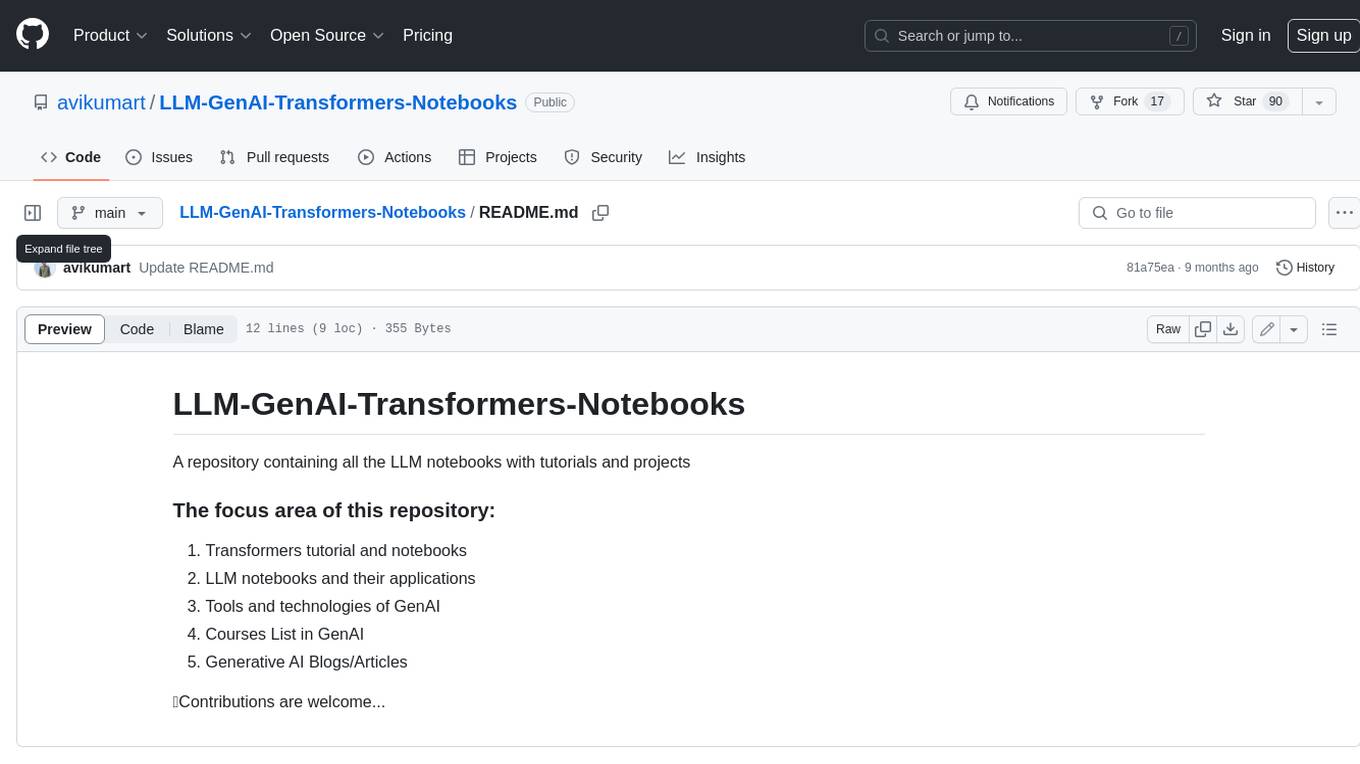
LLM-GenAI-Transformers-Notebooks
This repository is a collection of LLM notebooks with tutorials and projects. It covers topics such as Transformers tutorials, LLM notebooks and their applications, tools and technologies of GenAI, courses in GenAI, and Generative AI blogs/articles. Contributions are welcome.
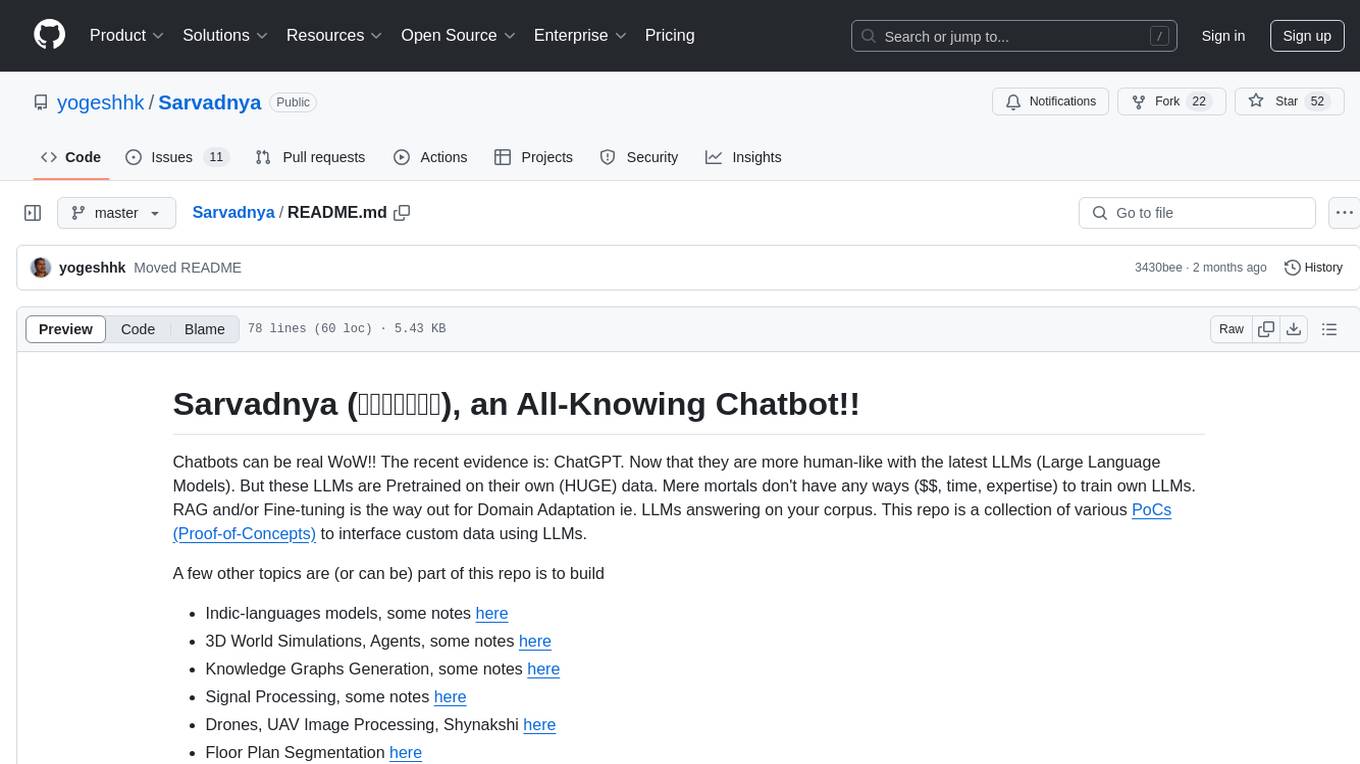
Sarvadnya
Sarvadnya is a repository focused on interfacing custom data using Large Language Models (LLMs) through Proof-of-Concepts (PoCs) like Retrieval Augmented Generation (RAG) and Fine-Tuning. It aims to enable domain adaptation for LLMs to answer on user-specific corpora. The repository also covers topics such as Indic-languages models, 3D World Simulations, Knowledge Graphs Generation, Signal Processing, Drones, UAV Image Processing, and Floor Plan Segmentation. It provides insights into building chatbots of various modalities, preparing videos, and creating content for different platforms like Medium, LinkedIn, and YouTube. The tech stacks involved range from enterprise solutions like Google Doc AI and Microsoft Azure Language AI Services to open-source tools like Langchain and HuggingFace.
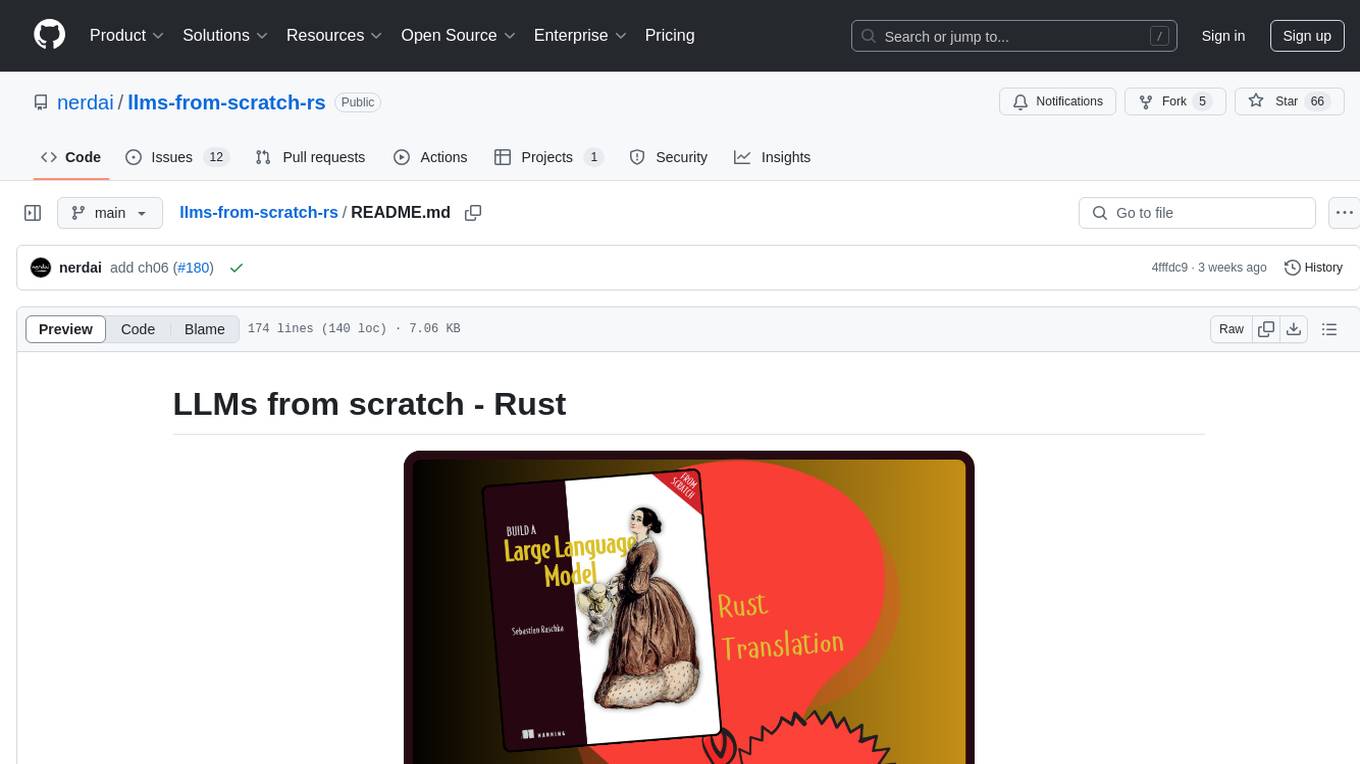
llms-from-scratch-rs
This project provides Rust code that follows the text 'Build An LLM From Scratch' by Sebastian Raschka. It translates PyTorch code into Rust using the Candle crate, aiming to build a GPT-style LLM. Users can clone the repo, run examples/exercises, and access the same datasets as in the book. The project includes chapters on understanding large language models, working with text data, coding attention mechanisms, implementing a GPT model, pretraining unlabeled data, fine-tuning for classification, and fine-tuning to follow instructions.
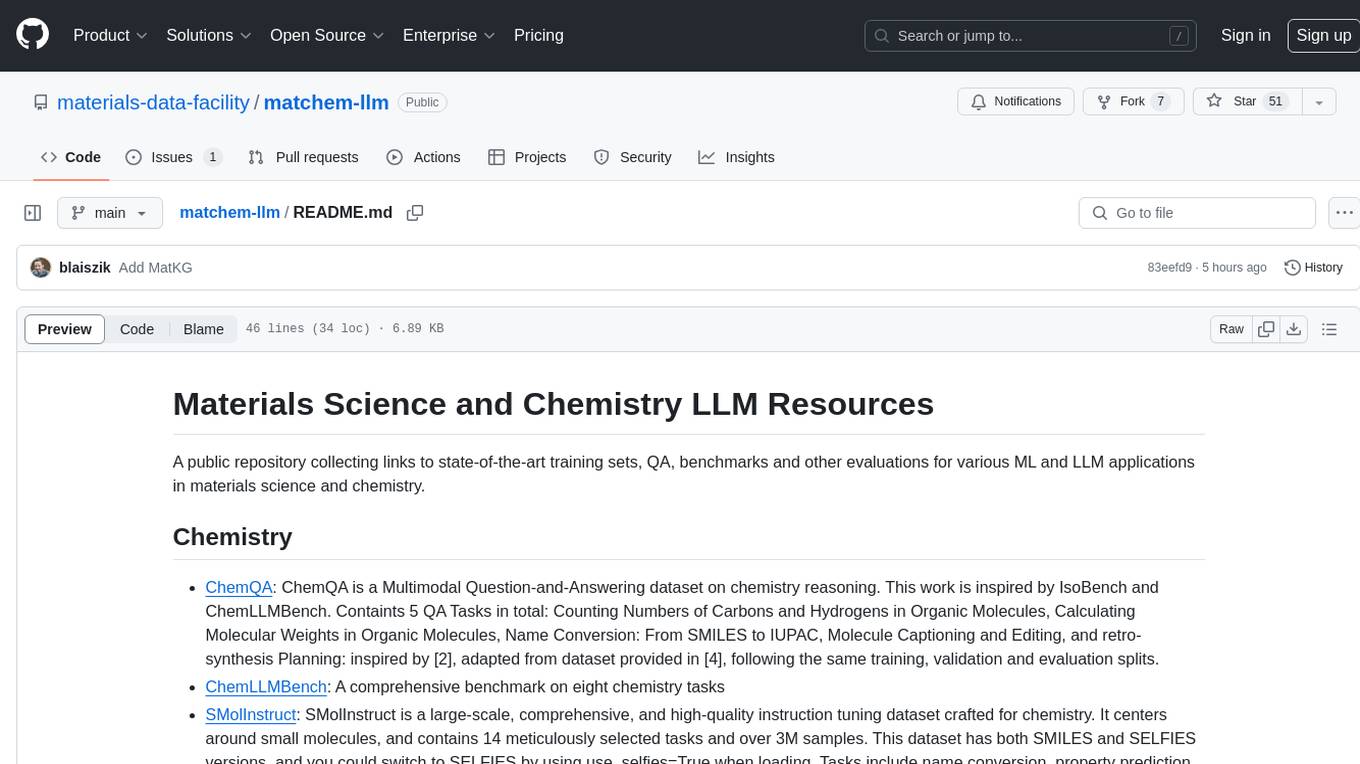
matchem-llm
A public repository collecting links to state-of-the-art training sets, QA, benchmarks and other evaluations for various ML and LLM applications in materials science and chemistry. It includes datasets related to chemistry, materials, multimodal data, and knowledge graphs in the field. The repository aims to provide resources for training and evaluating machine learning models in the materials science and chemistry domains.
For similar tasks
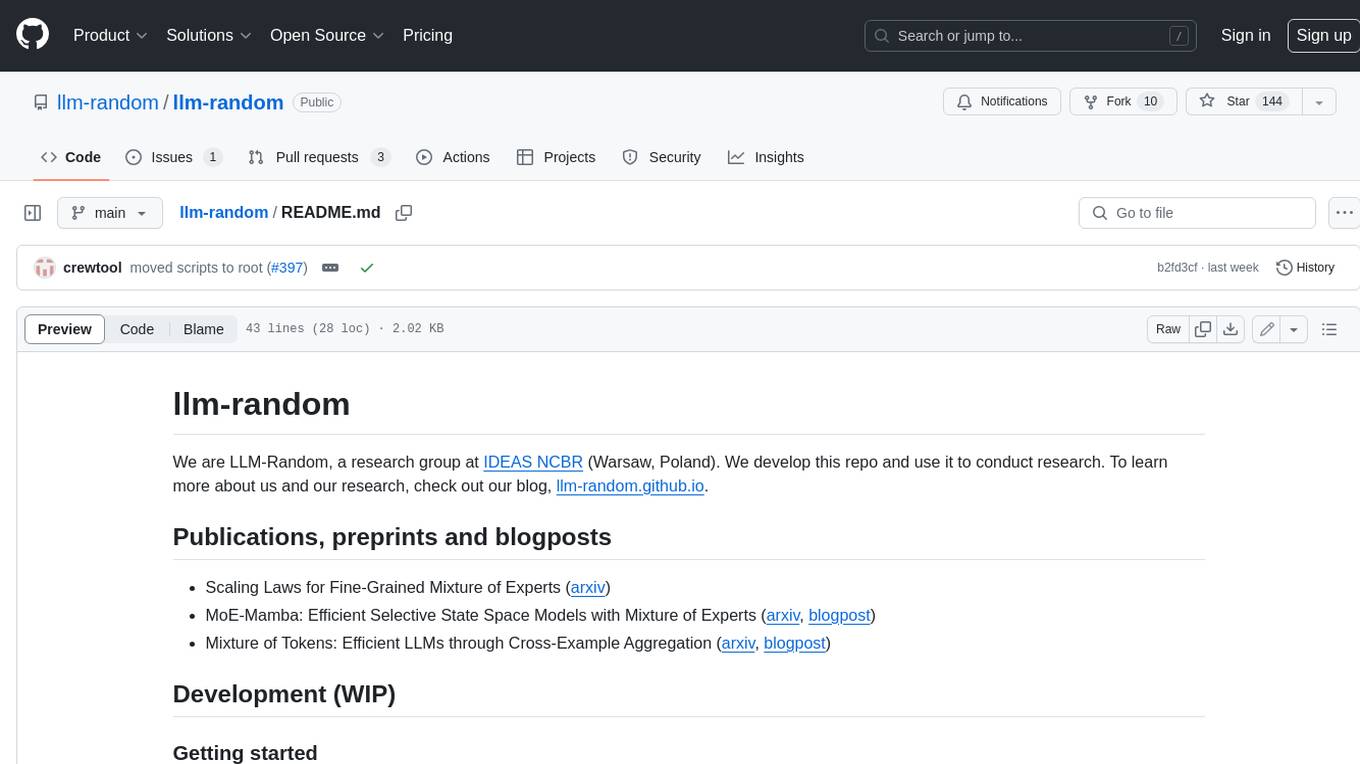
llm-random
This repository contains code for research conducted by the LLM-Random research group at IDEAS NCBR in Warsaw, Poland. The group focuses on developing and using this repository to conduct research. For more information about the group and its research, refer to their blog, llm-random.github.io.
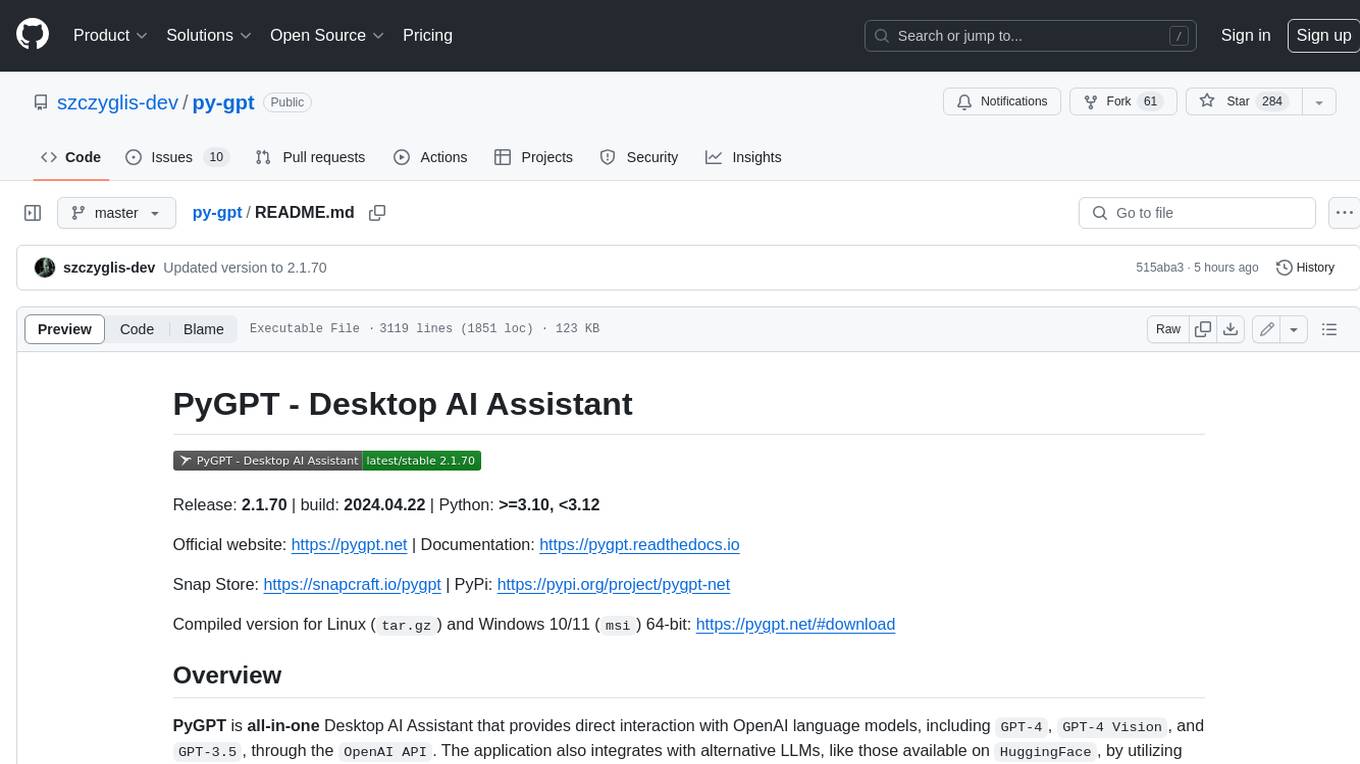
py-gpt
Py-GPT is a Python library that provides an easy-to-use interface for OpenAI's GPT-3 API. It allows users to interact with the powerful GPT-3 model for various natural language processing tasks. With Py-GPT, developers can quickly integrate GPT-3 capabilities into their applications, enabling them to generate text, answer questions, and more with just a few lines of code.
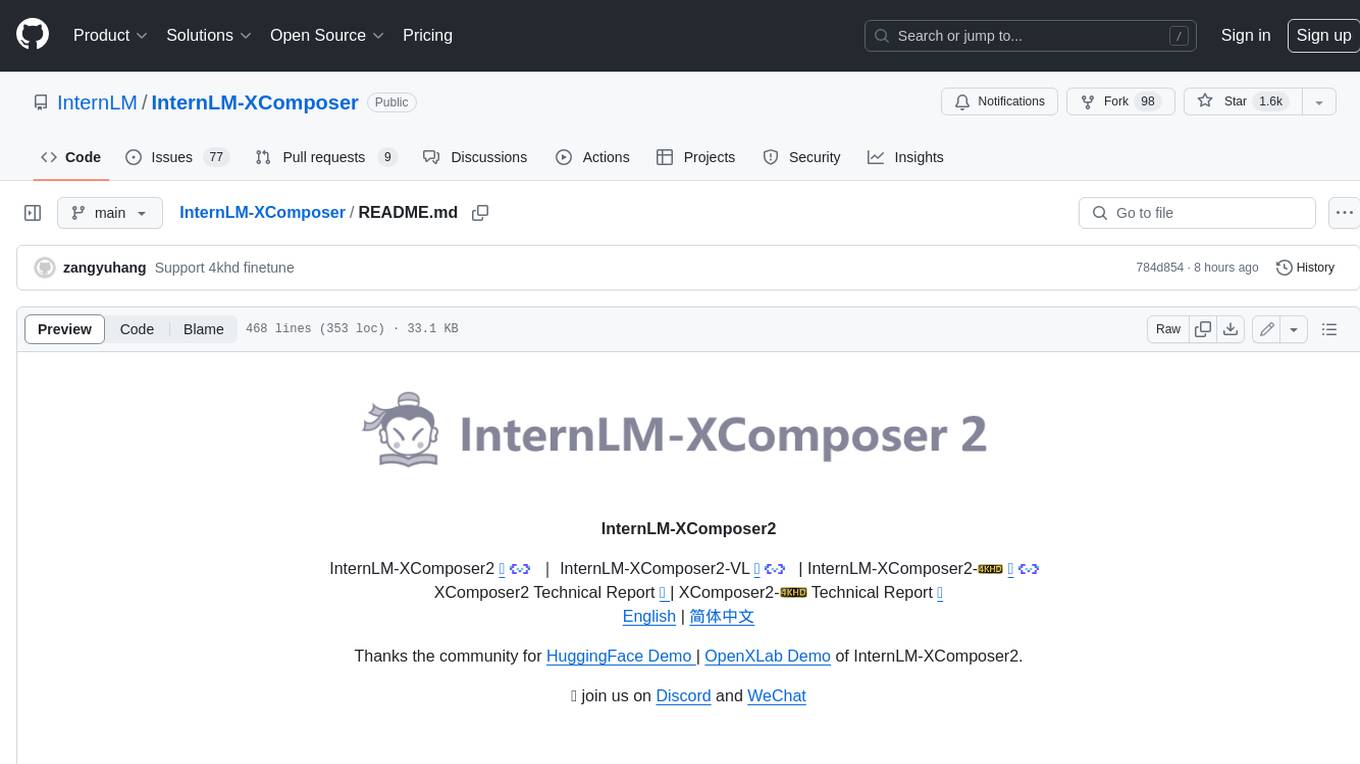
InternLM-XComposer
InternLM-XComposer2 is a groundbreaking vision-language large model (VLLM) based on InternLM2-7B excelling in free-form text-image composition and comprehension. It boasts several amazing capabilities and applications: * **Free-form Interleaved Text-Image Composition** : InternLM-XComposer2 can effortlessly generate coherent and contextual articles with interleaved images following diverse inputs like outlines, detailed text requirements and reference images, enabling highly customizable content creation. * **Accurate Vision-language Problem-solving** : InternLM-XComposer2 accurately handles diverse and challenging vision-language Q&A tasks based on free-form instructions, excelling in recognition, perception, detailed captioning, visual reasoning, and more. * **Awesome performance** : InternLM-XComposer2 based on InternLM2-7B not only significantly outperforms existing open-source multimodal models in 13 benchmarks but also **matches or even surpasses GPT-4V and Gemini Pro in 6 benchmarks** We release InternLM-XComposer2 series in three versions: * **InternLM-XComposer2-4KHD-7B** 🤗: The high-resolution multi-task trained VLLM model with InternLM-7B as the initialization of the LLM for _High-resolution understanding_ , _VL benchmarks_ and _AI assistant_. * **InternLM-XComposer2-VL-7B** 🤗 : The multi-task trained VLLM model with InternLM-7B as the initialization of the LLM for _VL benchmarks_ and _AI assistant_. **It ranks as the most powerful vision-language model based on 7B-parameter level LLMs, leading across 13 benchmarks.** * **InternLM-XComposer2-VL-1.8B** 🤗 : A lightweight version of InternLM-XComposer2-VL based on InternLM-1.8B. * **InternLM-XComposer2-7B** 🤗: The further instruction tuned VLLM for _Interleaved Text-Image Composition_ with free-form inputs. Please refer to Technical Report and 4KHD Technical Reportfor more details.
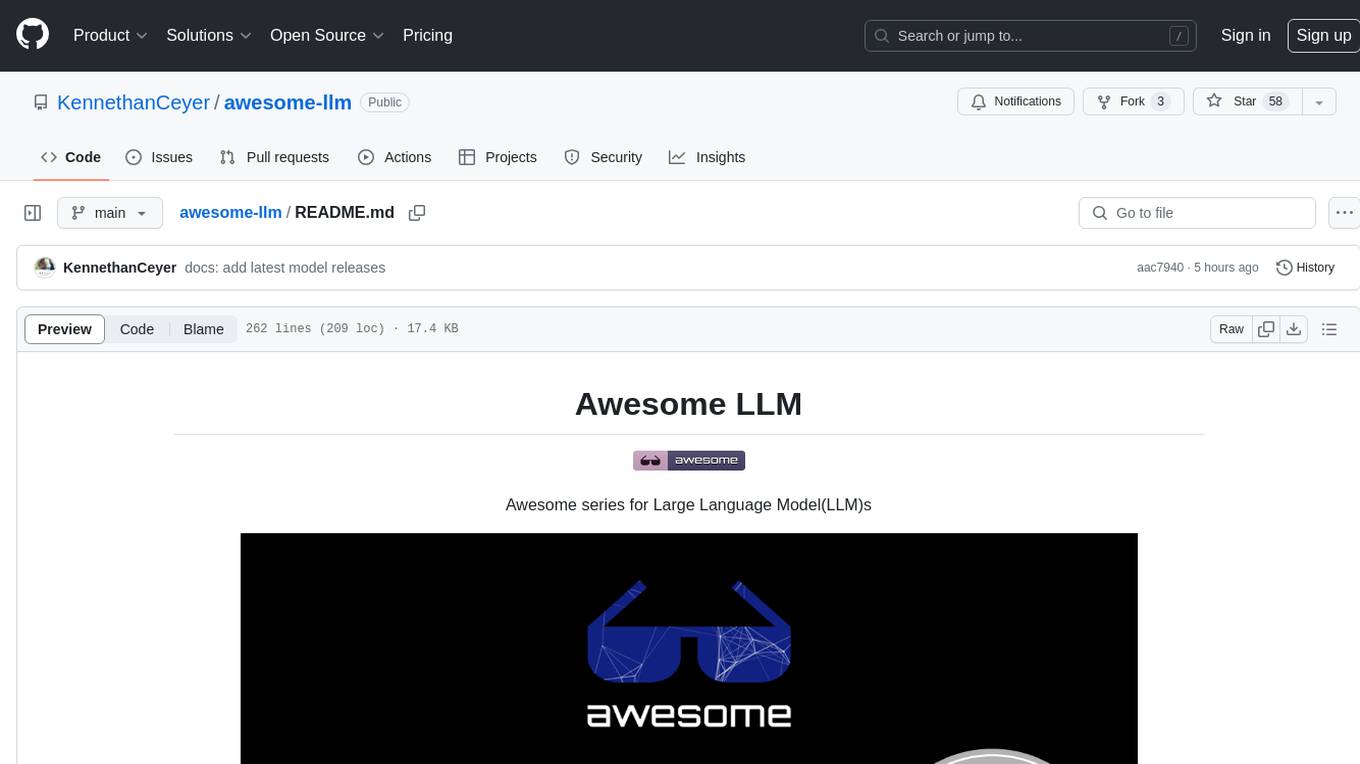
awesome-llm
Awesome LLM is a curated list of resources related to Large Language Models (LLMs), including models, projects, datasets, benchmarks, materials, papers, posts, GitHub repositories, HuggingFace repositories, and reading materials. It provides detailed information on various LLMs, their parameter sizes, announcement dates, and contributors. The repository covers a wide range of LLM-related topics and serves as a valuable resource for researchers, developers, and enthusiasts interested in the field of natural language processing and artificial intelligence.
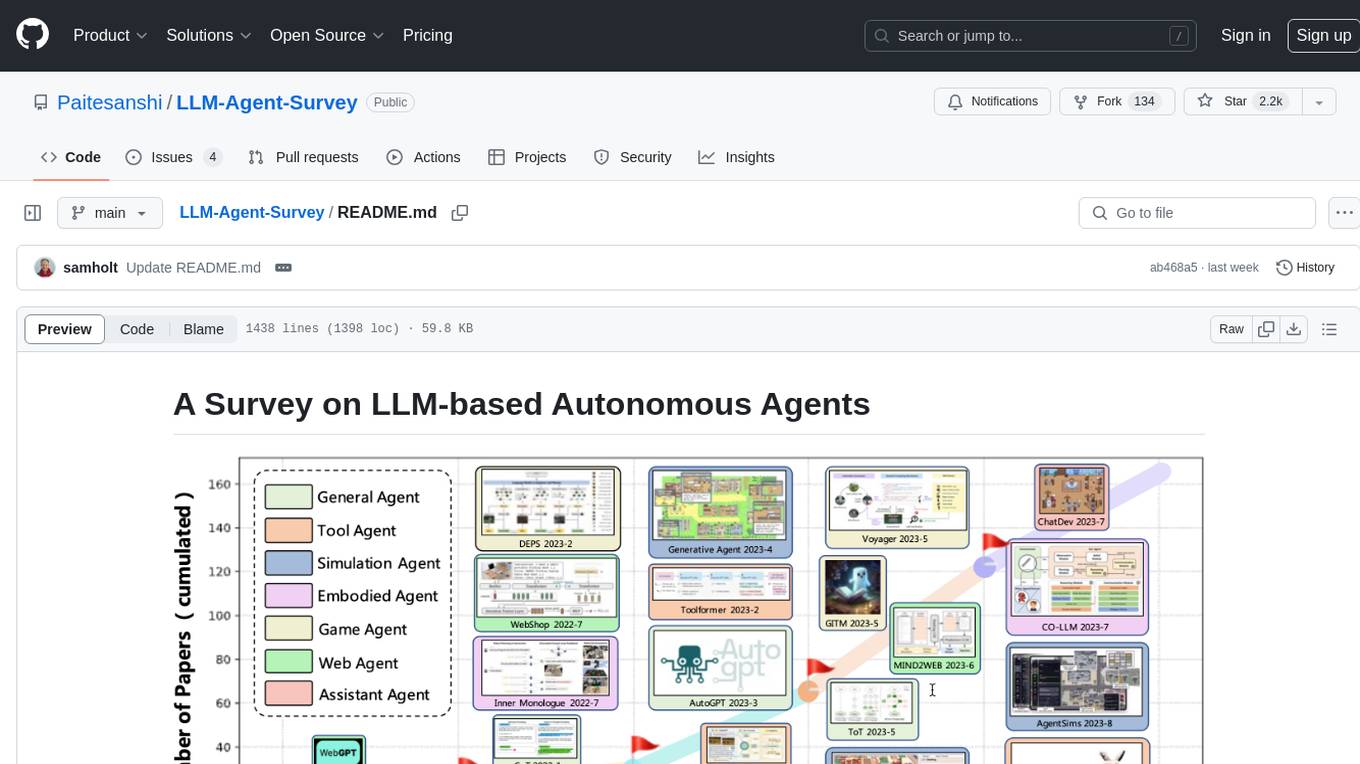
LLM-Agent-Survey
Autonomous agents are designed to achieve specific objectives through self-guided instructions. With the emergence and growth of large language models (LLMs), there is a growing trend in utilizing LLMs as fundamental controllers for these autonomous agents. This repository conducts a comprehensive survey study on the construction, application, and evaluation of LLM-based autonomous agents. It explores essential components of AI agents, application domains in natural sciences, social sciences, and engineering, and evaluation strategies. The survey aims to be a resource for researchers and practitioners in this rapidly evolving field.
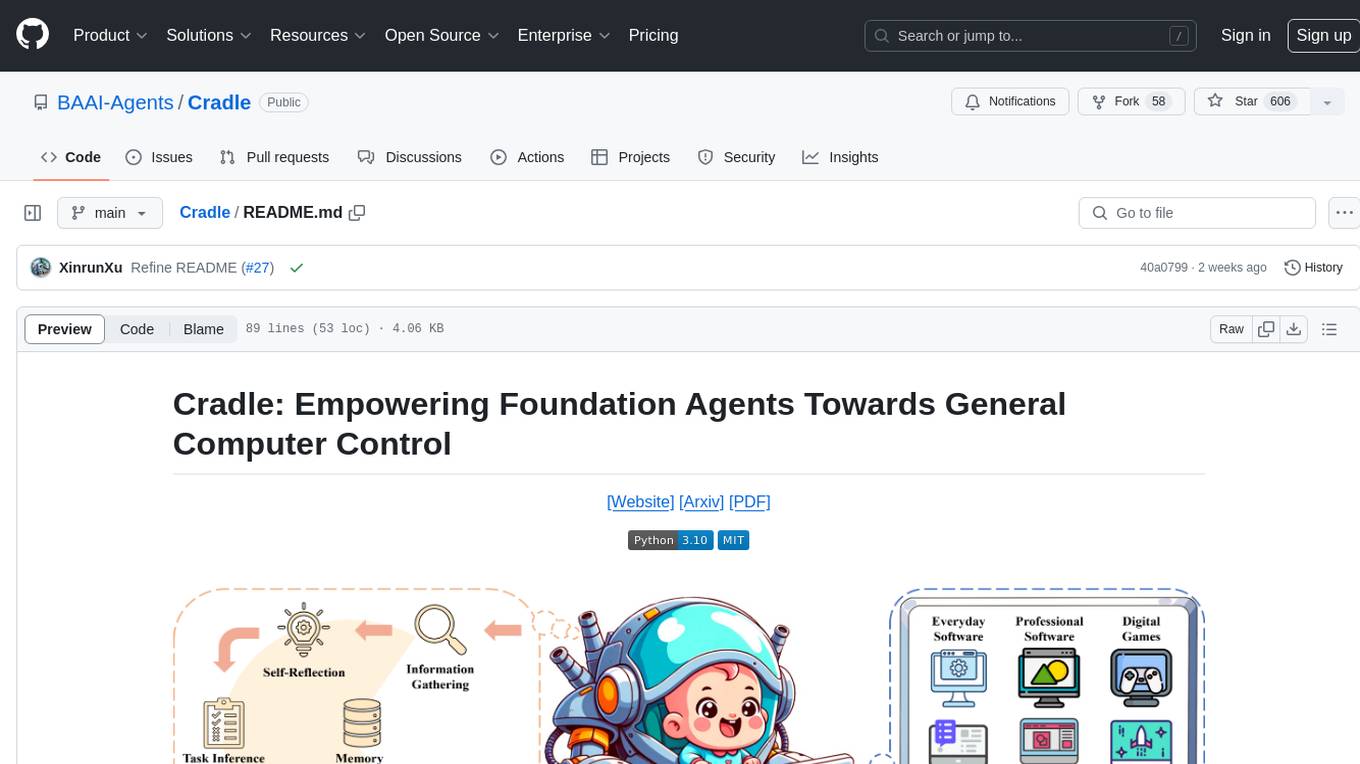
Cradle
The Cradle project is a framework designed for General Computer Control (GCC), empowering foundation agents to excel in various computer tasks through strong reasoning abilities, self-improvement, and skill curation. It provides a standardized environment with minimal requirements, constantly evolving to support more games and software. The repository includes released versions, publications, and relevant assets.
awesome-agents
Awesome Agents is a curated list of open source AI agents designed for various tasks such as private interactions with documents, chat implementations, autonomous research, human-behavior simulation, code generation, HR queries, domain-specific research, and more. The agents leverage Large Language Models (LLMs) and other generative AI technologies to provide solutions for complex tasks and projects. The repository includes a diverse range of agents for different use cases, from conversational chatbots to AI coding engines, and from autonomous HR assistants to vision task solvers.
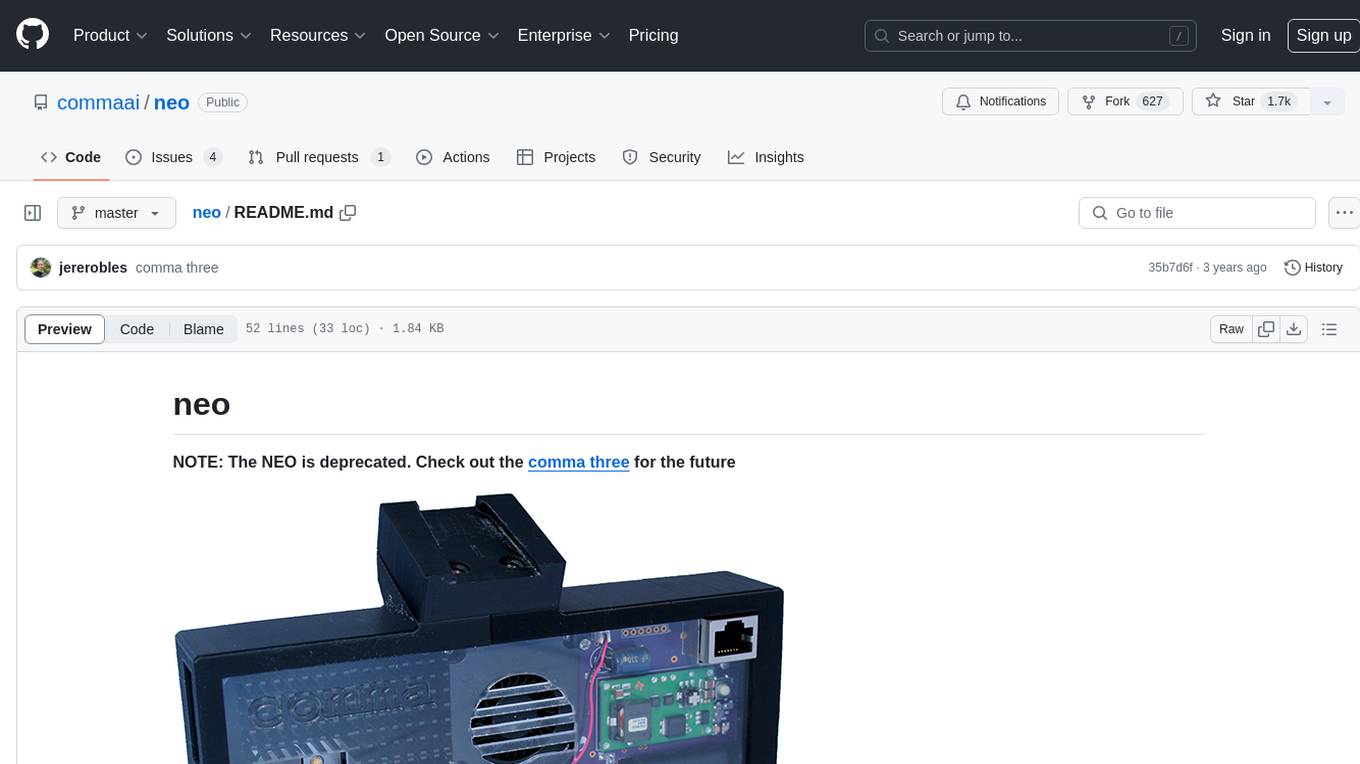
neo
The neo is an open source robotics research platform powered by a OnePlus 3 smartphone and an STM32F205-based CAN interface board, housed in a 3d-printed casing with active cooling. It includes NEOS, a stripped down Android ROM, and offers a modern Linux environment for development. The platform leverages the high performance embedded processor and sensor capabilities of modern smartphones at a low cost. A detailed guide is available for easy construction, requiring online shopping and soldering skills. The total cost for building a neo is approximately $700.
For similar jobs
asreview
The ASReview project implements active learning for systematic reviews, utilizing AI-aided pipelines to assist in finding relevant texts for search tasks. It accelerates the screening of textual data with minimal human input, saving time and increasing output quality. The software offers three modes: Oracle for interactive screening, Exploration for teaching purposes, and Simulation for evaluating active learning models. ASReview LAB is designed to support decision-making in any discipline or industry by improving efficiency and transparency in screening large amounts of textual data.
NewEraAI-Papers
The NewEraAI-Papers repository provides links to collections of influential and interesting research papers from top AI conferences, along with open-source code to promote reproducibility and provide detailed implementation insights beyond the scope of the article. Users can stay up to date with the latest advances in AI research by exploring this repository. Contributions to improve the completeness of the list are welcomed, and users can create pull requests, open issues, or contact the repository owner via email to enhance the repository further.
cltk
The Classical Language Toolkit (CLTK) is a Python library that provides natural language processing (NLP) capabilities for pre-modern languages. It offers a modular processing pipeline with pre-configured defaults and supports almost 20 languages. Users can install the latest version using pip and access detailed documentation on the official website. The toolkit is designed to meet the unique needs of researchers working with historical languages, filling a void in the NLP landscape that often neglects non-spoken languages and different research goals.
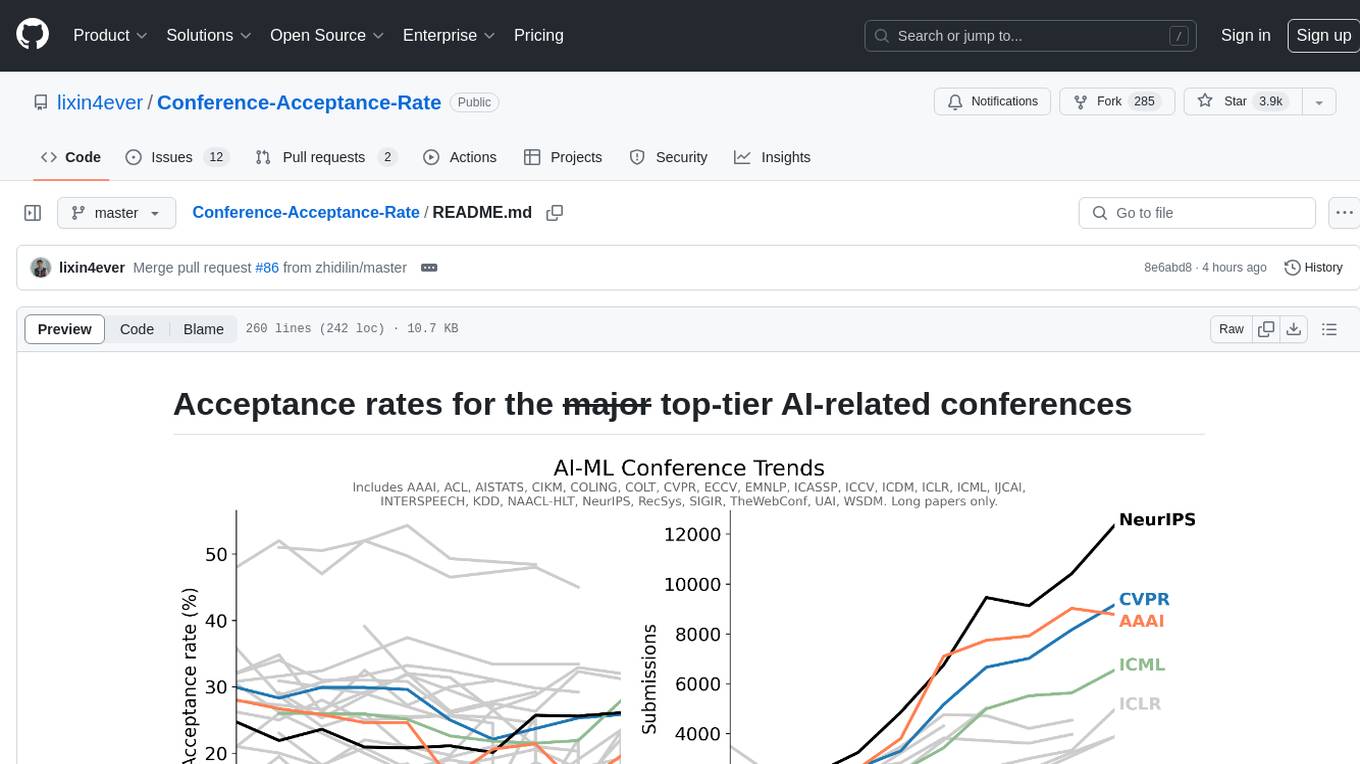
Conference-Acceptance-Rate
The 'Conference-Acceptance-Rate' repository provides acceptance rates for top-tier AI-related conferences in the fields of Natural Language Processing, Computational Linguistics, Computer Vision, Pattern Recognition, Machine Learning, Learning Theory, Artificial Intelligence, Data Mining, Information Retrieval, Speech Processing, and Signal Processing. The data includes acceptance rates for long papers and short papers over several years for each conference, allowing researchers to track trends and make informed decisions about where to submit their work.
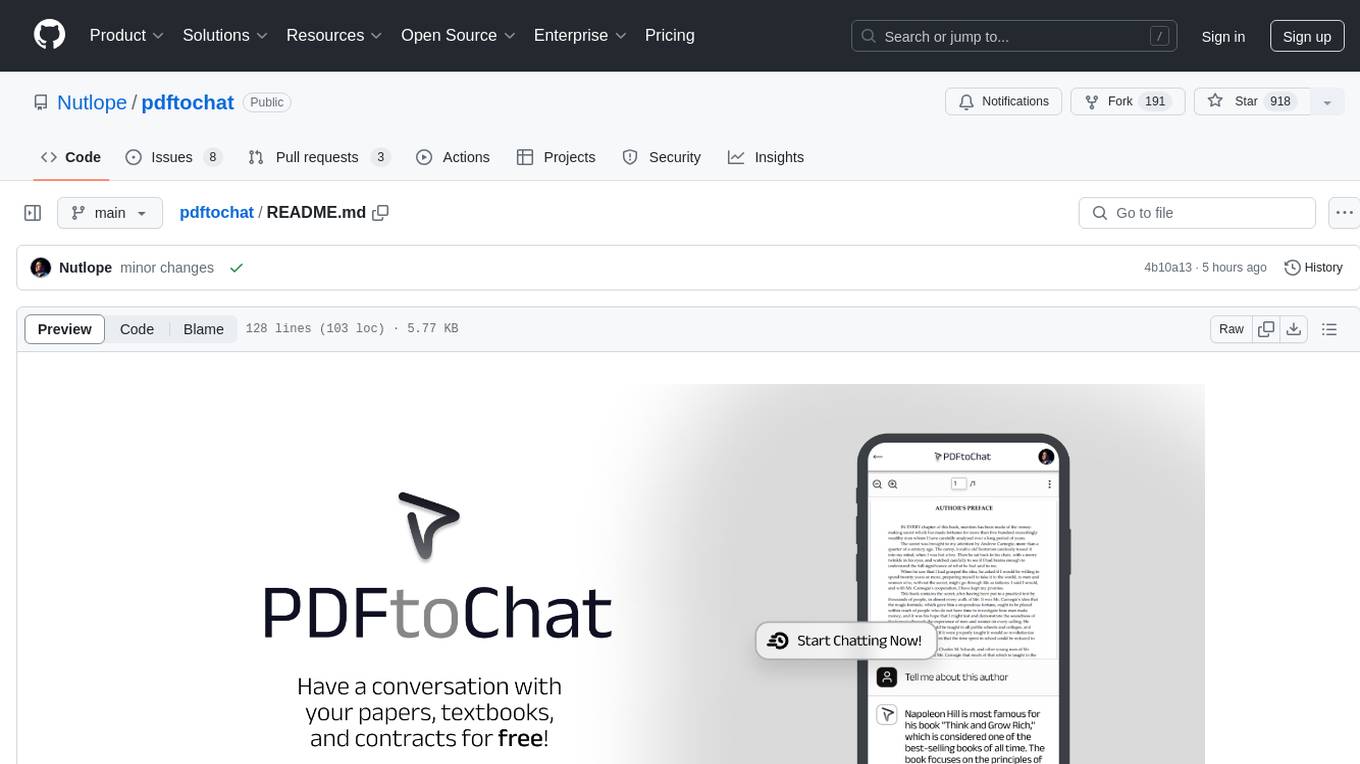
pdftochat
PDFToChat is a tool that allows users to chat with their PDF documents in seconds. It is powered by Together AI and Pinecone, utilizing a tech stack including Next.js, Mixtral, M2 Bert, LangChain.js, MongoDB Atlas, Bytescale, Vercel, Clerk, and Tailwind CSS. Users can deploy the tool to Vercel or any other host by setting up Together.ai, MongoDB Atlas database, Bytescale, Clerk, and Vercel. The tool enables users to interact with PDFs through chat, with future tasks including adding features like trash icon for deleting PDFs, exploring different embedding models, implementing auto scrolling, improving replies, benchmarking accuracy, researching chunking and retrieval best practices, adding demo video, upgrading to Next.js 14, adding analytics, customizing tailwind prose, saving chats in postgres DB, compressing large PDFs, implementing custom uploader, session tracking, error handling, and support for images in PDFs.
tods-arxiv-daily-paper
This repository provides a tool for fetching and summarizing daily papers from the arXiv repository. It allows users to stay updated with the latest research in various fields by automatically retrieving and summarizing papers on a daily basis. The tool simplifies the process of accessing and digesting academic papers, making it easier for researchers and enthusiasts to keep track of new developments in their areas of interest.
Awesome-LLM-Strawberry
Awesome LLM Strawberry is a collection of research papers and blogs related to OpenAI Strawberry(o1) and Reasoning. The repository is continuously updated to track the frontier of LLM Reasoning.
Call-for-Reviewers
The `Call-for-Reviewers` repository aims to collect the latest 'call for reviewers' links from various top CS/ML/AI conferences/journals. It provides an opportunity for individuals in the computer/ machine learning/ artificial intelligence fields to gain review experience for applying for NIW/H1B/EB1 or enhancing their CV. The repository helps users stay updated with the latest research trends and engage with the academic community.