


ai-server
AI Server
Stars: 87
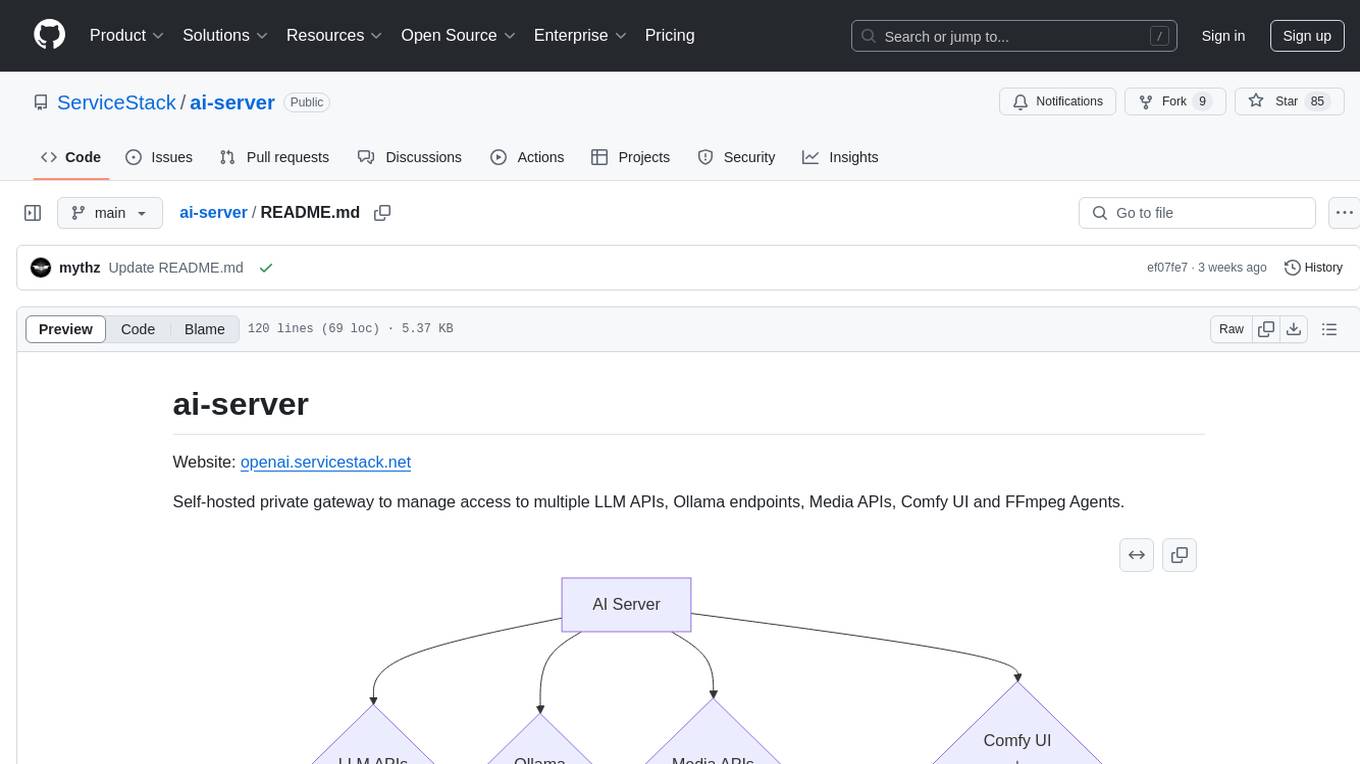
AI Server is a self-hosted private gateway that orchestrates AI requests through a single integration, allowing control over AI providers like LLM, Diffusion, and image transformation. It dynamically delegates requests across various providers, including LLM APIs, Media APIs, and Comfy UI with FFmpeg Agents. The tool also offers built-in UIs for tasks like chat, text-to-image, image-to-text, image upscaling, speech-to-text, and text-to-speech. Additionally, it provides admin UIs for managing AI and media providers, API key access, and monitoring background jobs and AI requests.
README:
Website: openai.servicestack.net
Self-hosted private gateway to manage access to multiple LLM APIs, Ollama endpoints, Media APIs, Comfy UI and FFmpeg Agents.
flowchart TB
    A[AI Server]
    A --> D{LLM APIs}
    A --> C{Ollama}
    A --> E{Media APIs}
    A --> F{Comfy UI
    +
    FFmpeg}
    D --> D1[OpenRouter / OpenAI / Mistral AI / Google Cloud / GroqCloud]
    E --> E1[Replicate / dall-e-3 / Text to speech]
F --> F1[Diffusion / Whisper / TTS]AI Server is a way to orchestrate your AI requests through a single self-hosted private gateway to control what AI Providers your Apps with only a single typed client integration. It can be used to process LLM, AI, Diffusion and image transformation requests which are dynamically delegated across multiple configured providers which can include any Ollama endpoint, OpenRouter / OpenAI / Mistral AI / Google Cloud / GroqCloud LLM APIs, Replicate / Open AI/Dall-e-3 / Text to speech Media APIs, Diffusion / Whisper / Text to Speech from Comfy UI and FFmpeg Agents.
As part of the overall AI Server solution we're also maintaining Docker Client Agents configured with Comfy UI, Whisper and FFmpeg which can be installed on GPU Servers to provide a full stack media processing pipeline for video and audio files which can be used as part of your AI workflows.
See AI Server Docs for documentation on installation and configuration.
In addition to its backend APIs, it also includes several built in UI's for utlizing AI Server features:


Use Admin UIs to manage AI and Media Providers and API Key Access

Increase capacity by adding AI Providers that can process LLM Requests

Add local Ollama endpoints and control which of their Models can be used

Glossary of LLM models available via Ollama or LLM APIs

List of different AI Provider Types that AI Server supports

Increase capacity by adding AI Providers that can process Media & FFmpeg Requests

Add a new Replicate API Media Provider and which diffusion models to enable

Add a new Comfy UI Agent and control which of its models can be used

Glossary of different Media Provider Types that AI Server supports

View completed and failed Background Jobs from Jobs Dashboard

Monitor Live progress of executing AI Requests

View all currently pending and executing AI Requests

Use Admin UI to manage API Keys that can access AI Server APIs and Features

Edit API Keys for fine grain control over API Keys access and scope

For Tasks:
Click tags to check more tools for each tasksFor Jobs:
Alternative AI tools for ai-server
Similar Open Source Tools
ai-server
AI Server is a self-hosted private gateway that orchestrates AI requests through a single integration, allowing control over AI providers like LLM, Diffusion, and image transformation. It dynamically delegates requests across various providers, including LLM APIs, Media APIs, and Comfy UI with FFmpeg Agents. The tool also offers built-in UIs for tasks like chat, text-to-image, image-to-text, image upscaling, speech-to-text, and text-to-speech. Additionally, it provides admin UIs for managing AI and media providers, API key access, and monitoring background jobs and AI requests.
chat-xiuliu
Chat-xiuliu is a bidirectional voice assistant powered by ChatGPT, capable of accessing the internet, executing code, reading/writing files, and supporting GPT-4V's image recognition feature. It can also call DALL·E 3 to generate images. The project is a fork from a background of a virtual cat girl named Xiuliu, with removed live chat interaction and added voice input. It can receive questions from microphone or interface, answer them vocally, upload images and PDFs, process tasks through function calls, remember conversation content, search the web, generate images using DALL·E 3, read/write local files, execute JavaScript code in a sandbox, open local files or web pages, customize the cat girl's speaking style, save conversation screenshots, and support Azure OpenAI and other API endpoints in openai format. It also supports setting proxies and various AI models like GPT-4, GPT-3.5, and DALL·E 3.
L3AGI
L3AGI is an open-source tool that enables AI Assistants to collaborate together as effectively as human teams. It provides a robust set of functionalities that empower users to design, supervise, and execute both autonomous AI Assistants and Teams of Assistants. Key features include the ability to create and manage Teams of AI Assistants, design and oversee standalone AI Assistants, equip AI Assistants with the ability to retain and recall information, connect AI Assistants to an array of data sources for efficient information retrieval and processing, and employ curated sets of tools for specific tasks. L3AGI also offers a user-friendly interface, APIs for integration with other systems, and a vibrant community for support and collaboration.
neural-compressor
Intel® Neural Compressor is an open-source Python library that supports popular model compression techniques such as quantization, pruning (sparsity), distillation, and neural architecture search on mainstream frameworks such as TensorFlow, PyTorch, ONNX Runtime, and MXNet. It provides key features, typical examples, and open collaborations, including support for a wide range of Intel hardware, validation of popular LLMs, and collaboration with cloud marketplaces, software platforms, and open AI ecosystems.
intlayer
Intlayer is an open-source, flexible i18n toolkit with AI-powered translation and CMS capabilities. It is a modern i18n solution for web and mobile apps, framework-agnostic, and includes features like per-locale content files, TypeScript autocompletion, tree-shakable dictionaries, and CI/CD integration. With Intlayer, internationalization becomes faster, cleaner, and smarter, offering benefits such as cross-framework support, JavaScript-powered content management, simplified setup, enhanced routing, AI-powered translation, and more.
ASTRA.ai
ASTRA is an open-source platform designed for developing applications utilizing large language models. It merges the ideas of Backend-as-a-Service and LLM operations, allowing developers to swiftly create production-ready generative AI applications. Additionally, it empowers non-technical users to engage in defining and managing data operations for AI applications. With ASTRA, you can easily create real-time, multi-modal AI applications with low latency, even without any coding knowledge.
vnc-lm
vnc-lm is a Discord bot designed for messaging with language models. Users can configure model parameters, branch conversations, and edit prompts to enhance responses. The bot supports various providers like OpenAI, Huggingface, and Cloudflare Workers AI. It integrates with ollama and LiteLLM, allowing users to access a wide range of language model APIs through a single interface. Users can manage models, switch between models, split long messages, and create conversation branches. LiteLLM integration enables support for OpenAI-compatible APIs and local LLM services. The bot requires Docker for installation and can be configured through environment variables. Troubleshooting tips are provided for common issues like context window problems, Discord API errors, and LiteLLM issues.
free-one-api
Free-one-api is a tool that allows access to all LLM reverse engineering libraries in a standard OpenAI API format. It supports automatic load balancing, Web UI, stream mode, multiple LLM reverse libraries, heartbeat detection mechanism, automatic disabling of unavailable channels, and runtime log recording. The tool is designed to work with the 'one-api' project and 'songquanpeng/one-api' for accessing official interfaces of various LLMs (paid). Contributors are needed to test adapters, find new reverse engineering libraries, and submit PRs.
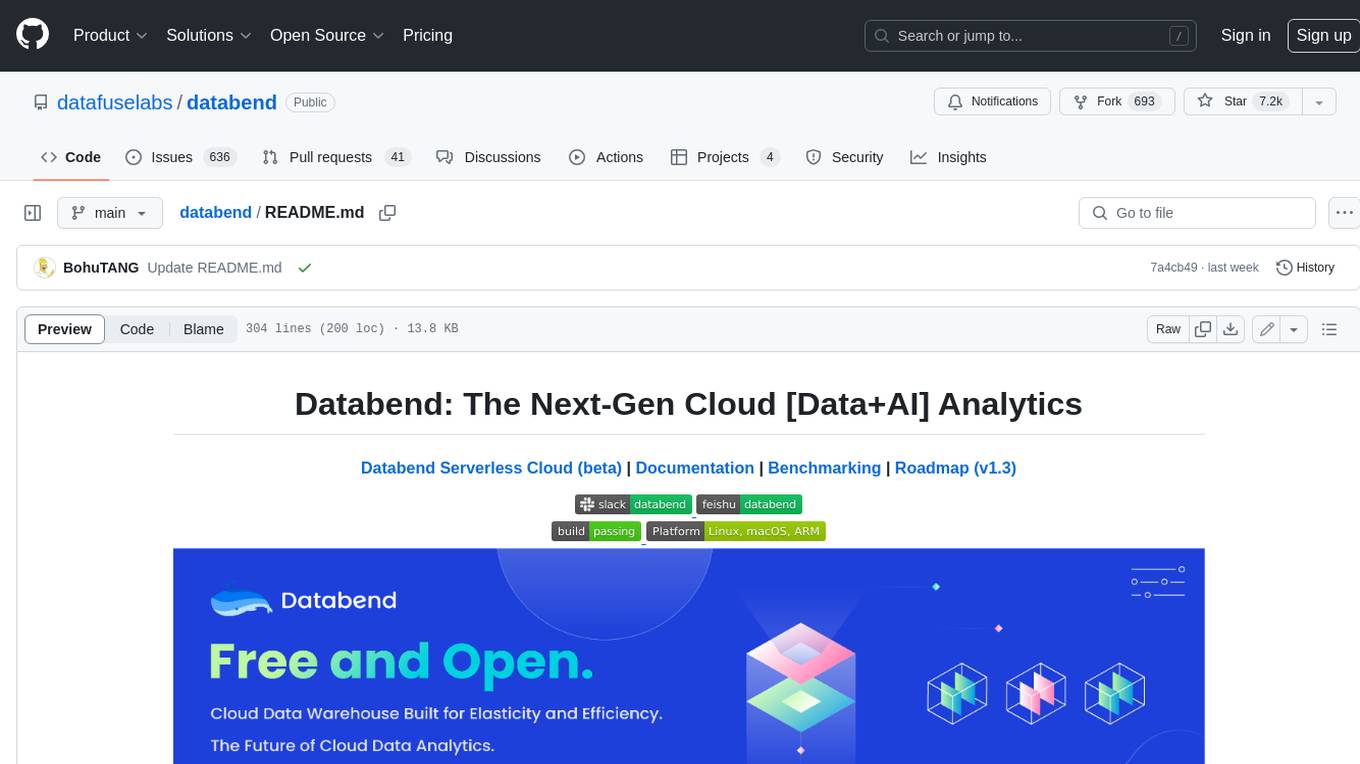
databend
Databend is an open-source cloud data warehouse that serves as a cost-effective alternative to Snowflake. With its focus on fast query execution and data ingestion, it's designed for complex analysis of the world's largest datasets.
nacos
Nacos is an easy-to-use platform designed for dynamic service discovery and configuration and service management. It helps build cloud native applications and microservices platform easily. Nacos provides functions like service discovery, health check, dynamic configuration management, dynamic DNS service, and service metadata management.
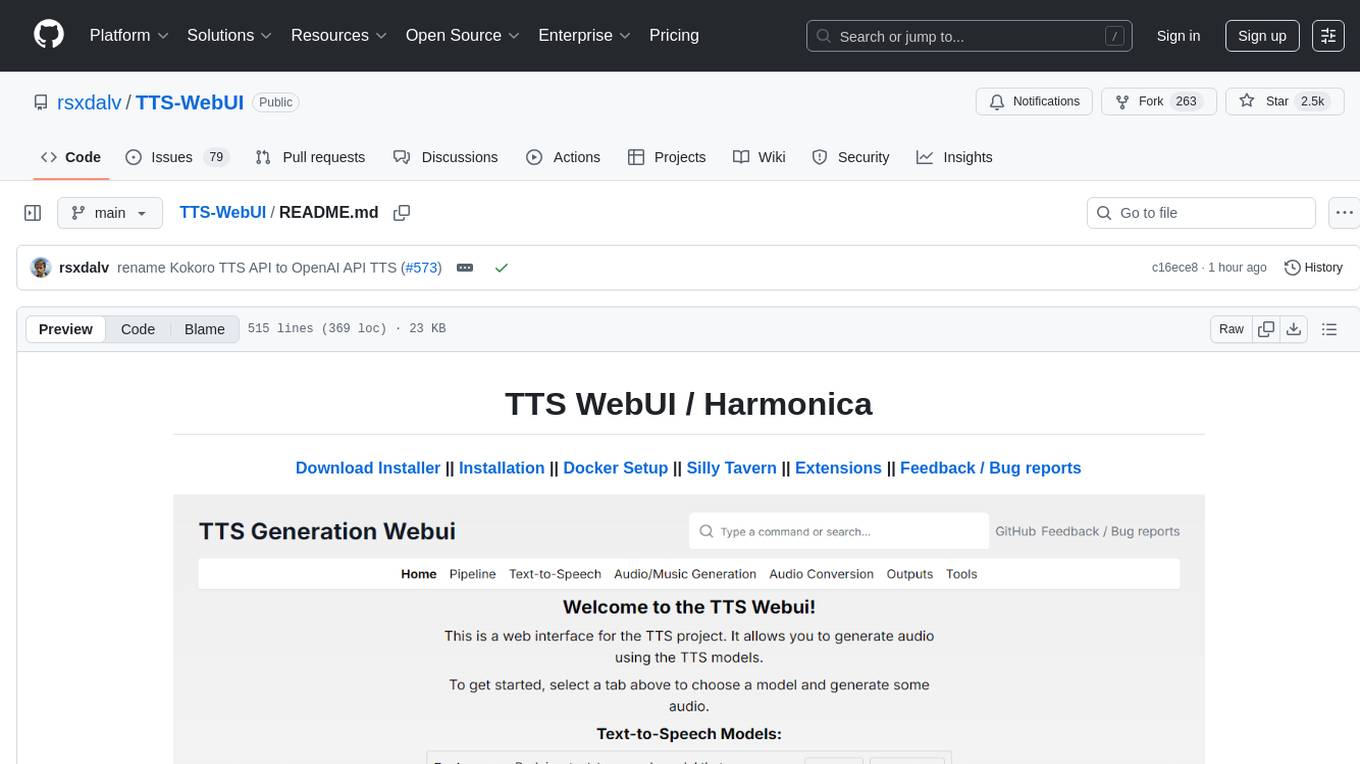
TTS-WebUI
TTS WebUI is a comprehensive tool for text-to-speech synthesis, audio/music generation, and audio conversion. It offers a user-friendly interface for various AI projects related to voice and audio processing. The tool provides a range of models and extensions for different tasks, along with integrations like Silly Tavern and OpenWebUI. With support for Docker setup and compatibility with Linux and Windows, TTS WebUI aims to facilitate creative and responsible use of AI technologies in a user-friendly manner.
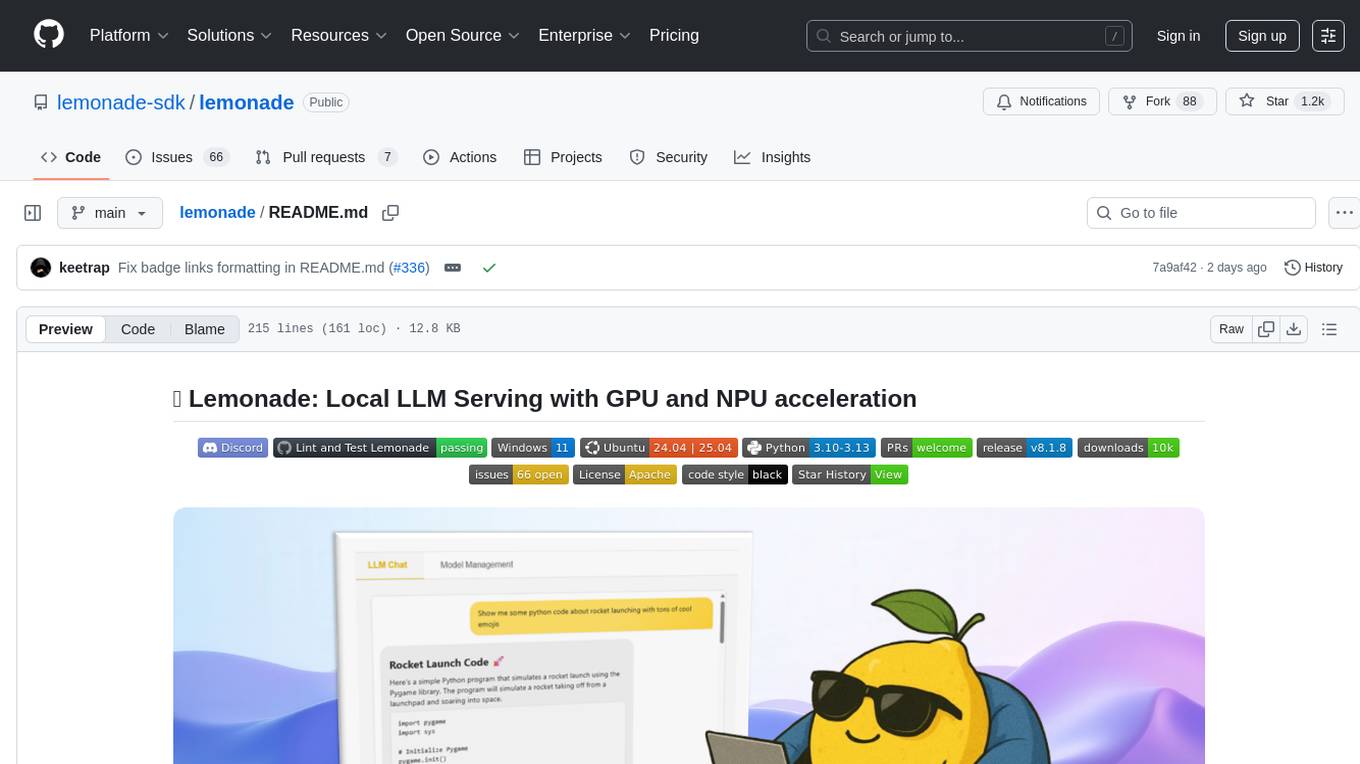
lemonade
Lemonade is a tool that helps users run local Large Language Models (LLMs) with high performance by configuring state-of-the-art inference engines for their Neural Processing Units (NPUs) and Graphics Processing Units (GPUs). It is used by startups, research teams, and large companies to run LLMs efficiently. Lemonade provides a high-level Python API for direct integration of LLMs into Python applications and a CLI for mixing and matching LLMs with various features like prompting templates, accuracy testing, performance benchmarking, and memory profiling. The tool supports both GGUF and ONNX models and allows importing custom models from Hugging Face using the Model Manager. Lemonade is designed to be easy to use and switch between different configurations at runtime, making it a versatile tool for running LLMs locally.
pgx
Pgx is a collection of GPU/TPU-accelerated parallel game simulators for reinforcement learning (RL). It provides JAX-native game simulators for various games like Backgammon, Chess, Shogi, and Go, offering super fast parallel execution on accelerators and beautiful visualization in SVG format. Pgx focuses on faster implementations while also being sufficiently general, allowing environments to be converted to the AEC API of PettingZoo for running Pgx environments through the PettingZoo API.
Noi
Noi is an AI-enhanced customizable browser designed to streamline digital experiences. It includes curated AI websites, allows adding any URL, offers prompts management, Noi Ask for batch messaging, various themes, Noi Cache Mode for quick link access, cookie data isolation, and more. Users can explore, extend, and empower their browsing experience with Noi.
luna-ai
Luna AI is a virtual streamer driven by a 'brain' composed of ChatterBot, GPT, Claude, langchain, chatglm, text-generation-webui, 讯飞星火, 智谱AI. It can interact with viewers in real-time during live streams on platforms like Bilibili, Douyin, Kuaishou, Douyu, or chat with you locally. Luna AI uses natural language processing and text-to-speech technologies like Edge-TTS, VITS-Fast, elevenlabs, bark-gui, VALL-E-X to generate responses to viewer questions and can change voice using so-vits-svc, DDSP-SVC. It can also collaborate with Stable Diffusion for drawing displays and loop custom texts. This project is completely free, and any identical copycat selling programs are pirated, please stop them promptly.
ASTRA.ai
Astra.ai is a multimodal agent powered by TEN, showcasing its capabilities in speech, vision, and reasoning through RAG from local documentation. It provides a platform for developing AI agents with features like RTC transportation, extension store, workflow builder, and local deployment. Users can build and test agents locally using Docker and Node.js, with prerequisites including Agora App ID, Azure's speech-to-text and text-to-speech API keys, and OpenAI API key. The platform offers advanced customization options through config files and API keys setup, enabling users to create and deploy their AI agents for various tasks.
For similar tasks
ai-server
AI Server is a self-hosted private gateway that orchestrates AI requests through a single integration, allowing control over AI providers like LLM, Diffusion, and image transformation. It dynamically delegates requests across various providers, including LLM APIs, Media APIs, and Comfy UI with FFmpeg Agents. The tool also offers built-in UIs for tasks like chat, text-to-image, image-to-text, image upscaling, speech-to-text, and text-to-speech. Additionally, it provides admin UIs for managing AI and media providers, API key access, and monitoring background jobs and AI requests.
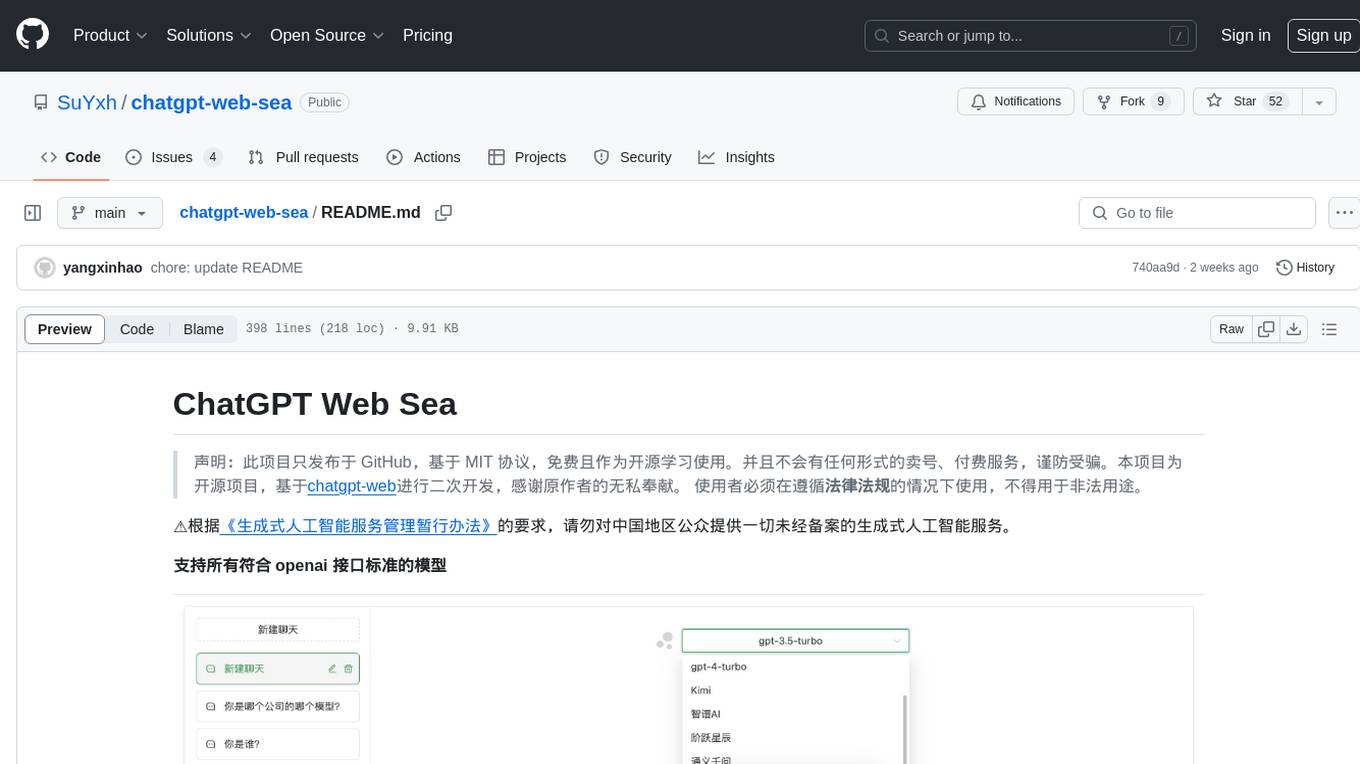
chatgpt-web-sea
ChatGPT Web Sea is an open-source project based on ChatGPT-web for secondary development. It supports all models that comply with the OpenAI interface standard, allows for model selection, configuration, and extension, and is compatible with OneAPI. The tool includes a Chinese ChatGPT tuning guide, supports file uploads, and provides model configuration options. Users can interact with the tool through a web interface, configure models, and perform tasks such as model selection, API key management, and chat interface setup. The project also offers Docker deployment options and instructions for manual packaging.
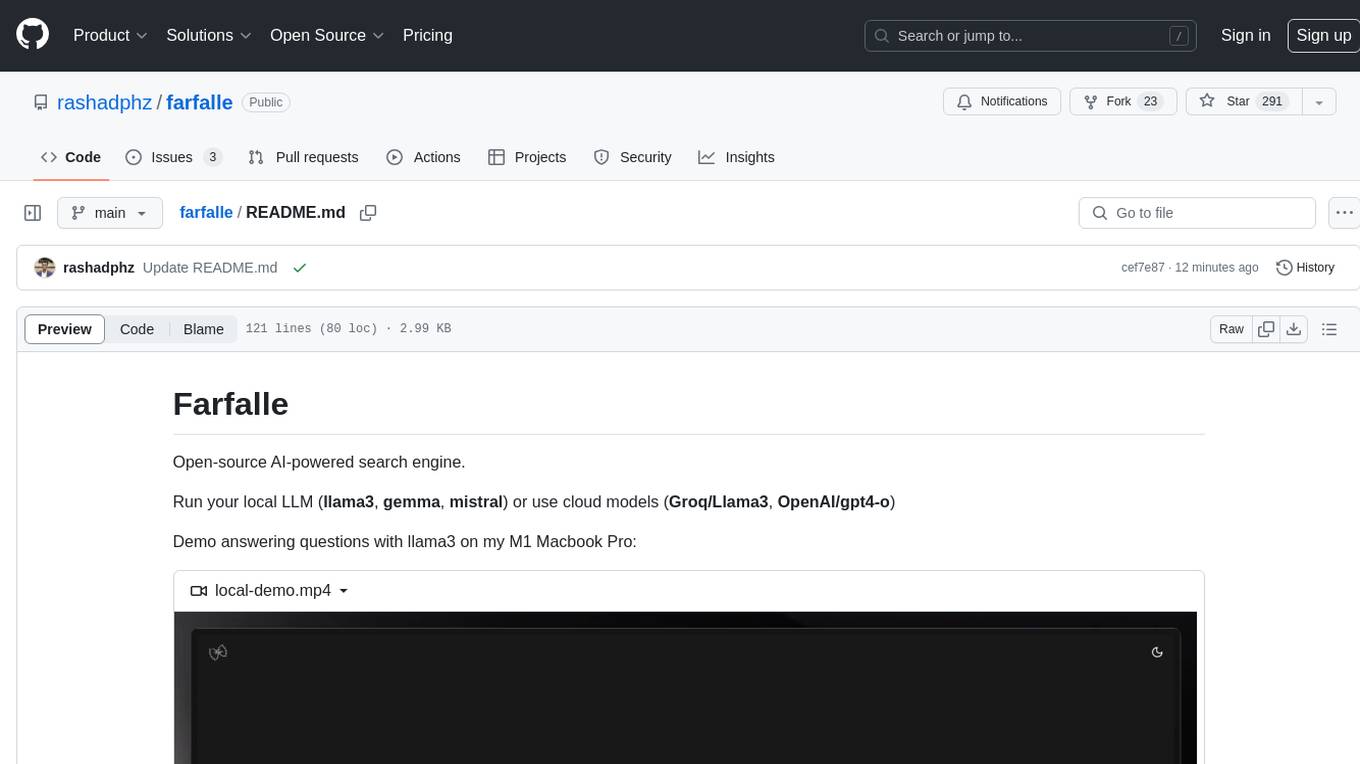
farfalle
Farfalle is an open-source AI-powered search engine that allows users to run their own local LLM or utilize the cloud. It provides a tech stack including Next.js for frontend, FastAPI for backend, Tavily for search API, Logfire for logging, and Redis for rate limiting. Users can get started by setting up prerequisites like Docker and Ollama, and obtaining API keys for Tavily, OpenAI, and Groq. The tool supports models like llama3, mistral, and gemma. Users can clone the repository, set environment variables, run containers using Docker Compose, and deploy the backend and frontend using services like Render and Vercel.
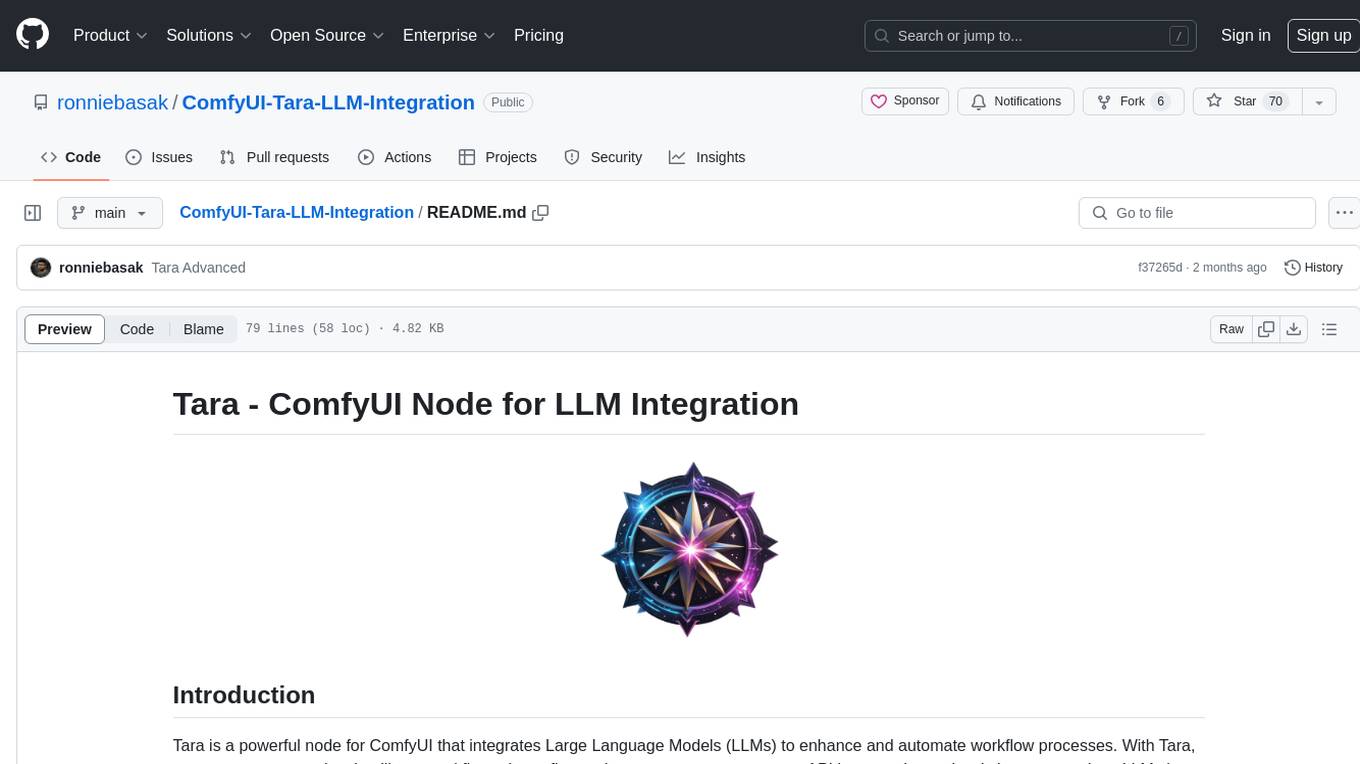
ComfyUI-Tara-LLM-Integration
Tara is a powerful node for ComfyUI that integrates Large Language Models (LLMs) to enhance and automate workflow processes. With Tara, you can create complex, intelligent workflows that refine and generate content, manage API keys, and seamlessly integrate various LLMs into your projects. It comprises nodes for handling OpenAI-compatible APIs, saving and loading API keys, composing multiple texts, and using predefined templates for OpenAI and Groq. Tara supports OpenAI and Grok models with plans to expand support to together.ai and Replicate. Users can install Tara via Git URL or ComfyUI Manager and utilize it for tasks like input guidance, saving and loading API keys, and generating text suitable for chaining in workflows.
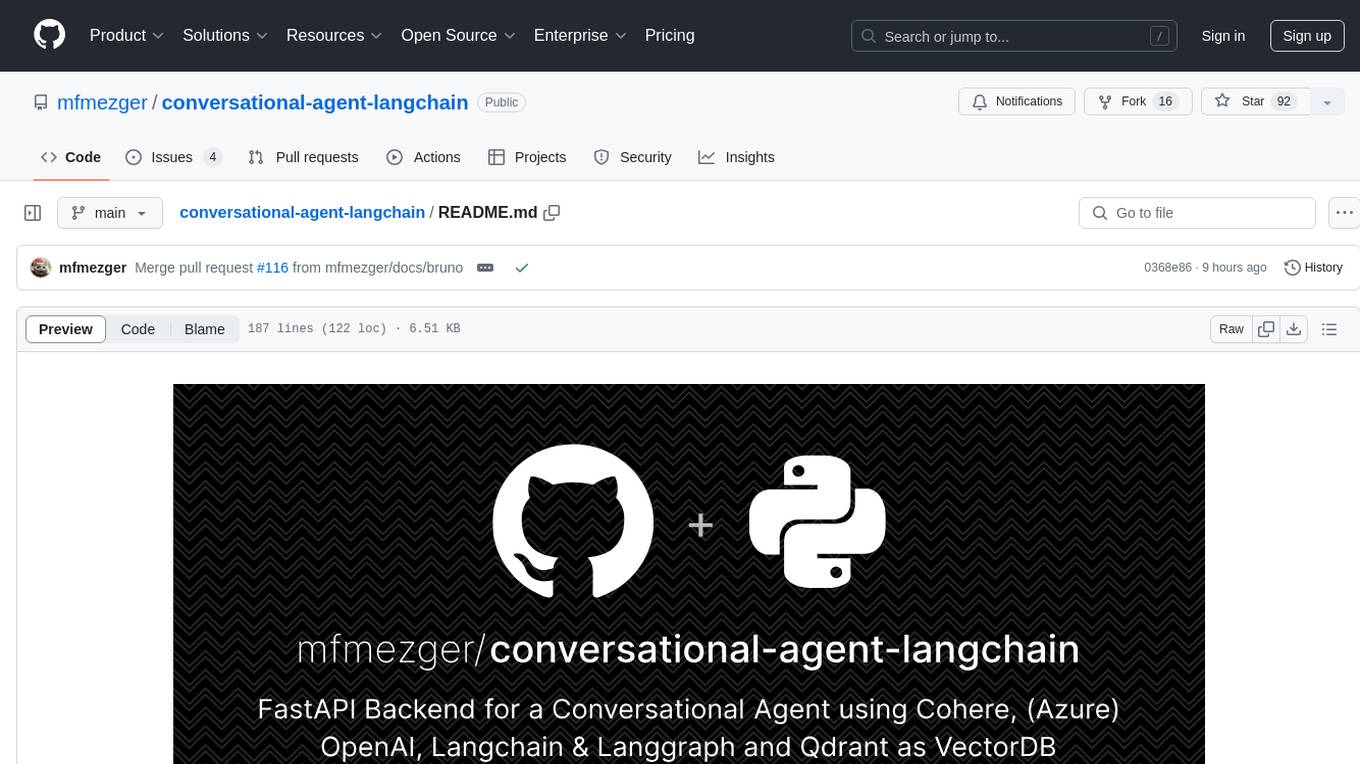
conversational-agent-langchain
This repository contains a Rest-Backend for a Conversational Agent that allows embedding documents, semantic search, QA based on documents, and document processing with Large Language Models. It uses Aleph Alpha and OpenAI Large Language Models to generate responses to user queries, includes a vector database, and provides a REST API built with FastAPI. The project also features semantic search, secret management for API keys, installation instructions, and development guidelines for both backend and frontend components.

ChatGPT-Next-Web-Pro
ChatGPT-Next-Web-Pro is a tool that provides an enhanced version of ChatGPT-Next-Web with additional features and functionalities. It offers complete ChatGPT-Next-Web functionality, file uploading and storage capabilities, drawing and video support, multi-modal support, reverse model support, knowledge base integration, translation, customizations, and more. The tool can be deployed with or without a backend, allowing users to interact with AI models, manage accounts, create models, manage API keys, handle orders, manage memberships, and more. It supports various cloud services like Aliyun OSS, Tencent COS, and Minio for file storage, and integrates with external APIs like Azure, Google Gemini Pro, and Luma. The tool also provides options for customizing website titles, subtitles, icons, and plugin buttons, and offers features like voice input, file uploading, real-time token count display, and more.
APIMyLlama
APIMyLlama is a server application that provides an interface to interact with the Ollama API, a powerful AI tool to run LLMs. It allows users to easily distribute API keys to create amazing things. The tool offers commands to generate, list, remove, add, change, activate, deactivate, and manage API keys, as well as functionalities to work with webhooks, set rate limits, and get detailed information about API keys. Users can install APIMyLlama packages with NPM, PIP, Jitpack Repo+Gradle or Maven, or from the Crates Repository. The tool supports Node.JS, Python, Java, and Rust for generating responses from the API. Additionally, it provides built-in health checking commands for monitoring API health status.
IntelliChat
IntelliChat is an open-source AI chatbot tool designed to accelerate the integration of multiple language models into chatbot apps. Users can select their preferred AI provider and model from the UI, manage API keys, and access data using Intellinode. The tool is built with Intellinode and Next.js, and supports various AI providers such as OpenAI ChatGPT, Google Gemini, Azure Openai, Cohere Coral, Replicate, Mistral AI, Anthropic, and vLLM. It offers a user-friendly interface for developers to easily incorporate AI capabilities into their chatbot applications.
For similar jobs
sweep
Sweep is an AI junior developer that turns bugs and feature requests into code changes. It automatically handles developer experience improvements like adding type hints and improving test coverage.
teams-ai
The Teams AI Library is a software development kit (SDK) that helps developers create bots that can interact with Teams and Microsoft 365 applications. It is built on top of the Bot Framework SDK and simplifies the process of developing bots that interact with Teams' artificial intelligence capabilities. The SDK is available for JavaScript/TypeScript, .NET, and Python.
ai-guide
This guide is dedicated to Large Language Models (LLMs) that you can run on your home computer. It assumes your PC is a lower-end, non-gaming setup.
classifai
Supercharge WordPress Content Workflows and Engagement with Artificial Intelligence. Tap into leading cloud-based services like OpenAI, Microsoft Azure AI, Google Gemini and IBM Watson to augment your WordPress-powered websites. Publish content faster while improving SEO performance and increasing audience engagement. ClassifAI integrates Artificial Intelligence and Machine Learning technologies to lighten your workload and eliminate tedious tasks, giving you more time to create original content that matters.
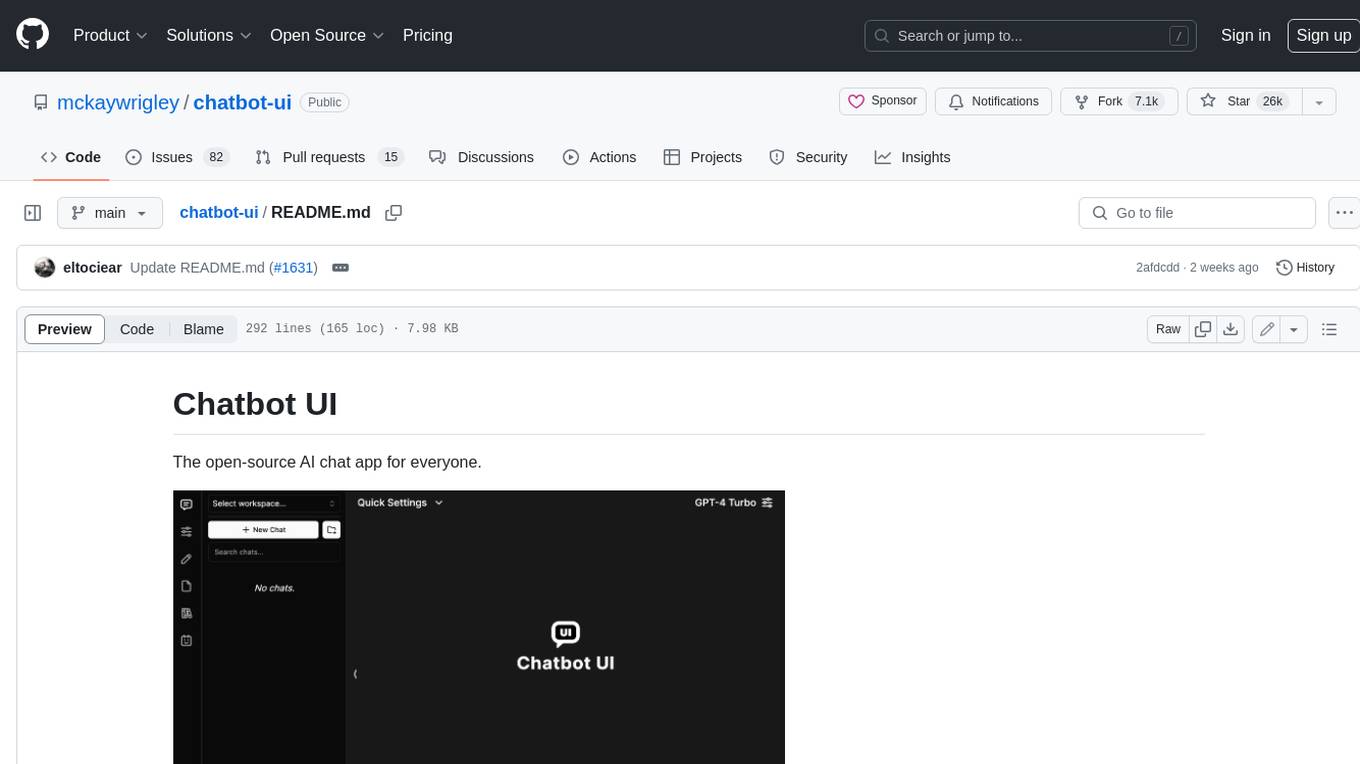
chatbot-ui
Chatbot UI is an open-source AI chat app that allows users to create and deploy their own AI chatbots. It is easy to use and can be customized to fit any need. Chatbot UI is perfect for businesses, developers, and anyone who wants to create a chatbot.
BricksLLM
BricksLLM is a cloud native AI gateway written in Go. Currently, it provides native support for OpenAI, Anthropic, Azure OpenAI and vLLM. BricksLLM aims to provide enterprise level infrastructure that can power any LLM production use cases. Here are some use cases for BricksLLM: * Set LLM usage limits for users on different pricing tiers * Track LLM usage on a per user and per organization basis * Block or redact requests containing PIIs * Improve LLM reliability with failovers, retries and caching * Distribute API keys with rate limits and cost limits for internal development/production use cases * Distribute API keys with rate limits and cost limits for students
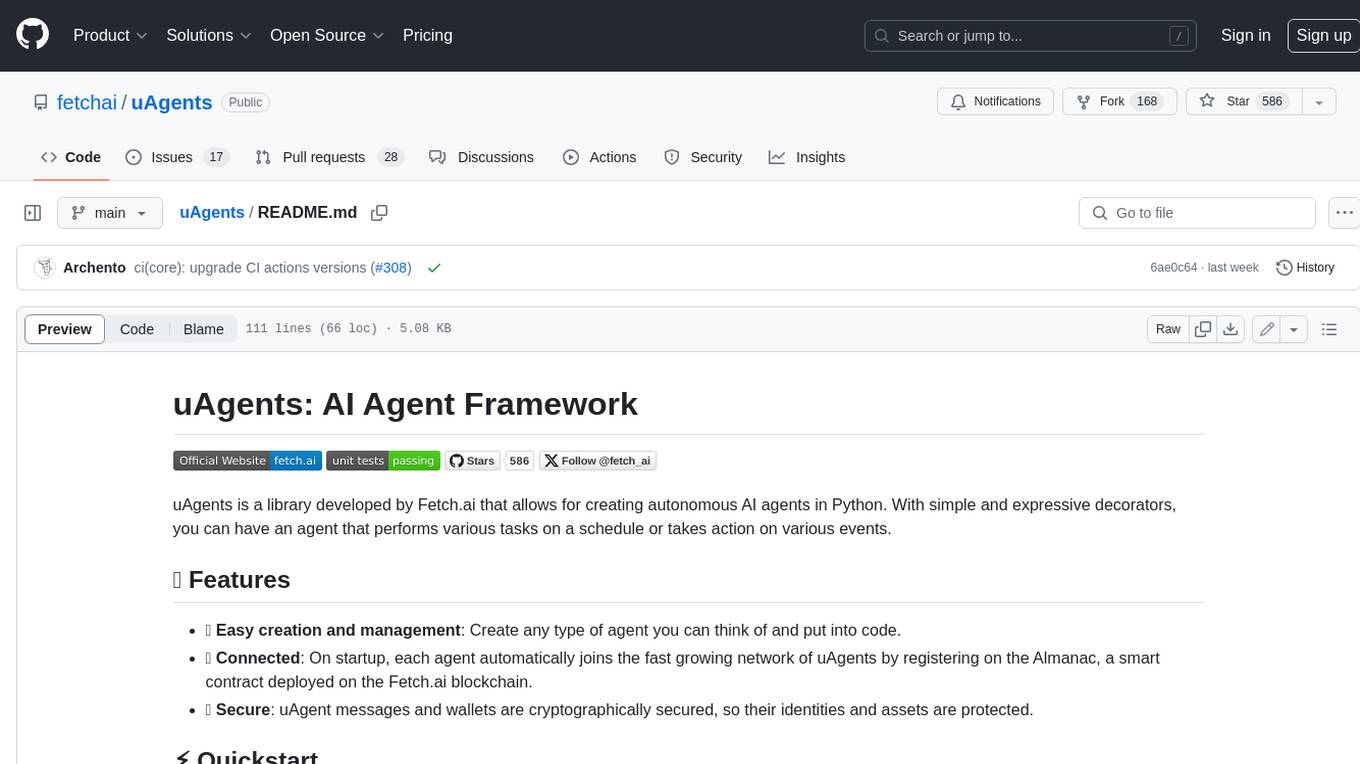
uAgents
uAgents is a Python library developed by Fetch.ai that allows for the creation of autonomous AI agents. These agents can perform various tasks on a schedule or take action on various events. uAgents are easy to create and manage, and they are connected to a fast-growing network of other uAgents. They are also secure, with cryptographically secured messages and wallets.
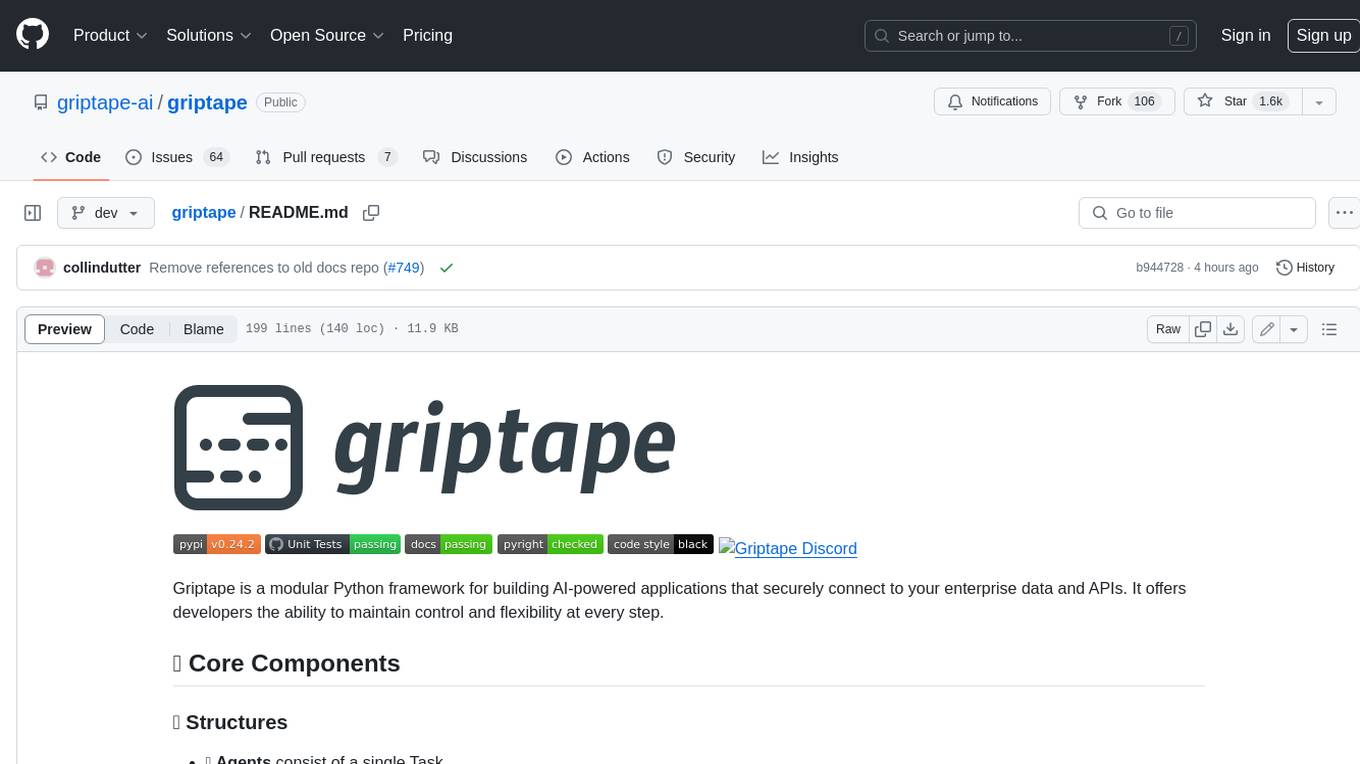
griptape
Griptape is a modular Python framework for building AI-powered applications that securely connect to your enterprise data and APIs. It offers developers the ability to maintain control and flexibility at every step. Griptape's core components include Structures (Agents, Pipelines, and Workflows), Tasks, Tools, Memory (Conversation Memory, Task Memory, and Meta Memory), Drivers (Prompt and Embedding Drivers, Vector Store Drivers, Image Generation Drivers, Image Query Drivers, SQL Drivers, Web Scraper Drivers, and Conversation Memory Drivers), Engines (Query Engines, Extraction Engines, Summary Engines, Image Generation Engines, and Image Query Engines), and additional components (Rulesets, Loaders, Artifacts, Chunkers, and Tokenizers). Griptape enables developers to create AI-powered applications with ease and efficiency.