


btp-cap-genai-rag
Explore this repository for GenAI samples on SAP Business Technology Platform (SAP BTP). We provide examples for single and multitenant versions, showcasing integration of LLMs via SAP AI Core, LangChain in SAP CAP, and advanced techniques like Retrieval Augmented Generation (RAG).
Stars: 79
This GitHub repository provides support for developers, partners, and customers to create advanced GenAI solutions on SAP Business Technology Platform (SAP BTP) following the Reference Architecture. It includes examples on integrating Foundation Models and Large Language Models via Generative AI Hub, using LangChain in CAP, and implementing advanced techniques like Retrieval Augmented Generation (RAG) through embeddings and SAP HANA Cloud's Vector Engine for enhanced value in customer support scenarios.
README:
Welcome to our dedicated GitHub repository, designed to provide valuable support to developers, partners and customers aiming to create advanced GenAI solutions on SAP Business Technology Platform (SAP BTP) following the Reference Architecture. Inside, you'll find a carefully crafted example that follows SAP BTP's respected Golden Path development approach. Discover how to smoothly integrate different Foundation Models and Large Language Models (LLMs) via Generative AI Hub by SAP AI Core, make the most of LangChain in CAP and use advanced techniques like output parsing according a custom schema or Retrieval Augmented Generation (RAG) through embeddings and SAP HANA Cloud's Vector Engine to achieve even higher value for your use case.
We encourage you to check out our accompanying Discovery Center Mission Develop a CAP-based application using GenAI and RAG along with the corresponding reference architecture guidance for Retrieval Augmented Generation with GenAI on SAP BTP. To learn more about Generative AI at SAP, we highly recommend to visit this openSAP course.
Basic Sample: For a more lightweight, basic backend-only sample of this Reference Architecture including CAP, generative AI hub and SAP HANA Cloud's Vector Engine, please check out the separate branch specifically dedicated to the basic boilerplate sample: cap-genaihub-vectorengine-sample.
 Architecture: GenAI application with RAG on SAP BTP
The provided code sample presents an application crafted by a potential SAP partner or customer, tailored for SAP Business Technology Platform (SAP BTP). This scenario presents a comprehensive solution for enhancing customer support within a travel agency, utilizing advanced email insights and automation. The system analyzes incoming emails using Large Language Models (LLMs) to offer core insights such as categorization, sentiment analysis and urgency assessment. It goes beyond basic analysis by extracting key facts and customizable fields like location, managed through a dedicated configuration page.
One innovative feature involves utilizing email embeddings to identify similar historical emails, aiding in understanding how similar requests were handled previously. This fosters consistent and efficient customer service. The code also demonstrates the capabilities of summarizing and translating both email subject and body, enabling streamlined comprehension across languages.
Furthermore, the system takes automation to the next level by generating potential responses for customer inquiries. This response generation is influenced by configurable actions and services, enhancing response accuracy and speed. The flexibility to connect with SAP systems like SAP Concur adds an enterprise dimension, allowing seamless integration of processes and data.
Though initially tailored for a travel agency, the code can be adapted to suit various industries, making it a versatile solution for augmenting customer support with data-driven insights and automation.
The business scenario can also be enhanced to become a multitenant SaaS solution.
Insight: If the concept of multitenancy in SAP BTP is new to you, we strongly suggest perusing the following GitHub repository to gain a deeper understanding of deploying a CAP-based multitenant application in the SAP BTP, Kyma Runtime, as well as the SAP BTP, Cloud Foundry Runtime.
Explore the development of a multitenant Software as a Service application in SAP BTP using CAP


This sample scenario comes with a step-by-step tutorial for a deployment in your own SAP BTP landscape. Check the following chapters and setup the scenario step-by-step in your own environment. The guide covers the deployment of the single-tenant as well as the multitenant version of the application.
Create an issue in this repository if you find a bug or have questions about the content.
For additional support, ask a question in SAP Community.
-
Error during paketo build process
- Description: The cap-js/sqlite package is currently not part of the dependencies as it causes issues during the paketo build process.
- Workaround: Install the cap-js/sqlite package manually without saving it in your package dependencies by running - npm i @cap-js/sqlite --no-save in the /(multi/single)-tenant/code directory.
Thanks to all collaborators to make this application real!
- Adi Pleyer
- Iyad Al Hafez
- Julian Schambeck
- Kay Schmitteckert
- Martin Frick
- Karen Detken
- Hyun Lee
If you wish to contribute code, offer fixes or improvements, please send a pull request. Due to legal reasons, contributors will be asked to accept a DCO when they create the first pull request to this project. This happens in an automated fashion during the submission process. SAP uses the standard DCO text of the Linux Foundation.
Copyright (c) 2023 SAP SE or an SAP affiliate company. All rights reserved. This project is licensed under the Apache Software License, version 2.0 except as noted otherwise in the LICENSE file.
For Tasks:
Click tags to check more tools for each tasksFor Jobs:
Alternative AI tools for btp-cap-genai-rag
Similar Open Source Tools
btp-cap-genai-rag
This GitHub repository provides support for developers, partners, and customers to create advanced GenAI solutions on SAP Business Technology Platform (SAP BTP) following the Reference Architecture. It includes examples on integrating Foundation Models and Large Language Models via Generative AI Hub, using LangChain in CAP, and implementing advanced techniques like Retrieval Augmented Generation (RAG) through embeddings and SAP HANA Cloud's Vector Engine for enhanced value in customer support scenarios.
agentUniverse
agentUniverse is a framework for developing applications powered by multi-agent based on large language model. It provides essential components for building single agent and multi-agent collaboration mechanism for customizing collaboration patterns. Developers can easily construct multi-agent applications and share pattern practices from different fields. The framework includes pre-installed collaboration patterns like PEER and DOE for complex task breakdown and data-intensive tasks.
morphik-core
Morphik is an AI-native toolset designed to help developers integrate context into their AI applications by providing tools to store, represent, and search unstructured data. It offers features such as multimodal search, fast metadata extraction, and integrations with existing tools. Morphik aims to address the challenges of traditional AI approaches that struggle with visually rich documents and provide a more comprehensive solution for understanding and processing complex data.
CodeFuse-muAgent
CodeFuse-muAgent is a Multi-Agent framework designed to streamline Standard Operating Procedure (SOP) orchestration for agents. It integrates toolkits, code libraries, knowledge bases, and sandbox environments for rapid construction of complex Multi-Agent interactive applications. The framework enables efficient execution and handling of multi-layered and multi-dimensional tasks.
langchain4j
LangChain for Java simplifies integrating Large Language Models (LLMs) into Java applications by offering unified APIs for various LLM providers and embedding stores. It provides a comprehensive toolbox with tools for prompt templating, chat memory management, function calling, and high-level patterns like Agents and RAG. The library supports 15+ popular LLM providers and 15+ embedding stores, offering numerous examples to help users quickly start building LLM-powered applications. LangChain4j is a fusion of ideas from various projects and actively incorporates new techniques and integrations to keep users up-to-date. The project is under active development, with core functionality already in place for users to start building LLM-powered apps.
miyagi
Project Miyagi showcases Microsoft's Copilot Stack in an envisioning workshop aimed at designing, developing, and deploying enterprise-grade intelligent apps. By exploring both generative and traditional ML use cases, Miyagi offers an experiential approach to developing AI-infused product experiences that enhance productivity and enable hyper-personalization. Additionally, the workshop introduces traditional software engineers to emerging design patterns in prompt engineering, such as chain-of-thought and retrieval-augmentation, as well as to techniques like vectorization for long-term memory, fine-tuning of OSS models, agent-like orchestration, and plugins or tools for augmenting and grounding LLMs.
coze-studio
Coze Studio is an all-in-one AI agent development tool that offers the most convenient AI agent development environment, from development to deployment. It provides core technologies for AI agent development, complete app templates, and build frameworks. Coze Studio aims to simplify creating, debugging, and deploying AI agents through visual design and build tools, enabling powerful AI app development and customized business logic. The tool is developed using Golang for the backend, React + TypeScript for the frontend, and follows microservices architecture based on domain-driven design principles.
llmops-promptflow-template
LLMOps with Prompt flow is a template and guidance for building LLM-infused apps using Prompt flow. It provides centralized code hosting, lifecycle management, variant and hyperparameter experimentation, A/B deployment, many-to-many dataset/flow relationships, multiple deployment targets, comprehensive reporting, BYOF capabilities, configuration-based development, local prompt experimentation and evaluation, endpoint testing, and optional Human-in-loop validation. The tool is customizable to suit various application needs.
synthora
Synthora is a lightweight and extensible framework for LLM-driven Agents and ALM research. It aims to simplify the process of building, testing, and evaluating agents by providing essential components. The framework allows for easy agent assembly with a single config, reducing the effort required for tuning and sharing agents. Although in early development stages with unstable APIs, Synthora welcomes feedback and contributions to enhance its stability and functionality.
supervisely
Supervisely is a computer vision platform that provides a range of tools and services for developing and deploying computer vision solutions. It includes a data labeling platform, a model training platform, and a marketplace for computer vision apps. Supervisely is used by a variety of organizations, including Fortune 500 companies, research institutions, and government agencies.
PulsarRPA
PulsarRPA is a high-performance, distributed, open-source Robotic Process Automation (RPA) framework designed to handle large-scale RPA tasks with ease. It provides a comprehensive solution for browser automation, web content understanding, and data extraction. PulsarRPA addresses challenges of browser automation and accurate web data extraction from complex and evolving websites. It incorporates innovative technologies like browser rendering, RPA, intelligent scraping, advanced DOM parsing, and distributed architecture to ensure efficient, accurate, and scalable web data extraction. The tool is open-source, customizable, and supports cutting-edge information extraction technology, making it a preferred solution for large-scale web data extraction.

agentUniverse
agentUniverse is a multi-agent framework based on large language models, providing flexible capabilities for building individual agents. It focuses on collaborative pattern components to solve problems in various fields and integrates domain experience. The framework supports LLM model integration and offers various pattern components like PEER and DOE. Users can easily configure models and set up agents for tasks. agentUniverse aims to assist developers and enterprises in constructing domain-expert-level intelligent agents for seamless collaboration.
Robyn
Robyn is an experimental, semi-automated and open-sourced Marketing Mix Modeling (MMM) package from Meta Marketing Science. It uses various machine learning techniques to define media channel efficiency and effectivity, explore adstock rates and saturation curves. Built for granular datasets with many independent variables, especially suitable for digital and direct response advertisers with rich data sources. Aiming to democratize MMM, make it accessible for advertisers of all sizes, and contribute to the measurement landscape.
csghub
CSGHub is an open source platform for managing large model assets, including datasets, model files, and codes. It offers functionalities similar to a privatized Huggingface, managing assets in a manner akin to how OpenStack Glance manages virtual machine images. Users can perform operations such as uploading, downloading, storing, verifying, and distributing assets through various interfaces. The platform provides microservice submodules and standardized OpenAPIs for easy integration with users' systems. CSGHub is designed for large models and can be deployed On-Premise for offline operation.
agentUniverse
agentUniverse is a multi-agent framework based on large language models, providing flexible capabilities for building individual agents. It focuses on multi-agent collaborative patterns, integrating domain experience to help agents solve problems in various fields. The framework includes pattern components like PEER and DOE for event interpretation, industry analysis, and financial report generation. It offers features for agent construction, multi-agent collaboration, and domain expertise integration, aiming to create intelligent applications with professional know-how.
mindsdb
MindsDB is a platform for customizing AI from enterprise data. You can create, serve, and fine-tune models in real-time from your database, vector store, and application data. MindsDB "enhances" SQL syntax with AI capabilities to make it accessible for developers worldwide. With MindsDB’s nearly 200 integrations, any developer can create AI customized for their purpose, faster and more securely. Their AI systems will constantly improve themselves — using companies’ own data, in real-time.
For similar tasks
btp-cap-genai-rag
This GitHub repository provides support for developers, partners, and customers to create advanced GenAI solutions on SAP Business Technology Platform (SAP BTP) following the Reference Architecture. It includes examples on integrating Foundation Models and Large Language Models via Generative AI Hub, using LangChain in CAP, and implementing advanced techniques like Retrieval Augmented Generation (RAG) through embeddings and SAP HANA Cloud's Vector Engine for enhanced value in customer support scenarios.
enterprise-h2ogpte
Enterprise h2oGPTe - GenAI RAG is a repository containing code examples, notebooks, and benchmarks for the enterprise version of h2oGPTe, a powerful AI tool for generating text based on the RAG (Retrieval-Augmented Generation) architecture. The repository provides resources for leveraging h2oGPTe in enterprise settings, including implementation guides, performance evaluations, and best practices. Users can explore various applications of h2oGPTe in natural language processing tasks, such as text generation, content creation, and conversational AI.
Riona-AI-Agent
Riona-AI-Agent is a versatile AI chatbot designed to assist users in various tasks. It utilizes natural language processing and machine learning algorithms to understand user queries and provide accurate responses. The chatbot can be integrated into websites, applications, and messaging platforms to enhance user experience and streamline communication. With its customizable features and easy deployment, Riona-AI-Agent is suitable for businesses, developers, and individuals looking to automate customer support, provide information, and engage with users in a conversational manner.
chat.md
This repository contains a chatbot tool that utilizes natural language processing to interact with users. The tool is designed to understand and respond to user input in a conversational manner, providing information and assistance. It can be integrated into various applications to enhance user experience and automate customer support. The chatbot tool is user-friendly and customizable, making it suitable for businesses looking to improve customer engagement and streamline communication.
enthusiast
Enthusiast is a production-ready agentic AI framework for E-commerce, offering tools like Retrieval-Argumented Generation (RAG), vector search, and workflow orchestrator. It helps in building AI-powered tools with customized agents for tasks like smart information search, customer support, content generation, and knowledge base automation. Enthusiast provides validation and evaluation components to ensure responses are grounded in actual data, reducing time, cost, and complexity in AI development.
nlp-llms-resources
The 'nlp-llms-resources' repository is a comprehensive resource list for Natural Language Processing (NLP) and Large Language Models (LLMs). It covers a wide range of topics including traditional NLP datasets, data acquisition, libraries for NLP, neural networks, sentiment analysis, optical character recognition, information extraction, semantics, topic modeling, multilingual NLP, domain-specific LLMs, vector databases, ethics, costing, books, courses, surveys, aggregators, newsletters, papers, conferences, and societies. The repository provides valuable information and resources for individuals interested in NLP and LLMs.
Awesome-Segment-Anything
Awesome-Segment-Anything is a powerful tool for segmenting and extracting information from various types of data. It provides a user-friendly interface to easily define segmentation rules and apply them to text, images, and other data formats. The tool supports both supervised and unsupervised segmentation methods, allowing users to customize the segmentation process based on their specific needs. With its versatile functionality and intuitive design, Awesome-Segment-Anything is ideal for data analysts, researchers, content creators, and anyone looking to efficiently extract valuable insights from complex datasets.
fairseq
Fairseq is a sequence modeling toolkit that enables researchers and developers to train custom models for translation, summarization, language modeling, and other text generation tasks. It provides reference implementations of various sequence modeling papers covering CNN, LSTM networks, Transformer networks, LightConv, DynamicConv models, Non-autoregressive Transformers, Finetuning, and more. The toolkit supports multi-GPU training, fast generation on CPU and GPU, mixed precision training, extensibility, flexible configuration based on Hydra, and full parameter and optimizer state sharding. Pre-trained models are available for translation and language modeling with a torch.hub interface. Fairseq also offers pre-trained models and examples for tasks like XLS-R, cross-lingual retrieval, wav2vec 2.0, unsupervised quality estimation, and more.
For similar jobs
promptflow
**Prompt flow** is a suite of development tools designed to streamline the end-to-end development cycle of LLM-based AI applications, from ideation, prototyping, testing, evaluation to production deployment and monitoring. It makes prompt engineering much easier and enables you to build LLM apps with production quality.
deepeval
DeepEval is a simple-to-use, open-source LLM evaluation framework specialized for unit testing LLM outputs. It incorporates various metrics such as G-Eval, hallucination, answer relevancy, RAGAS, etc., and runs locally on your machine for evaluation. It provides a wide range of ready-to-use evaluation metrics, allows for creating custom metrics, integrates with any CI/CD environment, and enables benchmarking LLMs on popular benchmarks. DeepEval is designed for evaluating RAG and fine-tuning applications, helping users optimize hyperparameters, prevent prompt drifting, and transition from OpenAI to hosting their own Llama2 with confidence.
MegaDetector
MegaDetector is an AI model that identifies animals, people, and vehicles in camera trap images (which also makes it useful for eliminating blank images). This model is trained on several million images from a variety of ecosystems. MegaDetector is just one of many tools that aims to make conservation biologists more efficient with AI. If you want to learn about other ways to use AI to accelerate camera trap workflows, check out our of the field, affectionately titled "Everything I know about machine learning and camera traps".
leapfrogai
LeapfrogAI is a self-hosted AI platform designed to be deployed in air-gapped resource-constrained environments. It brings sophisticated AI solutions to these environments by hosting all the necessary components of an AI stack, including vector databases, model backends, API, and UI. LeapfrogAI's API closely matches that of OpenAI, allowing tools built for OpenAI/ChatGPT to function seamlessly with a LeapfrogAI backend. It provides several backends for various use cases, including llama-cpp-python, whisper, text-embeddings, and vllm. LeapfrogAI leverages Chainguard's apko to harden base python images, ensuring the latest supported Python versions are used by the other components of the stack. The LeapfrogAI SDK provides a standard set of protobuffs and python utilities for implementing backends and gRPC. LeapfrogAI offers UI options for common use-cases like chat, summarization, and transcription. It can be deployed and run locally via UDS and Kubernetes, built out using Zarf packages. LeapfrogAI is supported by a community of users and contributors, including Defense Unicorns, Beast Code, Chainguard, Exovera, Hypergiant, Pulze, SOSi, United States Navy, United States Air Force, and United States Space Force.
llava-docker
This Docker image for LLaVA (Large Language and Vision Assistant) provides a convenient way to run LLaVA locally or on RunPod. LLaVA is a powerful AI tool that combines natural language processing and computer vision capabilities. With this Docker image, you can easily access LLaVA's functionalities for various tasks, including image captioning, visual question answering, text summarization, and more. The image comes pre-installed with LLaVA v1.2.0, Torch 2.1.2, xformers 0.0.23.post1, and other necessary dependencies. You can customize the model used by setting the MODEL environment variable. The image also includes a Jupyter Lab environment for interactive development and exploration. Overall, this Docker image offers a comprehensive and user-friendly platform for leveraging LLaVA's capabilities.

carrot
The 'carrot' repository on GitHub provides a list of free and user-friendly ChatGPT mirror sites for easy access. The repository includes sponsored sites offering various GPT models and services. Users can find and share sites, report errors, and access stable and recommended sites for ChatGPT usage. The repository also includes a detailed list of ChatGPT sites, their features, and accessibility options, making it a valuable resource for ChatGPT users seeking free and unlimited GPT services.
TrustLLM
TrustLLM is a comprehensive study of trustworthiness in LLMs, including principles for different dimensions of trustworthiness, established benchmark, evaluation, and analysis of trustworthiness for mainstream LLMs, and discussion of open challenges and future directions. Specifically, we first propose a set of principles for trustworthy LLMs that span eight different dimensions. Based on these principles, we further establish a benchmark across six dimensions including truthfulness, safety, fairness, robustness, privacy, and machine ethics. We then present a study evaluating 16 mainstream LLMs in TrustLLM, consisting of over 30 datasets. The document explains how to use the trustllm python package to help you assess the performance of your LLM in trustworthiness more quickly. For more details about TrustLLM, please refer to project website.
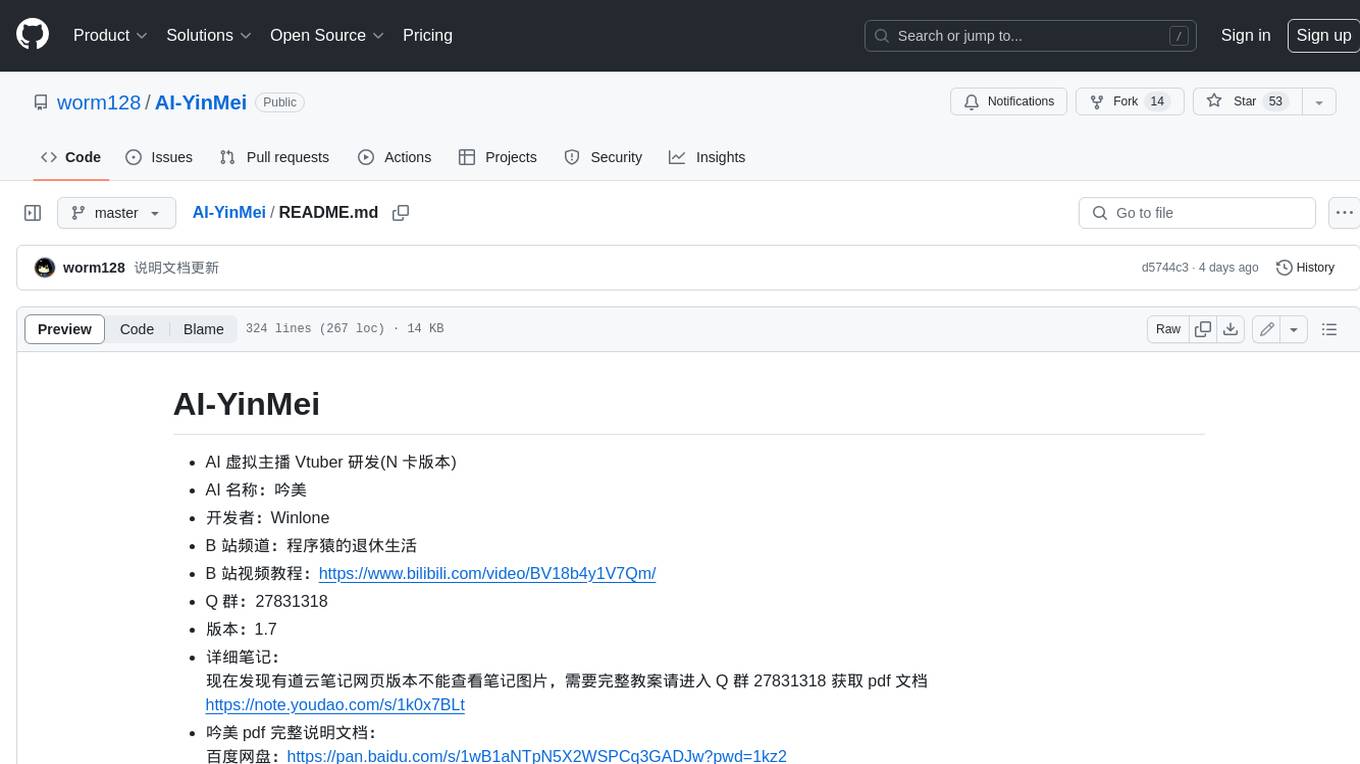
AI-YinMei
AI-YinMei is an AI virtual anchor Vtuber development tool (N card version). It supports fastgpt knowledge base chat dialogue, a complete set of solutions for LLM large language models: [fastgpt] + [one-api] + [Xinference], supports docking bilibili live broadcast barrage reply and entering live broadcast welcome speech, supports Microsoft edge-tts speech synthesis, supports Bert-VITS2 speech synthesis, supports GPT-SoVITS speech synthesis, supports expression control Vtuber Studio, supports painting stable-diffusion-webui output OBS live broadcast room, supports painting picture pornography public-NSFW-y-distinguish, supports search and image search service duckduckgo (requires magic Internet access), supports image search service Baidu image search (no magic Internet access), supports AI reply chat box [html plug-in], supports AI singing Auto-Convert-Music, supports playlist [html plug-in], supports dancing function, supports expression video playback, supports head touching action, supports gift smashing action, supports singing automatic start dancing function, chat and singing automatic cycle swing action, supports multi scene switching, background music switching, day and night automatic switching scene, supports open singing and painting, let AI automatically judge the content.