


platform
[🧠] Platform is a Bittensor subnet built to advance collaborative AI research through multiple simultaneous challenges powered by sub-subnet technology. It enables miners to compete and cooperate across diverse challenges, ensuring confidentiality, transparent evaluation, and the continuous pursuit of the most efficient and innovative code.
Stars: 98
Platform is a WASM-only, peer-to-peer validator network for deterministic evaluation of miner submissions on Bittensor. It follows core principles of decentralized libp2p mesh, stake-weighted PBFT-style consensus, and deterministic WASM execution. The network architecture includes validators executing challenge logic and submitting weights to the chain. Consensus and weight submission process involves proposal, voting, and weight submission. The tool enforces a strict runtime policy for WASM execution and handles route execution. Review assignment flow includes submission, validator selection, review aggregation, and final score calculation. Subnet owner resolution involves metagraph sync and updating chain state. Quick start guide for validators includes cloning the repository, setting up environment variables, building the validator node, and starting the node with a secret key.
README:





Platform is a WASM-only, peer-to-peer validator network for deterministic evaluation of miner submissions on Bittensor. Validators execute challenge logic in a hardened WASM runtime, reach stake-weighted consensus over libp2p, and submit finalized weights to the chain.
Core principles
- Decentralized libp2p mesh (gossipsub + DHT) with no centralized relays.
- Stake-weighted PBFT-style consensus for challenge state and weight aggregation.
- Deterministic WASM execution with strict runtime policy and auditability.
- Architecture
- Security Model
- Challenges
- Challenge Integration Guide
- Validator Guide
- Validator Operations
flowchart LR
    Owner[Sudo Owner] -->|Signed challenge actions| Mesh[(libp2p Mesh)]
    Mesh --> DHT[(DHT: submissions + consensus state)]
    Mesh --> V1[Validator 1]
    Mesh --> V2[Validator 2]
    Mesh --> VN[Validator N]
    V1 -->|Evaluations + votes| Mesh
    V2 -->|Evaluations + votes| Mesh
    VN -->|Evaluations + votes| Mesh
    V1 -->|Final weights| BT[Bittensor Chain]
    V2 -->|Final weights| BT
VN -->|Final weights| BTsequenceDiagram
participant L as Leader
participant V1 as Validator 1
participant V2 as Validator 2
participant Vn as Validator N
participant BT as Bittensor
L->>V1: Proposal(action, height)
L->>V2: Proposal(action, height)
L->>Vn: Proposal(action, height)
V1-->>L: Vote(approve/reject)
V2-->>L: Vote(approve/reject)
Vn-->>L: Vote(approve/reject)
L-->>V1: Commit(>=2f+1 approvals)
L-->>V2: Commit(>=2f+1 approvals)
L-->>Vn: Commit(>=2f+1 approvals)
V1->>BT: Submit weights
V2->>BT: Submit weights
Vn->>BT: Submit weightsflowchart LR
Validator[Validator Node] --> Runtime[WASM Runtime]
Runtime --> Policy[Runtime Policy]
Runtime --> HostFns[Whitelisted Host Functions]
Runtime --> Audit[Audit Logs]
Policy --> Runtime
HostFns --> Runtime
Runtime -->|Deterministic outputs| ValidatorsequenceDiagram
participant Client
participant RPC as RPC Server
participant WE as WASM Executor
participant WM as WASM Module
Client->>RPC: challenge_call(id, method, path)
RPC->>WE: execute_handle_route(request)
WE->>WM: handle_route(serialized_request)
WM-->>WE: serialized_response
WE-->>RPC: WasmRouteResponse
RPC-->>Client: JSON-RPC resultflowchart LR
Submit[Submission] --> Select[Validator Selection]
Select --> LLM[3 LLM Reviewers]
Select --> AST[3 AST Reviewers]
LLM --> |Review Results| Aggregate[Result Aggregation]
AST --> |Review Results| Aggregate
Aggregate --> Score[Final Score]
LLM -.-> |Timeout| Replace1[Replacement Validator]
AST -.-> |Timeout| Replace2[Replacement Validator]flowchart TB
Sync[Metagraph Sync] --> Parse[Parse Neurons]
Parse --> UID0{UID 0 Found?}
UID0 -->|Yes| Update[Update ChainState.sudo_key]
UID0 -->|No| Keep[Keep Existing]
Update --> Owner[Subnet Owner = UID 0 Hotkey]git clone https://github.com/PlatformNetwork/platform.git
cd platform
# Configure environment
cp .env.example .env
# Edit .env and set your VALIDATOR_SECRET_KEY (BIP39 mnemonic)
nano .env
# Start validator
docker compose up -d
# View logs
docker compose logs -f validator| Variable | Description | Required |
|---|---|---|
VALIDATOR_SECRET_KEY |
BIP39 mnemonic (24 words) | Yes |
NETUID |
Subnet UID (default: 100) | No |
SUBTENSOR_ENDPOINT |
Bittensor RPC endpoint | No |
RPC_PORT |
RPC API port (default: 8080) | No |
P2P_PORT |
P2P port (default: 8090) | No |
See Validator Operations for hardware, configuration, and monitoring.
MIT
For Tasks:
Click tags to check more tools for each tasksFor Jobs:
Alternative AI tools for platform
Similar Open Source Tools
platform
Platform is a WASM-only, peer-to-peer validator network for deterministic evaluation of miner submissions on Bittensor. It follows core principles of decentralized libp2p mesh, stake-weighted PBFT-style consensus, and deterministic WASM execution. The network architecture includes validators executing challenge logic and submitting weights to the chain. Consensus and weight submission process involves proposal, voting, and weight submission. The tool enforces a strict runtime policy for WASM execution and handles route execution. Review assignment flow includes submission, validator selection, review aggregation, and final score calculation. Subnet owner resolution involves metagraph sync and updating chain state. Quick start guide for validators includes cloning the repository, setting up environment variables, building the validator node, and starting the node with a secret key.
ctinexus
CTINexus is a framework that leverages optimized in-context learning of large language models to automatically extract cyber threat intelligence from unstructured text and construct cybersecurity knowledge graphs. It processes threat intelligence reports to extract cybersecurity entities, identify relationships between security concepts, and construct knowledge graphs with interactive visualizations. The framework requires minimal configuration, with no extensive training data or parameter tuning needed.
sdk
The Kubeflow SDK is a set of unified Pythonic APIs that simplify running AI workloads at any scale without needing to learn Kubernetes. It offers consistent APIs across the Kubeflow ecosystem, enabling users to focus on building AI applications rather than managing complex infrastructure. The SDK provides a unified experience, simplifies AI workloads, is built for scale, allows rapid iteration, and supports local development without a Kubernetes cluster.
OSA
OSA (Open-Source-Advisor) is a tool designed to improve the quality of scientific open source projects by automating the generation of README files, documentation, CI/CD scripts, and providing advice and recommendations for repositories. It supports various LLMs accessible via API, local servers, or osa_bot hosted on ITMO servers. OSA is currently under development with features like README file generation, documentation generation, automatic implementation of changes, LLM integration, and GitHub Action Workflow generation. It requires Python 3.10 or higher and tokens for GitHub/GitLab/Gitverse and LLM API key. Users can install OSA using PyPi or build from source, and run it using CLI commands or Docker containers.
alphora
Alphora is a full-stack framework for building production AI agents, providing agent orchestration, prompt engineering, tool execution, memory management, streaming, and deployment with an async-first, OpenAI-compatible design. It offers features like agent derivation, reasoning-action loop, async streaming, visual debugger, OpenAI compatibility, multimodal support, tool system with zero-config tools and type safety, prompt engine with dynamic prompts, memory and storage management, sandbox for secure execution, deployment as API, and more. Alphora allows users to build sophisticated AI agents easily and efficiently.
llm-context.py
LLM Context is a tool designed to assist developers in quickly injecting relevant content from code/text projects into Large Language Model chat interfaces. It leverages `.gitignore` patterns for smart file selection and offers a streamlined clipboard workflow using the command line. The tool also provides direct integration with Large Language Models through the Model Context Protocol (MCP). LLM Context is optimized for code repositories and collections of text/markdown/html documents, making it suitable for developers working on projects that fit within an LLM's context window. The tool is under active development and aims to enhance AI-assisted development workflows by harnessing the power of Large Language Models.
QuantaAlpha
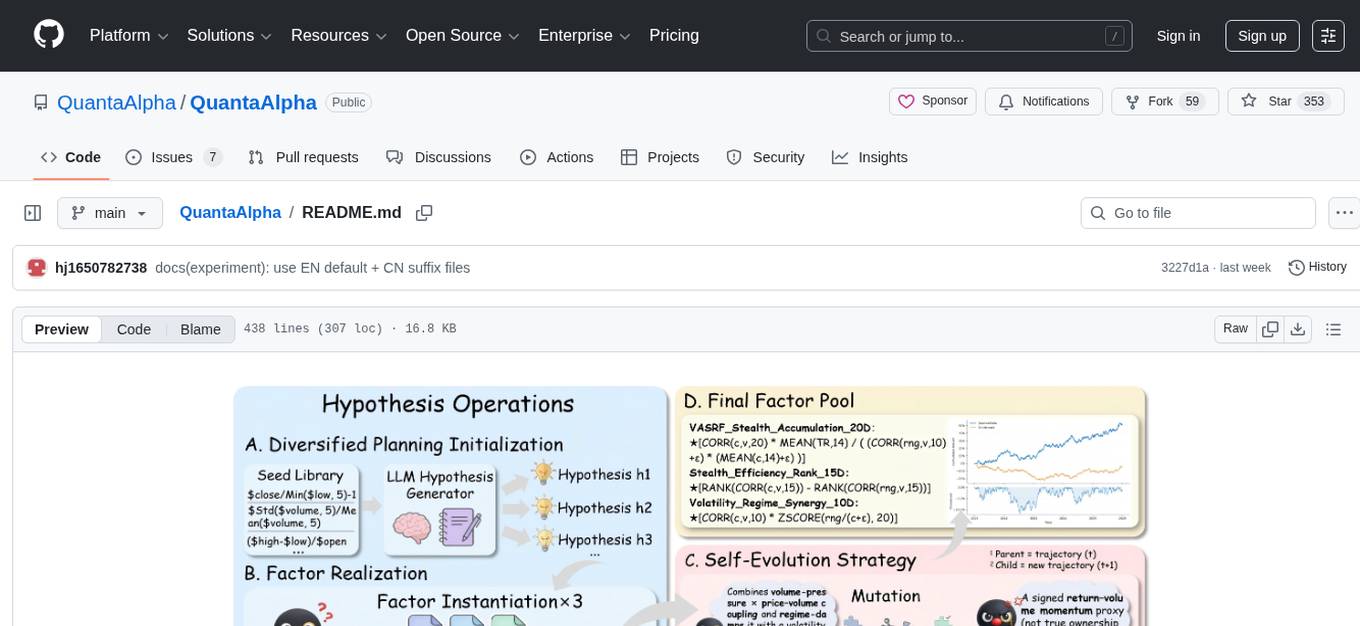
QuantaAlpha is a framework designed for factor mining in quantitative alpha research. It combines LLM intelligence with evolutionary strategies to automatically mine, evolve, and validate alpha factors through self-evolving trajectories. The framework provides a trajectory-based approach with diversified planning initialization and structured hypothesis-code constraint. Users can describe their research direction and observe the automatic factor mining process. QuantaAlpha aims to transform how quantitative alpha factors are discovered by leveraging advanced technologies and self-evolving methodologies.
OpenSandbox
OpenSandbox is a general-purpose sandbox platform for AI applications, offering multi-language SDKs, unified sandbox APIs, and Docker/Kubernetes runtimes for scenarios like Coding Agents, GUI Agents, Agent Evaluation, AI Code Execution, and RL Training. It provides features such as multi-language SDKs, sandbox protocol, sandbox runtime, sandbox environments, and network policy. Users can perform basic sandbox operations like installing and configuring the sandbox server, starting the sandbox server, creating a code interpreter, and executing commands. The platform also offers examples for coding agent integrations, browser and desktop environments, and ML and training tasks.

evalchemy
Evalchemy is a unified and easy-to-use toolkit for evaluating language models, focusing on post-trained models. It integrates multiple existing benchmarks such as RepoBench, AlpacaEval, and ZeroEval. Key features include unified installation, parallel evaluation, simplified usage, and results management. Users can run various benchmarks with a consistent command-line interface and track results locally or integrate with a database for systematic tracking and leaderboard submission.
zcf
ZCF (Zero-Config Claude-Code Flow) is a tool that provides zero-configuration, one-click setup for Claude Code with bilingual support, intelligent agent system, and personalized AI assistant. It offers an interactive menu for easy operations and direct commands for quick execution. The tool supports bilingual operation with automatic language switching and customizable AI output styles. ZCF also includes features like BMad Workflow for enterprise-grade workflow system, Spec Workflow for structured feature development, CCR (Claude Code Router) support for proxy routing, and CCometixLine for real-time usage tracking. It provides smart installation, complete configuration management, and core features like professional agents, command system, and smart configuration. ZCF is cross-platform compatible, supports Windows and Termux environments, and includes security features like dangerous operation confirmation mechanism.
agentfield
AgentField is an open-source control plane designed for autonomous AI agents, providing infrastructure for agents to make decisions beyond chatbots. It offers features like scaling infrastructure, routing & discovery, async execution, durable state, observability, trust infrastructure with cryptographic identity, verifiable credentials, and policy enforcement. Users can write agents in Python, Go, TypeScript, or interact via REST APIs. The tool enables the creation of AI backends that reason autonomously within defined boundaries, offering predictability and flexibility. AgentField aims to bridge the gap between AI frameworks and production-ready infrastructure for AI agents.
augustus
Augustus is a Go-based LLM vulnerability scanner designed for security professionals to test large language models against a wide range of adversarial attacks. It integrates with 28 LLM providers, covers 210+ adversarial attacks including prompt injection, jailbreaks, encoding exploits, and data extraction, and produces actionable vulnerability reports. The tool is built for production security testing with features like concurrent scanning, rate limiting, retry logic, and timeout handling out of the box.
mcp-devtools
MCP DevTools is a high-performance server written in Go that replaces multiple Node.js and Python-based servers. It provides access to essential developer tools through a unified, modular interface. The server is efficient, with minimal memory footprint and fast response times. It offers a comprehensive tool suite for agentic coding, including 20+ essential developer agent tools. The tool registry allows for easy addition of new tools. The server supports multiple transport modes, including STDIO, HTTP, and SSE. It includes a security framework for multi-layered protection and a plugin system for adding new tools.
paperbanana
PaperBanana is an automated academic illustration tool designed for AI scientists. It implements an agentic framework for generating publication-quality academic diagrams and statistical plots from text descriptions. The tool utilizes a two-phase multi-agent pipeline with iterative refinement, Gemini-based VLM planning, and image generation. It offers a CLI, Python API, and MCP server for IDE integration, along with Claude Code skills for generating diagrams, plots, and evaluating diagrams. PaperBanana is not affiliated with or endorsed by the original authors or Google Research, and it may differ from the original system described in the paper.
ex-fuzzy
Ex-Fuzzy is a comprehensive Python library for explainable artificial intelligence through fuzzy logic programming. It enables researchers and practitioners to create interpretable machine learning models using fuzzy association rules. The library supports explainable rule-based learning, complete rule base visualization and validation, advanced learning routines, and complete fuzzy logic systems support. It provides rich visualizations, statistical analysis of results, and performance comparisons between different backends. Ex-Fuzzy also supports conformal learning for more reliable predictions and offers various examples and documentation for users to get started.

simba
Simba is an open source, portable Knowledge Management System (KMS) designed to seamlessly integrate with any Retrieval-Augmented Generation (RAG) system. It features a modern UI and modular architecture, allowing developers to focus on building advanced AI solutions without the complexities of knowledge management. Simba offers a user-friendly interface to visualize and modify document chunks, supports various vector stores and embedding models, and simplifies knowledge management for developers. It is community-driven, extensible, and aims to enhance AI functionality by providing a seamless integration with RAG-based systems.
For similar tasks
platform
Platform is a WASM-only, peer-to-peer validator network for deterministic evaluation of miner submissions on Bittensor. It follows core principles of decentralized libp2p mesh, stake-weighted PBFT-style consensus, and deterministic WASM execution. The network architecture includes validators executing challenge logic and submitting weights to the chain. Consensus and weight submission process involves proposal, voting, and weight submission. The tool enforces a strict runtime policy for WASM execution and handles route execution. Review assignment flow includes submission, validator selection, review aggregation, and final score calculation. Subnet owner resolution involves metagraph sync and updating chain state. Quick start guide for validators includes cloning the repository, setting up environment variables, building the validator node, and starting the node with a secret key.
For similar jobs
ethereum-etl-airflow
This repository contains Airflow DAGs for extracting, transforming, and loading (ETL) data from the Ethereum blockchain into BigQuery. The DAGs use the Google Cloud Platform (GCP) services, including BigQuery, Cloud Storage, and Cloud Composer, to automate the ETL process. The repository also includes scripts for setting up the GCP environment and running the DAGs locally.
airnode
Airnode is a fully-serverless oracle node that is designed specifically for API providers to operate their own oracles.
CHATPGT-MEV-BOT
The 𝓜𝓔𝓥-𝓑𝓞𝓣 is a revolutionary tool that empowers users to maximize their ETH earnings through advanced slippage techniques within the Ethereum ecosystem. Its user-centric design, optimized earning mechanism, and comprehensive security measures make it an indispensable tool for traders seeking to enhance their crypto trading strategies. With its current free access, there's no better time to explore the 𝓜𝓔𝓥-𝓑𝓞𝓣's capabilities and witness the transformative impact it can have on your crypto trading journey.
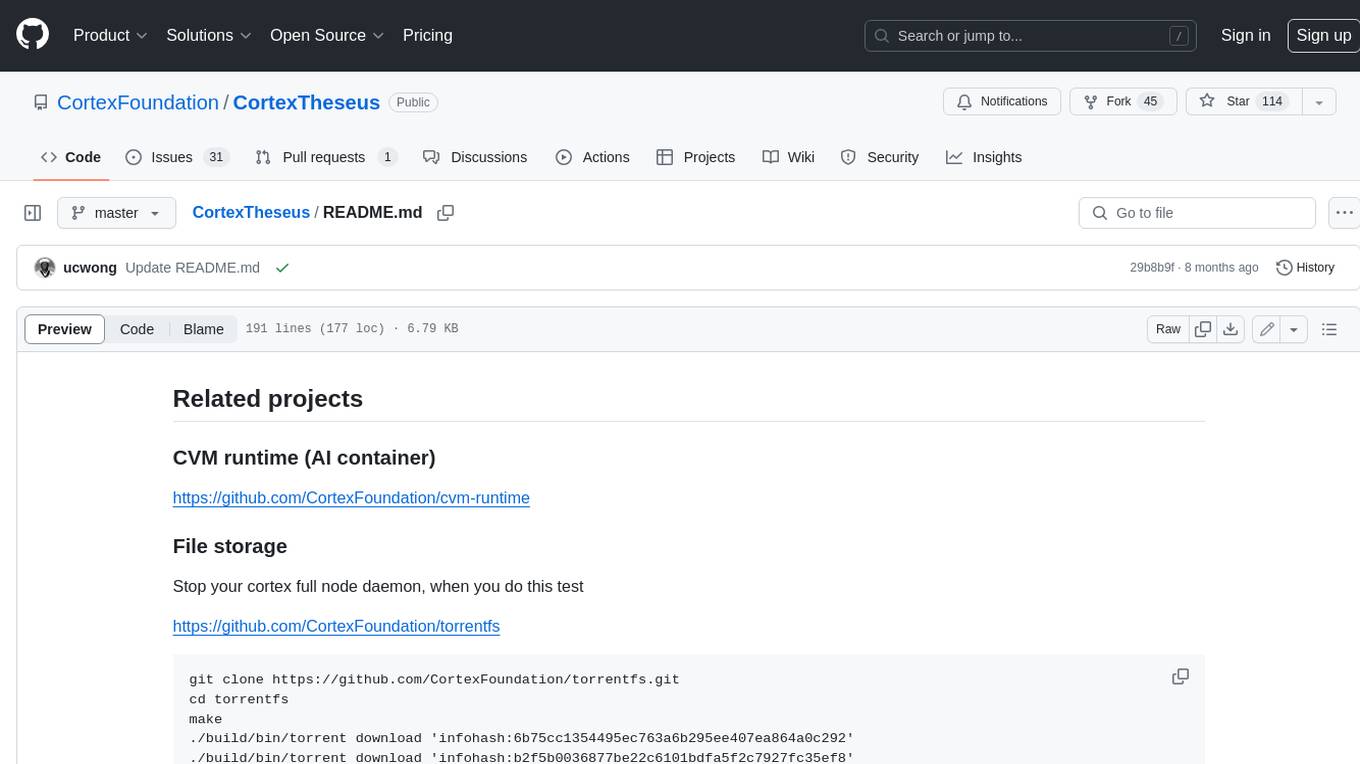
CortexTheseus
CortexTheseus is a full node implementation of the Cortex blockchain, written in C++. It provides a complete set of features for interacting with the Cortex network, including the ability to create and manage accounts, send and receive transactions, and participate in consensus. CortexTheseus is designed to be scalable, secure, and easy to use, making it an ideal choice for developers building applications on the Cortex blockchain.
CHATPGT-MEV-BOT-ETH
This tool is a bot that monitors the performance of MEV transactions on the Ethereum blockchain. It provides real-time data on MEV profitability, transaction volume, and network congestion. The bot can be used to identify profitable MEV opportunities and to track the performance of MEV strategies.
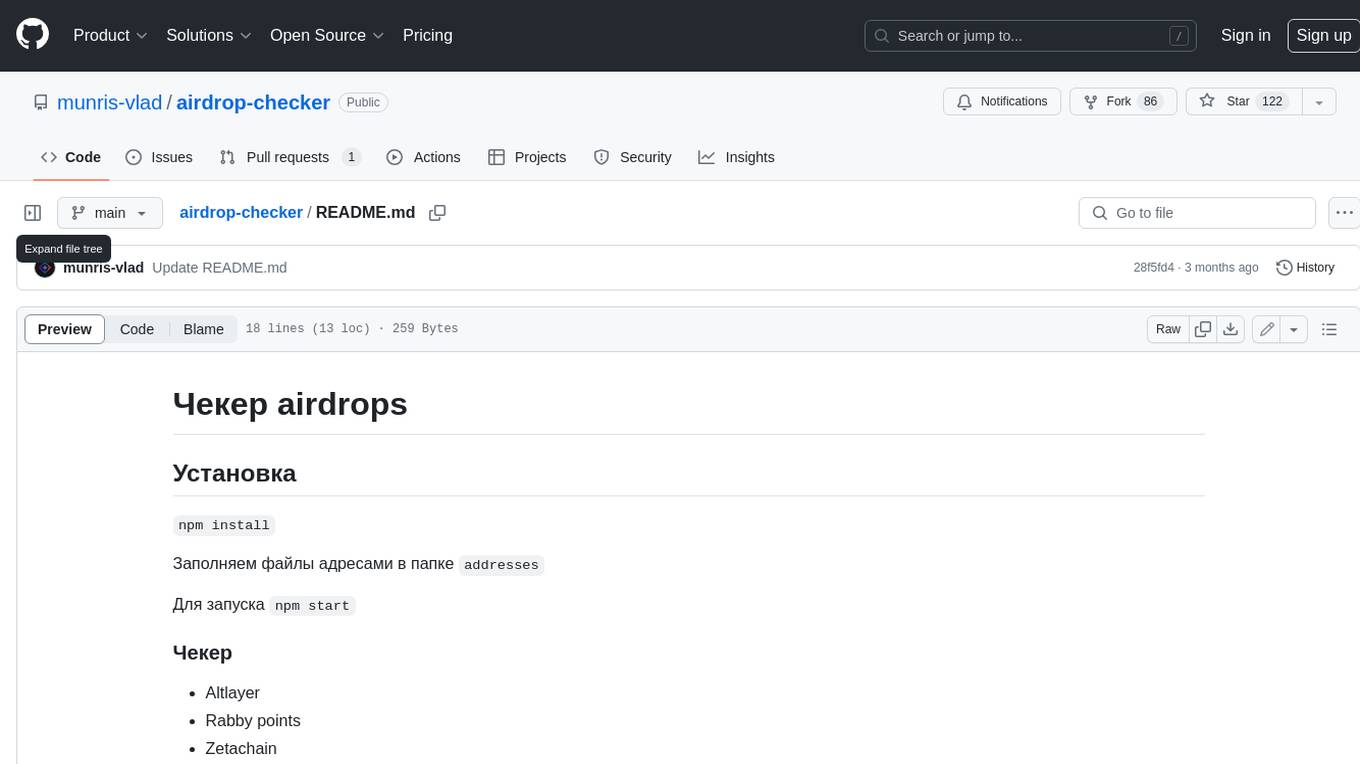
airdrop-checker
Airdrop-checker is a tool that helps you to check if you are eligible for any airdrops. It supports multiple airdrops, including Altlayer, Rabby points, Zetachain, Frame, Anoma, Dymension, and MEME. To use the tool, you need to install it using npm and then fill the addresses files in the addresses folder with your wallet addresses. Once you have done this, you can run the tool using npm start.
go-cyber
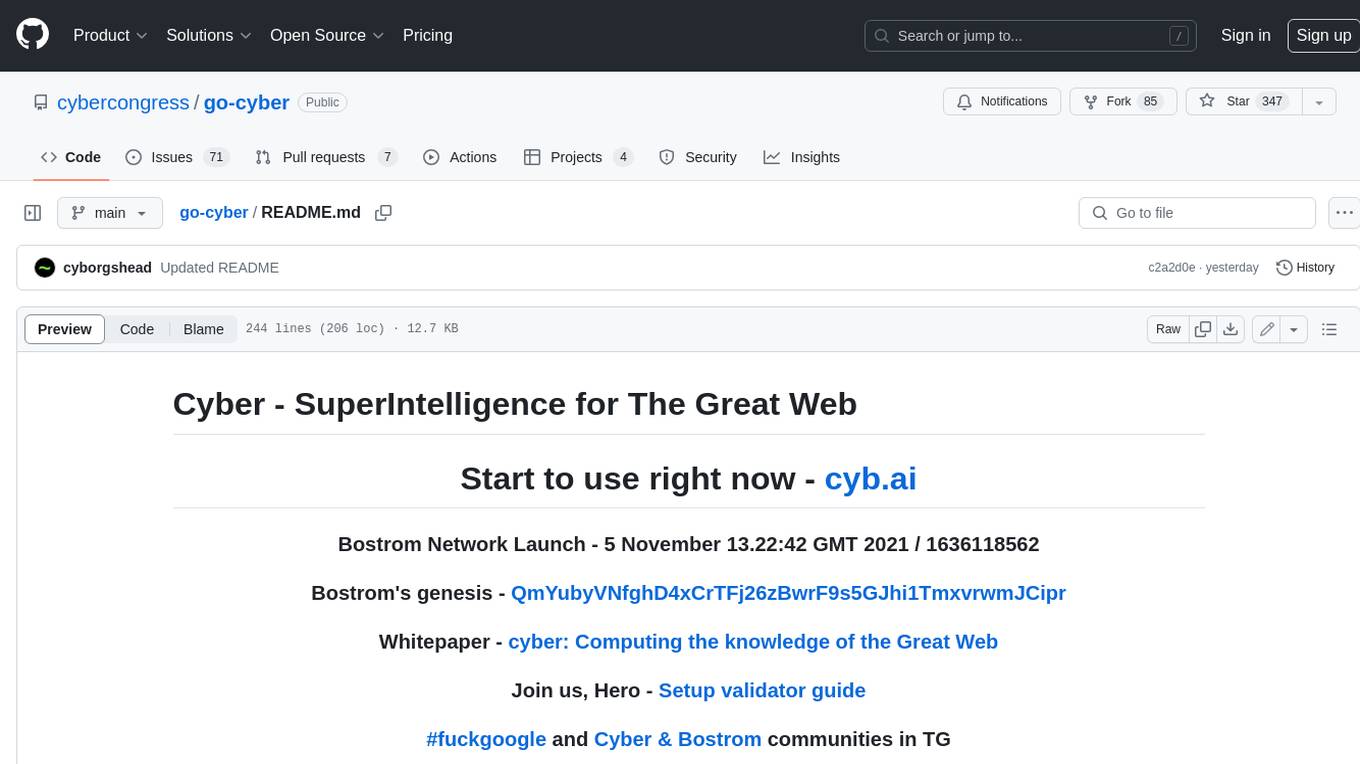
Cyber is a superintelligence protocol that aims to create a decentralized and censorship-resistant internet. It uses a novel consensus mechanism called CometBFT and a knowledge graph to store and process information. Cyber is designed to be scalable, secure, and efficient, and it has the potential to revolutionize the way we interact with the internet.
bittensor
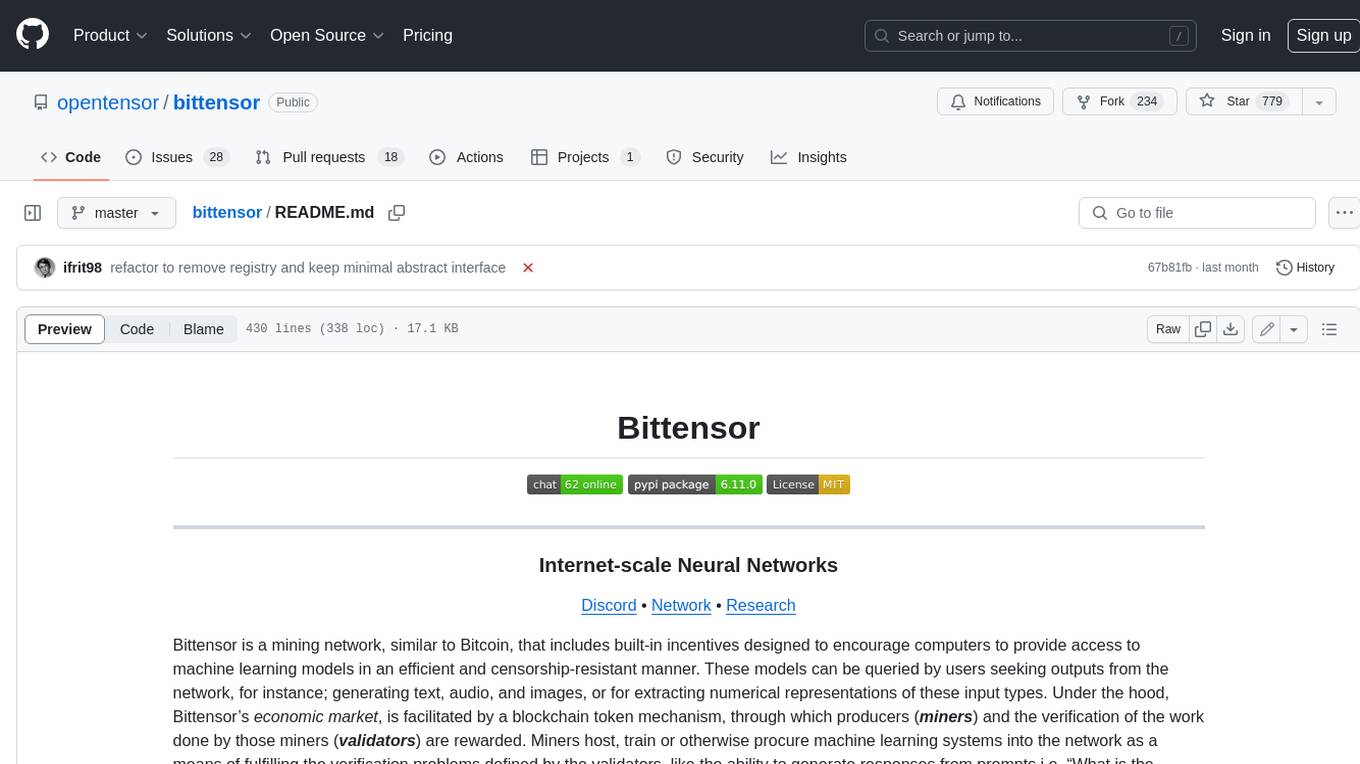
Bittensor is an internet-scale neural network that incentivizes computers to provide access to machine learning models in a decentralized and censorship-resistant manner. It operates through a token-based mechanism where miners host, train, and procure machine learning systems to fulfill verification problems defined by validators. The network rewards miners and validators for their contributions, ensuring continuous improvement in knowledge output. Bittensor allows anyone to participate, extract value, and govern the network without centralized control. It supports tasks such as generating text, audio, images, and extracting numerical representations.