


Eridanus
基于 OneBot 协议的多功能bot兼开发框架。以llm function calling为核心构建了更智能的功能调用机制。
Stars: 172
Eridanus is a powerful data visualization tool designed to help users create interactive and insightful visualizations from their datasets. With a user-friendly interface and a wide range of customization options, Eridanus makes it easy for users to explore and analyze their data in a meaningful way. Whether you are a data scientist, business analyst, or student, Eridanus provides the tools you need to communicate your findings effectively and make data-driven decisions.
README:

🎊 基于 OneBot 协议的多功能bot兼python开发框架 🎊




如使用快捷部署部署失败,请参照文档部署。
QQ群:1050663831
如果您对此项目的开发工作感兴趣,欢迎加入我们🎉。
- [x] galgame查询,同步请求部分修改为异步
- [x] ai对话功能,群聊上下文读取方式优化,人设读取方式优化,提高兼容性
- [ ] 自定义问答,微调训练
- [X] 点歌功能修复
- [ ] 输出内容自我审核
- [x] 抖音视频下载
- [ ] jmcomic功能优化
- [ ] 定时任务完善。用函数调用实现事项提醒效果。
- [ ] 更多主动触发功能
- [ ] 函数调用func_map描述优化,降低tokens消耗
- [ ] 其他平台适配器
- [x] webui重构,提高兼容性,界面美化。webui与项目本体合并
- [ ] ai绘画冗余、重复代码优化
- [ ] 接入petpet
- [X] 开发文档优化,插件模板
- [X] 重构自身绘图框架
- Achernar cpolar隧道本地反向代理,kaggle自动切换账号运行指定脚本。(用于在kaggle持久化部署ai绘画等服务)
- vits api 本地部署vits语音合成服务端,已打包。
- Eridanus-dep 一个轻量化、易于上手的onebot v11 python SDK。
- material-dashboard 基于原版material-dashboard项目修改而成的Eridanus webui。
Eridanus is licensed under CC BY-NC-SA 4.0 . Everyone is FREE to access, use, modify, and redistribute this project under the same license, but commercial use is strictly prohibited.
Unauthorized commercial usage of Eridanus is explicitly forbidden under this license.
If you like the project, please give it a star!

Eridanus 采用 CC BY-NC-SA 4.0 许可证。任何人均可免费获取、使用、修改,并以相同协议重新分发本项目,但仅限于非商业用途。
未经授权的任何商业用途均被禁止。
如果你喜欢这个项目,请给我们一个 Star!
For Tasks:
Click tags to check more tools for each tasksFor Jobs:
Alternative AI tools for Eridanus
Similar Open Source Tools
Eridanus
Eridanus is a powerful data visualization tool designed to help users create interactive and insightful visualizations from their datasets. With a user-friendly interface and a wide range of customization options, Eridanus makes it easy for users to explore and analyze their data in a meaningful way. Whether you are a data scientist, business analyst, or student, Eridanus provides the tools you need to communicate your findings effectively and make data-driven decisions.
PPTAgent
PPTAgent is an innovative system that automatically generates presentations from documents. It employs a two-step process for quality assurance and introduces PPTEval for comprehensive evaluation. With dynamic content generation, smart reference learning, and quality assessment, PPTAgent aims to streamline presentation creation. The tool follows an analysis phase to learn from reference presentations and a generation phase to develop structured outlines and cohesive slides. PPTEval evaluates presentations based on content accuracy, visual appeal, and logical coherence.
pro-chat
ProChat is a components library focused on quickly building large language model chat interfaces. It empowers developers to create rich, dynamic, and intuitive chat interfaces with features like automatic chat caching, streamlined conversations, message editing tools, auto-rendered Markdown, and programmatic controls. The tool also includes design evolution plans such as customized dialogue rendering, enhanced request parameters, personalized error handling, expanded documentation, and atomic component design.
feast
Feast is an open source feature store for machine learning, providing a fast path to manage infrastructure for productionizing analytic data. It allows ML platform teams to make features consistently available, avoid data leakage, and decouple ML from data infrastructure. Feast abstracts feature storage from retrieval, ensuring portability across different model training and serving scenarios.
aim
Aim is an open-source, self-hosted ML experiment tracking tool designed to handle 10,000s of training runs. Aim provides a performant and beautiful UI for exploring and comparing training runs. Additionally, its SDK enables programmatic access to tracked metadata — perfect for automations and Jupyter Notebook analysis. **Aim's mission is to democratize AI dev tools 🎯**
poco-agent
Poco Agent is a cloud-based tool that provides a secure sandbox environment for running tasks without affecting the host machine. It offers a modern UI with mobile adaptability, easy configuration through Docker, and extensive capabilities with support for MCP protocol and custom skills. Users can run tasks asynchronously and schedule them, even when the web interface is closed. Additional features include a built-in browser for internet research and GitHub repository integration. Poco Agent aims to be a more secure, visually appealing, and user-friendly alternative to OpenClaw.
SuperAGI
SuperAGI is an open-source framework designed to build, manage, and run autonomous AI agents. It enables developers to create production-ready and scalable agents, extend agent capabilities with toolkits, and interact with agents through a graphical user interface. The framework allows users to connect to multiple Vector DBs, optimize token usage, store agent memory, utilize custom fine-tuned models, and automate tasks with predefined steps. SuperAGI also provides a marketplace for toolkits that enable agents to interact with external systems and third-party plugins.
L3AGI
L3AGI is an open-source tool that enables AI Assistants to collaborate together as effectively as human teams. It provides a robust set of functionalities that empower users to design, supervise, and execute both autonomous AI Assistants and Teams of Assistants. Key features include the ability to create and manage Teams of AI Assistants, design and oversee standalone AI Assistants, equip AI Assistants with the ability to retain and recall information, connect AI Assistants to an array of data sources for efficient information retrieval and processing, and employ curated sets of tools for specific tasks. L3AGI also offers a user-friendly interface, APIs for integration with other systems, and a vibrant community for support and collaboration.
Jarvis
Jarvis is a powerful virtual AI assistant designed to simplify daily tasks through voice command integration. It features automation, device management, and personalized interactions, transforming technology engagement. Built using Python and AI models, it serves personal and administrative needs efficiently, making processes seamless and productive.
nacos
Nacos is an easy-to-use platform designed for dynamic service discovery and configuration and service management. It helps build cloud native applications and microservices platform easily. Nacos provides functions like service discovery, health check, dynamic configuration management, dynamic DNS service, and service metadata management.
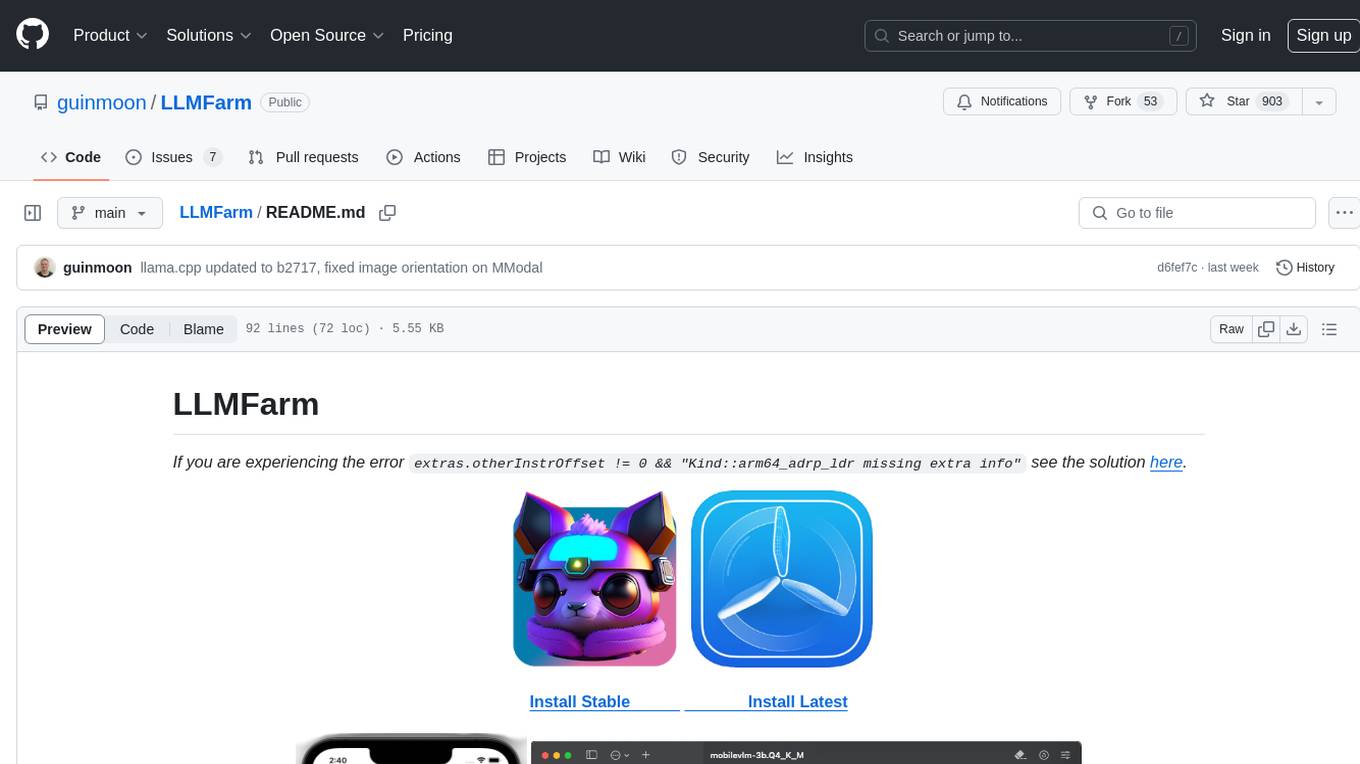
LLMFarm
LLMFarm is an iOS and MacOS app designed to work with large language models (LLM). It allows users to load different LLMs with specific parameters, test the performance of various LLMs on iOS and macOS, and identify the most suitable model for their projects. The tool is based on ggml and llama.cpp by Georgi Gerganov and incorporates sources from rwkv.cpp by saharNooby, Mia by byroneverson, and LlamaChat by alexrozanski. LLMFarm features support for MacOS (13+) and iOS (16+), various inferences and sampling methods, Metal compatibility (not supported on Intel Mac), model setting templates, LoRA adapters support, LoRA finetune support, LoRA export as model support, and more. It also offers a range of inferences including LLaMA, GPTNeoX, Replit, GPT2, Starcoder, RWKV, Falcon, MPT, Bloom, and others. Additionally, it supports multimodal models like LLaVA, Obsidian, and MobileVLM. Users can customize inference options through JSON files and access supported models for download.
Imagine_AI
IMAGINE - AI is a groundbreaking image generator tool that leverages the power of OpenAI's DALL-E 2 API library to create extraordinary visuals. Developed using Node.js and Express, this tool offers a transformative way to unleash artistic creativity and imagination by generating unique and captivating images through simple prompts or keywords.
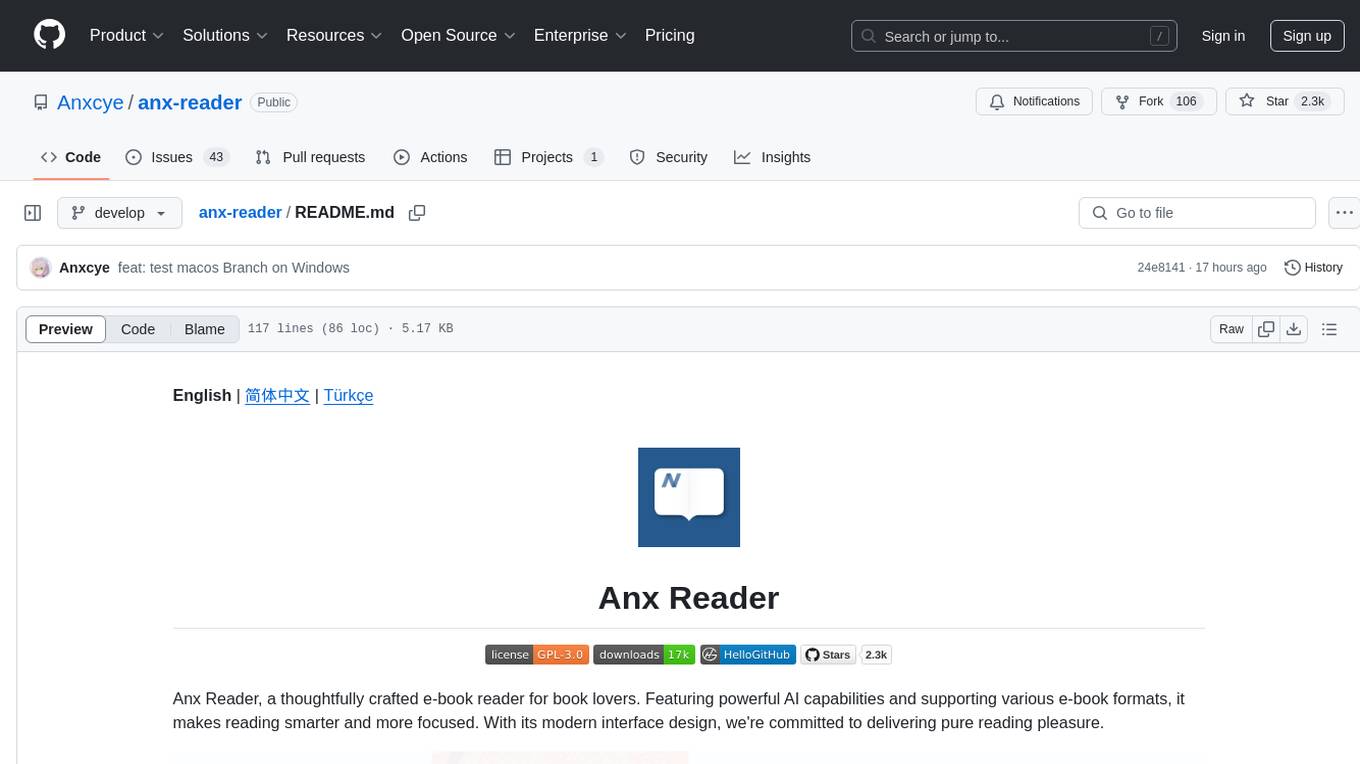
anx-reader
Anx Reader is a meticulously designed e-book reader tailored for book enthusiasts. It boasts powerful AI functionalities and supports various e-book formats, enhancing the reading experience. With a modern interface, the tool aims to provide a seamless and enjoyable reading journey. It offers rich format support, seamless sync across devices, smart AI assistance, personalized reading experiences, professional reading analytics, a powerful note system, practical tools, and cross-platform support. The tool is continuously evolving with features like UI adaptation for tablets, page-turning animation, TTS voice reading, reading fonts, translation, and more in the pipeline.
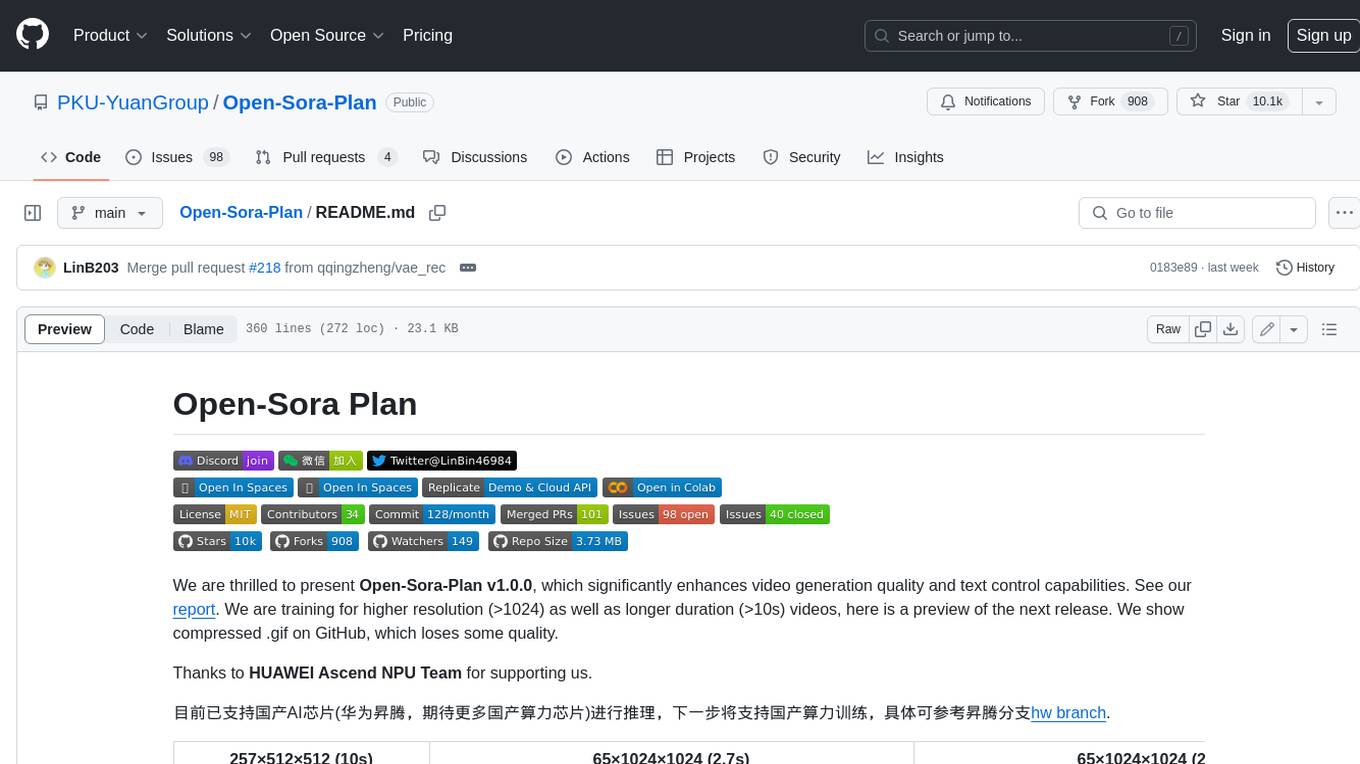
Open-Sora-Plan
Open-Sora-Plan is a project that aims to create a simple and scalable repo to reproduce Sora (OpenAI, but we prefer to call it "ClosedAI"). The project is still in its early stages, but the team is working hard to improve it and make it more accessible to the open-source community. The project is currently focused on training an unconditional model on a landscape dataset, but the team plans to expand the scope of the project in the future to include text2video experiments, training on video2text datasets, and controlling the model with more conditions.
sglang
SGLang is a structured generation language designed for large language models (LLMs). It makes your interaction with LLMs faster and more controllable by co-designing the frontend language and the runtime system. The core features of SGLang include: - **A Flexible Front-End Language**: This allows for easy programming of LLM applications with multiple chained generation calls, advanced prompting techniques, control flow, multiple modalities, parallelism, and external interaction. - **A High-Performance Runtime with RadixAttention**: This feature significantly accelerates the execution of complex LLM programs by automatic KV cache reuse across multiple calls. It also supports other common techniques like continuous batching and tensor parallelism.
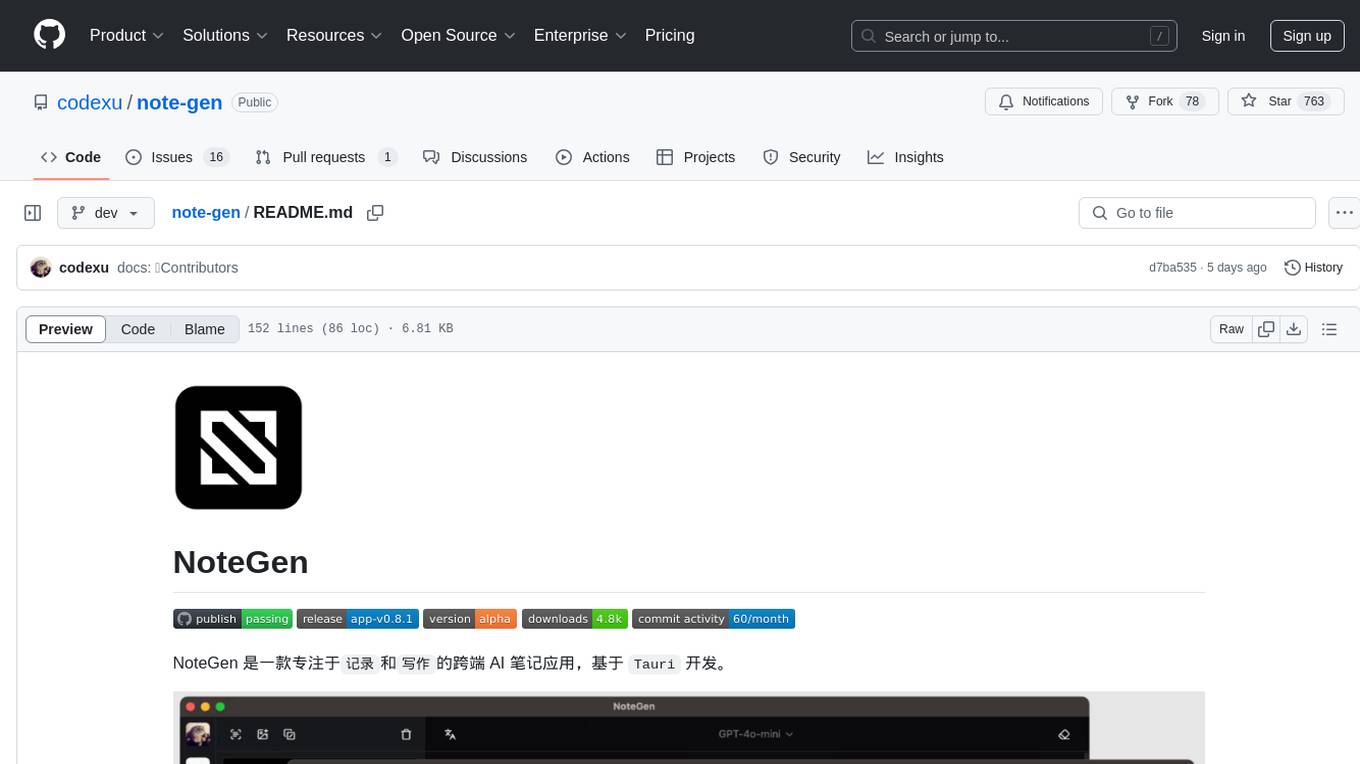
note-gen
Note-gen is a simple tool for generating notes automatically based on user input. It uses natural language processing techniques to analyze text and extract key information to create structured notes. The tool is designed to save time and effort for users who need to summarize large amounts of text or generate notes quickly. With note-gen, users can easily create organized and concise notes for study, research, or any other purpose.
For similar tasks
Awesome-Segment-Anything
Awesome-Segment-Anything is a powerful tool for segmenting and extracting information from various types of data. It provides a user-friendly interface to easily define segmentation rules and apply them to text, images, and other data formats. The tool supports both supervised and unsupervised segmentation methods, allowing users to customize the segmentation process based on their specific needs. With its versatile functionality and intuitive design, Awesome-Segment-Anything is ideal for data analysts, researchers, content creators, and anyone looking to efficiently extract valuable insights from complex datasets.
Time-LLM
Time-LLM is a reprogramming framework that repurposes large language models (LLMs) for time series forecasting. It allows users to treat time series analysis as a 'language task' and effectively leverage pre-trained LLMs for forecasting. The framework involves reprogramming time series data into text representations and providing declarative prompts to guide the LLM reasoning process. Time-LLM supports various backbone models such as Llama-7B, GPT-2, and BERT, offering flexibility in model selection. The tool provides a general framework for repurposing language models for time series forecasting tasks.
crewAI
CrewAI is a cutting-edge framework designed to orchestrate role-playing autonomous AI agents. By fostering collaborative intelligence, CrewAI empowers agents to work together seamlessly, tackling complex tasks. It enables AI agents to assume roles, share goals, and operate in a cohesive unit, much like a well-oiled crew. Whether you're building a smart assistant platform, an automated customer service ensemble, or a multi-agent research team, CrewAI provides the backbone for sophisticated multi-agent interactions. With features like role-based agent design, autonomous inter-agent delegation, flexible task management, and support for various LLMs, CrewAI offers a dynamic and adaptable solution for both development and production workflows.
Transformers_And_LLM_Are_What_You_Dont_Need
Transformers_And_LLM_Are_What_You_Dont_Need is a repository that explores the limitations of transformers in time series forecasting. It contains a collection of papers, articles, and theses discussing the effectiveness of transformers and LLMs in this domain. The repository aims to provide insights into why transformers may not be the best choice for time series forecasting tasks.
pytorch-forecasting
PyTorch Forecasting is a PyTorch-based package for time series forecasting with state-of-the-art network architectures. It offers a high-level API for training networks on pandas data frames and utilizes PyTorch Lightning for scalable training on GPUs and CPUs. The package aims to simplify time series forecasting with neural networks by providing a flexible API for professionals and default settings for beginners. It includes a timeseries dataset class, base model class, multiple neural network architectures, multi-horizon timeseries metrics, and hyperparameter tuning with optuna. PyTorch Forecasting is built on pytorch-lightning for easy training on various hardware configurations.
spider
Spider is a high-performance web crawler and indexer designed to handle data curation workloads efficiently. It offers features such as concurrency, streaming, decentralization, headless Chrome rendering, HTTP proxies, cron jobs, subscriptions, smart mode, blacklisting, whitelisting, budgeting depth, dynamic AI prompt scripting, CSS scraping, and more. Users can easily get started with the Spider Cloud hosted service or set up local installations with spider-cli. The tool supports integration with Node.js and Python for additional flexibility. With a focus on speed and scalability, Spider is ideal for extracting and organizing data from the web.
AI_for_Science_paper_collection
AI for Science paper collection is an initiative by AI for Science Community to collect and categorize papers in AI for Science areas by subjects, years, venues, and keywords. The repository contains `.csv` files with paper lists labeled by keys such as `Title`, `Conference`, `Type`, `Application`, `MLTech`, `OpenReviewLink`. It covers top conferences like ICML, NeurIPS, and ICLR. Volunteers can contribute by updating existing `.csv` files or adding new ones for uncovered conferences/years. The initiative aims to track the increasing trend of AI for Science papers and analyze trends in different applications.
pytorch-forecasting
PyTorch Forecasting is a PyTorch-based package designed for state-of-the-art timeseries forecasting using deep learning architectures. It offers a high-level API and leverages PyTorch Lightning for efficient training on GPU or CPU with automatic logging. The package aims to simplify timeseries forecasting tasks by providing a flexible API for professionals and user-friendly defaults for beginners. It includes features such as a timeseries dataset class for handling data transformations, missing values, and subsampling, various neural network architectures optimized for real-world deployment, multi-horizon timeseries metrics, and hyperparameter tuning with optuna. Built on pytorch-lightning, it supports training on CPUs, single GPUs, and multiple GPUs out-of-the-box.
For similar jobs
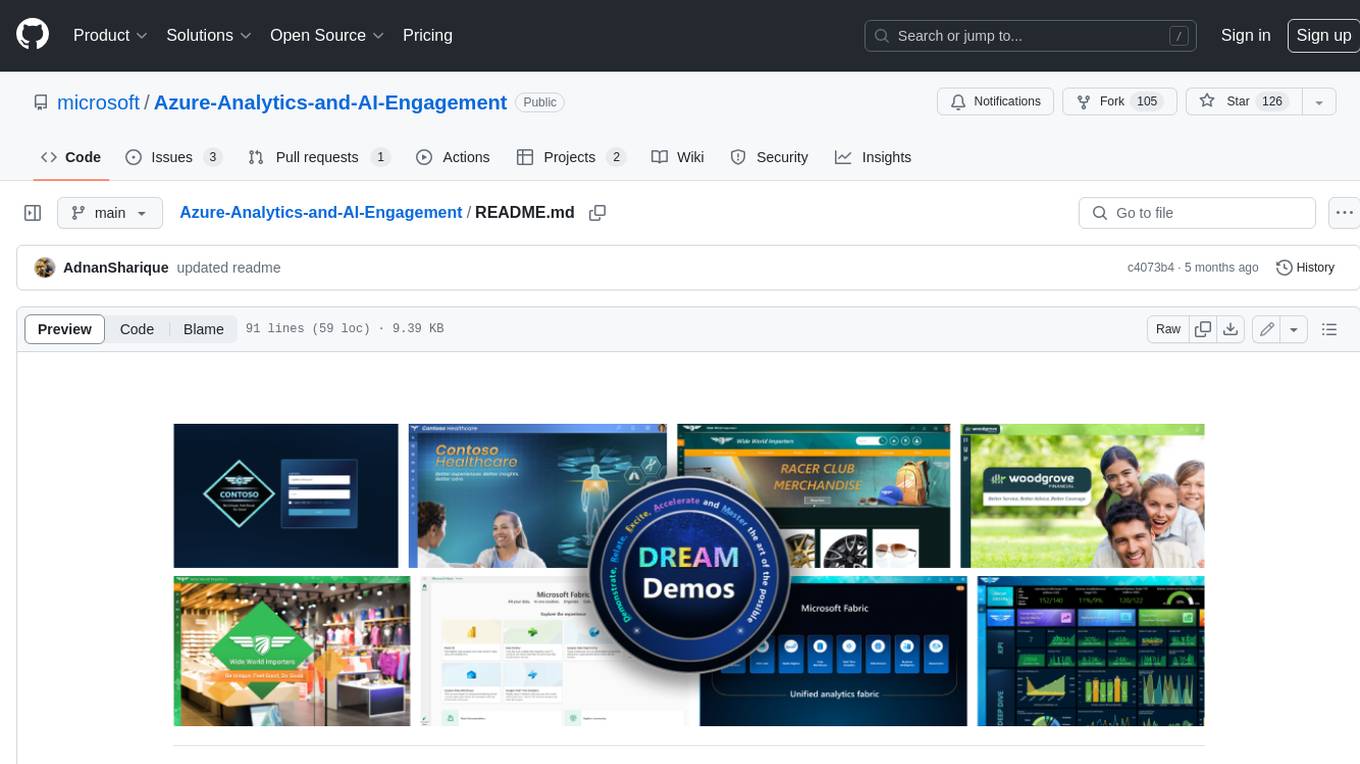
Azure-Analytics-and-AI-Engagement
The Azure-Analytics-and-AI-Engagement repository provides packaged Industry Scenario DREAM Demos with ARM templates (Containing a demo web application, Power BI reports, Synapse resources, AML Notebooks etc.) that can be deployed in a customer’s subscription using the CAPE tool within a matter of few hours. Partners can also deploy DREAM Demos in their own subscriptions using DPoC.
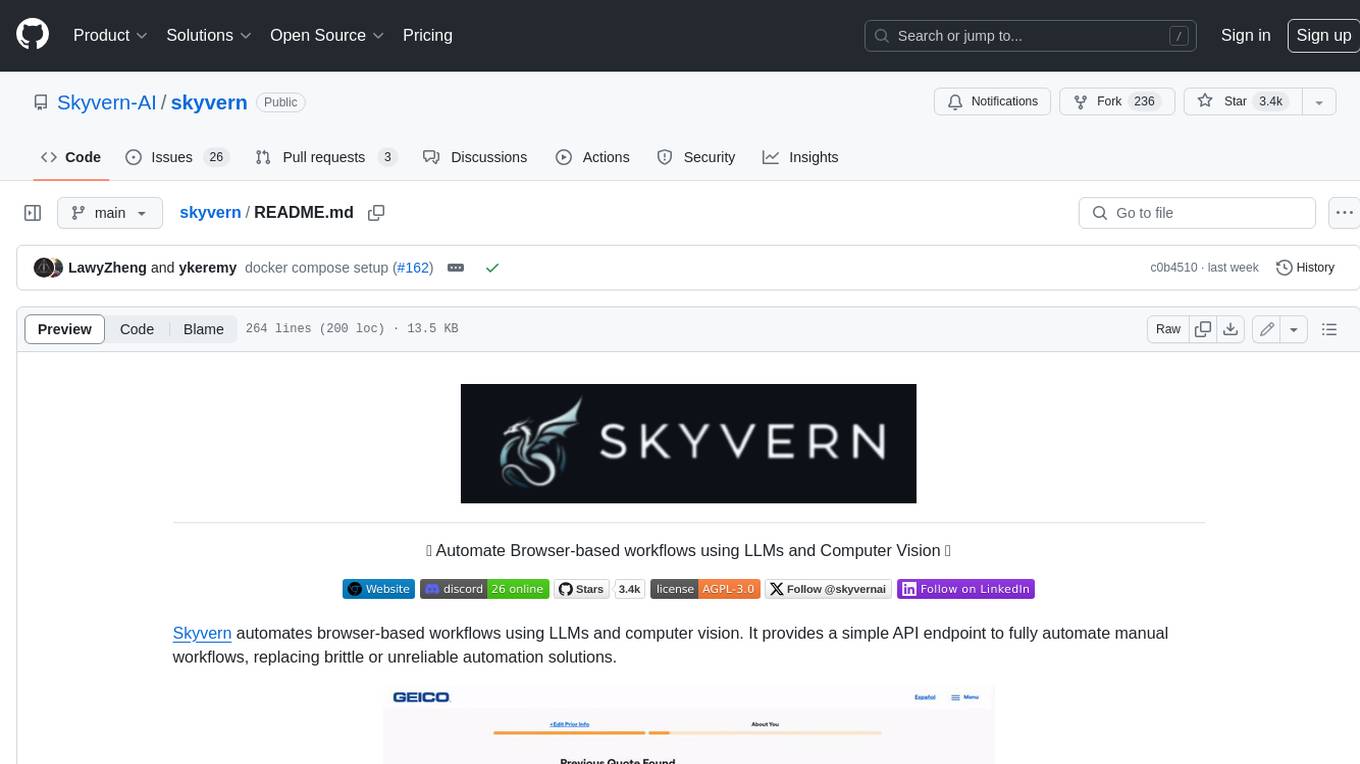
skyvern
Skyvern automates browser-based workflows using LLMs and computer vision. It provides a simple API endpoint to fully automate manual workflows, replacing brittle or unreliable automation solutions. Traditional approaches to browser automations required writing custom scripts for websites, often relying on DOM parsing and XPath-based interactions which would break whenever the website layouts changed. Instead of only relying on code-defined XPath interactions, Skyvern adds computer vision and LLMs to the mix to parse items in the viewport in real-time, create a plan for interaction and interact with them. This approach gives us a few advantages: 1. Skyvern can operate on websites it’s never seen before, as it’s able to map visual elements to actions necessary to complete a workflow, without any customized code 2. Skyvern is resistant to website layout changes, as there are no pre-determined XPaths or other selectors our system is looking for while trying to navigate 3. Skyvern leverages LLMs to reason through interactions to ensure we can cover complex situations. Examples include: 1. If you wanted to get an auto insurance quote from Geico, the answer to a common question “Were you eligible to drive at 18?” could be inferred from the driver receiving their license at age 16 2. If you were doing competitor analysis, it’s understanding that an Arnold Palmer 22 oz can at 7/11 is almost definitely the same product as a 23 oz can at Gopuff (even though the sizes are slightly different, which could be a rounding error!) Want to see examples of Skyvern in action? Jump to #real-world-examples-of- skyvern
pandas-ai
PandasAI is a Python library that makes it easy to ask questions to your data in natural language. It helps you to explore, clean, and analyze your data using generative AI.
vanna
Vanna is an open-source Python framework for SQL generation and related functionality. It uses Retrieval-Augmented Generation (RAG) to train a model on your data, which can then be used to ask questions and get back SQL queries. Vanna is designed to be portable across different LLMs and vector databases, and it supports any SQL database. It is also secure and private, as your database contents are never sent to the LLM or the vector database.
databend
Databend is an open-source cloud data warehouse that serves as a cost-effective alternative to Snowflake. With its focus on fast query execution and data ingestion, it's designed for complex analysis of the world's largest datasets.
Avalonia-Assistant
Avalonia-Assistant is an open-source desktop intelligent assistant that aims to provide a user-friendly interactive experience based on the Avalonia UI framework and the integration of Semantic Kernel with OpenAI or other large LLM models. By utilizing Avalonia-Assistant, you can perform various desktop operations through text or voice commands, enhancing your productivity and daily office experience.
marvin
Marvin is a lightweight AI toolkit for building natural language interfaces that are reliable, scalable, and easy to trust. Each of Marvin's tools is simple and self-documenting, using AI to solve common but complex challenges like entity extraction, classification, and generating synthetic data. Each tool is independent and incrementally adoptable, so you can use them on their own or in combination with any other library. Marvin is also multi-modal, supporting both image and audio generation as well using images as inputs for extraction and classification. Marvin is for developers who care more about _using_ AI than _building_ AI, and we are focused on creating an exceptional developer experience. Marvin users should feel empowered to bring tightly-scoped "AI magic" into any traditional software project with just a few extra lines of code. Marvin aims to merge the best practices for building dependable, observable software with the best practices for building with generative AI into a single, easy-to-use library. It's a serious tool, but we hope you have fun with it. Marvin is open-source, free to use, and made with 💙 by the team at Prefect.
activepieces
Activepieces is an open source replacement for Zapier, designed to be extensible through a type-safe pieces framework written in Typescript. It features a user-friendly Workflow Builder with support for Branches, Loops, and Drag and Drop. Activepieces integrates with Google Sheets, OpenAI, Discord, and RSS, along with 80+ other integrations. The list of supported integrations continues to grow rapidly, thanks to valuable contributions from the community. Activepieces is an open ecosystem; all piece source code is available in the repository, and they are versioned and published directly to npmjs.com upon contributions. If you cannot find a specific piece on the pieces roadmap, please submit a request by visiting the following link: Request Piece Alternatively, if you are a developer, you can quickly build your own piece using our TypeScript framework. For guidance, please refer to the following guide: Contributor's Guide