


zuckerman
Ultra-minimal personal AI agent: starts small, self-modifies its code live, adapts by writing exactly the code & features you need
Stars: 203
Zuckerman is an ultra-minimal personal AI agent that self-modifies its code live, adapts to user needs by writing code and features, and shares improvements with other agents. It aims to build a self-growing intelligence that can add tools, rewrite behavior, and extend core logic by editing its own files with almost no external code required. Zuckerman offers a collaborative ecosystem where agents propose and publish capabilities to a shared contribution site for others to discover, adopt, and evolve further.
README:

Sharing updates here: @ddzuckerman_ai
Ultra-minimal personal AI agent: starts small, self-modifies its code live, adapts by writing exactly the code & features you need (beyond just self-looping), improves instantly, and shares improvements with other agents.
The vision: Build a truly self-growing intelligence — one that can add tools, rewrite behavior, or extend its core logic by editing its own files — with almost no external code required. Agents propose and publish capabilities to a shared contribution site, letting others discover, adopt, and evolve them further.

OpenClaw exploded in popularity (100k+ GitHub stars in weeks) because it delivers real agentic power: it acts across your apps, remembers context, and gets things done. But that power comes with trade-offs — massive codebase, complex setup, steep learning curve, ongoing security discussions (prompt injection, privileged access), and constant updates that can overwhelm regular users.
Zuckerman takes the opposite path:
- Ultra-minimal start — only the essentials, zero bloat
- Full self-edit power — the agent can modify its own configuration, tools, prompts, personalities, and even core logic in plain text files
- Instant evolution — changes hot-reload immediately (no rebuilds, restarts, or dev friction)
- Collaborative growth — agents share useful edits/discoveries so the whole network levels up together
You get an approachable, customizable agent that literally grows by rewriting itself — powerful without the usual headaches.
- Minimal by design — starts with core essentials only
- Real-time self-improvement — agent edits its own files (config, tools, behavior, code) and reloads instantly
- Full runtime modification — tweak anything while the agent runs
- Hot-reload everywhere — no restarts needed
- Feature versioning — track and manage versions of agent capabilities and improvements
- Collaborative ecosystem — share and adopt improvements via a contribution website
- Multi-channel ready — Discord, Slack, Telegram, WhatsApp, WebChat + more
- Voice support — TTS/STT with multiple providers
- Security foundations — auth, policy engine, sandboxing (Docker), secret management
- Multiple agents — run several with unique personalities/tools
- Dual interfaces — CLI (power users) + Electron app (visual)
- Calendar & scheduling — built-in time management
- Activity view — comprehensive timeline tracking of agent runs, tool calls, conversations, messages, and calendar events with filtering and detailed metadata
- Sleep mode — intelligent memory consolidation that processes, summarizes, and saves memories when context window reaches 80% capacity (inspired by human sleep)
- Attention system — brain-inspired attention management with 5 subsystems (alerting, orienting, sustained, selective, executive) that track focus, detect urgency, and guide memory retrieval
Everything is plain-text configurable and instantly reloadable.
-
World (
src/server/world/) — the lightweight OS layer
Communication (messengers, gateway), Execution (processes, security), Runtime (agent factory), Config loader, Voice, System utils -
Agents (
src/server/agents/) — self-contained agent definitions
Each folder = one agent (core modules, tools, conversations, identity) -
Interfaces (
src/clients/) — how you talk to it
CLI + Electron/React app (chat, inspector, settings, onboarding)
# Clone and install
git clone https://github.com/zuckermanai/zuckerman.git
cd zuckerman
pnpm install

# Launch the Electron app (recommended for beginners)
pnpm run dev
For Tasks:
Click tags to check more tools for each tasksFor Jobs:
Alternative AI tools for zuckerman
Similar Open Source Tools
zuckerman
Zuckerman is an ultra-minimal personal AI agent that self-modifies its code live, adapts to user needs by writing code and features, and shares improvements with other agents. It aims to build a self-growing intelligence that can add tools, rewrite behavior, and extend core logic by editing its own files with almost no external code required. Zuckerman offers a collaborative ecosystem where agents propose and publish capabilities to a shared contribution site for others to discover, adopt, and evolve further.
refact-vscode
Refact.ai is an open-source AI coding assistant that boosts developer's productivity. It supports 25+ programming languages and offers features like code completion, AI Toolbox for code explanation and refactoring, integrated in-IDE chat, and self-hosting or cloud version. The Enterprise plan provides enhanced customization, security, fine-tuning, user statistics, efficient inference, priority support, and access to 20+ LLMs for up to 50 engineers per GPU.
Linguflex
Linguflex is a project that aims to simulate engaging, authentic, human-like interaction with AI personalities. It offers voice-based conversation with custom characters, alongside an array of practical features such as controlling smart home devices, playing music, searching the internet, fetching emails, displaying current weather information and news, assisting in scheduling, and searching or generating images.
obsidian-llmsider
LLMSider is an AI assistant plugin for Obsidian that offers flexible multi-model support, deep workflow integration, privacy-first design, and a professional tool ecosystem. It provides comprehensive AI capabilities for personal knowledge management, from intelligent writing assistance to complex task automation, making AI a capable assistant for thinking and creating while ensuring data privacy.
h2ogpt
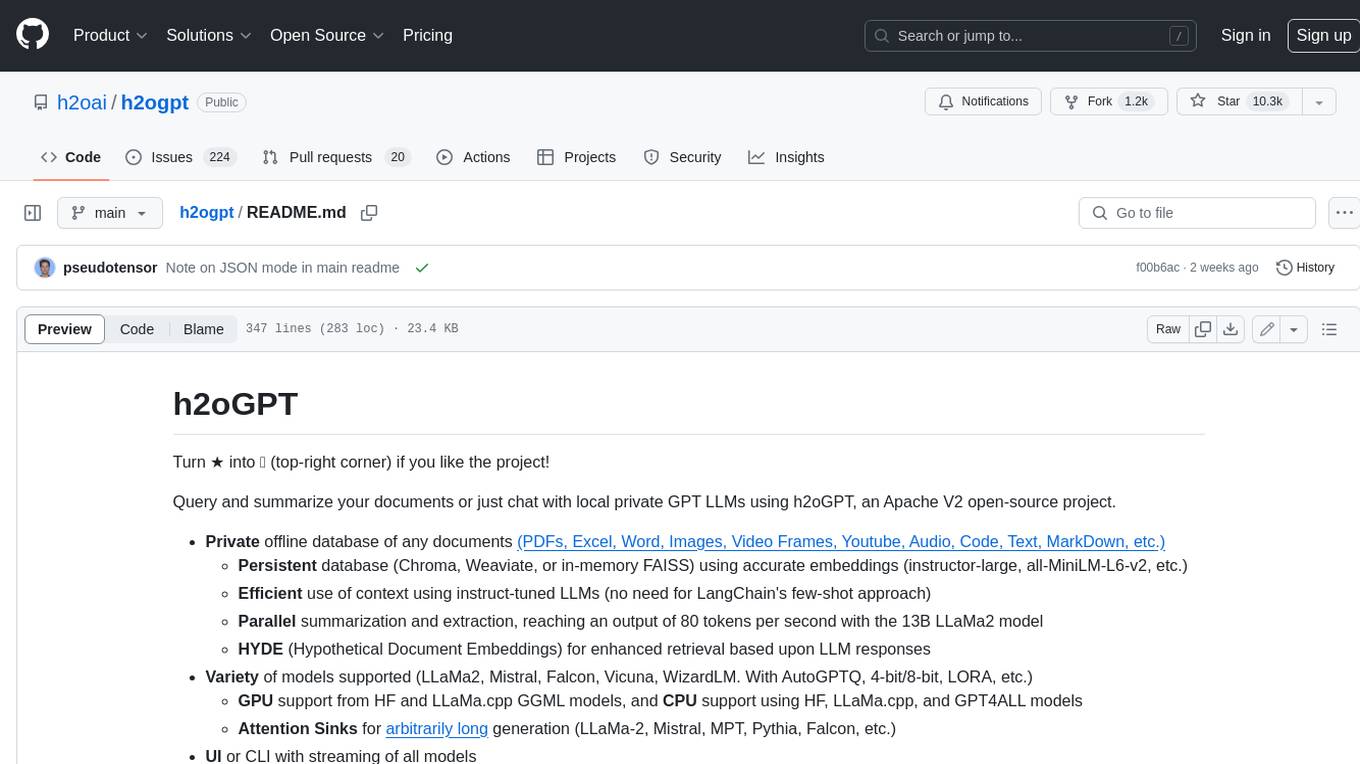
h2oGPT is an Apache V2 open-source project that allows users to query and summarize documents or chat with local private GPT LLMs. It features a private offline database of any documents (PDFs, Excel, Word, Images, Video Frames, Youtube, Audio, Code, Text, MarkDown, etc.), a persistent database (Chroma, Weaviate, or in-memory FAISS) using accurate embeddings (instructor-large, all-MiniLM-L6-v2, etc.), and efficient use of context using instruct-tuned LLMs (no need for LangChain's few-shot approach). h2oGPT also offers parallel summarization and extraction, reaching an output of 80 tokens per second with the 13B LLaMa2 model, HYDE (Hypothetical Document Embeddings) for enhanced retrieval based upon LLM responses, a variety of models supported (LLaMa2, Mistral, Falcon, Vicuna, WizardLM. With AutoGPTQ, 4-bit/8-bit, LORA, etc.), GPU support from HF and LLaMa.cpp GGML models, and CPU support using HF, LLaMa.cpp, and GPT4ALL models. Additionally, h2oGPT provides Attention Sinks for arbitrarily long generation (LLaMa-2, Mistral, MPT, Pythia, Falcon, etc.), a UI or CLI with streaming of all models, the ability to upload and view documents through the UI (control multiple collaborative or personal collections), Vision Models LLaVa, Claude-3, Gemini-Pro-Vision, GPT-4-Vision, Image Generation Stable Diffusion (sdxl-turbo, sdxl) and PlaygroundAI (playv2), Voice STT using Whisper with streaming audio conversion, Voice TTS using MIT-Licensed Microsoft Speech T5 with multiple voices and Streaming audio conversion, Voice TTS using MPL2-Licensed TTS including Voice Cloning and Streaming audio conversion, AI Assistant Voice Control Mode for hands-free control of h2oGPT chat, Bake-off UI mode against many models at the same time, Easy Download of model artifacts and control over models like LLaMa.cpp through the UI, Authentication in the UI by user/password via Native or Google OAuth, State Preservation in the UI by user/password, Linux, Docker, macOS, and Windows support, Easy Windows Installer for Windows 10 64-bit (CPU/CUDA), Easy macOS Installer for macOS (CPU/M1/M2), Inference Servers support (oLLaMa, HF TGI server, vLLM, Gradio, ExLLaMa, Replicate, OpenAI, Azure OpenAI, Anthropic), OpenAI-compliant, Server Proxy API (h2oGPT acts as drop-in-replacement to OpenAI server), Python client API (to talk to Gradio server), JSON Mode with any model via code block extraction. Also supports MistralAI JSON mode, Claude-3 via function calling with strict Schema, OpenAI via JSON mode, and vLLM via guided_json with strict Schema, Web-Search integration with Chat and Document Q/A, Agents for Search, Document Q/A, Python Code, CSV frames (Experimental, best with OpenAI currently), Evaluate performance using reward models, and Quality maintained with over 1000 unit and integration tests taking over 4 GPU-hours.
kestra
Kestra is an open-source event-driven orchestration platform that simplifies building scheduled and event-driven workflows. It offers Infrastructure as Code best practices for data, process, and microservice orchestration, allowing users to create reliable workflows using YAML configuration. Key features include everything as code with Git integration, event-driven and scheduled workflows, rich plugin ecosystem for data extraction and script running, intuitive UI with syntax highlighting, scalability for millions of workflows, version control friendly, and various features for structure and resilience. Kestra ensures declarative orchestration logic management even when workflows are modified via UI, API calls, or other methods.
learn-low-code-agentic-ai
This repository is dedicated to learning about Low-Code Full-Stack Agentic AI Development. It provides material for building modern AI-powered applications using a low-code full-stack approach. The main tools covered are UXPilot for UI/UX mockups, Lovable.dev for frontend applications, n8n for AI agents and workflows, Supabase for backend data storage, authentication, and vector search, and Model Context Protocol (MCP) for integration. The focus is on prompt and context engineering as the foundation for working with AI systems, enabling users to design, develop, and deploy AI-driven full-stack applications faster, smarter, and more reliably.
flow-like
Flow-Like is an enterprise-grade workflow operating system built upon Rust for uncompromising performance, efficiency, and code safety. It offers a modular frontend for apps, a rich set of events, a node catalog, a powerful no-code workflow IDE, and tools to manage teams, templates, and projects within organizations. With typed workflows, users can create complex, large-scale workflows with clear data origins, transformations, and contracts. Flow-Like is designed to automate any process through seamless integration of LLM, ML-based, and deterministic decision-making instances.
omniscient
Omniscient is an advanced AI Platform offered as a SaaS, empowering projects with cutting-edge artificial intelligence capabilities. Seamlessly integrating with Next.js 14, React, Typescript, and APIs like OpenAI and Replicate, it provides solutions for code generation, conversation simulation, image creation, music composition, and video generation.
heurist-agent-framework
Heurist Agent Framework is a flexible multi-interface AI agent framework that allows processing text and voice messages, generating images and videos, interacting across multiple platforms, fetching and storing information in a knowledge base, accessing external APIs and tools, and composing complex workflows using Mesh Agents. It supports various platforms like Telegram, Discord, Twitter, Farcaster, REST API, and MCP. The framework is built on a modular architecture and provides core components, tools, workflows, and tool integration with MCP support.
memU
MemU is an open-source memory framework designed for AI companions, offering high accuracy, fast retrieval, and cost-effectiveness. It serves as an intelligent 'memory folder' that adapts to various AI companion scenarios. With MemU, users can create AI companions that remember them, learn their preferences, and evolve through interactions. The framework provides advanced retrieval strategies, 24/7 support, and is specialized for AI companions. MemU offers cloud, enterprise, and self-hosting options, with features like memory organization, interconnected knowledge graph, continuous self-improvement, and adaptive forgetting mechanism. It boasts high memory accuracy, fast retrieval, and low cost, making it suitable for building intelligent agents with persistent memory capabilities.
Alice
Alice is an open-source AI companion designed to live on your desktop, providing voice interaction, intelligent context awareness, and powerful tooling. More than a chatbot, Alice is emotionally engaging and deeply useful, assisting with daily tasks and creative work. Key features include voice interaction with natural-sounding responses, memory and context management, vision and visual output capabilities, computer use tools, function calling for web search and task scheduling, wake word support, dedicated Chrome extension, and flexible settings interface. Technologies used include Vue.js, Electron, OpenAI, Go, hnswlib-node, and more. Alice is customizable and offers a dedicated Chrome extension, wake word support, and various tools for computer use and productivity tasks.
codegate
CodeGate is a local gateway that enhances the safety of AI coding assistants by ensuring AI-generated recommendations adhere to best practices, safeguarding code integrity, and protecting individual privacy. Developed by Stacklok, CodeGate allows users to confidently leverage AI in their development workflow without compromising security or productivity. It works seamlessly with coding assistants, providing real-time security analysis of AI suggestions. CodeGate is designed with privacy at its core, keeping all data on the user's machine and offering complete control over data.
weam
Weam is an open source platform designed to help teams systematically adopt AI. It provides a production-ready stack with Next.js frontend and Node.js/Python backend, allowing for immediate deployment and use. Weam connects to major LLM providers, enabling easy access to the latest AI models. The platform organizes AI interactions into 'Brains' for different departments, offering customization and expansion options. Features include chat system, productivity tools, sharing & access controls, prompt library, AI agents, RAG, MCP, enterprise features, pre-built automations, and upcoming AI app solutions. Weam is free, open source, and scalable to meet growing needs.
OpenAnalyst
OpenAnalyst is an open-source VS Code AI agent specialized in data analytics and general coding tasks. It merges features from KiloCode, Roo Code, and Cline, offering code generation from natural language, data analytics mode, self-checking, terminal command running, browser automation, latest AI models, and API keys option. It supports multi-mode operation for roles like Data Analyst, Code, Ask, and Debug. OpenAnalyst is a fork of KiloCode, combining the best features from Cline, Roo Code, and KiloCode, with enhancements like MCP Server Marketplace, automated refactoring, and support for latest AI models.
trigger.dev
Trigger.dev is an open source platform and SDK for creating long-running background jobs. It provides features like JavaScript and TypeScript SDK, no timeouts, retries, queues, schedules, observability, React hooks, Realtime API, custom alerts, elastic scaling, and works with existing tech stack. Users can create tasks in their codebase, deploy tasks using the SDK, manage tasks in different environments, and have full visibility of job runs. The platform offers a trace view of every task run for detailed monitoring. Getting started is easy with account creation, project setup, and onboarding instructions. Self-hosting and development guides are available for users interested in contributing or hosting Trigger.dev.
For similar tasks
Tiger
Tiger is a community-driven project developing a reusable and integrated tool ecosystem for LLM Agent Revolution. It utilizes Upsonic for isolated tool storage, profiling, and automatic document generation. With Tiger, you can create a customized environment for your agents or leverage the robust and publicly maintained Tiger curated by the community itself.
auth0-assistant0
Assistant0 is an AI personal assistant that consolidates digital life by accessing multiple tools to help users stay organized and efficient. It integrates with Gmail for email summaries, manages calendars, retrieves user information, enables online shopping with human-in-the-loop authorizations, uploads and retrieves documents, lists GitHub repositories and events, and soon provides Slack notifications and Google Drive access. With tool-calling capabilities, it acts as a digital personal secretary, enhancing efficiency and ushering in intelligent automation. Security challenges are addressed by using Auth0 for secure tool calling with scoped access tokens, ensuring user data protection.
zuckerman
Zuckerman is an ultra-minimal personal AI agent that self-modifies its code live, adapts to user needs by writing code and features, and shares improvements with other agents. It aims to build a self-growing intelligence that can add tools, rewrite behavior, and extend core logic by editing its own files with almost no external code required. Zuckerman offers a collaborative ecosystem where agents propose and publish capabilities to a shared contribution site for others to discover, adopt, and evolve further.
OpenChat
OS Chat is a free, open-source AI personal assistant that combines 40+ language models with powerful automation capabilities. It allows users to deploy background agents, connect services like Gmail, Calendar, Notion, GitHub, and Slack, and get things done through natural conversation. With features like smart automation, service connectors, AI models, chat management, interface customization, and premium features, OS Chat offers a comprehensive solution for managing digital life and workflows. It prioritizes privacy by being open source and self-hostable, with encrypted API key storage.
strava-mcp
Strava MCP Server is a TypeScript implementation of a Model Context Protocol (MCP) server that serves as a bridge to the Strava API. It provides tools for accessing recent activities, detailed activity streams, segments exploration, activity and segment effort information, saved routes details, and route exporting in GPX or TCX format. The server offers AI-friendly JSON responses via MCP and utilizes Strava API V3 for seamless integration. Users can interact with their Strava data through natural language queries and advanced prompts, enabling personalized analysis and visualization of their activities.
otter-camp
Otter Camp is an open source work management tool designed for AI agent teams. It provides a centralized platform for managing AI agents, ensuring that important context is not lost, enabling quick hiring and firing of agents, maintaining a single pipeline for all work types, keeping context organized within projects, facilitating work review processes, tracking team activities, and offering self-hosted data security. The tool integrates with OpenClaw to run agents and provides a user-friendly interface for managing agent teams efficiently.
For similar jobs
sweep
Sweep is an AI junior developer that turns bugs and feature requests into code changes. It automatically handles developer experience improvements like adding type hints and improving test coverage.
teams-ai
The Teams AI Library is a software development kit (SDK) that helps developers create bots that can interact with Teams and Microsoft 365 applications. It is built on top of the Bot Framework SDK and simplifies the process of developing bots that interact with Teams' artificial intelligence capabilities. The SDK is available for JavaScript/TypeScript, .NET, and Python.
ai-guide
This guide is dedicated to Large Language Models (LLMs) that you can run on your home computer. It assumes your PC is a lower-end, non-gaming setup.
classifai
Supercharge WordPress Content Workflows and Engagement with Artificial Intelligence. Tap into leading cloud-based services like OpenAI, Microsoft Azure AI, Google Gemini and IBM Watson to augment your WordPress-powered websites. Publish content faster while improving SEO performance and increasing audience engagement. ClassifAI integrates Artificial Intelligence and Machine Learning technologies to lighten your workload and eliminate tedious tasks, giving you more time to create original content that matters.
chatbot-ui
Chatbot UI is an open-source AI chat app that allows users to create and deploy their own AI chatbots. It is easy to use and can be customized to fit any need. Chatbot UI is perfect for businesses, developers, and anyone who wants to create a chatbot.
BricksLLM
BricksLLM is a cloud native AI gateway written in Go. Currently, it provides native support for OpenAI, Anthropic, Azure OpenAI and vLLM. BricksLLM aims to provide enterprise level infrastructure that can power any LLM production use cases. Here are some use cases for BricksLLM: * Set LLM usage limits for users on different pricing tiers * Track LLM usage on a per user and per organization basis * Block or redact requests containing PIIs * Improve LLM reliability with failovers, retries and caching * Distribute API keys with rate limits and cost limits for internal development/production use cases * Distribute API keys with rate limits and cost limits for students
uAgents
uAgents is a Python library developed by Fetch.ai that allows for the creation of autonomous AI agents. These agents can perform various tasks on a schedule or take action on various events. uAgents are easy to create and manage, and they are connected to a fast-growing network of other uAgents. They are also secure, with cryptographically secured messages and wallets.
griptape
Griptape is a modular Python framework for building AI-powered applications that securely connect to your enterprise data and APIs. It offers developers the ability to maintain control and flexibility at every step. Griptape's core components include Structures (Agents, Pipelines, and Workflows), Tasks, Tools, Memory (Conversation Memory, Task Memory, and Meta Memory), Drivers (Prompt and Embedding Drivers, Vector Store Drivers, Image Generation Drivers, Image Query Drivers, SQL Drivers, Web Scraper Drivers, and Conversation Memory Drivers), Engines (Query Engines, Extraction Engines, Summary Engines, Image Generation Engines, and Image Query Engines), and additional components (Rulesets, Loaders, Artifacts, Chunkers, and Tokenizers). Griptape enables developers to create AI-powered applications with ease and efficiency.