


Linguflex
Personal Assistant that enables voice-based conversation with custom AI personalities. Handles smart home control and music playback. Efficiently conducts Internet searches, retrieves emails, and presents weather updates and news. Assists with scheduling appointments. Capable of image search and generation.
Stars: 125
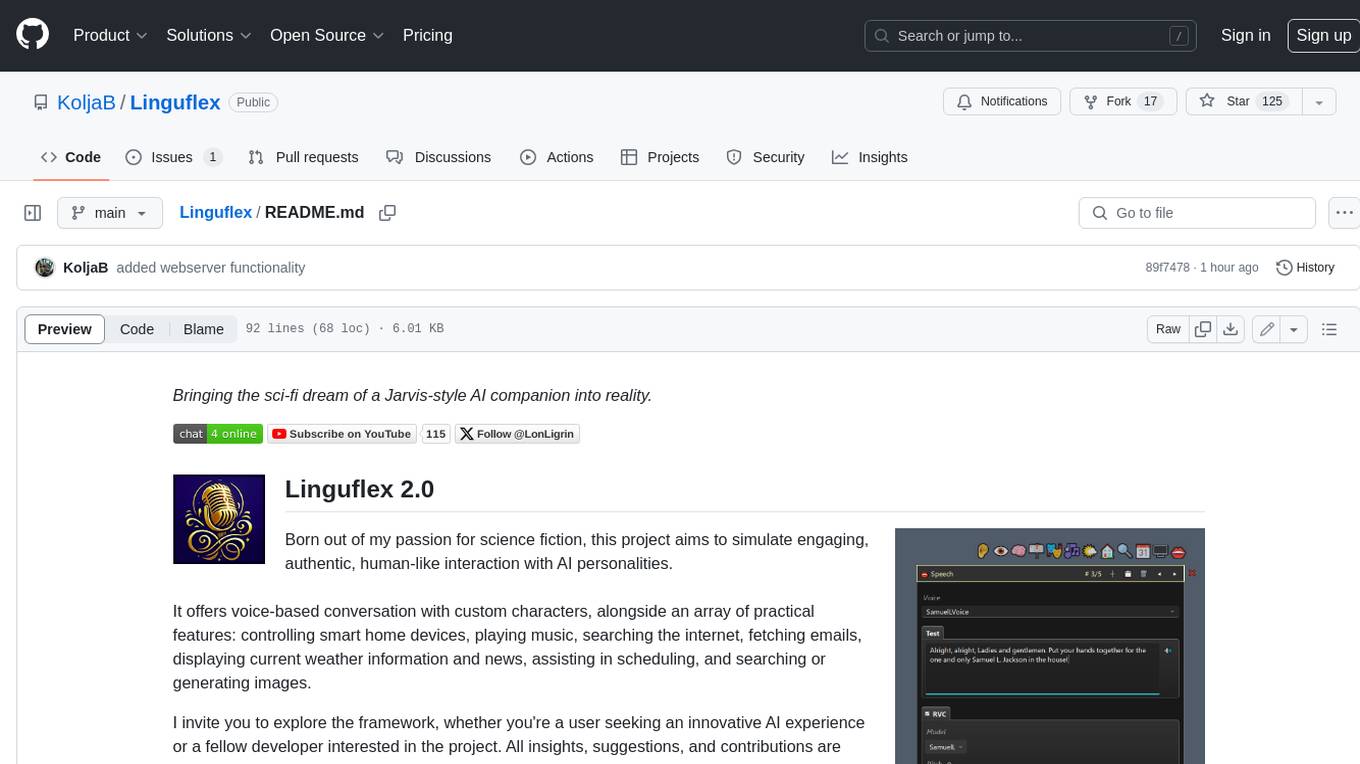
Linguflex is a project that aims to simulate engaging, authentic, human-like interaction with AI personalities. It offers voice-based conversation with custom characters, alongside an array of practical features such as controlling smart home devices, playing music, searching the internet, fetching emails, displaying current weather information and news, assisting in scheduling, and searching or generating images.
README:
Bringing the sci-fi dream of a Jarvis-style AI companion into reality.



It offers voice-based conversation with custom characters, alongside an array of practical features: controlling smart home devices, playing music, searching the internet, fetching emails, displaying current weather information and news, assisting in scheduling, and searching or generating images.
I invite you to explore the framework, whether you're a user seeking an innovative AI experience or a fellow developer interested in the project. All insights, suggestions, and contributions are appreciated. I want to bring this personal passion project towards its full potential, hopefully with the community's assistance, to collectively contribute to the evolution of AI.
📓 Linguflex 2.0 installation
🎥 Installation video guide
🎥 See in action (short clip)
- Ultra-Low Latency: Every aspect of Linguflex was fine-tuned to minimize response times, achieving unparalleled speed in both language model communication and text-to-speech (TTS) generation.
- Local Operation: Full functionality is maintained locally, encompassing speech-to-text, TTS, and language model inference, ensuring privacy and reliability.
- High-Quality Audio: Integrating advanced voice clone technology for real-time post-processing, Linguflex offers a near-Elevenlabs quality in local TTS synthesis.
- Enhanced Functionality: Streamlined function selection allows Linguflex to quickly adapt and respond to a wide range of text-based commands and queries.
- Developer-Friendly: Building new modules is more intuitive and efficient, thanks to the minimalistic and clear coding framework.
- Listen (Audio Input Module): Serving as Linguflex's auditory system, this module captures spoken instructions via the microphone with precision.
- Brain: Cognitive Processing Module. Heart of Linguflex, processes user input, either with a local language model or OpenAI GPT API.
- Speech (Audio Output Module): Offers realtime TTS with various provider options, and advanced voice tuning capabilities, including Realtime Voice Cloning (RVC).
- Mimic: This creative tool allows users to design custom AI characters, assign unique voices created with the Speech module, and switch between them.
- Music: A voice-command module for playing selected songs or albums, enhancing the user experience with musical integration.
- Mail: Retrieves emails via IMAP, integrating with your digital correspondence.
- Weather: Provides current weather data and forecasts, adapting to your location.
- House: Smart Home control for Tuya-compatible devices, enhancing your living experience.
- Calendar: Manages personal calendars and appointments, including Google Calendar integration.
- Search: Performs text and image searches using the Google Search API.
- See: Empower the assistant with visual capabilities using the GPT Vision API. Enables processing of webcam pictures and desktop screenshots.
- Memory: Stores and retrieves JSON-translatable data.
- News: Delivers compact summaries of current news.
- Finance: Offers financial management integrating various financial APIs for real-time tracking of investments.
- Create: Image generation using DALL-E API, turning text prompts into vivid images.
Follow the Modules Guide for step-by-step instructions about how to set up and configure the Linguflex modules.
The codebase is under MIT License and the TTS model weights are under the individual TTS engine licenses listed below:
- License: Open-source only for noncommercial projects.
- Commercial Use: Requires a paid plan.
- Details: CoquiEngine License
- License: Open-source only for noncommercial projects.
- Commercial Use: Available with every paid plan.
- Details: ElevenlabsEngine License
- License: Open-source only for noncommercial projects.
- Commercial Use: Available from the standard tier upwards.
- Details: AzureEngine License
- License: Mozilla Public License 2.0 and GNU Lesser General Public License (LGPL) version 3.0.
- Commercial Use: Allowed under this license.
- Details: SystemEngine License
- License: please read OpenAI Terms of Use
For Tasks:
Click tags to check more tools for each tasksFor Jobs:
Alternative AI tools for Linguflex
Similar Open Source Tools
Linguflex
Linguflex is a project that aims to simulate engaging, authentic, human-like interaction with AI personalities. It offers voice-based conversation with custom characters, alongside an array of practical features such as controlling smart home devices, playing music, searching the internet, fetching emails, displaying current weather information and news, assisting in scheduling, and searching or generating images.
obsidian-llmsider
LLMSider is an AI assistant plugin for Obsidian that offers flexible multi-model support, deep workflow integration, privacy-first design, and a professional tool ecosystem. It provides comprehensive AI capabilities for personal knowledge management, from intelligent writing assistance to complex task automation, making AI a capable assistant for thinking and creating while ensuring data privacy.
meeting-minutes
An open-source AI assistant for taking meeting notes that captures live meeting audio, transcribes it in real-time, and generates summaries while ensuring user privacy. Perfect for teams to focus on discussions while automatically capturing and organizing meeting content without external servers or complex infrastructure. Features include modern UI, real-time audio capture, speaker diarization, local processing for privacy, and more. The tool also offers a Rust-based implementation for better performance and native integration, with features like live transcription, speaker diarization, and a rich text editor for notes. Future plans include database connection for saving meeting minutes, improving summarization quality, and adding download options for meeting transcriptions and summaries. The backend supports multiple LLM providers through a unified interface, with configurations for Anthropic, Groq, and Ollama models. System architecture includes core components like audio capture service, transcription engine, LLM orchestrator, data services, and API layer. Prerequisites for setup include Node.js, Python, FFmpeg, and Rust. Development guidelines emphasize project structure, testing, documentation, type hints, and ESLint configuration. Contributions are welcome under the MIT License.
weam
Weam is an open source platform designed to help teams systematically adopt AI. It provides a production-ready stack with Next.js frontend and Node.js/Python backend, allowing for immediate deployment and use. Weam connects to major LLM providers, enabling easy access to the latest AI models. The platform organizes AI interactions into 'Brains' for different departments, offering customization and expansion options. Features include chat system, productivity tools, sharing & access controls, prompt library, AI agents, RAG, MCP, enterprise features, pre-built automations, and upcoming AI app solutions. Weam is free, open source, and scalable to meet growing needs.
memU
MemU is an open-source memory framework designed for AI companions, offering high accuracy, fast retrieval, and cost-effectiveness. It serves as an intelligent 'memory folder' that adapts to various AI companion scenarios. With MemU, users can create AI companions that remember them, learn their preferences, and evolve through interactions. The framework provides advanced retrieval strategies, 24/7 support, and is specialized for AI companions. MemU offers cloud, enterprise, and self-hosting options, with features like memory organization, interconnected knowledge graph, continuous self-improvement, and adaptive forgetting mechanism. It boasts high memory accuracy, fast retrieval, and low cost, making it suitable for building intelligent agents with persistent memory capabilities.
ChatFAQ
ChatFAQ is an open-source comprehensive platform for creating a wide variety of chatbots: generic ones, business-trained, or even capable of redirecting requests to human operators. It includes a specialized NLP/NLG engine based on a RAG architecture and customized chat widgets, ensuring a tailored experience for users and avoiding vendor lock-in.
promptbook
Promptbook is a library designed to build responsible, controlled, and transparent applications on top of large language models (LLMs). It helps users overcome limitations of LLMs like hallucinations, off-topic responses, and poor quality output by offering features such as fine-tuning models, prompt-engineering, and orchestrating multiple prompts in a pipeline. The library separates concerns, establishes a common format for prompt business logic, and handles low-level details like model selection and context size. It also provides tools for pipeline execution, caching, fine-tuning, anomaly detection, and versioning. Promptbook supports advanced techniques like Retrieval-Augmented Generation (RAG) and knowledge utilization to enhance output quality.
omniscient
Omniscient is an advanced AI Platform offered as a SaaS, empowering projects with cutting-edge artificial intelligence capabilities. Seamlessly integrating with Next.js 14, React, Typescript, and APIs like OpenAI and Replicate, it provides solutions for code generation, conversation simulation, image creation, music composition, and video generation.
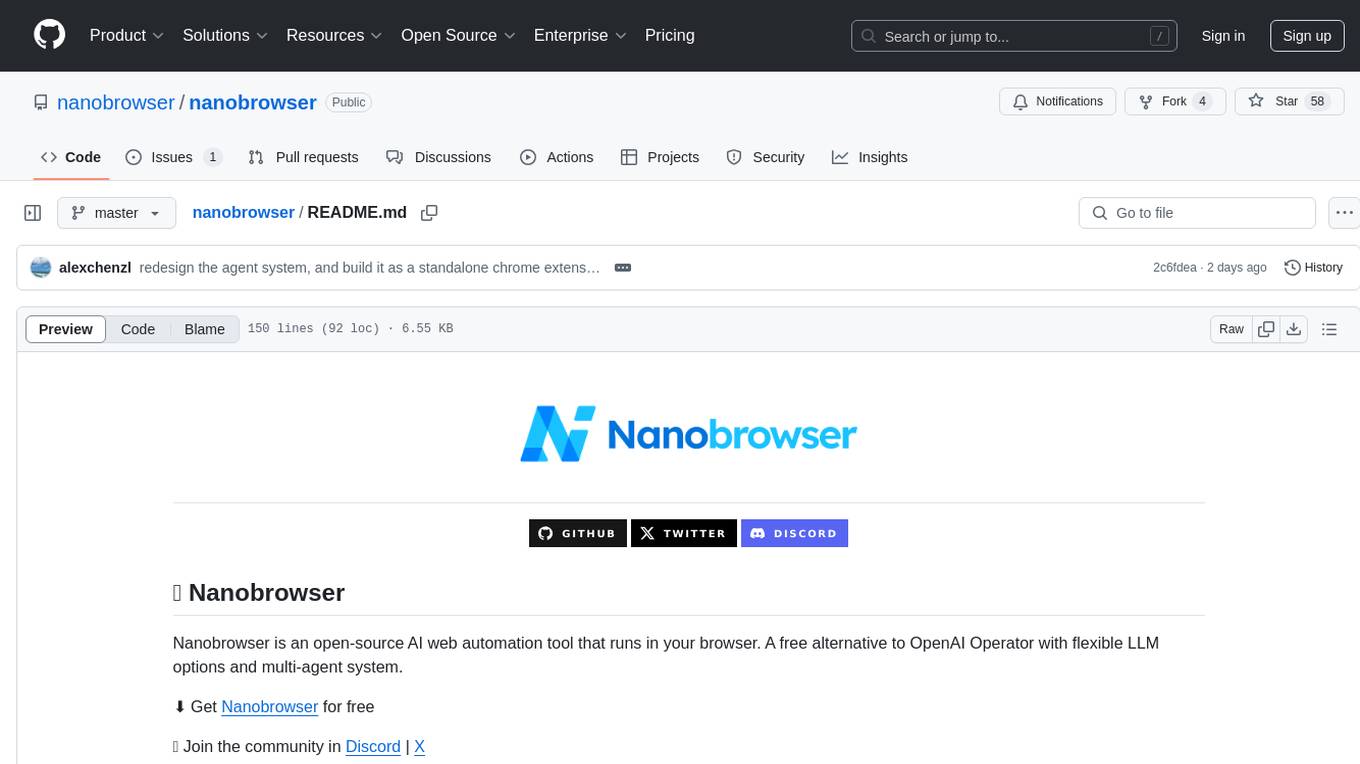
nanobrowser
Nanobrowser is an open-source AI web automation tool that runs in your browser. It is a free alternative to OpenAI Operator with flexible LLM options and a multi-agent system. Nanobrowser offers premium web automation capabilities while keeping users in complete control, with features like a multi-agent system, interactive side panel, task automation, follow-up questions, and multiple LLM support. Users can easily download and install Nanobrowser as a Chrome extension, configure agent models, and accomplish tasks such as news summary, GitHub research, and shopping research with just a sentence. The tool uses a specialized multi-agent system powered by large language models to understand and execute complex web tasks. Nanobrowser is actively developed with plans to expand LLM support, implement security measures, optimize memory usage, enable session replay, and develop specialized agents for domain-specific tasks. Contributions from the community are welcome to improve Nanobrowser and build the future of web automation.
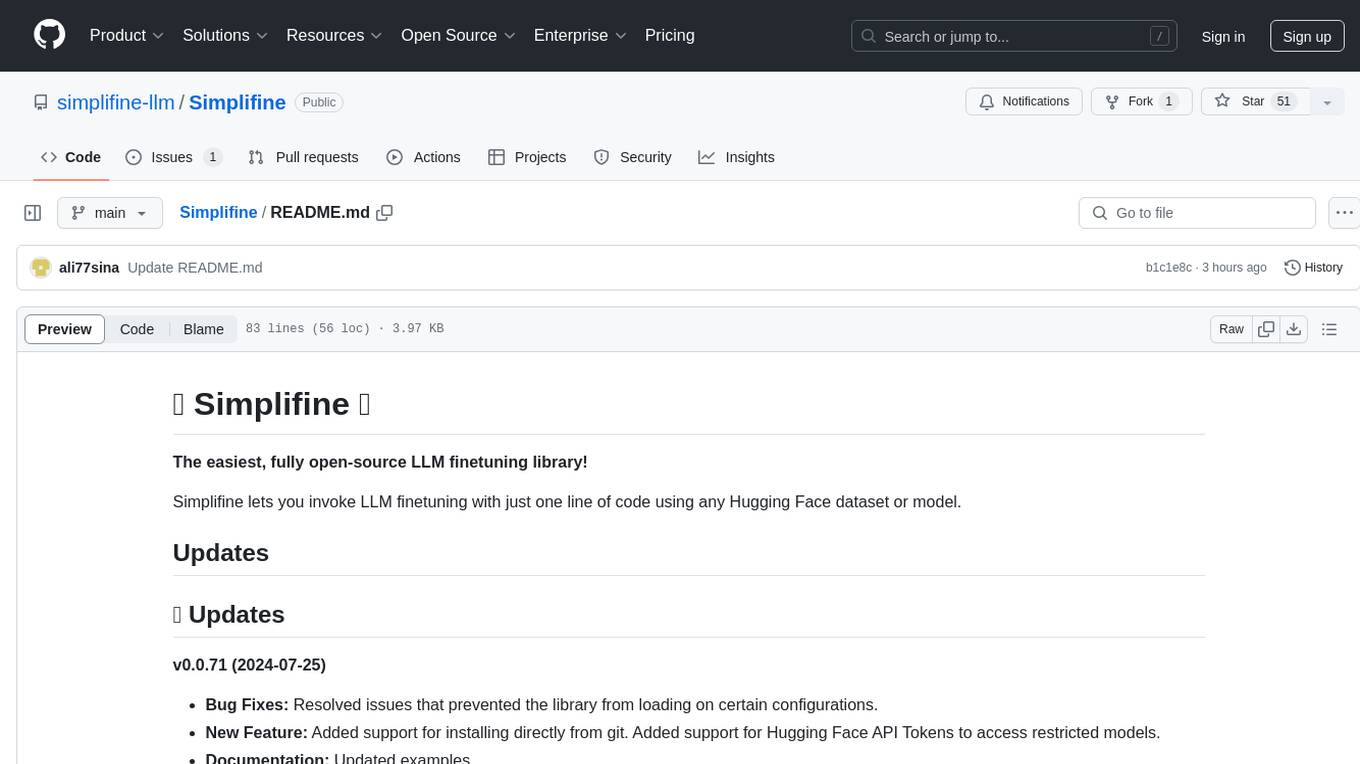
Simplifine
Simplifine is an open-source library designed for easy LLM finetuning, enabling users to perform tasks such as supervised fine tuning, question-answer finetuning, contrastive loss for embedding tasks, multi-label classification finetuning, and more. It provides features like WandB logging, in-built evaluation tools, automated finetuning parameters, and state-of-the-art optimization techniques. The library offers bug fixes, new features, and documentation updates in its latest version. Users can install Simplifine via pip or directly from GitHub. The project welcomes contributors and provides comprehensive documentation and support for users.
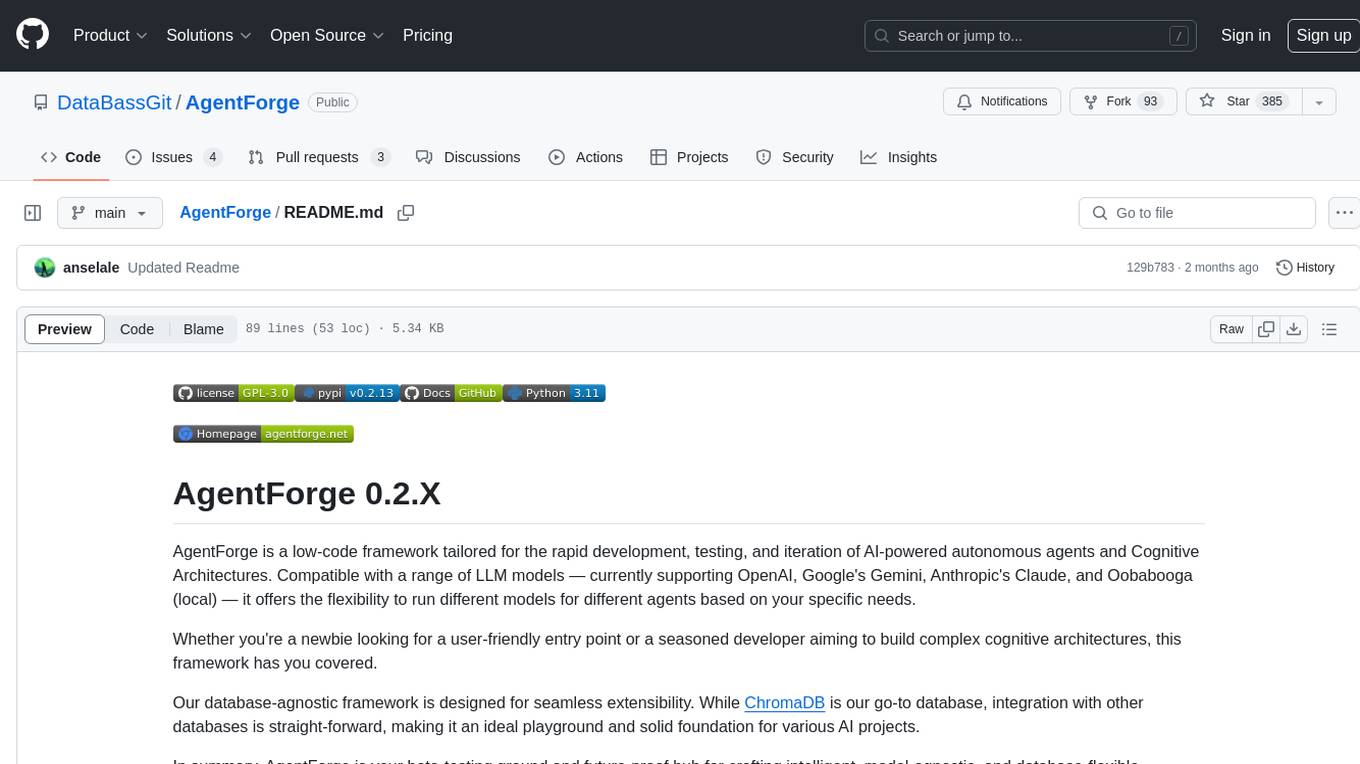
AgentForge
AgentForge is a low-code framework tailored for the rapid development, testing, and iteration of AI-powered autonomous agents and Cognitive Architectures. It is compatible with a range of LLM models and offers flexibility to run different models for different agents based on specific needs. The framework is designed for seamless extensibility and database-flexibility, making it an ideal playground for various AI projects. AgentForge is a beta-testing ground and future-proof hub for crafting intelligent, model-agnostic autonomous agents.
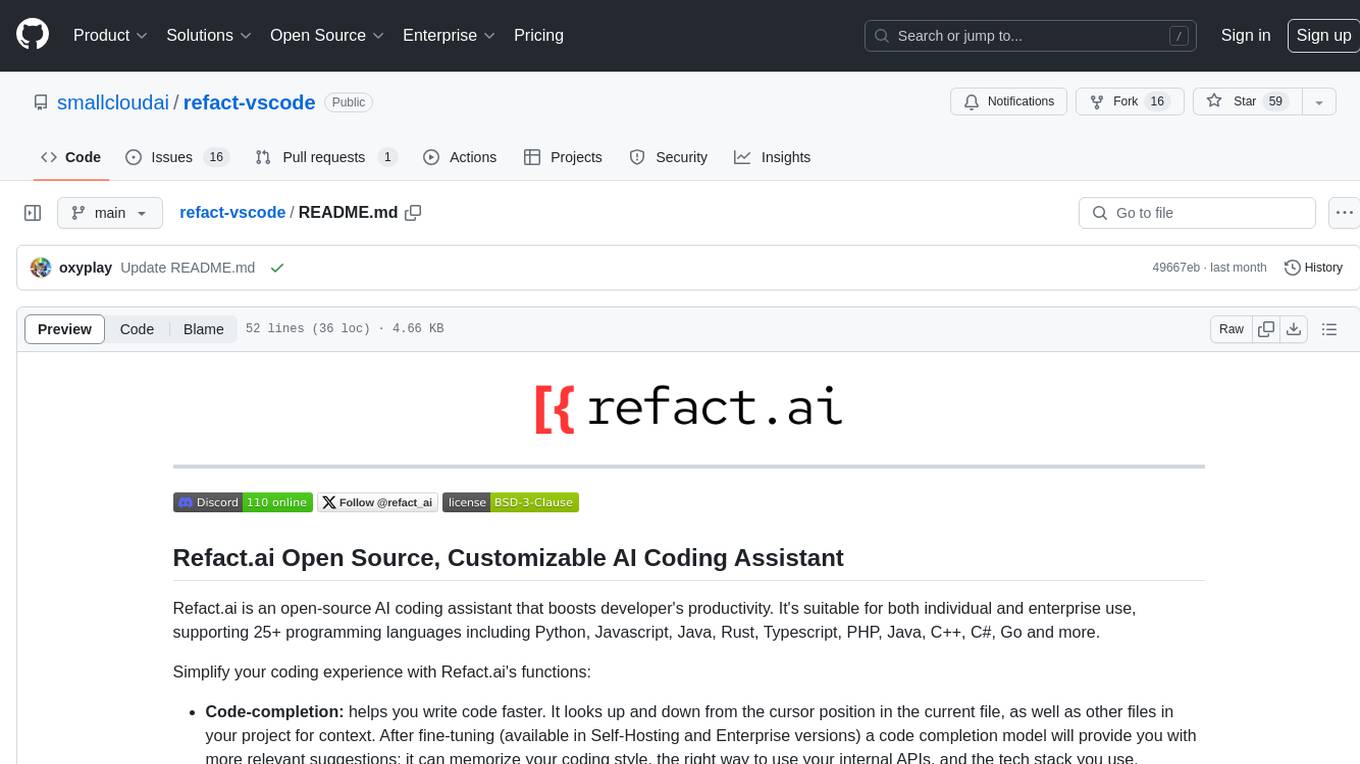
refact-vscode
Refact.ai is an open-source AI coding assistant that boosts developer's productivity. It supports 25+ programming languages and offers features like code completion, AI Toolbox for code explanation and refactoring, integrated in-IDE chat, and self-hosting or cloud version. The Enterprise plan provides enhanced customization, security, fine-tuning, user statistics, efficient inference, priority support, and access to 20+ LLMs for up to 50 engineers per GPU.
AIOStreams
AIOStreams is a versatile tool that combines streams from various addons into one platform, offering extensive customization options. Users can change result formats, filter results by various criteria, remove duplicates, prioritize services, sort results, specify size limits, and more. The tool scrapes results from selected addons, applies user configurations, and presents the results in a unified manner. It simplifies the process of finding and accessing desired content from multiple sources, enhancing user experience and efficiency.
griptape
Griptape is a modular Python framework for building AI-powered applications that securely connect to your enterprise data and APIs. It offers developers the ability to maintain control and flexibility at every step. Griptape's core components include Structures (Agents, Pipelines, and Workflows), Tasks, Tools, Memory (Conversation Memory, Task Memory, and Meta Memory), Drivers (Prompt and Embedding Drivers, Vector Store Drivers, Image Generation Drivers, Image Query Drivers, SQL Drivers, Web Scraper Drivers, and Conversation Memory Drivers), Engines (Query Engines, Extraction Engines, Summary Engines, Image Generation Engines, and Image Query Engines), and additional components (Rulesets, Loaders, Artifacts, Chunkers, and Tokenizers). Griptape enables developers to create AI-powered applications with ease and efficiency.
intellij-aicoder
AI Coding Assistant is a free and open-source IntelliJ plugin that leverages cutting-edge Language Model APIs to enhance developers' coding experience. It seamlessly integrates with various leading LLM APIs, offers an intuitive toolbar UI, and allows granular control over API requests. With features like Code & Patch Chat, Planning with AI Agents, Markdown visualization, and versatile text processing capabilities, this tool aims to streamline coding workflows and boost productivity.
AI-Blueprints
This repository hosts a collection of AI blueprint projects for HP AI Studio, providing end-to-end solutions across key AI domains like data science, machine learning, deep learning, and generative AI. The projects are designed to be plug-and-play, utilizing open-source and hosted models to offer ready-to-use solutions. The repository structure includes projects related to classical machine learning, deep learning applications, generative AI, NGC integration, and troubleshooting guidelines for common issues. Each project is accompanied by detailed descriptions and use cases, showcasing the versatility and applicability of AI technologies in various domains.
For similar tasks
Linguflex
Linguflex is a project that aims to simulate engaging, authentic, human-like interaction with AI personalities. It offers voice-based conversation with custom characters, alongside an array of practical features such as controlling smart home devices, playing music, searching the internet, fetching emails, displaying current weather information and news, assisting in scheduling, and searching or generating images.
M.I.L.E.S
M.I.L.E.S. (Machine Intelligent Language Enabled System) is a voice assistant powered by GPT-4 Turbo, offering a range of capabilities beyond existing assistants. With its advanced language understanding, M.I.L.E.S. provides accurate and efficient responses to user queries. It seamlessly integrates with smart home devices, Spotify, and offers real-time weather information. Additionally, M.I.L.E.S. possesses persistent memory, a built-in calculator, and multi-tasking abilities. Its realistic voice, accurate wake word detection, and internet browsing capabilities enhance the user experience. M.I.L.E.S. prioritizes user privacy by processing data locally, encrypting sensitive information, and adhering to strict data retention policies.
promptic
Promptic is a tool designed for LLM app development, providing a productive and pythonic way to build LLM applications. It leverages LiteLLM, allowing flexibility to switch LLM providers easily. Promptic focuses on building features by providing type-safe structured outputs, easy-to-build agents, streaming support, automatic prompt caching, and built-in conversation memory.
home-llm
Home LLM is a project that provides the necessary components to control your Home Assistant installation with a completely local Large Language Model acting as a personal assistant. The goal is to provide a drop-in solution to be used as a "conversation agent" component by Home Assistant. The 2 main pieces of this solution are Home LLM and Llama Conversation. Home LLM is a fine-tuning of the Phi model series from Microsoft and the StableLM model series from StabilityAI. The model is able to control devices in the user's house as well as perform basic question and answering. The fine-tuning dataset is a custom synthetic dataset designed to teach the model function calling based on the device information in the context. Llama Conversation is a custom component that exposes the locally running LLM as a "conversation agent" in Home Assistant. This component can be interacted with in a few ways: using a chat interface, integrating with Speech-to-Text and Text-to-Speech addons, or running the oobabooga/text-generation-webui project to provide access to the LLM via an API interface.
leon
Leon is an open-source personal assistant who can live on your server. He does stuff when you ask him to. You can talk to him and he can talk to you. You can also text him and he can also text you. If you want to, Leon can communicate with you by being offline to protect your privacy.
J.A.R.V.I.S.-Ai-Assistant-V1-
Jarvis Version 3 is a versatile personal assistant application designed to enhance productivity by automating common tasks. It can interact with websites and applications, perform searches, manage device functions, and control music. Users can give commands to open websites, search on Google or YouTube, scroll pages, manage applications, check time, internet speed, battery percentage, battery alerts, charging status, play music, and synchronize clapping with music. The tool offers features for web navigation, search functionality, scrolling, application management, device management, and music control.
LLM-Assistant
LLM-Assistant is a browser interface based on Gradio that interfaces with local LLMs to call functions and act as a general assistant. It works with any instruct-finetuned LLM, can search for information (RAG), knows when to call functions, has realtime mode for working across the system, and answers questions from PDF files. The tool aims to provide voice access and more functions in the future. Current bugs include rare crashes. Setup involves cloning the repo to a virtual environment, installing requirements, downloading and placing LLM model in the model folder, and running main.py. Usage includes Assistant mode for general chat and calling functions like playing music, as well as Realtime mode for editing documents or replying to emails in real-time.
ESP32_AI_LLM
ESP32_AI_LLM is a project that uses ESP32 to connect to Xunfei Xinghuo, Dou Bao, and Tongyi Qianwen large models to achieve voice chat functions, supporting online voice wake-up, continuous conversation, music playback, and real-time display of conversation content on an external screen. The project requires specific hardware components and provides functionalities such as voice wake-up, voice conversation, convenient network configuration, music playback, volume adjustment, LED control, model switching, and screen display. Users can deploy the project by setting up Xunfei services, cloning the repository, configuring necessary parameters, installing drivers, compiling, and burning the code.
For similar jobs
ChatFAQ
ChatFAQ is an open-source comprehensive platform for creating a wide variety of chatbots: generic ones, business-trained, or even capable of redirecting requests to human operators. It includes a specialized NLP/NLG engine based on a RAG architecture and customized chat widgets, ensuring a tailored experience for users and avoiding vendor lock-in.
anything-llm
AnythingLLM is a full-stack application that enables you to turn any document, resource, or piece of content into context that any LLM can use as references during chatting. This application allows you to pick and choose which LLM or Vector Database you want to use as well as supporting multi-user management and permissions.
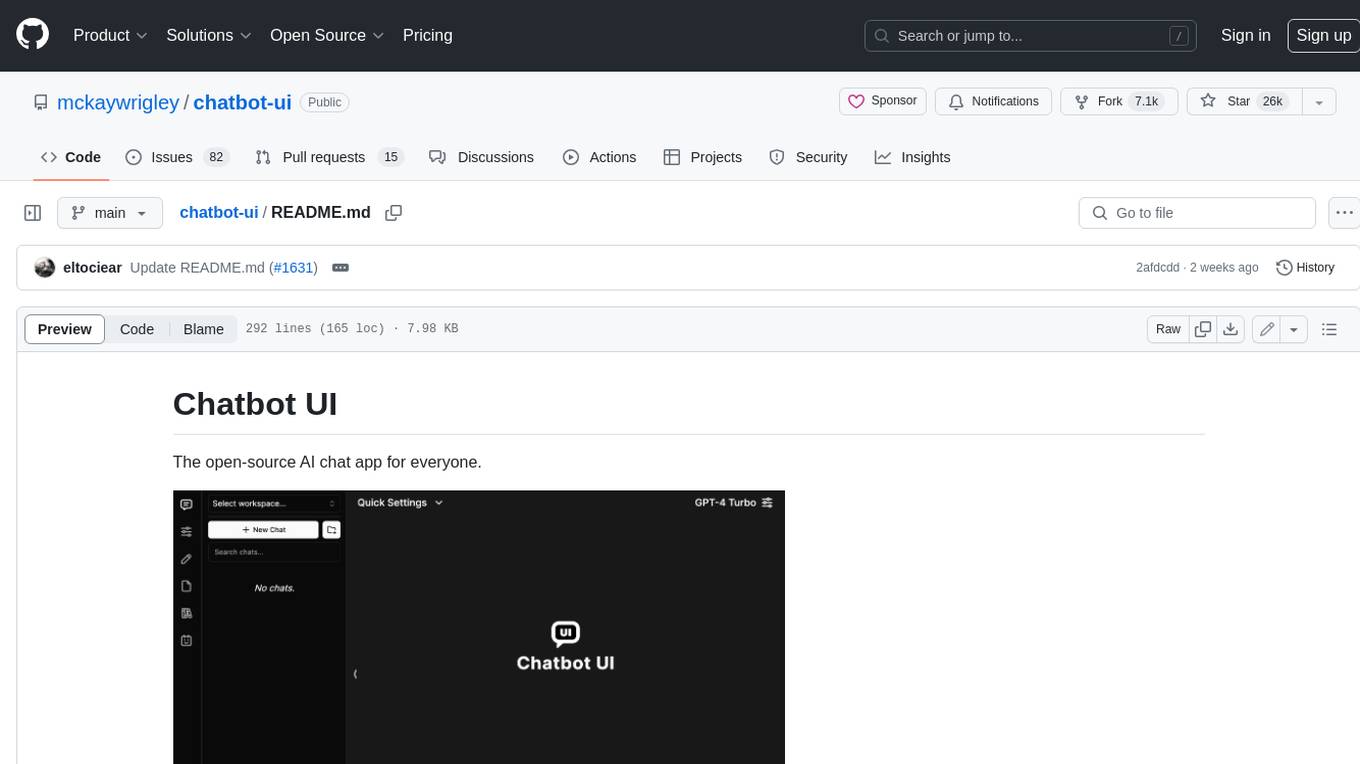
chatbot-ui
Chatbot UI is an open-source AI chat app that allows users to create and deploy their own AI chatbots. It is easy to use and can be customized to fit any need. Chatbot UI is perfect for businesses, developers, and anyone who wants to create a chatbot.
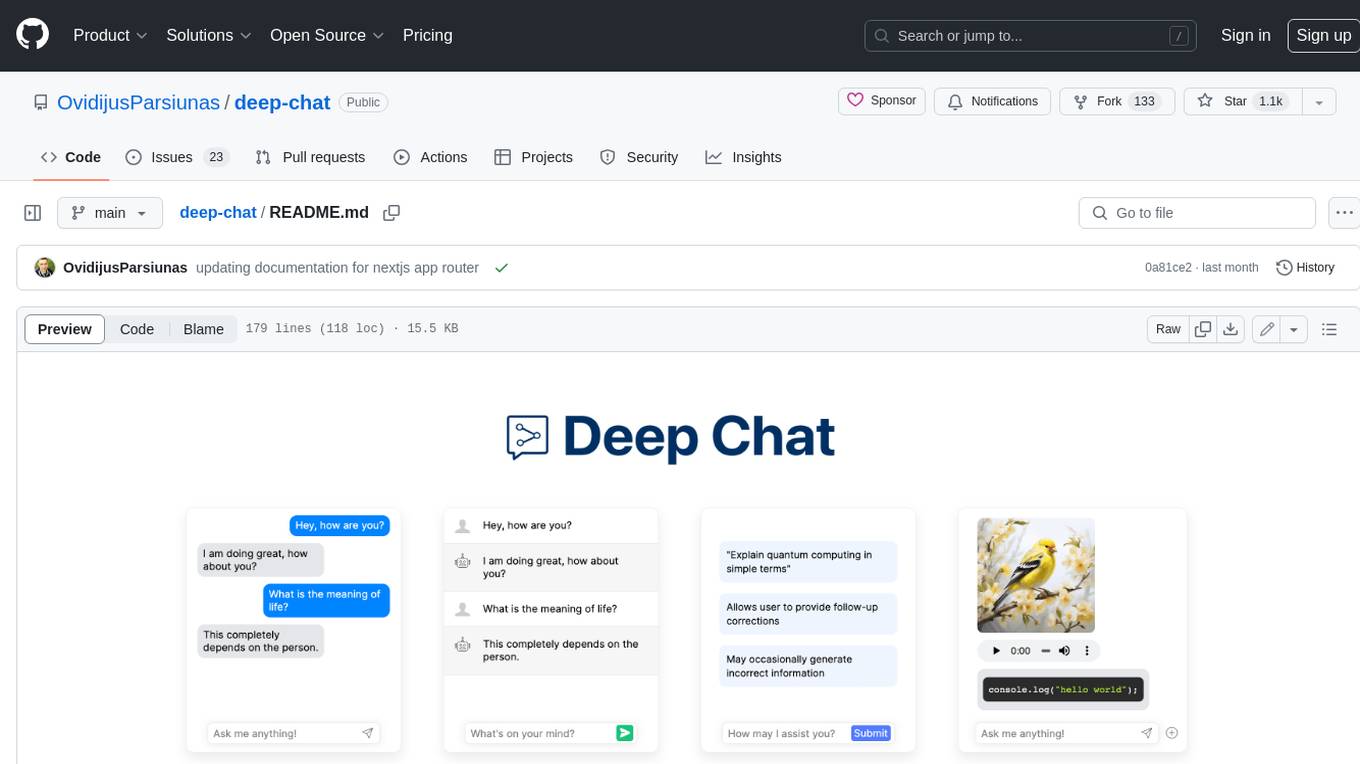
deep-chat
Deep Chat is a fully customizable AI chat component that can be injected into your website with minimal to no effort. Whether you want to create a chatbot that leverages popular APIs such as ChatGPT or connect to your own custom service, this component can do it all! Explore deepchat.dev to view all of the available features, how to use them, examples and more!
Avalonia-Assistant
Avalonia-Assistant is an open-source desktop intelligent assistant that aims to provide a user-friendly interactive experience based on the Avalonia UI framework and the integration of Semantic Kernel with OpenAI or other large LLM models. By utilizing Avalonia-Assistant, you can perform various desktop operations through text or voice commands, enhancing your productivity and daily office experience.
chatgpt-web
ChatGPT Web is a web application that provides access to the ChatGPT API. It offers two non-official methods to interact with ChatGPT: through the ChatGPTAPI (using the `gpt-3.5-turbo-0301` model) or through the ChatGPTUnofficialProxyAPI (using a web access token). The ChatGPTAPI method is more reliable but requires an OpenAI API key, while the ChatGPTUnofficialProxyAPI method is free but less reliable. The application includes features such as user registration and login, synchronization of conversation history, customization of API keys and sensitive words, and management of users and keys. It also provides a user interface for interacting with ChatGPT and supports multiple languages and themes.
tiledesk-dashboard
Tiledesk is an open-source live chat platform with integrated chatbots written in Node.js and Express. It is designed to be a multi-channel platform for web, Android, and iOS, and it can be used to increase sales or provide post-sales customer service. Tiledesk's chatbot technology allows for automation of conversations, and it also provides APIs and webhooks for connecting external applications. Additionally, it offers a marketplace for apps and features such as CRM, ticketing, and data export.
UFO
UFO is a UI-focused dual-agent framework to fulfill user requests on Windows OS by seamlessly navigating and operating within individual or spanning multiple applications.