


rikkahub
RikkaHub is an Android APP that supports for multiple LLM providers.
Stars: 3268
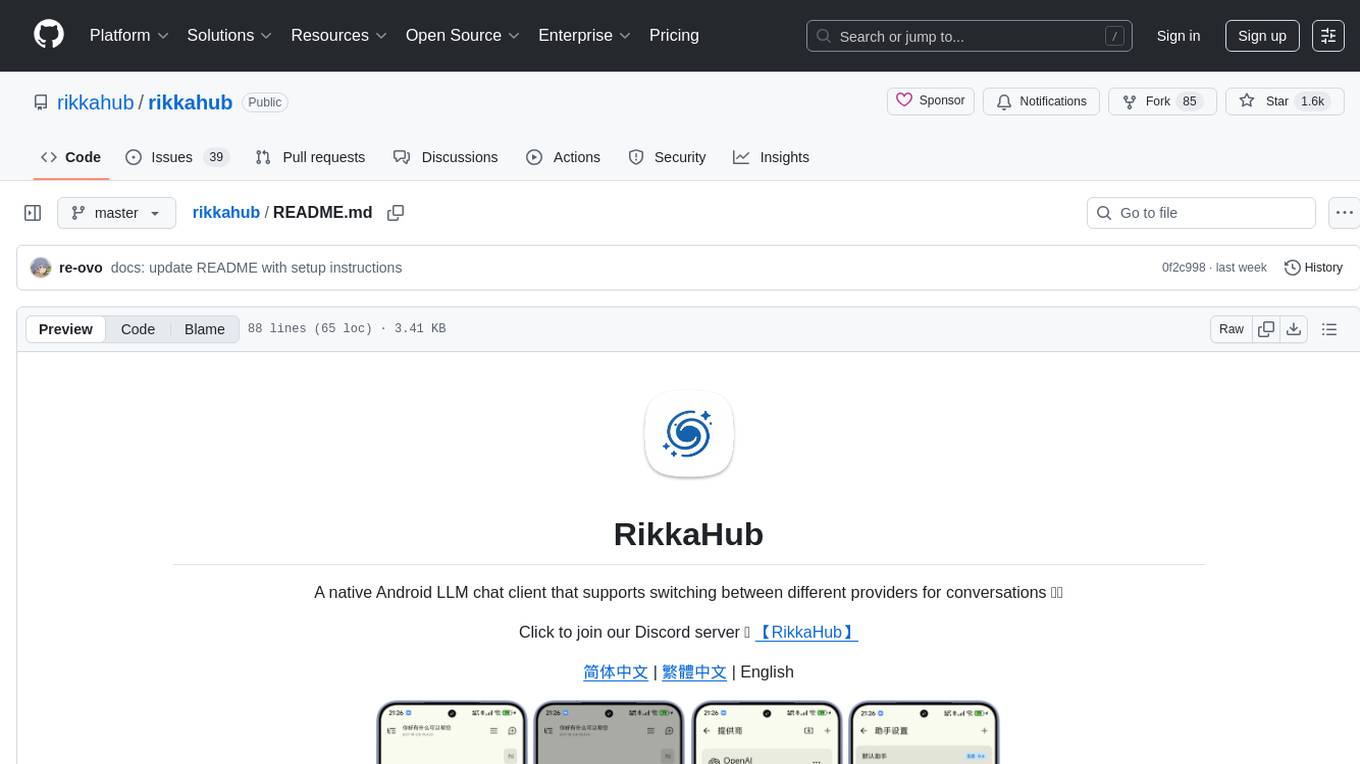
RikkaHub is a native Android LLM chat client that supports switching between different providers for conversations. It features a modern Android app design with dark mode, support for multiple provider types, multimodal input support, Markdown rendering, search capabilities, prompt variables, QR code export/import, agent customization, ChatGPT-like memory feature, AI translation, and custom HTTP request headers and bodies. The project is developed using Kotlin, Koin, Jetpack Compose, DataStore, Room, Coil, Material You, Navigation Compose, Okhttp, kotlinx.serialization, and compose-icons/lucide.
README:



A native Android LLM chat client that supports switching between different providers for conversations 🤖💬
Click to join our Discord server 👉 【RikkaHub】


Aihubmix
Thanks to aihubmix.com for their financial support. We recommend using aihubmix as a one-stop shop for mainstream models worldwide. (OpenAI, Claude, Google Gemini, DeepSeek, Qwen, and hundreds more).
- 🎨 Material You Design and 🌙 Dark mode
- 🔄 Multiple AI Provider Support: custom API / URL / models (all OpenAI, Google, Anthropic compatible api)
- 🖼️ Multimodal input support (Image, Text Documentation, PDF, Docx)
- 🖥️ Web access for multi-platform use
- 🛠️ MCP support
- 📝 Markdown Rendering (with code highlighting, Latex formulas, tables, Mermaid)
- Message Branching
- 🔍 Search capabilities (Exa, Tavily, Zhipu, LinkUp, Brave, Perplexity, etc.)
- 🧩 Prompt variables (model name, time, etc.)
- 🤳 QR code export and import for providers
- 🤖 Agent customization
- 🧠 ChatGPT-like memory feature
- 📝 AI Translation
- 🌐 Custom HTTP request headers and request bodies
- 💌 Silly Tavern character card import
This project is developed using Android Studio. PRs are welcome!
Technology stack documentation:
- Kotlin (Development language)
- Koin (Dependency Injection)
- Jetpack Compose (UI framework)
- DataStore (Preference data storage)
- Room (Database)
- Coil (Image loading)
- Material You (UI design)
- Navigation Compose (Navigation)
- Okhttp (HTTP client)
- kotlinx.serialization (JSON serialization)
- compose-icons/lucide (Icon library)
[!TIP] You need a
google-services.jsonfile atappfolder to build the app.
[!IMPORTANT]
The following PRs will be rejected:
- Translation related changes, such as adding new languages or updating existing translations
- Adding new features, this project is opinionated and will not accept pull requests for new features
- Large-scale refactoring and changes generated by AI
If you like this project, please give it a star ⭐
For Tasks:
Click tags to check more tools for each tasksFor Jobs:
Alternative AI tools for rikkahub
Similar Open Source Tools
rikkahub
RikkaHub is a native Android LLM chat client that supports switching between different providers for conversations. It features a modern Android app design with dark mode, support for multiple provider types, multimodal input support, Markdown rendering, search capabilities, prompt variables, QR code export/import, agent customization, ChatGPT-like memory feature, AI translation, and custom HTTP request headers and bodies. The project is developed using Kotlin, Koin, Jetpack Compose, DataStore, Room, Coil, Material You, Navigation Compose, Okhttp, kotlinx.serialization, and compose-icons/lucide.
AIaW
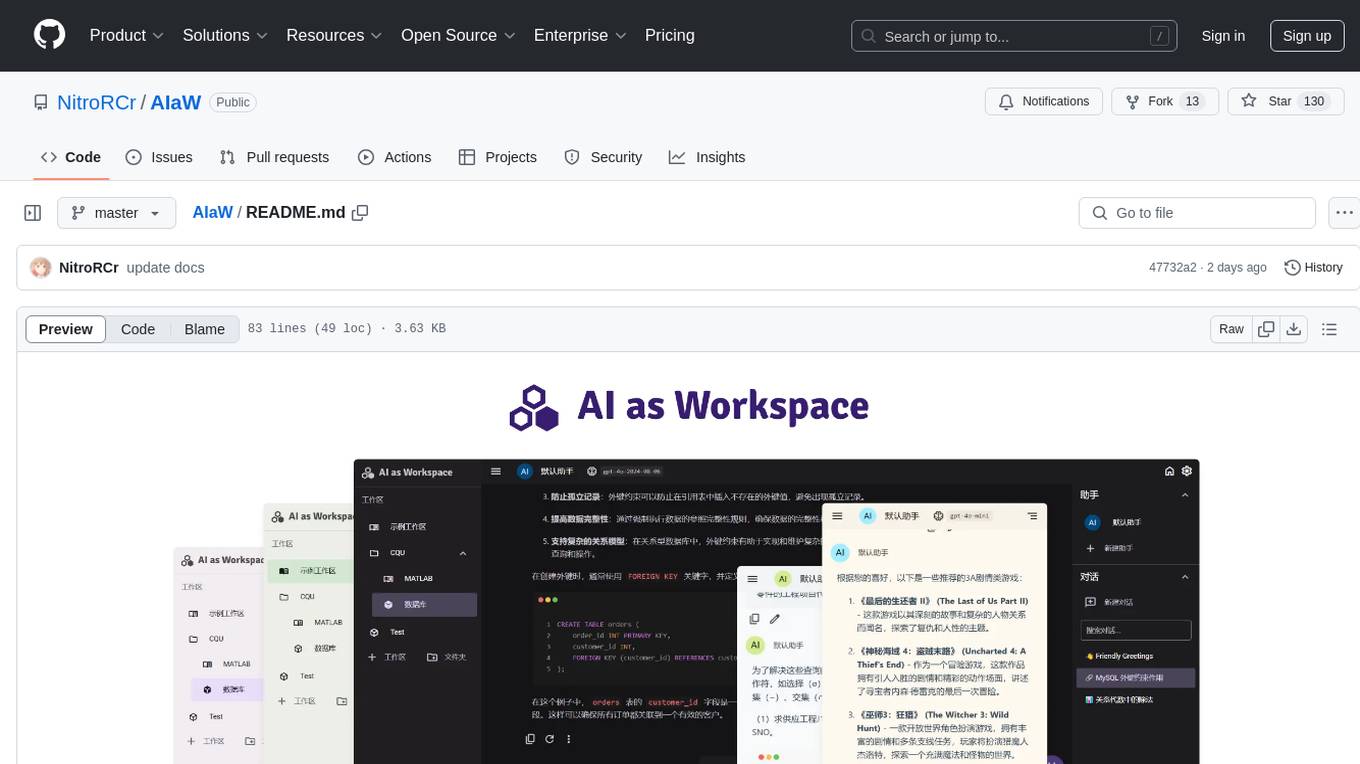
AIaW is a next-generation LLM client with full functionality, lightweight, and extensible. It supports various basic functions such as streaming transfer, image uploading, and latex formulas. The tool is cross-platform with a responsive interface design. It supports multiple service providers like OpenAI, Anthropic, and Google. Users can modify questions, regenerate in a forked manner, and visualize conversations in a tree structure. Additionally, it offers features like file parsing, video parsing, plugin system, assistant market, local storage with real-time cloud sync, and customizable interface themes. Users can create multiple workspaces, use dynamic prompt word variables, extend plugins, and benefit from detailed design elements like real-time content preview, optimized code pasting, and support for various file types.
llm.nvim
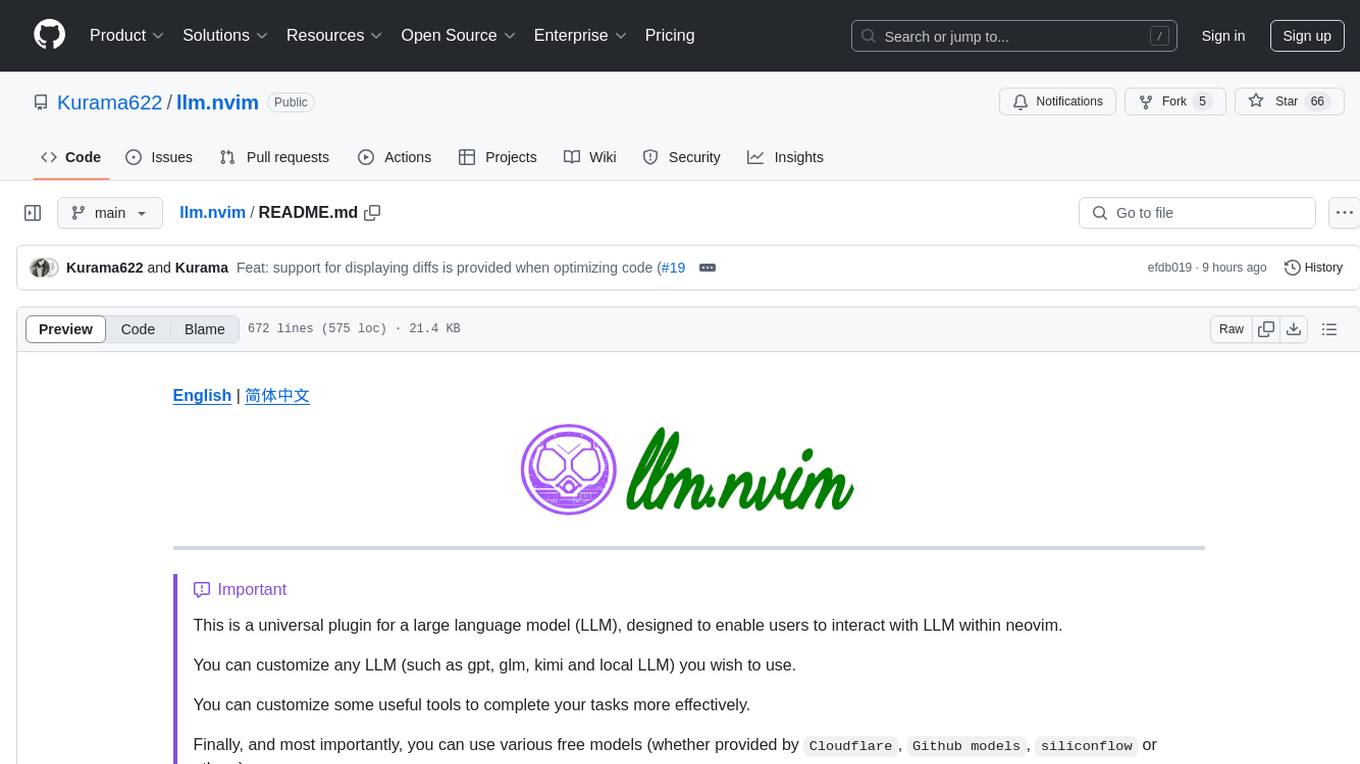
llm.nvim is a universal plugin for a large language model (LLM) designed to enable users to interact with LLM within neovim. Users can customize various LLMs such as gpt, glm, kimi, and local LLM. The plugin provides tools for optimizing code, comparing code, translating text, and more. It also supports integration with free models from Cloudflare, Github models, siliconflow, and others. Users can customize tools, chat with LLM, quickly translate text, and explain code snippets. The plugin offers a flexible window interface for easy interaction and customization.
goclaw
goclaw is a powerful AI Agent framework written in Go language. It provides a complete tool system for FileSystem, Shell, Web, and Browser with Docker sandbox support and permission control. The framework includes a skill system compatible with OpenClaw and AgentSkills specifications, supporting automatic discovery and environment gating. It also offers persistent session storage, multi-channel support for Telegram, WhatsApp, Feishu, QQ, and WeWork, flexible configuration with YAML/JSON support, multiple LLM providers like OpenAI, Anthropic, and OpenRouter, WebSocket Gateway, Cron scheduling, and Browser automation based on Chrome DevTools Protocol.
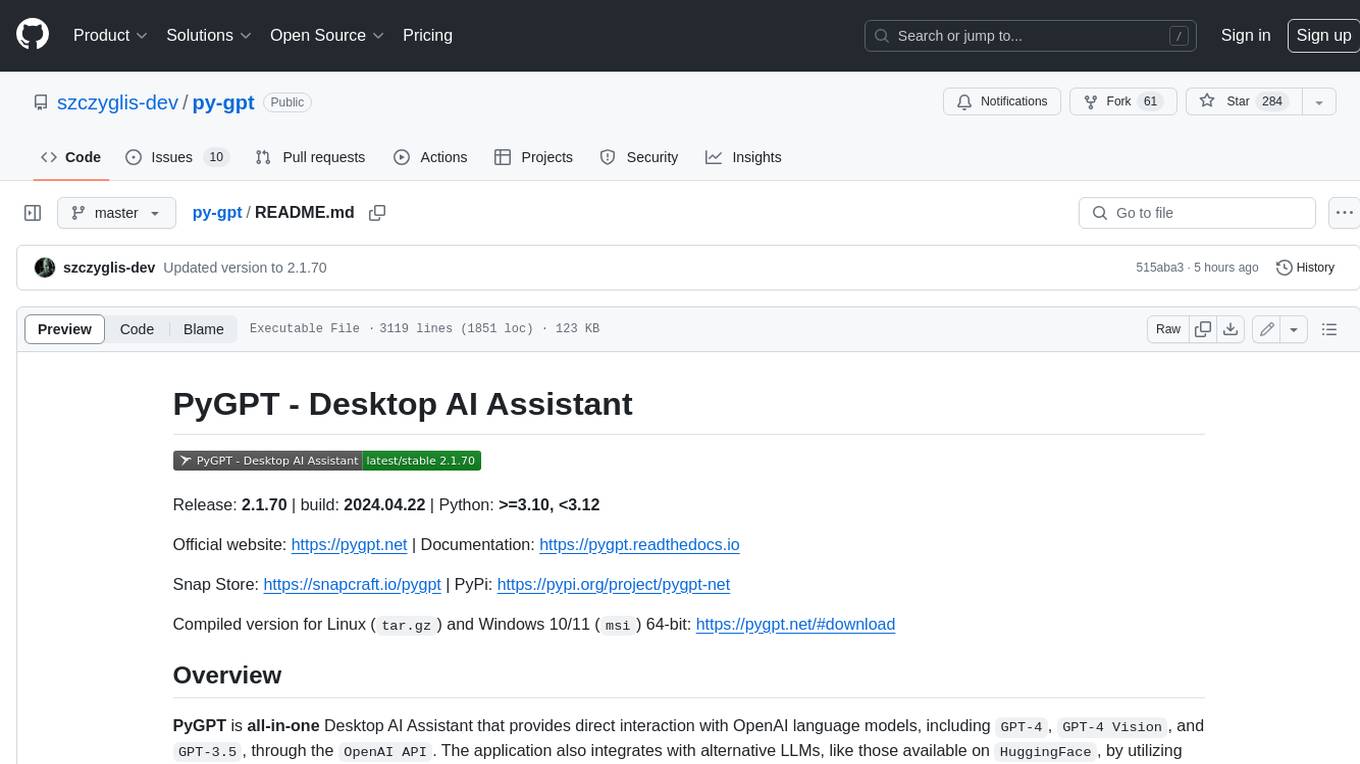
py-gpt
Py-GPT is a Python library that provides an easy-to-use interface for OpenAI's GPT-3 API. It allows users to interact with the powerful GPT-3 model for various natural language processing tasks. With Py-GPT, developers can quickly integrate GPT-3 capabilities into their applications, enabling them to generate text, answer questions, and more with just a few lines of code.
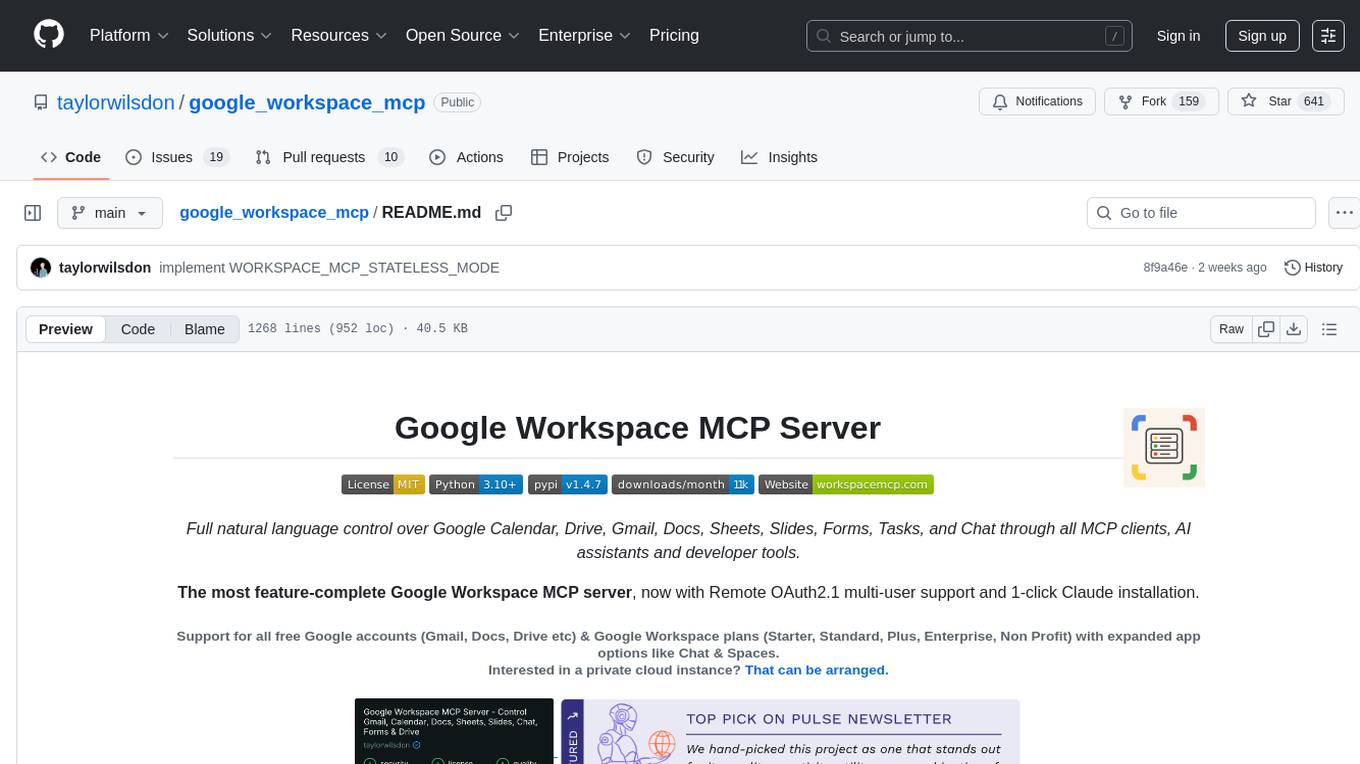
google_workspace_mcp
The Google Workspace MCP Server is a production-ready server that integrates major Google Workspace services with AI assistants. It supports single-user and multi-user authentication via OAuth 2.1, making it a powerful backend for custom applications. Built with FastMCP for optimal performance, it features advanced authentication handling, service caching, and streamlined development patterns. The server provides full natural language control over Google Calendar, Drive, Gmail, Docs, Sheets, Slides, Forms, Tasks, and Chat through all MCP clients, AI assistants, and developer tools. It supports free Google accounts and Google Workspace plans with expanded app options like Chat & Spaces. The server also offers private cloud instance options.
celeste-python
Celeste AI is a type-safe, modality/provider-agnostic tool that offers unified interface for various providers like OpenAI, Anthropic, Gemini, Mistral, and more. It supports multiple modalities including text, image, audio, video, and embeddings, with full Pydantic validation and IDE autocomplete. Users can switch providers instantly, ensuring zero lock-in and a lightweight architecture. The tool provides primitives, not frameworks, for clean I/O operations.
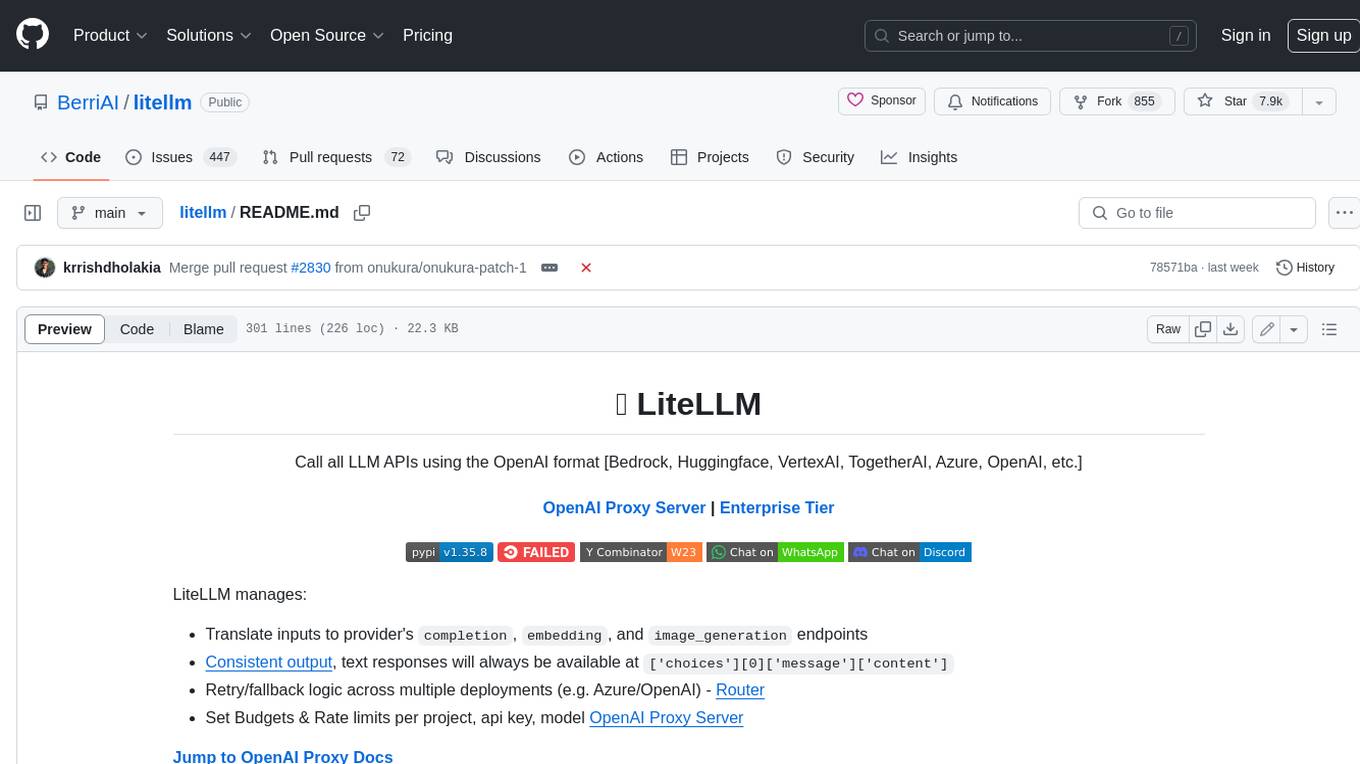
litellm
LiteLLM is a tool that allows you to call all LLM APIs using the OpenAI format. This includes Bedrock, Huggingface, VertexAI, TogetherAI, Azure, OpenAI, and more. LiteLLM manages translating inputs to provider's `completion`, `embedding`, and `image_generation` endpoints, providing consistent output, and retry/fallback logic across multiple deployments. It also supports setting budgets and rate limits per project, api key, and model.
supabase
Supabase is an open source Firebase alternative that provides a wide range of features including a hosted Postgres database, authentication and authorization, auto-generated APIs, REST and GraphQL support, realtime subscriptions, functions, file storage, AI and vector/embeddings toolkit, and a dashboard. It aims to offer developers a Firebase-like experience using enterprise-grade open source tools.
openchamber
OpenChamber is a web and desktop interface for the OpenCode AI coding agent, designed to work alongside the OpenCode TUI. The project was built entirely with AI coding agents under supervision, serving as a proof of concept that AI agents can create usable software. It offers features like integrated terminal, Git operations with AI commit message generation, smart tool visualization, permission management, multi-agent runs, task tracker UI, model selection UX, UI scaling controls, session auto-cleanup, and memory optimizations. OpenChamber provides cross-device continuity, remote access, and a visual alternative for developers preferring GUI workflows.
jadx-mcp-server
JADX-MCP-SERVER is a standalone Python server that interacts with JADX-AI-MCP Plugin to analyze Android APKs using LLMs like Claude. It enables live communication with decompiled Android app context, uncovering vulnerabilities, parsing manifests, and facilitating reverse engineering effortlessly. The tool combines JADX-AI-MCP and JADX MCP SERVER to provide real-time reverse engineering support with LLMs, offering features like quick analysis, vulnerability detection, AI code modification, static analysis, and reverse engineering helpers. It supports various MCP tools for fetching class information, text, methods, fields, smali code, AndroidManifest.xml content, strings.xml file, resource files, and more. Tested on Claude Desktop, it aims to support other LLMs in the future, enhancing Android reverse engineering and APK modification tools connectivity for easier reverse engineering purely from vibes.
llm
The 'llm' package for Emacs provides an interface for interacting with Large Language Models (LLMs). It abstracts functionality to a higher level, concealing API variations and ensuring compatibility with various LLMs. Users can set up providers like OpenAI, Gemini, Vertex, Claude, Ollama, GPT4All, and a fake client for testing. The package allows for chat interactions, embeddings, token counting, and function calling. It also offers advanced prompt creation and logging capabilities. Users can handle conversations, create prompts with placeholders, and contribute by creating providers.
databerry
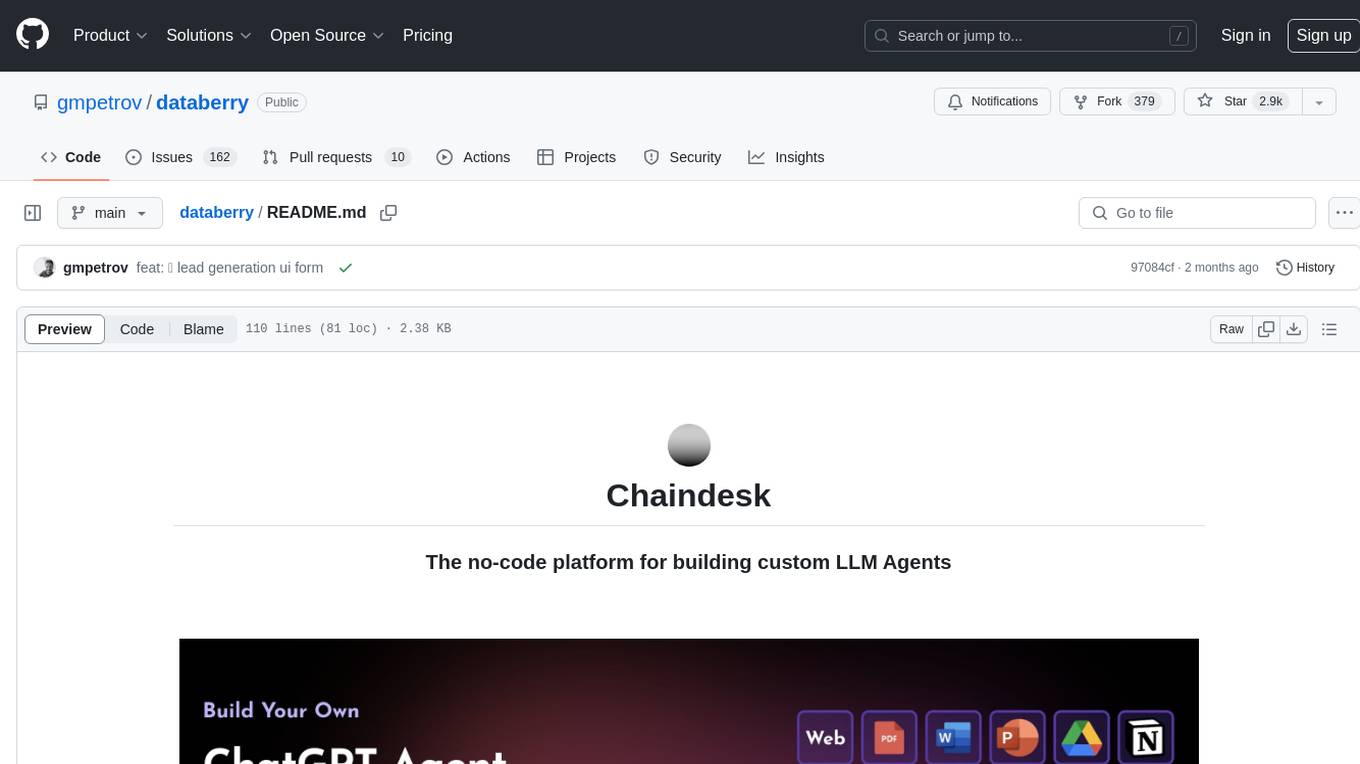
Chaindesk is a no-code platform that allows users to easily set up a semantic search system for personal data without technical knowledge. It supports loading data from various sources such as raw text, web pages, files (Word, Excel, PowerPoint, PDF, Markdown, Plain Text), and upcoming support for web sites, Notion, and Airtable. The platform offers a user-friendly interface for managing datastores, querying data via a secure API endpoint, and auto-generating ChatGPT Plugins for each datastore. Chaindesk utilizes a Vector Database (Qdrant), Openai's text-embedding-ada-002 for embeddings, and has a chunk size of 1024 tokens. The technology stack includes Next.js, Joy UI, LangchainJS, PostgreSQL, Prisma, and Qdrant, inspired by the ChatGPT Retrieval Plugin.
nexa-sdk
Nexa SDK is a comprehensive toolkit supporting ONNX and GGML models for text generation, image generation, vision-language models (VLM), and text-to-speech (TTS) capabilities. It offers an OpenAI-compatible API server with JSON schema mode and streaming support, along with a user-friendly Streamlit UI. Users can run Nexa SDK on any device with Python environment, with GPU acceleration supported. The toolkit provides model support, conversion engine, inference engine for various tasks, and differentiating features from other tools.
LocalLLMClient
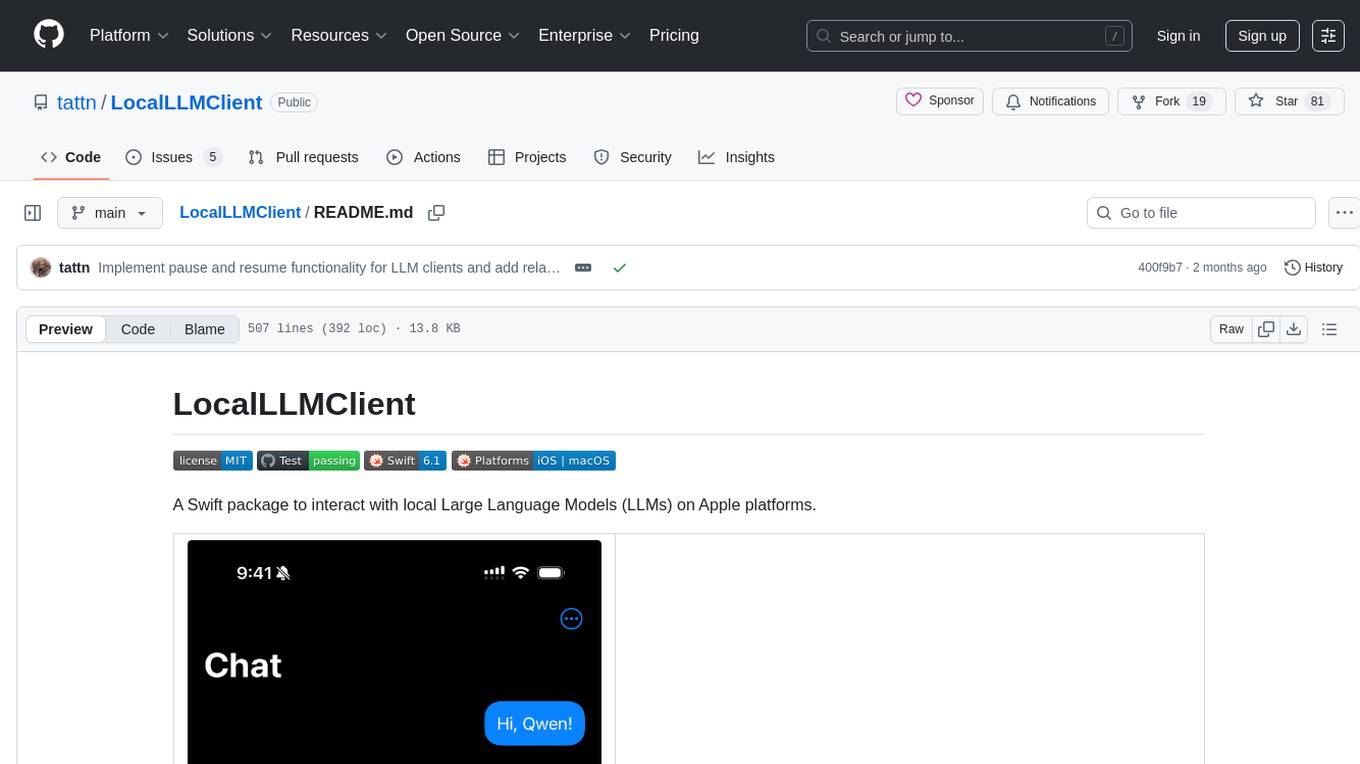
LocalLLMClient is a Swift package designed to interact with local Large Language Models (LLMs) on Apple platforms. It supports GGUF, MLX models, and the FoundationModels framework, providing streaming API, multimodal capabilities, and tool calling functionalities. Users can easily integrate this tool to work with various models for text generation and processing. The package also includes advanced features for low-level API control and multimodal image processing. LocalLLMClient is experimental and subject to API changes, offering support for iOS, macOS, and Linux platforms.
mllm
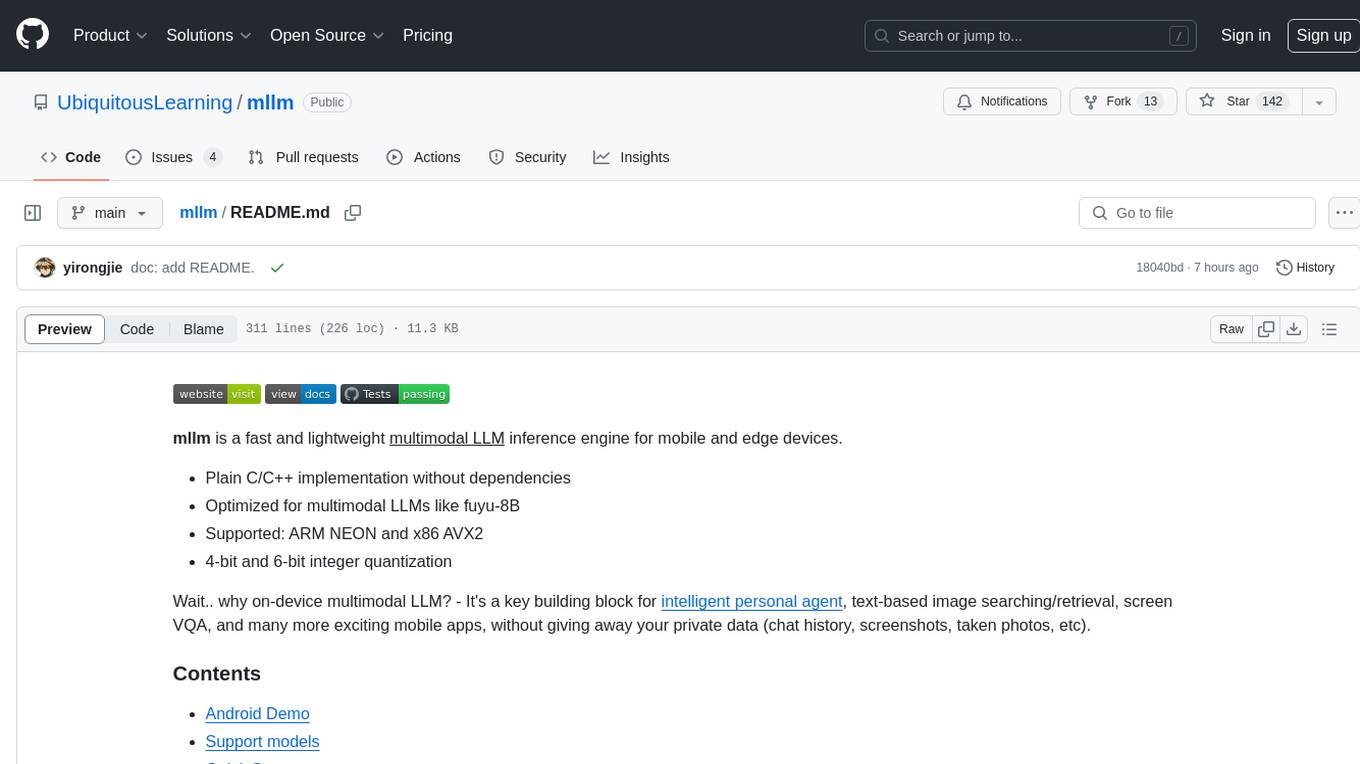
mllm is a fast and lightweight multimodal LLM inference engine for mobile and edge devices. It is a Plain C/C++ implementation without dependencies, optimized for multimodal LLMs like fuyu-8B, and supports ARM NEON and x86 AVX2. The engine offers 4-bit and 6-bit integer quantization, making it suitable for intelligent personal agents, text-based image searching/retrieval, screen VQA, and various mobile applications without compromising user privacy.
For similar tasks
rikkahub
RikkaHub is a native Android LLM chat client that supports switching between different providers for conversations. It features a modern Android app design with dark mode, support for multiple provider types, multimodal input support, Markdown rendering, search capabilities, prompt variables, QR code export/import, agent customization, ChatGPT-like memory feature, AI translation, and custom HTTP request headers and bodies. The project is developed using Kotlin, Koin, Jetpack Compose, DataStore, Room, Coil, Material You, Navigation Compose, Okhttp, kotlinx.serialization, and compose-icons/lucide.
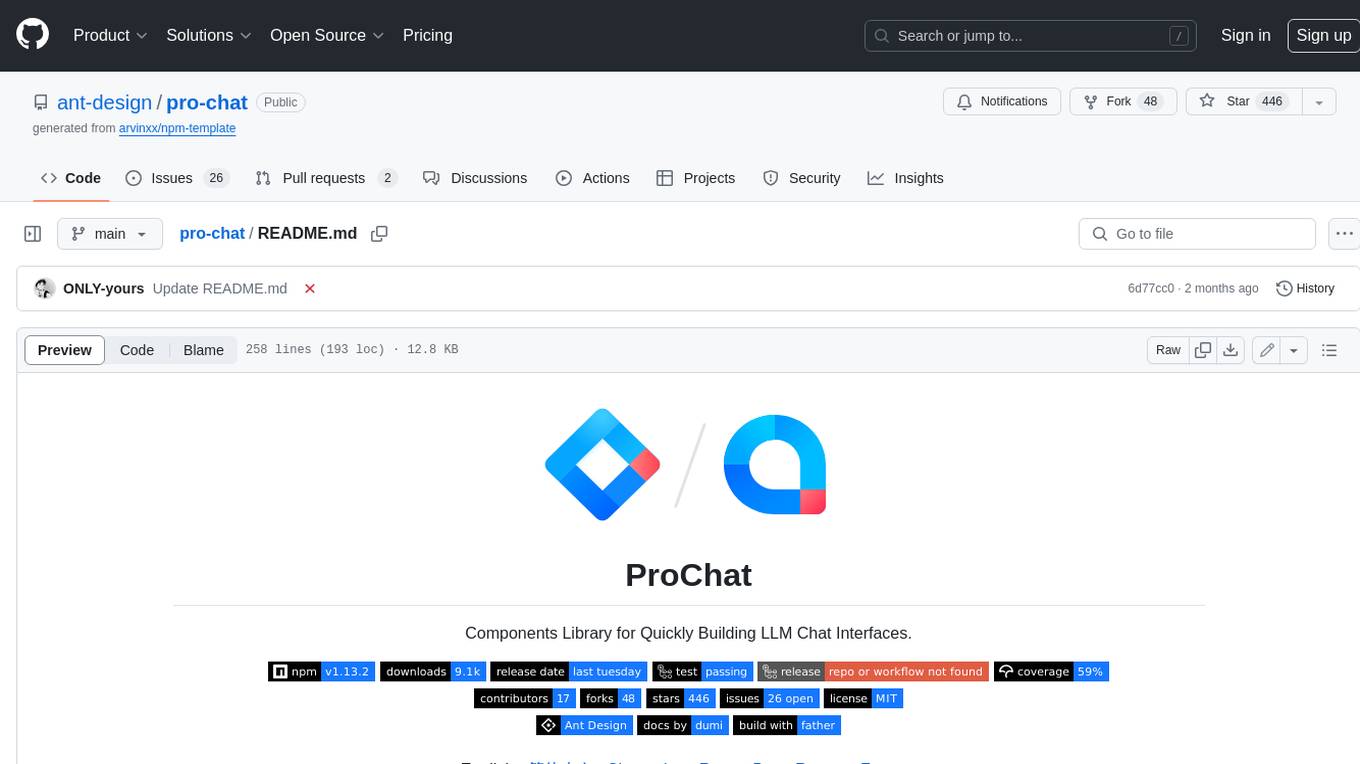
pro-chat
ProChat is a components library focused on quickly building large language model chat interfaces. It empowers developers to create rich, dynamic, and intuitive chat interfaces with features like automatic chat caching, streamlined conversations, message editing tools, auto-rendered Markdown, and programmatic controls. The tool also includes design evolution plans such as customized dialogue rendering, enhanced request parameters, personalized error handling, expanded documentation, and atomic component design.
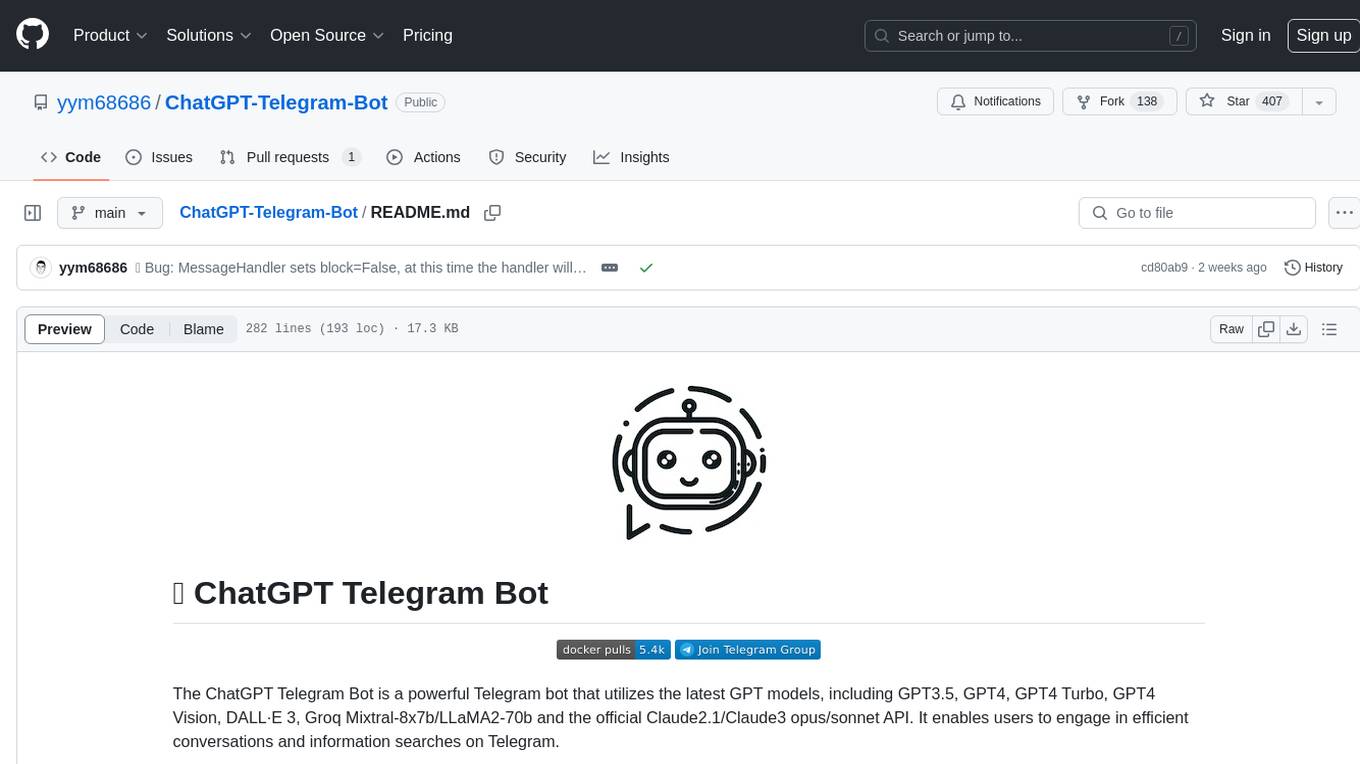
ChatGPT-Telegram-Bot
The ChatGPT Telegram Bot is a powerful Telegram bot that utilizes various GPT models, including GPT3.5, GPT4, GPT4 Turbo, GPT4 Vision, DALL·E 3, Groq Mixtral-8x7b/LLaMA2-70b, and Claude2.1/Claude3 opus/sonnet API. It enables users to engage in efficient conversations and information searches on Telegram. The bot supports multiple AI models, online search with DuckDuckGo and Google, user-friendly interface, efficient message processing, document interaction, Markdown rendering, and convenient deployment options like Zeabur, Replit, and Docker. Users can set environment variables for configuration and deployment. The bot also provides Q&A functionality, supports model switching, and can be deployed in group chats with whitelisting. The project is open source under GPLv3 license.
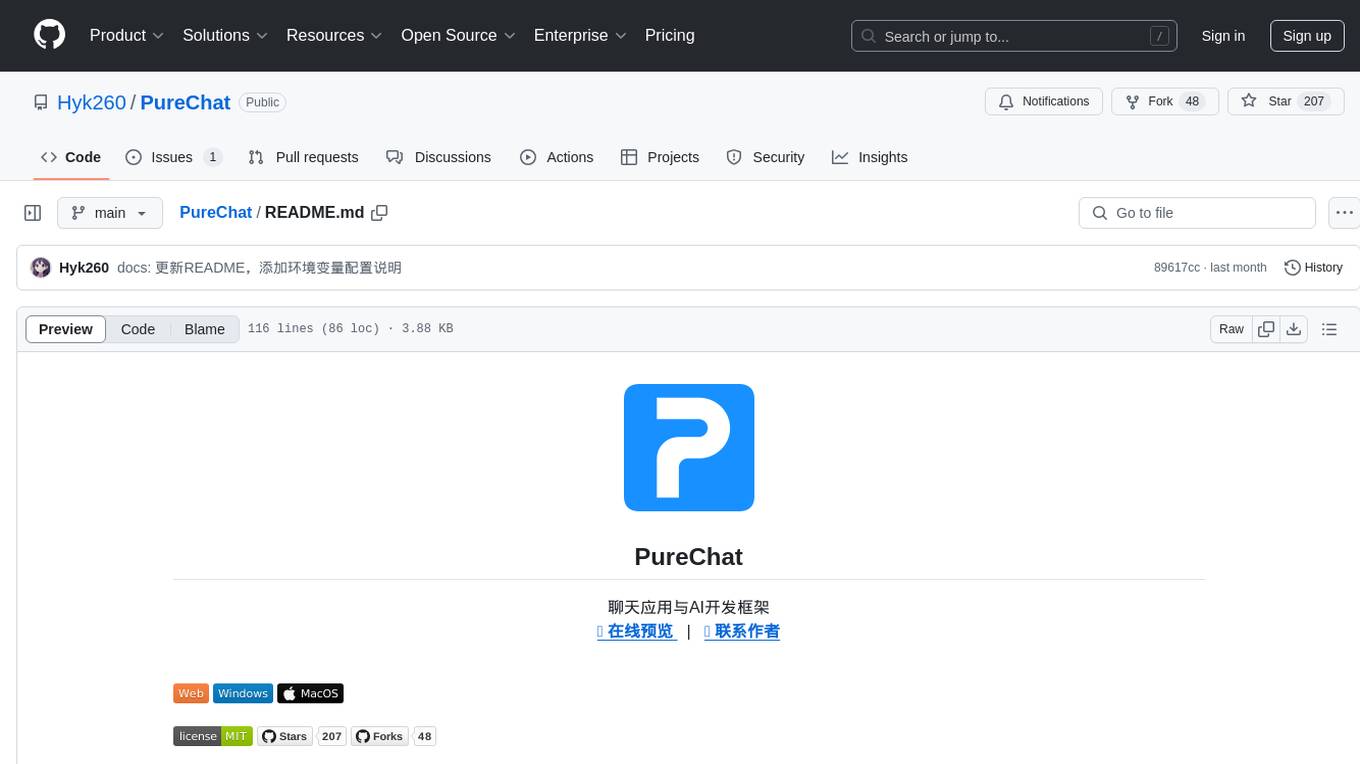
PureChat
PureChat is a chat application integrated with ChatGPT, featuring efficient application building with Vite5, screenshot generation and copy support for chat records, IM instant messaging SDK for sessions, automatic light and dark mode switching based on system theme, Markdown rendering, code highlighting, and link recognition support, seamless social experience with GitHub quick login, integration of large language models like ChatGPT Ollama for streaming output, preset prompts, and context, Electron desktop app versions for macOS and Windows, ongoing development of more features. Environment setup requires Node.js 18.20+. Clone code with 'git clone https://github.com/Hyk260/PureChat.git', install dependencies with 'pnpm install', start project with 'pnpm dev', and build with 'pnpm build'.
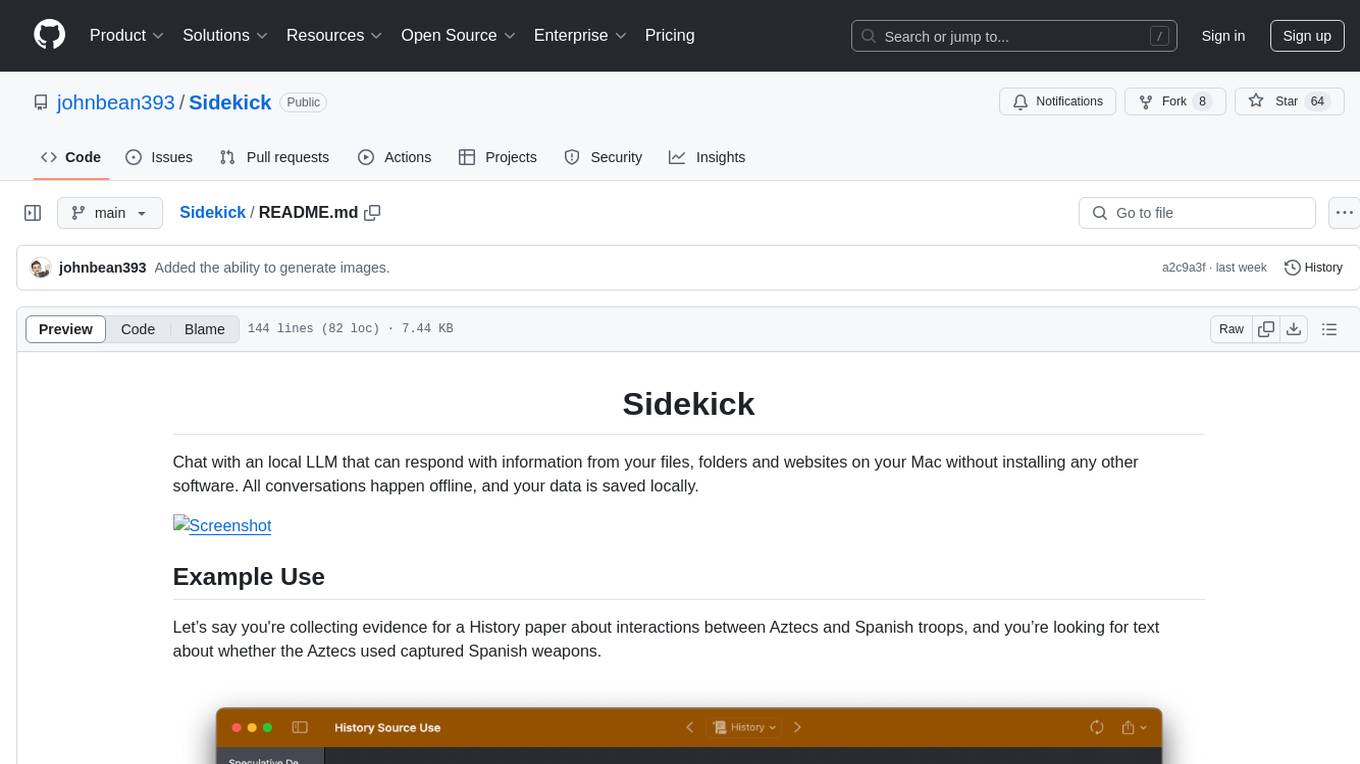
Sidekick
Sidekick is a native LLM application for macOS that allows users to chat with a local language model to retrieve information from files, folders, and websites without the need for additional software installation. It operates offline, ensuring data privacy and security. Sidekick offers features such as resource access, image generation, inline writing assistance, advanced markdown rendering, fast generation speeds, and more. The tool aims to provide a simple and powerful solution for accessing local, private models with context awareness of user files and content on the web.
Code-Atlas
Code Atlas is a lightweight interpreter developed in C++ that supports the execution of multi-language code snippets and partial Markdown rendering. It consumes significantly lower resources compared to similar tools, making it suitable for resource-limited devices. It leverages llama.cpp for local large-model inference and supports cloud-based large-model APIs. The tool provides features for code execution, Markdown rendering, local AI inference, and resource efficiency.
deepchat
DeepChat is a versatile chat tool that supports multiple model cloud services and local model deployment. It offers multi-channel chat concurrency support, platform compatibility, complete Markdown rendering, and easy usability with a comprehensive guide. The tool aims to enhance chat experiences by leveraging various AI models and ensuring efficient conversation management.
reachat
Reachat is a UI library designed for building chat experiences without the need for manual coding of components. Users can customize each component and theme using Tailwind. The library offers features such as console and companion modes, markdown rendering, code highlighting, tables, JSON support, math rendering, YouTube embeds, file uploads, message sources, animations, conversation pagination, keyboard shortcuts, responsive design, and more. Reachat is highly customizable and suitable for creating interactive chat interfaces.
For similar jobs
sweep
Sweep is an AI junior developer that turns bugs and feature requests into code changes. It automatically handles developer experience improvements like adding type hints and improving test coverage.
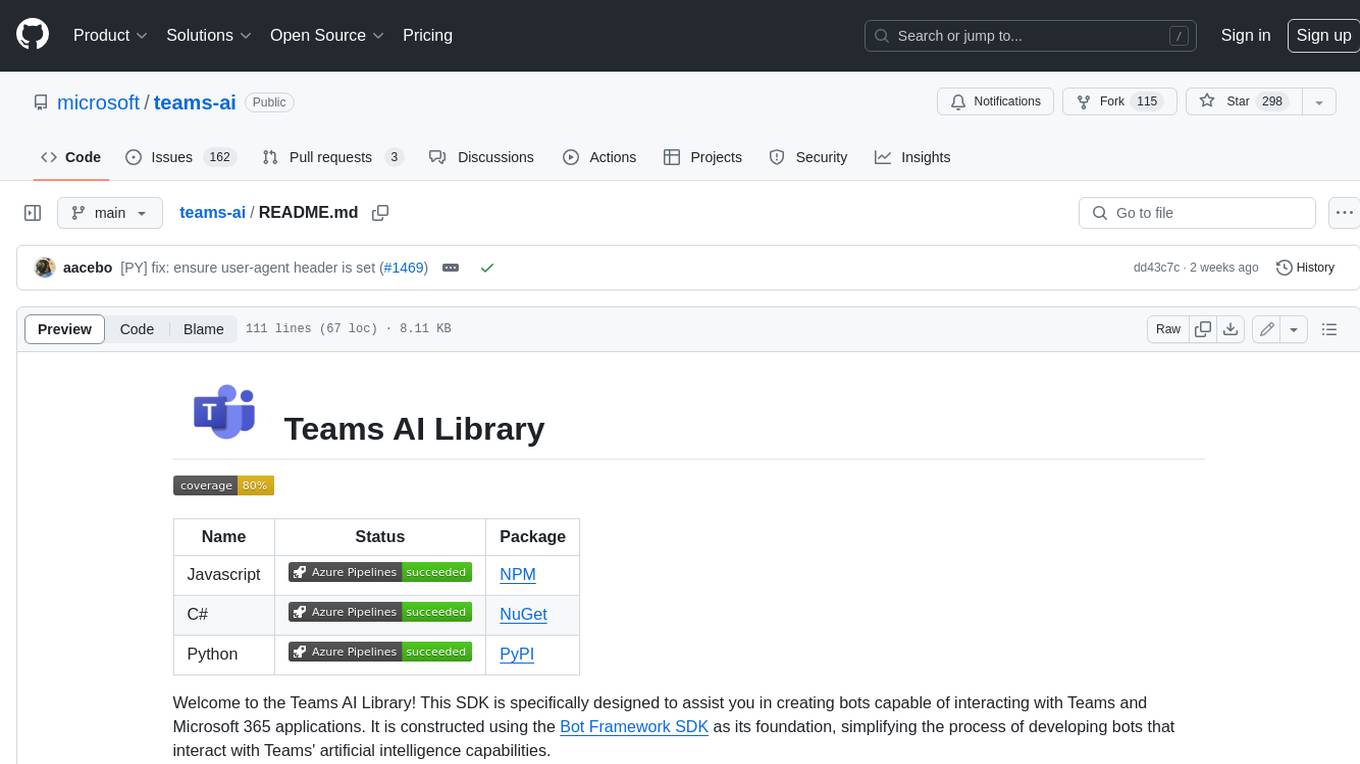
teams-ai
The Teams AI Library is a software development kit (SDK) that helps developers create bots that can interact with Teams and Microsoft 365 applications. It is built on top of the Bot Framework SDK and simplifies the process of developing bots that interact with Teams' artificial intelligence capabilities. The SDK is available for JavaScript/TypeScript, .NET, and Python.
ai-guide
This guide is dedicated to Large Language Models (LLMs) that you can run on your home computer. It assumes your PC is a lower-end, non-gaming setup.
classifai
Supercharge WordPress Content Workflows and Engagement with Artificial Intelligence. Tap into leading cloud-based services like OpenAI, Microsoft Azure AI, Google Gemini and IBM Watson to augment your WordPress-powered websites. Publish content faster while improving SEO performance and increasing audience engagement. ClassifAI integrates Artificial Intelligence and Machine Learning technologies to lighten your workload and eliminate tedious tasks, giving you more time to create original content that matters.
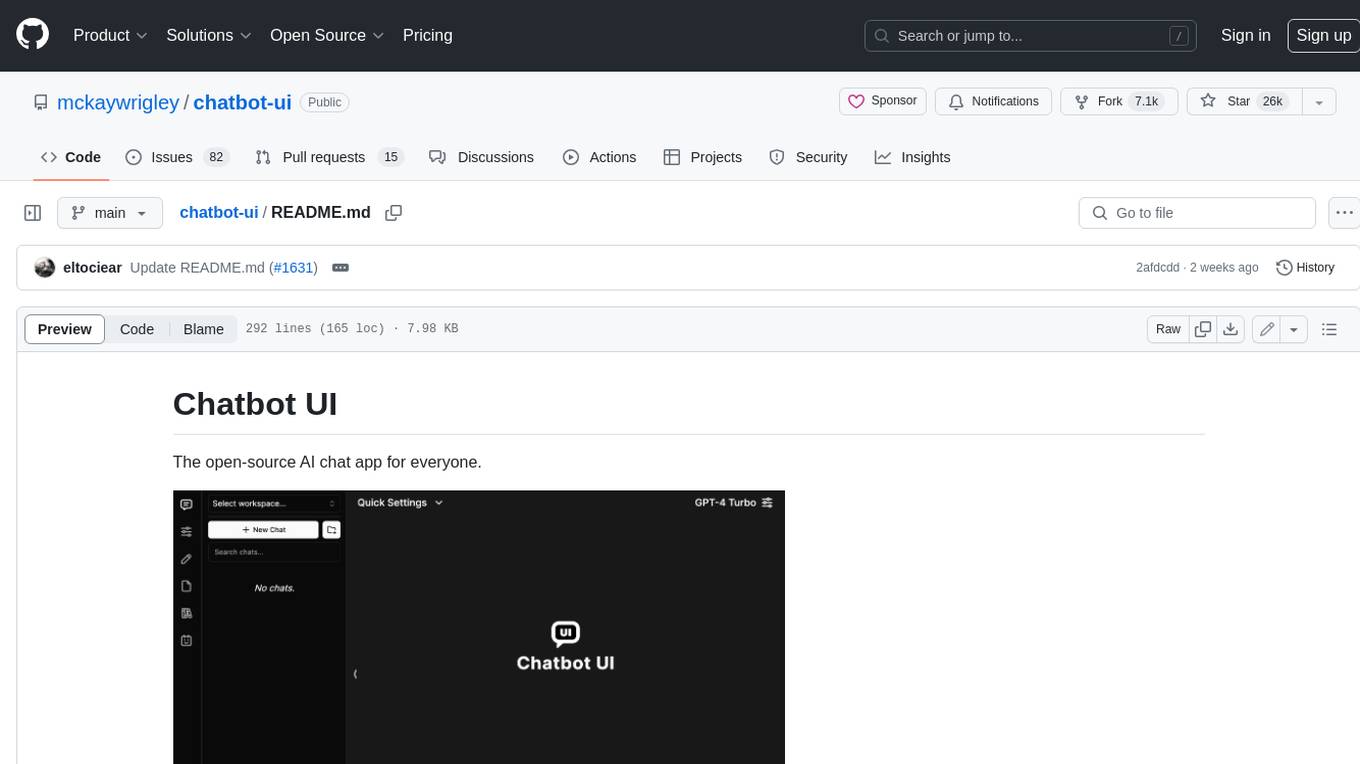
chatbot-ui
Chatbot UI is an open-source AI chat app that allows users to create and deploy their own AI chatbots. It is easy to use and can be customized to fit any need. Chatbot UI is perfect for businesses, developers, and anyone who wants to create a chatbot.
BricksLLM
BricksLLM is a cloud native AI gateway written in Go. Currently, it provides native support for OpenAI, Anthropic, Azure OpenAI and vLLM. BricksLLM aims to provide enterprise level infrastructure that can power any LLM production use cases. Here are some use cases for BricksLLM: * Set LLM usage limits for users on different pricing tiers * Track LLM usage on a per user and per organization basis * Block or redact requests containing PIIs * Improve LLM reliability with failovers, retries and caching * Distribute API keys with rate limits and cost limits for internal development/production use cases * Distribute API keys with rate limits and cost limits for students
uAgents
uAgents is a Python library developed by Fetch.ai that allows for the creation of autonomous AI agents. These agents can perform various tasks on a schedule or take action on various events. uAgents are easy to create and manage, and they are connected to a fast-growing network of other uAgents. They are also secure, with cryptographically secured messages and wallets.
griptape
Griptape is a modular Python framework for building AI-powered applications that securely connect to your enterprise data and APIs. It offers developers the ability to maintain control and flexibility at every step. Griptape's core components include Structures (Agents, Pipelines, and Workflows), Tasks, Tools, Memory (Conversation Memory, Task Memory, and Meta Memory), Drivers (Prompt and Embedding Drivers, Vector Store Drivers, Image Generation Drivers, Image Query Drivers, SQL Drivers, Web Scraper Drivers, and Conversation Memory Drivers), Engines (Query Engines, Extraction Engines, Summary Engines, Image Generation Engines, and Image Query Engines), and additional components (Rulesets, Loaders, Artifacts, Chunkers, and Tokenizers). Griptape enables developers to create AI-powered applications with ease and efficiency.