


memobase
Profile-Based Long-Term Memory for AI Applications
Stars: 994
Memobase is a user profile-based memory system designed to enhance Generative AI applications by enabling them to remember, understand, and evolve with users. It provides structured user profiles, scalable profiling, easy integration with existing LLM stacks, batch processing for speed, and is production-ready. Users can manage users, insert data, get memory profiles, and track user preferences and behaviors. Memobase is ideal for applications that require user analysis, tracking, and personalized interactions.
README:




Memobase is a user profile-based memory system designed to bring long-term user memory to your Generative AI (GenAI) applications. Whether you're building virtual companions, educational tools, or personalized assistants, Memobase empowers your AI to remember, understand, and evolve with your users.
Memobase can provide you structured user profiles of users, check out the result (compared with mem0) from a 900-turns real-world chatting:
Profile Output
{
  "basic_info": {
    "language_spoken": ["English", "Korean"],
    "name": "오*영"
  },
  "demographics": {
    "marital_status": "married"
  },
  "education": {
    "notes": "Had an English teacher who emphasized capitalization rules during school days",
    "major": "국어국문학과 (Korean Language and Literature)"
  },
  "interest": {
    "games": 'User is interested in Cyberpunk 2077 and wants to create a game better than it',
    'youtube_channels': "Kurzgesagt",
    ...
  },
  "psychological": {...},
  'work': {'working_industry': ..., 'title': ..., },
  ...
}- 🎯 Memory for User, not Agent: Define and control exactly what user information your AI captures.
- ➡️ Time-aware Memory: Memobase saves specific dates in profiles to prevent outdated information from affecting your AI. Check Memobase event for sequential events (episodic memory).
- 🖼️ Contorllable Memory: Among all types of memory, only some may enhance your product experience. Memobase offers a flexible configuration for you to design the profile.
- 🔌 Easy Integration: Minimal code changes to integrate with your existing LLM stack with API, Python/Node/Go SDK.
- ⚡️ Batch Processing: Industry-leading speeds via non-embedding system and session buffer. Fast & Cheap.
- 🚀 Production Ready: Battle-tested by our partners in production.

How Memobase works?
-
Start your Memobase Backend, you should have the below two things to continue:
-
A project url. default to
http://localhost:8019 -
A project token. default to
secret
-
-
Install the Python SDK:
pip install memobase -
Get ready to make AI remember your users now.
Here's a step-by-step guide and breakdown for you.
[!TIP]
You can just run this equivalent quickstart script
Or you can keep things super easy by using OpenAI SDK with Memobase., Ollama with Memobase
from memobase import MemoBaseClient, ChatBlob

mb = MemoBaseClient(
    project_url=PROJECT_URL,
    api_key=PROJECT_TOKEN,
)
assert mb.ping()uid = mb.add_user({"any_key": "any_value"})
mb.update_user(uid, {"any_key": "any_value2"})
u = mb.get_user(uid)
print(u)
# mb.delete(uid)In Memobase, all types of data are blobs to a user that can insert, get and delete:
messages = [
  {
      "role": "user",
      "content": "Hello, I'm Gus",
  },
  {
      "role": "assistant",
      "content": "Hi, nice to meet you, Gus!",
  }
]
bid = u.insert(ChatBlob(messages=messages))
print(u.get(bid)) # not found once you flush the memory.

# u.delete(bid)
Be default, Memobase will remove the blobs once they're processed. This means that apart from the relevant memory, your data will not be stored with Memobase. You can persist the blobs by adjusting the configuration file.
u.flush()And what will you get?
print(u.profile(need_json=True))

# results
{
  "basic_info": {
    "name": {
      "content": "Gus",
      "id": ...,
      "created_at": ...
    }
  }
}
u.profile() will return structured profiles that are learned from this user, including topic, sub_topic and content. As you insert more blobs, the profile will become better.
Why need a flush?
In Memobase, we don't memoize users in hot path. We use buffer zones for the recent inserted blobs.
When the buffer zone becomes too large (e.g., 1024 tokens) or remains idle for an extended period (e.g., 1 hour), Memobase will flush the entire buffer into memory. Alternatively, you can use flush() manually decide when to flush, such as when a chat session is closed in your app.
Memobase has a context api to pack everything you need into a simple string, where you can insert it into your prompt directly:
print(u.context(max_token_size=500, prefer_topics=["basic_info"]))Something like:
<memory>
# Below is the user profile:
- basic_info::name: Gus
...
# Below is the latest events of the user:
2025/02/24 04:25PM:
- work::meetings: Scheduled a meeting with John.
...
</memory>
Please provide your answer using the information within the <memory> tag at the appropriate time.
Checkout the detail params here.
- Checkout the quickstart script for more details
- You may want to explore the customization of Memobase to make sure the system works as your expectation.
- If you want to test Memobase on your own data, we offer a script that allows you to set multiple chat sessions and see how the memory grows.
By placing profiles into your AI (e.g. system prompt).
Demo
PROFILES = "\n".join([p.describe for p in u.profile()])

print(PROFILES)
# basic_info: name - Gus
# basic_info: age - 25
# ...
# interest: foods - Mexican cuisine
# psychological: goals - Build something that maybe useful
# ...Too much information is hidden in the conversations between users and AI, that's why you need a new data tracking method to record user preference and behavior.
Demo
PROFILES = u.profile()

def under_age_30(p):
  return p.sub_topic == "age" and int(p.content) < 30

def love_cat(p):
  return p.topic == "interest" and p.sub_topic == "pets" and "cat" in p.content

is_user_under_30 = (
    len([p for p in profiles if under_age_30(p)]) > 0
)
is_user_love_cat = (
  len([p for p in profiles if love_cat(p)]) > 0
)
...Not everyone is looking for Grammarly, it's always nice to sell something your users might want.
Demo
def pick_an_ad(profiles):
  work_titles = [p for p in profiles if p.topic=="work" and p.sub_topic=="title"]
  if not len(work_titles):
    return None
  wt = work_titles[0].content
  if wt == "Software Engineer":
    return "Deep Learning Stuff"
  elif wt == "some job":
    return "some ads"
...For detailed usage instructions, visit the documentation.
Star Memobase on Github to support and receive instant notifications!

Join the community for support and discussions:
Or Just email us ❤️
- Check out our Changelog first, make sure the feature you want has not been developed or is currently being planned.:)
- Go through Contributing document to setup and contribute to Memobase.
This project is licensed under the Apache 2.0 License - see the LICENSE file for details.
For Tasks:
Click tags to check more tools for each tasksFor Jobs:
Alternative AI tools for memobase
Similar Open Source Tools
memobase
Memobase is a user profile-based memory system designed to enhance Generative AI applications by enabling them to remember, understand, and evolve with users. It provides structured user profiles, scalable profiling, easy integration with existing LLM stacks, batch processing for speed, and is production-ready. Users can manage users, insert data, get memory profiles, and track user preferences and behaviors. Memobase is ideal for applications that require user analysis, tracking, and personalized interactions.
simpleAI
SimpleAI is a self-hosted alternative to the not-so-open AI API, focused on replicating main endpoints for LLM such as text completion, chat, edits, and embeddings. It allows quick experimentation with different models, creating benchmarks, and handling specific use cases without relying on external services. Users can integrate and declare models through gRPC, query endpoints using Swagger UI or API, and resolve common issues like CORS with FastAPI middleware. The project is open for contributions and welcomes PRs, issues, documentation, and more.
FlashLearn
FlashLearn is a tool that provides a simple interface and orchestration for incorporating Agent LLMs into workflows and ETL pipelines. It allows data transformations, classifications, summarizations, rewriting, and custom multi-step tasks using LLMs. Each step and task has a compact JSON definition, making pipelines easy to understand and maintain. FlashLearn supports LiteLLM, Ollama, OpenAI, DeepSeek, and other OpenAI-compatible clients.
openai
An open-source client package that allows developers to easily integrate the power of OpenAI's state-of-the-art AI models into their Dart/Flutter applications. The library provides simple and intuitive methods for making requests to OpenAI's various APIs, including the GPT-3 language model, DALL-E image generation, and more. It is designed to be lightweight and easy to use, enabling developers to focus on building their applications without worrying about the complexities of dealing with HTTP requests. Note that this is an unofficial library as OpenAI does not have an official Dart library.
vinagent
Vinagent is a lightweight and flexible library designed for building smart agent assistants across various industries. It provides a simple yet powerful foundation for creating AI-powered customer service bots, data analysis assistants, or domain-specific automation agents. With its modular tool system, users can easily extend their agent's capabilities by integrating a wide range of tools that are self-contained, well-documented, and can be registered dynamically. Vinagent allows users to scale and adapt their agents to new tasks or environments effortlessly.
call-center-ai
Call Center AI is an AI-powered call center solution that leverages Azure and OpenAI GPT. It is a proof of concept demonstrating the integration of Azure Communication Services, Azure Cognitive Services, and Azure OpenAI to build an automated call center solution. The project showcases features like accessing claims on a public website, customer conversation history, language change during conversation, bot interaction via phone number, multiple voice tones, lexicon understanding, todo list creation, customizable prompts, content filtering, GPT-4 Turbo for customer requests, specific data schema for claims, documentation database access, SMS report sending, conversation resumption, and more. The system architecture includes components like RAG AI Search, SMS gateway, call gateway, moderation, Cosmos DB, event broker, GPT-4 Turbo, Redis cache, translation service, and more. The tool can be deployed remotely using GitHub Actions and locally with prerequisites like Azure environment setup, configuration file creation, and resource hosting. Advanced usage includes custom training data with AI Search, prompt customization, language customization, moderation level customization, claim data schema customization, OpenAI compatible model usage for the LLM, and Twilio integration for SMS.
instructor
Instructor is a popular Python library for managing structured outputs from large language models (LLMs). It offers a user-friendly API for validation, retries, and streaming responses. With support for various LLM providers and multiple languages, Instructor simplifies working with LLM outputs. The library includes features like response models, retry management, validation, streaming support, and flexible backends. It also provides hooks for logging and monitoring LLM interactions, and supports integration with Anthropic, Cohere, Gemini, Litellm, and Google AI models. Instructor facilitates tasks such as extracting user data from natural language, creating fine-tuned models, managing uploaded files, and monitoring usage of OpenAI models.
suno-api
Suno AI API is an open-source project that allows developers to integrate the music generation capabilities of Suno.ai into their own applications. The API provides a simple and convenient way to generate music, lyrics, and other audio content using Suno.ai's powerful AI models. With Suno AI API, developers can easily add music generation functionality to their apps, websites, and other projects.
claim-ai-phone-bot
AI-powered call center solution with Azure and OpenAI GPT. The bot can answer calls, understand the customer's request, and provide relevant information or assistance. It can also create a todo list of tasks to complete the claim, and send a report after the call. The bot is customizable, and can be used in multiple languages.
ash_ai
Ash AI is a tool that provides a Model Context Protocol (MCP) server for exposing tool definitions to an MCP client. It allows for the installation of dev and production MCP servers, and supports features like OAuth2 flow with AshAuthentication, tool data access, tool execution callbacks, prompt-backed actions, and vectorization strategies. Users can also generate a chat feature for their Ash & Phoenix application using `ash_oban` and `ash_postgres`, and specify LLM API keys for OpenAI. The tool is designed to help developers experiment with tools and actions, monitor tool execution, and expose actions as tool calls.
llm-rag-workshop
The LLM RAG Workshop repository provides a workshop on using Large Language Models (LLMs) and Retrieval-Augmented Generation (RAG) to generate and understand text in a human-like manner. It includes instructions on setting up the environment, indexing Zoomcamp FAQ documents, creating a Q&A system, and using OpenAI for generation based on retrieved information. The repository focuses on enhancing language model responses with retrieved information from external sources, such as document databases or search engines, to improve factual accuracy and relevance of generated text.
swarmzero
SwarmZero SDK is a library that simplifies the creation and execution of AI Agents and Swarms of Agents. It supports various LLM Providers such as OpenAI, Azure OpenAI, Anthropic, MistralAI, Gemini, Nebius, and Ollama. Users can easily install the library using pip or poetry, set up the environment and configuration, create and run Agents, collaborate with Swarms, add tools for complex tasks, and utilize retriever tools for semantic information retrieval. Sample prompts are provided to help users explore the capabilities of the agents and swarms. The SDK also includes detailed examples and documentation for reference.
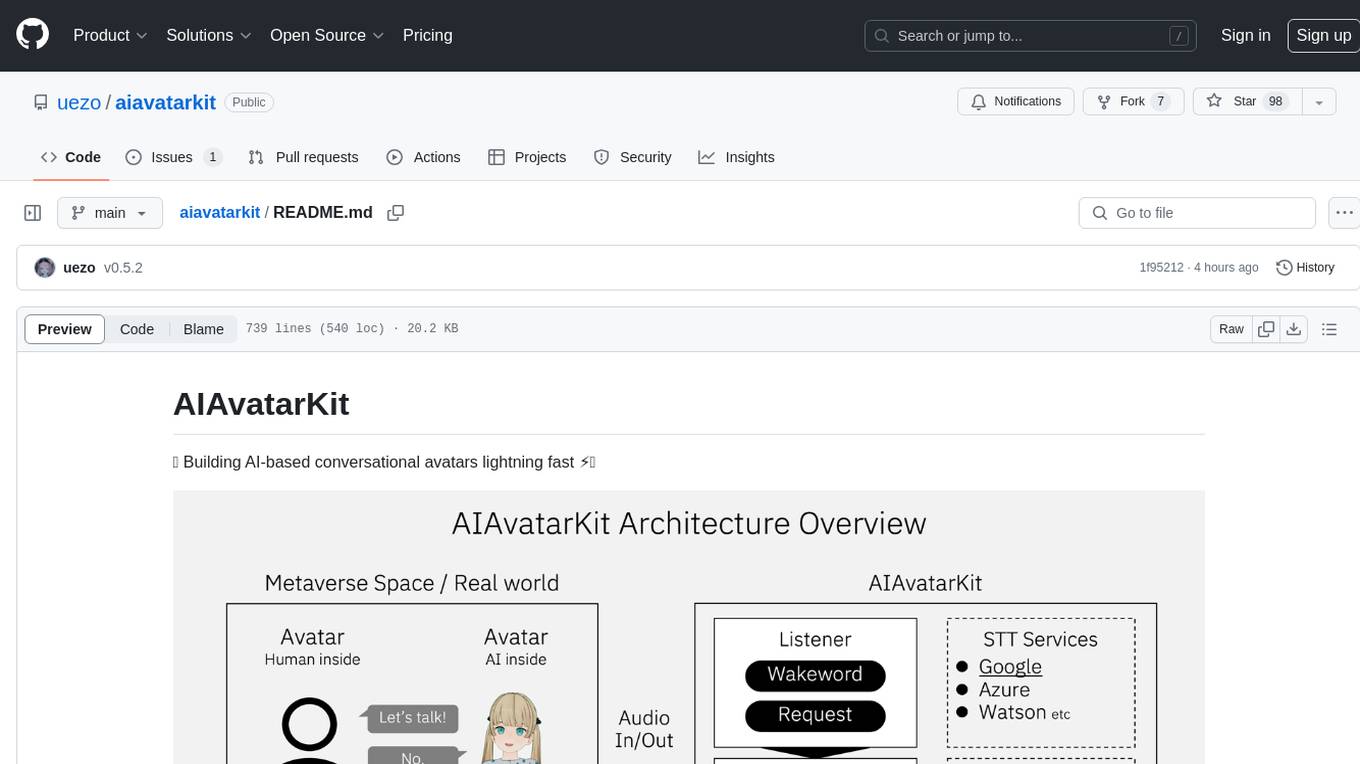
aiavatarkit
AIAvatarKit is a tool for building AI-based conversational avatars quickly. It supports various platforms like VRChat and cluster, along with real-world devices. The tool is extensible, allowing unlimited capabilities based on user needs. It requires VOICEVOX API, Google or Azure Speech Services API keys, and Python 3.10. Users can start conversations out of the box and enjoy seamless interactions with the avatars.
uzu-swift
Swift package for uzu, a high-performance inference engine for AI models on Apple Silicon. Deploy AI directly in your app with zero latency, full data privacy, and no inference costs. Key features include a simple, high-level API, specialized configurations for performance boosts, broad model support, and an observable model manager. Easily set up projects, obtain an API key, choose a model, and run it with corresponding identifiers. Examples include chat, speedup with speculative decoding, chat with dynamic context, chat with static context, summarization, classification, cloud, and structured output. Troubleshooting available via Discord or email. Licensed under MIT.
pandas-ai
PandaAI is a Python platform that enables users to interact with their data in natural language, catering to both non-technical and technical users. It simplifies data querying and analysis, offering conversational data analytics capabilities with minimal code. Users can ask questions, visualize charts, and compare dataframes effortlessly. The tool aims to streamline data exploration and decision-making processes by providing a user-friendly interface for data manipulation and analysis.
instructor
Instructor is a Python library that makes it a breeze to work with structured outputs from large language models (LLMs). Built on top of Pydantic, it provides a simple, transparent, and user-friendly API to manage validation, retries, and streaming responses. Get ready to supercharge your LLM workflows!
For similar tasks
memobase
Memobase is a user profile-based memory system designed to enhance Generative AI applications by enabling them to remember, understand, and evolve with users. It provides structured user profiles, scalable profiling, easy integration with existing LLM stacks, batch processing for speed, and is production-ready. Users can manage users, insert data, get memory profiles, and track user preferences and behaviors. Memobase is ideal for applications that require user analysis, tracking, and personalized interactions.
For similar jobs

sweep
Sweep is an AI junior developer that turns bugs and feature requests into code changes. It automatically handles developer experience improvements like adding type hints and improving test coverage.

teams-ai
The Teams AI Library is a software development kit (SDK) that helps developers create bots that can interact with Teams and Microsoft 365 applications. It is built on top of the Bot Framework SDK and simplifies the process of developing bots that interact with Teams' artificial intelligence capabilities. The SDK is available for JavaScript/TypeScript, .NET, and Python.

ai-guide
This guide is dedicated to Large Language Models (LLMs) that you can run on your home computer. It assumes your PC is a lower-end, non-gaming setup.

classifai
Supercharge WordPress Content Workflows and Engagement with Artificial Intelligence. Tap into leading cloud-based services like OpenAI, Microsoft Azure AI, Google Gemini and IBM Watson to augment your WordPress-powered websites. Publish content faster while improving SEO performance and increasing audience engagement. ClassifAI integrates Artificial Intelligence and Machine Learning technologies to lighten your workload and eliminate tedious tasks, giving you more time to create original content that matters.

chatbot-ui
Chatbot UI is an open-source AI chat app that allows users to create and deploy their own AI chatbots. It is easy to use and can be customized to fit any need. Chatbot UI is perfect for businesses, developers, and anyone who wants to create a chatbot.

BricksLLM
BricksLLM is a cloud native AI gateway written in Go. Currently, it provides native support for OpenAI, Anthropic, Azure OpenAI and vLLM. BricksLLM aims to provide enterprise level infrastructure that can power any LLM production use cases. Here are some use cases for BricksLLM: * Set LLM usage limits for users on different pricing tiers * Track LLM usage on a per user and per organization basis * Block or redact requests containing PIIs * Improve LLM reliability with failovers, retries and caching * Distribute API keys with rate limits and cost limits for internal development/production use cases * Distribute API keys with rate limits and cost limits for students

uAgents
uAgents is a Python library developed by Fetch.ai that allows for the creation of autonomous AI agents. These agents can perform various tasks on a schedule or take action on various events. uAgents are easy to create and manage, and they are connected to a fast-growing network of other uAgents. They are also secure, with cryptographically secured messages and wallets.

griptape
Griptape is a modular Python framework for building AI-powered applications that securely connect to your enterprise data and APIs. It offers developers the ability to maintain control and flexibility at every step. Griptape's core components include Structures (Agents, Pipelines, and Workflows), Tasks, Tools, Memory (Conversation Memory, Task Memory, and Meta Memory), Drivers (Prompt and Embedding Drivers, Vector Store Drivers, Image Generation Drivers, Image Query Drivers, SQL Drivers, Web Scraper Drivers, and Conversation Memory Drivers), Engines (Query Engines, Extraction Engines, Summary Engines, Image Generation Engines, and Image Query Engines), and additional components (Rulesets, Loaders, Artifacts, Chunkers, and Tokenizers). Griptape enables developers to create AI-powered applications with ease and efficiency.