


pi-mono
AI agent toolkit: coding agent CLI, unified LLM API, TUI & web UI libraries, Slack bot, vLLM pods
Stars: 14675
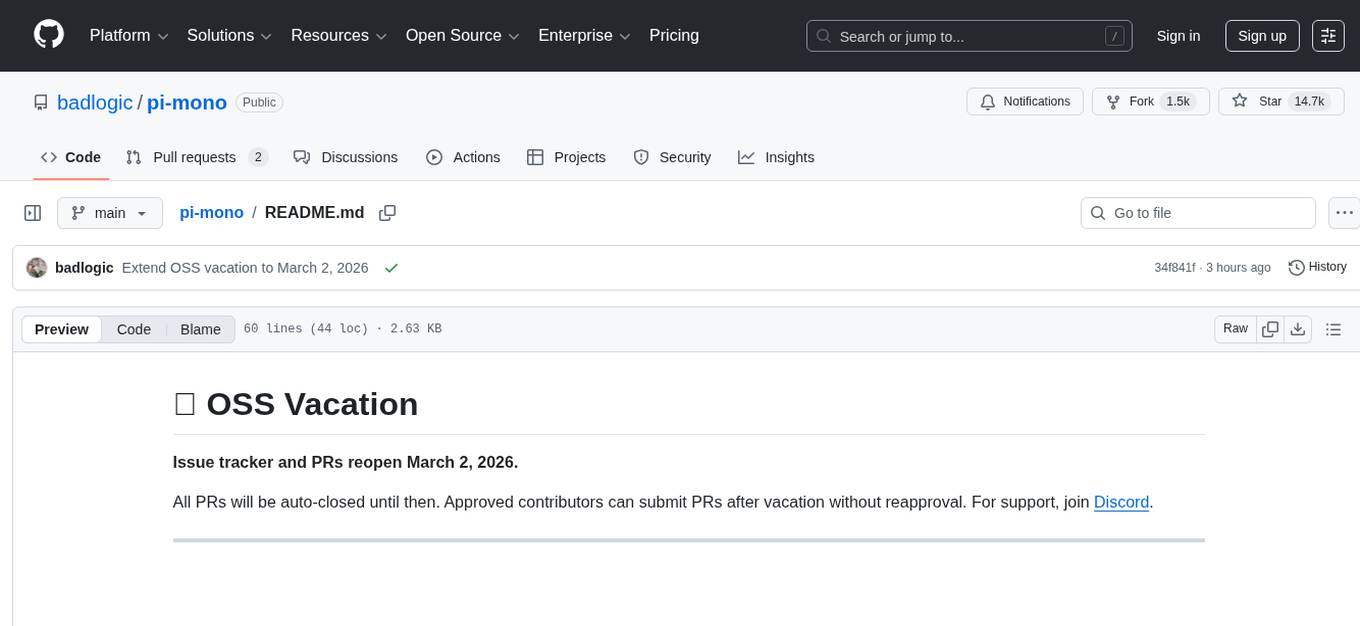
Pi Monorepo is a collection of tools designed for building AI agents and managing LLM deployments. It includes packages for unified multi-provider LLM API, agent runtime with tool calling and state management, interactive coding agent CLI, Slack bot for message delegation, terminal UI library, web components for AI chat interfaces, and CLI for managing vLLM deployments on GPU pods. The repository provides guidelines for contributing and specific rules for humans and agents. Development involves installing dependencies, building packages, linting, formatting, type checking, and running tests. The project is licensed under MIT.
README:
Issue tracker and PRs reopen February 23, 2026.
All PRs will be auto-closed until then. Approved contributors can submit PRs after vacation without reapproval. For support, join Discord.



pi.dev domain graciously donated by

exe.dev
Looking for the pi coding agent? See packages/coding-agent for installation and usage.
Tools for building AI agents and managing LLM deployments.
| Package | Description |
|---|---|
| @mariozechner/pi-ai | Unified multi-provider LLM API (OpenAI, Anthropic, Google, etc.) |
| @mariozechner/pi-agent-core | Agent runtime with tool calling and state management |
| @mariozechner/pi-coding-agent | Interactive coding agent CLI |
| @mariozechner/pi-mom | Slack bot that delegates messages to the pi coding agent |
| @mariozechner/pi-tui | Terminal UI library with differential rendering |
| @mariozechner/pi-web-ui | Web components for AI chat interfaces |
| @mariozechner/pi-pods | CLI for managing vLLM deployments on GPU pods |
See CONTRIBUTING.md for contribution guidelines and AGENTS.md for project-specific rules (for both humans and agents).
npm install          # Install all dependencies
npm run build        # Build all packages
npm run check        # Lint, format, and type check
./test.sh            # Run tests (skips LLM-dependent tests without API keys)
./pi-test.sh         # Run pi from sources (must be run from repo root)
Note:
npm run checkrequiresnpm run buildto be run first. The web-ui package usestscwhich needs compiled.d.tsfiles from dependencies.
MIT
For Tasks:
Click tags to check more tools for each tasksFor Jobs:
Alternative AI tools for pi-mono
Similar Open Source Tools
pi-mono
Pi Monorepo is a collection of tools designed for building AI agents and managing LLM deployments. It includes packages for unified multi-provider LLM API, agent runtime with tool calling and state management, interactive coding agent CLI, Slack bot for message delegation, terminal UI library, web components for AI chat interfaces, and CLI for managing vLLM deployments on GPU pods. The repository provides guidelines for contributing and specific rules for humans and agents. Development involves installing dependencies, building packages, linting, formatting, type checking, and running tests. The project is licensed under MIT.
yournextstore
Your Next Store is an open-source Next.js e-commerce platform designed for AI development. It offers a Stripe-native integration, ultra-fast page loads, and typed APIs. The codebase follows consistent patterns, provides blazing fast performance with Next.js 16 and edge caching, and allows direct API integration without the need for plugins. With a focus on AI coding tools, Your Next Store offers familiar patterns, typed APIs for Commerce Kit SDK methods, and a well-defined domain for commerce data models, making it easier for AI models to generate accurate suggestions and write correct code.
nexus
Nexus is a virtual filesystem server designed for AI agents, offering a unified path-based API that integrates files, databases, APIs, and SaaS tools. It provides built-in permissions, memory management, semantic search, and skills lifecycle management. The Nexus Control Panel allows humans to curate files, memories, permissions, and integrations for agents, ensuring oversight and control while agents focus on execution. The repository includes the open-source server, SDK, CLI, and examples, catering to the needs of AI-native filesystems for cognitive agents.
proxypal
ProxyPal is a desktop app that allows users to utilize multiple AI subscriptions (such as Claude, ChatGPT, Gemini, GitHub Copilot) with any coding tool. It acts as a bridge between various AI providers and coding tools, offering features like connecting to different AI services, GitHub Copilot integration, Antigravity support, usage analytics, request monitoring, and auto-configuration. The app supports multiple platforms and clients, providing a seamless experience for developers to leverage AI capabilities in their coding workflow. ProxyPal simplifies the process of using AI models in coding environments, enhancing productivity and efficiency.
graphbit
GraphBit is an industry-grade agentic AI framework built for developers and AI teams that demand stability, scalability, and low resource usage. It is written in Rust for maximum performance and safety, delivering significantly lower CPU usage and memory footprint compared to leading alternatives. The framework is designed to run multi-agent workflows in parallel, persist memory across steps, recover from failures, and ensure 100% task success under load. With lightweight architecture, observability, and concurrency support, GraphBit is suitable for deployment in high-scale enterprise environments and low-resource edge scenarios.
InsForge
InsForge is a backend development platform designed for AI coding agents and AI code editors. It serves as a semantic layer that enables agents to interact with backend primitives such as databases, authentication, storage, and functions in a meaningful way. The platform allows agents to fetch backend context, configure primitives, and inspect backend state through structured schemas. InsForge facilitates backend context engineering for AI coding agents to understand, operate, and monitor backend systems effectively.
airunner
AI Runner is a multi-modal AI interface that allows users to run open-source large language models and AI image generators on their own hardware. The tool provides features such as voice-based chatbot conversations, text-to-speech, speech-to-text, vision-to-text, text generation with large language models, image generation capabilities, image manipulation tools, utility functions, and more. It aims to provide a stable and user-friendly experience with security updates, a new UI, and a streamlined installation process. The application is designed to run offline on users' hardware without relying on a web server, offering a smooth and responsive user experience.
agentsys
AgentSys is a modular runtime and orchestration system for AI agents, with 14 plugins, 43 agents, and 30 skills that compose into structured pipelines for software development. Each agent has a single responsibility, a specific model assignment, and defined inputs/outputs. The system runs on Claude Code, OpenCode, and Codex CLI, and plugins are fetched automatically from their repos. AgentSys orchestrates agents to handle tasks like task selection, branch management, code review, artifact cleanup, CI, PR comments, and deployment.
flow-like
Flow-Like is an enterprise-grade workflow operating system built upon Rust for uncompromising performance, efficiency, and code safety. It offers a modular frontend for apps, a rich set of events, a node catalog, a powerful no-code workflow IDE, and tools to manage teams, templates, and projects within organizations. With typed workflows, users can create complex, large-scale workflows with clear data origins, transformations, and contracts. Flow-Like is designed to automate any process through seamless integration of LLM, ML-based, and deterministic decision-making instances.
EvoAgentX
EvoAgentX is an open-source framework for building, evaluating, and evolving LLM-based agents or agentic workflows in an automated, modular, and goal-driven manner. It enables developers and researchers to move beyond static prompt chaining or manual workflow orchestration by introducing a self-evolving agent ecosystem. The framework includes features such as agent workflow autoconstruction, built-in evaluation, self-evolution engine, plug-and-play compatibility, comprehensive built-in tools, memory module support, and human-in-the-loop interactions.
db2rest
DB2Rest is a modern low code REST DATA API platform that enables the rapid development of intelligent applications by combining databases, language models, and vector stores. It facilitates context-aware, reasoning applications without vendor lock-in. The tool accelerates application delivery, fosters faster innovation with AI, serves as a secure database gateway, and simplifies integration. It supports various databases like PostgreSQL, MySQL, MS SQL Server, Oracle, MongoDB, and more, with planned support for additional databases. Users can connect on Discord for support and contact [email protected] for inquiries.
MemMachine
MemMachine is an open-source long-term memory layer designed for AI agents and LLM-powered applications. It enables AI to learn, store, and recall information from past sessions, transforming stateless chatbots into personalized, context-aware assistants. With capabilities like episodic memory, profile memory, working memory, and agent memory persistence, MemMachine offers a developer-friendly API, flexible storage options, and seamless integration with various AI frameworks. It is suitable for developers, researchers, and teams needing persistent, cross-session memory for their LLM applications.
ToolJet
ToolJet is an open-source platform for building and deploying internal tools, workflows, and AI agents. It offers a visual builder with drag-and-drop UI, integrations with databases, APIs, SaaS apps, and object storage. The community edition includes features like a visual app builder, ToolJet database, multi-page apps, collaboration tools, extensibility with plugins, code execution, and security measures. ToolJet AI, the enterprise version, adds AI capabilities for app generation, query building, debugging, agent creation, security compliance, user management, environment management, GitSync, branding, access control, embedded apps, and enterprise support.
agentsys
AgentSys is a modular runtime and orchestration system for AI agents, with 13 plugins, 42 agents, and 28 skills that compose into structured pipelines for software development. It handles task selection, branch management, code review, artifact cleanup, CI, PR comments, and deployment. The system runs on Claude Code, OpenCode, and Codex CLI, providing a functional software suite and runtime for AI agent orchestration.
deepchat
DeepChat is a versatile chat tool that supports multiple model cloud services and local model deployment. It offers multi-channel chat concurrency support, platform compatibility, complete Markdown rendering, and easy usability with a comprehensive guide. The tool aims to enhance chat experiences by leveraging various AI models and ensuring efficient conversation management.
jean
Jean is an AI assistant application that helps manage multiple projects, worktrees, and sessions with Claude CLI. It provides automated worktree management, context loading from sessions and GitHub, magic Git commands/prompts, merge conflict resolution, worktree/archiving, and more. The tool is designed to streamline project management and version control tasks.
For similar tasks
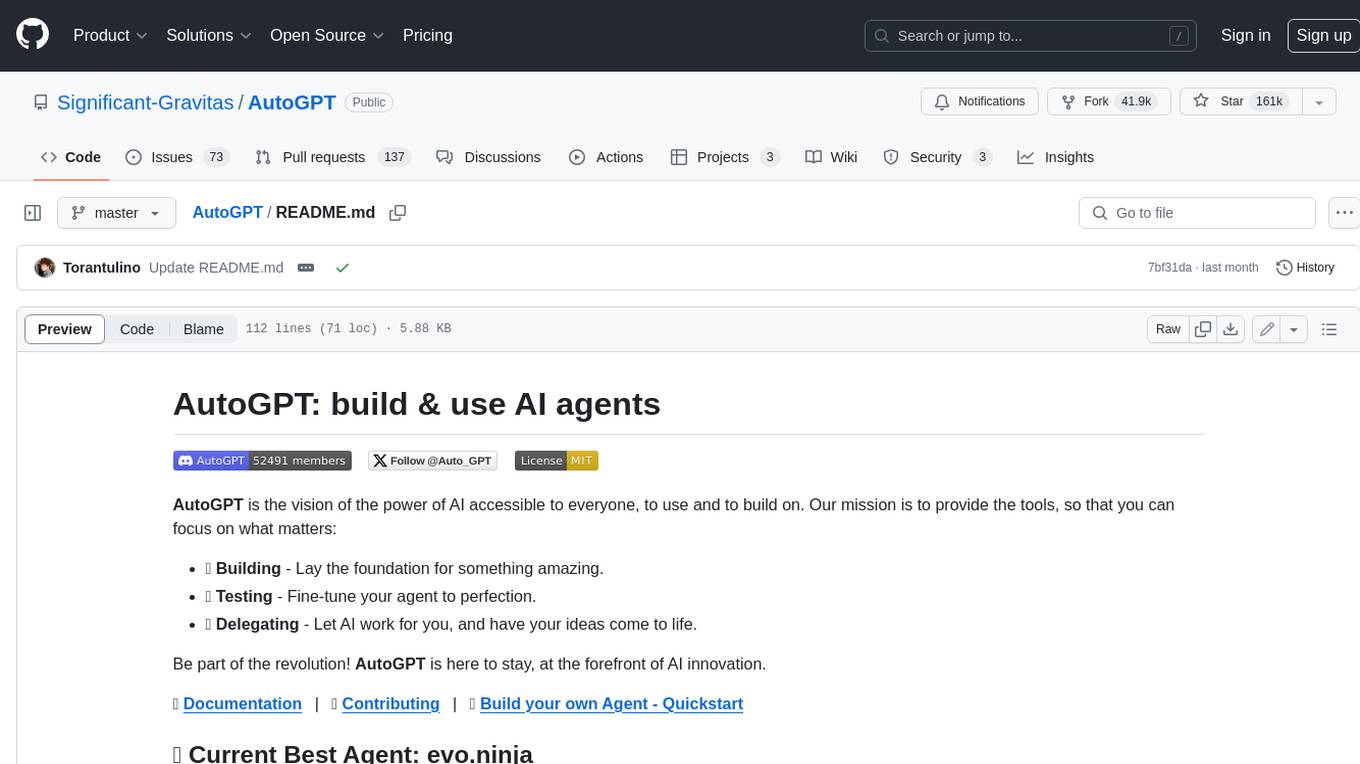
AutoGPT
AutoGPT is a revolutionary tool that empowers everyone to harness the power of AI. With AutoGPT, you can effortlessly build, test, and delegate tasks to AI agents, unlocking a world of possibilities. Our mission is to provide the tools you need to focus on what truly matters: innovation and creativity.
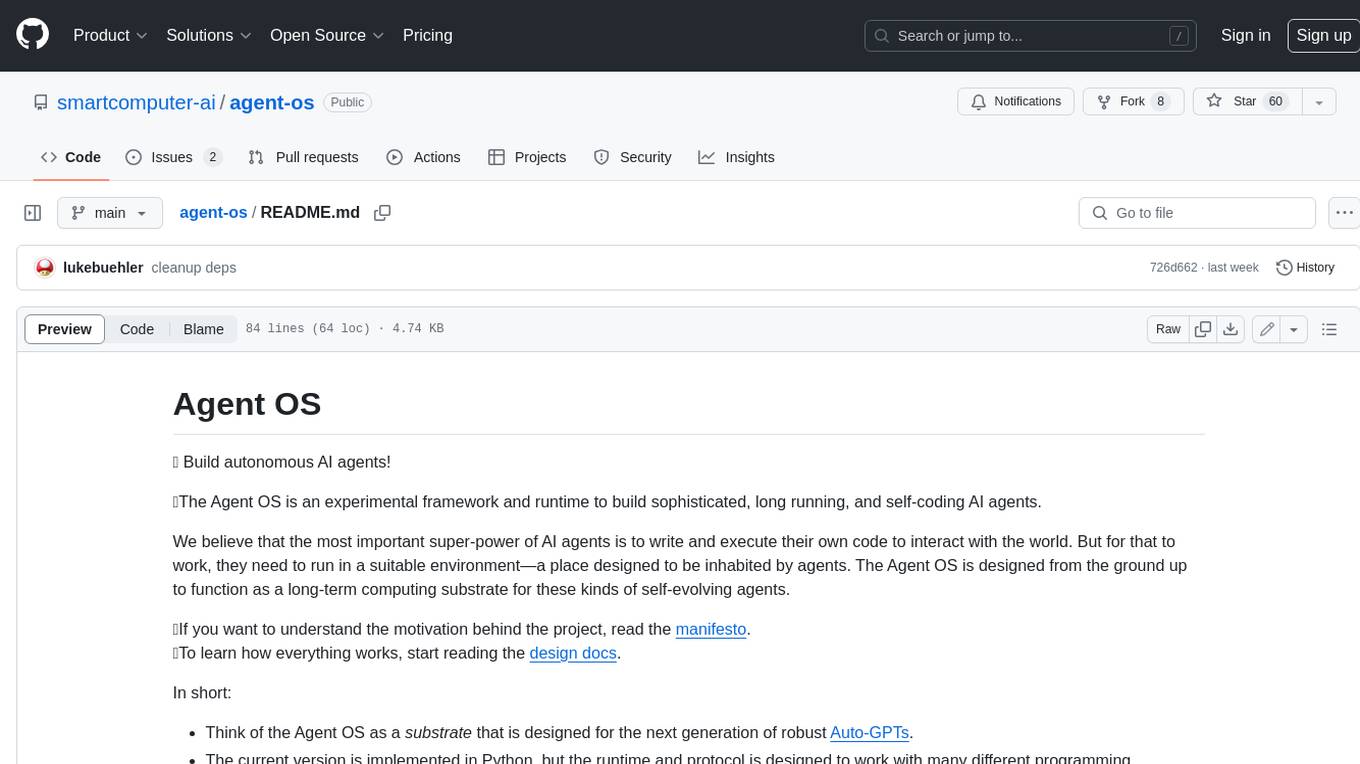
agent-os
The Agent OS is an experimental framework and runtime to build sophisticated, long running, and self-coding AI agents. We believe that the most important super-power of AI agents is to write and execute their own code to interact with the world. But for that to work, they need to run in a suitable environment—a place designed to be inhabited by agents. The Agent OS is designed from the ground up to function as a long-term computing substrate for these kinds of self-evolving agents.
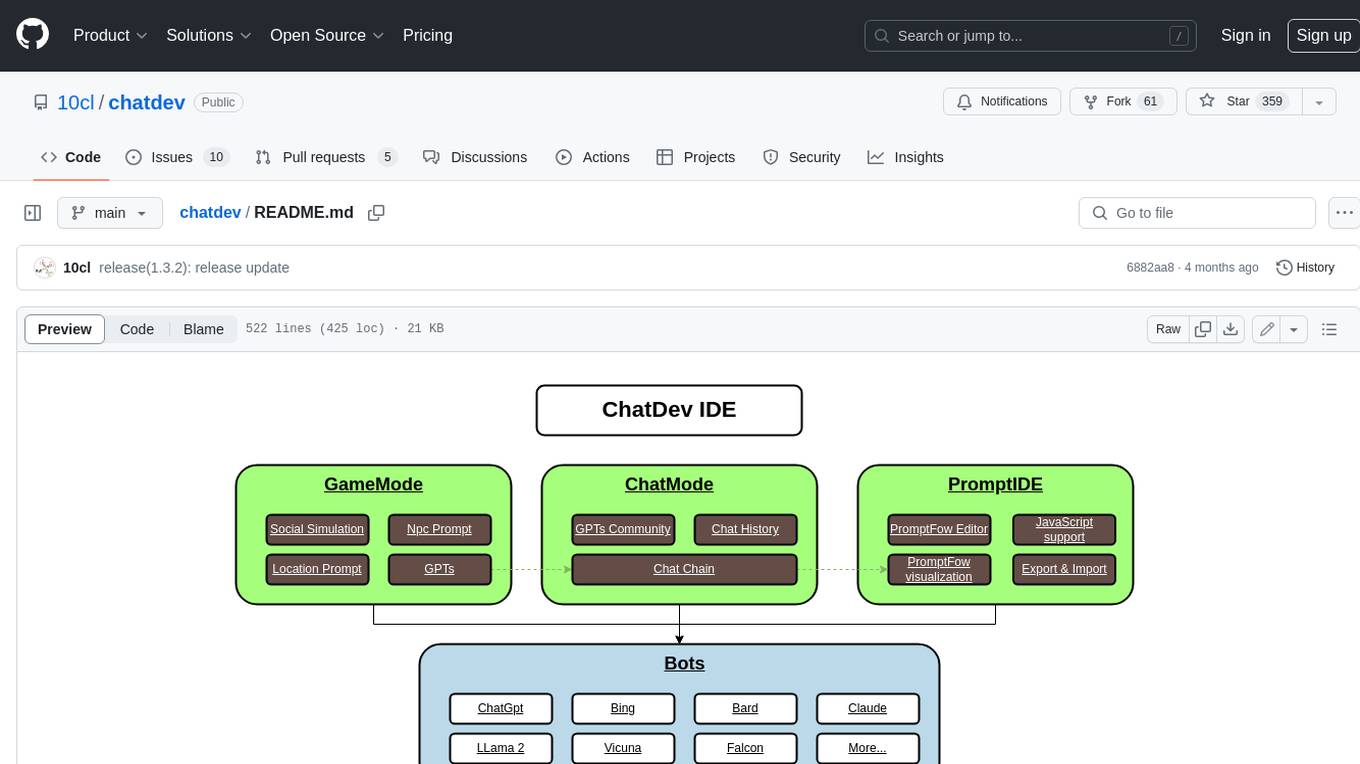
chatdev
ChatDev IDE is a tool for building your AI agent, Whether it's NPCs in games or powerful agent tools, you can design what you want for this platform. It accelerates prompt engineering through **JavaScript Support** that allows implementing complex prompting techniques.
module-ballerinax-ai.agent
This library provides functionality required to build ReAct Agent using Large Language Models (LLMs).
npi
NPi is an open-source platform providing Tool-use APIs to empower AI agents with the ability to take action in the virtual world. It is currently under active development, and the APIs are subject to change in future releases. NPi offers a command line tool for installation and setup, along with a GitHub app for easy access to repositories. The platform also includes a Python SDK and examples like Calendar Negotiator and Twitter Crawler. Join the NPi community on Discord to contribute to the development and explore the roadmap for future enhancements.
ai-agents
The 'ai-agents' repository is a collection of books and resources focused on developing AI agents, including topics such as GPT models, building AI agents from scratch, machine learning theory and practice, and basic methods and tools for data analysis. The repository provides detailed explanations and guidance for individuals interested in learning about and working with AI agents.
llms
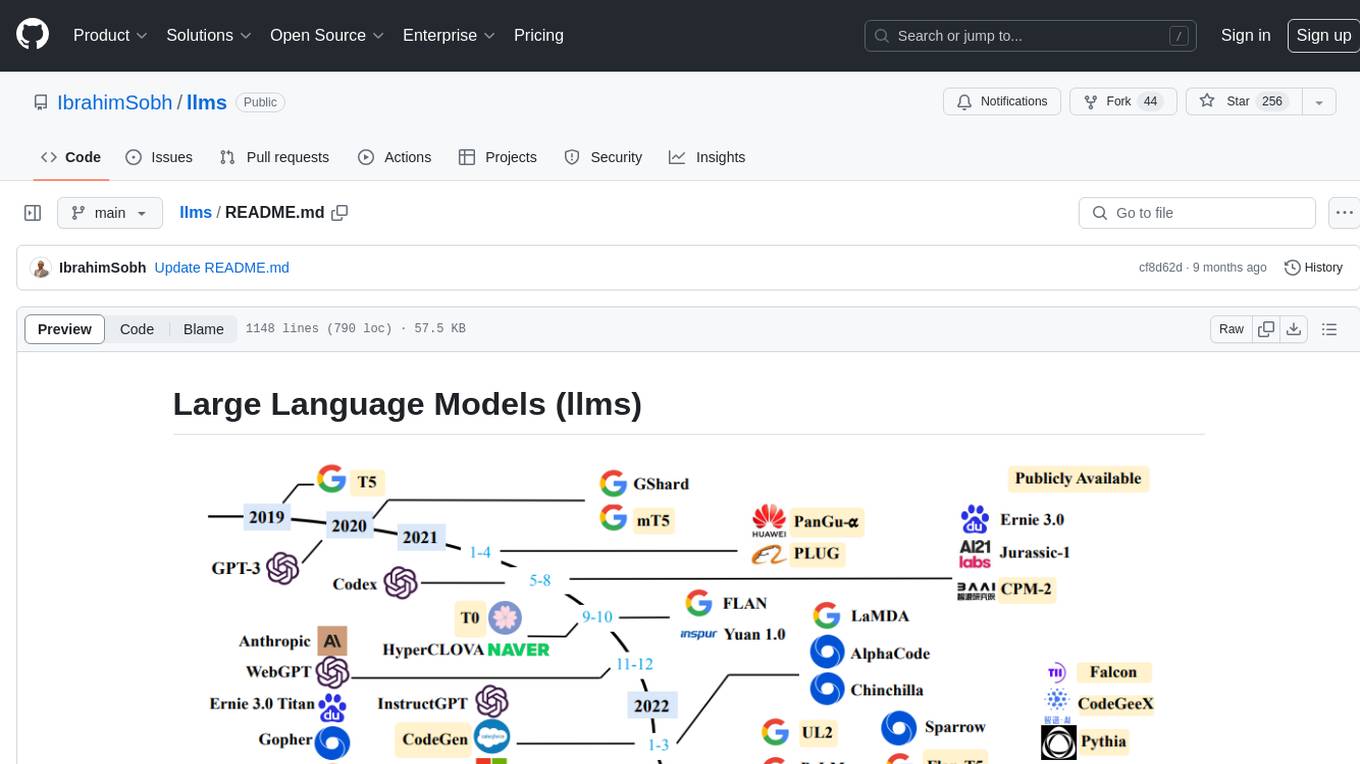
The 'llms' repository is a comprehensive guide on Large Language Models (LLMs), covering topics such as language modeling, applications of LLMs, statistical language modeling, neural language models, conditional language models, evaluation methods, transformer-based language models, practical LLMs like GPT and BERT, prompt engineering, fine-tuning LLMs, retrieval augmented generation, AI agents, and LLMs for computer vision. The repository provides detailed explanations, examples, and tools for working with LLMs.
ai-app
The 'ai-app' repository is a comprehensive collection of tools and resources related to artificial intelligence, focusing on topics such as server environment setup, PyCharm and Anaconda installation, large model deployment and training, Transformer principles, RAG technology, vector databases, AI image, voice, and music generation, and AI Agent frameworks. It also includes practical guides and tutorials on implementing various AI applications. The repository serves as a valuable resource for individuals interested in exploring different aspects of AI technology.
For similar jobs
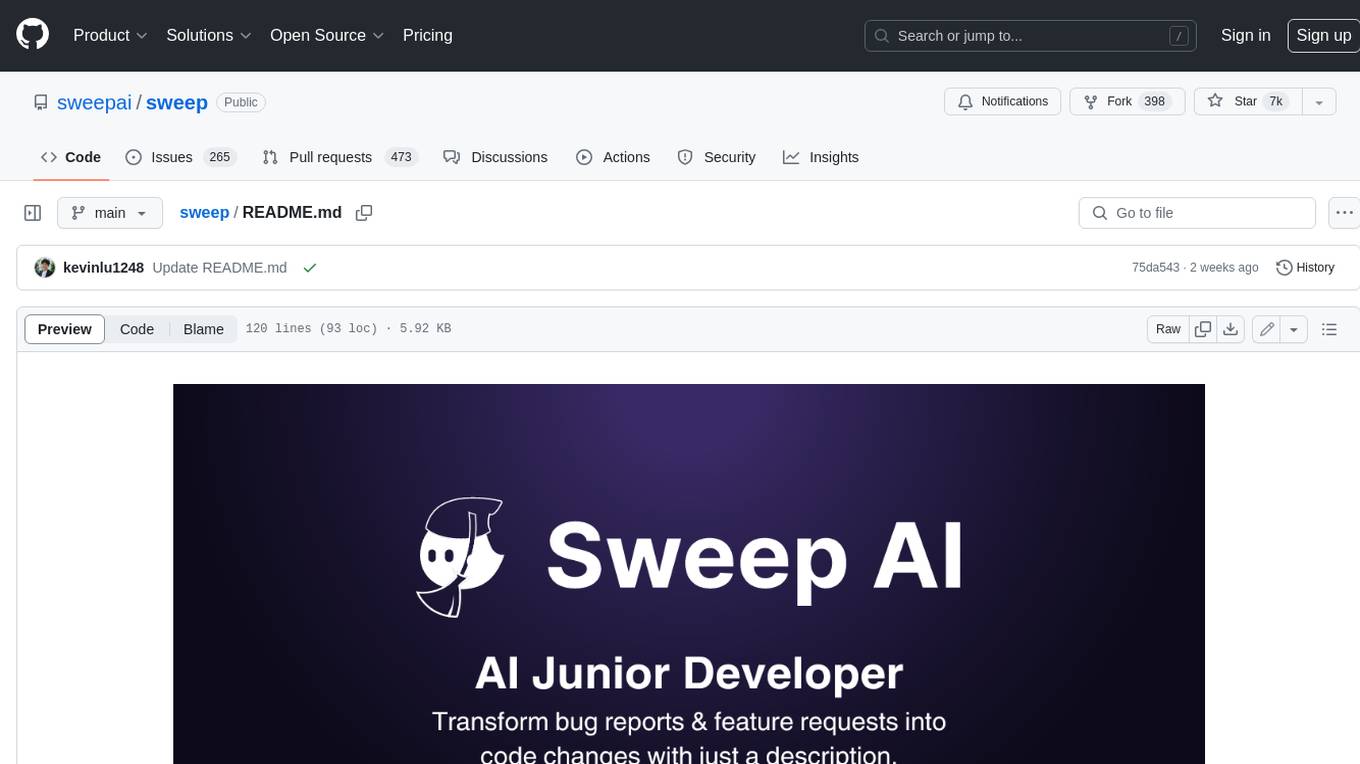
sweep
Sweep is an AI junior developer that turns bugs and feature requests into code changes. It automatically handles developer experience improvements like adding type hints and improving test coverage.
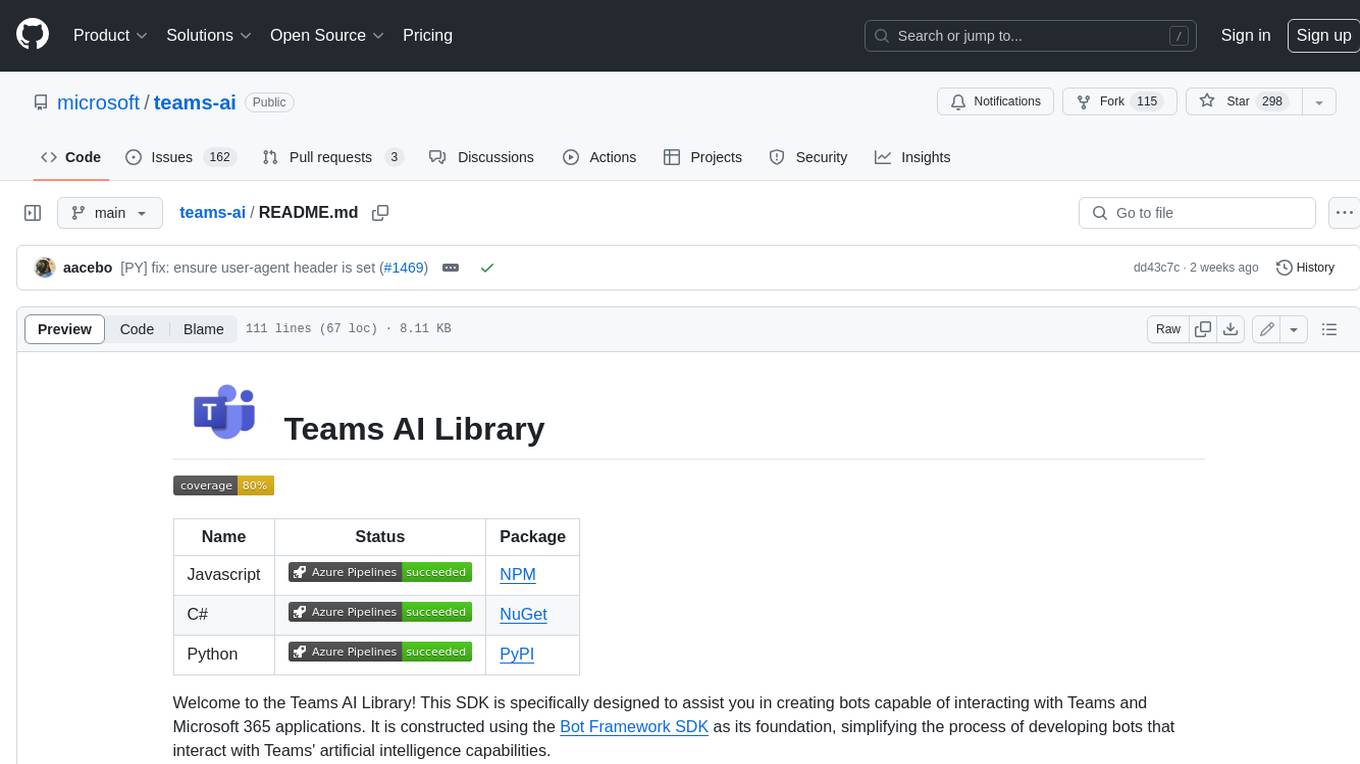
teams-ai
The Teams AI Library is a software development kit (SDK) that helps developers create bots that can interact with Teams and Microsoft 365 applications. It is built on top of the Bot Framework SDK and simplifies the process of developing bots that interact with Teams' artificial intelligence capabilities. The SDK is available for JavaScript/TypeScript, .NET, and Python.
ai-guide
This guide is dedicated to Large Language Models (LLMs) that you can run on your home computer. It assumes your PC is a lower-end, non-gaming setup.
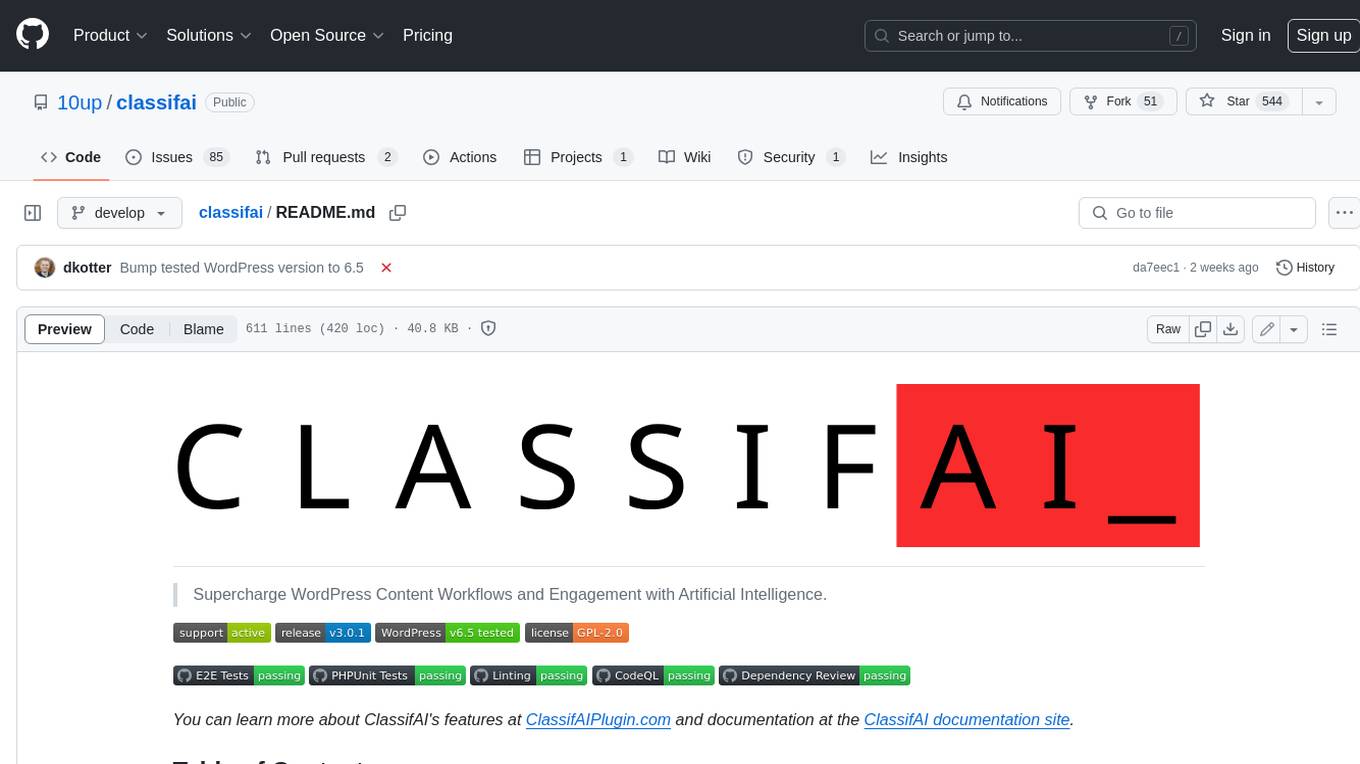
classifai
Supercharge WordPress Content Workflows and Engagement with Artificial Intelligence. Tap into leading cloud-based services like OpenAI, Microsoft Azure AI, Google Gemini and IBM Watson to augment your WordPress-powered websites. Publish content faster while improving SEO performance and increasing audience engagement. ClassifAI integrates Artificial Intelligence and Machine Learning technologies to lighten your workload and eliminate tedious tasks, giving you more time to create original content that matters.
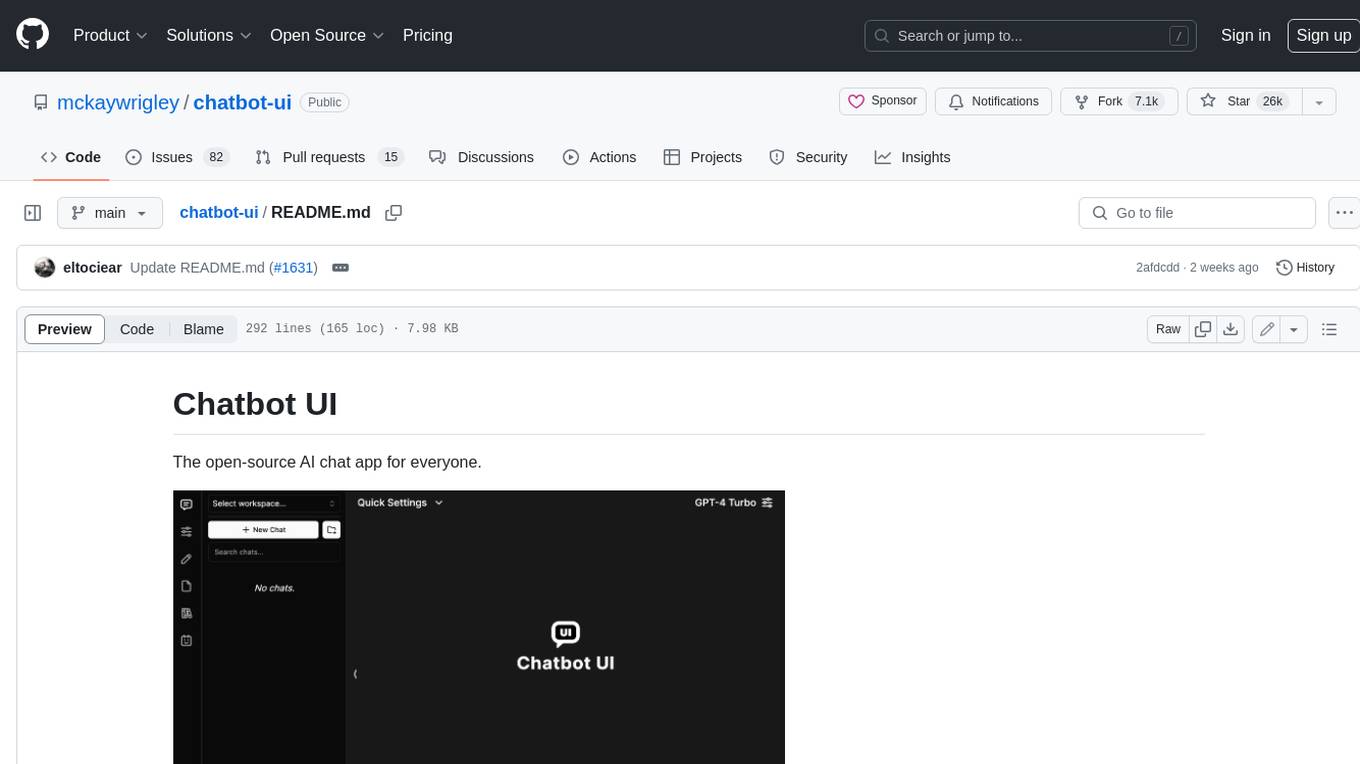
chatbot-ui
Chatbot UI is an open-source AI chat app that allows users to create and deploy their own AI chatbots. It is easy to use and can be customized to fit any need. Chatbot UI is perfect for businesses, developers, and anyone who wants to create a chatbot.
BricksLLM
BricksLLM is a cloud native AI gateway written in Go. Currently, it provides native support for OpenAI, Anthropic, Azure OpenAI and vLLM. BricksLLM aims to provide enterprise level infrastructure that can power any LLM production use cases. Here are some use cases for BricksLLM: * Set LLM usage limits for users on different pricing tiers * Track LLM usage on a per user and per organization basis * Block or redact requests containing PIIs * Improve LLM reliability with failovers, retries and caching * Distribute API keys with rate limits and cost limits for internal development/production use cases * Distribute API keys with rate limits and cost limits for students
uAgents
uAgents is a Python library developed by Fetch.ai that allows for the creation of autonomous AI agents. These agents can perform various tasks on a schedule or take action on various events. uAgents are easy to create and manage, and they are connected to a fast-growing network of other uAgents. They are also secure, with cryptographically secured messages and wallets.
griptape
Griptape is a modular Python framework for building AI-powered applications that securely connect to your enterprise data and APIs. It offers developers the ability to maintain control and flexibility at every step. Griptape's core components include Structures (Agents, Pipelines, and Workflows), Tasks, Tools, Memory (Conversation Memory, Task Memory, and Meta Memory), Drivers (Prompt and Embedding Drivers, Vector Store Drivers, Image Generation Drivers, Image Query Drivers, SQL Drivers, Web Scraper Drivers, and Conversation Memory Drivers), Engines (Query Engines, Extraction Engines, Summary Engines, Image Generation Engines, and Image Query Engines), and additional components (Rulesets, Loaders, Artifacts, Chunkers, and Tokenizers). Griptape enables developers to create AI-powered applications with ease and efficiency.