


python-sdk
Python SDK for ACP clients and agents.
Stars: 158
Python SDK is a software development kit that provides tools and resources for developers to interact with Python programming language. It simplifies the process of integrating Python code into applications and services, offering a wide range of functionalities and libraries to streamline development workflows. With Python SDK, developers can easily access and manipulate data, create automation scripts, build web applications, and perform various tasks efficiently. It is designed to enhance the productivity and flexibility of Python developers by providing a comprehensive set of tools and utilities for software development.
README:

Build ACP-compliant agents and clients in Python with generated schema models, asyncio transports, helper builders, and runnable demos.
Releases track the upstream ACP schema; contributions that tighten coverage or tooling are always welcome.
pip install agent-client-protocol
# or
uv add agent-client-protocol-
Spec parity: Generated Pydantic models in
acp.schematrack every ACP release so payloads stay valid. - Runtime ergonomics: Async base classes, stdio JSON-RPC plumbing, and lifecycle helpers keep custom agents tiny.
-
Examples ready: Streaming, permissions, Gemini bridge, and duet demos live under
examples/. -
Helper builders:
acp.helpersmirrors the Go/TS SDK APIs for content blocks, tool calls, and session updates. - Contrib utilities: Session accumulators, tool call trackers, and permission brokers share patterns from real deployments.
- Agent authors who need typed models, helper builders, and event-stream ergonomics for ACP-compatible assistants.
- Client integrators embedding ACP parties inside Python applications or wrapping existing CLIs via stdio.
- Tooling teams experimenting with permission flows, streaming UX, or Gemini bridges without re-implementing transports. See real adopters like kimi-cli in the Use Cases list.
- Follow the Quickstart guide for installation, echo-agent validation, editor wiring (e.g. Zed), and programmatic launch recipes.
- Browse the example gallery to see progressively richer integrations you can copy or extend.
- Skim the docs hub for focused references on contrib helpers, releasing, and transport details.
-
src/acp/: runtime package (agents, clients, transports, helpers, schema bindings, contrib utilities) -
schema/: upstream JSON schema sources (regenerate viamake gen-all) -
docs/: MkDocs content backing the published documentation -
examples/: runnable scripts covering stdio orchestration patterns -
tests/: pytest suite with golden fixtures and optional Gemini coverage
-
make installprovisions theuvvirtualenv and installs pre-commit hooks. -
make checkruns Ruff formatting/linting, type analysis, dependency hygiene, and lock verification. -
make testexecutespytest(with doctests) inside the managed environment. -
ACP_SCHEMA_VERSION=<ref> make gen-allrefreshes protocol artifacts when the schema advances.
Keep docs and examples current whenever you ship public API or transport changes, and prefer Conventional Commits (feat:, fix:, etc.) when submitting patches.
- File issues or feature requests at https://github.com/agentclientprotocol/python-sdk.
- Discuss ideas or get help via GitHub Discussions: https://github.com/agentclientprotocol/python-sdk/discussions.
- Join the broader ACP conversations at https://agentclientprotocol.com/, the Zed community channels, or the community Zulip: https://agentclientprotocol.zulipchat.com/.
- Shared learnings, integrations, or third-party transports are welcome additions to the documentation—open a PR!
For Tasks:
Click tags to check more tools for each tasksFor Jobs:
Alternative AI tools for python-sdk
Similar Open Source Tools
python-sdk
Python SDK is a software development kit that provides tools and resources for developers to interact with Python programming language. It simplifies the process of integrating Python code into applications and services, offering a wide range of functionalities and libraries to streamline development workflows. With Python SDK, developers can easily access and manipulate data, create automation scripts, build web applications, and perform various tasks efficiently. It is designed to enhance the productivity and flexibility of Python developers by providing a comprehensive set of tools and utilities for software development.
arcade-ai
Arcade AI is a developer-focused tooling and API platform designed to enhance the capabilities of LLM applications and agents. It simplifies the process of connecting agentic applications with user data and services, allowing developers to concentrate on building their applications. The platform offers prebuilt toolkits for interacting with various services, supports multiple authentication providers, and provides access to different language models. Users can also create custom toolkits and evaluate their tools using Arcade AI. Contributions are welcome, and self-hosting is possible with the provided documentation.
llm-agents.nix
Nix packages for AI coding agents and development tools. Automatically updated daily. This repository provides a wide range of AI coding agents and tools that can be used in the terminal environment. The tools cover various functionalities such as code assistance, AI-powered development agents, CLI tools for AI coding, workflow and project management, code review, utilities like search tools and browser automation, and usage analytics for AI coding sessions. The repository also includes experimental features like sandboxed execution, provider abstraction, and tool composition to explore how Nix can enhance AI-powered development.
ai-app-lab
The ai-app-lab is a high-code Python SDK Arkitect designed for enterprise developers with professional development capabilities. It provides a toolset and workflow set for developing large model applications tailored to specific business scenarios. The SDK offers highly customizable application orchestration, quality business tools, one-stop development and hosting services, security enhancements, and AI prototype application code examples. It caters to complex enterprise development scenarios, enabling the creation of highly customized intelligent applications for various industries.
trubrics-sdk
Trubrics-sdk is a software development kit designed to facilitate the integration of analytics features into applications. It provides a set of tools and functionalities that enable developers to easily incorporate analytics capabilities, such as data collection, analysis, and reporting, into their software products. The SDK streamlines the process of implementing analytics solutions, allowing developers to focus on building and enhancing their applications' functionality and user experience. By leveraging trubrics-sdk, developers can quickly and efficiently integrate robust analytics features, gaining valuable insights into user behavior and application performance.
c4-genai-suite
C4-GenAI-Suite is a comprehensive AI tool for generating code snippets and automating software development tasks. It leverages advanced machine learning models to assist developers in writing efficient and error-free code. The suite includes features such as code completion, refactoring suggestions, and automated testing, making it a valuable asset for enhancing productivity and code quality in software development projects.
ai21-python
The AI21 Labs Python SDK is a comprehensive tool for interacting with the AI21 API. It provides functionalities for chat completions, conversational RAG, token counting, error handling, and support for various cloud providers like AWS, Azure, and Vertex. The SDK offers both synchronous and asynchronous usage, along with detailed examples and documentation. Users can quickly get started with the SDK to leverage AI21's powerful models for various natural language processing tasks.
tools
Strands Agents Tools is a community-driven project that provides a powerful set of tools for your agents to use. It bridges the gap between large language models and practical applications by offering ready-to-use tools for file operations, system execution, API interactions, mathematical operations, and more. The tools cover a wide range of functionalities including file operations, shell integration, memory storage, web infrastructure, HTTP client, Slack client, Python execution, mathematical tools, AWS integration, image and video processing, audio output, environment management, task scheduling, advanced reasoning, swarm intelligence, dynamic MCP client, parallel tool execution, browser automation, diagram creation, RSS feed management, and computer automation.
airstate
AirState is a straightforward software development kit that enables users to integrate real-time collaboration functionalities into their web applications. With its user-friendly interface and robust capabilities, AirState simplifies the process of incorporating live collaboration features, making it an ideal choice for developers seeking to enhance the interactive elements of their projects. The SDK offers a seamless solution for creating engaging and interactive web experiences, allowing users to easily implement real-time collaboration tools without the need for extensive coding knowledge or complex configurations. By leveraging AirState, developers can streamline the development process and deliver dynamic web applications that facilitate real-time communication and collaboration among users.
ollama4j
Ollama4j is a Java library that serves as a wrapper or binding for the Ollama server. It allows users to communicate with the Ollama server and manage models for various deployment scenarios. The library provides APIs for interacting with Ollama, generating fake data, testing UI interactions, translating messages, and building web UIs. Users can easily integrate Ollama4j into their Java projects to leverage the functionalities offered by the Ollama server.
Awesome-Repo-Level-Code-Generation
This repository contains a collection of tools and scripts for generating code at the repository level. It provides a set of utilities to automate the process of creating and managing code across multiple files and directories. The tools included in this repository aim to improve code generation efficiency and maintainability by streamlining the development workflow. With a focus on enhancing productivity and reducing manual effort, this collection offers a variety of code generation options and customization features to suit different project requirements.
orchestkit
OrchestKit is a powerful and flexible orchestration tool designed to streamline and automate complex workflows. It provides a user-friendly interface for defining and managing orchestration tasks, allowing users to easily create, schedule, and monitor workflows. With support for various integrations and plugins, OrchestKit enables seamless automation of tasks across different systems and applications. Whether you are a developer looking to automate deployment processes or a system administrator managing complex IT operations, OrchestKit offers a comprehensive solution to simplify and optimize your workflow management.
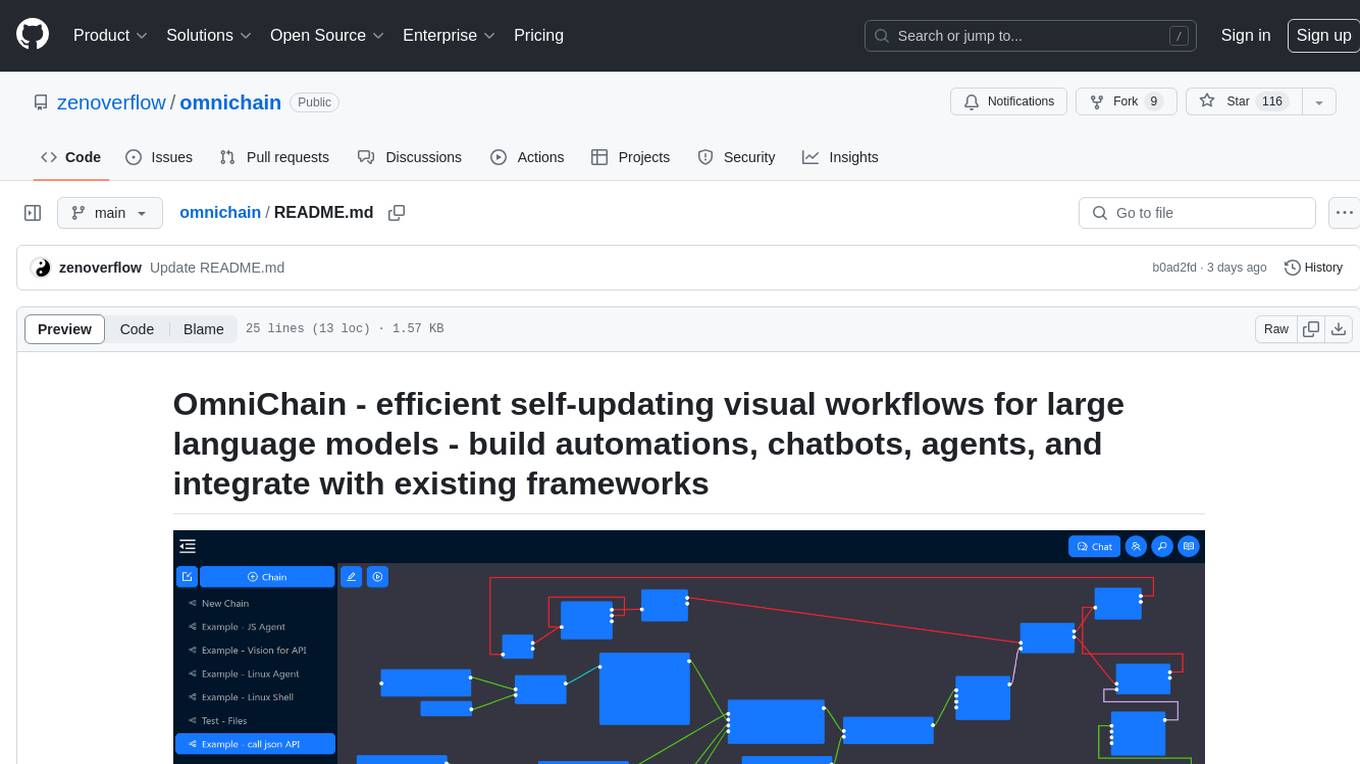
omnichain
OmniChain is a tool for building efficient self-updating visual workflows using AI language models, enabling users to automate tasks, create chatbots, agents, and integrate with existing frameworks. It allows users to create custom workflows guided by logic processes, store and recall information, and make decisions based on that information. The tool enables users to create tireless robot employees that operate 24/7, access the underlying operating system, generate and run NodeJS code snippets, and create custom agents and logic chains. OmniChain is self-hosted, open-source, and available for commercial use under the MIT license, with no coding skills required.
koog
Koog is a Kotlin-based framework for building and running AI agents entirely in idiomatic Kotlin. It allows users to create agents that interact with tools, handle complex workflows, and communicate with users. Key features include pure Kotlin implementation, MCP integration, embedding capabilities, custom tool creation, ready-to-use components, intelligent history compression, powerful streaming API, persistent agent memory, comprehensive tracing, flexible graph workflows, modular feature system, scalable architecture, and multiplatform support.
navigator
Navigator is a versatile tool for navigating through complex codebases efficiently. It provides a user-friendly interface to explore code files, search for specific functions or variables, and visualize code dependencies. With Navigator, developers can easily understand the structure of a project and quickly locate relevant code snippets. The tool supports various programming languages and offers customizable settings to enhance the coding experience. Whether you are working on a small project or a large codebase, Navigator can help you streamline your development process and improve code comprehension.
apex
Apex is a powerful and flexible programming language for building cloud-based applications on the Salesforce platform. It allows developers to create custom business logic, automate processes, and integrate with external systems. With its robust features and easy-to-use syntax, Apex empowers developers to extend the capabilities of Salesforce and deliver tailored solutions to meet business requirements.
For similar tasks
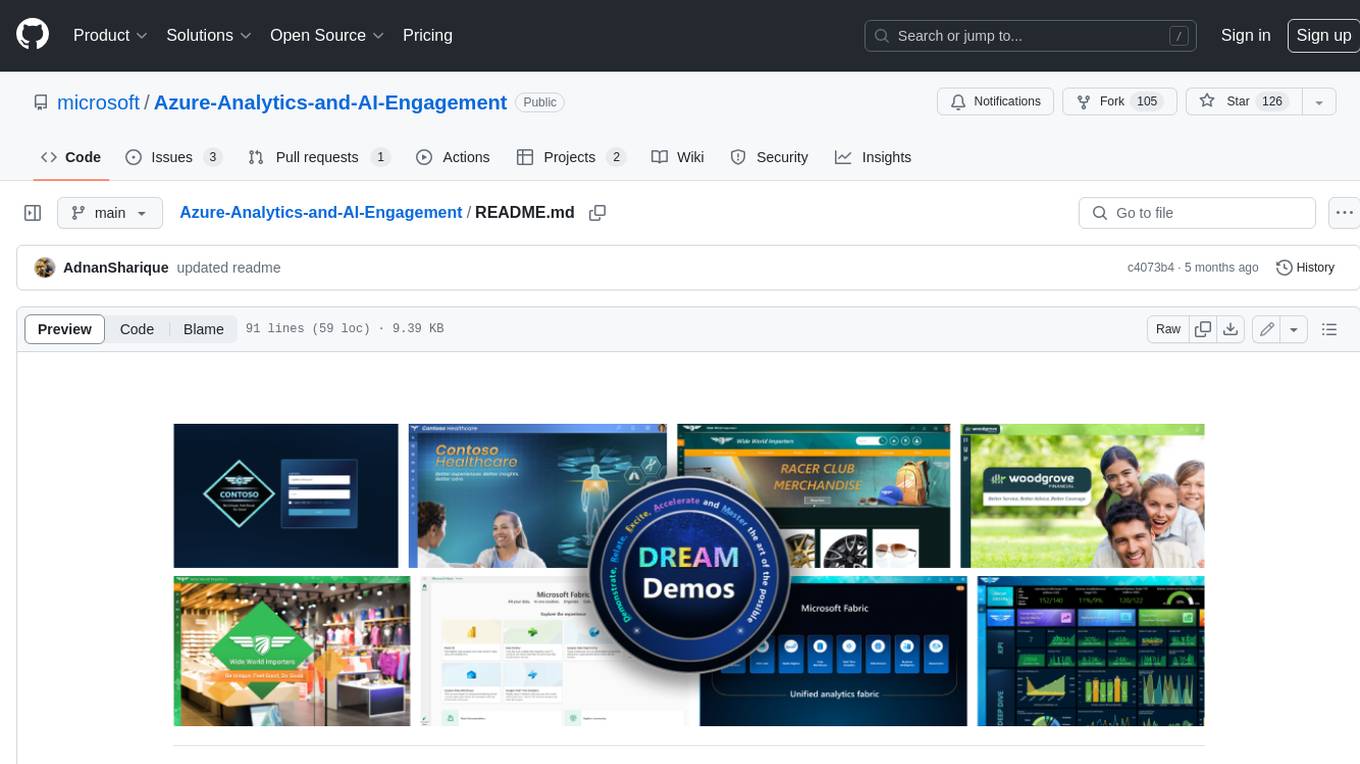
Azure-Analytics-and-AI-Engagement
The Azure-Analytics-and-AI-Engagement repository provides packaged Industry Scenario DREAM Demos with ARM templates (Containing a demo web application, Power BI reports, Synapse resources, AML Notebooks etc.) that can be deployed in a customer’s subscription using the CAPE tool within a matter of few hours. Partners can also deploy DREAM Demos in their own subscriptions using DPoC.
sorrentum
Sorrentum is an open-source project that aims to combine open-source development, startups, and brilliant students to build machine learning, AI, and Web3 / DeFi protocols geared towards finance and economics. The project provides opportunities for internships, research assistantships, and development grants, as well as the chance to work on cutting-edge problems, learn about startups, write academic papers, and get internships and full-time positions at companies working on Sorrentum applications.
tidb
TiDB is an open-source distributed SQL database that supports Hybrid Transactional and Analytical Processing (HTAP) workloads. It is MySQL compatible and features horizontal scalability, strong consistency, and high availability.

zep-python
Zep is an open-source platform for building and deploying large language model (LLM) applications. It provides a suite of tools and services that make it easy to integrate LLMs into your applications, including chat history memory, embedding, vector search, and data enrichment. Zep is designed to be scalable, reliable, and easy to use, making it a great choice for developers who want to build LLM-powered applications quickly and easily.
telemetry-airflow
This repository codifies the Airflow cluster that is deployed at workflow.telemetry.mozilla.org (behind SSO) and commonly referred to as "WTMO" or simply "Airflow". Some links relevant to users and developers of WTMO: * The `dags` directory in this repository contains some custom DAG definitions * Many of the DAGs registered with WTMO don't live in this repository, but are instead generated from ETL task definitions in bigquery-etl * The Data SRE team maintains a WTMO Developer Guide (behind SSO)
mojo
Mojo is a new programming language that bridges the gap between research and production by combining Python syntax and ecosystem with systems programming and metaprogramming features. Mojo is still young, but it is designed to become a superset of Python over time.
pandas-ai
PandasAI is a Python library that makes it easy to ask questions to your data in natural language. It helps you to explore, clean, and analyze your data using generative AI.
databend
Databend is an open-source cloud data warehouse that serves as a cost-effective alternative to Snowflake. With its focus on fast query execution and data ingestion, it's designed for complex analysis of the world's largest datasets.
For similar jobs
sweep
Sweep is an AI junior developer that turns bugs and feature requests into code changes. It automatically handles developer experience improvements like adding type hints and improving test coverage.
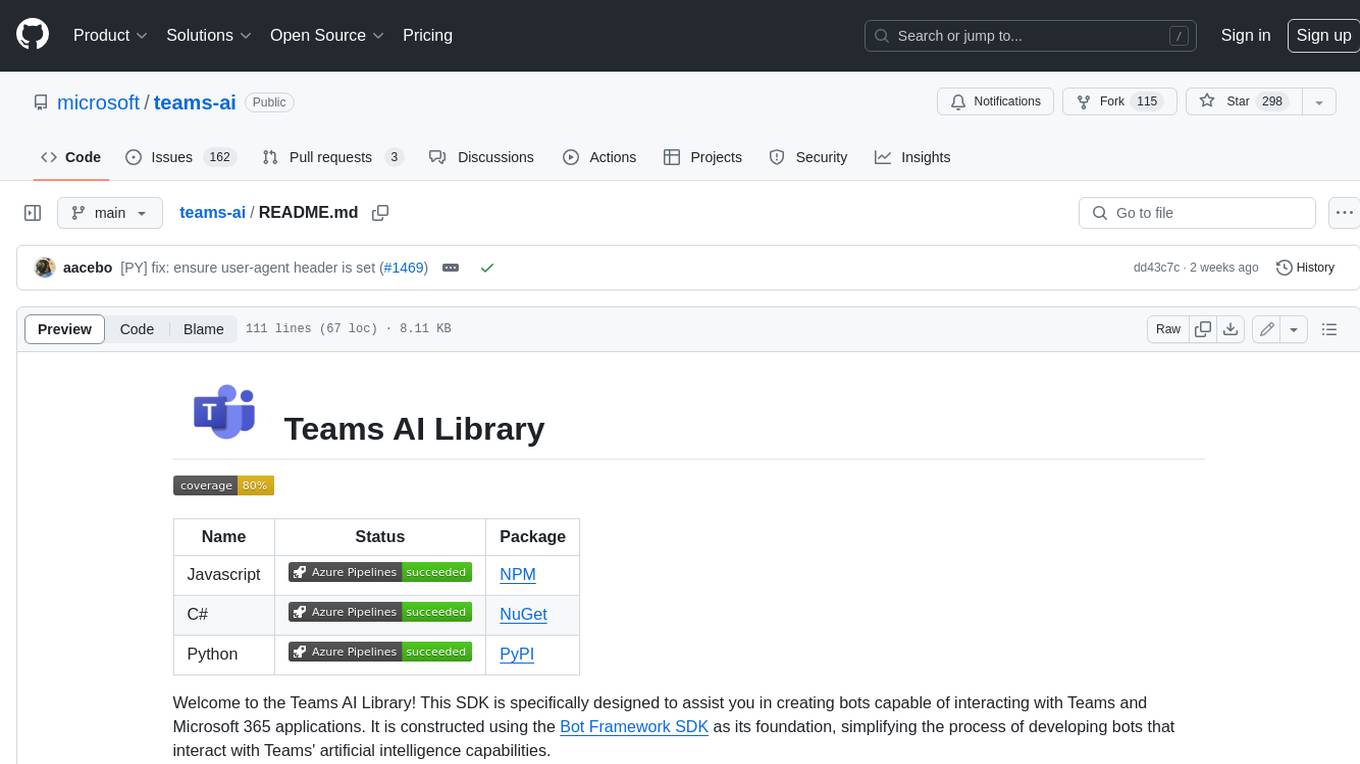
teams-ai
The Teams AI Library is a software development kit (SDK) that helps developers create bots that can interact with Teams and Microsoft 365 applications. It is built on top of the Bot Framework SDK and simplifies the process of developing bots that interact with Teams' artificial intelligence capabilities. The SDK is available for JavaScript/TypeScript, .NET, and Python.
ai-guide
This guide is dedicated to Large Language Models (LLMs) that you can run on your home computer. It assumes your PC is a lower-end, non-gaming setup.
classifai
Supercharge WordPress Content Workflows and Engagement with Artificial Intelligence. Tap into leading cloud-based services like OpenAI, Microsoft Azure AI, Google Gemini and IBM Watson to augment your WordPress-powered websites. Publish content faster while improving SEO performance and increasing audience engagement. ClassifAI integrates Artificial Intelligence and Machine Learning technologies to lighten your workload and eliminate tedious tasks, giving you more time to create original content that matters.
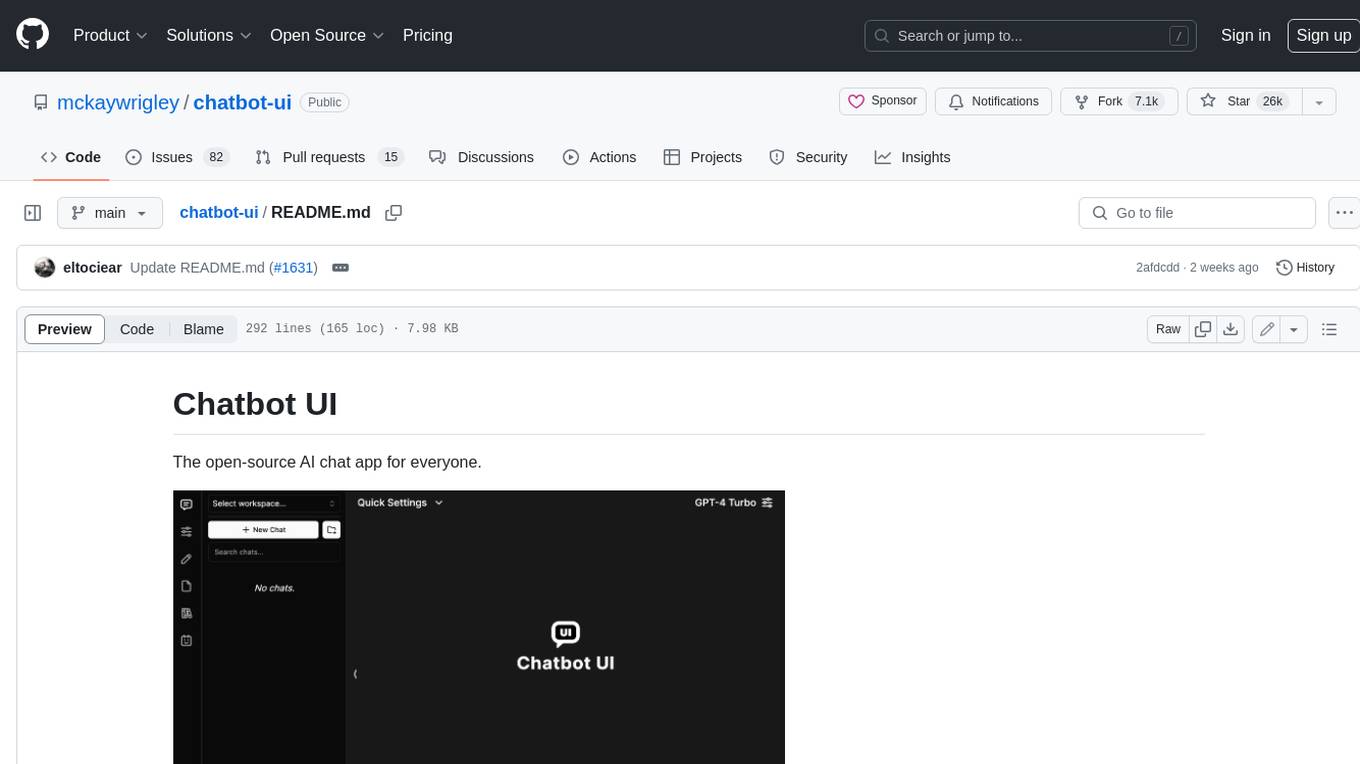
chatbot-ui
Chatbot UI is an open-source AI chat app that allows users to create and deploy their own AI chatbots. It is easy to use and can be customized to fit any need. Chatbot UI is perfect for businesses, developers, and anyone who wants to create a chatbot.
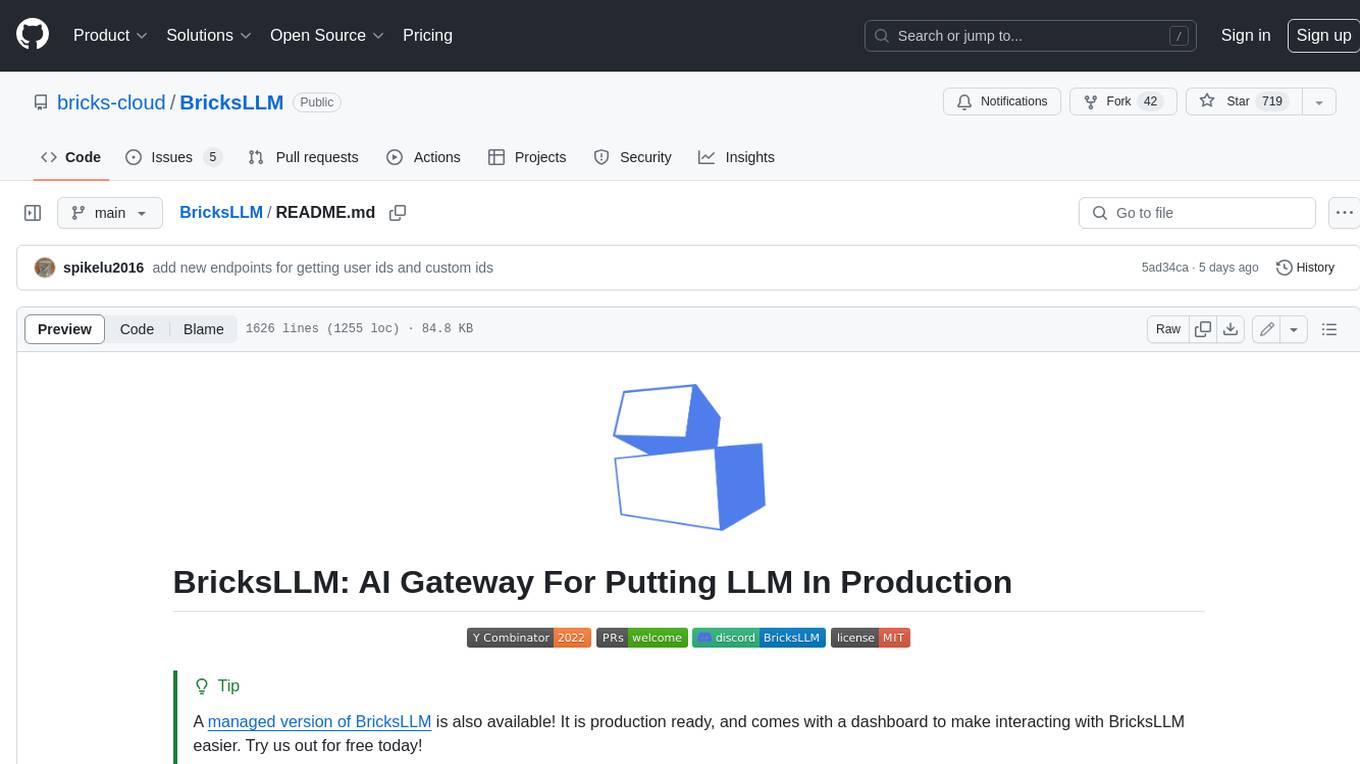
BricksLLM
BricksLLM is a cloud native AI gateway written in Go. Currently, it provides native support for OpenAI, Anthropic, Azure OpenAI and vLLM. BricksLLM aims to provide enterprise level infrastructure that can power any LLM production use cases. Here are some use cases for BricksLLM: * Set LLM usage limits for users on different pricing tiers * Track LLM usage on a per user and per organization basis * Block or redact requests containing PIIs * Improve LLM reliability with failovers, retries and caching * Distribute API keys with rate limits and cost limits for internal development/production use cases * Distribute API keys with rate limits and cost limits for students
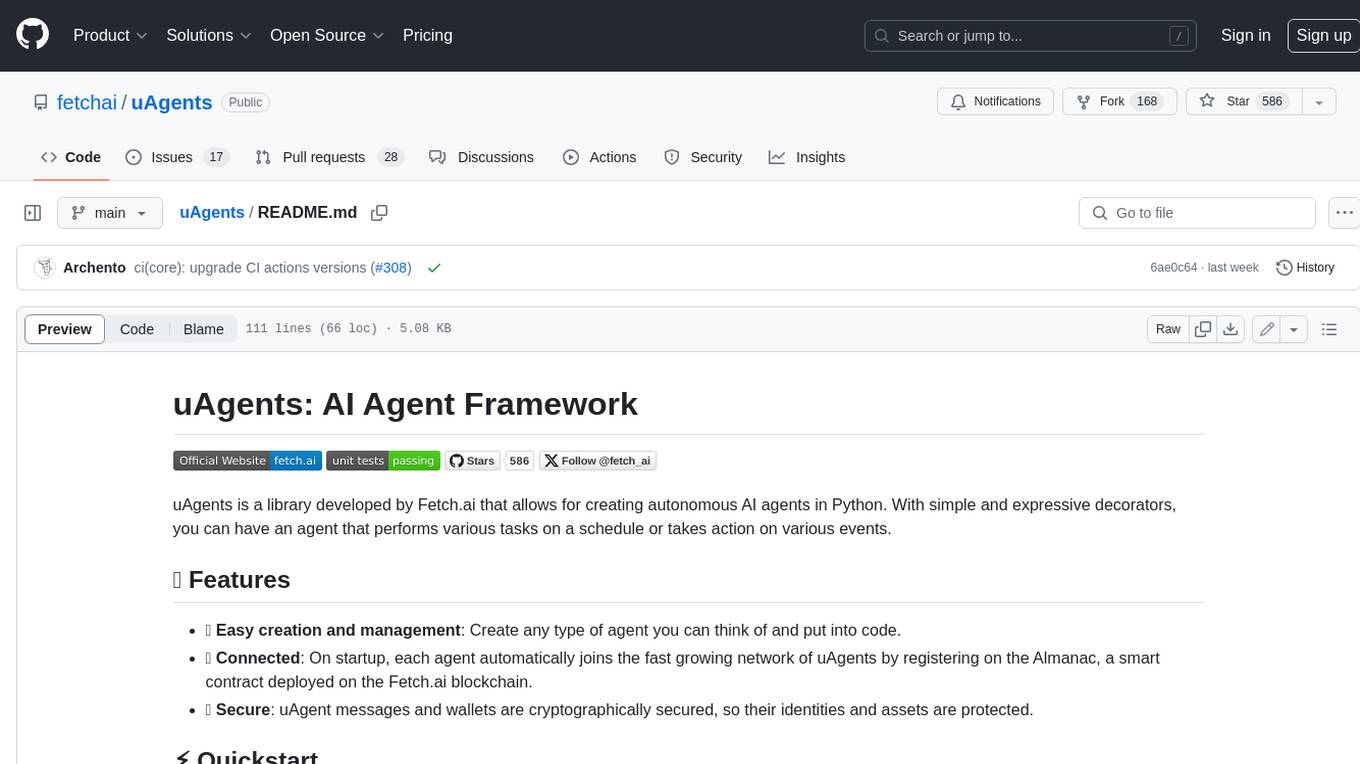
uAgents
uAgents is a Python library developed by Fetch.ai that allows for the creation of autonomous AI agents. These agents can perform various tasks on a schedule or take action on various events. uAgents are easy to create and manage, and they are connected to a fast-growing network of other uAgents. They are also secure, with cryptographically secured messages and wallets.
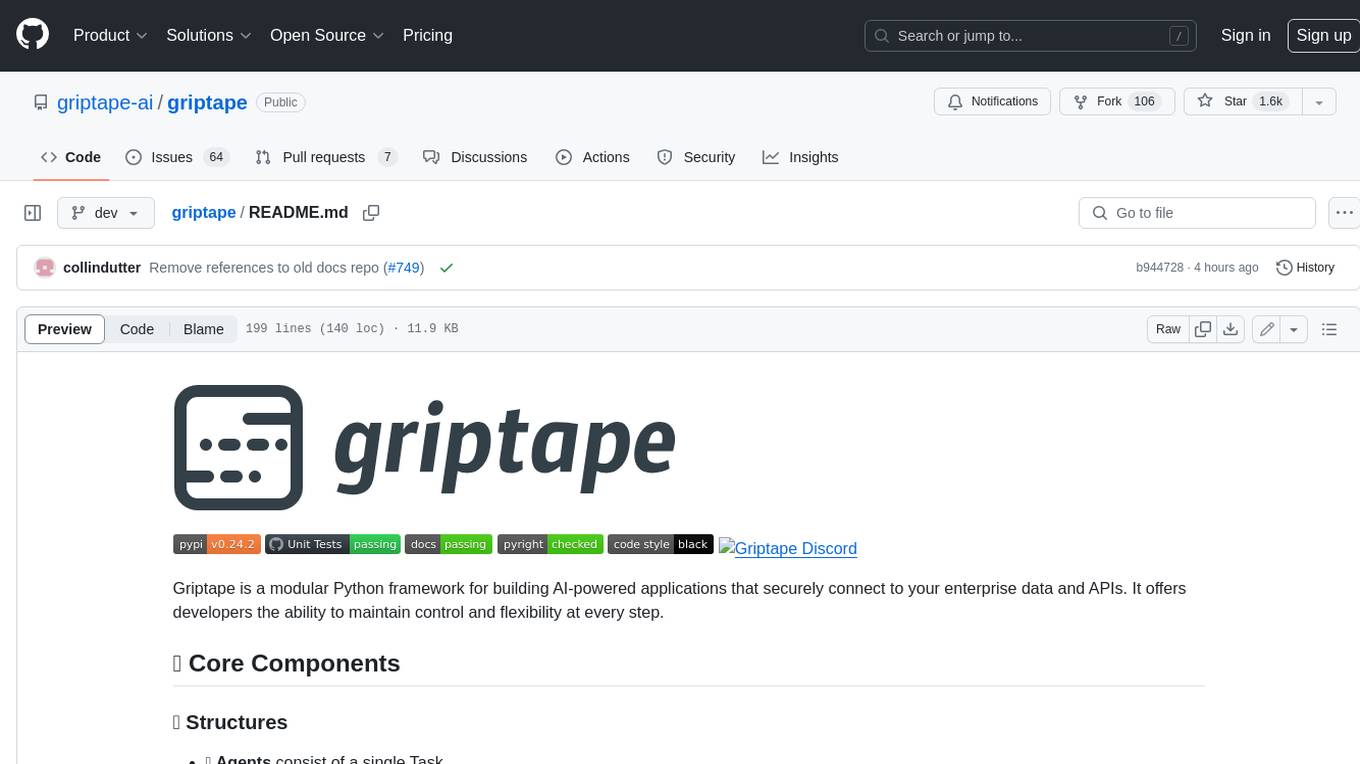
griptape
Griptape is a modular Python framework for building AI-powered applications that securely connect to your enterprise data and APIs. It offers developers the ability to maintain control and flexibility at every step. Griptape's core components include Structures (Agents, Pipelines, and Workflows), Tasks, Tools, Memory (Conversation Memory, Task Memory, and Meta Memory), Drivers (Prompt and Embedding Drivers, Vector Store Drivers, Image Generation Drivers, Image Query Drivers, SQL Drivers, Web Scraper Drivers, and Conversation Memory Drivers), Engines (Query Engines, Extraction Engines, Summary Engines, Image Generation Engines, and Image Query Engines), and additional components (Rulesets, Loaders, Artifacts, Chunkers, and Tokenizers). Griptape enables developers to create AI-powered applications with ease and efficiency.