


go-interview-practice
Interactive Go Interview Platform - 30+ coding challenges with instant feedback, AI interview simulation, competitive leaderboards, and automated testing. From beginner to advanced levels with real-world scenarios.
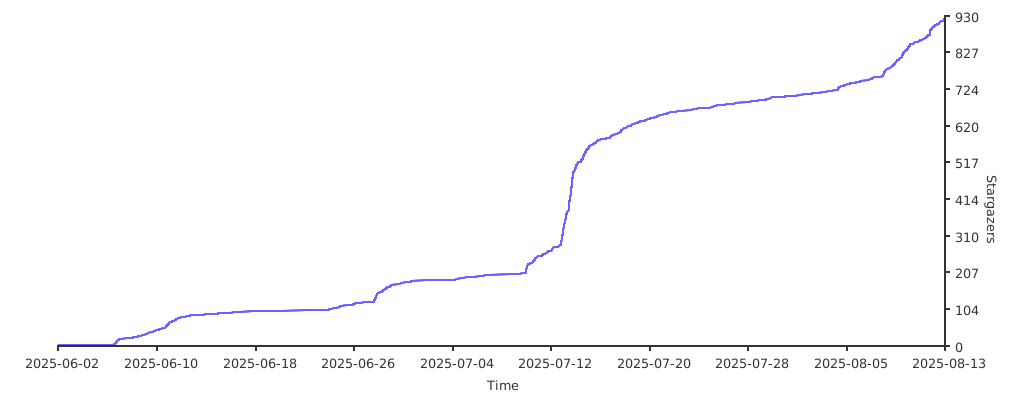
Stars: 1262
The Go Interview Practice repository is a comprehensive platform designed to help users practice and master Go programming through interactive coding challenges. It offers an interactive web interface with a code editor, testing experience, and competitive leaderboard. Users can practice with challenges categorized by difficulty levels, contribute solutions, and track their progress. The repository also features AI-powered interview simulation, real-time code review, dynamic interview questions, and progressive hints. Users can showcase their achievements with auto-updating profile badges and contribute to the project by submitting solutions or adding new challenges.
README:



⭐ Star the repo if it’s useful to you
Welcome to the Go Interview Practice repository! Master Go programming and ace your technical interviews with our interactive coding challenges.
Our interactive platform is now live at gointerview.dev 🎉 Explore challenges, track your progress, and elevate your Go skills with AI-powered mentorship.

Our comprehensive web interface provides everything you need to practice and master Go programming:
A brief introduction to the project


|
Interactive Code Editor Write, edit, and test your Go solutions with syntax highlighting and real-time feedback |
Instant Results & Analytics Get immediate test results, performance metrics, and detailed execution analysis |

Beautiful leaderboard showcasing top developers with challenge completion indicators, rankings, and achievements
Our most accomplished Go developers, ranked by number of challenges completed:
Note: The data below is automatically updated by GitHub Actions when challenge scoreboards change.
| 🏅 | Developer | Solved | Rate | Achievement | Progress |
|---|---|---|---|---|---|
| 🥇 |
 PolinaSvet |
30/30 | 100.0% | Master | ✅✅✅✅✅✅✅✅✅✅✅✅✅✅✅ ✅✅✅✅✅✅✅✅✅✅✅✅✅✅✅ |
| 🥈 |
 odelbos |
30/30 | 100.0% | Master | ✅✅✅✅✅✅✅✅✅✅✅✅✅✅✅ ✅✅✅✅✅✅✅✅✅✅✅✅✅✅✅ |
| 🥉 |
 mick4711 |
23/30 | 76.7% | Master | ✅✅✅✅✅✅✅✅✅✅⬜⬜✅✅⬜ ✅✅✅✅✅✅✅✅⬜⬜✅✅⬜⬜✅ |
| 4 |
 Gandook |
22/30 | 73.3% | Master | ✅✅✅✅✅✅✅✅✅✅⬜⬜✅⬜⬜ ⬜✅✅✅⬜✅✅✅✅✅✅✅⬜⬜✅ |
| 5 |
 y1hao |
21/30 | 70.0% | Master | ✅✅✅✅✅✅✅✅⬜✅⬜⬜✅✅⬜ ✅✅✅✅✅✅✅✅⬜⬜⬜✅⬜⬜✅ |
| 6 |
 JackDalberg |
20/30 | 66.7% | Master | ✅✅✅✅✅✅✅✅⬜✅⬜⬜✅✅⬜ ⬜✅✅✅✅✅✅✅⬜⬜⬜✅⬜⬜✅ |
| 7 |
 Cpoing |
17/30 | 56.7% | Expert | ✅✅✅✅⬜✅✅✅✅✅✅✅✅✅✅ ⬜✅✅⬜⬜✅⬜⬜⬜⬜⬜⬜⬜⬜⬜ |
| 8 |
 ashwinipatankar ❤️ |
17/30 | 56.7% | Expert | ✅✅✅⬜✅✅✅⬜✅✅⬜⬜✅✅⬜ ⬜✅✅✅⬜⬜✅✅⬜⬜⬜✅⬜⬜✅ |
| 9 |
 t4e1 |
15/30 | 50.0% | Expert | ✅✅✅✅✅✅✅⬜⬜✅⬜⬜✅⬜⬜ ⬜✅✅✅⬜✅✅⬜⬜⬜⬜✅⬜⬜⬜ |
| 10 |
 KhaledMosaad |
14/30 | 46.7% | Advanced | ✅✅✅⬜⬜✅⬜⬜⬜⬜⬜⬜✅⬜⬜ ⬜✅✅✅⬜✅✅✅⬜⬜✅✅⬜⬜✅ |
✅ Completed • ⬜ Not Completed
All 30 challenges shown in two rows
Updated automatically based on 30 available challenges
- Total Challenges Available: 30
- Active Developers: 138
- Most Challenges Solved: 30 by PolinaSvet
Master Go packages through hands-on challenges! Each package offers a structured learning path with real-world scenarios.
Note: The data below is automatically updated by GitHub Actions when package challenge scoreboards change.
| 🏅 | Developer | Total Solved | Packages | Achievement | Challenge Distribution |
|---|---|---|---|---|---|
| 🥇 |
odelbos |
17 | 4 pkgs | 🔥 Package Master | cobra: 4 • fiber: 4 • gin: 4 • gorm: 5 |
| 🥈 |
PolinaSvet |
8 | 2 pkgs | 💪 Package Advanced | cobra: 4 • gin: 4 |
| 🥉 |
 RezaSi |
7 | 6 pkgs | 💪 Package Advanced | cobra: 1 • echo: 1 • fiber: 1 • gin: 1 • gorm: 1 • mongodb: 2 |
| 4 |
ashwinipatankar ❤️ |
3 | 1 pkg | 🚀 Package Intermediate | cobra: 3 |
| 5 |
 GleeN987 |
1 | 1 pkg | 🌱 Package Beginner | gin: 1 |
| 6 |
 MarioPaez |
1 | 1 pkg | 🌱 Package Beginner | gin: 1 |
| 7 |
 kelvin-yong |
1 | 1 pkg | 🌱 Package Beginner | gin: 1 |
🚀 Package Challenges - Learn Go packages through practical, real-world scenarios
| Rank | Developer | Completed | Progress |
|---|---|---|---|
| 🥇 | PolinaSvet | 4/4 | 🟩🟩🟩🟩🟩🟩🟩🟩🟩🟩 100% |
| 🥈 | odelbos | 4/4 | 🟩🟩🟩🟩🟩🟩🟩🟩🟩🟩 100% |
| 🥉 | ashwinipatankar | 3/4 | 🟩🟩🟩🟩🟩🟩🟩⬜⬜⬜ 75% |
| 4 | RezaSi | 1/4 | 🟩🟩⬜⬜⬜⬜⬜⬜⬜⬜ 25% |
| Rank | Developer | Completed | Progress |
|---|---|---|---|
| 🥇 | RezaSi | 1/4 | 🟩🟩⬜⬜⬜⬜⬜⬜⬜⬜ 25% |
| Rank | Developer | Completed | Progress |
|---|---|---|---|
| 🥇 | odelbos | 4/4 | 🟩🟩🟩🟩🟩🟩🟩🟩🟩🟩 100% |
| 🥈 | RezaSi | 1/4 | 🟩🟩⬜⬜⬜⬜⬜⬜⬜⬜ 25% |
| Rank | Developer | Completed | Progress |
|---|---|---|---|
| 🥇 | PolinaSvet | 4/4 | 🟩🟩🟩🟩🟩🟩🟩🟩🟩🟩 100% |
| 🥈 | odelbos | 4/4 | 🟩🟩🟩🟩🟩🟩🟩🟩🟩🟩 100% |
| 🥉 | GleeN987 | 1/4 | 🟩🟩⬜⬜⬜⬜⬜⬜⬜⬜ 25% |
| 4 | MarioPaez | 1/4 | 🟩🟩⬜⬜⬜⬜⬜⬜⬜⬜ 25% |
| 5 | RezaSi | 1/4 | 🟩🟩⬜⬜⬜⬜⬜⬜⬜⬜ 25% |
| Rank | Developer | Completed | Progress |
|---|---|---|---|
| 🥇 | odelbos | 5/5 | 🟩🟩🟩🟩🟩🟩🟩🟩🟩🟩 100% |
| 🥈 | RezaSi | 1/5 | 🟩🟩⬜⬜⬜⬜⬜⬜⬜⬜ 20% |
| Rank | Developer | Completed | Progress |
|---|---|---|---|
| 🥇 | RezaSi | 2/5 | 🟩🟩🟩🟩⬜⬜⬜⬜⬜⬜ 40% |
-
Total Package Challenges Available: 26
-
Active Package Learners: 7
-
Available Packages: 6 (cobra, echo, fiber, gin, gorm, mongodb)
-
Most Package Challenges Solved: 17 by odelbos
- Interactive Web UI - Code, test, and submit solutions in your browser
- Automated Testing - Get immediate feedback on your solutions
- Automated Scoreboards - Solutions are automatically scored and ranked
- Profile Badges - Beautiful auto-updating badges for GitHub profiles, LinkedIn, and portfolios
- Performance Analytics - Track execution time and memory usage for your solutions
- Comprehensive Learning - Each challenge includes detailed explanations and resources
- Progressive Difficulty - From beginner to advanced Go concepts
- AI Interview Simulation - Practice with AI-powered code review and interviewer questions
Transform your coding practice into realistic interview scenarios with our AI-powered features:
Real-Time Code Review - Get instant feedback on code quality, complexity analysis, and improvement suggestions
Dynamic Interview Questions - AI generates follow-up questions based on your solution approach
Progressive Hints - 4-level hint system from subtle nudges to detailed explanations
Multi-LLM Support - Works with Gemini (recommended), OpenAI, or Claude
Simply add your API key to experience interview-style feedback that adapts to your code and challenges you with realistic technical questions.


|
AI Code Review Get instant feedback on code quality, complexity analysis, and improvement suggestions from AI |
Dynamic Interview Questions AI generates follow-up questions based on your solution approach and coding patterns |
Important: You must fork this repository first before cloning, otherwise you won't be able to push your solutions or create pull requests!
# 1. First, fork this repository on GitHub
#    Go to https://github.com/RezaSi/go-interview-practice
#    Click the "Fork" button in the top-right corner

# 2. Clone your forked repository (replace 'yourusername' with your GitHub username)
git clone https://github.com/yourusername/go-interview-practice.git
cd go-interview-practice

# 3. Start the web interface
cd web-ui
go run main.go

# 4. Open http://localhost:8080 in your browser

# 5. Optional: Enable AI Features (Recommended) 🤖
# Add your free Gemini API key to enable AI interview simulation
echo "AI_PROVIDER=gemini" > web-ui/.env
echo "GEMINI_API_KEY=your_actual_api_key_here" >> web-ui/.env
# Get your free API key: https://makersuite.google.com/app/apikey
# Note: .env files are automatically ignored by git for security
After solving challenges and submitting solutions:
- Your solutions will be automatically saved to your local repository
- Follow the provided Git commands to commit and push your changes
- Create a pull request to contribute your solutions back to the main project
Want to get started instantly without setting up anything locally? Use GitHub Codespaces!
- Fork this repository (if you haven't already)
- Open in Codespaces: Click the green "Code" button on your forked repository, then select "Codespaces" tab
- Create Codespace: Click "Create codespace on main"
-
Start the Web UI: Once the codespace loads, open a terminal and run:
cd web-ui go run main.go -
Optional: Enable AI Features: Add your Gemini API key:
echo "AI_PROVIDER=gemini" > .env
echo "GEMINI_API_KEY=your_actual_api_key_here" >> .env
- Access the Web UI: Click on the "Ports" tab in the bottom panel, then click the "Open in Browser" button next to port 8080
Benefits of using Codespaces:
- No local setup required
- Pre-configured Go environment
- Full VS Code experience in the browser
- Automatic port forwarding for the web UI
- All dependencies pre-installed
- Works on any device with a browser
Deploy your own instance of the platform to the cloud with Railway!

Perfect for:
- Teams & Organizations: Private instance for internal use
- Educators: Custom environment for students
- Customization: Fork and modify for specific needs
- Always Available: 24/7 cloud hosting with automatic scaling
Setup Steps:
- Click Deploy Button above
-
Configure AI Features (optional but recommended):
- Choose AI provider:
gemini(recommended - free tier) - Add API key: Get free Gemini key
- Choose AI provider:
- Access Your Platform: Railway provides instant public URL
- Start Using: Full platform with all challenges immediately available
# 1. Fork the repository first (see step 1 above)
# 2. Clone your fork and set up a challenge workspace
git clone https://github.com/yourusername/go-interview-practice.git
cd go-interview-practice
./create_submission.sh 1  # For challenge #1

# 3. Implement your solution in the editor of your choice

# 4. Run tests
cd challenge-1
./run_tests.shShowcase your Go programming achievements with auto-updating profile badges for GitHub profiles, portfolios, and personal websites.


[](https://github.com/RezaSi/go-interview-practice)After contributing solutions, your badges are automatically generated in badges/YOUR_USERNAME_badges.md with multiple formats ready to use.
Complete Badge Guide & Examples →
Perfect for those new to Go or brushing up on fundamentals
- Challenge 1: Sum of Two Numbers
- Challenge 2: Reverse a String
- Challenge 3: Employee Data Management
- Challenge 6: Word Frequency Counter
- Challenge 18: Temperature Converter
- Challenge 21: Binary Search Implementation
- Challenge 22: Greedy Coin Change
For developers familiar with Go who want to deepen their knowledge
- Challenge 4: Concurrent Graph BFS Queries
- Challenge 5: HTTP Authentication Middleware
- Challenge 7: Bank Account with Error Handling
- Challenge 10: Polymorphic Shape Calculator
- Challenge 13: SQL Database Operations
- Challenge 14: Microservices with gRPC
- Challenge 16: Performance Optimization
- Challenge 17: Interactive Debugging Tutorial
- Challenge 19: Slice Operations
- Challenge 20: Circuit Breaker Pattern
- Challenge 23: String Pattern Matching
- Challenge 27: Go Generics Data Structures
- Challenge 30: Context Management Implementation
Challenging problems that test mastery of Go and computer science concepts
- Challenge 8: Chat Server with Channels
- Challenge 9: RESTful Book Management API
- Challenge 11: Concurrent Web Content Aggregator
- Challenge 12: File Processing Pipeline
- Challenge 15: OAuth2 Authentication
- Challenge 24: Dynamic Programming - Longest Increasing Subsequence
- Challenge 25: Graph Algorithms - Shortest Path
- Challenge 26: Regular Expression Text Processor
- Challenge 28: Cache Implementation with Multiple Eviction Policies
- Challenge 29: Rate Limiter Implementation
Browse challenges through the web UI or in the code repository. Each challenge includes:
- Detailed problem statement
- Function signature to implement
- Comprehensive test cases
- Learning resources
Write code that solves the challenge requirements and passes all test cases.
Use the built-in testing tools to validate your solution, then refine it for:
- Correctness
- Efficiency
- Code quality
Submit your passing solution to be added to the scoreboard:
- Your solution is automatically tested and scored
- Execution time and resource usage are recorded
- Your solution is ranked among other submissions
- Access detailed performance metrics to optimize further
Review the learning materials to deepen your understanding of the concepts used.
We welcome contributions! You can contribute in several ways:
Submit Solutions:
- Solve existing classic or package challenges
- Submit your solutions via pull request
Add New Challenges:
- Package Challenges: Framework-specific practical applications (Gin, Cobra, GORM, etc.)
Quick Steps:
- Fork the repository
- Choose challenge type (classic or package-based)
- Follow our template structure
- Submit a pull request
See CONTRIBUTING.md for detailed guidelines on both challenge types.
Thank you to our premium sponsors who make this project possible!
Interested in premium sponsorship? Contact us to feature your company logo here and on our platform!
This project is licensed under the MIT License - see the LICENSE file for details.
Happy Coding! 💻
For Tasks:
Click tags to check more tools for each tasksFor Jobs:
Alternative AI tools for go-interview-practice
Similar Open Source Tools
go-interview-practice
The Go Interview Practice repository is a comprehensive platform designed to help users practice and master Go programming through interactive coding challenges. It offers an interactive web interface with a code editor, testing experience, and competitive leaderboard. Users can practice with challenges categorized by difficulty levels, contribute solutions, and track their progress. The repository also features AI-powered interview simulation, real-time code review, dynamic interview questions, and progressive hints. Users can showcase their achievements with auto-updating profile badges and contribute to the project by submitting solutions or adding new challenges.
langtrace
Langtrace is an open source observability software that lets you capture, debug, and analyze traces and metrics from all your applications that leverage LLM APIs, Vector Databases, and LLM-based Frameworks. It supports Open Telemetry Standards (OTEL), and the traces generated adhere to these standards. Langtrace offers both a managed SaaS version (Langtrace Cloud) and a self-hosted option. The SDKs for both Typescript/Javascript and Python are available, making it easy to integrate Langtrace into your applications. Langtrace automatically captures traces from various vendors, including OpenAI, Anthropic, Azure OpenAI, Langchain, LlamaIndex, Pinecone, and ChromaDB.
Rankify
Rankify is a Python toolkit designed for unified retrieval, re-ranking, and retrieval-augmented generation (RAG) research. It integrates 40 pre-retrieved benchmark datasets and supports 7 retrieval techniques, 24 state-of-the-art re-ranking models, and multiple RAG methods. Rankify provides a modular and extensible framework, enabling seamless experimentation and benchmarking across retrieval pipelines. It offers comprehensive documentation, open-source implementation, and pre-built evaluation tools, making it a powerful resource for researchers and practitioners in the field.

ClaraVerse
ClaraVerse is a privacy-first AI assistant and agent builder that allows users to chat with AI, create intelligent agents, and turn them into fully functional apps. It operates entirely on open-source models running on the user's device, ensuring data privacy and security. With features like AI assistant, image generation, intelligent agent builder, and image gallery, ClaraVerse offers a versatile platform for AI interaction and app development. Users can install ClaraVerse through Docker, native desktop apps, or the web version, with detailed instructions provided for each option. The tool is designed to empower users with control over their AI stack and leverage community-driven innovations for AI development.

motia
Motia is an AI agent framework designed for software engineers to create, test, and deploy production-ready AI agents quickly. It provides a code-first approach, allowing developers to write agent logic in familiar languages and visualize execution in real-time. With Motia, developers can focus on business logic rather than infrastructure, offering zero infrastructure headaches, multi-language support, composable steps, built-in observability, instant APIs, and full control over AI logic. Ideal for building sophisticated agents and intelligent automations, Motia's event-driven architecture and modular steps enable the creation of GenAI-powered workflows, decision-making systems, and data processing pipelines.
sktime
sktime is a Python library for time series analysis that provides a unified interface for various time series learning tasks such as classification, regression, clustering, annotation, and forecasting. It offers time series algorithms and tools compatible with scikit-learn for building, tuning, and validating time series models. sktime aims to enhance the interoperability and usability of the time series analysis ecosystem by empowering users to apply algorithms across different tasks and providing interfaces to related libraries like scikit-learn, statsmodels, tsfresh, PyOD, and fbprophet.
shimmy
Shimmy is a 5.1MB single-binary local inference server providing OpenAI-compatible endpoints for GGUF models. It offers fast, reliable AI inference with sub-second responses, zero configuration, and automatic port management. Perfect for developers seeking privacy, cost-effectiveness, speed, and easy integration with popular tools like VSCode and Cursor. Shimmy is designed to be invisible infrastructure that simplifies local AI development and deployment.
prism-insight
PRISM-INSIGHT is a comprehensive stock analysis and trading simulation system based on AI agents. It automatically captures daily surging stocks via Telegram channel, generates expert-level analyst reports, and performs trading simulations. The system utilizes OpenAI GPT-4.1 for in-depth stock analysis and GPT-5 for investment strategy simulation. It also interacts with users via Anthropic Claude for Telegram conversations. The system architecture includes AI analysis agents, stock tracking, PDF conversion, and Telegram bot functionalities. Users can customize criteria for identifying surging stocks, modify AI prompts, and adjust chart styles. The project is open-source under the MIT license, and all investment decisions based on the analysis are the responsibility of the user.
timeline-studio
Timeline Studio is a next-generation professional video editor with AI integration that automates content creation for social media. It combines the power of desktop applications with the convenience of web interfaces. With 257 AI tools, GPU acceleration, plugin system, multi-language interface, and local processing, Timeline Studio offers complete video production automation. Users can create videos for various social media platforms like TikTok, YouTube, Vimeo, Telegram, and Instagram with optimized versions. The tool saves time, understands trends, provides professional quality, and allows for easy feature extension through plugins. Timeline Studio is open source, transparent, and offers significant time savings and quality improvements for video editing tasks.
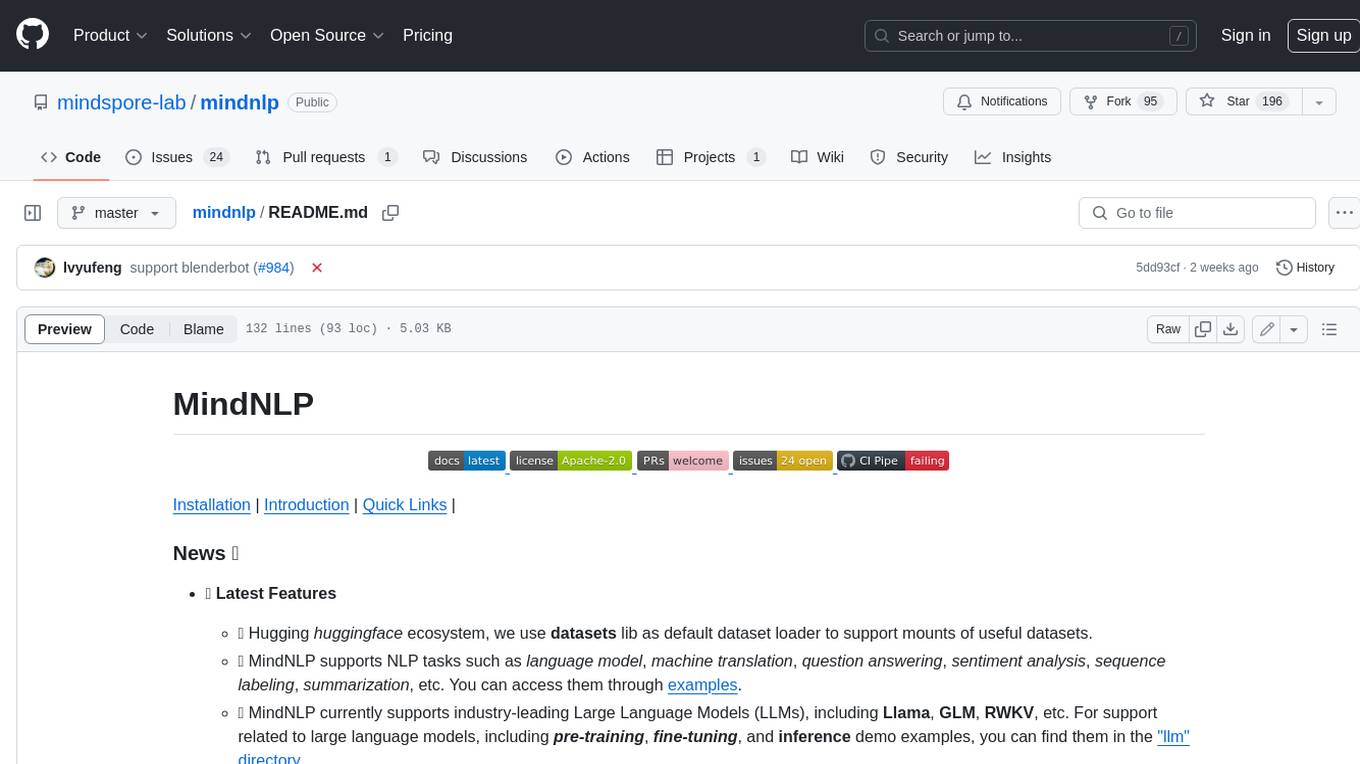
mindnlp
MindNLP is an open-source NLP library based on MindSpore. It provides a platform for solving natural language processing tasks, containing many common approaches in NLP. It can help researchers and developers to construct and train models more conveniently and rapidly. Key features of MindNLP include: * Comprehensive data processing: Several classical NLP datasets are packaged into a friendly module for easy use, such as Multi30k, SQuAD, CoNLL, etc. * Friendly NLP model toolset: MindNLP provides various configurable components. It is friendly to customize models using MindNLP. * Easy-to-use engine: MindNLP simplified complicated training process in MindSpore. It supports Trainer and Evaluator interfaces to train and evaluate models easily. MindNLP supports a wide range of NLP tasks, including: * Language modeling * Machine translation * Question answering * Sentiment analysis * Sequence labeling * Summarization MindNLP also supports industry-leading Large Language Models (LLMs), including Llama, GLM, RWKV, etc. For support related to large language models, including pre-training, fine-tuning, and inference demo examples, you can find them in the "llm" directory. To install MindNLP, you can either install it from Pypi, download the daily build wheel, or install it from source. The installation instructions are provided in the documentation. MindNLP is released under the Apache 2.0 license. If you find this project useful in your research, please consider citing the following paper: @misc{mindnlp2022, title={{MindNLP}: a MindSpore NLP library}, author={MindNLP Contributors}, howpublished = {\url{https://github.com/mindlab-ai/mindnlp}}, year={2022} }
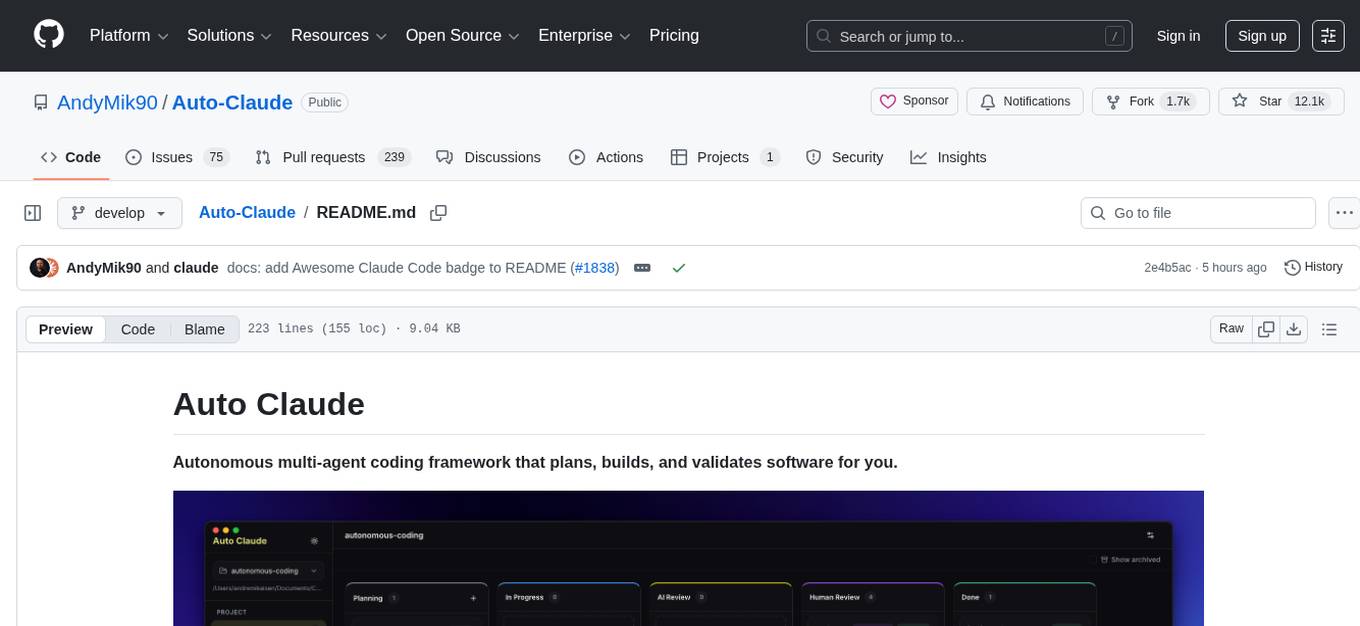
Auto-Claude
Auto Claude is an autonomous multi-agent coding framework that plans, builds, and validates software for users. It provides features such as autonomous tasks handling planning, implementation, and validation, parallel execution with multiple agent terminals, isolated workspaces for safe changes, self-validating quality assurance, AI-powered merge for conflict resolution, memory layer for smarter builds, GitHub/GitLab integration, cross-platform native desktop apps, auto-updates, and more. The tool offers a visual Kanban board for task management, AI-powered terminals for parallel work, AI-assisted feature planning, insights chat interface, ideation for code improvements, performance issues, and vulnerabilities discovery, and changelog generation from completed tasks. It follows a three-layer security model with OS sandbox, filesystem restrictions, and dynamic command allowlist, ensuring security through VirusTotal scans, SHA256 checksums, and code-signing for macOS releases.
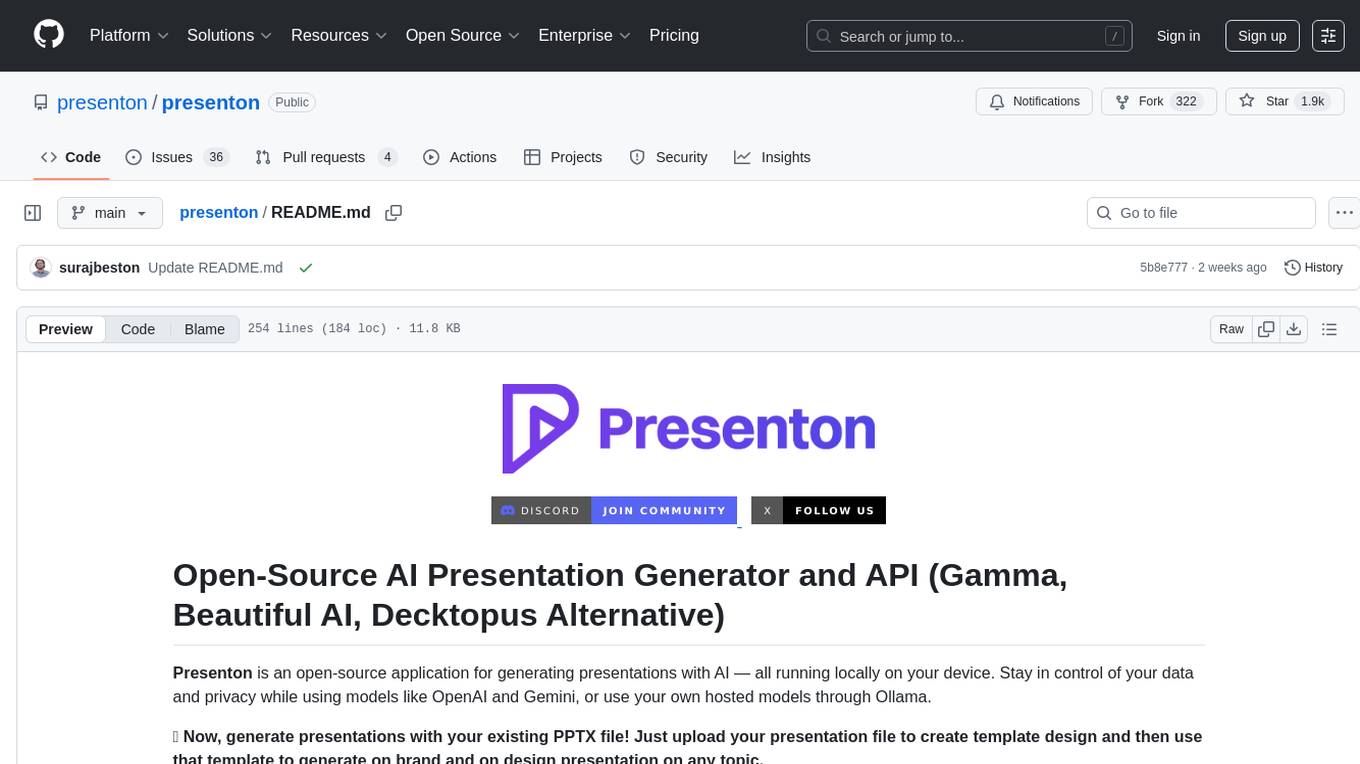
presenton
Presenton is an open-source AI presentation generator and API that allows users to create professional presentations locally on their devices. It offers complete control over the presentation workflow, including custom templates, AI template generation, flexible generation options, and export capabilities. Users can use their own API keys for various models, integrate with Ollama for local model running, and connect to OpenAI-compatible endpoints. The tool supports multiple providers for text and image generation, runs locally without cloud dependencies, and can be deployed as a Docker container with GPU support.
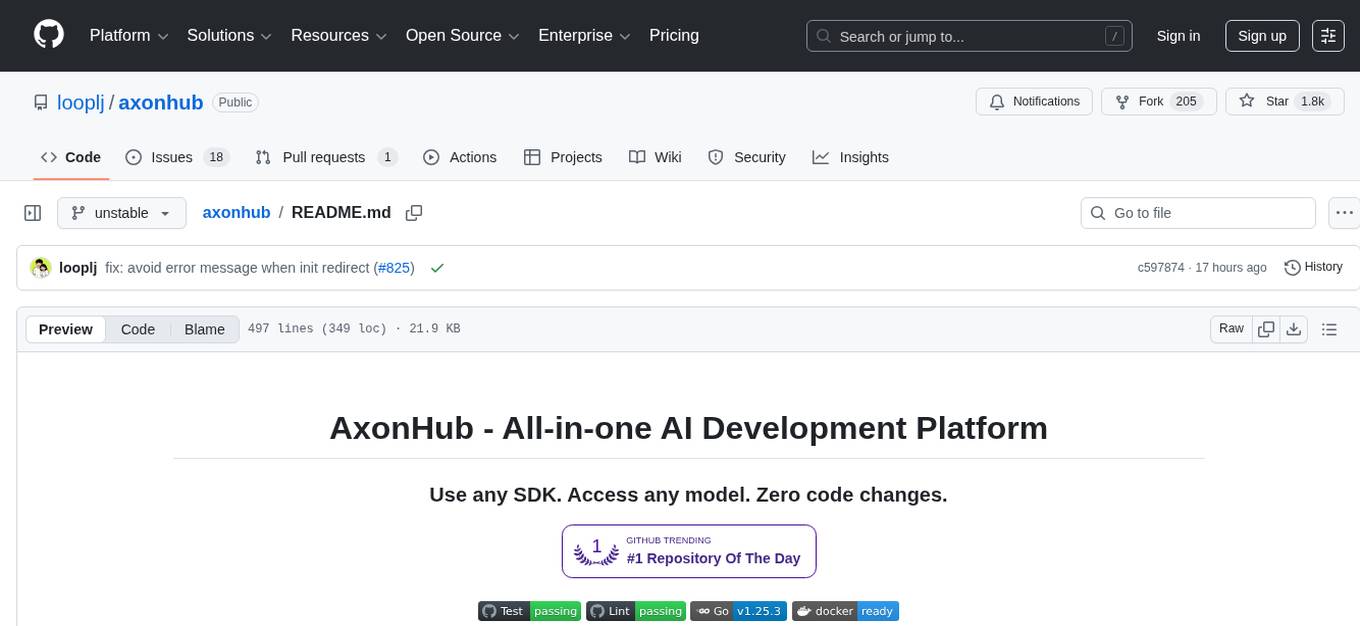
axonhub
AxonHub is an all-in-one AI development platform that serves as an AI gateway allowing users to switch between model providers without changing any code. It provides features like vendor lock-in prevention, integration simplification, observability enhancement, and cost control. Users can access any model using any SDK with zero code changes. The platform offers full request tracing, enterprise RBAC, smart load balancing, and real-time cost tracking. AxonHub supports multiple databases, provides a unified API gateway, and offers flexible model management and API key creation for authentication. It also integrates with various AI coding tools and SDKs for seamless usage.
AutoAgents
AutoAgents is a cutting-edge multi-agent framework built in Rust that enables the creation of intelligent, autonomous agents powered by Large Language Models (LLMs) and Ractor. Designed for performance, safety, and scalability. AutoAgents provides a robust foundation for building complex AI systems that can reason, act, and collaborate. With AutoAgents you can create Cloud Native Agents, Edge Native Agents and Hybrid Models as well. It is so extensible that other ML Models can be used to create complex pipelines using Actor Framework.
codemod
Codemod platform is a tool that helps developers create, distribute, and run codemods in codebases of any size. The AI-powered, community-led codemods enable automation of framework upgrades, large refactoring, and boilerplate programming with speed and developer experience. It aims to make dream migrations a reality for developers by providing a platform for seamless codemod operations.
ClashRoyaleBuildABot
Clash Royale Build-A-Bot is a project that allows users to build their own bot to play Clash Royale. It provides an advanced state generator that accurately returns detailed information using cutting-edge technologies. The project includes tutorials for setting up the environment, building a basic bot, and understanding state generation. It also offers updates such as replacing YOLOv5 with YOLOv8 unit model and enhancing performance features like placement and elixir management. The future roadmap includes plans to label more images of diverse cards, add a tracking layer for unit predictions, publish tutorials on Q-learning and imitation learning, release the YOLOv5 training notebook, implement chest opening and card upgrading features, and create a leaderboard for the best bots developed with this repository.
For similar tasks
go-interview-practice
The Go Interview Practice repository is a comprehensive platform designed to help users practice and master Go programming through interactive coding challenges. It offers an interactive web interface with a code editor, testing experience, and competitive leaderboard. Users can practice with challenges categorized by difficulty levels, contribute solutions, and track their progress. The repository also features AI-powered interview simulation, real-time code review, dynamic interview questions, and progressive hints. Users can showcase their achievements with auto-updating profile badges and contribute to the project by submitting solutions or adding new challenges.
learnhouse
LearnHouse is an open-source platform that allows anyone to easily provide world-class educational content. It supports various content types, including dynamic pages, videos, and documents. The platform is still in early development and should not be used in production environments. However, it offers several features, such as dynamic Notion-like pages, ease of use, multi-organization support, support for uploading videos and documents, course collections, user management, quizzes, course progress tracking, and an AI-powered assistant for teachers and students. LearnHouse is built using various open-source projects, including Next.js, TailwindCSS, Radix UI, Tiptap, FastAPI, YJS, PostgreSQL, LangChain, and React.
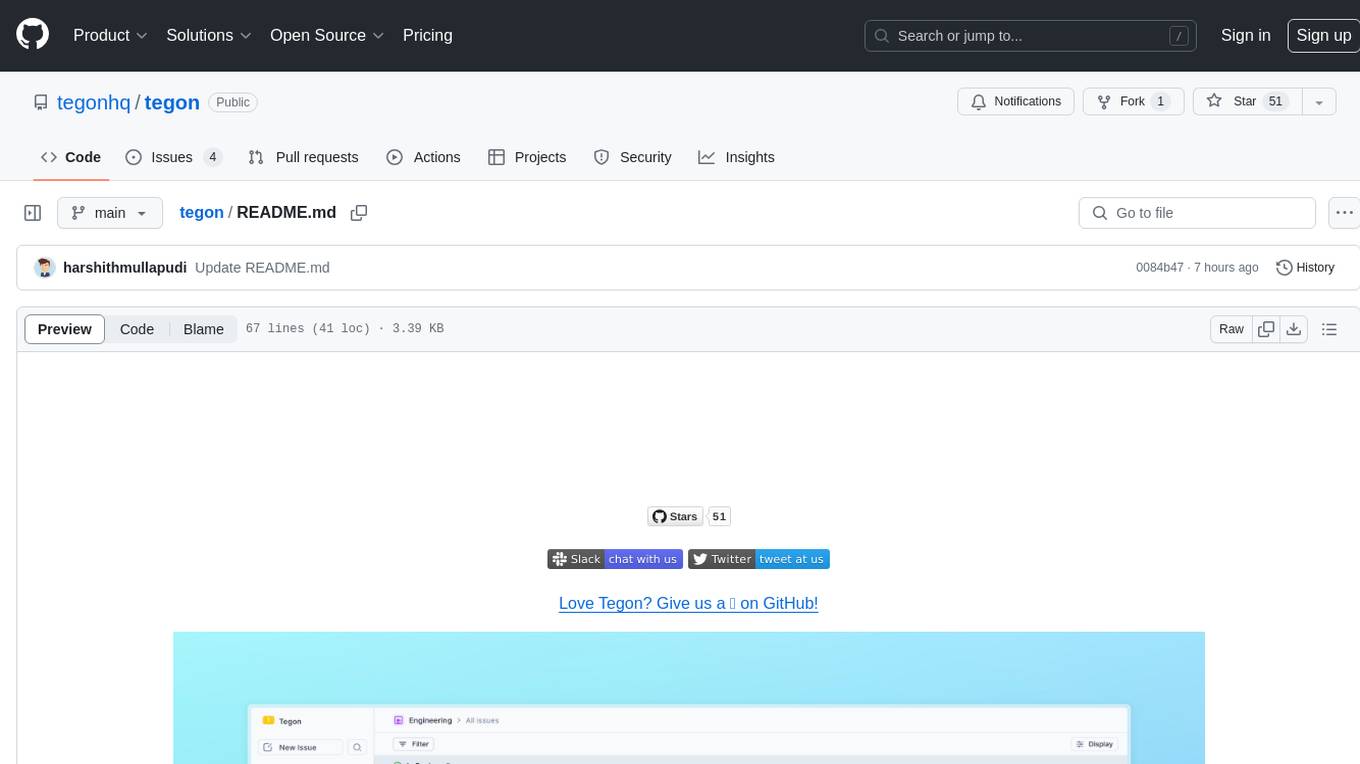
tegon
Tegon is an open-source AI-First issue tracking tool designed for engineering teams. It aims to simplify task management by leveraging AI and integrations to automate task creation, prioritize tasks, and enhance bug resolution. Tegon offers features like issues tracking, automatic title generation, AI-generated labels and assignees, custom views, and upcoming features like sprints and task prioritization. It integrates with GitHub, Slack, and Sentry to streamline issue tracking processes. Tegon also plans to introduce AI Agents like PR Agent and Bug Agent to enhance product management and bug resolution. Contributions are welcome, and the product is licensed under the MIT License.
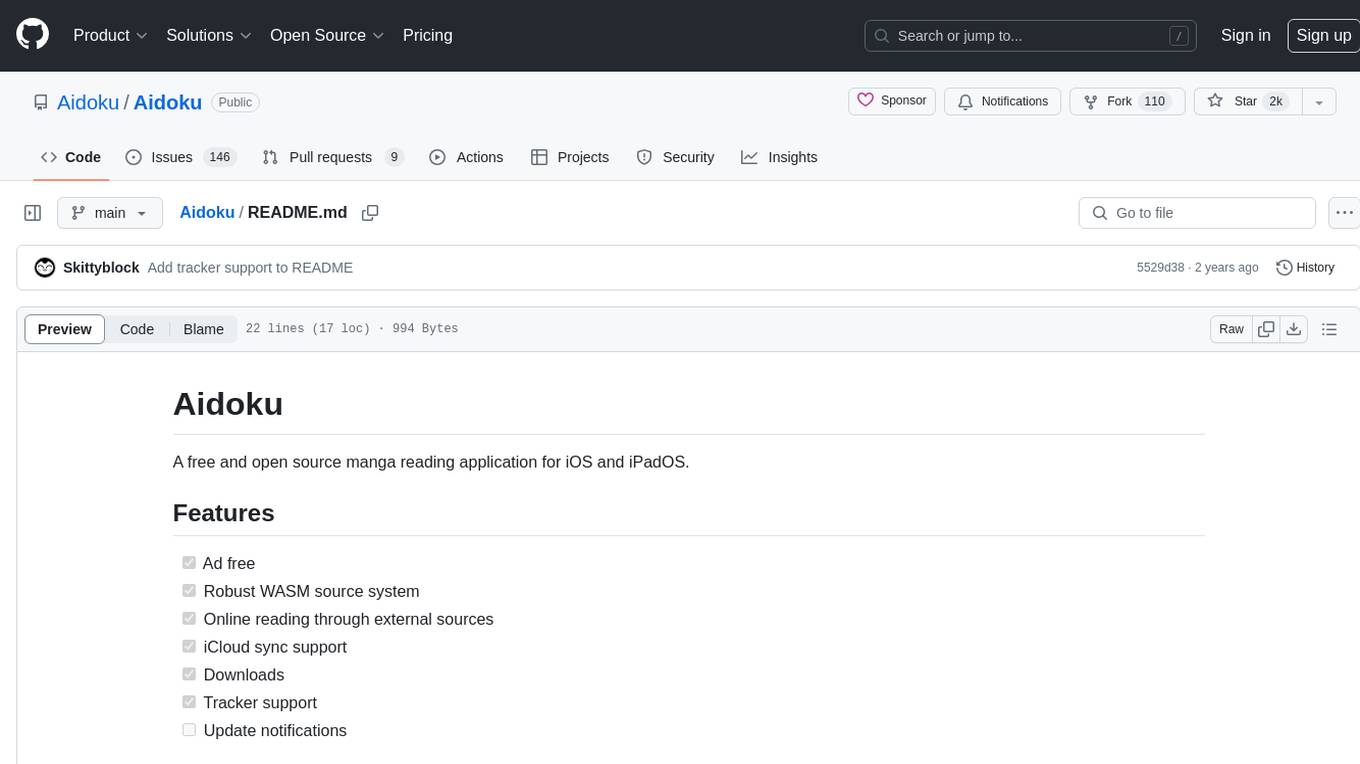
Aidoku
Aidoku is a free and open source manga reading application for iOS and iPadOS. It offers features like ad-free experience, robust WASM source system, online reading through external sources, iCloud sync support, downloads, and tracker support. Users can access the latest ipa from the releases page and join TestFlight via the Aidoku Discord for detailed installation instructions. The project is open to contributions, with planned features and fixes. Translation efforts are welcomed through Weblate for crowd-sourced translations.
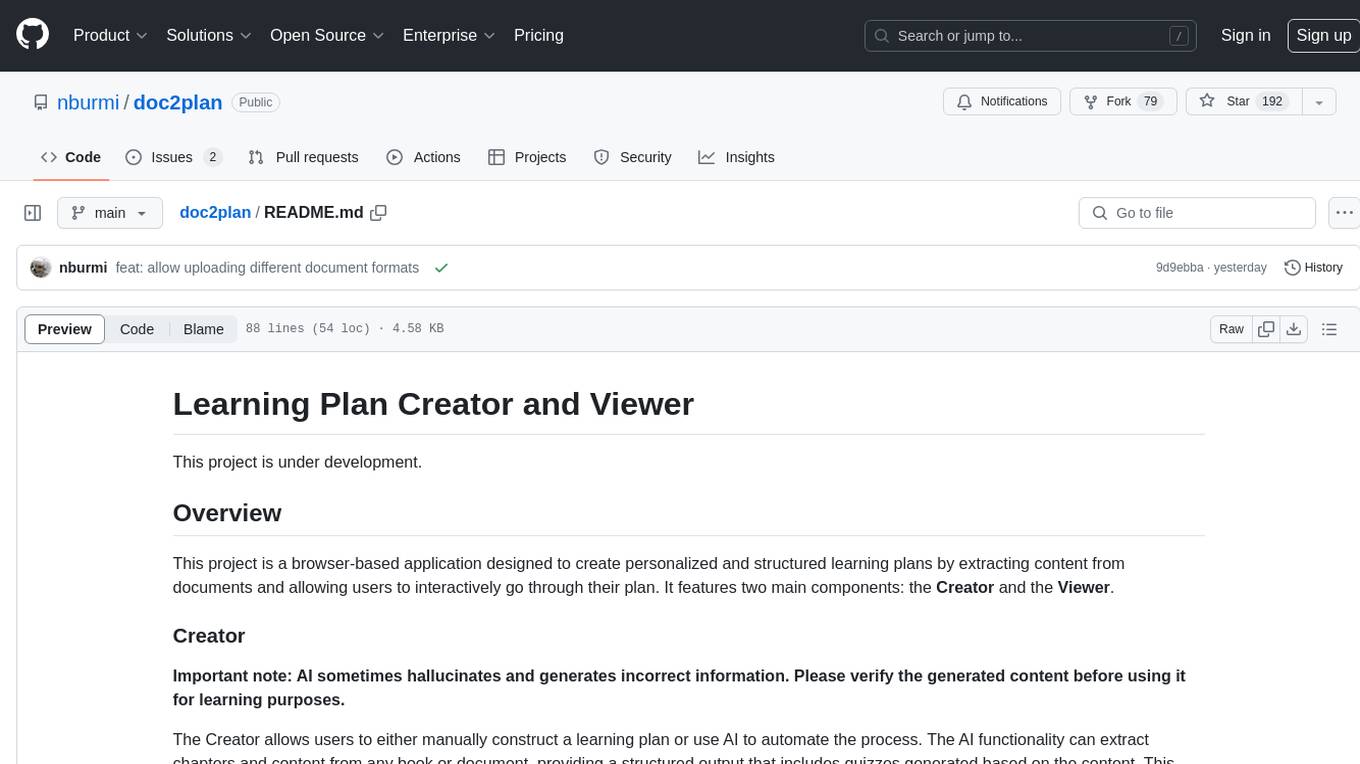
doc2plan
doc2plan is a browser-based application that helps users create personalized learning plans by extracting content from documents. It features a Creator for manual or AI-assisted plan construction and a Viewer for interactive plan navigation. Users can extract chapters, key topics, generate quizzes, and track progress. The application includes AI-driven content extraction, quiz generation, progress tracking, plan import/export, assistant management, customizable settings, viewer chat with text-to-speech and speech-to-text support, and integration with various Retrieval-Augmented Generation (RAG) models. It aims to simplify the creation of comprehensive learning modules tailored to individual needs.
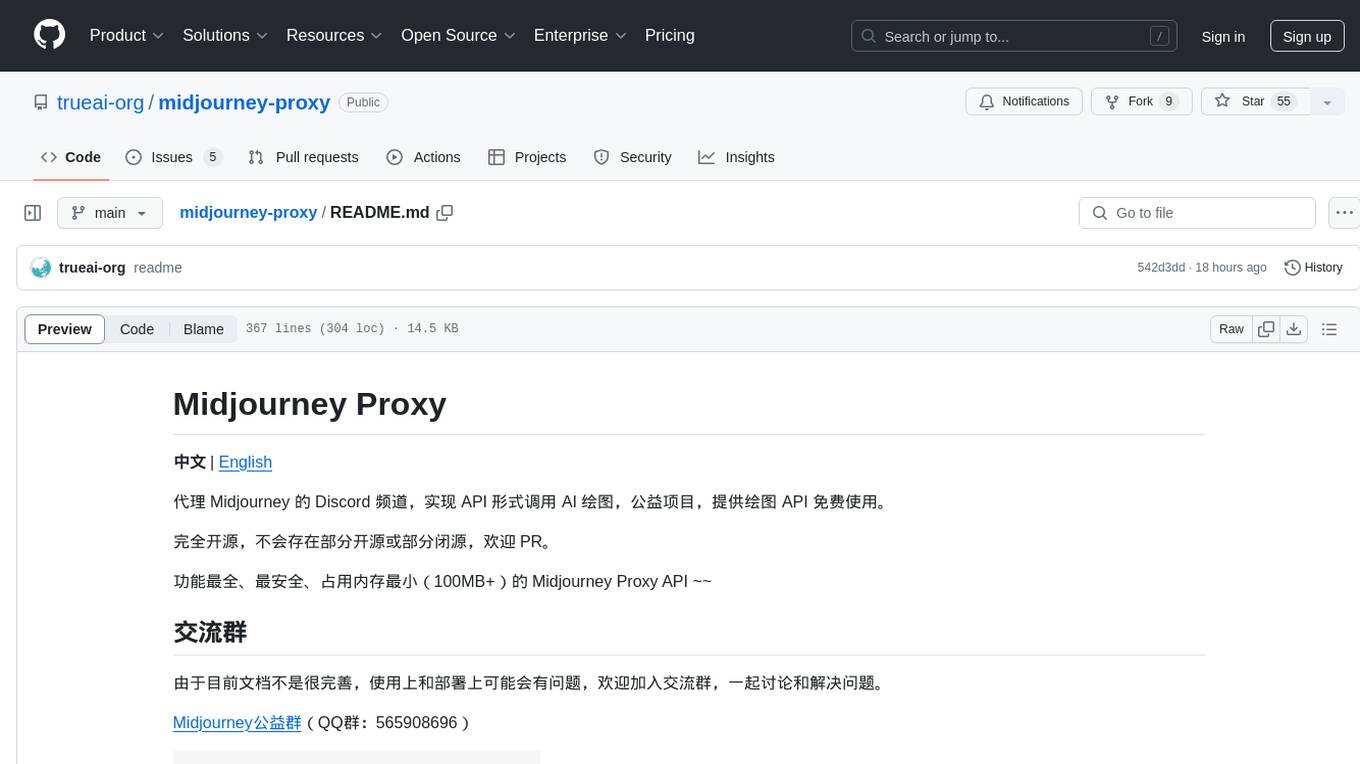
midjourney-proxy
Midjourney Proxy is an open-source project that acts as a proxy for the Midjourney Discord channel, allowing API-based AI drawing calls for charitable purposes. It provides drawing API for free use, ensuring full functionality, security, and minimal memory usage. The project supports various commands and actions related to Imagine, Blend, Describe, and more. It also offers real-time progress tracking, Chinese prompt translation, sensitive word pre-detection, user-token connection via wss for error information retrieval, and various account configuration options. Additionally, it includes features like image zooming, seed value retrieval, account-specific speed mode settings, multiple account configurations, and more. The project aims to support mainstream drawing clients and API calls, with features like task hierarchy, Remix mode, image saving, and CDN acceleration, among others.
shipstation
ShipStation is an AI-based website and agents generation platform that optimizes landing page websites and generic connect-anything-to-anything services. It enables seamless communication between service providers and integration partners, offering features like user authentication, project management, code editing, payment integration, and real-time progress tracking. The project architecture includes server-side (Node.js) and client-side (React with Vite) components. Prerequisites include Node.js, npm or yarn, Anthropic API key, Supabase account, Tavily API key, and Razorpay account. Setup instructions involve cloning the repository, setting up Supabase, configuring environment variables, and starting the backend and frontend servers. Users can access the application through the browser, sign up or log in, create landing pages or portfolios, and get websites stored in an S3 bucket. Deployment to Heroku involves building the client project, committing changes, and pushing to the main branch. Contributions to the project are encouraged, and the license encourages doing good.
AlgoListed
Algolisted is a pioneering platform dedicated to algorithmic problem-solving, offering a centralized hub for a diverse array of algorithmic challenges. It provides an immersive online environment for programmers to enhance their skills through Data Structures and Algorithms (DSA) sheets, academic progress tracking, resume refinement with OpenAI integration, adaptive testing, and job opportunity listings. The project is built on the MERN stack, Flask, Beautiful Soup, and Selenium,GEN AI, and deployed on Firebase. Algolisted aims to be a reliable companion in the pursuit of coding knowledge and proficiency.
For similar jobs
sweep
Sweep is an AI junior developer that turns bugs and feature requests into code changes. It automatically handles developer experience improvements like adding type hints and improving test coverage.
teams-ai
The Teams AI Library is a software development kit (SDK) that helps developers create bots that can interact with Teams and Microsoft 365 applications. It is built on top of the Bot Framework SDK and simplifies the process of developing bots that interact with Teams' artificial intelligence capabilities. The SDK is available for JavaScript/TypeScript, .NET, and Python.
ai-guide
This guide is dedicated to Large Language Models (LLMs) that you can run on your home computer. It assumes your PC is a lower-end, non-gaming setup.
classifai
Supercharge WordPress Content Workflows and Engagement with Artificial Intelligence. Tap into leading cloud-based services like OpenAI, Microsoft Azure AI, Google Gemini and IBM Watson to augment your WordPress-powered websites. Publish content faster while improving SEO performance and increasing audience engagement. ClassifAI integrates Artificial Intelligence and Machine Learning technologies to lighten your workload and eliminate tedious tasks, giving you more time to create original content that matters.
chatbot-ui
Chatbot UI is an open-source AI chat app that allows users to create and deploy their own AI chatbots. It is easy to use and can be customized to fit any need. Chatbot UI is perfect for businesses, developers, and anyone who wants to create a chatbot.
BricksLLM
BricksLLM is a cloud native AI gateway written in Go. Currently, it provides native support for OpenAI, Anthropic, Azure OpenAI and vLLM. BricksLLM aims to provide enterprise level infrastructure that can power any LLM production use cases. Here are some use cases for BricksLLM: * Set LLM usage limits for users on different pricing tiers * Track LLM usage on a per user and per organization basis * Block or redact requests containing PIIs * Improve LLM reliability with failovers, retries and caching * Distribute API keys with rate limits and cost limits for internal development/production use cases * Distribute API keys with rate limits and cost limits for students
uAgents
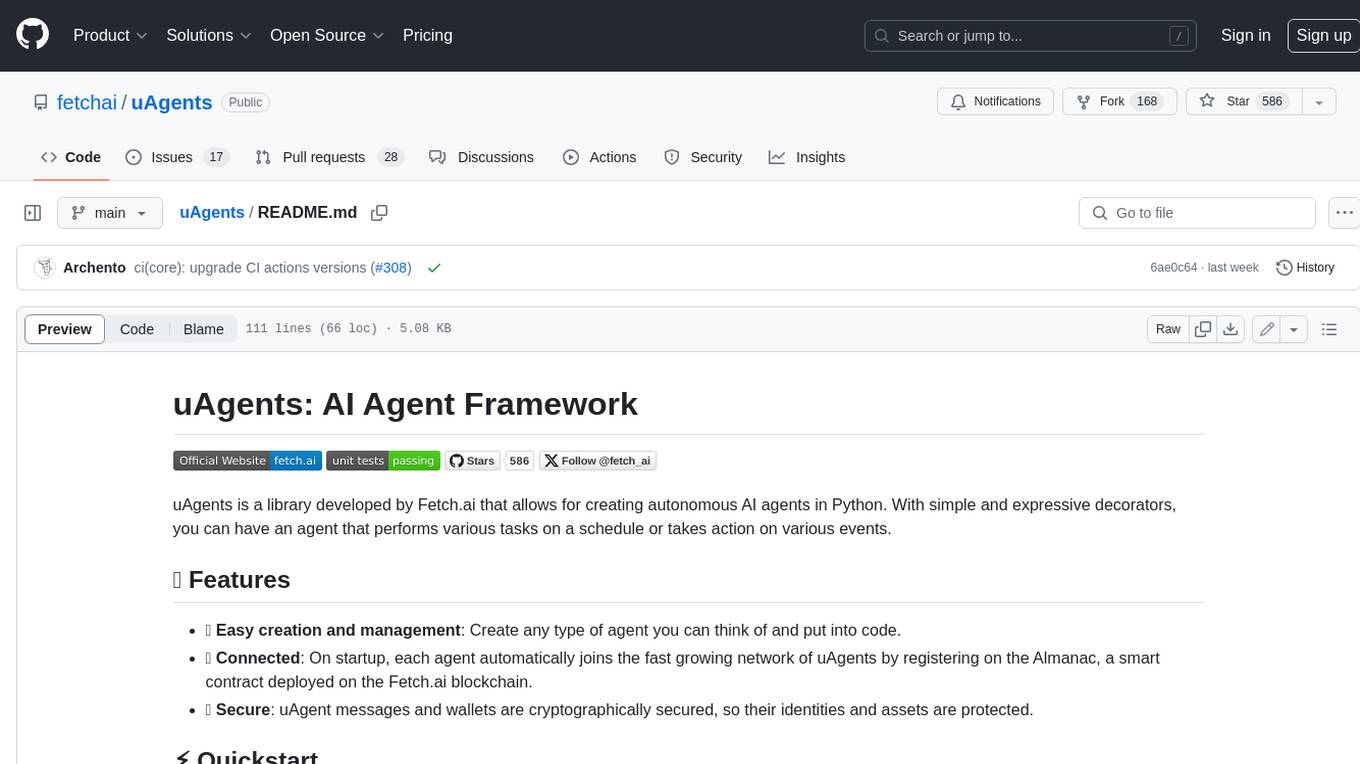
uAgents is a Python library developed by Fetch.ai that allows for the creation of autonomous AI agents. These agents can perform various tasks on a schedule or take action on various events. uAgents are easy to create and manage, and they are connected to a fast-growing network of other uAgents. They are also secure, with cryptographically secured messages and wallets.
griptape
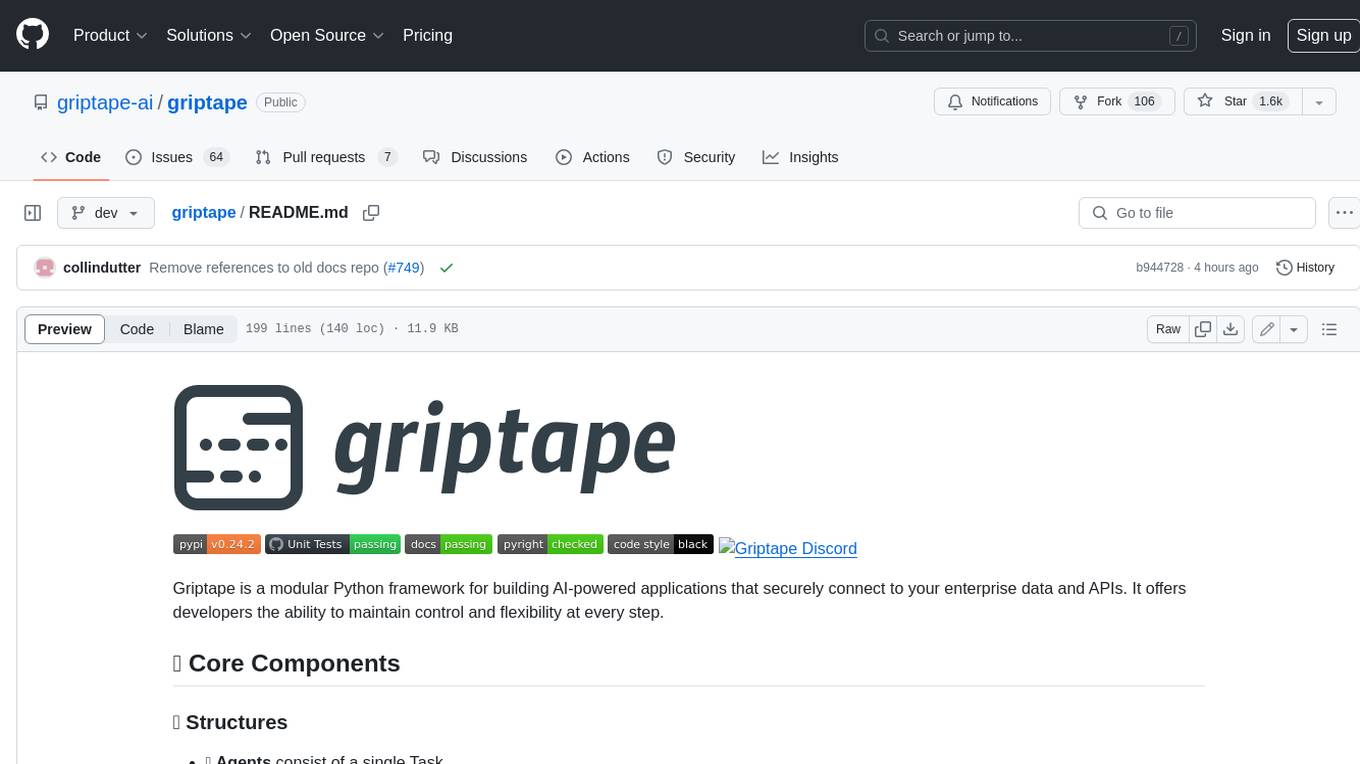
Griptape is a modular Python framework for building AI-powered applications that securely connect to your enterprise data and APIs. It offers developers the ability to maintain control and flexibility at every step. Griptape's core components include Structures (Agents, Pipelines, and Workflows), Tasks, Tools, Memory (Conversation Memory, Task Memory, and Meta Memory), Drivers (Prompt and Embedding Drivers, Vector Store Drivers, Image Generation Drivers, Image Query Drivers, SQL Drivers, Web Scraper Drivers, and Conversation Memory Drivers), Engines (Query Engines, Extraction Engines, Summary Engines, Image Generation Engines, and Image Query Engines), and additional components (Rulesets, Loaders, Artifacts, Chunkers, and Tokenizers). Griptape enables developers to create AI-powered applications with ease and efficiency.