


evals
A comprehensive evaluation framework for AI agents and LLM applications.
Stars: 72
Strands Evals SDK is a comprehensive evaluation framework for AI agents and LLM applications. It provides tools for output validation, trajectory analysis, interaction evaluation, and automated experiment generation. Users can assess agent behavior, simulate multi-turn conversations, and generate test suites. The SDK offers custom evaluators, experiment management, and built-in scoring tools for comprehensive evaluation of AI systems.
README:







Strands Evaluation is a powerful framework for evaluating AI agents and LLM applications. From simple output validation to complex multi-agent interaction analysis, trajectory evaluation, and automated experiment generation, Strands Evaluation provides comprehensive tools to measure and improve your AI systems.
- Multiple Evaluation Types: Output evaluation, trajectory analysis, tool usage assessment, and interaction evaluation
- Dynamic Simulators: Multi-turn conversation simulation with realistic user behavior and goal-oriented interactions
- LLM-as-a-Judge: Built-in evaluators using language models for sophisticated assessment with structured scoring
- Trace-based Evaluation: Analyze agent behavior through OpenTelemetry execution traces
- Automated Experiment Generation: Generate comprehensive test suites from context descriptions
- Custom Evaluators: Extensible framework for domain-specific evaluation logic
- Experiment Management: Save, load, and version your evaluation experiments with JSON serialization
- Built-in Scoring Tools: Helper functions for exact, in-order, and any-order trajectory matching
# Install Strands Evals SDK
pip install strands-agents-evals
from strands import Agent
from strands_evals import Case, Experiment
from strands_evals.evaluators import OutputEvaluator
# Create test cases
test_cases = [
Case[str, str](
name="knowledge-1",
input="What is the capital of France?",
expected_output="The capital of France is Paris.",
metadata={"category": "knowledge"}
)
]
# Create evaluators with custom rubric
evaluators = [
OutputEvaluator(
rubric="""
Evaluate based on:
1. Accuracy - Is the information correct?
2. Completeness - Does it fully answer the question?
3. Clarity - Is it easy to understand?
Score 1.0 if all criteria are met excellently.
Score 0.5 if some criteria are partially met.
Score 0.0 if the response is inadequate.
"""
)
]
# Create experiment and run evaluation
experiment = Experiment[str, str](cases=test_cases, evaluators=evaluators)
def get_response(case: Case) -> str:
agent = Agent(callback_handler=None)
return str(agent(case.input))
# Run evaluations
reports = experiment.run_evaluations(get_response)
reports[0].run_display()Ensure you have Python 3.10+ installed, then:
# Create and activate virtual environment
python -m venv .venv
source .venv/bin/activate  # On Windows use: .venv\Scripts\activate

# Install in development mode
pip install -e .

# Install with test dependencies
pip install -e ".[test]"

# Install with both test and dev dependencies
pip install -e ".[test,dev]"Evaluate agent responses using LLM-as-a-judge with flexible scoring criteria:
from strands_evals.evaluators import OutputEvaluator

evaluator = OutputEvaluator(
    rubric="Score 1.0 for accurate, complete responses. Score 0.5 for partial answers. Score 0.0 for incorrect or unhelpful responses.",
    include_inputs=True,  # Include context in evaluation
    model="us.anthropic.claude-sonnet-4-20250514-v1:0"  # Custom judge model
)Analyze agent tool usage and action sequences with helper scoring functions:
from strands_evals.evaluators import TrajectoryEvaluator
from strands_evals.extractors import tools_use_extractor
from strands_tools import calculator

def get_response_with_tools(case: Case) -> dict:
    agent = Agent(tools=[calculator])
    response = agent(case.input)

    # Extract trajectory efficiently to prevent context overflow
    trajectory = tools_use_extractor.extract_agent_tools_used_from_messages(agent.messages)

    # Update evaluator with tool descriptions
    evaluator.update_trajectory_description(
        tools_use_extractor.extract_tools_description(agent, is_short=True)
    )

    return {"output": str(response), "trajectory": trajectory}

# Evaluator includes built-in scoring tools: exact_match_scorer, in_order_match_scorer, any_order_match_scorer
evaluator = TrajectoryEvaluator(
    rubric="Score 1.0 if correct tools used in proper sequence. Use scoring tools to verify trajectory matches."
)Evaluate agent helpfulness using OpenTelemetry traces with seven-level scoring:
from strands_evals.evaluators import HelpfulnessEvaluator
from strands_evals.telemetry import StrandsEvalsTelemetry
from strands_evals.mappers import StrandsInMemorySessionMapper

# Setup telemetry for trace capture
telemetry = StrandsEvalsTelemetry().setup_in_memory_exporter()

def user_task_function(case: Case) -> dict:
    telemetry.memory_exporter.clear()

    agent = Agent(
        trace_attributes={"session.id": case.session_id},
        callback_handler=None
    )
    response = agent(case.input)

    # Map spans to session for evaluation
    spans = telemetry.memory_exporter.get_finished_spans()
    mapper = StrandsInMemorySessionMapper()
    session = mapper.map_to_session(spans, session_id=case.session_id)

    return {"output": str(response), "trajectory": session}

# Seven-level scoring: Not helpful (0.0) to Above and beyond (1.0)
evaluators = [HelpfulnessEvaluator()]
experiment = Experiment[str, str](cases=test_cases, evaluators=evaluators)

# Run evaluations
reports = experiment.run_evaluations(user_task_function)
reports[0].run_display()Simulate realistic user interactions with dynamic, goal-oriented conversations using ActorSimulator:
from strands import Agent
from strands_evals import Case, Experiment, ActorSimulator
from strands_evals.evaluators import HelpfulnessEvaluator, GoalSuccessRateEvaluator
from strands_evals.mappers import StrandsInMemorySessionMapper
from strands_evals.telemetry import StrandsEvalsTelemetry

# Setup telemetry
telemetry = StrandsEvalsTelemetry().setup_in_memory_exporter()
memory_exporter = telemetry.in_memory_exporter

def task_function(case: Case) -> dict:
    # Create simulator to drive conversation
    simulator = ActorSimulator.from_case_for_user_simulator(
        case=case,
        max_turns=10
    )

    # Create agent to evaluate
    agent = Agent(
        trace_attributes={
            "gen_ai.conversation.id": case.session_id,
            "session.id": case.session_id
        },
        callback_handler=None
    )

    # Run multi-turn conversation
    all_spans = []
    user_message = case.input

    while simulator.has_next():
        memory_exporter.clear()
        agent_response = agent(user_message)
        turn_spans = list(memory_exporter.get_finished_spans())
        all_spans.extend(turn_spans)

        user_result = simulator.act(str(agent_response))
        user_message = str(user_result.structured_output.message)

    # Map to session for evaluation
    mapper = StrandsInMemorySessionMapper()
    session = mapper.map_to_session(all_spans, session_id=case.session_id)

    return {"output": str(agent_response), "trajectory": session}

# Use evaluators to assess simulated conversations
evaluators = [
    HelpfulnessEvaluator(),
    GoalSuccessRateEvaluator()
]

experiment = Experiment(cases=test_cases, evaluators=evaluators)
reports = experiment.run_evaluations(task_function)
Key Benefits:
- Dynamic Interactions: Simulator adapts responses based on agent behavior
- Goal-Oriented Testing: Verify agents can complete user objectives through dialogue
- Realistic Conversations: Generate authentic multi-turn interaction patterns
- No Predefined Scripts: Test agents without hardcoded conversation paths
- Comprehensive Evaluation: Combine with trace-based evaluators for full assessment
Generate comprehensive test suites automatically from context descriptions:
from strands_evals.generators import ExperimentGenerator
from strands_evals.evaluators import TrajectoryEvaluator

# Define available tools and context
tool_context = """
Available tools:
- calculator(expression: str) -> float: Evaluate mathematical expressions
- web_search(query: str) -> str: Search the web for information
- file_read(path: str) -> str: Read file contents
"""

# Generate experiment with multiple test cases
generator = ExperimentGenerator[str, str](str, str)
experiment = await generator.from_context_async(
    context=tool_context,
    num_cases=10,
    evaluator=TrajectoryEvaluator,
    task_description="Math and research assistant with tool usage",
    num_topics=3  # Distribute cases across multiple topics
)

# Save generated experiment
experiment.to_file("generated_experiment", "json")Create domain-specific evaluation logic with standardized output format:
from strands_evals.evaluators import Evaluator
from strands_evals.types import EvaluationData, EvaluationOutput

class PolicyComplianceEvaluator(Evaluator[str, str]):
    def evaluate(self, evaluation_case: EvaluationData[str, str]) -> EvaluationOutput:
        # Custom evaluation logic
        response = evaluation_case.actual_output

        # Check for policy violations
        violations = self._check_policy_violations(response)

        if not violations:
            return EvaluationOutput(
                score=1.0,
                test_pass=True,
                reason="Response complies with all policies",
                label="compliant"
            )
        else:
            return EvaluationOutput(
                score=0.0,
                test_pass=False,
                reason=f"Policy violations: {', '.join(violations)}",
                label="non_compliant"
            )

    def _check_policy_violations(self, response: str) -> list[str]:
        # Implementation details...
return []Evaluate specific aspects of tool usage with specialized evaluators:
from strands_evals.evaluators import ToolSelectionAccuracyEvaluator, ToolParameterAccuracyEvaluator

# Evaluate if correct tools were selected
tool_selection_evaluator = ToolSelectionAccuracyEvaluator(
    rubric="Score 1.0 if optimal tools selected, 0.5 if suboptimal but functional, 0.0 if wrong tools"
)

# Evaluate if tool parameters were correct
tool_parameter_evaluator = ToolParameterAccuracyEvaluator(
    rubric="Score based on parameter accuracy and appropriateness for the task"
)- OutputEvaluator: Flexible LLM-based evaluation with custom rubrics
- TrajectoryEvaluator: Action sequence evaluation with built-in scoring tools
- HelpfulnessEvaluator: Seven-level helpfulness assessment from user perspective
- FaithfulnessEvaluator: Evaluates if responses are grounded in conversation history
- GoalSuccessRateEvaluator: Measures if user goals were achieved
- ToolSelectionAccuracyEvaluator: Evaluates appropriateness of tool choices
- ToolParameterAccuracyEvaluator: Evaluates correctness of tool parameters
- InteractionsEvaluator: Multi-agent interaction and handoff evaluation
- Custom Evaluators: Extensible base class for domain-specific logic
Save, load, and version experiments for reproducibility:
# Save experiment with metadata
experiment.to_file("customer_service_eval", "json")

# Load experiment from file
loaded_experiment = Experiment.from_file("./experiment_files/customer_service_eval.json", "json")

# Experiment files include:
# - Test cases with metadata
# - Evaluator configuration
# - Expected outputs and trajectories
# - Versioning informationTrack comprehensive metrics across multiple dimensions:
# Built-in metrics to consider:
metrics = {
    "accuracy": "Factual correctness of responses",
    "task_completion": "Whether agent completed the task",
    "tool_selection": "Appropriateness of tool choices",
    "response_time": "Agent response latency",
    "hallucination_rate": "Frequency of fabricated information",
    "token_usage": "Efficiency of token consumption",
    "user_satisfaction": "Subjective helpfulness ratings"
}

# Generate analysis reports
reports = experiment.run_evaluations(task_function)
reports[0].run_display() # Interactive display with metrics breakdown- Diversify Test Cases: Cover knowledge, reasoning, tool usage, conversation, edge cases, and safety scenarios
- Use Statistical Baselines: Run multiple evaluations to account for LLM non-determinism
- Combine Multiple Evaluators: Use output, trajectory, and helpfulness evaluators together
- Regular Evaluation Cadence: Implement consistent evaluation schedules for continuous improvement
-
Use Extractors: Always use
tools_use_extractorfunctions to prevent context overflow -
Update Descriptions Dynamically: Call
update_trajectory_description()with tool descriptions - Choose Appropriate Judge Models: Use stronger models for complex evaluations
- Batch Evaluations: Process multiple test cases efficiently
- Write Clear Rubrics: Include explicit scoring criteria and examples
- Include Expected Trajectories: Define exact sequences for trajectory evaluation
- Use Appropriate Matching: Choose between exact, in-order, or any-order matching
- Version Control: Track agent configurations alongside evaluation results
For detailed guidance & examples, explore our documentation:
We welcome contributions! See our Contributing Guide for details on:
- Development setup
- Contributing via Pull Requests
- Code of Conduct
- Reporting of security issues
This project is licensed under the Apache License 2.0 - see the LICENSE file for details.
See CONTRIBUTING for more information.
For Tasks:
Click tags to check more tools for each tasksFor Jobs:
Alternative AI tools for evals
Similar Open Source Tools
evals
Strands Evals SDK is a comprehensive evaluation framework for AI agents and LLM applications. It provides tools for output validation, trajectory analysis, interaction evaluation, and automated experiment generation. Users can assess agent behavior, simulate multi-turn conversations, and generate test suites. The SDK offers custom evaluators, experiment management, and built-in scoring tools for comprehensive evaluation of AI systems.
lionagi
LionAGI is a robust framework for orchestrating multi-step AI operations with precise control. It allows users to bring together multiple models, advanced reasoning, tool integrations, and custom validations in a single coherent pipeline. The framework is structured, expandable, controlled, and transparent, offering features like real-time logging, message introspection, and tool usage tracking. LionAGI supports advanced multi-step reasoning with ReAct, integrates with Anthropic's Model Context Protocol, and provides observability and debugging tools. Users can seamlessly orchestrate multiple models, integrate with Claude Code CLI SDK, and leverage a fan-out fan-in pattern for orchestration. The framework also offers optional dependencies for additional functionalities like reader tools, local inference support, rich output formatting, database support, and graph visualization.
orra
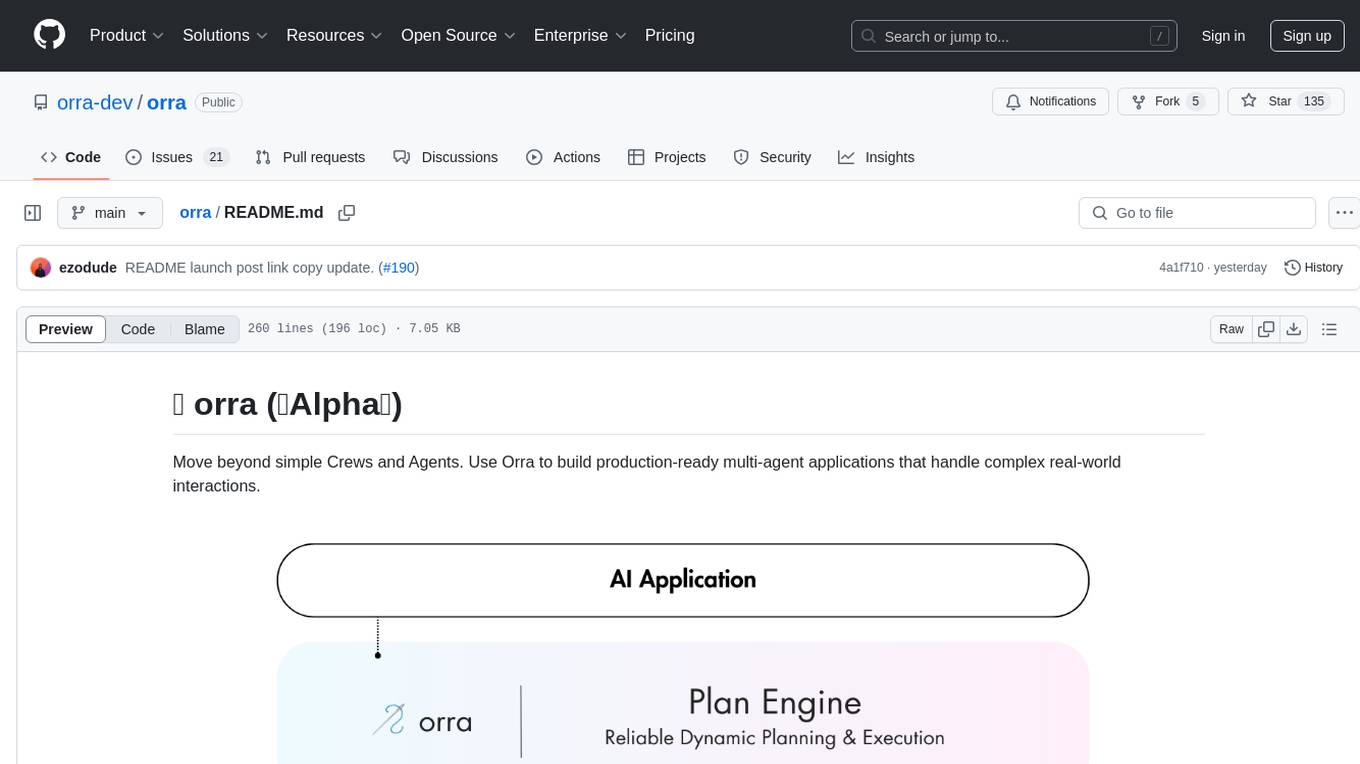
Orra is a tool for building production-ready multi-agent applications that handle complex real-world interactions. It coordinates tasks across existing stack, agents, and tools run as services using intelligent reasoning. With features like smart pre-evaluated execution plans, domain grounding, durable execution, and automatic service health monitoring, Orra enables users to go fast with tools as services and revert state to handle failures. It provides real-time status tracking and webhook result delivery, making it ideal for developers looking to move beyond simple crews and agents.
agentpress
AgentPress is a collection of simple but powerful utilities that serve as building blocks for creating AI agents. It includes core components for managing threads, registering tools, processing responses, state management, and utilizing LLMs. The tool provides a modular architecture for handling messages, LLM API calls, response processing, tool execution, and results management. Users can easily set up the environment, create custom tools with OpenAPI or XML schema, and manage conversation threads with real-time interaction. AgentPress aims to be agnostic, simple, and flexible, allowing users to customize and extend functionalities as needed.
sdk-typescript
Strands Agents - TypeScript SDK is a lightweight and flexible SDK that takes a model-driven approach to building and running AI agents in TypeScript/JavaScript. It brings key features from the Python Strands framework to Node.js environments, enabling type-safe agent development for various applications. The SDK supports model agnostic development with first-class support for Amazon Bedrock and OpenAI, along with extensible architecture for custom providers. It also offers built-in MCP support, real-time response streaming, extensible hooks, and conversation management features. With tools for interaction with external systems and seamless integration with MCP servers, the SDK provides a comprehensive solution for developing AI agents.
pilottai
PilottAI is a Python framework for building autonomous multi-agent systems with advanced orchestration capabilities. It provides enterprise-ready features for building scalable AI applications. The framework includes hierarchical agent systems, production-ready features like asynchronous processing and fault tolerance, advanced memory management with semantic storage, and integrations with multiple LLM providers and custom tools. PilottAI offers specialized agents for various tasks such as customer service, document processing, email handling, knowledge acquisition, marketing, research analysis, sales, social media, and web search. The framework also provides documentation, example use cases, and advanced features like memory management, load balancing, and fault tolerance.
lionagi
LionAGI is a powerful intelligent workflow automation framework that introduces advanced ML models into any existing workflows and data infrastructure. It can interact with almost any model, run interactions in parallel for most models, produce structured pydantic outputs with flexible usage, automate workflow via graph based agents, use advanced prompting techniques, and more. LionAGI aims to provide a centralized agent-managed framework for "ML-powered tools coordination" and to dramatically lower the barrier of entries for creating use-case/domain specific tools. It is designed to be asynchronous only and requires Python 3.10 or higher.
GraphRAG-SDK
Build fast and accurate GenAI applications with GraphRAG SDK, a specialized toolkit for building Graph Retrieval-Augmented Generation (GraphRAG) systems. It integrates knowledge graphs, ontology management, and state-of-the-art LLMs to deliver accurate, efficient, and customizable RAG workflows. The SDK simplifies the development process by automating ontology creation, knowledge graph agent creation, and query handling, enabling users to interact and query their knowledge graphs effectively. It supports multi-agent systems and orchestrates agents specialized in different domains. The SDK is optimized for FalkorDB, ensuring high performance and scalability for large-scale applications. By leveraging knowledge graphs, it enables semantic relationships and ontology-driven queries that go beyond standard vector similarity, enhancing retrieval-augmented generation capabilities.
req_llm
ReqLLM is a Req-based library for LLM interactions, offering a unified interface to AI providers through a plugin-based architecture. It brings composability and middleware advantages to LLM interactions, with features like auto-synced providers/models, typed data structures, ergonomic helpers, streaming capabilities, usage & cost extraction, and a plugin-based provider system. Users can easily generate text, structured data, embeddings, and track usage costs. The tool supports various AI providers like Anthropic, OpenAI, Groq, Google, and xAI, and allows for easy addition of new providers. ReqLLM also provides API key management, detailed documentation, and a roadmap for future enhancements.
memento-mcp
Memento MCP is a scalable, high-performance knowledge graph memory system designed for LLMs. It offers semantic retrieval, contextual recall, and temporal awareness to any LLM client supporting the model context protocol. The system is built on core concepts like entities and relations, utilizing Neo4j as its storage backend for unified graph and vector search capabilities. With advanced features such as semantic search, temporal awareness, confidence decay, and rich metadata support, Memento MCP provides a robust solution for managing knowledge graphs efficiently and effectively.
sdk-python
Strands Agents is a lightweight and flexible SDK that takes a model-driven approach to building and running AI agents. It supports various model providers, offers advanced capabilities like multi-agent systems and streaming support, and comes with built-in MCP server support. Users can easily create tools using Python decorators, integrate MCP servers seamlessly, and leverage multiple model providers for different AI tasks. The SDK is designed to scale from simple conversational assistants to complex autonomous workflows, making it suitable for a wide range of AI development needs.
agent-sdk-go
Agent Go SDK is a powerful Go framework for building production-ready AI agents that seamlessly integrates memory management, tool execution, multi-LLM support, and enterprise features into a flexible, extensible architecture. It offers core capabilities like multi-model intelligence, modular tool ecosystem, advanced memory management, and MCP integration. The SDK is enterprise-ready with built-in guardrails, complete observability, and support for enterprise multi-tenancy. It provides a structured task framework, declarative configuration, and zero-effort bootstrapping for development experience. The SDK supports environment variables for configuration and includes features like creating agents with YAML configuration, auto-generating agent configurations, using MCP servers with an agent, and CLI tool for headless usage.
sdg_hub
sdg_hub is a modular Python framework designed for building synthetic data generation pipelines using composable blocks and flows. Users can mix and match LLM-powered and traditional processing blocks to create sophisticated data generation workflows. The toolkit offers features such as modular composability, async performance, built-in validation, auto-discovery, rich monitoring, dataset schema discovery, and easy extensibility. sdg_hub provides detailed documentation and supports high-throughput processing with error handling. It simplifies the process of transforming datasets by allowing users to chain blocks together in YAML-configured flows, enabling the creation of complex data generation pipelines.
code_puppy
Code Puppy is an AI-powered code generation agent designed to understand programming tasks, generate high-quality code, and explain its reasoning. It supports multi-language code generation, interactive CLI, and detailed code explanations. The tool requires Python 3.9+ and API keys for various models like GPT, Google's Gemini, Cerebras, and Claude. It also integrates with MCP servers for advanced features like code search and documentation lookups. Users can create custom JSON agents for specialized tasks and access a variety of tools for file management, code execution, and reasoning sharing.
jido
Jido is a toolkit for building autonomous, distributed agent systems in Elixir. It provides the foundation for creating smart, composable workflows that can evolve and respond to their environment. Geared towards Agent builders, it contains core state primitives, composable actions, agent data structures, real-time sensors, signal system, skills, and testing tools. Jido is designed for multi-node Elixir clusters and offers rich helpers for unit and property-based testing.
For similar tasks
evals
Strands Evals SDK is a comprehensive evaluation framework for AI agents and LLM applications. It provides tools for output validation, trajectory analysis, interaction evaluation, and automated experiment generation. Users can assess agent behavior, simulate multi-turn conversations, and generate test suites. The SDK offers custom evaluators, experiment management, and built-in scoring tools for comprehensive evaluation of AI systems.
NotHotDog
NotHotDog is an open-source platform for testing, evaluating, and simulating AI agents. It offers a robust framework for generating test cases, running conversational scenarios, and analyzing agent performance.
oasis
OASIS is a scalable, open-source social media simulator that integrates large language models with rule-based agents to realistically mimic the behavior of up to one million users on platforms like Twitter and Reddit. It facilitates the study of complex social phenomena such as information spread, group polarization, and herd behavior, offering a versatile tool for exploring diverse social dynamics and user interactions in digital environments. With features like scalability, dynamic environments, diverse action spaces, and integrated recommendation systems, OASIS provides a comprehensive platform for simulating social media interactions at a large scale.
For similar jobs
weave
Weave is a toolkit for developing Generative AI applications, built by Weights & Biases. With Weave, you can log and debug language model inputs, outputs, and traces; build rigorous, apples-to-apples evaluations for language model use cases; and organize all the information generated across the LLM workflow, from experimentation to evaluations to production. Weave aims to bring rigor, best-practices, and composability to the inherently experimental process of developing Generative AI software, without introducing cognitive overhead.
LLMStack
LLMStack is a no-code platform for building generative AI agents, workflows, and chatbots. It allows users to connect their own data, internal tools, and GPT-powered models without any coding experience. LLMStack can be deployed to the cloud or on-premise and can be accessed via HTTP API or triggered from Slack or Discord.
VisionCraft
The VisionCraft API is a free API for using over 100 different AI models. From images to sound.
kaito
Kaito is an operator that automates the AI/ML inference model deployment in a Kubernetes cluster. It manages large model files using container images, avoids tuning deployment parameters to fit GPU hardware by providing preset configurations, auto-provisions GPU nodes based on model requirements, and hosts large model images in the public Microsoft Container Registry (MCR) if the license allows. Using Kaito, the workflow of onboarding large AI inference models in Kubernetes is largely simplified.
PyRIT
PyRIT is an open access automation framework designed to empower security professionals and ML engineers to red team foundation models and their applications. It automates AI Red Teaming tasks to allow operators to focus on more complicated and time-consuming tasks and can also identify security harms such as misuse (e.g., malware generation, jailbreaking), and privacy harms (e.g., identity theft). The goal is to allow researchers to have a baseline of how well their model and entire inference pipeline is doing against different harm categories and to be able to compare that baseline to future iterations of their model. This allows them to have empirical data on how well their model is doing today, and detect any degradation of performance based on future improvements.
tabby
Tabby is a self-hosted AI coding assistant, offering an open-source and on-premises alternative to GitHub Copilot. It boasts several key features: * Self-contained, with no need for a DBMS or cloud service. * OpenAPI interface, easy to integrate with existing infrastructure (e.g Cloud IDE). * Supports consumer-grade GPUs.
spear
SPEAR (Simulator for Photorealistic Embodied AI Research) is a powerful tool for training embodied agents. It features 300 unique virtual indoor environments with 2,566 unique rooms and 17,234 unique objects that can be manipulated individually. Each environment is designed by a professional artist and features detailed geometry, photorealistic materials, and a unique floor plan and object layout. SPEAR is implemented as Unreal Engine assets and provides an OpenAI Gym interface for interacting with the environments via Python.
Magick
Magick is a groundbreaking visual AIDE (Artificial Intelligence Development Environment) for no-code data pipelines and multimodal agents. Magick can connect to other services and comes with nodes and templates well-suited for intelligent agents, chatbots, complex reasoning systems and realistic characters.