


onnx
Open standard for machine learning interoperability
Stars: 20326
Open Neural Network Exchange (ONNX) is an open ecosystem that empowers AI developers to choose the right tools as their project evolves. ONNX provides an open source format for AI models, both deep learning and traditional ML. It defines an extensible computation graph model, as well as definitions of built-in operators and standard data types. Currently, we focus on the capabilities needed for inferencing (scoring). ONNX is widely supported and can be found in many frameworks, tools, and hardware, enabling interoperability between different frameworks and streamlining the path from research to production to increase the speed of innovation in the AI community. Join us to further evolve ONNX.
README:



Open Neural Network Exchange (ONNX) is an open ecosystem that empowers AI developers to choose the right tools as their project evolves. ONNX provides an open source format for AI models, both deep learning and traditional ML. It defines an extensible computation graph model, as well as definitions of built-in operators and standard data types. Currently we focus on the capabilities needed for inferencing (scoring).
ONNX is widely supported and can be found in many frameworks, tools, and hardware. Enabling interoperability between different frameworks and streamlining the path from research to production helps increase the speed of innovation in the AI community. We invite the community to join us and further evolve ONNX.
- Overview
- ONNX intermediate representation spec
- Versioning principles of the spec
- Operators documentation
- Operators documentation (latest release)
- Python API Overview
ONNX is a community project and the open governance model is described here. We encourage you to join the effort and contribute feedback, ideas, and code. You can participate in the Special Interest Groups and Working Groups to shape the future of ONNX.
Check out our contribution guide to get started.
If you think some operator should be added to ONNX specification, please read this document.
The schedules of the regular meetings of the Steering Committee, the working groups and the SIGs can be found here
Community Meetups are held at least once a year. Content from previous community meetups are at:
- 2020.04.09 https://lf-aidata.atlassian.net/wiki/spaces/DL/pages/14091402/LF+AI+Day+-ONNX+Community+Virtual+Meetup+-+Silicon+Valley+-+2020+April+9
- 2020.10.14 https://lf-aidata.atlassian.net/wiki/spaces/DL/pages/14092138/LF+AI+Day+-+ONNX+Community+Workshop+-+2020+October+14
- 2021.03.24 https://lf-aidata.atlassian.net/wiki/spaces/DL/pages/14092424/Instructions+for+Event+Hosts+-+LF+AI+Data+Day+-+ONNX+Virtual+Community+Meetup+-+March+2021
- 2021.10.21 https://lf-aidata.atlassian.net/wiki/spaces/DL/pages/14093194/LF+AI+Data+Day+ONNX+Community+Virtual+Meetup+-+October+2021
- 2022.06.24 https://lf-aidata.atlassian.net/wiki/spaces/DL/pages/14093969/ONNX+Community+Day+-+2022+June+24
- 2023.06.28 https://lf-aidata.atlassian.net/wiki/spaces/DL/pages/14094507/ONNX+Community+Day+2023+-+June+28
We encourage you to open Issues, or use Slack (If you have not joined yet, please use this link to join the group) for more real-time discussion.
Stay up to date with the latest ONNX news. [Facebook] [Twitter/X]
A roadmap process takes place every year. More details can be found here
ONNX released packages are published in PyPi.
pip install onnx # or pip install onnx[reference] for optional reference implementation dependenciesONNX weekly packages are published in PyPI to enable experimentation and early testing.
Detailed install instructions, including Common Build Options and Common Errors can be found here
This package provides abi3-compatible wheels, allowing a single binary wheel to work across multiple Python versions (from 3.12 onwards).
ONNX uses pytest as test driver. In order to run tests, you will first need to install pytest:
pip install pytestAfter installing pytest, use the following command to run tests.
pytestCheck out the contributor guide for instructions.
This project provides reproducible builds for Linux.
A reproducible build means that the same source code will always produce identical binary outputs, no matter who builds it or where it is built.
To achieve this, we use the SOURCE_DATE_EPOCH standard. This ensures that build timestamps and other time-dependent information are fixed, making the output bit-for-bit identical across different environments.
- Transparency: Anyone can verify that the distributed binaries were created from the published source code.
- Security: Prevents tampering or hidden changes in the build process.
- Trust: Users can be confident that the binaries they download are exactly what the maintainers intended.
If you prefer, you can use the prebuilt reproducible binaries instead of building from source yourself.
Checkout https://trademarks.justia.com for the trademark.
For Tasks:
Click tags to check more tools for each tasksFor Jobs:
Alternative AI tools for onnx
Similar Open Source Tools
onnx
Open Neural Network Exchange (ONNX) is an open ecosystem that empowers AI developers to choose the right tools as their project evolves. ONNX provides an open source format for AI models, both deep learning and traditional ML. It defines an extensible computation graph model, as well as definitions of built-in operators and standard data types. Currently, we focus on the capabilities needed for inferencing (scoring). ONNX is widely supported and can be found in many frameworks, tools, and hardware, enabling interoperability between different frameworks and streamlining the path from research to production to increase the speed of innovation in the AI community. Join us to further evolve ONNX.
Robyn
Robyn is an experimental, semi-automated and open-sourced Marketing Mix Modeling (MMM) package from Meta Marketing Science. It uses various machine learning techniques to define media channel efficiency and effectivity, explore adstock rates and saturation curves. Built for granular datasets with many independent variables, especially suitable for digital and direct response advertisers with rich data sources. Aiming to democratize MMM, make it accessible for advertisers of all sizes, and contribute to the measurement landscape.
morphik-core
Morphik is an AI-native toolset designed to help developers integrate context into their AI applications by providing tools to store, represent, and search unstructured data. It offers features such as multimodal search, fast metadata extraction, and integrations with existing tools. Morphik aims to address the challenges of traditional AI approaches that struggle with visually rich documents and provide a more comprehensive solution for understanding and processing complex data.
lollms-webui
LoLLMs WebUI (Lord of Large Language Multimodal Systems: One tool to rule them all) is a user-friendly interface to access and utilize various LLM (Large Language Models) and other AI models for a wide range of tasks. With over 500 AI expert conditionings across diverse domains and more than 2500 fine tuned models over multiple domains, LoLLMs WebUI provides an immediate resource for any problem, from car repair to coding assistance, legal matters, medical diagnosis, entertainment, and more. The easy-to-use UI with light and dark mode options, integration with GitHub repository, support for different personalities, and features like thumb up/down rating, copy, edit, and remove messages, local database storage, search, export, and delete multiple discussions, make LoLLMs WebUI a powerful and versatile tool.
promptmage
PromptMage simplifies the process of creating and managing LLM workflows as a self-hosted solution. It offers an intuitive interface for prompt testing and comparison, incorporates version control features, and aims to improve productivity in both small teams and large enterprises. The tool bridges the gap in LLM workflow management, empowering developers, researchers, and organizations to make LLM technology more accessible and manageable for the next wave of AI innovations.
GrAIdient
GrAIdient is a framework designed to enable the development of deep learning models using the internal GPU of a Mac. It provides access to the graph of layers, allowing for unique model design with greater understanding, control, and reproducibility. The goal is to challenge the understanding of deep learning models, transitioning from black box to white box models. Key features include direct access to layers, native Mac GPU support, Swift language implementation, gradient checking, PyTorch interoperability, and more. The documentation covers main concepts, architecture, and examples. GrAIdient is MIT licensed.
supervisely
Supervisely is a computer vision platform that provides a range of tools and services for developing and deploying computer vision solutions. It includes a data labeling platform, a model training platform, and a marketplace for computer vision apps. Supervisely is used by a variety of organizations, including Fortune 500 companies, research institutions, and government agencies.
burn
Burn is a new comprehensive dynamic Deep Learning Framework built using Rust with extreme flexibility, compute efficiency and portability as its primary goals.
wandb
Weights & Biases (W&B) is a platform that helps users build better machine learning models faster by tracking and visualizing all components of the machine learning pipeline, from datasets to production models. It offers tools for tracking, debugging, evaluating, and monitoring machine learning applications. W&B provides integrations with popular frameworks like PyTorch, TensorFlow/Keras, Hugging Face Transformers, PyTorch Lightning, XGBoost, and Sci-Kit Learn. Users can easily log metrics, visualize performance, and compare experiments using W&B. The platform also supports hosting options in the cloud or on private infrastructure, making it versatile for various deployment needs.
mastra
Mastra is an opinionated Typescript framework designed to help users quickly build AI applications and features. It provides primitives such as workflows, agents, RAG, integrations, syncs, and evals. Users can run Mastra locally or deploy it to a serverless cloud. The framework supports various LLM providers, offers tools for building language models, workflows, and accessing knowledge bases. It includes features like durable graph-based state machines, retrieval-augmented generation, integrations, syncs, and automated tests for evaluating LLM outputs.
langchain4j
LangChain for Java simplifies integrating Large Language Models (LLMs) into Java applications by offering unified APIs for various LLM providers and embedding stores. It provides a comprehensive toolbox with tools for prompt templating, chat memory management, function calling, and high-level patterns like Agents and RAG. The library supports 15+ popular LLM providers and 15+ embedding stores, offering numerous examples to help users quickly start building LLM-powered applications. LangChain4j is a fusion of ideas from various projects and actively incorporates new techniques and integrations to keep users up-to-date. The project is under active development, with core functionality already in place for users to start building LLM-powered apps.
airbyte-platform
Airbyte is an open-source data integration platform that makes it easy to move data from any source to any destination. With Airbyte, you can build and manage data pipelines without writing any code. Airbyte provides a library of pre-built connectors that make it easy to connect to popular data sources and destinations. You can also create your own connectors using Airbyte's low-code Connector Development Kit (CDK). Airbyte is used by data engineers and analysts at companies of all sizes to move data for a variety of purposes, including data warehousing, data analysis, and machine learning.
council
Council is an open-source platform designed for the rapid development and deployment of customized generative AI applications using teams of agents. It extends the LLM tool ecosystem by providing advanced control flow and scalable oversight for AI agents. Users can create sophisticated agents with predictable behavior by leveraging Council's powerful approach to control flow using Controllers, Filters, Evaluators, and Budgets. The framework allows for automated routing between agents, comparing, evaluating, and selecting the best results for a task. Council aims to facilitate packaging and deploying agents at scale on multiple platforms while enabling enterprise-grade monitoring and quality control.
graphrag
The GraphRAG project is a data pipeline and transformation suite designed to extract meaningful, structured data from unstructured text using LLMs. It enhances LLMs' ability to reason about private data. The repository provides guidance on using knowledge graph memory structures to enhance LLM outputs, with a warning about the potential costs of GraphRAG indexing. It offers contribution guidelines, development resources, and encourages prompt tuning for optimal results. The Responsible AI FAQ addresses GraphRAG's capabilities, intended uses, evaluation metrics, limitations, and operational factors for effective and responsible use.
modus
Modus is an open-source, serverless framework for building APIs powered by WebAssembly. It simplifies integrating AI models, data, and business logic with sandboxed execution. Modus extracts metadata, compiles code with optimizations, caches compiled modules, prepares invocation plans, generates API schema, and activates endpoints. Users query the endpoint, and Modus loads compiled code into a sandboxed environment, runs code securely, queries data and AI models, and responds via API. It provides a production-ready scalable endpoint for AI-enabled apps, optimized for sub-second response times. Modus supports programming languages like AssemblyScript and Go, and can be hosted on Hypermode or any platform. Developed by Hypermode as an open-source project, Modus welcomes external contributions.
basalt
Basalt is a lightweight and flexible CSS framework designed to help developers quickly build responsive and modern websites. It provides a set of pre-designed components and utilities that can be easily customized to create unique and visually appealing web interfaces. With Basalt, developers can save time and effort by leveraging its modular structure and responsive design principles to create professional-looking websites with ease.
For similar tasks
onnx
Open Neural Network Exchange (ONNX) is an open ecosystem that empowers AI developers to choose the right tools as their project evolves. ONNX provides an open source format for AI models, both deep learning and traditional ML. It defines an extensible computation graph model, as well as definitions of built-in operators and standard data types. Currently, we focus on the capabilities needed for inferencing (scoring). ONNX is widely supported and can be found in many frameworks, tools, and hardware, enabling interoperability between different frameworks and streamlining the path from research to production to increase the speed of innovation in the AI community. Join us to further evolve ONNX.
resonance
Resonance is a framework designed to facilitate interoperability and messaging between services in your infrastructure and beyond. It provides AI capabilities and takes full advantage of asynchronous PHP, built on top of Swoole. With Resonance, you can: * Chat with Open-Source LLMs: Create prompt controllers to directly answer user's prompts. LLM takes care of determining user's intention, so you can focus on taking appropriate action. * Asynchronous Where it Matters: Respond asynchronously to incoming RPC or WebSocket messages (or both combined) with little overhead. You can set up all the asynchronous features using attributes. No elaborate configuration is needed. * Simple Things Remain Simple: Writing HTTP controllers is similar to how it's done in the synchronous code. Controllers have new exciting features that take advantage of the asynchronous environment. * Consistency is Key: You can keep the same approach to writing software no matter the size of your project. There are no growing central configuration files or service dependencies registries. Every relation between code modules is local to those modules. * Promises in PHP: Resonance provides a partial implementation of Promise/A+ spec to handle various asynchronous tasks. * GraphQL Out of the Box: You can build elaborate GraphQL schemas by using just the PHP attributes. Resonance takes care of reusing SQL queries and optimizing the resources' usage. All fields can be resolved asynchronously.
whetstone.chatgpt
Whetstone.ChatGPT is a simple light-weight library that wraps the Open AI API with support for dependency injection. It supports features like GPT 4, GPT 3.5 Turbo, chat completions, audio transcription and translation, vision completions, files, fine tunes, images, embeddings, moderations, and response streaming. The library provides a video walkthrough of a Blazor web app built on it and includes examples such as a command line bot. It offers quickstarts for dependency injection, chat completions, completions, file handling, fine tuning, image generation, and audio transcription.

ChatGPT-Next-Web-Pro
ChatGPT-Next-Web-Pro is a tool that provides an enhanced version of ChatGPT-Next-Web with additional features and functionalities. It offers complete ChatGPT-Next-Web functionality, file uploading and storage capabilities, drawing and video support, multi-modal support, reverse model support, knowledge base integration, translation, customizations, and more. The tool can be deployed with or without a backend, allowing users to interact with AI models, manage accounts, create models, manage API keys, handle orders, manage memberships, and more. It supports various cloud services like Aliyun OSS, Tencent COS, and Minio for file storage, and integrates with external APIs like Azure, Google Gemini Pro, and Luma. The tool also provides options for customizing website titles, subtitles, icons, and plugin buttons, and offers features like voice input, file uploading, real-time token count display, and more.
bytechef
ByteChef is an open-source, low-code, extendable API integration and workflow automation platform. It provides an intuitive UI Workflow Editor, event-driven & scheduled workflows, multiple flow controls, built-in code editor supporting Java, JavaScript, Python, and Ruby, rich component ecosystem, extendable with custom connectors, AI-ready with built-in AI components, developer-ready to expose workflows as APIs, version control friendly, self-hosted, scalable, and resilient. It allows users to build and visualize workflows, automate tasks across SaaS apps, internal APIs, and databases, and handle millions of workflows with high availability and fault tolerance.
GOLEM
GOLEM is an open-source AI framework focused on optimization and learning of structured graph-based models using meta-heuristic methods. It emphasizes the potential of meta-heuristics in complex problem spaces where gradient-based methods are not suitable, and the importance of structured models in various problem domains. The framework offers features like structured model optimization, metaheuristic methods, multi-objective optimization, constrained optimization, extensibility, interpretability, and reproducibility. It can be applied to optimization problems represented as directed graphs with defined fitness functions. GOLEM has applications in areas like AutoML, Bayesian network structure search, differential equation discovery, geometric design, and neural architecture search. The project structure includes packages for core functionalities, adapters, graph representation, optimizers, genetic algorithms, utilities, serialization, visualization, examples, and testing. Contributions are welcome, and the project is supported by ITMO University's Research Center Strong Artificial Intelligence in Industry.
intel-extension-for-tensorflow
Intel® Extension for TensorFlow* is a high performance deep learning extension plugin based on TensorFlow PluggableDevice interface. It aims to accelerate AI workloads by allowing users to plug Intel CPU or GPU devices into TensorFlow on-demand, exposing the computing power inside Intel's hardware. The extension provides XPU specific implementation, kernels & operators, graph optimizer, device runtime, XPU configuration management, XPU backend selection, and options for turning on/off advanced features.
lightning-bolts
Bolts package provides a variety of components to extend PyTorch Lightning, such as callbacks & datasets, for applied research and production. Users can accelerate Lightning training with the Torch ORT Callback to optimize ONNX graph for faster training & inference. Additionally, users can introduce sparsity with the SparseMLCallback to accelerate inference by leveraging the DeepSparse engine. Specific research implementations are encouraged, with contributions that help train SSL models and integrate with Lightning Flash for state-of-the-art models in applied research.
For similar jobs
weave
Weave is a toolkit for developing Generative AI applications, built by Weights & Biases. With Weave, you can log and debug language model inputs, outputs, and traces; build rigorous, apples-to-apples evaluations for language model use cases; and organize all the information generated across the LLM workflow, from experimentation to evaluations to production. Weave aims to bring rigor, best-practices, and composability to the inherently experimental process of developing Generative AI software, without introducing cognitive overhead.
LLMStack
LLMStack is a no-code platform for building generative AI agents, workflows, and chatbots. It allows users to connect their own data, internal tools, and GPT-powered models without any coding experience. LLMStack can be deployed to the cloud or on-premise and can be accessed via HTTP API or triggered from Slack or Discord.
VisionCraft
The VisionCraft API is a free API for using over 100 different AI models. From images to sound.
kaito
Kaito is an operator that automates the AI/ML inference model deployment in a Kubernetes cluster. It manages large model files using container images, avoids tuning deployment parameters to fit GPU hardware by providing preset configurations, auto-provisions GPU nodes based on model requirements, and hosts large model images in the public Microsoft Container Registry (MCR) if the license allows. Using Kaito, the workflow of onboarding large AI inference models in Kubernetes is largely simplified.
PyRIT
PyRIT is an open access automation framework designed to empower security professionals and ML engineers to red team foundation models and their applications. It automates AI Red Teaming tasks to allow operators to focus on more complicated and time-consuming tasks and can also identify security harms such as misuse (e.g., malware generation, jailbreaking), and privacy harms (e.g., identity theft). The goal is to allow researchers to have a baseline of how well their model and entire inference pipeline is doing against different harm categories and to be able to compare that baseline to future iterations of their model. This allows them to have empirical data on how well their model is doing today, and detect any degradation of performance based on future improvements.
tabby
Tabby is a self-hosted AI coding assistant, offering an open-source and on-premises alternative to GitHub Copilot. It boasts several key features: * Self-contained, with no need for a DBMS or cloud service. * OpenAPI interface, easy to integrate with existing infrastructure (e.g Cloud IDE). * Supports consumer-grade GPUs.
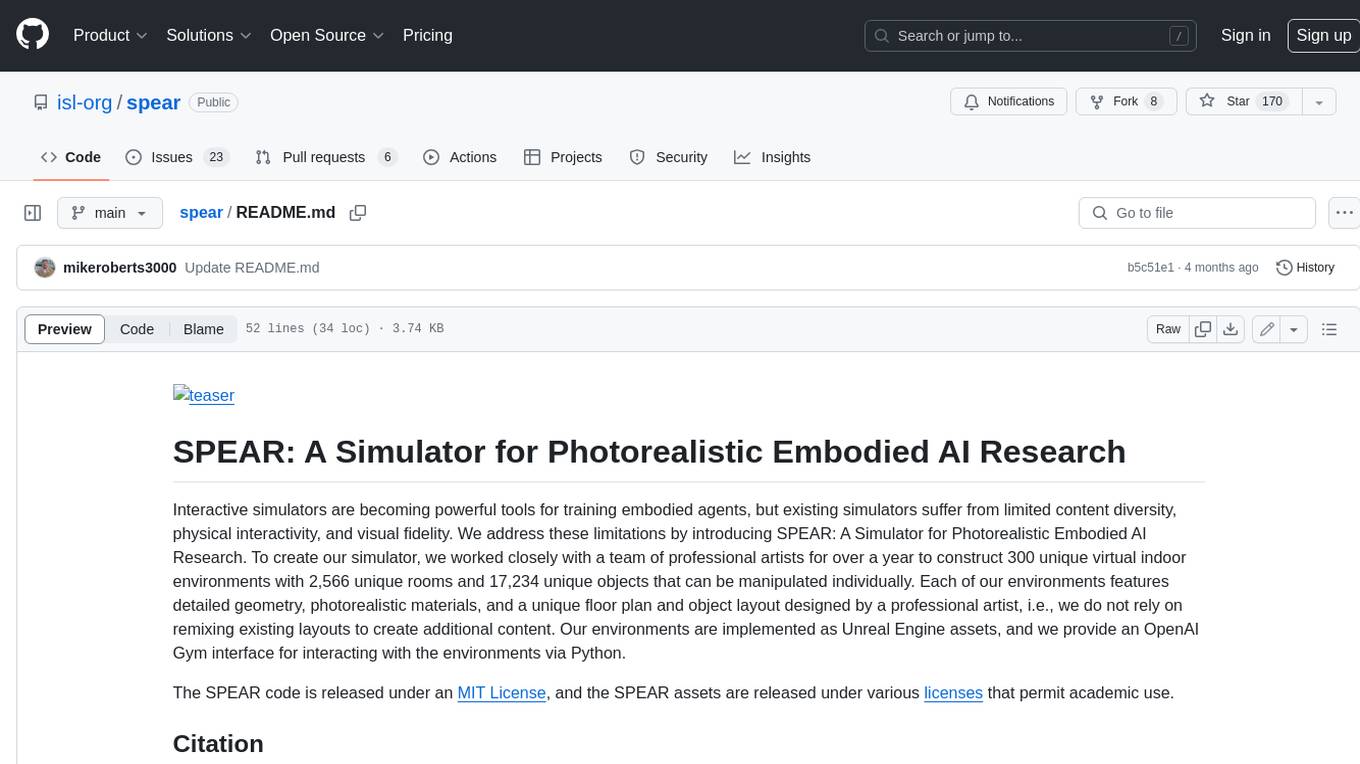
spear
SPEAR (Simulator for Photorealistic Embodied AI Research) is a powerful tool for training embodied agents. It features 300 unique virtual indoor environments with 2,566 unique rooms and 17,234 unique objects that can be manipulated individually. Each environment is designed by a professional artist and features detailed geometry, photorealistic materials, and a unique floor plan and object layout. SPEAR is implemented as Unreal Engine assets and provides an OpenAI Gym interface for interacting with the environments via Python.
Magick
Magick is a groundbreaking visual AIDE (Artificial Intelligence Development Environment) for no-code data pipelines and multimodal agents. Magick can connect to other services and comes with nodes and templates well-suited for intelligent agents, chatbots, complex reasoning systems and realistic characters.