


langgraph
Build resilient language agents as graphs.
Stars: 24549
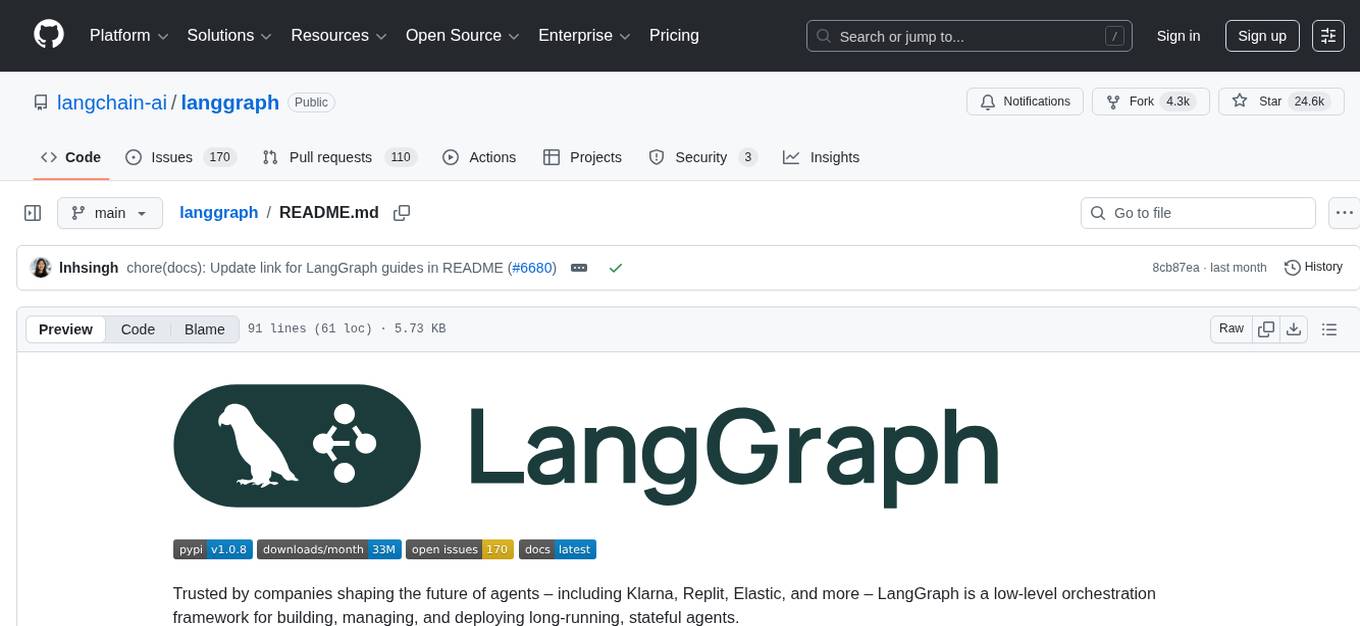
LangGraph is a low-level orchestration framework for building, managing, and deploying long-running, stateful agents. It provides durable execution, human-in-the-loop capabilities, comprehensive memory management, debugging tools, and production-ready deployment infrastructure. LangGraph can be used standalone or integrated with other LangChain products to streamline LLM application development.
README:





Trusted by companies shaping the future of agents – including Klarna, Replit, Elastic, and more – LangGraph is a low-level orchestration framework for building, managing, and deploying long-running, stateful agents.
Install LangGraph:
pip install -U langgraph
Create a simple workflow:
from langgraph.graph import START, StateGraph
from typing_extensions import TypedDict


class State(TypedDict):
    text: str


def node_a(state: State) -> dict:
    return {"text": state["text"] + "a"}


def node_b(state: State) -> dict:
    return {"text": state["text"] + "b"}


graph = StateGraph(State)
graph.add_node("node_a", node_a)
graph.add_node("node_b", node_b)
graph.add_edge(START, "node_a")
graph.add_edge("node_a", "node_b")

print(graph.compile().invoke({"text": ""}))
# {'text': 'ab'}
Get started with the LangGraph Quickstart.
To quickly build agents with LangChain's create_agent (built on LangGraph), see the LangChain Agents documentation.
LangGraph provides low-level supporting infrastructure for any long-running, stateful workflow or agent. LangGraph does not abstract prompts or architecture, and provides the following central benefits:
- Durable execution: Build agents that persist through failures and can run for extended periods, automatically resuming from exactly where they left off.
- Human-in-the-loop: Seamlessly incorporate human oversight by inspecting and modifying agent state at any point during execution.
- Comprehensive memory: Create truly stateful agents with both short-term working memory for ongoing reasoning and long-term persistent memory across sessions.
- Debugging with LangSmith: Gain deep visibility into complex agent behavior with visualization tools that trace execution paths, capture state transitions, and provide detailed runtime metrics.
- Production-ready deployment: Deploy sophisticated agent systems confidently with scalable infrastructure designed to handle the unique challenges of stateful, long-running workflows.
While LangGraph can be used standalone, it also integrates seamlessly with any LangChain product, giving developers a full suite of tools for building agents. To improve your LLM application development, pair LangGraph with:
- LangSmith — Helpful for agent evals and observability. Debug poor-performing LLM app runs, evaluate agent trajectories, gain visibility in production, and improve performance over time.
- LangSmith Deployment — Deploy and scale agents effortlessly with a purpose-built deployment platform for long running, stateful workflows. Discover, reuse, configure, and share agents across teams — and iterate quickly with visual prototyping in LangGraph Studio.
- LangChain – Provides integrations and composable components to streamline LLM application development.
[!NOTE] Looking for the JS version of LangGraph? See the JS repo and the JS docs.
- Guides: Quick, actionable code snippets for topics such as streaming, adding memory & persistence, and design patterns (e.g. branching, subgraphs, etc.).
- Reference: Detailed reference on core classes, methods, how to use the graph and checkpointing APIs, and higher-level prebuilt components.
- Examples: Guided examples on getting started with LangGraph.
- LangChain Forum: Connect with the community and share all of your technical questions, ideas, and feedback.
- LangChain Academy: Learn the basics of LangGraph in our free, structured course.
- Case studies: Hear how industry leaders use LangGraph to ship AI applications at scale.
LangGraph is inspired by Pregel and Apache Beam. The public interface draws inspiration from NetworkX. LangGraph is built by LangChain Inc, the creators of LangChain, but can be used without LangChain.
For Tasks:
Click tags to check more tools for each tasksFor Jobs:
Alternative AI tools for langgraph
Similar Open Source Tools
langgraph
LangGraph is a low-level orchestration framework for building, managing, and deploying long-running, stateful agents. It provides durable execution, human-in-the-loop capabilities, comprehensive memory management, debugging tools, and production-ready deployment infrastructure. LangGraph can be used standalone or integrated with other LangChain products to streamline LLM application development.
synthora
Synthora is a lightweight and extensible framework for LLM-driven Agents and ALM research. It aims to simplify the process of building, testing, and evaluating agents by providing essential components. The framework allows for easy agent assembly with a single config, reducing the effort required for tuning and sharing agents. Although in early development stages with unstable APIs, Synthora welcomes feedback and contributions to enhance its stability and functionality.
LazyLLM
LazyLLM is a low-code development tool for building complex AI applications with multiple agents. It assists developers in building AI applications at a low cost and continuously optimizing their performance. The tool provides a convenient workflow for application development and offers standard processes and tools for various stages of application development. Users can quickly prototype applications with LazyLLM, analyze bad cases with scenario task data, and iteratively optimize key components to enhance the overall application performance. LazyLLM aims to simplify the AI application development process and provide flexibility for both beginners and experts to create high-quality applications.
CodeFuse-muAgent
CodeFuse-muAgent is a Multi-Agent framework designed to streamline Standard Operating Procedure (SOP) orchestration for agents. It integrates toolkits, code libraries, knowledge bases, and sandbox environments for rapid construction of complex Multi-Agent interactive applications. The framework enables efficient execution and handling of multi-layered and multi-dimensional tasks.
langchain
LangChain is a framework for building LLM-powered applications that simplifies AI application development by chaining together interoperable components and third-party integrations. It helps developers connect LLMs to diverse data sources, swap models easily, and future-proof decisions as technology evolves. LangChain's ecosystem includes tools like LangSmith for agent evals, LangGraph for complex task handling, and LangGraph Platform for deployment and scaling. Additional resources include tutorials, how-to guides, conceptual guides, a forum, API reference, and chat support.
agentUniverse
agentUniverse is a multi-agent framework based on large language models, providing flexible capabilities for building individual agents. It focuses on multi-agent collaborative patterns, integrating domain experience to help agents solve problems in various fields. The framework includes pattern components like PEER and DOE for event interpretation, industry analysis, and financial report generation. It offers features for agent construction, multi-agent collaboration, and domain expertise integration, aiming to create intelligent applications with professional know-how.
agentUniverse
agentUniverse is a multi-agent framework based on large language models, providing flexible capabilities for building individual agents. It focuses on collaborative pattern components to solve problems in various fields and integrates domain experience. The framework supports LLM model integration and offers various pattern components like PEER and DOE. Users can easily configure models and set up agents for tasks. agentUniverse aims to assist developers and enterprises in constructing domain-expert-level intelligent agents for seamless collaboration.
agentUniverse
agentUniverse is a framework for developing applications powered by multi-agent based on large language model. It provides essential components for building single agent and multi-agent collaboration mechanism for customizing collaboration patterns. Developers can easily construct multi-agent applications and share pattern practices from different fields. The framework includes pre-installed collaboration patterns like PEER and DOE for complex task breakdown and data-intensive tasks.
Genkit
Genkit is an open-source framework for building full-stack AI-powered applications, used in production by Google's Firebase. It provides SDKs for JavaScript/TypeScript (Stable), Go (Beta), and Python (Alpha) with unified interface for integrating AI models from providers like Google, OpenAI, Anthropic, Ollama. Rapidly build chatbots, automations, and recommendation systems using streamlined APIs for multimodal content, structured outputs, tool calling, and agentic workflows. Genkit simplifies AI integration with open-source SDK, unified APIs, and offers text and image generation, structured data generation, tool calling, prompt templating, persisted chat interfaces, AI workflows, and AI-powered data retrieval (RAG).
genkit
Firebase Genkit (beta) is a framework with powerful tooling to help app developers build, test, deploy, and monitor AI-powered features with confidence. Genkit is cloud optimized and code-centric, integrating with many services that have free tiers to get started. It provides unified API for generation, context-aware AI features, evaluation of AI workflow, extensibility with plugins, easy deployment to Firebase or Google Cloud, observability and monitoring with OpenTelemetry, and a developer UI for prototyping and testing AI features locally. Genkit works seamlessly with Firebase or Google Cloud projects through official plugins and templates.
agents
Inkeep Agents is a platform for building AI agents using a No-Code Visual Builder or TypeScript SDK. It allows technical and non-technical teams to create and manage agents collaboratively. The platform supports real-time AI chat assistants and AI workflow automation, with features like multi-agent architecture, MCP tools, UI component library, and observability via Traces UI & OpenTelemetry. Inkeep Agents is interoperable, allowing seamless editing and management of agents in both visual and code formats.
dapr-agents
Dapr Agents is a developer framework for building production-grade resilient AI agent systems that operate at scale. It enables software developers to create AI agents that reason, act, and collaborate using Large Language Models (LLMs), while providing built-in observability and stateful workflow execution to ensure agentic workflows complete successfully. The framework is scalable, efficient, Kubernetes-native, data-driven, secure, observable, vendor-neutral, and open source. It offers features like scalable workflows, cost-effective AI adoption, data-centric AI agents, accelerated development, integrated security and reliability, built-in messaging and state infrastructure, and vendor-neutral and open source support. Dapr Agents is designed to simplify the development of AI applications and workflows by providing a comprehensive API surface and seamless integration with various data sources and services.
ControlFlow
ControlFlow is a Python framework designed for building agentic AI workflows. It provides a structured approach for defining tasks, assigning specialized AI agents, and orchestrating complex behaviors. By balancing AI autonomy with precise oversight, users can create sophisticated AI-powered applications with confidence. ControlFlow offers a task-centric architecture, structured results with type-safe outputs, specialized agents for efficient problem-solving, ecosystem integration with LangChain models, flexible control over workflows, multi-agent orchestration, and native observability and debugging capabilities.
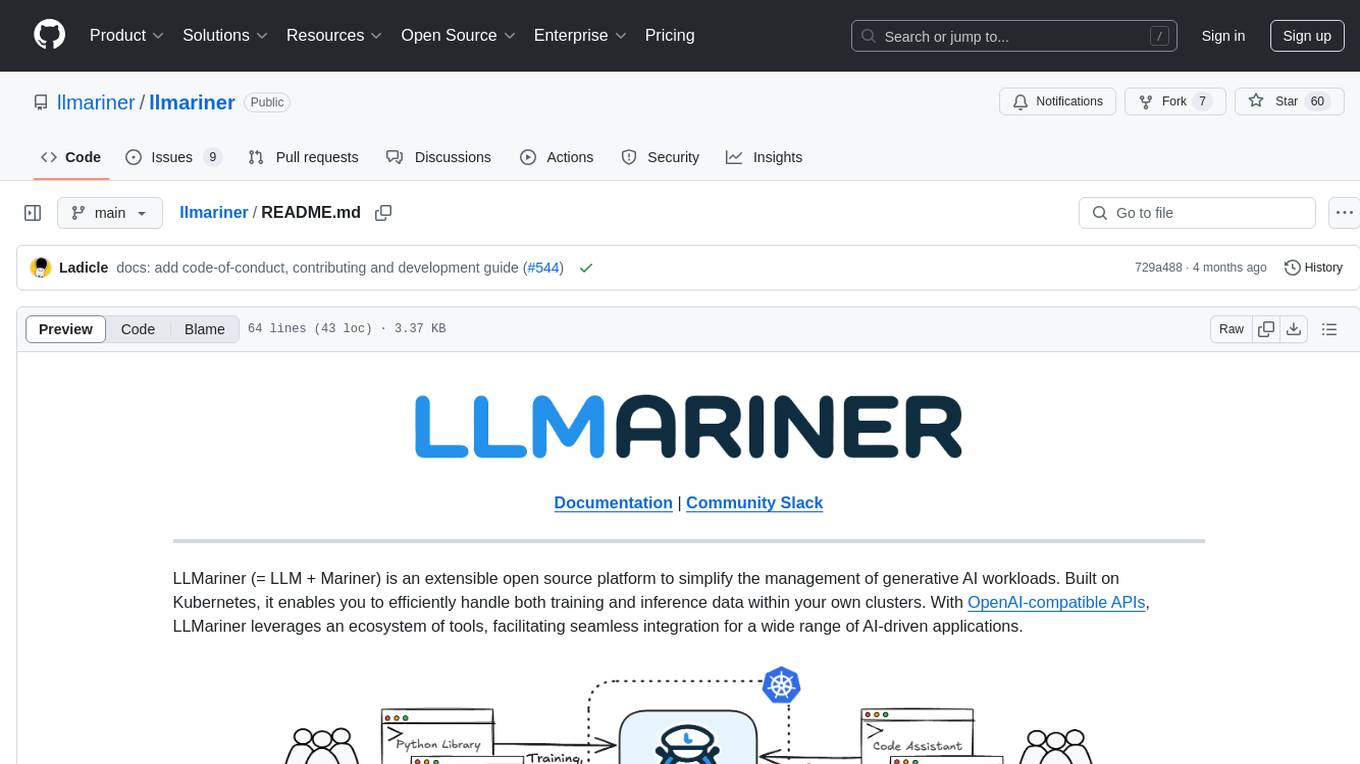
llmariner
LLMariner is an extensible open source platform built on Kubernetes to simplify the management of generative AI workloads. It enables efficient handling of training and inference data within clusters, with OpenAI-compatible APIs for seamless integration with a wide range of AI-driven applications.
agentsociety
AgentSociety is an advanced framework designed for building agents in urban simulation environments. It integrates LLMs' planning, memory, and reasoning capabilities to generate realistic behaviors. The framework supports dataset-based, text-based, and rule-based environments with interactive visualization. It includes tools for interviews, surveys, interventions, and metric recording tailored for social experimentation.
adk-java
Agent Development Kit (ADK) for Java is an open-source toolkit designed for developers to build, evaluate, and deploy sophisticated AI agents with flexibility and control. It allows defining agent behavior, orchestration, and tool use directly in code, enabling robust debugging, versioning, and deployment anywhere. The toolkit offers a rich tool ecosystem, code-first development approach, and support for modular multi-agent systems, making it ideal for creating advanced AI agents integrated with Google Cloud services.
For similar tasks
OpenAGI
OpenAGI is an AI agent creation package designed for researchers and developers to create intelligent agents using advanced machine learning techniques. The package provides tools and resources for building and training AI models, enabling users to develop sophisticated AI applications. With a focus on collaboration and community engagement, OpenAGI aims to facilitate the integration of AI technologies into various domains, fostering innovation and knowledge sharing among experts and enthusiasts.
GPTSwarm
GPTSwarm is a graph-based framework for LLM-based agents that enables the creation of LLM-based agents from graphs and facilitates the customized and automatic self-organization of agent swarms with self-improvement capabilities. The library includes components for domain-specific operations, graph-related functions, LLM backend selection, memory management, and optimization algorithms to enhance agent performance and swarm efficiency. Users can quickly run predefined swarms or utilize tools like the file analyzer. GPTSwarm supports local LM inference via LM Studio, allowing users to run with a local LLM model. The framework has been accepted by ICML2024 and offers advanced features for experimentation and customization.
AgentForge
AgentForge is a low-code framework tailored for the rapid development, testing, and iteration of AI-powered autonomous agents and Cognitive Architectures. It is compatible with a range of LLM models and offers flexibility to run different models for different agents based on specific needs. The framework is designed for seamless extensibility and database-flexibility, making it an ideal playground for various AI projects. AgentForge is a beta-testing ground and future-proof hub for crafting intelligent, model-agnostic autonomous agents.
atomic_agents
Atomic Agents is a modular and extensible framework designed for creating powerful applications. It follows the principles of Atomic Design, emphasizing small and single-purpose components. Leveraging Pydantic for data validation and serialization, the framework offers a set of tools and agents that can be combined to build AI applications. It depends on the Instructor package and supports various APIs like OpenAI, Cohere, Anthropic, and Gemini. Atomic Agents is suitable for developers looking to create AI agents with a focus on modularity and flexibility.
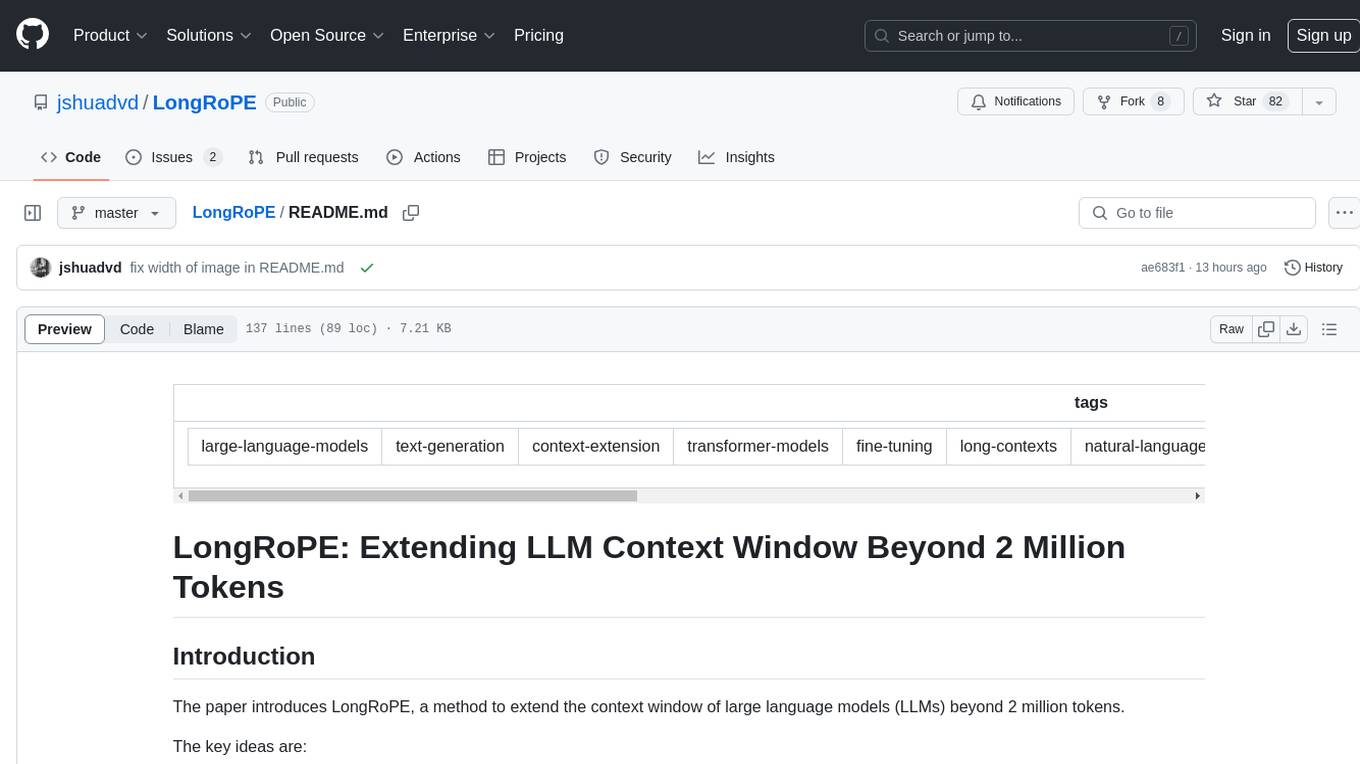
LongRoPE
LongRoPE is a method to extend the context window of large language models (LLMs) beyond 2 million tokens. It identifies and exploits non-uniformities in positional embeddings to enable 8x context extension without fine-tuning. The method utilizes a progressive extension strategy with 256k fine-tuning to reach a 2048k context. It adjusts embeddings for shorter contexts to maintain performance within the original window size. LongRoPE has been shown to be effective in maintaining performance across various tasks from 4k to 2048k context lengths.
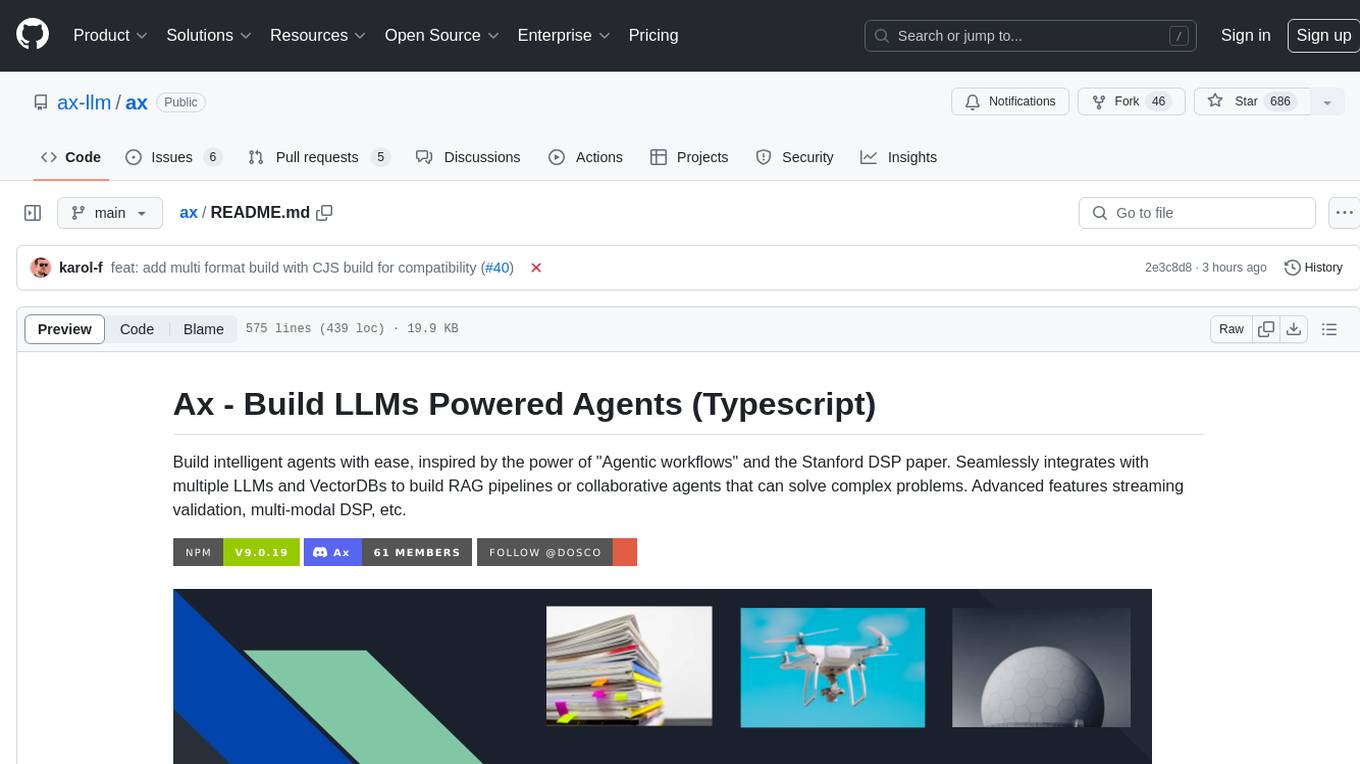
ax
Ax is a Typescript library that allows users to build intelligent agents inspired by agentic workflows and the Stanford DSP paper. It seamlessly integrates with multiple Large Language Models (LLMs) and VectorDBs to create RAG pipelines or collaborative agents capable of solving complex problems. The library offers advanced features such as streaming validation, multi-modal DSP, and automatic prompt tuning using optimizers. Users can easily convert documents of any format to text, perform smart chunking, embedding, and querying, and ensure output validation while streaming. Ax is production-ready, written in Typescript, and has zero dependencies.
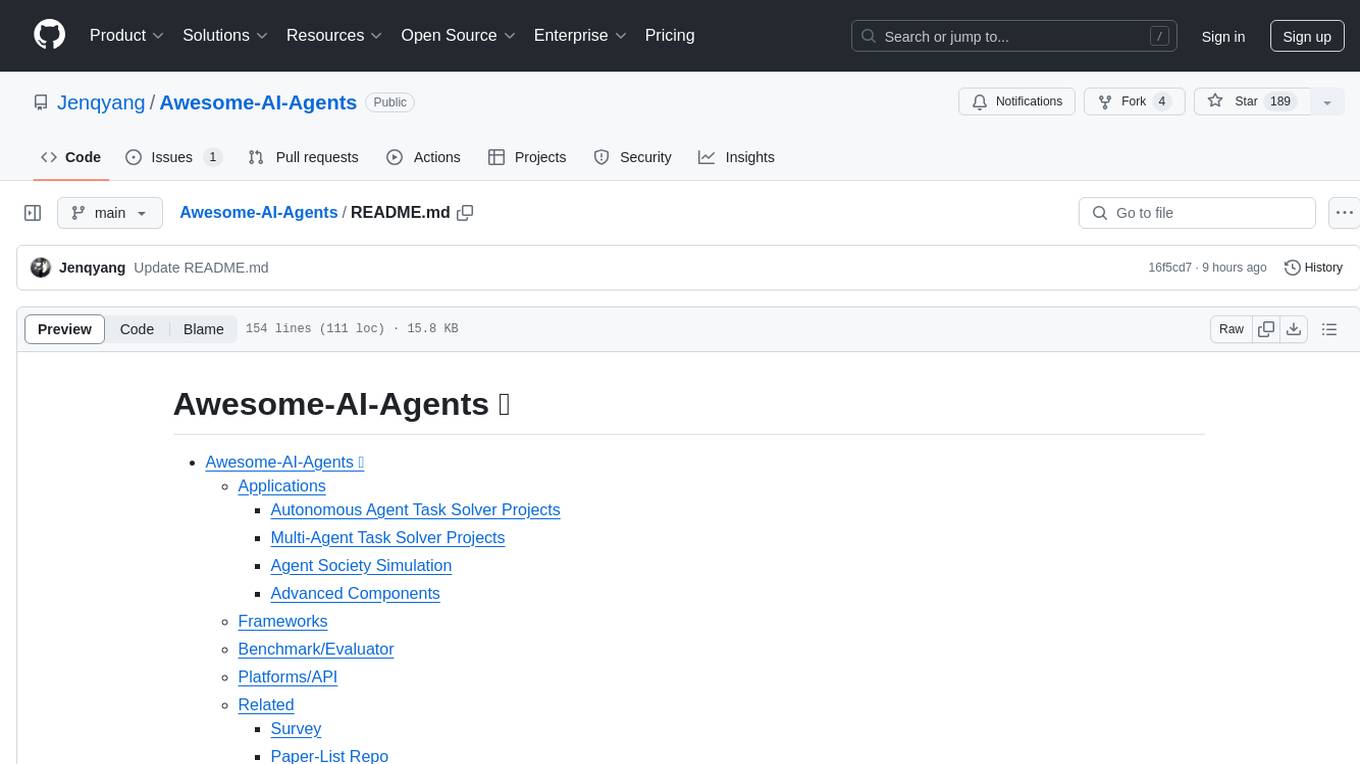
Awesome-AI-Agents
Awesome-AI-Agents is a curated list of projects, frameworks, benchmarks, platforms, and related resources focused on autonomous AI agents powered by Large Language Models (LLMs). The repository showcases a wide range of applications, multi-agent task solver projects, agent society simulations, and advanced components for building and customizing AI agents. It also includes frameworks for orchestrating role-playing, evaluating LLM-as-Agent performance, and connecting LLMs with real-world applications through platforms and APIs. Additionally, the repository features surveys, paper lists, and blogs related to LLM-based autonomous agents, making it a valuable resource for researchers, developers, and enthusiasts in the field of AI.
CodeFuse-muAgent
CodeFuse-muAgent is a Multi-Agent framework designed to streamline Standard Operating Procedure (SOP) orchestration for agents. It integrates toolkits, code libraries, knowledge bases, and sandbox environments for rapid construction of complex Multi-Agent interactive applications. The framework enables efficient execution and handling of multi-layered and multi-dimensional tasks.
For similar jobs
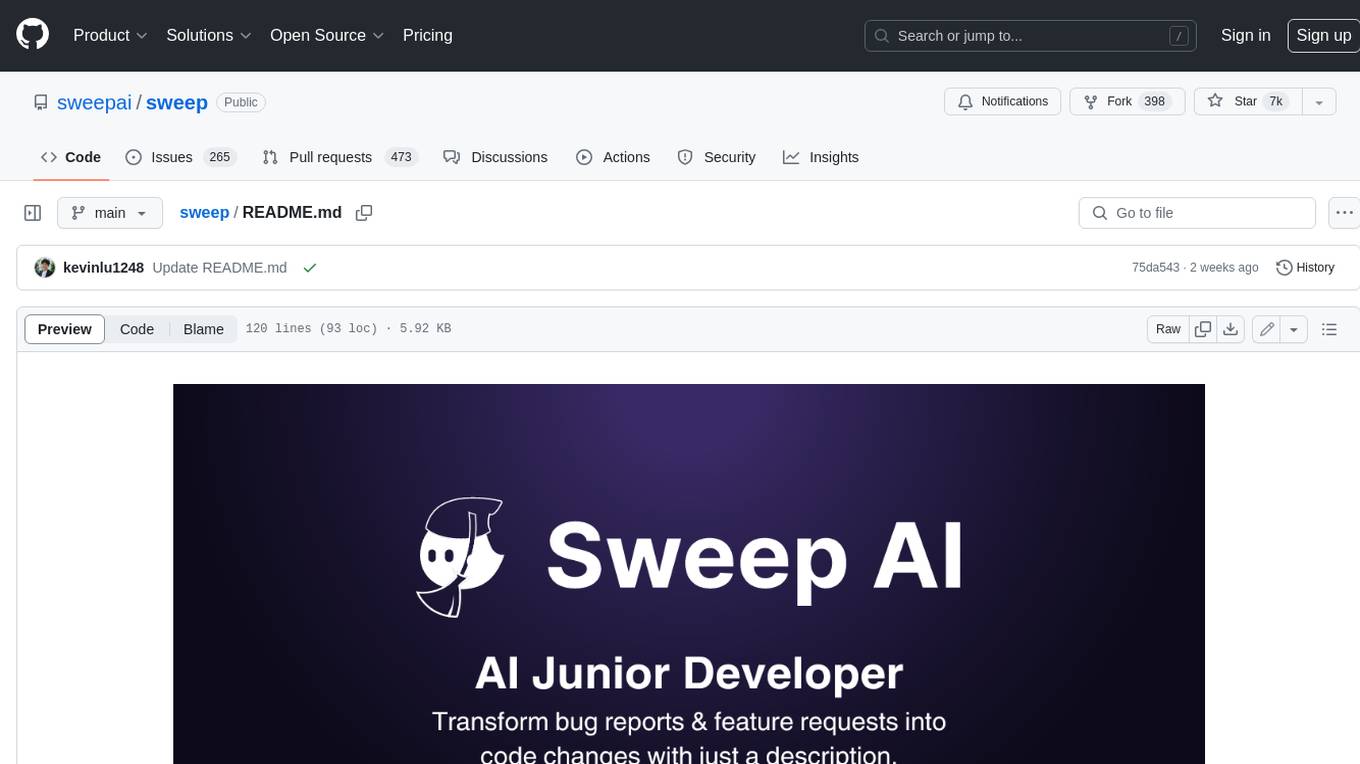
sweep
Sweep is an AI junior developer that turns bugs and feature requests into code changes. It automatically handles developer experience improvements like adding type hints and improving test coverage.
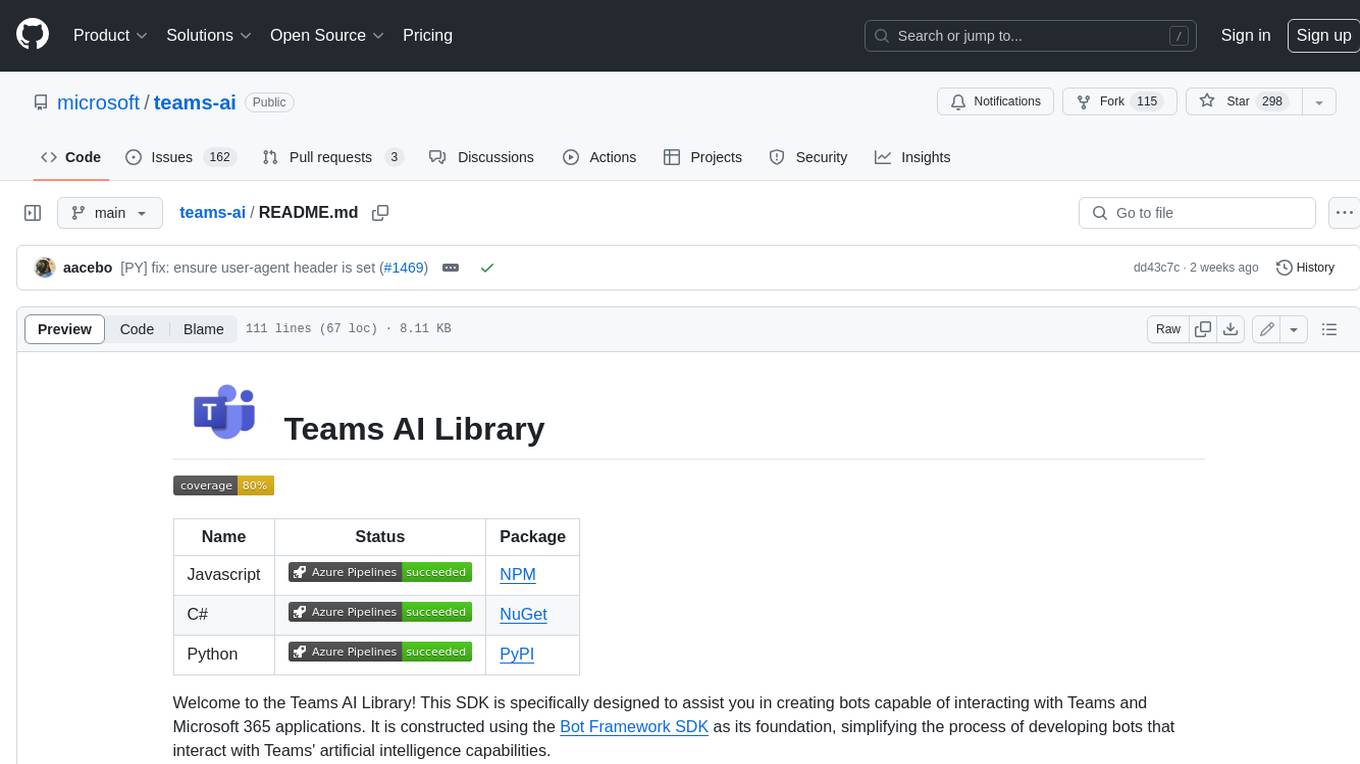
teams-ai
The Teams AI Library is a software development kit (SDK) that helps developers create bots that can interact with Teams and Microsoft 365 applications. It is built on top of the Bot Framework SDK and simplifies the process of developing bots that interact with Teams' artificial intelligence capabilities. The SDK is available for JavaScript/TypeScript, .NET, and Python.
ai-guide
This guide is dedicated to Large Language Models (LLMs) that you can run on your home computer. It assumes your PC is a lower-end, non-gaming setup.
classifai
Supercharge WordPress Content Workflows and Engagement with Artificial Intelligence. Tap into leading cloud-based services like OpenAI, Microsoft Azure AI, Google Gemini and IBM Watson to augment your WordPress-powered websites. Publish content faster while improving SEO performance and increasing audience engagement. ClassifAI integrates Artificial Intelligence and Machine Learning technologies to lighten your workload and eliminate tedious tasks, giving you more time to create original content that matters.
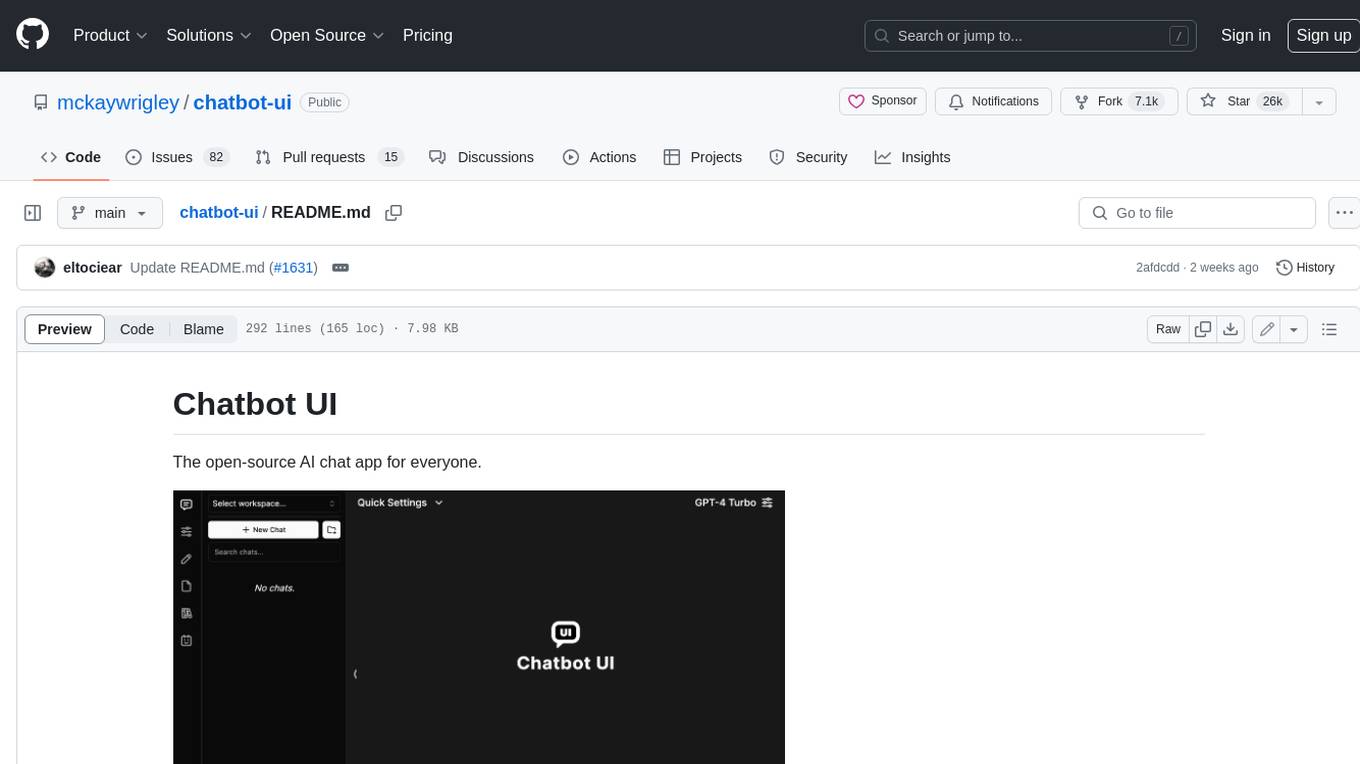
chatbot-ui
Chatbot UI is an open-source AI chat app that allows users to create and deploy their own AI chatbots. It is easy to use and can be customized to fit any need. Chatbot UI is perfect for businesses, developers, and anyone who wants to create a chatbot.
BricksLLM
BricksLLM is a cloud native AI gateway written in Go. Currently, it provides native support for OpenAI, Anthropic, Azure OpenAI and vLLM. BricksLLM aims to provide enterprise level infrastructure that can power any LLM production use cases. Here are some use cases for BricksLLM: * Set LLM usage limits for users on different pricing tiers * Track LLM usage on a per user and per organization basis * Block or redact requests containing PIIs * Improve LLM reliability with failovers, retries and caching * Distribute API keys with rate limits and cost limits for internal development/production use cases * Distribute API keys with rate limits and cost limits for students
uAgents
uAgents is a Python library developed by Fetch.ai that allows for the creation of autonomous AI agents. These agents can perform various tasks on a schedule or take action on various events. uAgents are easy to create and manage, and they are connected to a fast-growing network of other uAgents. They are also secure, with cryptographically secured messages and wallets.
griptape
Griptape is a modular Python framework for building AI-powered applications that securely connect to your enterprise data and APIs. It offers developers the ability to maintain control and flexibility at every step. Griptape's core components include Structures (Agents, Pipelines, and Workflows), Tasks, Tools, Memory (Conversation Memory, Task Memory, and Meta Memory), Drivers (Prompt and Embedding Drivers, Vector Store Drivers, Image Generation Drivers, Image Query Drivers, SQL Drivers, Web Scraper Drivers, and Conversation Memory Drivers), Engines (Query Engines, Extraction Engines, Summary Engines, Image Generation Engines, and Image Query Engines), and additional components (Rulesets, Loaders, Artifacts, Chunkers, and Tokenizers). Griptape enables developers to create AI-powered applications with ease and efficiency.