


hide
🤖 Headless IDE for AI agents
Stars: 118

Hide is a headless IDE that provides containerized development environments for codebases and exposes APIs for agents to interact with them. It spins up devcontainers, installs dependencies, and offers APIs for codebase interaction. Hide can be used to create custom toolkits or utilize pre-built toolkits for popular frameworks like Langchain. The Hide Runtime manages development containers and executes tasks, while the SDK provides APIs and toolkits for coding agents to interact with the codebase. Installation can be done via Homebrew or building from source, with Docker Engine as a prerequisite. The tool offers flexibility in managing development environments and simplifies codebase interaction for developers.
README:

Hide provides containerized development environments for codebases and exposes APIs for agents to interact with them. When given a code repo, Hide spins up a devcontainer, installs the dependencies and provides APIs for codebase interaction. Developers can craft custom toolkits using Hide APIs or use Hide's pre-built toolkits for popular frameworks like Langchain.
A typical installation for Hide consists of 2 parts: a runtime that runs on a local or remote Docker host, and an SDK that interacts with it. Runtime is the backend system responsible for managing development containers and executing tasks. SDK is a set of APIs and toolkits designed for coding agents to interact with the codebase.
This repository contains the source code for the Hide Runtime. For more information on how to use Hide and Hide SDK, go to our documentation site: https://hide.sh
Hide Runtime can be installed using Homebrew or built from source.
Hide Runtime requires Docker Engine to be installed on your system. Note that if you intend to use Hide with a remote Docker host, you will need to install Docker Engine on that host.
For installation instructions for your OS, see the Docker Engine documentation.
-
Add the Hide tap to your Homebrew:
brew tap hide-org/formulae
-
Install Hide using the brew install command:
brew install hide
To build Hide from source, follow these steps:
-
Ensure you have Go 1.22+ or later installed on your system.
-
Clone the Hide repository:
git clone https://github.com/hide-org/hide.git cd hide -
Build the project:
make build
-
(Optional) Install Hide to your
$GOPATH/bindirectory:make install
You can start the runtime by running the following command:
hide runYou should see logs indicating that the server is running, something like: Server started on 127.0.0.1:8080. For more options, including how to specify the port, see help:
hide --helpSee CONTRIBUTING.md for information on how to contribute to Hide.
See DEVELOPMENT.md for information on how to develop Hide.
Hide is licensed under the MIT License.
For Tasks:
Click tags to check more tools for each tasksFor Jobs:
Alternative AI tools for hide
Similar Open Source Tools
hide
Hide is a headless IDE that provides containerized development environments for codebases and exposes APIs for agents to interact with them. It spins up devcontainers, installs dependencies, and offers APIs for codebase interaction. Hide can be used to create custom toolkits or utilize pre-built toolkits for popular frameworks like Langchain. The Hide Runtime manages development containers and executes tasks, while the SDK provides APIs and toolkits for coding agents to interact with the codebase. Installation can be done via Homebrew or building from source, with Docker Engine as a prerequisite. The tool offers flexibility in managing development environments and simplifies codebase interaction for developers.
hide
Hide is a headless IDE that provides containerized development environments for codebases and exposes APIs for agents to interact with them. It spins up devcontainers, installs dependencies, and offers APIs for codebase interaction. Hide can be used to create custom toolkits or utilize pre-built toolkits for popular frameworks like Langchain. The Hide Runtime manages development containers and tasks, while the SDK provides APIs for coding agents to interact with the codebase.
raggenie
RAGGENIE is a low-code RAG builder tool designed to simplify the creation of conversational AI applications. It offers out-of-the-box plugins for connecting to various data sources and building conversational AI on top of them, including integration with pre-built agents for actions. The tool is open-source under the MIT license, with a current focus on making it easy to build RAG applications and future plans for maintenance, monitoring, and transitioning applications from pilots to production.
FlowTest
FlowTestAI is the world’s first GenAI powered OpenSource Integrated Development Environment (IDE) designed for crafting, visualizing, and managing API-first workflows. It operates as a desktop app, interacting with the local file system, ensuring privacy and enabling collaboration via version control systems. The platform offers platform-specific binaries for macOS, with versions for Windows and Linux in development. It also features a CLI for running API workflows from the command line interface, facilitating automation and CI/CD processes.
shipstation
ShipStation is an AI-based website and agents generation platform that optimizes landing page websites and generic connect-anything-to-anything services. It enables seamless communication between service providers and integration partners, offering features like user authentication, project management, code editing, payment integration, and real-time progress tracking. The project architecture includes server-side (Node.js) and client-side (React with Vite) components. Prerequisites include Node.js, npm or yarn, Anthropic API key, Supabase account, Tavily API key, and Razorpay account. Setup instructions involve cloning the repository, setting up Supabase, configuring environment variables, and starting the backend and frontend servers. Users can access the application through the browser, sign up or log in, create landing pages or portfolios, and get websites stored in an S3 bucket. Deployment to Heroku involves building the client project, committing changes, and pushing to the main branch. Contributions to the project are encouraged, and the license encourages doing good.
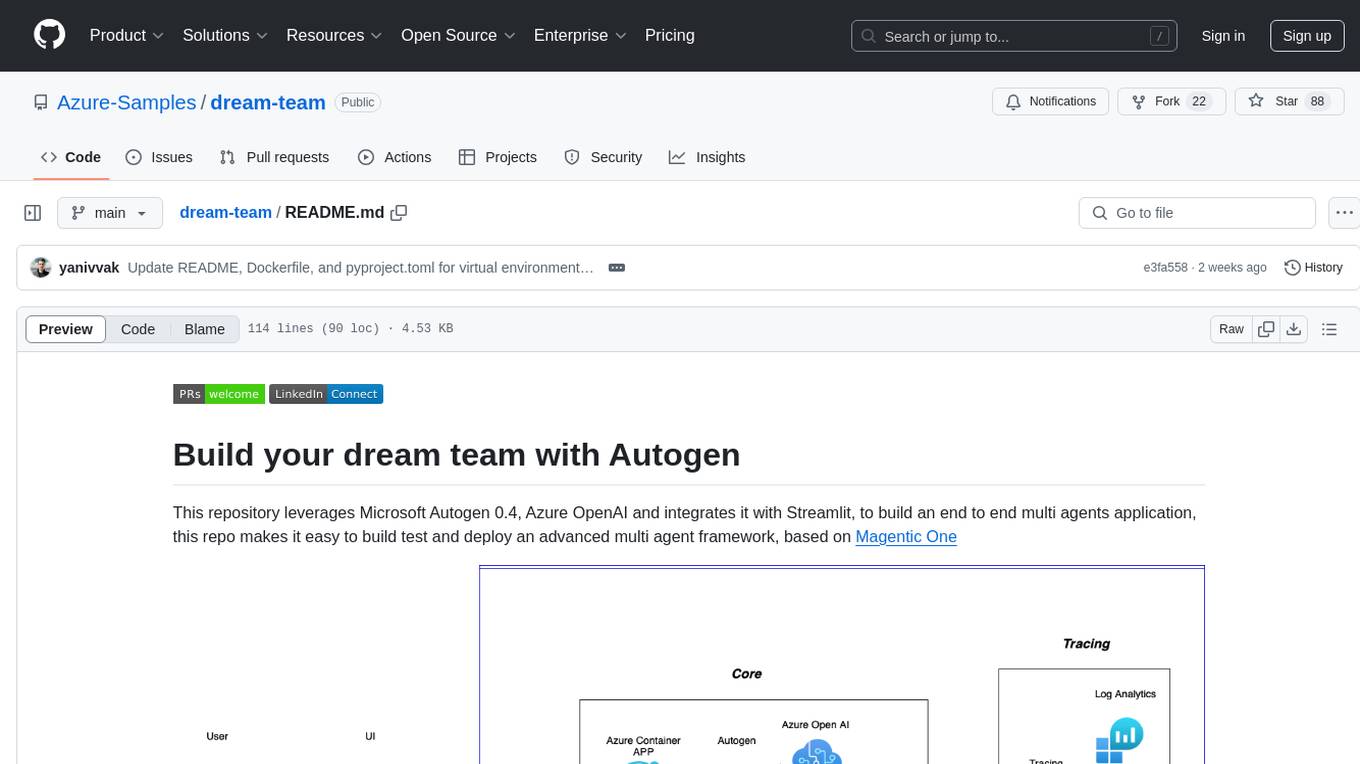
dream-team
Build your dream team with Autogen is a repository that leverages Microsoft Autogen 0.4, Azure OpenAI, and Streamlit to create an end-to-end multi-agent application. It provides an advanced multi-agent framework based on Magentic One, with features such as a friendly UI, single-line deployment, secure code execution, managed identities, and observability & debugging tools. Users can deploy Azure resources and the app with simple commands, work locally with virtual environments, install dependencies, update configurations, and run the application. The repository also offers resources for learning more about building applications with Autogen.
NeoHaskell
NeoHaskell is a newcomer-friendly and productive dialect of Haskell. It aims to be easy to learn and use, while also powerful enough for app development with minimal effort and maximum confidence. The project prioritizes design and documentation before implementation, with ongoing work on design documents for community sharing.
vespa
Vespa is a platform that performs operations such as selecting a subset of data in a large corpus, evaluating machine-learned models over the selected data, organizing and aggregating it, and returning it, typically in less than 100 milliseconds, all while the data corpus is continuously changing. It has been in development for many years and is used on a number of large internet services and apps which serve hundreds of thousands of queries from Vespa per second.
conversational-agent-langchain
This repository contains a Rest-Backend for a Conversational Agent that allows embedding documents, semantic search, QA based on documents, and document processing with Large Language Models. It uses Aleph Alpha and OpenAI Large Language Models to generate responses to user queries, includes a vector database, and provides a REST API built with FastAPI. The project also features semantic search, secret management for API keys, installation instructions, and development guidelines for both backend and frontend components.
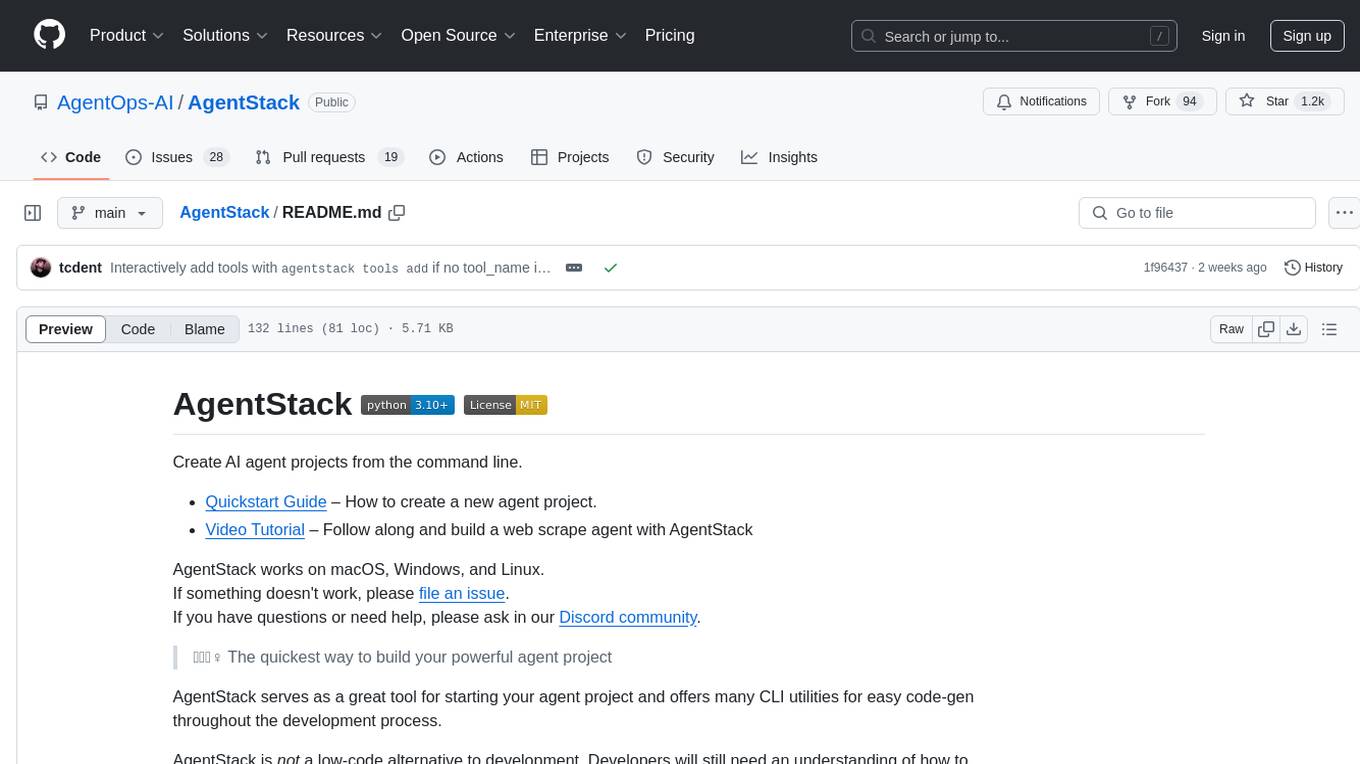
AgentStack
AgentStack is a command-line tool that helps users create AI agent projects quickly and efficiently. It offers CLI utilities for code generation and simplifies the process of building agents and tasks. The tool is designed to work on macOS, Windows, and Linux, providing a seamless experience for developers. AgentStack aims to streamline the development process by offering pre-built templates, easy access to tools, and a curated experience on top of popular agent frameworks and LLM providers. It is not a low-code solution but rather a head-start for starting agent projects from scratch.
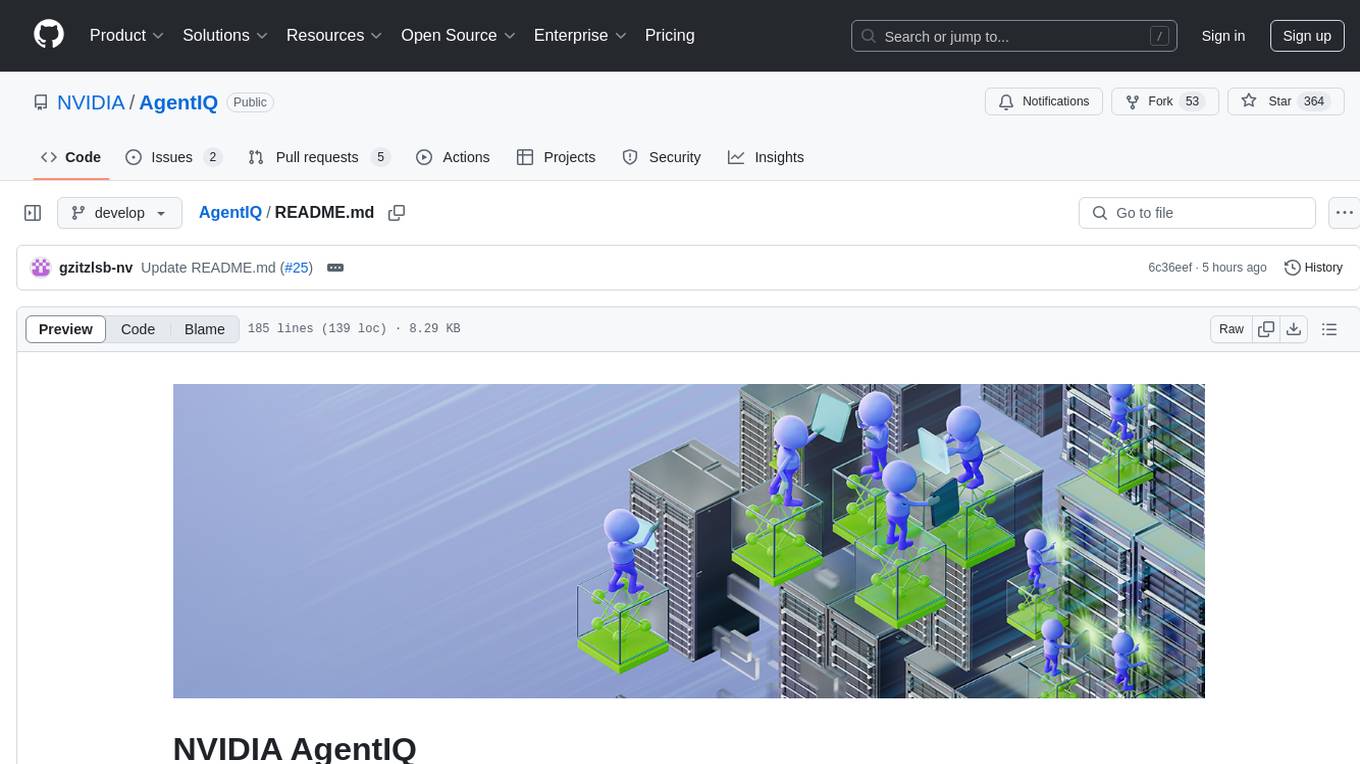
AgentIQ
AgentIQ is a flexible library designed to seamlessly integrate enterprise agents with various data sources and tools. It enables true composability by treating agents, tools, and workflows as simple function calls. With features like framework agnosticism, reusability, rapid development, profiling, observability, evaluation system, user interface, and MCP compatibility, AgentIQ empowers developers to move quickly, experiment freely, and ensure reliability across agent-driven projects.
concierge
Concierge is a versatile automation tool designed to streamline repetitive tasks and workflows. It provides a user-friendly interface for creating custom automation scripts without the need for extensive coding knowledge. With Concierge, users can automate various tasks across different platforms and applications, increasing efficiency and productivity. The tool offers a wide range of pre-built automation templates and allows users to customize and schedule their automation processes. Concierge is suitable for individuals and businesses looking to automate routine tasks and improve overall workflow efficiency.
holohub
Holohub is a central repository for the NVIDIA Holoscan AI sensor processing community to share reference applications, operators, tutorials, and benchmarks. It includes example applications, community components, package configurations, and tutorials. Users and developers of the Holoscan platform are invited to reuse and contribute to this repository. The repository provides detailed instructions on prerequisites, building, running applications, contributing, and glossary terms. It also offers a searchable catalog of available components on the Holoscan SDK User Guide website.
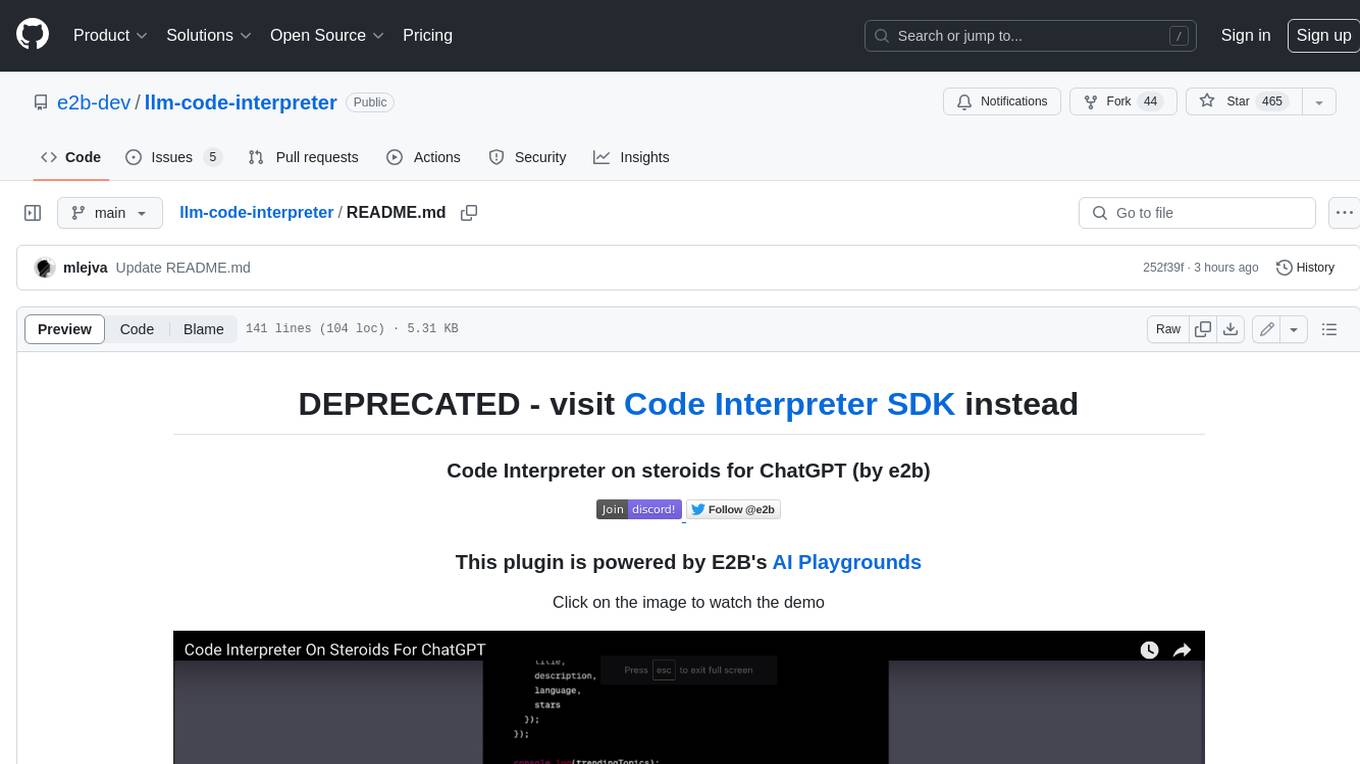
llm-code-interpreter
The 'llm-code-interpreter' repository is a deprecated plugin that provides a code interpreter on steroids for ChatGPT by E2B. It gives ChatGPT access to a sandboxed cloud environment with capabilities like running any code, accessing Linux OS, installing programs, using filesystem, running processes, and accessing the internet. The plugin exposes commands to run shell commands, read files, and write files, enabling various possibilities such as running different languages, installing programs, starting servers, deploying websites, and more. It is powered by the E2B API and is designed for agents to freely experiment within a sandboxed environment.
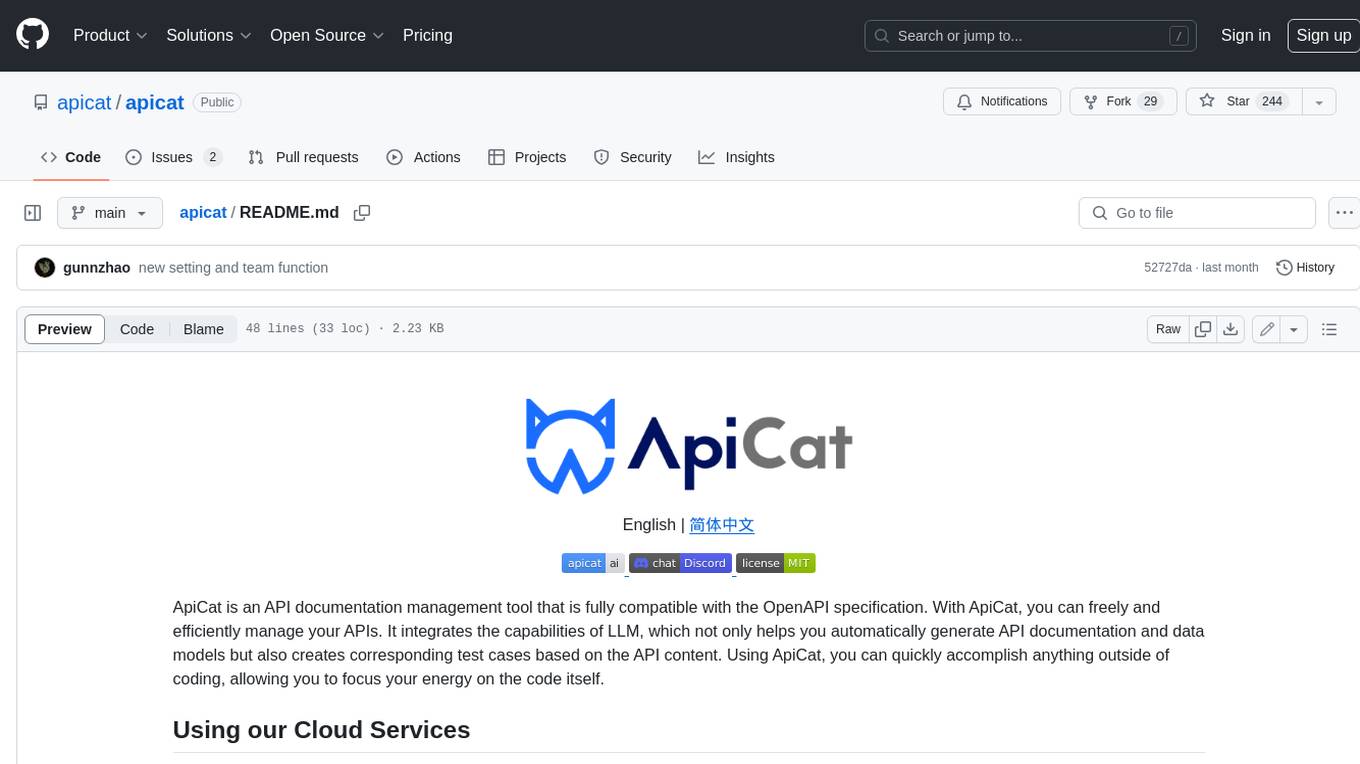
apicat
ApiCat is an API documentation management tool that is fully compatible with the OpenAPI specification. With ApiCat, you can freely and efficiently manage your APIs. It integrates the capabilities of LLM, which not only helps you automatically generate API documentation and data models but also creates corresponding test cases based on the API content. Using ApiCat, you can quickly accomplish anything outside of coding, allowing you to focus your energy on the code itself.
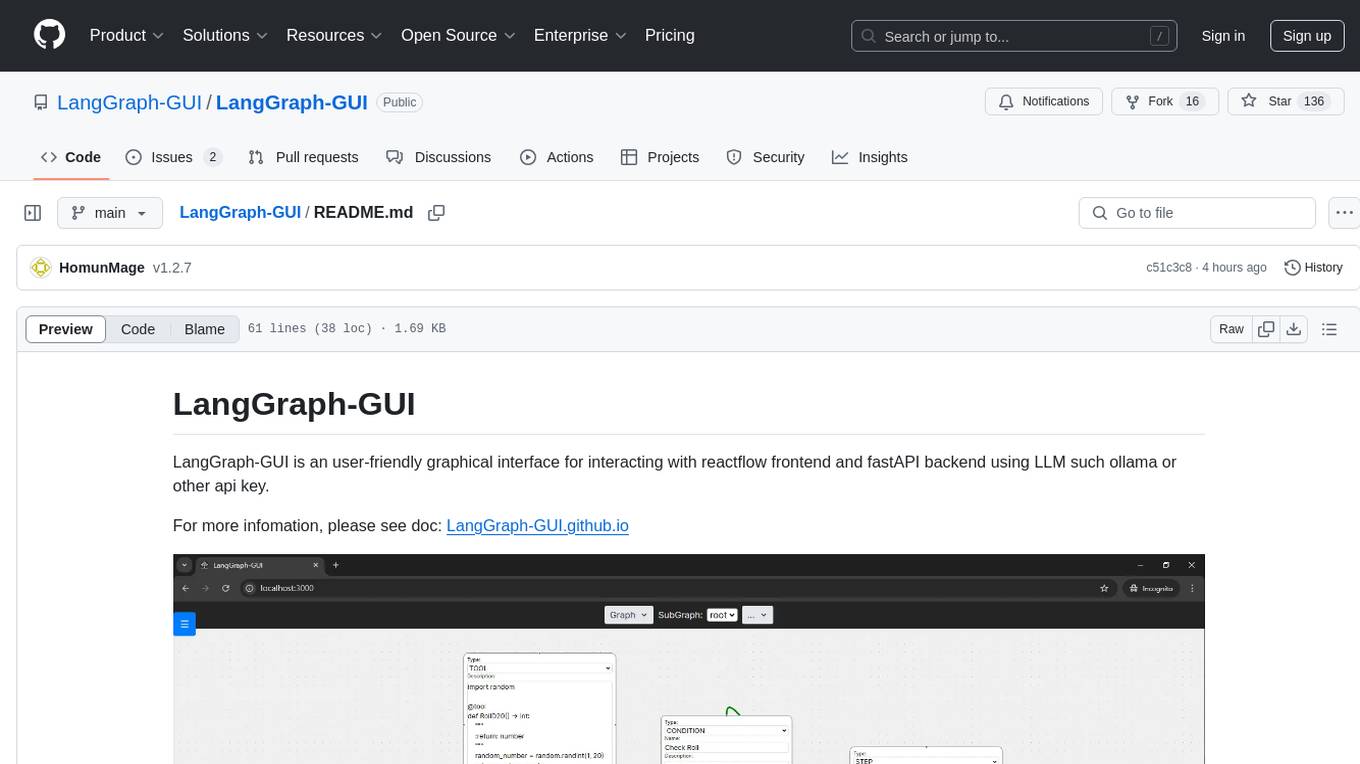
LangGraph-GUI
LangGraph-GUI is a user-friendly graphical interface for interacting with reactflow frontend and fastAPI backend using LLM such as ollama or other API key. It provides a convenient way to work with language models and APIs, offering a seamless experience for users to visualize and interact with the data flow. The tool simplifies the process of setting up the environment and accessing the application, making it easier for users to leverage the power of language models in their projects.
For similar tasks
hide
Hide is a headless IDE that provides containerized development environments for codebases and exposes APIs for agents to interact with them. It spins up devcontainers, installs dependencies, and offers APIs for codebase interaction. Hide can be used to create custom toolkits or utilize pre-built toolkits for popular frameworks like Langchain. The Hide Runtime manages development containers and tasks, while the SDK provides APIs for coding agents to interact with the codebase.
hide
Hide is a headless IDE that provides containerized development environments for codebases and exposes APIs for agents to interact with them. It spins up devcontainers, installs dependencies, and offers APIs for codebase interaction. Hide can be used to create custom toolkits or utilize pre-built toolkits for popular frameworks like Langchain. The Hide Runtime manages development containers and executes tasks, while the SDK provides APIs and toolkits for coding agents to interact with the codebase. Installation can be done via Homebrew or building from source, with Docker Engine as a prerequisite. The tool offers flexibility in managing development environments and simplifies codebase interaction for developers.
aios-core
Synkra AIOS is a Framework for Universal AI Agents powered by AI. It is founded on Agent-Driven Agile Development, offering revolutionary capabilities for AI-driven development and more. Transform any domain with specialized AI expertise: software development, entertainment, creative writing, business strategy, personal well-being, and more. The framework follows a clear hierarchy of priorities: CLI First, Observability Second, UI Third. The CLI is where intelligence resides, all execution, decisions, and automation happen there. Observability is for observing and monitoring what happens in the CLI in real-time. The UI is for specific management and visualizations when necessary. The two key innovations of Synkra AIOS are Planejamento Agêntico and Desenvolvimento Contextualizado por Engenharia, which eliminate inconsistency in planning and loss of context in AI-assisted development.
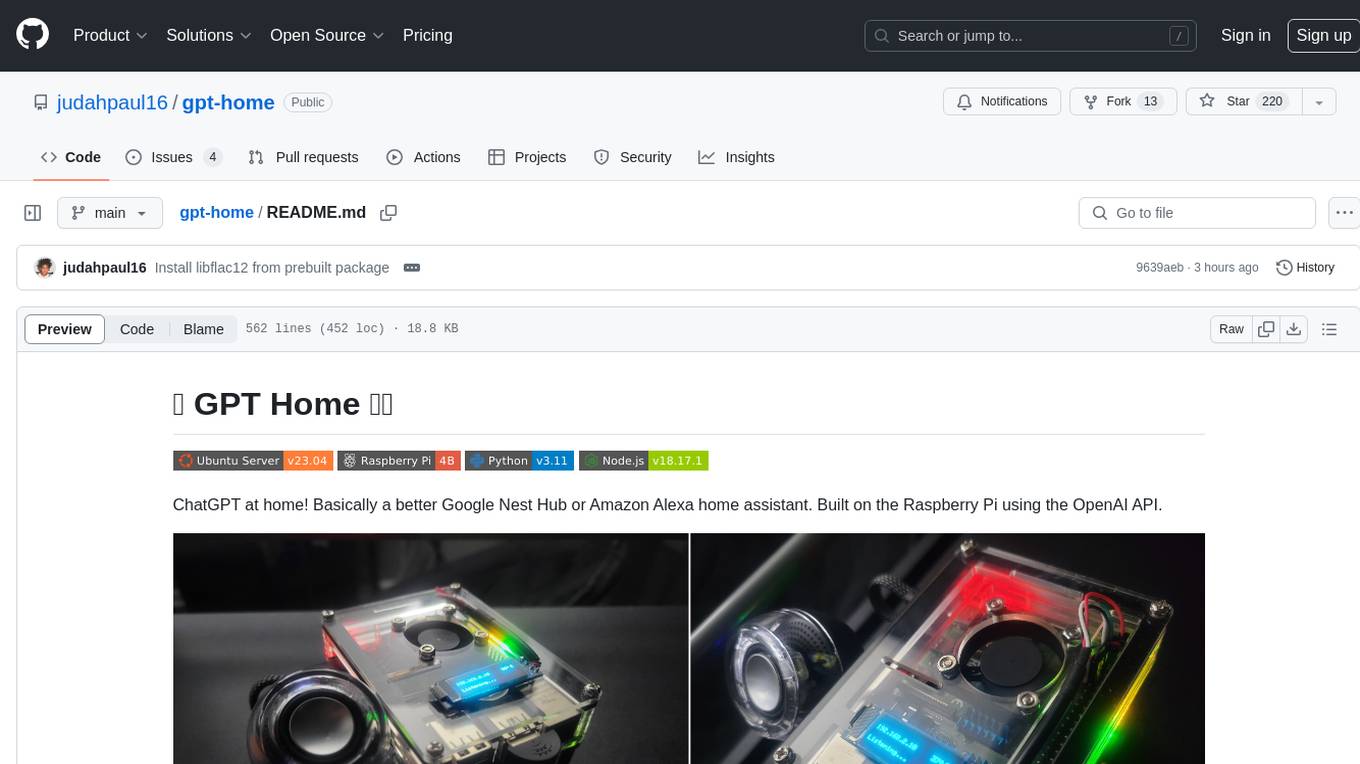
gpt-home
GPT Home is a project that allows users to build their own home assistant using Raspberry Pi and OpenAI API. It serves as a guide for setting up a smart home assistant similar to Google Nest Hub or Amazon Alexa. The project integrates various components like OpenAI, Spotify, Philips Hue, and OpenWeatherMap to provide a personalized home assistant experience. Users can follow the detailed instructions provided to build their own version of the home assistant on Raspberry Pi, with optional components for customization. The project also includes system configurations, dependencies installation, and setup scripts for easy deployment. Overall, GPT Home offers a DIY solution for creating a smart home assistant using Raspberry Pi and OpenAI technology.
comfy-cli
comfy-cli is a command line tool designed to simplify the installation and management of ComfyUI, an open-source machine learning framework. It allows users to easily set up ComfyUI, install packages, manage custom nodes, download checkpoints, and ensure cross-platform compatibility. The tool provides comprehensive documentation and examples to aid users in utilizing ComfyUI efficiently.
crewAI-tools
The crewAI Tools repository provides a guide for setting up tools for crewAI agents, enabling the creation of custom tools to enhance AI solutions. Tools play a crucial role in improving agent functionality. The guide explains how to equip agents with a range of tools and how to create new tools. Tools are designed to return strings for generating responses. There are two main methods for creating tools: subclassing BaseTool and using the tool decorator. Contributions to the toolset are encouraged, and the development setup includes steps for installing dependencies, activating the virtual environment, setting up pre-commit hooks, running tests, static type checking, packaging, and local installation. Enhance AI agent capabilities with advanced tooling.
aipan-netdisk-search
Aipan-Netdisk-Search is a free and open-source web project for searching netdisk resources. It utilizes third-party APIs with IP access restrictions, suggesting self-deployment. The project can be easily deployed on Vercel and provides instructions for manual deployment. Users can clone the project, install dependencies, run it in the browser, and access it at localhost:3001. The project also includes documentation for deploying on personal servers using NUXT.JS. Additionally, there are options for donations and communication via WeChat.
Agently-Daily-News-Collector
Agently Daily News Collector is an open-source project showcasing a workflow powered by the Agent ly AI application development framework. It allows users to generate news collections on various topics by inputting the field topic. The AI agents automatically perform the necessary tasks to generate a high-quality news collection saved in a markdown file. Users can edit settings in the YAML file, install Python and required packages, input their topic idea, and wait for the news collection to be generated. The process involves tasks like outlining, searching, summarizing, and preparing column data. The project dependencies include Agently AI Development Framework, duckduckgo-search, BeautifulSoup4, and PyYAM.
For similar jobs
sweep
Sweep is an AI junior developer that turns bugs and feature requests into code changes. It automatically handles developer experience improvements like adding type hints and improving test coverage.
teams-ai
The Teams AI Library is a software development kit (SDK) that helps developers create bots that can interact with Teams and Microsoft 365 applications. It is built on top of the Bot Framework SDK and simplifies the process of developing bots that interact with Teams' artificial intelligence capabilities. The SDK is available for JavaScript/TypeScript, .NET, and Python.
ai-guide
This guide is dedicated to Large Language Models (LLMs) that you can run on your home computer. It assumes your PC is a lower-end, non-gaming setup.
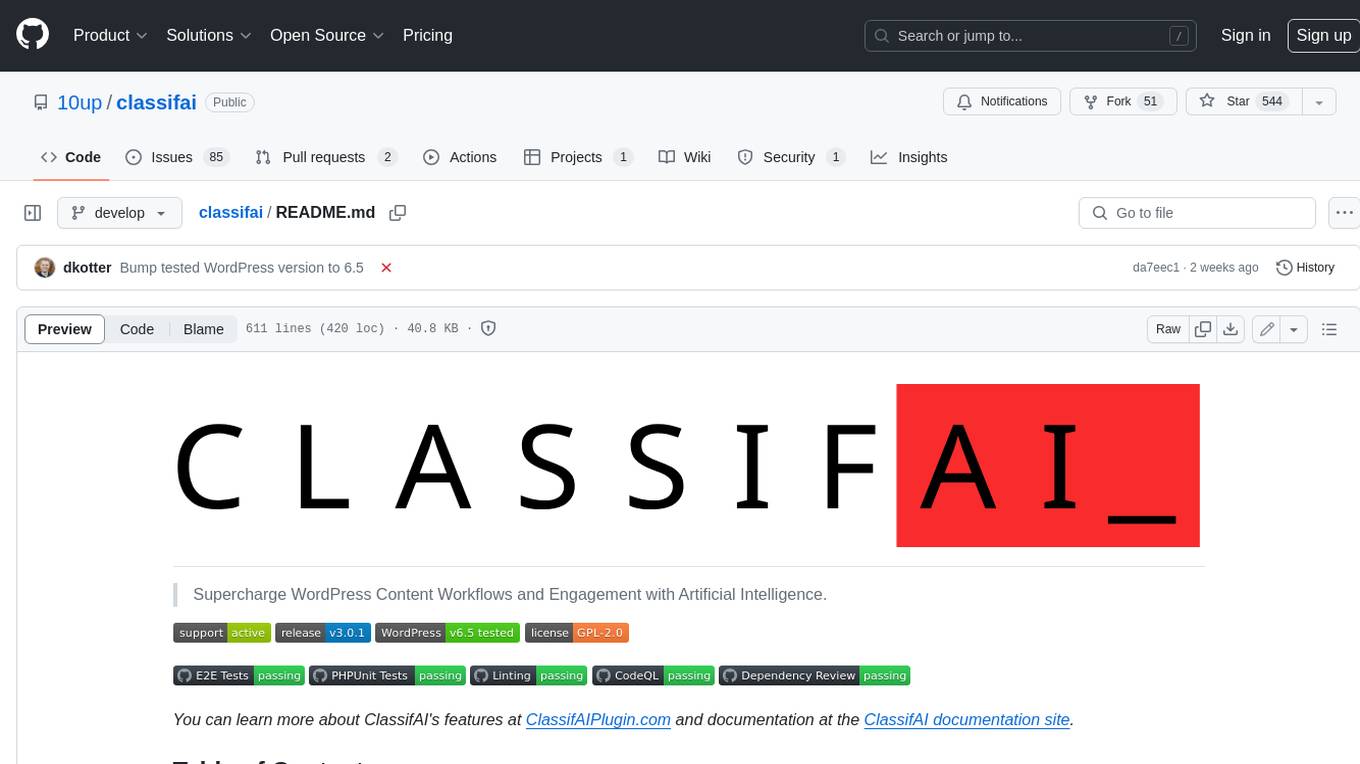
classifai
Supercharge WordPress Content Workflows and Engagement with Artificial Intelligence. Tap into leading cloud-based services like OpenAI, Microsoft Azure AI, Google Gemini and IBM Watson to augment your WordPress-powered websites. Publish content faster while improving SEO performance and increasing audience engagement. ClassifAI integrates Artificial Intelligence and Machine Learning technologies to lighten your workload and eliminate tedious tasks, giving you more time to create original content that matters.
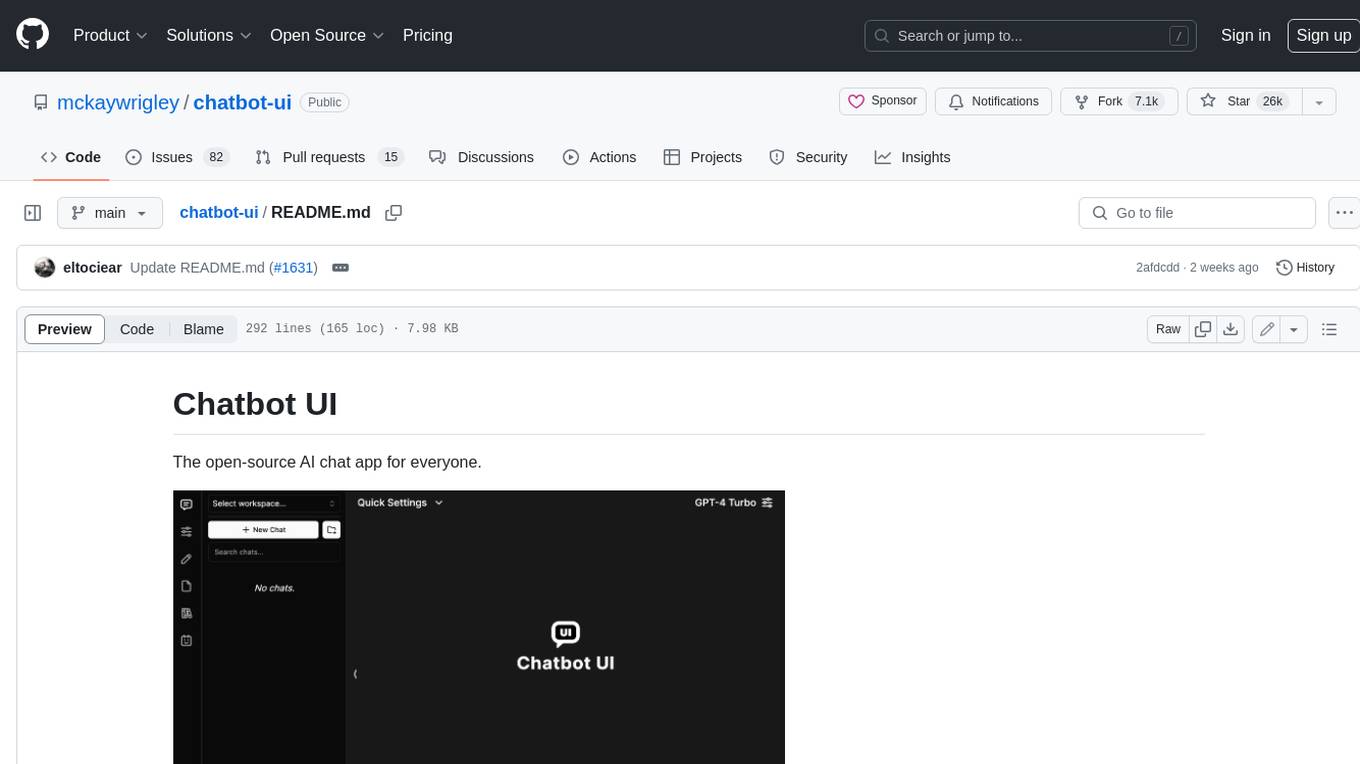
chatbot-ui
Chatbot UI is an open-source AI chat app that allows users to create and deploy their own AI chatbots. It is easy to use and can be customized to fit any need. Chatbot UI is perfect for businesses, developers, and anyone who wants to create a chatbot.
BricksLLM
BricksLLM is a cloud native AI gateway written in Go. Currently, it provides native support for OpenAI, Anthropic, Azure OpenAI and vLLM. BricksLLM aims to provide enterprise level infrastructure that can power any LLM production use cases. Here are some use cases for BricksLLM: * Set LLM usage limits for users on different pricing tiers * Track LLM usage on a per user and per organization basis * Block or redact requests containing PIIs * Improve LLM reliability with failovers, retries and caching * Distribute API keys with rate limits and cost limits for internal development/production use cases * Distribute API keys with rate limits and cost limits for students
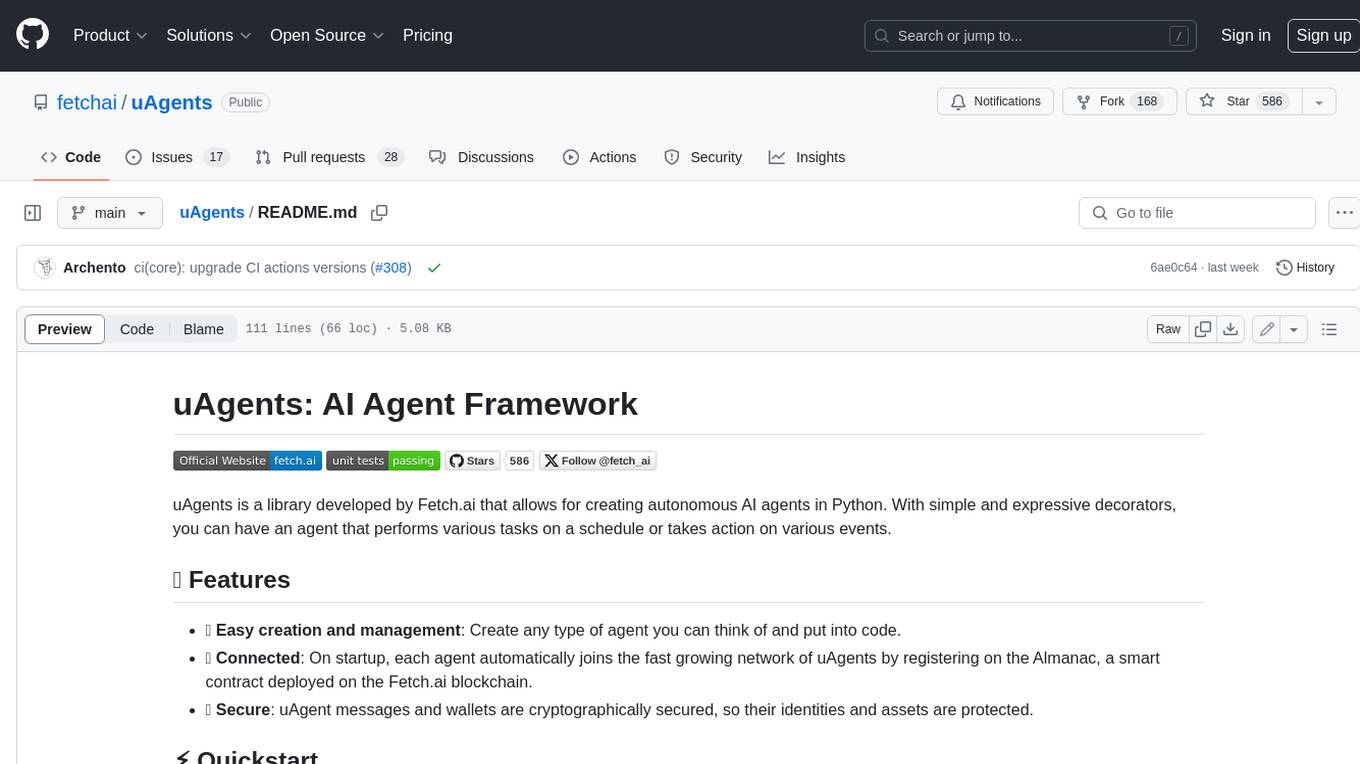
uAgents
uAgents is a Python library developed by Fetch.ai that allows for the creation of autonomous AI agents. These agents can perform various tasks on a schedule or take action on various events. uAgents are easy to create and manage, and they are connected to a fast-growing network of other uAgents. They are also secure, with cryptographically secured messages and wallets.
griptape
Griptape is a modular Python framework for building AI-powered applications that securely connect to your enterprise data and APIs. It offers developers the ability to maintain control and flexibility at every step. Griptape's core components include Structures (Agents, Pipelines, and Workflows), Tasks, Tools, Memory (Conversation Memory, Task Memory, and Meta Memory), Drivers (Prompt and Embedding Drivers, Vector Store Drivers, Image Generation Drivers, Image Query Drivers, SQL Drivers, Web Scraper Drivers, and Conversation Memory Drivers), Engines (Query Engines, Extraction Engines, Summary Engines, Image Generation Engines, and Image Query Engines), and additional components (Rulesets, Loaders, Artifacts, Chunkers, and Tokenizers). Griptape enables developers to create AI-powered applications with ease and efficiency.