


sre-agent
A Site Reliability Engineer AI agent that can monitor application and infrastructure logs, diagnose issues, and report on diagnostics.
Stars: 147
SRE Agent is an open-source AI agent designed to help Site Reliability Engineers (SREs) debug, maintain healthy Kubernetes systems, and simplify DevOps tasks. With a command-line interface (CLI), users can interact directly with the agent to diagnose issues, report diagnostics, and streamline operations. The agent supports root cause debugging, Kubernetes log querying, GitHub codebase search, and CLI-powered interactions. It is powered by the Model Context Protocol (MCP) for seamless connectivity. Users can configure AWS credentials, GitHub integration, and Anthropic API key to start monitoring deployments and diagnosing issues. The tool is structured with Python services and TypeScript MCP servers for development and maintenance.
README:
Welcome to the SRE Agent project! This open-source AI agent helps you debug, keep your systems on Kubernetes healthy, and make your DevOps life easier.
Now powered by a command-line interface (CLI), you can interact directly with the agent from your terminal. Plug in your Kubernetes cluster, GitHub repo, and let the agent handle the heavy lifting, diagnosing, reporting, and keeping your team in the loop.
SRE Agent is your AI-powered teammate for monitoring application and infrastructure logs, diagnosing issues, and reporting diagnostics after errors. With the new CLI, it’s easier than ever to connect the agent into your stack and start focusing on building instead of firefighting.

We wanted to learn best practices, costs, security, and performance tips for AI agents in production. Our journey is open-source, check out our Production Journey Page and Agent Architecture Page for the full story.
We've been writing blogs and sharing our learnings along the way. Check out our blog for insights and updates.
Contributions welcome! Join us and help shape the future of AI-powered SRE.
- 🕵️♂️ Root Cause Debugging – Finds the real reason behind app and system errors
- 📜 Kubernetes Logs – Queries your cluster for logs and info
- 🔍 GitHub Search – Digs through your codebase for bugs
- 🚦 CLI Powered – Interact with the agent directly from your terminal, with guided setup and zero manual image building required. Run diagnostics, manage integrations, and get insights without leaving the CLI.
Powered by the Model Context Protocol (MCP) for seamless LLM-to-tool connectivity.
The SRE Agent currently supports:
- Models: e.g. "claude-4-0-sonnet-latest"
-
Setup: Requires
ANTHROPIC_API_KEY
- Python 3.12 or higher
- An app deployed on AWS EKS (Elastic Kubernetes Service)
- Anthropic API key
pip install sre-agentsre-agentThis is what you’ll see when the agent starts up for the first time.

The first step is setting up your AWS credentials so the agent can access the cluster where your app is deployed.

From your AWS portal, click Access keys:

Copy the credentials shown under Option 2 and paste them into the CLI.

Next, provide your cluster name. This should be the cluster where your app is deployed and where you want to monitor your deployments.
Once entered, the agent will automatically test the connection to the cluster using the credentials you provided.
Select the specific services you want to monitor by using a list such as [2,6,7] or all of them if you would like,

We will need to configure github access with a pat token so that the agent can read your repository and look at the code to find out what's causing the error.
Follow the guided step, this should be straight forward:

Start by configuring your AWS credentials so the agent can access the cluster where your app is deployed.
From your AWS portal, click Access keys:
Copy the credentials shown under Option 2 and paste them into the CLI.
Next, enter your cluster name. This should be the cluster where your app is deployed and where you want to monitor your deployments.
The agent will then test the connection to the cluster using the credentials you provided.
After that, select the specific services you want to monitor. You can choose by index (for example, [2,6,7]) or select all of them.
Next, configure GitHub access using a Personal Access Token (PAT). This allows the agent to read your repository and inspect the code when diagnosing issues.
Follow the guided step in the CLI—it’s straightforward:
Finally, provide your Anthropic API key, which will be used as the model provider powering the agent.

You’re now inside the sre-agent CLI and ready to run diagnostics.
For example, if your cluster has a service named currencyservice, you can run:
diagnose currencyservice
When the diagnosing is completed, you should see the result inside the cli.
To exit the agent, just run the exit command.
You can use the config command to set up options such as the cluster name, GitHub settings, and model providers. It also lets you enable additional add-ons, like sending diagnostic results to Slack or activating the Llama Firewall.

📦 Development Workflow
This is a uv workspace with multiple Python services and TypeScript MCP servers:
-
sre_agent/client/: FastAPI orchestrator (Python) -
sre_agent/llm/: LLM service with multi-provider support (Python) -
sre_agent/firewall/: Llama Prompt Guard security layer (Python) -
sre_agent/servers/mcp-server-kubernetes/: Kubernetes operations (TypeScript) -
sre_agent/servers/github/: GitHub API integration (TypeScript) -
sre_agent/servers/slack/: Slack notifications (TypeScript) -
sre_agent/servers/prompt_server/: Structured prompts (Python) -
sre_agent/cli/: The Python CLI that powers the agent (Python)
make project-setup    # Install uv, create venv, install pre-commit hooks
make check            # Run linting, pre-commit hooks, and lock file check
make tests            # Run pytest with coverage
make license-check # Verify dependency licenses# Kubernetes MCP server
cd sre_agent/servers/mcp-server-kubernetes
npm run build && npm run test
# GitHub/Slack MCP servers
cd sre_agent/servers/github # or /slack
npm run build && npm run watchAt a high level, there are two main parts you can work on:
- The CLI, which you can think of as the “front end.”
- The agents/MCP servers, which run in the background.
If you want to work on the CLI, you can install and run it locally with:
source .venv/bin/activate && pip install -e .If you’re working on the MCP servers, you’ll need to rebuild the Docker images for any server you modify.
We provide two Compose files:
-
compose.agent.yaml: uses images hosted on GHCR
-
compose.dev.yaml: uses images built locally on your machine
To test local changes, start the sre-agent with the --dev flag:
sre-agent --devThis will start the agent using the compose.dev.yaml file.
Find all the docs you need in the docs folder:
Big thanks to:
- Suyog Sonwalkar for the Kubernetes MCP server
- Anthropic's Model Context Protocol team for the Slack and GitHub MCP servers
Check out our blog posts for insights and updates:
For Tasks:
Click tags to check more tools for each tasksFor Jobs:
Alternative AI tools for sre-agent
Similar Open Source Tools
sre-agent
SRE Agent is an open-source AI agent designed to help Site Reliability Engineers (SREs) debug, maintain healthy Kubernetes systems, and simplify DevOps tasks. With a command-line interface (CLI), users can interact directly with the agent to diagnose issues, report diagnostics, and streamline operations. The agent supports root cause debugging, Kubernetes log querying, GitHub codebase search, and CLI-powered interactions. It is powered by the Model Context Protocol (MCP) for seamless connectivity. Users can configure AWS credentials, GitHub integration, and Anthropic API key to start monitoring deployments and diagnosing issues. The tool is structured with Python services and TypeScript MCP servers for development and maintenance.
mobile-use
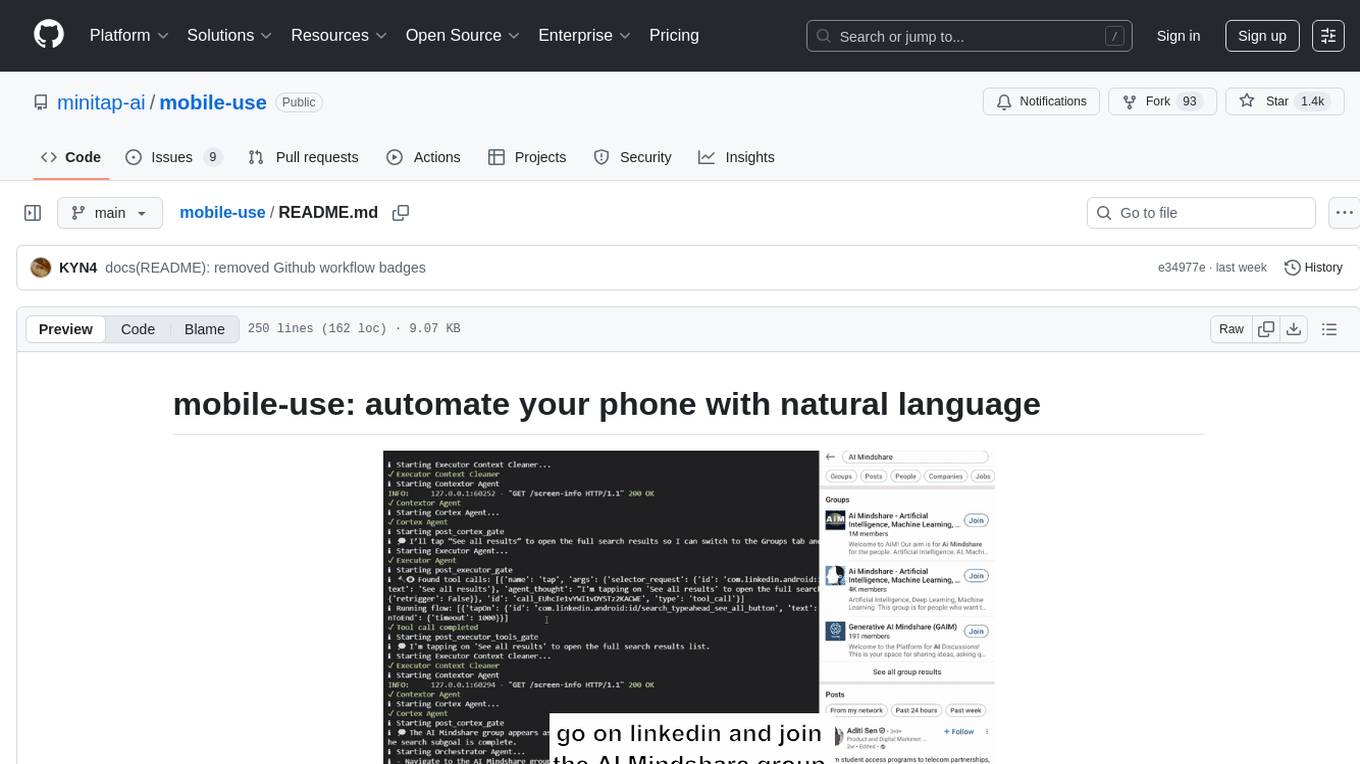
Mobile-use is an open-source AI agent that controls Android or IOS devices using natural language. It understands commands to perform tasks like sending messages and navigating apps. Features include natural language control, UI-aware automation, data scraping, and extensibility. Users can automate their mobile experience by setting up environment variables, customizing LLM configurations, and launching the tool via Docker or manually for development. The tool supports physical Android phones, Android simulators, and iOS simulators. Contributions are welcome, and the project is licensed under MIT.

opencode
Opencode is an AI coding agent designed for the terminal. It is a tool that allows users to interact with AI models for coding tasks in a terminal-based environment. Opencode is open source, provider-agnostic, and focuses on a terminal user interface (TUI) for coding. It offers features such as client/server architecture, support for various AI models, and a strong emphasis on community contributions and feedback.
mattermost-plugin-agents
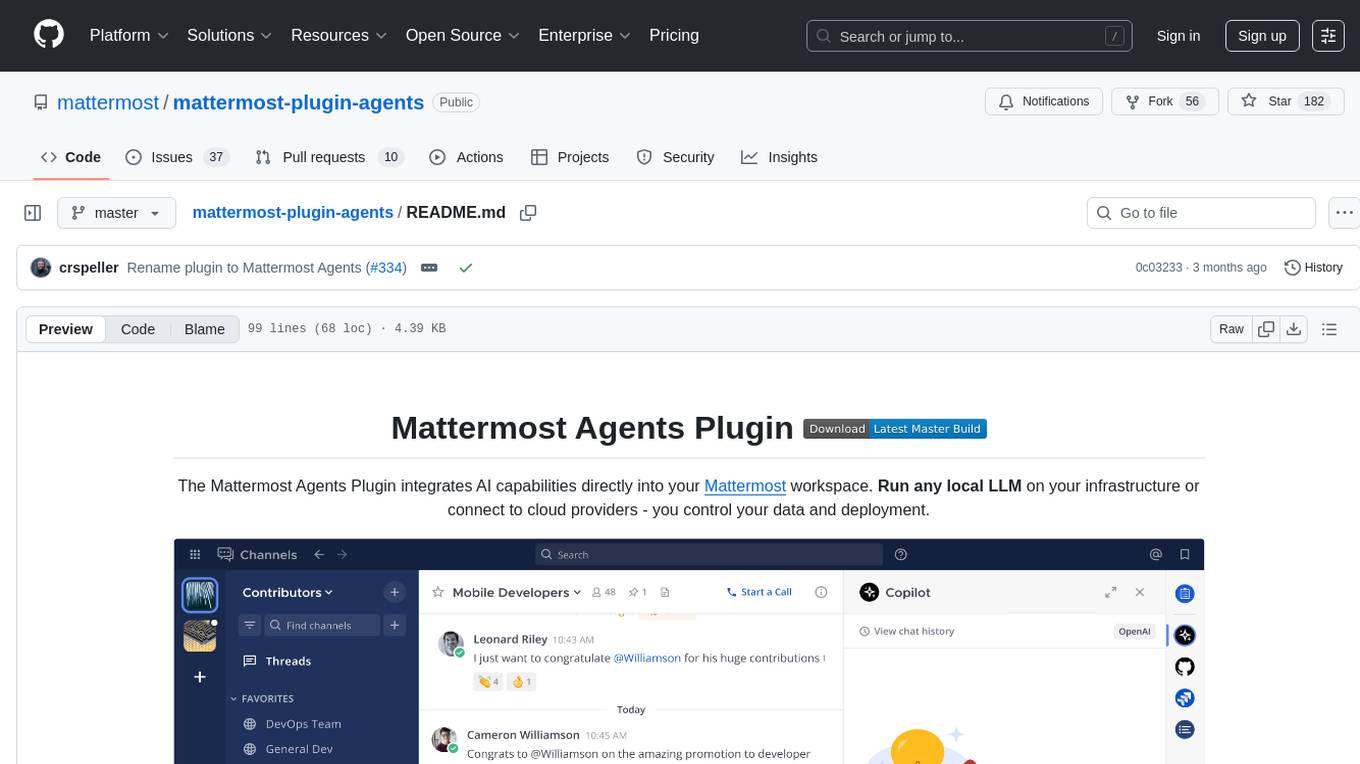
The Mattermost Agents Plugin integrates AI capabilities directly into your Mattermost workspace, allowing users to run local LLMs on their infrastructure or connect to cloud providers. It offers multiple AI assistants with specialized personalities, thread and channel summarization, action item extraction, meeting transcription, semantic search, smart reactions, direct conversations with AI assistants, and flexible LLM support. The plugin comes with comprehensive documentation, installation instructions, system requirements, and development guidelines for users to interact with AI features and configure LLM providers.
openmeter
OpenMeter is a real-time and scalable usage metering tool for AI, usage-based billing, infrastructure, and IoT use cases. It provides a REST API for integrations and offers client SDKs in Node.js, Python, Go, and Web. OpenMeter is licensed under the Apache 2.0 License.
langmanus
LangManus is a community-driven AI automation framework that combines language models with specialized tools for tasks like web search, crawling, and Python code execution. It implements a hierarchical multi-agent system with agents like Coordinator, Planner, Supervisor, Researcher, Coder, Browser, and Reporter. The framework supports LLM integration, search and retrieval tools, Python integration, workflow management, and visualization. LangManus aims to give back to the open-source community and welcomes contributions in various forms.
vision-agent
AskUI Vision Agent is a powerful automation framework that enables you and AI agents to control your desktop, mobile, and HMI devices and automate tasks. It supports multiple AI models, multi-platform compatibility, and enterprise-ready features. The tool provides support for Windows, Linux, MacOS, Android, and iOS device automation, single-step UI automation commands, in-background automation on Windows machines, flexible model use, and secure deployment of agents in enterprise environments.
middleware
Middleware is an open-source engineering management tool that helps engineering leaders measure and analyze team effectiveness using DORA metrics. It integrates with CI/CD tools, automates DORA metric collection and analysis, visualizes key performance indicators, provides customizable reports and dashboards, and integrates with project management platforms. Users can set up Middleware using Docker or manually, generate encryption keys, set up backend and web servers, and access the application to view DORA metrics. The tool calculates DORA metrics using GitHub data, including Deployment Frequency, Lead Time for Changes, Mean Time to Restore, and Change Failure Rate. Middleware aims to provide DORA metrics to users based on their Git data, simplifying the process of tracking software delivery performance and operational efficiency.
codebox-api
CodeBox is a cloud infrastructure tool designed for running Python code in an isolated environment. It also offers simple file input/output capabilities and will soon support vector database operations. Users can install CodeBox using pip and utilize it by setting up an API key. The tool allows users to execute Python code snippets and interact with the isolated environment. CodeBox is currently in early development stages and requires manual handling for certain operations like refunds and cancellations. The tool is open for contributions through issue reporting and pull requests. It is licensed under MIT and can be contacted via email at [email protected].
lexido
Lexido is an innovative assistant for the Linux command line, designed to boost your productivity and efficiency. Powered by Gemini Pro 1.0 and utilizing the free API, Lexido offers smart suggestions for commands based on your prompts and importantly your current environment. Whether you're installing software, managing files, or configuring system settings, Lexido streamlines the process, making it faster and more intuitive.
botpress
Botpress is a platform for building next-generation chatbots and assistants powered by OpenAI. It provides a range of tools and integrations to help developers quickly and easily create and deploy chatbots for various use cases.
browser
Lightpanda Browser is an open-source headless browser designed for fast web automation, AI agents, LLM training, scraping, and testing. It features ultra-low memory footprint, exceptionally fast execution, and compatibility with Playwright and Puppeteer through CDP. Built for performance, Lightpanda offers Javascript execution, support for Web APIs, and is optimized for minimal memory usage. It is a modern solution for web scraping and automation tasks, providing a lightweight alternative to traditional browsers like Chrome.
qrev
QRev is an open-source alternative to Salesforce, offering AI agents to scale sales organizations infinitely. It aims to provide digital workers for various sales roles or a superagent named Qai. The tech stack includes TypeScript for frontend, NodeJS for backend, MongoDB for app server database, ChromaDB for vector database, SQLite for AI server SQL relational database, and Langchain for LLM tooling. The tool allows users to run client app, app server, and AI server components. It requires Node.js and MongoDB to be installed, and provides detailed setup instructions in the README file.
agent-service-toolkit
The AI Agent Service Toolkit is a comprehensive toolkit designed for running an AI agent service using LangGraph, FastAPI, and Streamlit. It includes a LangGraph agent, a FastAPI service, a client for interacting with the service, and a Streamlit app for providing a chat interface. The project offers a template for building and running agents with the LangGraph framework, showcasing a complete setup from agent definition to user interface. Key features include LangGraph Agent with latest features, FastAPI Service, Advanced Streaming support, Streamlit Interface, Multiple Agent Support, Asynchronous Design, Content Moderation, RAG Agent implementation, Feedback Mechanism, Docker Support, and Testing. The repository structure includes directories for defining agents, protocol schema, core modules, service, client, Streamlit app, and tests.
gpt-engineer
GPT-Engineer is a tool that allows you to specify a software in natural language, sit back and watch as an AI writes and executes the code, and ask the AI to implement improvements.
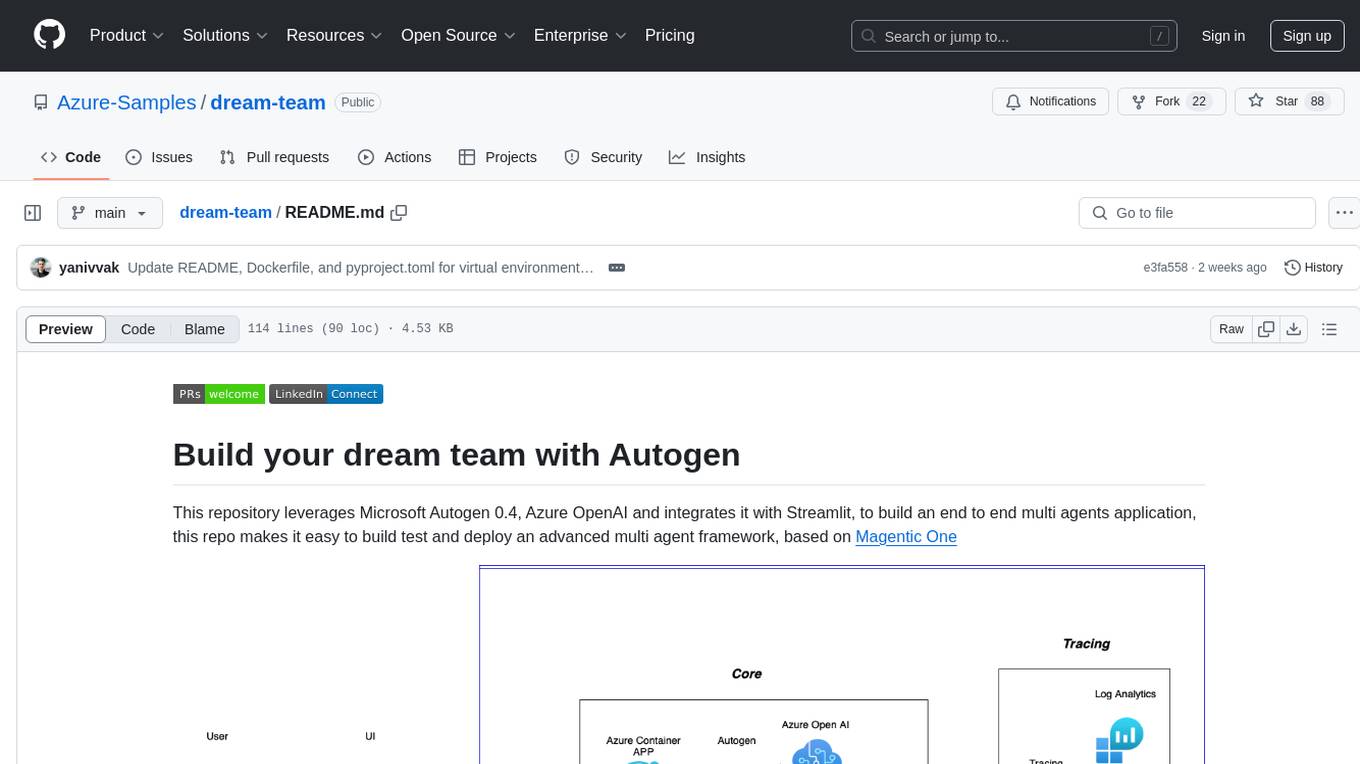
dream-team
Build your dream team with Autogen is a repository that leverages Microsoft Autogen 0.4, Azure OpenAI, and Streamlit to create an end-to-end multi-agent application. It provides an advanced multi-agent framework based on Magentic One, with features such as a friendly UI, single-line deployment, secure code execution, managed identities, and observability & debugging tools. Users can deploy Azure resources and the app with simple commands, work locally with virtual environments, install dependencies, update configurations, and run the application. The repository also offers resources for learning more about building applications with Autogen.
For similar tasks
sre-agent
SRE Agent is an open-source AI agent designed to help Site Reliability Engineers (SREs) debug, maintain healthy Kubernetes systems, and simplify DevOps tasks. With a command-line interface (CLI), users can interact directly with the agent to diagnose issues, report diagnostics, and streamline operations. The agent supports root cause debugging, Kubernetes log querying, GitHub codebase search, and CLI-powered interactions. It is powered by the Model Context Protocol (MCP) for seamless connectivity. Users can configure AWS credentials, GitHub integration, and Anthropic API key to start monitoring deployments and diagnosing issues. The tool is structured with Python services and TypeScript MCP servers for development and maintenance.
Shellsage
Shell Sage is an intelligent terminal companion and AI-powered terminal assistant that enhances the terminal experience with features like local and cloud AI support, context-aware error diagnosis, natural language to command translation, and safe command execution workflows. It offers interactive workflows, supports various API providers, and allows for custom model selection. Users can configure the tool for local or API mode, select specific models, and switch between modes easily. Currently in alpha development, Shell Sage has known limitations like limited Windows support and occasional false positives in error detection. The roadmap includes improvements like better context awareness, Windows PowerShell integration, Tmux integration, and CI/CD error pattern database.
parseable
Parseable is a full stack observability platform designed to ingest, analyze, and extract insights from various types of telemetry data. It can be run locally, in the cloud, or as a managed service. The platform offers features like high availability, smart cache, alerts, role-based access control, OAuth2 support, and OpenTelemetry integration. Users can easily ingest data, query logs, and access the dashboard to monitor and analyze data. Parseable provides a seamless experience for observability and monitoring tasks.
SeaGOAT
SeaGOAT is a local search tool that leverages vector embeddings to enable you to search your codebase semantically. It is designed to work on Linux, macOS, and Windows and can process files in various formats, including text, Markdown, Python, C, C++, TypeScript, JavaScript, HTML, Go, Java, PHP, and Ruby. SeaGOAT uses a vector database called ChromaDB and a local vector embedding engine to provide fast and accurate search results. It also supports regular expression/keyword-based matches. SeaGOAT is open-source and licensed under an open-source license, and users are welcome to examine the source code, raise concerns, or create pull requests to fix problems.
AutoDocs
AutoDocs by Sita is a tool designed to automate documentation for any repository. It parses the repository using tree-sitter and SCIP, constructs a code dependency graph, and generates repository-wide, dependency-aware documentation and summaries. It provides a FastAPI backend for ingestion/search and a Next.js web UI for chat and exploration. Additionally, it includes an MCP server for deep search capabilities. The tool aims to simplify the process of generating accurate and high-signal documentation for codebases.
For similar jobs
cb-tumblebug
CB-Tumblebug (CB-TB) is a system for managing multi-cloud infrastructure consisting of resources from multiple cloud service providers. It provides an overview, features, and architecture. The tool supports various cloud providers and resource types, with ongoing development and localization efforts. Users can deploy a multi-cloud infra with GPUs, enjoy multiple LLMs in parallel, and utilize LLM-related scripts. The tool requires Linux, Docker, Docker Compose, and Golang for building the source. Users can run CB-TB with Docker Compose or from the Makefile, set up prerequisites, contribute to the project, and view a list of contributors. The tool is licensed under an open-source license.
robusta
Robusta is a tool designed to enhance Prometheus notifications for Kubernetes environments. It offers features such as smart grouping to reduce notification spam, AI investigation for alert analysis, alert enrichment with additional data like pod logs, self-healing capabilities for defining auto-remediation rules, advanced routing options, problem detection without PromQL, change-tracking for Kubernetes resources, auto-resolve functionality, and integration with various external systems like Slack, Teams, and Jira. Users can utilize Robusta with or without Prometheus, and it can be installed alongside existing Prometheus setups or as part of an all-in-one Kubernetes observability stack.
AI-CloudOps
AI+CloudOps is a cloud-native operations management platform designed for enterprises. It aims to integrate artificial intelligence technology with cloud-native practices to significantly improve the efficiency and level of operations work. The platform offers features such as AIOps for monitoring data analysis and alerts, multi-dimensional permission management, visual CMDB for resource management, efficient ticketing system, deep integration with Prometheus for real-time monitoring, and unified Kubernetes management for cluster optimization.
awesome-mcp-servers-devops
This repository, 'awesome-mcp-servers-devops', is a curated list of Model Context Protocol servers for DevOps workflows. It includes servers for various aspects of DevOps such as infrastructure, CI/CD, monitoring, security, and cloud operations. The repository provides information on different MCP servers available for tools like GitHub, GitLab, Azure DevOps, Gitea, Terraform, Vault, Pulumi, Kubernetes, Docker Hub, Portainer, Qovery, various command line and local operation tools, browser automation tools, code execution tools, coding agents, aggregators, CI/CD tools like Argo CD, Jenkins, GitHub Actions, Codemagic, DevOps visibility tools, build tools, cloud platforms like AWS, Azure, Cloudflare, Alibaba Cloud, observability tools like Grafana, Datadog, Prometheus, VictoriaMetrics, Alertmanager, APM & monitoring tools, security tools like Snyk, Semgrep, and community security servers, collaboration tools like Atlassian, Jira, project management tools, service desks, Notion, and more.
sre-agent
SRE Agent is an open-source AI agent designed to help Site Reliability Engineers (SREs) debug, maintain healthy Kubernetes systems, and simplify DevOps tasks. With a command-line interface (CLI), users can interact directly with the agent to diagnose issues, report diagnostics, and streamline operations. The agent supports root cause debugging, Kubernetes log querying, GitHub codebase search, and CLI-powered interactions. It is powered by the Model Context Protocol (MCP) for seamless connectivity. Users can configure AWS credentials, GitHub integration, and Anthropic API key to start monitoring deployments and diagnosing issues. The tool is structured with Python services and TypeScript MCP servers for development and maintenance.
kaito
Kaito is an operator that automates the AI/ML inference model deployment in a Kubernetes cluster. It manages large model files using container images, avoids tuning deployment parameters to fit GPU hardware by providing preset configurations, auto-provisions GPU nodes based on model requirements, and hosts large model images in the public Microsoft Container Registry (MCR) if the license allows. Using Kaito, the workflow of onboarding large AI inference models in Kubernetes is largely simplified.
ai-on-gke
This repository contains assets related to AI/ML workloads on Google Kubernetes Engine (GKE). Run optimized AI/ML workloads with Google Kubernetes Engine (GKE) platform orchestration capabilities. A robust AI/ML platform considers the following layers: Infrastructure orchestration that support GPUs and TPUs for training and serving workloads at scale Flexible integration with distributed computing and data processing frameworks Support for multiple teams on the same infrastructure to maximize utilization of resources
tidb
TiDB is an open-source distributed SQL database that supports Hybrid Transactional and Analytical Processing (HTAP) workloads. It is MySQL compatible and features horizontal scalability, strong consistency, and high availability.