


chunkhound
Modern RAG for your codebase - semantic and regex search via MCP
Stars: 97
ChunkHound is a tool that transforms your codebase into a searchable knowledge base for AI assistants using semantic and regex search. It integrates with AI assistants via the Model Context Protocol (MCP) and offers features such as cAST algorithm for semantic code chunking, multi-hop semantic search, natural language queries, regex search without API keys, support for 22 languages, and local-first architecture. It provides intelligent code discovery by following semantic relationships and discovering related implementations. ChunkHound is built on the cAST algorithm from Carnegie Mellon University, ensuring structure-aware chunking that preserves code meaning. It supports universal language parsing and offers efficient updates for large codebases.
README:

Modern RAG for your codebase - semantic and regex search via MCP.




Transform your codebase into a searchable knowledge base for AI assistants using semantic search via cAST algorithm and regex search. Integrates with AI assistants via the Model Context Protocol (MCP).
- cAST Algorithm - Research-backed semantic code chunking
- Multi-Hop Semantic Search - Discovers interconnected code relationships beyond direct matches
- Semantic search - Natural language queries like "find authentication code"
- Regex search - Pattern matching without API keys
- Local-first - Your code stays on your machine
-
22 languages with structured parsing
- Programming (via Tree-sitter): Python, JavaScript, TypeScript, JSX, TSX, Java, Kotlin, Groovy, C, C++, C#, Go, Rust, Bash, MATLAB, Makefile
- Configuration (via Tree-sitter): JSON, YAML, TOML, Markdown
- Text-based (custom parsers): Text files, PDF
- MCP integration - Works with Claude, VS Code, Cursor, Windsurf, Zed, etc
Visit chunkhound.github.io for complete guides:
- Python 3.10+
- uv package manager
- API key for semantic search (optional - regex search works without any keys)
# Install uv if needed
curl -LsSf https://astral.sh/uv/install.sh | sh

# Install ChunkHound
uv tool install chunkhound- Create
.chunkhound.jsonin project root file
{
  "embedding": {
    "provider": "openai",
    "api_key": "your-api-key-here"
  }
}- Index your codebase
chunkhound indexchunkhound index --no-embeddingsFor configuration, IDE setup, and advanced usage, see the documentation.
Automatic File Watching: MCP servers monitor your codebase and update the index automatically as you edit files. No manual re-indexing required.
Smart Content Diffs: Only changed code chunks get re-processed. Unchanged chunks keep their existing embeddings, making updates efficient even for large codebases.
Seamless Branch Switching: When you switch git branches, ChunkHound automatically detects and re-indexes only the files that actually changed between branches.
Live Memory Systems: Index markdown notes or documentation that updates in real-time while you work, creating a dynamic knowledge base.
Research Foundation: Built on the cAST (Chunking via Abstract Syntax Trees) algorithm from Carnegie Mellon University, providing:
- 4.3 point gain in Recall@5 on RepoEval retrieval
- 2.67 point gain in Pass@1 on SWE-bench generation
- Structure-aware chunking that preserves code meaning
Local-First Architecture:
- Your code never leaves your machine
- Works offline with Ollama local models
- No per-token charges for large codebases
Universal Language Support:
- Structured parsing for 22 languages (Tree-sitter + custom parsers)
- Same semantic concepts across all programming languages
Intelligent Code Discovery:
- Multi-hop search follows semantic relationships to find related implementations
- Automatically discovers complete feature patterns: find "authentication" to get password hashing, token validation, session management
- Convergence detection prevents semantic drift while maximizing discovery
MIT
For Tasks:
Click tags to check more tools for each tasksFor Jobs:
Alternative AI tools for chunkhound
Similar Open Source Tools
chunkhound
ChunkHound is a tool that transforms your codebase into a searchable knowledge base for AI assistants using semantic and regex search. It integrates with AI assistants via the Model Context Protocol (MCP) and offers features such as cAST algorithm for semantic code chunking, multi-hop semantic search, natural language queries, regex search without API keys, support for 22 languages, and local-first architecture. It provides intelligent code discovery by following semantic relationships and discovering related implementations. ChunkHound is built on the cAST algorithm from Carnegie Mellon University, ensuring structure-aware chunking that preserves code meaning. It supports universal language parsing and offers efficient updates for large codebases.
chunkhound
ChunkHound is a modern tool for transforming your codebase into a searchable knowledge base for AI assistants. It utilizes semantic search via the cAST algorithm and regex search, integrating with AI assistants through the Model Context Protocol (MCP). With features like cAST Algorithm, Multi-Hop Semantic Search, Regex search, and support for 22 languages, ChunkHound offers a local-first approach to code analysis and discovery. It provides intelligent code discovery, universal language support, and real-time indexing capabilities, making it a powerful tool for developers looking to enhance their coding experience.
vearch
Vearch is a cloud-native distributed vector database designed for efficient similarity search of embedding vectors in AI applications. It supports hybrid search with vector search and scalar filtering, offers fast vector retrieval from millions of objects in milliseconds, and ensures scalability and reliability through replication and elastic scaling out. Users can deploy Vearch cluster on Kubernetes, add charts from the repository or locally, start with Docker-compose, or compile from source code. The tool includes components like Master for schema management, Router for RESTful API, and PartitionServer for hosting document partitions with raft-based replication. Vearch can be used for building visual search systems for indexing images and offers a Python SDK for easy installation and usage. The tool is suitable for AI developers and researchers looking for efficient vector search capabilities in their applications.
haiku.rag
Haiku RAG is a Retrieval-Augmented Generation (RAG) library that utilizes LanceDB as a local vector database. It supports semantic and full-text search, hybrid search with Reciprocal Rank Fusion, multiple embedding and QA providers, default search result reranking, question answering, file monitoring, and various file formats. It can be used via CLI or Python API, and can serve as tools for AI assistants like Claude Desktop. The library offers features for document management and search, with detailed documentation available.
ApeRAG
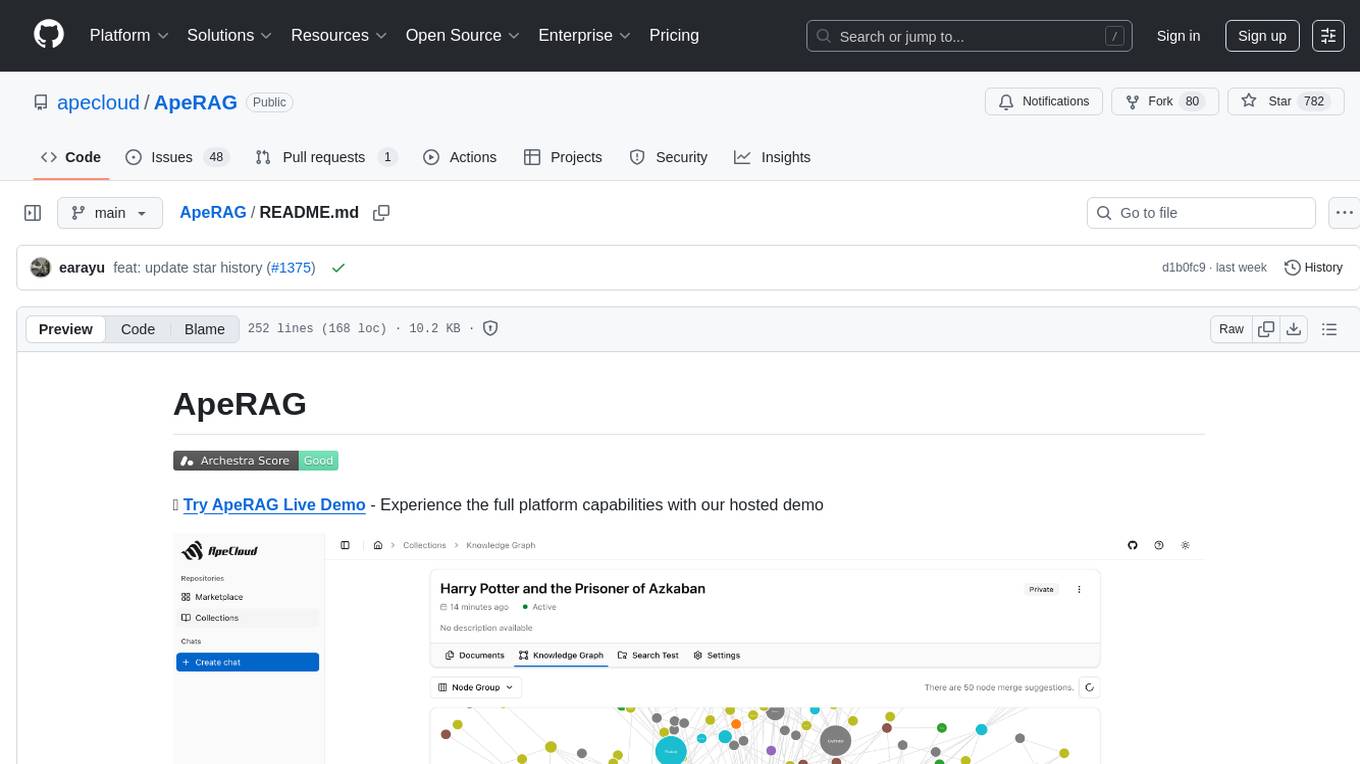
ApeRAG is a production-ready platform for Retrieval-Augmented Generation (RAG) that combines Graph RAG, vector search, and full-text search with advanced AI agents. It is ideal for building Knowledge Graphs, Context Engineering, and deploying intelligent AI agents for autonomous search and reasoning across knowledge bases. The platform offers features like advanced index types, intelligent AI agents with MCP support, enhanced Graph RAG with entity normalization, multimodal processing, hybrid retrieval engine, MinerU integration for document parsing, production-grade deployment with Kubernetes, enterprise management features, MCP integration, and developer-friendly tools for customization and contribution.
scrapegraph-sdk
Official SDKs for the ScrapeGraph AI API - Intelligent web scraping and search powered by AI. Extract structured data from any webpage or perform AI-powered web searches with natural language prompts. The SDK offers features such as SmartScraper for data extraction, SearchScraper for AI-powered web search, Markdownify for converting webpages to markdown, SmartCrawler for intelligent crawling, AgenticScraper for automated browser actions, and more. It provides seamless integration with popular frameworks and tools, supports Python and JavaScript SDKs, LLM frameworks, low-code platforms, and offers core features like AI-powered extraction, structured output, multiple data formats, high performance, and enterprise-grade security.
SMRY
SMRY.ai is a Next.js application that bypasses paywalls and generates AI-powered summaries by fetching content from multiple sources simultaneously. It provides a distraction-free reader with summary builder, cleans articles, offers multi-source fetching, built-in AI summaries in 14 languages, rich debug context, soft paywall access, smart extraction using Diffbot's AI, multi-source parallel fetching, type-safe error handling, dual caching strategy, intelligent source routing, content parsing pipeline, multilingual summaries, and more. The tool aims to make referencing reporting easier, provide original articles alongside summaries, and offer concise summaries in various languages.
Mira
Mira is an agentic AI library designed for automating company research by gathering information from various sources like company websites, LinkedIn profiles, and Google Search. It utilizes a multi-agent architecture to collect and merge data points into a structured profile with confidence scores and clear source attribution. The core library is framework-agnostic and can be integrated into applications, pipelines, or custom workflows. Mira offers features such as real-time progress events, confidence scoring, company criteria matching, and built-in services for data gathering. The tool is suitable for users looking to streamline company research processes and enhance data collection efficiency.
awesome-ai-coding
Awesome-AI-Coding is a curated list of AI coding topics, projects, datasets, LLM models, embedding models, papers, blogs, products, startups, and peer awesome lists related to artificial intelligence in coding. It includes tools for code completion, code generation, code documentation, and code search, as well as AI models and techniques for improving developer productivity. The repository also features information on various AI-powered developer tools, copilots, and related resources in the AI coding domain.
persistent-ai-memory
Persistent AI Memory System is a comprehensive tool that offers persistent, searchable storage for AI assistants. It includes features like conversation tracking, MCP tool call logging, and intelligent scheduling. The system supports multiple databases, provides enhanced memory management, and offers various tools for memory operations, schedule management, and system health checks. It also integrates with various platforms like LM Studio, VS Code, Koboldcpp, Ollama, and more. The system is designed to be modular, platform-agnostic, and scalable, allowing users to handle large conversation histories efficiently.
orbit
ORBIT (Open Retrieval-Based Inference Toolkit) is a middleware platform that provides a unified API for AI inference. It acts as a central gateway, allowing you to connect various local and remote AI models with your private data sources like SQL databases, vector stores, and local files. ORBIT uses a flexible adapter architecture to connect your data to AI models, creating specialized 'agents' for specific tasks. It supports scenarios like Knowledge Base Q&A and Chat with Your SQL Database, enabling users to interact with AI models seamlessly. The tool offers a RESTful API for programmatic access and includes features like authentication, API key management, system prompts, health monitoring, and file management. ORBIT is designed to streamline AI inference tasks and facilitate interactions between users and AI models.
Zentara-Code
Zentara Code is an AI coding assistant for VS Code that turns chat instructions into precise, auditable changes in the codebase. It is optimized for speed, safety, and correctness through parallel execution, LSP semantics, and integrated runtime debugging. It offers features like parallel subagents, integrated LSP tools, and runtime debugging for efficient code modification and analysis.
CyberStrikeAI
CyberStrikeAI is an AI-native security testing platform built in Go that integrates 100+ security tools, an intelligent orchestration engine, role-based testing with predefined security roles, a skills system with specialized testing skills, and comprehensive lifecycle management capabilities. It enables end-to-end automation from conversational commands to vulnerability discovery, attack-chain analysis, knowledge retrieval, and result visualization, delivering an auditable, traceable, and collaborative testing environment for security teams. The platform features an AI decision engine with OpenAI-compatible models, native MCP implementation with various transports, prebuilt tool recipes, large-result pagination, attack-chain graph, password-protected web UI, knowledge base with vector search, vulnerability management, batch task management, role-based testing, and skills system.
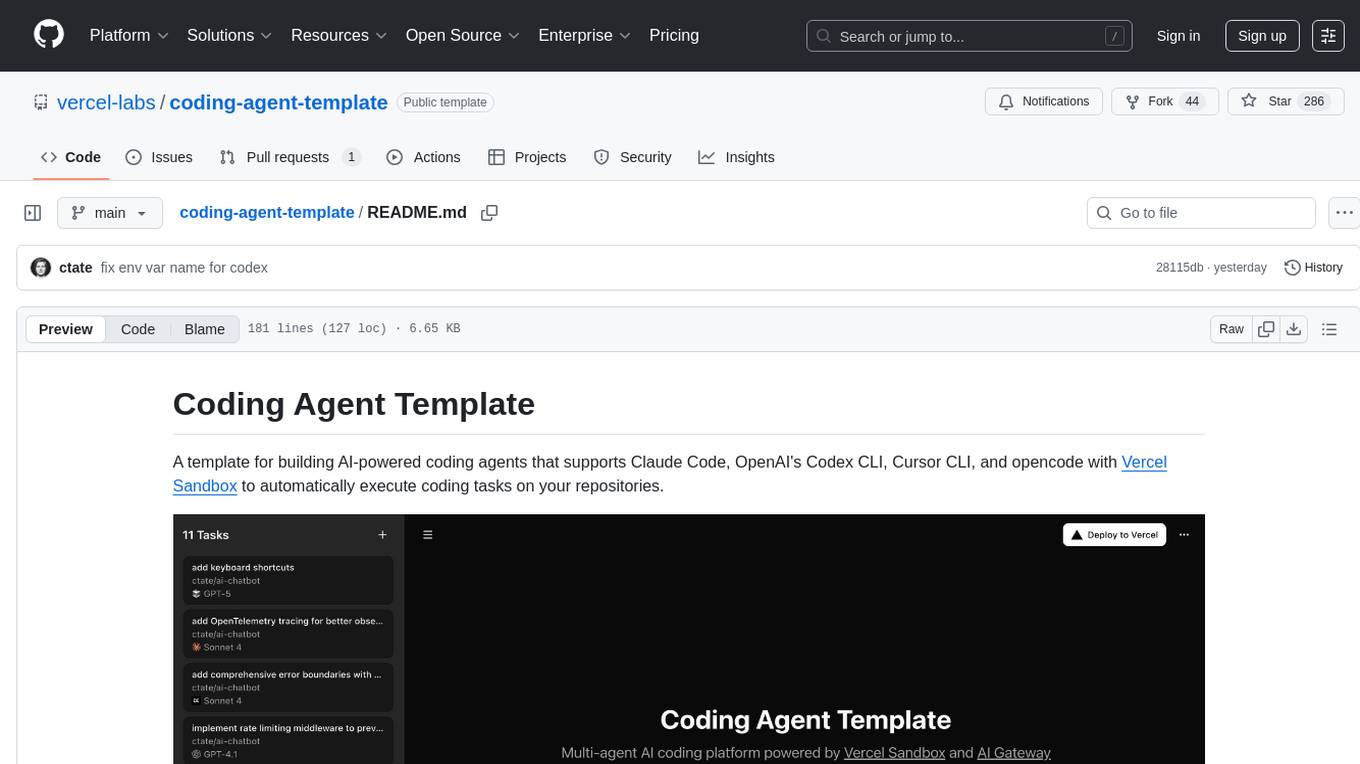
coding-agent-template
Coding Agent Template is a versatile tool for building AI-powered coding agents that support various coding tasks using Claude Code, OpenAI's Codex CLI, Cursor CLI, and opencode with Vercel Sandbox. It offers features like multi-agent support, Vercel Sandbox for secure code execution, AI Gateway integration, AI-generated branch names, task management, persistent storage, Git integration, and a modern UI built with Next.js and Tailwind CSS. Users can easily deploy their own version of the template to Vercel and set up the tool by cloning the repository, installing dependencies, configuring environment variables, setting up the database, and starting the development server. The tool simplifies the process of creating tasks, monitoring progress, reviewing results, and managing tasks, making it ideal for developers looking to automate coding tasks with AI agents.
gateway
CentralMind Gateway is an AI-first data gateway that securely connects any data source and automatically generates secure, LLM-optimized APIs. It filters out sensitive data, adds traceability, and optimizes for AI workloads. Suitable for companies deploying AI agents for customer support and analytics.
OpenChat
OS Chat is a free, open-source AI personal assistant that combines 40+ language models with powerful automation capabilities. It allows users to deploy background agents, connect services like Gmail, Calendar, Notion, GitHub, and Slack, and get things done through natural conversation. With features like smart automation, service connectors, AI models, chat management, interface customization, and premium features, OS Chat offers a comprehensive solution for managing digital life and workflows. It prioritizes privacy by being open source and self-hostable, with encrypted API key storage.
For similar tasks
chunkhound
ChunkHound is a tool that transforms your codebase into a searchable knowledge base for AI assistants using semantic and regex search. It integrates with AI assistants via the Model Context Protocol (MCP) and offers features such as cAST algorithm for semantic code chunking, multi-hop semantic search, natural language queries, regex search without API keys, support for 22 languages, and local-first architecture. It provides intelligent code discovery by following semantic relationships and discovering related implementations. ChunkHound is built on the cAST algorithm from Carnegie Mellon University, ensuring structure-aware chunking that preserves code meaning. It supports universal language parsing and offers efficient updates for large codebases.
chunkhound
ChunkHound is a modern tool for transforming your codebase into a searchable knowledge base for AI assistants. It utilizes semantic search via the cAST algorithm and regex search, integrating with AI assistants through the Model Context Protocol (MCP). With features like cAST Algorithm, Multi-Hop Semantic Search, Regex search, and support for 22 languages, ChunkHound offers a local-first approach to code analysis and discovery. It provides intelligent code discovery, universal language support, and real-time indexing capabilities, making it a powerful tool for developers looking to enhance their coding experience.
sourcegraph
Sourcegraph is a code search and navigation tool that helps developers read, write, and fix code in large, complex codebases. It provides features such as code search across all repositories and branches, code intelligence for navigation and refactoring, and the ability to fix and refactor code across multiple repositories at once.
awesome-code-ai
A curated list of AI coding tools, including code completion, refactoring, and assistants. This list includes both open-source and commercial tools, as well as tools that are still in development. Some of the most popular AI coding tools include GitHub Copilot, CodiumAI, Codeium, Tabnine, and Replit Ghostwriter.
moatless-tools
Moatless Tools is a hobby project focused on experimenting with using Large Language Models (LLMs) to edit code in large existing codebases. The project aims to build tools that insert the right context into prompts and handle responses effectively. It utilizes an agentic loop functioning as a finite state machine to transition between states like Search, Identify, PlanToCode, ClarifyChange, and EditCode for code editing tasks.
CodeGeeX4
CodeGeeX4-ALL-9B is an open-source multilingual code generation model based on GLM-4-9B, offering enhanced code generation capabilities. It supports functions like code completion, code interpreter, web search, function call, and repository-level code Q&A. The model has competitive performance on benchmarks like BigCodeBench and NaturalCodeBench, outperforming larger models in terms of speed and performance.
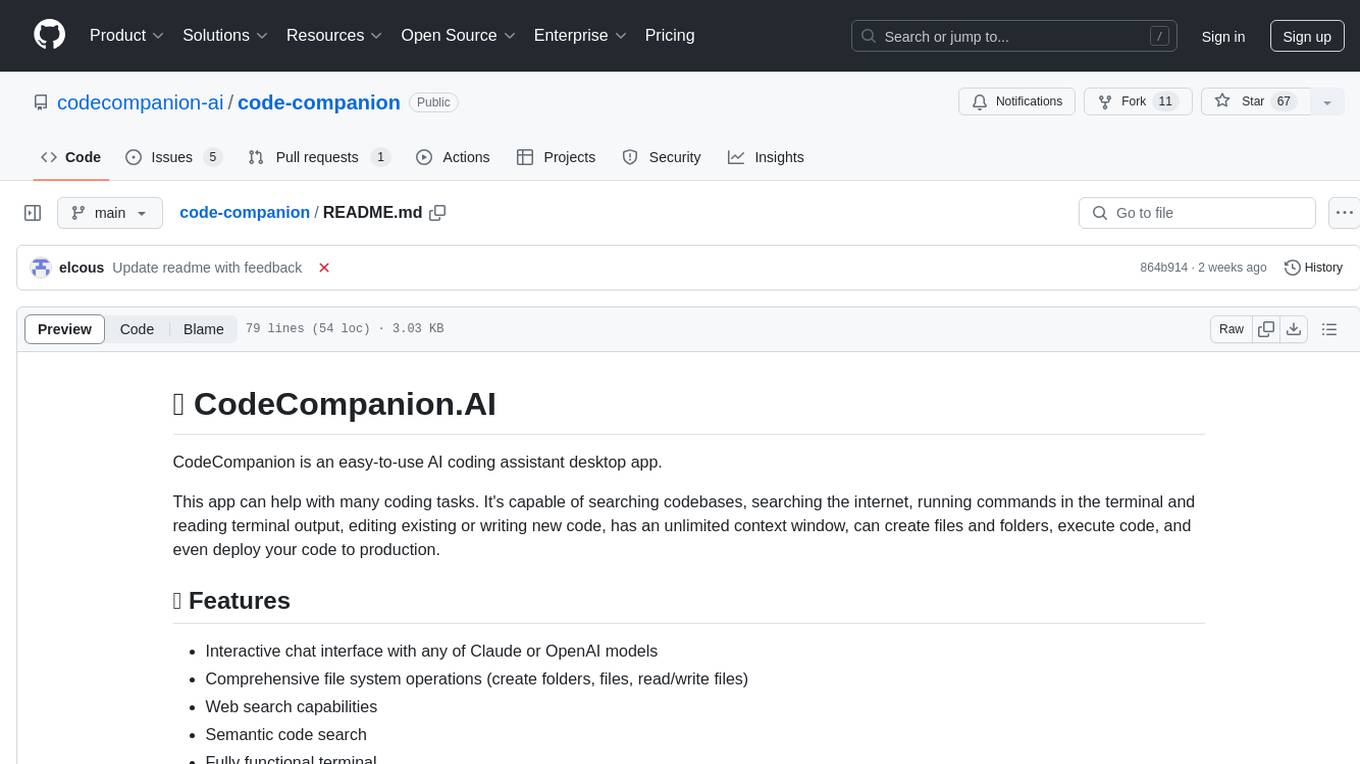
code-companion
CodeCompanion.AI is an AI coding assistant desktop app that helps with various coding tasks. It features an interactive chat interface, file system operations, web search capabilities, semantic code search, a fully functional terminal, code preview and approval, unlimited context window, dynamic context management, and more. Users can save chat conversations and set custom instructions per project.
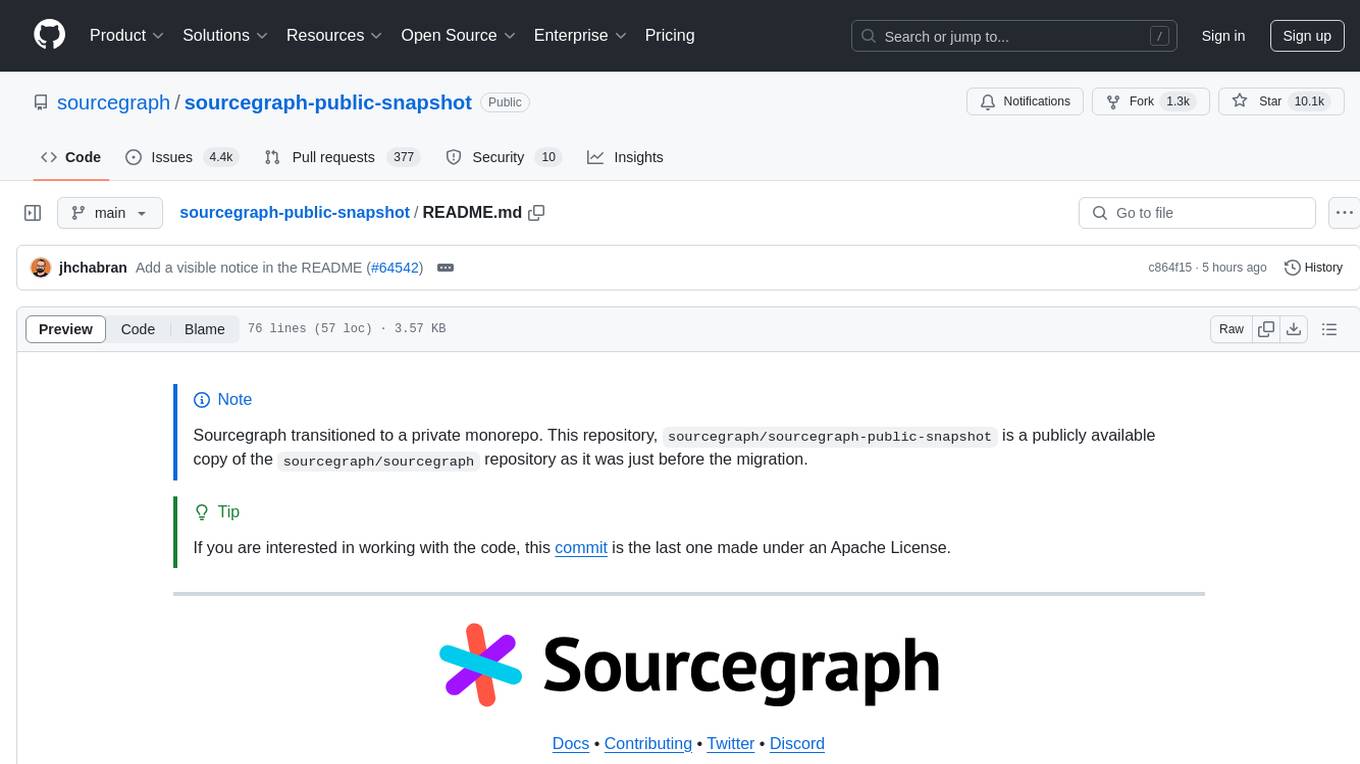
sourcegraph-public-snapshot
Sourcegraph is a tool that simplifies reading, writing, and fixing code in large and complex codebases. It offers features such as code search across repositories, code intelligence for code navigation and history tracing, and the ability to roll out large-scale changes to multiple repositories simultaneously. Sourcegraph can be used on the cloud or self-hosted, and provides public code search on Sourcegraph.com. The tool is designed to enhance code understanding and collaboration within development teams.
For similar jobs
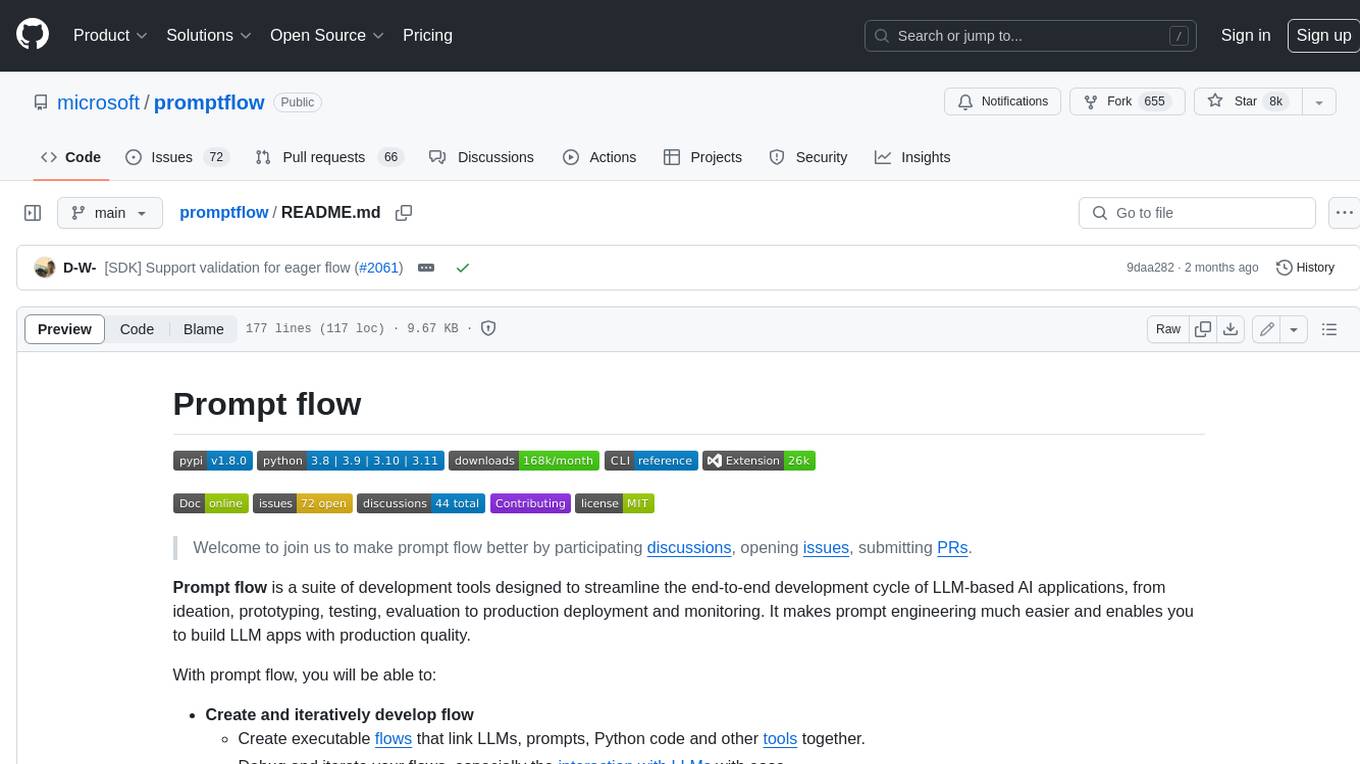
promptflow
**Prompt flow** is a suite of development tools designed to streamline the end-to-end development cycle of LLM-based AI applications, from ideation, prototyping, testing, evaluation to production deployment and monitoring. It makes prompt engineering much easier and enables you to build LLM apps with production quality.
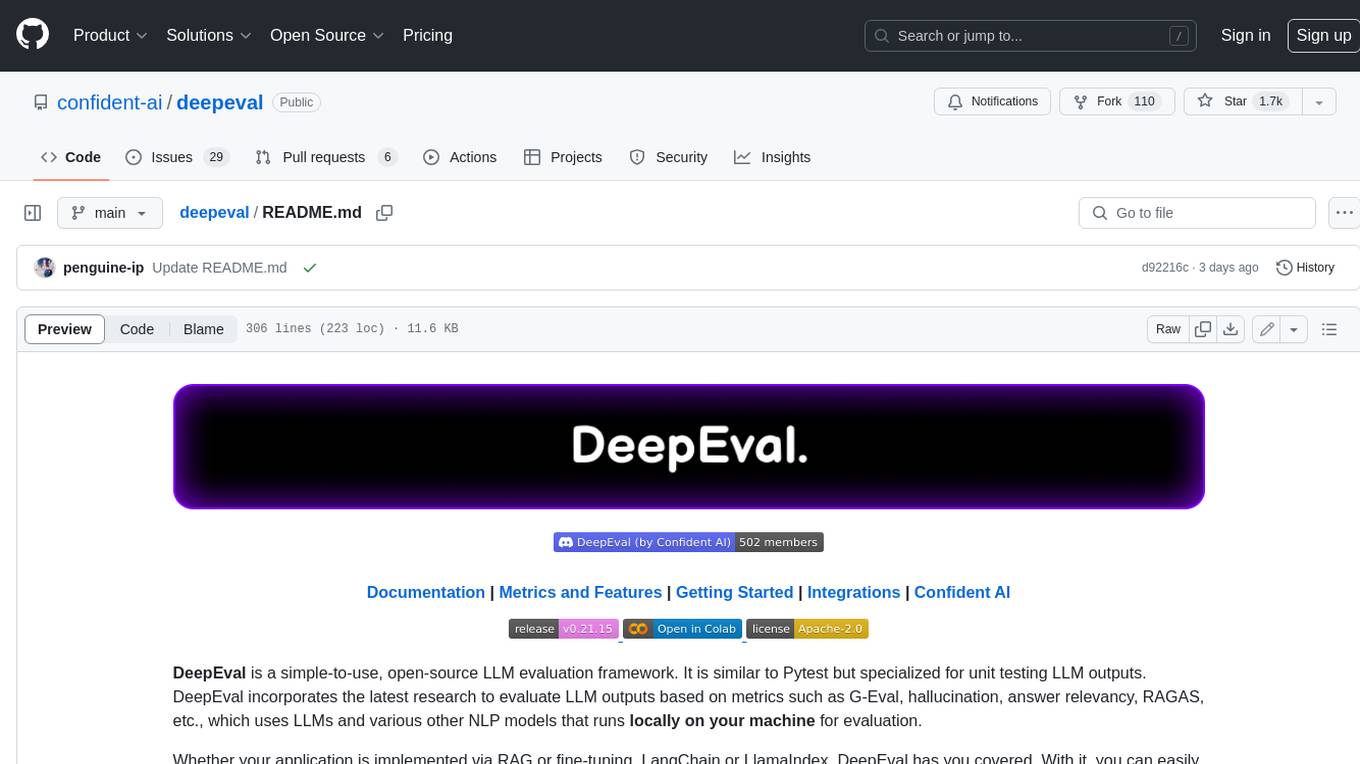
deepeval
DeepEval is a simple-to-use, open-source LLM evaluation framework specialized for unit testing LLM outputs. It incorporates various metrics such as G-Eval, hallucination, answer relevancy, RAGAS, etc., and runs locally on your machine for evaluation. It provides a wide range of ready-to-use evaluation metrics, allows for creating custom metrics, integrates with any CI/CD environment, and enables benchmarking LLMs on popular benchmarks. DeepEval is designed for evaluating RAG and fine-tuning applications, helping users optimize hyperparameters, prevent prompt drifting, and transition from OpenAI to hosting their own Llama2 with confidence.
MegaDetector
MegaDetector is an AI model that identifies animals, people, and vehicles in camera trap images (which also makes it useful for eliminating blank images). This model is trained on several million images from a variety of ecosystems. MegaDetector is just one of many tools that aims to make conservation biologists more efficient with AI. If you want to learn about other ways to use AI to accelerate camera trap workflows, check out our of the field, affectionately titled "Everything I know about machine learning and camera traps".
leapfrogai
LeapfrogAI is a self-hosted AI platform designed to be deployed in air-gapped resource-constrained environments. It brings sophisticated AI solutions to these environments by hosting all the necessary components of an AI stack, including vector databases, model backends, API, and UI. LeapfrogAI's API closely matches that of OpenAI, allowing tools built for OpenAI/ChatGPT to function seamlessly with a LeapfrogAI backend. It provides several backends for various use cases, including llama-cpp-python, whisper, text-embeddings, and vllm. LeapfrogAI leverages Chainguard's apko to harden base python images, ensuring the latest supported Python versions are used by the other components of the stack. The LeapfrogAI SDK provides a standard set of protobuffs and python utilities for implementing backends and gRPC. LeapfrogAI offers UI options for common use-cases like chat, summarization, and transcription. It can be deployed and run locally via UDS and Kubernetes, built out using Zarf packages. LeapfrogAI is supported by a community of users and contributors, including Defense Unicorns, Beast Code, Chainguard, Exovera, Hypergiant, Pulze, SOSi, United States Navy, United States Air Force, and United States Space Force.
llava-docker
This Docker image for LLaVA (Large Language and Vision Assistant) provides a convenient way to run LLaVA locally or on RunPod. LLaVA is a powerful AI tool that combines natural language processing and computer vision capabilities. With this Docker image, you can easily access LLaVA's functionalities for various tasks, including image captioning, visual question answering, text summarization, and more. The image comes pre-installed with LLaVA v1.2.0, Torch 2.1.2, xformers 0.0.23.post1, and other necessary dependencies. You can customize the model used by setting the MODEL environment variable. The image also includes a Jupyter Lab environment for interactive development and exploration. Overall, this Docker image offers a comprehensive and user-friendly platform for leveraging LLaVA's capabilities.

carrot
The 'carrot' repository on GitHub provides a list of free and user-friendly ChatGPT mirror sites for easy access. The repository includes sponsored sites offering various GPT models and services. Users can find and share sites, report errors, and access stable and recommended sites for ChatGPT usage. The repository also includes a detailed list of ChatGPT sites, their features, and accessibility options, making it a valuable resource for ChatGPT users seeking free and unlimited GPT services.
TrustLLM
TrustLLM is a comprehensive study of trustworthiness in LLMs, including principles for different dimensions of trustworthiness, established benchmark, evaluation, and analysis of trustworthiness for mainstream LLMs, and discussion of open challenges and future directions. Specifically, we first propose a set of principles for trustworthy LLMs that span eight different dimensions. Based on these principles, we further establish a benchmark across six dimensions including truthfulness, safety, fairness, robustness, privacy, and machine ethics. We then present a study evaluating 16 mainstream LLMs in TrustLLM, consisting of over 30 datasets. The document explains how to use the trustllm python package to help you assess the performance of your LLM in trustworthiness more quickly. For more details about TrustLLM, please refer to project website.
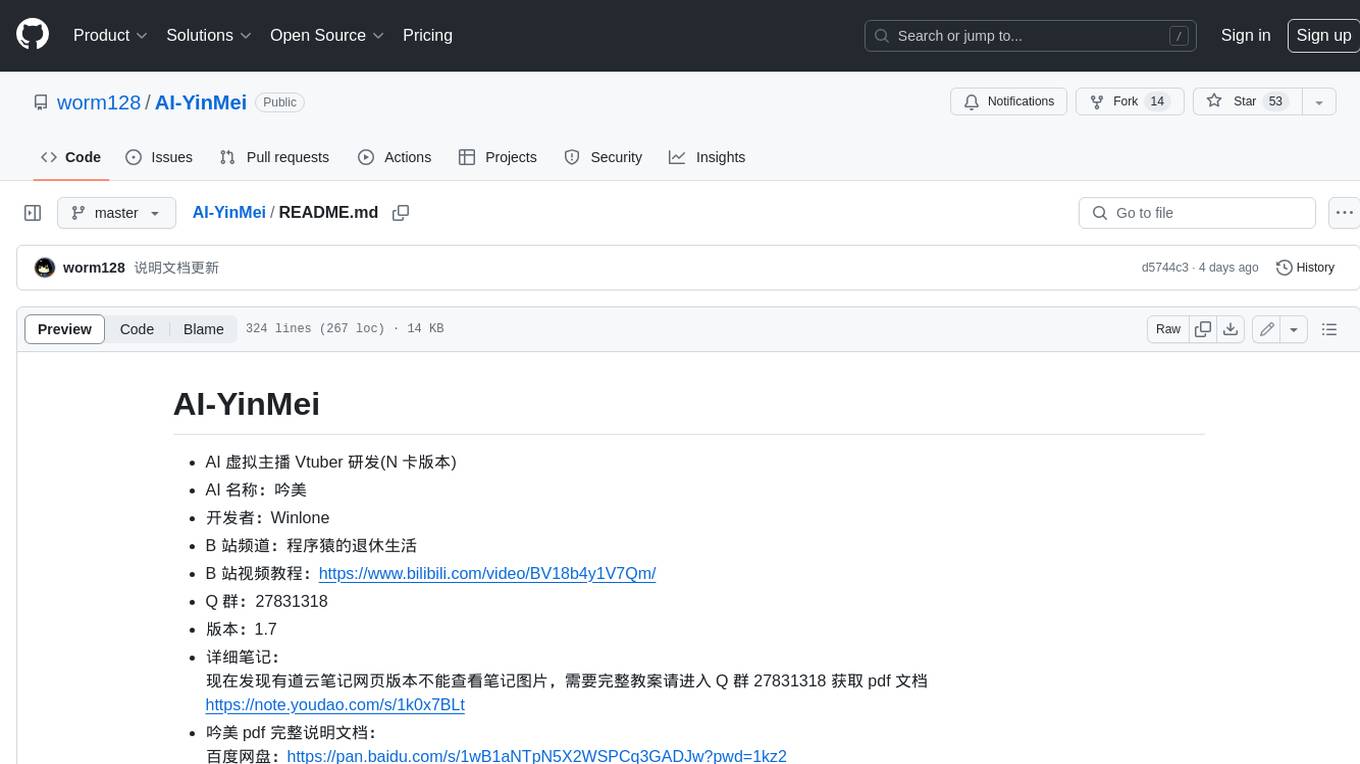
AI-YinMei
AI-YinMei is an AI virtual anchor Vtuber development tool (N card version). It supports fastgpt knowledge base chat dialogue, a complete set of solutions for LLM large language models: [fastgpt] + [one-api] + [Xinference], supports docking bilibili live broadcast barrage reply and entering live broadcast welcome speech, supports Microsoft edge-tts speech synthesis, supports Bert-VITS2 speech synthesis, supports GPT-SoVITS speech synthesis, supports expression control Vtuber Studio, supports painting stable-diffusion-webui output OBS live broadcast room, supports painting picture pornography public-NSFW-y-distinguish, supports search and image search service duckduckgo (requires magic Internet access), supports image search service Baidu image search (no magic Internet access), supports AI reply chat box [html plug-in], supports AI singing Auto-Convert-Music, supports playlist [html plug-in], supports dancing function, supports expression video playback, supports head touching action, supports gift smashing action, supports singing automatic start dancing function, chat and singing automatic cycle swing action, supports multi scene switching, background music switching, day and night automatic switching scene, supports open singing and painting, let AI automatically judge the content.