


casdoor
An open-source AI-first Identity and Access Management (IAM) /AI MCP gateway and auth server with web UI supporting MCP, A2A, OAuth 2.1, OIDC, SAML, CAS, LDAP, SCIM, WebAuthn, TOTP, MFA, Face ID, Google Workspace, Azure AD
Stars: 13020
Casdoor is an open-source AI-first Identity and Access Management (IAM) /AI MCP gateway and auth server with web UI supporting MCP, A2A, OAuth 2.1, OIDC, SAML, CAS, LDAP, SCIM, WebAuthn, TOTP, MFA, Face ID, Google Workspace, Azure AD. It provides a comprehensive solution for managing user identities and access control in various scenarios, offering a wide range of authentication and authorization mechanisms. Casdoor aims to simplify the process of integrating identity and access management functionalities into applications, enabling developers to focus on building secure and scalable systems.
README:
An open-source AI-first Identity and Access Management (IAM) /AI MCP gateway and auth server with web UI supporting MCP, A2A, OAuth 2.1, OIDC, SAML, CAS, LDAP, SCIM, WebAuthn, TOTP, MFA, Face ID, Google Workspace, Azure AD










- Read-only site: https://door.casdoor.com (any modification operation will fail)
- Writable site: https://demo.casdoor.com (original data will be restored for every 5 minutes)
- By source code: https://casdoor.org/docs/basic/server-installation
- By Docker: https://casdoor.org/docs/basic/try-with-docker
- By Kubernetes Helm: https://casdoor.org/docs/basic/try-with-helm
https://casdoor.org/docs/how-to-connect/overview
https://casdoor.org/docs/category/integrations
- Discord: https://discord.gg/5rPsrAzK7S
- Contact: https://casdoor.org/help
For casdoor, if you have any questions, you can give Issues, or you can also directly start Pull Requests(but we recommend giving issues first to communicate with the community).
If you are contributing to casdoor, please note that we use Crowdin as translating platform and i18next as translating tool. When you add some words using i18next in the web/ directory, please remember to add what you have added to the web/src/locales/en/data.json file.
For Tasks:
Click tags to check more tools for each tasksFor Jobs:
Alternative AI tools for casdoor
Similar Open Source Tools
casdoor
Casdoor is an open-source AI-first Identity and Access Management (IAM) /AI MCP gateway and auth server with web UI supporting MCP, A2A, OAuth 2.1, OIDC, SAML, CAS, LDAP, SCIM, WebAuthn, TOTP, MFA, Face ID, Google Workspace, Azure AD. It provides a comprehensive solution for managing user identities and access control in various scenarios, offering a wide range of authentication and authorization mechanisms. Casdoor aims to simplify the process of integrating identity and access management functionalities into applications, enabling developers to focus on building secure and scalable systems.
Chat2DB
Chat2DB is an AI-driven data development and analysis platform that enables users to communicate with databases using natural language. It supports a wide range of databases, including MySQL, PostgreSQL, Oracle, SQLServer, SQLite, MariaDB, ClickHouse, DM, Presto, DB2, OceanBase, Hive, KingBase, MongoDB, Redis, and Snowflake. Chat2DB provides a user-friendly interface that allows users to query databases, generate reports, and explore data using natural language commands. It also offers a variety of features to help users improve their productivity, such as auto-completion, syntax highlighting, and error checking.

macai
Macai is a native macOS client for interacting with modern AI tools, such as ChatGPT and Ollama. It features organized chats with custom system messages, system-defined light/dark themes, backup and restore functionality, customizable context size, support for any model with a compatible API, formatted code blocks and tables, multiple chat tabs, CoreData data storage, streamed responses, and automatic chat name generation. Macai is in active development, with contributions welcome.
bagofwords
Bag of words is an open-source AI platform that helps data teams deploy and manage chat-with-your-data agents in a controlled, reliable, and self-learning environment. It enables users to create charts, tables, and dashboards by chatting with their data, capture AI decisions and user feedback, automatically improve AI quality, integrate with various data sources and APIs, and ensure governance and integrations. The platform supports self-hosting in VPC via VMs, Docker/Compose, or Kubernetes, and offers additional integrations for AI Analyst in Slack, Excel, Google Sheets, and more. Users can start in minutes and scale to org-wide analytics.
ToolJet
ToolJet is an open-source platform for building and deploying internal tools, workflows, and AI agents. It offers a visual builder with drag-and-drop UI, integrations with databases, APIs, SaaS apps, and object storage. The community edition includes features like a visual app builder, ToolJet database, multi-page apps, collaboration tools, extensibility with plugins, code execution, and security measures. ToolJet AI, the enterprise version, adds AI capabilities for app generation, query building, debugging, agent creation, security compliance, user management, environment management, GitSync, branding, access control, embedded apps, and enterprise support.
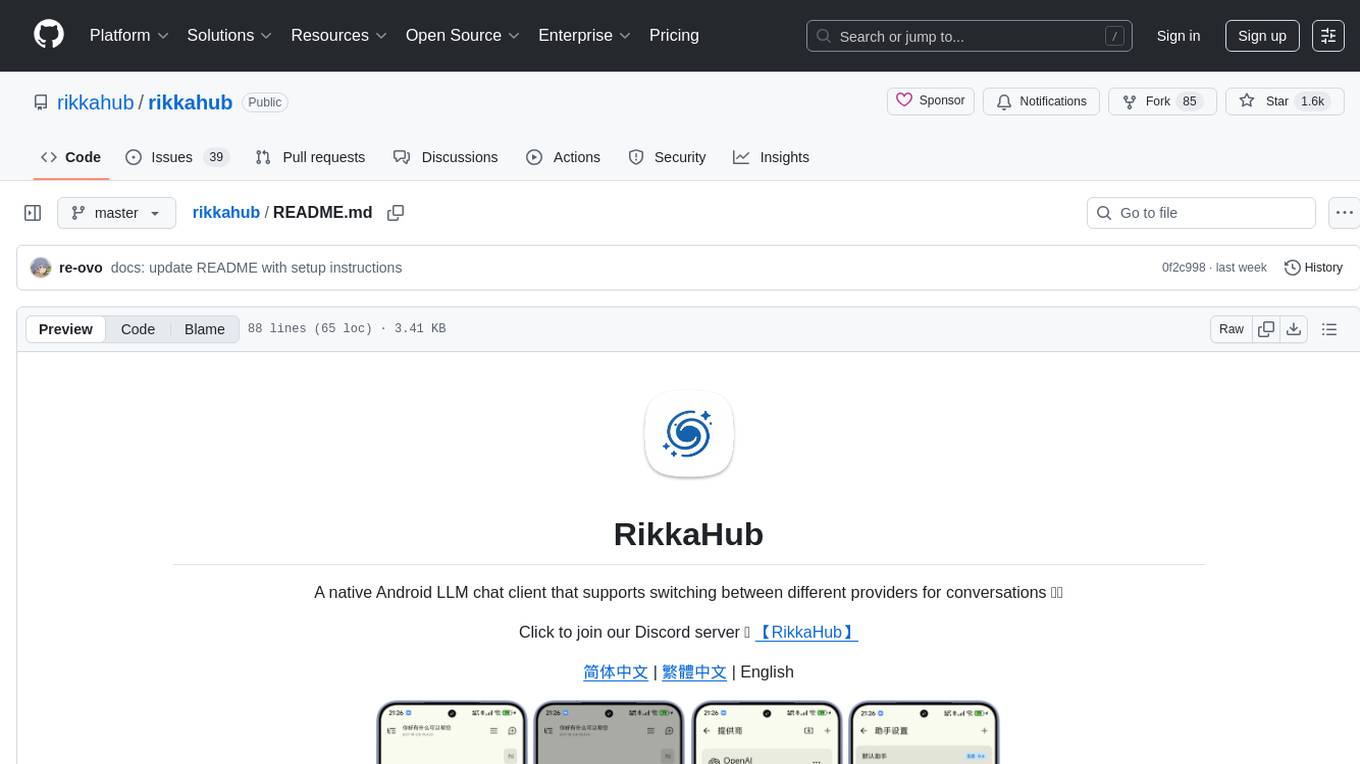
rikkahub
RikkaHub is a native Android LLM chat client that supports switching between different providers for conversations. It features a modern Android app design with dark mode, support for multiple provider types, multimodal input support, Markdown rendering, search capabilities, prompt variables, QR code export/import, agent customization, ChatGPT-like memory feature, AI translation, and custom HTTP request headers and bodies. The project is developed using Kotlin, Koin, Jetpack Compose, DataStore, Room, Coil, Material You, Navigation Compose, Okhttp, kotlinx.serialization, and compose-icons/lucide.
tidb
TiDB is an open-source distributed SQL database that supports Hybrid Transactional and Analytical Processing (HTAP) workloads. It is MySQL compatible and features horizontal scalability, strong consistency, and high availability.

genai-os
Kuwa GenAI OS is an open, free, secure, and privacy-focused Generative-AI Operating System. It provides a multi-lingual turnkey solution for GenAI development and deployment on Linux and Windows. Users can enjoy features such as concurrent multi-chat, quoting, full prompt-list import/export/share, and flexible orchestration of prompts, RAGs, bots, models, and hardware/GPUs. The system supports various environments from virtual hosts to cloud, and it is open source, allowing developers to contribute and customize according to their needs.
SuperCoder
SuperCoder is an open-source autonomous software development system that leverages advanced AI tools and agents to streamline and automate coding, testing, and deployment tasks, enhancing efficiency and reliability. It supports a variety of languages and frameworks for diverse development needs. Users can set up the environment variables, build and run the Go server, Asynq worker, and Postgres using Docker and Docker Compose. The project is under active development and may still have issues, but users can seek help and support from the Discord community or by creating new issues on GitHub.
growi
GROWI is a collaborative wiki platform that allows users to create hierarchical pages with markdown, edit simultaneously with multiple people, and support authentication with LDAP/Active Directory, OAuth, and SAML. It also integrates with Slack/Mattermost, IFTTT, and allows for plugin customization. GROWI is Docker and Docker Compose ready, supports multiple sites, HTTPS with Let's Encrypt proxy integration, and offers migration guides for on-premise installations. The tool is built with Node.js, npm, pnpm, Turborepo, and requires MongoDB, with optional dependencies on Redis and ElasticSearch for full-text search functionality.
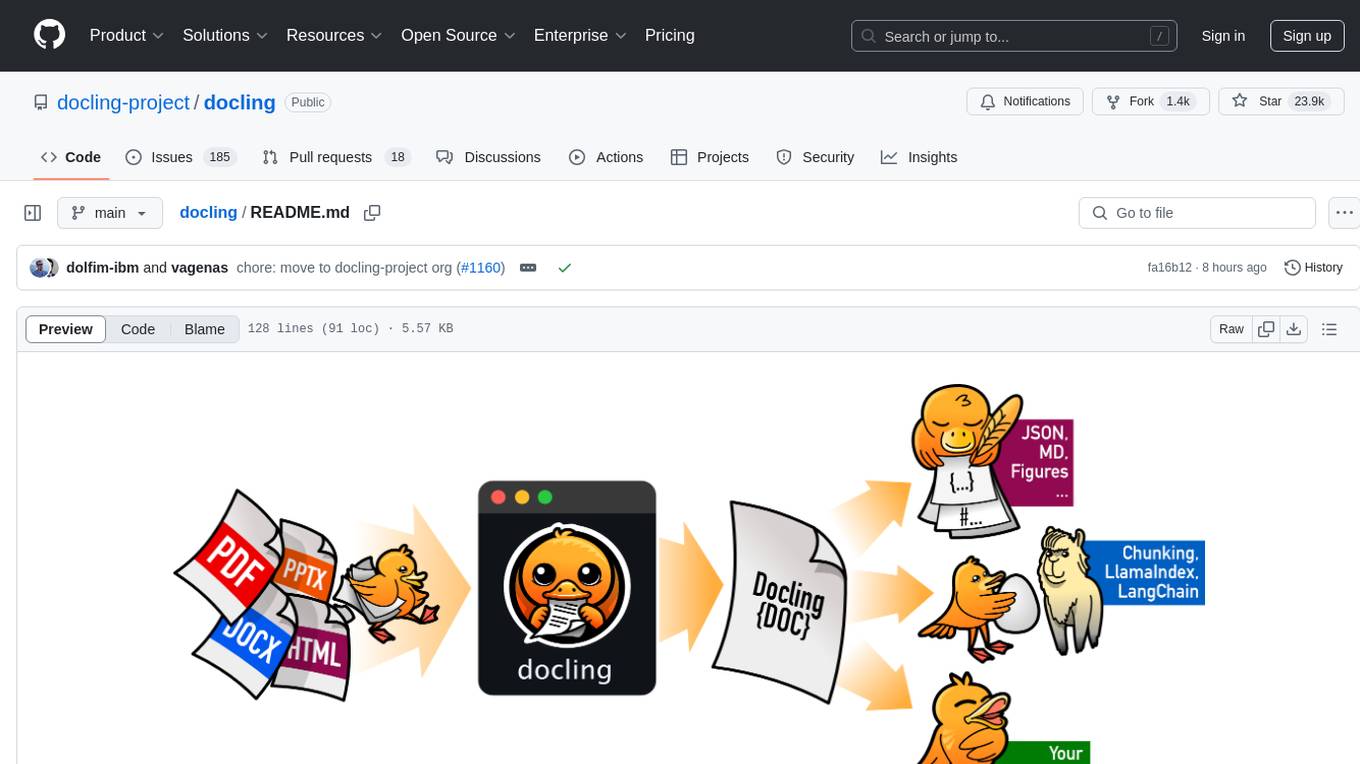
docling
Docling simplifies document processing, parsing diverse formats including advanced PDF understanding, and providing seamless integrations with the general AI ecosystem. It offers features such as parsing multiple document formats, advanced PDF understanding, unified DoclingDocument representation format, various export formats, local execution capabilities, plug-and-play integrations with agentic AI tools, extensive OCR support, and a simple CLI. Coming soon features include metadata extraction, visual language models, chart understanding, and complex chemistry understanding. Docling is installed via pip and works on macOS, Linux, and Windows environments. It provides detailed documentation, examples, integrations with popular frameworks, and support through the discussion section. The codebase is under the MIT license and has been developed by IBM.
archestra
Archestra is an enterprise-grade platform that enables non-technical users to safely leverage AI agents and MCP servers. It provides a secure runtime environment for AI interactions with sandboxing, resource controls, and prompt injection prevention. The platform supports MCP Protocol and is designed with a local-first architecture, enterprise-level security, and extensible tool system.
LMCache
LMCache is a serving engine extension designed to reduce time to first token (TTFT) and increase throughput, particularly in long-context scenarios. It stores key-value caches of reusable texts across different locations like GPU, CPU DRAM, and Local Disk, allowing the reuse of any text in any serving engine instance. By combining LMCache with vLLM, significant delay savings and GPU cycle reduction are achieved in various large language model (LLM) use cases, such as multi-round question answering and retrieval-augmented generation (RAG). LMCache provides integration with the latest vLLM version, offering both online serving and offline inference capabilities. It supports sharing key-value caches across multiple vLLM instances and aims to provide stable support for non-prefix key-value caches along with user and developer documentation.
gpt_mobile
GPT Mobile is a chat assistant for Android that allows users to chat with multiple models at once. It supports various platforms such as OpenAI GPT, Anthropic Claude, and Google Gemini. Users can customize temperature, top p (Nucleus sampling), and system prompt. The app features local chat history, Material You style UI, dark mode support, and per app language setting for Android 13+. It is built using 100% Kotlin, Jetpack Compose, and follows a modern app architecture for Android developers.
complexity
Complexity is a community-driven, open-source, and free third-party extension that enhances the features of Perplexity.ai. It provides various UI/UX/QoL tweaks, LLM/Image gen model selectors, a customizable theme, and a prompts library. The tool intercepts network traffic to alter the behavior of the host page, offering a solution to the limitations of Perplexity.ai. Users can install Complexity from Chrome Web Store, Mozilla Add-on, or build it from the source code.
logto
Logto is a modern, open-source authentication infrastructure designed for SaaS and AI applications. It simplifies OIDC and OAuth 2.1 implementation, enabling secure, production-ready authentication with features like multi-tenancy, enterprise SSO, and RBAC. Logto offers pre-built sign-in flows, customizable UIs, and SDKs for various frameworks, supporting protocols like OIDC, OAuth 2.1, and SAML. It is suitable for teams scaling SaaS, AI, and agent-based platforms without authentication complexities.
For similar tasks
gcloud-aio
This repository contains shared codebase for two projects: gcloud-aio and gcloud-rest. gcloud-aio is built for Python 3's asyncio, while gcloud-rest is a threadsafe requests-based implementation. It provides clients for Google Cloud services like Auth, BigQuery, Datastore, KMS, PubSub, Storage, and Task Queue. Users can install the library using pip and refer to the documentation for usage details. Developers can contribute to the project by following the contribution guide.
airbroke
Airbroke is an open-source error catcher tool designed for modern web applications. It provides a PostgreSQL-based backend with an Airbrake-compatible HTTP collector endpoint and a React-based frontend for error management. The tool focuses on simplicity, maintaining a small database footprint even under heavy data ingestion. Users can ask AI about issues, replay HTTP exceptions, and save/manage bookmarks for important occurrences. Airbroke supports multiple OAuth providers for secure user authentication and offers occurrence charts for better insights into error occurrences. The tool can be deployed in various ways, including building from source, using Docker images, deploying on Vercel, Render.com, Kubernetes with Helm, or Docker Compose. It requires Node.js, PostgreSQL, and specific system resources for deployment.
aiohttp-security
aiohttp_security is a library that provides identity and authorization for aiohttp.web. It offers features for handling authorization via cookies and supports aiohttp-session. The library includes examples for basic usage and database authentication, along with demos in the demo directory. For development, the library requires installation of specific requirements listed in the requirements-dev.txt file. aiohttp_security is licensed under the Apache 2 license.

EvoMaster
EvoMaster is an open-source AI-driven tool that automatically generates system-level test cases for web/enterprise applications. It uses Evolutionary Algorithm and Dynamic Program Analysis to evolve test cases, maximizing code coverage and fault detection. It supports REST, GraphQL, and RPC APIs, with whitebox testing for JVM-compiled APIs. The tool generates JUnit tests in Java or Kotlin, focusing on fault detection, self-contained tests, SQL handling, and authentication. Known limitations include manual driver creation for whitebox testing and longer execution times for better results. EvoMaster has been funded by ERC and RCN grants.
clarifai-python-grpc
This is the official Clarifai gRPC Python client for interacting with their recognition API. Clarifai offers a platform for data scientists, developers, researchers, and enterprises to utilize artificial intelligence for image, video, and text analysis through computer vision and natural language processing. The client allows users to authenticate, predict concepts in images, and access various functionalities provided by the Clarifai API. It follows a versioning scheme that aligns with the backend API updates and includes specific instructions for installation and troubleshooting. Users can explore the Clarifai demo, sign up for an account, and refer to the documentation for detailed information.
GeminiChatUp
Gemini ChatUp is a chat application utilizing the Google GeminiPro API Key. It supports responsive layout and can store multiple sets of conversations with customizable parameters for each set. Users can log in with a test account or provide their own API Key to deploy the feature. The application also offers user authentication through Edge config in Vercel, allowing users to add usernames and passwords in JSON format. Local deployment is possible by installing dependencies, setting up environment variables, and running the application locally.
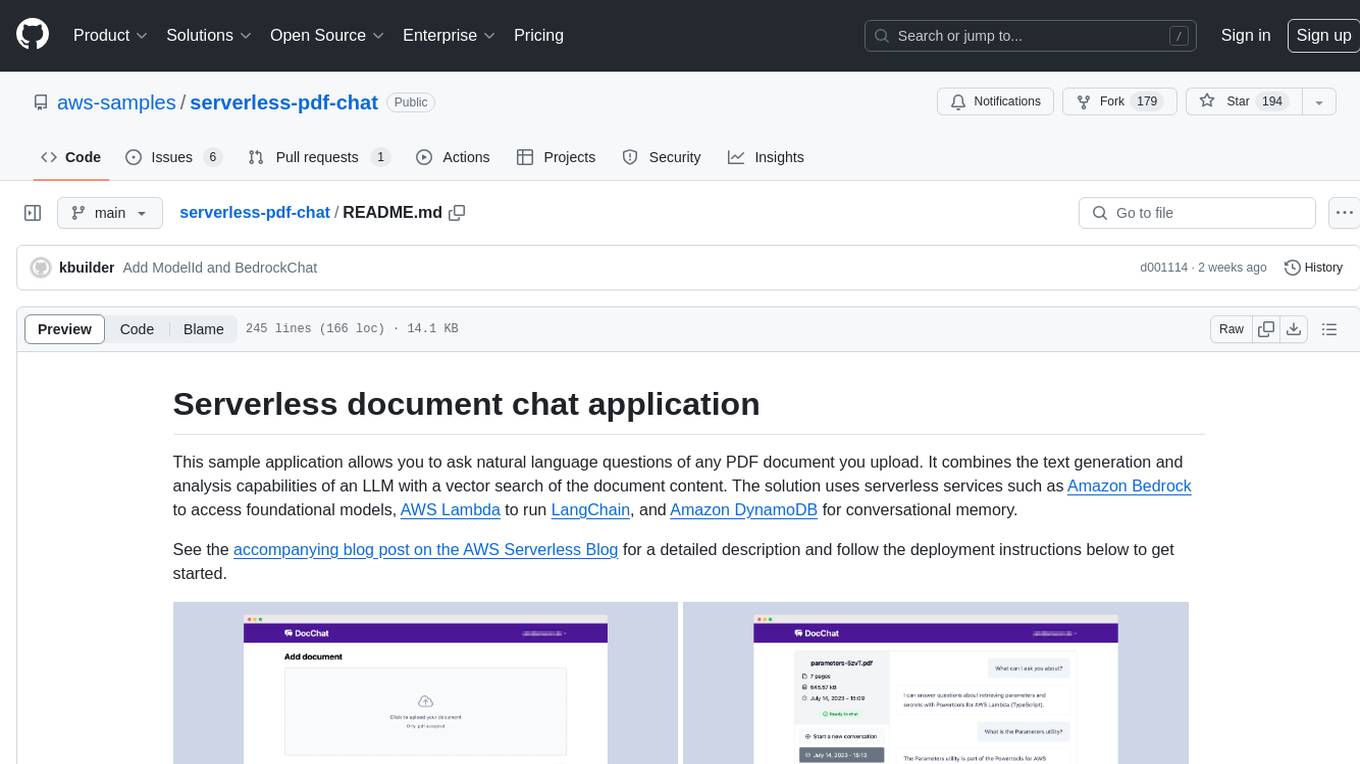
serverless-pdf-chat
The serverless-pdf-chat repository contains a sample application that allows users to ask natural language questions of any PDF document they upload. It leverages serverless services like Amazon Bedrock, AWS Lambda, and Amazon DynamoDB to provide text generation and analysis capabilities. The application architecture involves uploading a PDF document to an S3 bucket, extracting metadata, converting text to vectors, and using a LangChain to search for information related to user prompts. The application is not intended for production use and serves as a demonstration and educational tool.
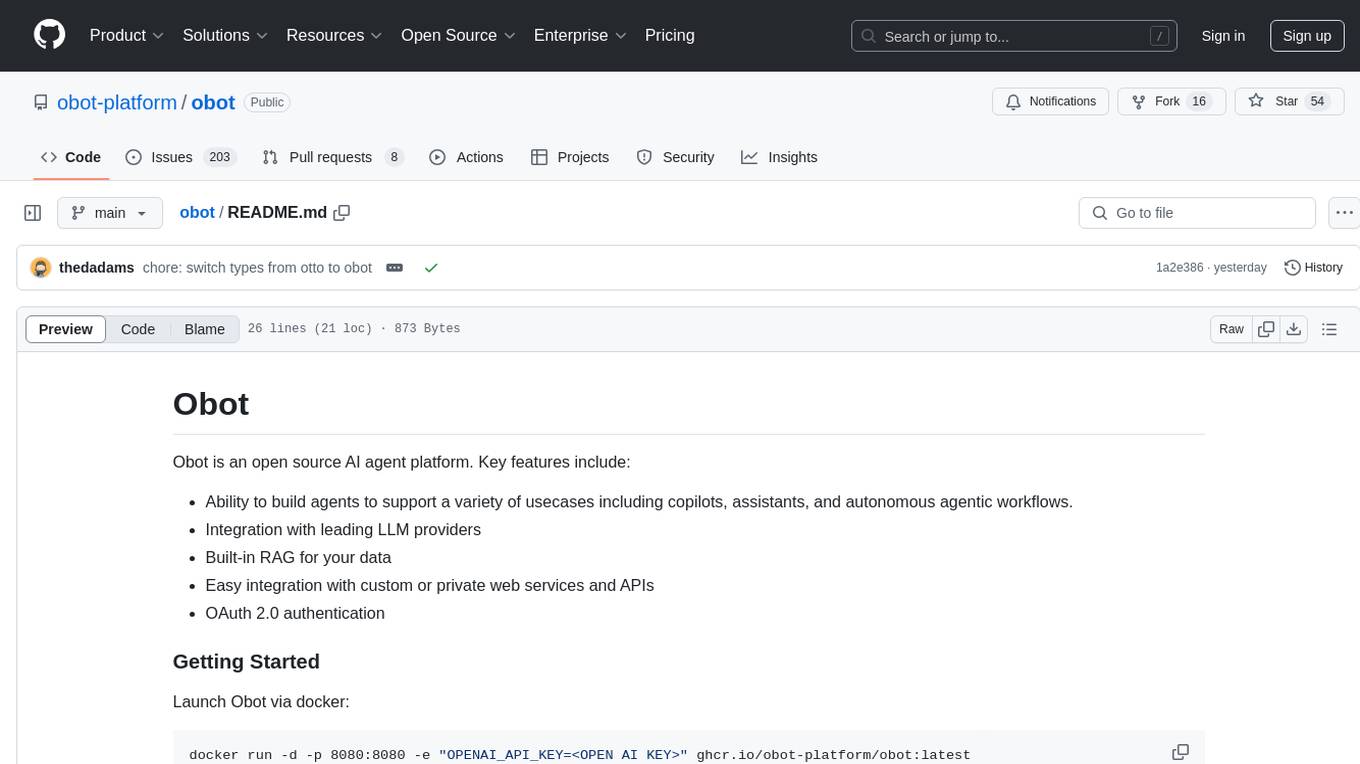
obot
Obot is an open source AI agent platform that allows users to build agents for various use cases such as copilots, assistants, and autonomous workflows. It offers integration with leading LLM providers, built-in RAG for data, easy integration with custom web services and APIs, and OAuth 2.0 authentication.
For similar jobs
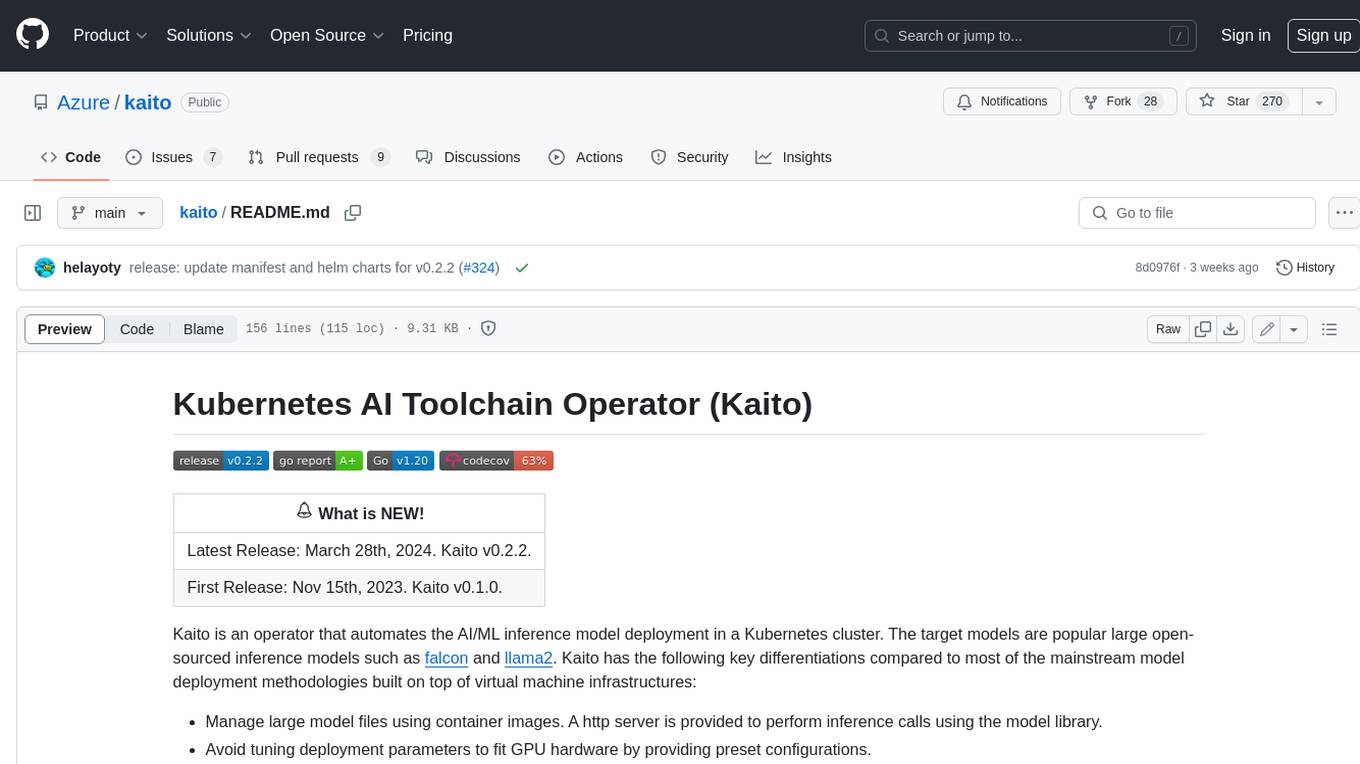
kaito
Kaito is an operator that automates the AI/ML inference model deployment in a Kubernetes cluster. It manages large model files using container images, avoids tuning deployment parameters to fit GPU hardware by providing preset configurations, auto-provisions GPU nodes based on model requirements, and hosts large model images in the public Microsoft Container Registry (MCR) if the license allows. Using Kaito, the workflow of onboarding large AI inference models in Kubernetes is largely simplified.
ai-on-gke
This repository contains assets related to AI/ML workloads on Google Kubernetes Engine (GKE). Run optimized AI/ML workloads with Google Kubernetes Engine (GKE) platform orchestration capabilities. A robust AI/ML platform considers the following layers: Infrastructure orchestration that support GPUs and TPUs for training and serving workloads at scale Flexible integration with distributed computing and data processing frameworks Support for multiple teams on the same infrastructure to maximize utilization of resources
tidb
TiDB is an open-source distributed SQL database that supports Hybrid Transactional and Analytical Processing (HTAP) workloads. It is MySQL compatible and features horizontal scalability, strong consistency, and high availability.
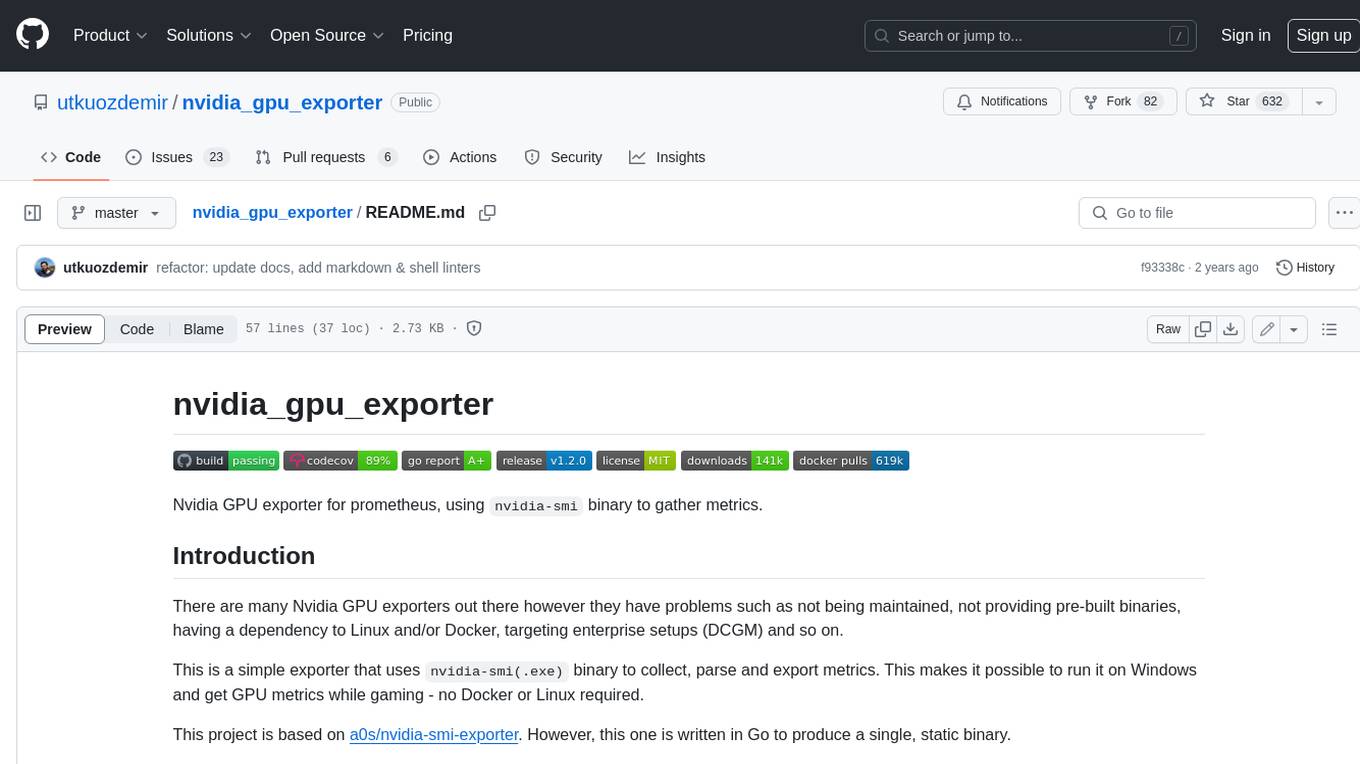
nvidia_gpu_exporter
Nvidia GPU exporter for prometheus, using `nvidia-smi` binary to gather metrics.
tracecat
Tracecat is an open-source automation platform for security teams. It's designed to be simple but powerful, with a focus on AI features and a practitioner-obsessed UI/UX. Tracecat can be used to automate a variety of tasks, including phishing email investigation, evidence collection, and remediation plan generation.
openinference
OpenInference is a set of conventions and plugins that complement OpenTelemetry to enable tracing of AI applications. It provides a way to capture and analyze the performance and behavior of AI models, including their interactions with other components of the application. OpenInference is designed to be language-agnostic and can be used with any OpenTelemetry-compatible backend. It includes a set of instrumentations for popular machine learning SDKs and frameworks, making it easy to add tracing to your AI applications.
BricksLLM
BricksLLM is a cloud native AI gateway written in Go. Currently, it provides native support for OpenAI, Anthropic, Azure OpenAI and vLLM. BricksLLM aims to provide enterprise level infrastructure that can power any LLM production use cases. Here are some use cases for BricksLLM: * Set LLM usage limits for users on different pricing tiers * Track LLM usage on a per user and per organization basis * Block or redact requests containing PIIs * Improve LLM reliability with failovers, retries and caching * Distribute API keys with rate limits and cost limits for internal development/production use cases * Distribute API keys with rate limits and cost limits for students
kong
Kong, or Kong API Gateway, is a cloud-native, platform-agnostic, scalable API Gateway distinguished for its high performance and extensibility via plugins. It also provides advanced AI capabilities with multi-LLM support. By providing functionality for proxying, routing, load balancing, health checking, authentication (and more), Kong serves as the central layer for orchestrating microservices or conventional API traffic with ease. Kong runs natively on Kubernetes thanks to its official Kubernetes Ingress Controller.