


archestra
Secure cloud-native MCP registry, gateway & orchestrator
Stars: 3512
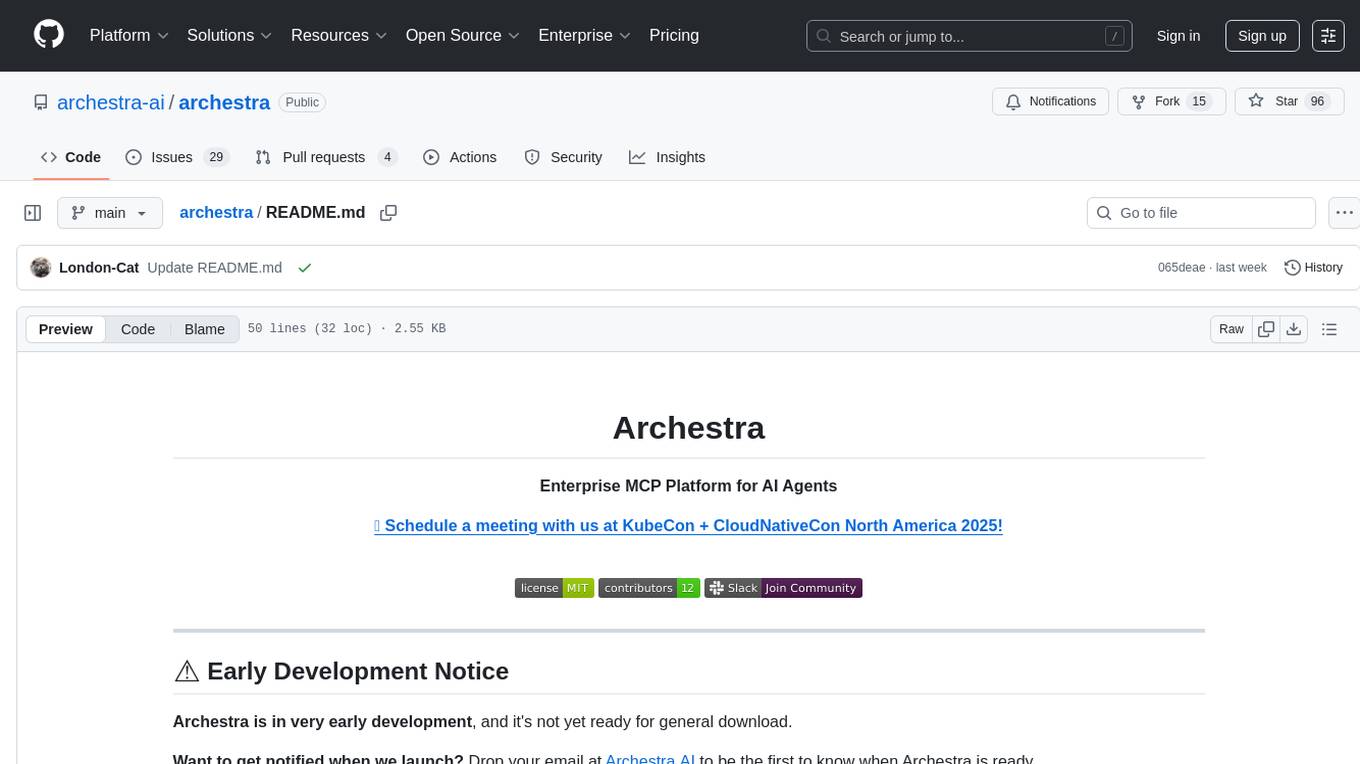
Archestra is an enterprise-grade platform that enables non-technical users to safely leverage AI agents and MCP servers. It provides a secure runtime environment for AI interactions with sandboxing, resource controls, and prompt injection prevention. The platform supports MCP Protocol and is designed with a local-first architecture, enterprise-level security, and extensible tool system.
README:
Simplify AI usage in your company, providing user-friendly MCP toolbox, observability and control built on a strong security foundation.




For Platform teams:
- Mitigate MCP chaos, move MCP servers from individual machines to a centralized orchestrator
- Manage how MCP access data and credentials usage
- Mitigate data exfiltration risks
- Manage AI costs
- AI Observability
For Developers:
- Deploy your MCP servers org-wide
- Build and deploy agents without worrying about security
For Management:
- Bring 1-click MCP adoption to the whole organization for technical and non-technical users
- Reduce AI costs up to 96%
- Get full visibility on AI adoption, usage and data access
docker pull archestra/platform:latest;
docker run -p 9000:9000 -p 3000:3000 \
  -e ARCHESTRA_QUICKSTART=true \
  -v /var/run/docker.sock:/var/run/docker.sock \
  -v archestra-postgres-data:/var/lib/postgresql/data \
  -v archestra-app-data:/app/data \
  archestra/platform;
🎁 with private company-wide prompt registry!

Add MCPs to your private registry to share them with your team: self-hosted and remote, self-built and third-party.
Learn more about Private MCP Registry →

Run MCP servers in kubernetes, managing their state, API keys, OAuth.
Learn more about MCP Orchestrator →

Isolating dangerous tool responses from the main agent to prevent prompt injections.

Models could consume prompt injections via MCP uncontrollably (read your inbox, read your GitHub issues, read your customer's inquiries) and follow them resulting in data exfiltration.
Learn more about Dynamic Tools → | The Lethal Trifecta →
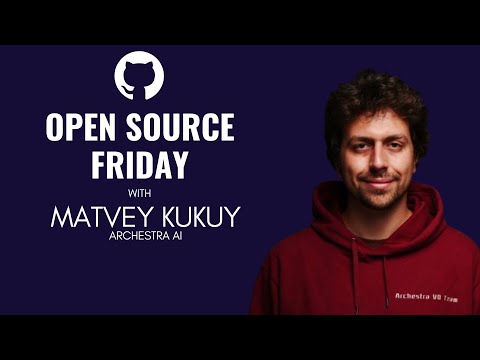
Live demo of archestra security engine preventing data leak from the private GitHub repo to the public repo:
Read more: Simon Willison, The Economist
Examples of hacks: ChatGPT (April 2023), ChatGPT Plugins (May 2023), Google Bard (November 2023), Writer.com (December 2023), Amazon Q (January 2024), Google NotebookLM (April 2024), GitHub Copilot Chat (June 2024), Google AI Studio (August 2024), Microsoft Copilot (August 2024), Slack (August 2024), Mistral Le Chat (October 2024), xAI's Grok (December 2024), Anthropic's Claude iOS app (December 2024), ChatGPT Operator (February 2025), Notion 3.0 (September 2024).
Per-team, per-agent or per-org cost monitoring and limitations. Dynamic optimizer allows to reduce cost up to 96% by simply switching to cheaper models automatically for simpler tasks.
Learn more about Costs & Limits →

Metrics, traces and logs allowing to come to a conclusion about per-org, per-agent and per-team token and tool usage, and performance.
Learn more about Observability →

- ✅ Lightning fast, 45ms at 95p: Performance & Latency benchmarks →
- ✅ Terraform provider →
- ✅ Helm Chart →
We welcome contributions from the community!
Thank you for contributing and continuously making Archestra better, you're awesome 🫶


For Tasks:
Click tags to check more tools for each tasksFor Jobs:
Alternative AI tools for archestra
Similar Open Source Tools
archestra
Archestra is an enterprise-grade platform that enables non-technical users to safely leverage AI agents and MCP servers. It provides a secure runtime environment for AI interactions with sandboxing, resource controls, and prompt injection prevention. The platform supports MCP Protocol and is designed with a local-first architecture, enterprise-level security, and extensible tool system.
pipeshub-ai
Pipeshub-ai is a versatile tool for automating data pipelines in AI projects. It provides a user-friendly interface to design, deploy, and monitor complex data workflows, enabling seamless integration of various AI models and data sources. With Pipeshub-ai, users can easily create end-to-end pipelines for tasks such as data preprocessing, model training, and inference, streamlining the AI development process and improving productivity. The tool supports integration with popular AI frameworks and cloud services, making it suitable for both beginners and experienced AI practitioners.
xpander.ai
xpander.ai is a Backend-as-a-Service for autonomous agents that abstracts the ops layer, allowing AI engineers to focus on behavior and outcomes. It provides managed agent hosting with version control and CI/CD, a fully managed PostgreSQL memory layer, and a library of 2,000+ functions. The platform features an AI native triggering system that processes inputs from various sources and delivers unified messages to agents. With support for any agent framework or SDK, including Agno and OpenAI, xpander.ai enables users to build intelligent, production-ready AI agents without dealing with infrastructure complexity.
sealos
Sealos is a cloud operating system distribution based on the Kubernetes kernel, designed for a seamless development lifecycle. It allows users to spin up full-stack environments in seconds, effortlessly push releases, and scale production seamlessly. With core features like easy application management, quick database creation, and cloud universality, Sealos offers efficient and economical cloud management with high universality and ease of use. The platform also emphasizes agility and security through its multi-tenancy sharing model. Sealos is supported by a community offering full documentation, Discord support, and active development roadmap.
ToolJet
ToolJet is an open-source platform for building and deploying internal tools, workflows, and AI agents. It offers a visual builder with drag-and-drop UI, integrations with databases, APIs, SaaS apps, and object storage. The community edition includes features like a visual app builder, ToolJet database, multi-page apps, collaboration tools, extensibility with plugins, code execution, and security measures. ToolJet AI, the enterprise version, adds AI capabilities for app generation, query building, debugging, agent creation, security compliance, user management, environment management, GitSync, branding, access control, embedded apps, and enterprise support.
agents-towards-production
Agents Towards Production is an open-source playbook for building production-ready GenAI agents that scale from prototype to enterprise. Tutorials cover stateful workflows, vector memory, real-time web search APIs, Docker deployment, FastAPI endpoints, security guardrails, GPU scaling, browser automation, fine-tuning, multi-agent coordination, observability, evaluation, and UI development.

genai-os
Kuwa GenAI OS is an open, free, secure, and privacy-focused Generative-AI Operating System. It provides a multi-lingual turnkey solution for GenAI development and deployment on Linux and Windows. Users can enjoy features such as concurrent multi-chat, quoting, full prompt-list import/export/share, and flexible orchestration of prompts, RAGs, bots, models, and hardware/GPUs. The system supports various environments from virtual hosts to cloud, and it is open source, allowing developers to contribute and customize according to their needs.
tidb
TiDB is an open-source distributed SQL database that supports Hybrid Transactional and Analytical Processing (HTAP) workloads. It is MySQL compatible and features horizontal scalability, strong consistency, and high availability.
SuperCoder
SuperCoder is an open-source autonomous software development system that leverages advanced AI tools and agents to streamline and automate coding, testing, and deployment tasks, enhancing efficiency and reliability. It supports a variety of languages and frameworks for diverse development needs. Users can set up the environment variables, build and run the Go server, Asynq worker, and Postgres using Docker and Docker Compose. The project is under active development and may still have issues, but users can seek help and support from the Discord community or by creating new issues on GitHub.
agentgateway
Agentgateway is an open source data plane optimized for agentic AI connectivity within or across any agent framework or environment. It provides drop-in security, observability, and governance for agent-to-agent and agent-to-tool communication, supporting leading interoperable protocols like Agent2Agent (A2A) and Model Context Protocol (MCP). Highly performant, security-first, multi-tenant, dynamic, and supporting legacy API transformation, agentgateway is designed to handle any scale and run anywhere with any agent framework.
SWE-agent
SWE-agent is a tool that turns language models (e.g. GPT-4) into software engineering agents capable of fixing bugs and issues in real GitHub repositories. It achieves state-of-the-art performance on the full test set by resolving 12.29% of issues. The tool is built and maintained by researchers from Princeton University. SWE-agent provides a command line tool and a graphical web interface for developers to interact with. It introduces an Agent-Computer Interface (ACI) to facilitate browsing, viewing, editing, and executing code files within repositories. The tool includes features such as a linter for syntax checking, a specialized file viewer, and a full-directory string searching command to enhance the agent's capabilities. SWE-agent aims to improve prompt engineering and ACI design to enhance the performance of language models in software engineering tasks.
toolhive-studio
ToolHive Studio is an experimental project under active development and testing, providing an easy way to discover, deploy, and manage Model Context Protocol (MCP) servers securely. Users can launch any MCP server in a locked-down container with just a few clicks, eliminating manual setup, security concerns, and runtime issues. The tool ensures instant deployment, default security measures, cross-platform compatibility, and seamless integration with popular clients like GitHub Copilot, Cursor, and Claude Code.
devopness
Devopness is a tool that simplifies the management of cloud applications and multi-cloud infrastructure for both AI agents and humans. It provides role-based access control, permission management, cost control, and visibility into DevOps and CI/CD workflows. The tool allows provisioning and deployment to major cloud providers like AWS, Azure, DigitalOcean, and GCP. Devopness aims to make software deployment and cloud infrastructure management accessible and affordable to all involved in software projects.
MaxKB
MaxKB is a knowledge base Q&A system based on the LLM large language model. MaxKB = Max Knowledge Base, which aims to become the most powerful brain of the enterprise.
xpert
Xpert is a powerful tool for data analysis and visualization. It provides a user-friendly interface to explore and manipulate datasets, perform statistical analysis, and create insightful visualizations. With Xpert, users can easily import data from various sources, clean and preprocess data, analyze trends and patterns, and generate interactive charts and graphs. Whether you are a data scientist, analyst, researcher, or student, Xpert simplifies the process of data analysis and visualization, making it accessible to users with varying levels of expertise.
kalavai-client
Kalavai is an open-source platform that transforms everyday devices into an AI supercomputer by aggregating resources from multiple machines. It facilitates matchmaking of resources for large AI projects, making AI hardware accessible and affordable. Users can create local and public pools, connect with the community's resources, and share computing power. The platform aims to be a management layer for research groups and organizations, enabling users to unlock the power of existing hardware without needing a devops team. Kalavai CLI tool helps manage both versions of the platform.
For similar tasks
archestra
Archestra is an enterprise-grade platform that enables non-technical users to safely leverage AI agents and MCP servers. It provides a secure runtime environment for AI interactions with sandboxing, resource controls, and prompt injection prevention. The platform supports MCP Protocol and is designed with a local-first architecture, enterprise-level security, and extensible tool system.
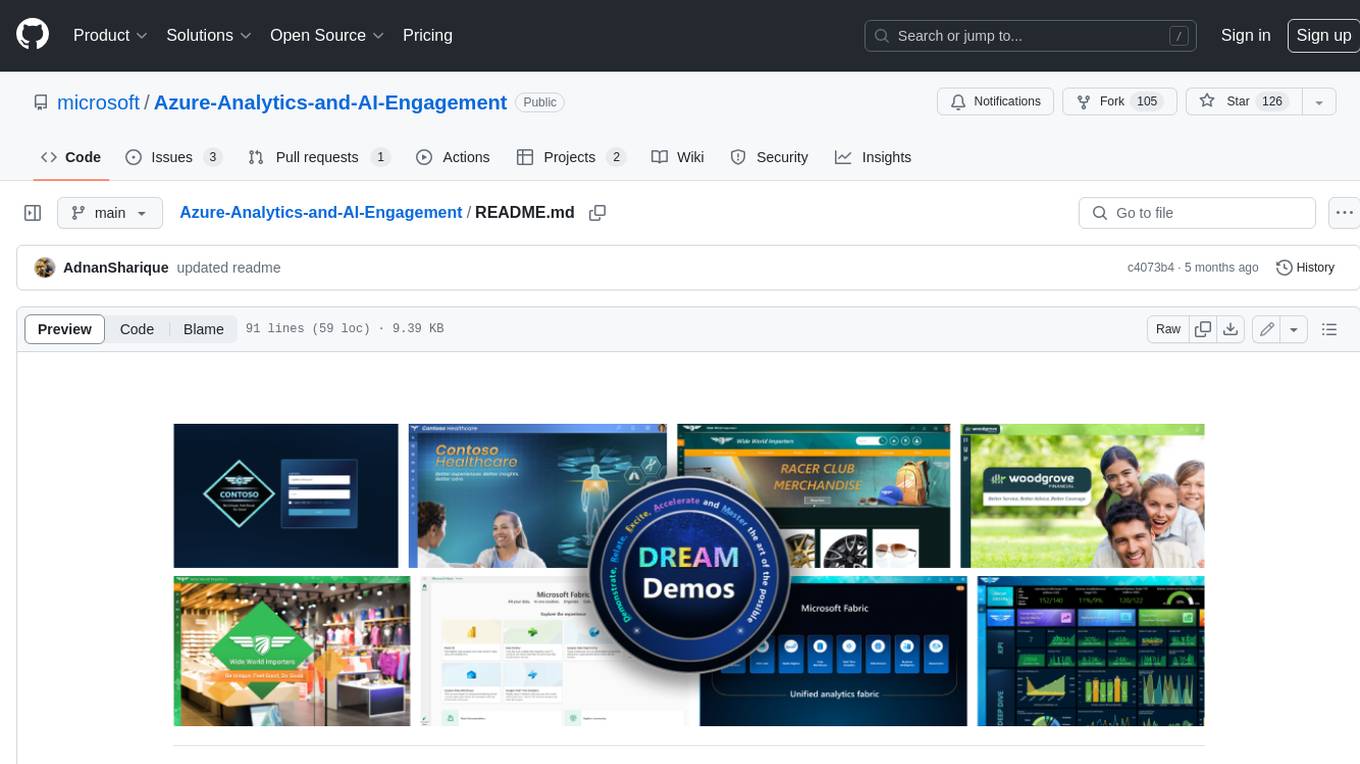
Azure-Analytics-and-AI-Engagement
The Azure-Analytics-and-AI-Engagement repository provides packaged Industry Scenario DREAM Demos with ARM templates (Containing a demo web application, Power BI reports, Synapse resources, AML Notebooks etc.) that can be deployed in a customer’s subscription using the CAPE tool within a matter of few hours. Partners can also deploy DREAM Demos in their own subscriptions using DPoC.
sorrentum
Sorrentum is an open-source project that aims to combine open-source development, startups, and brilliant students to build machine learning, AI, and Web3 / DeFi protocols geared towards finance and economics. The project provides opportunities for internships, research assistantships, and development grants, as well as the chance to work on cutting-edge problems, learn about startups, write academic papers, and get internships and full-time positions at companies working on Sorrentum applications.
tidb
TiDB is an open-source distributed SQL database that supports Hybrid Transactional and Analytical Processing (HTAP) workloads. It is MySQL compatible and features horizontal scalability, strong consistency, and high availability.

zep-python
Zep is an open-source platform for building and deploying large language model (LLM) applications. It provides a suite of tools and services that make it easy to integrate LLMs into your applications, including chat history memory, embedding, vector search, and data enrichment. Zep is designed to be scalable, reliable, and easy to use, making it a great choice for developers who want to build LLM-powered applications quickly and easily.
telemetry-airflow
This repository codifies the Airflow cluster that is deployed at workflow.telemetry.mozilla.org (behind SSO) and commonly referred to as "WTMO" or simply "Airflow". Some links relevant to users and developers of WTMO: * The `dags` directory in this repository contains some custom DAG definitions * Many of the DAGs registered with WTMO don't live in this repository, but are instead generated from ETL task definitions in bigquery-etl * The Data SRE team maintains a WTMO Developer Guide (behind SSO)
mojo
Mojo is a new programming language that bridges the gap between research and production by combining Python syntax and ecosystem with systems programming and metaprogramming features. Mojo is still young, but it is designed to become a superset of Python over time.
pandas-ai
PandasAI is a Python library that makes it easy to ask questions to your data in natural language. It helps you to explore, clean, and analyze your data using generative AI.
For similar jobs
sweep
Sweep is an AI junior developer that turns bugs and feature requests into code changes. It automatically handles developer experience improvements like adding type hints and improving test coverage.
teams-ai
The Teams AI Library is a software development kit (SDK) that helps developers create bots that can interact with Teams and Microsoft 365 applications. It is built on top of the Bot Framework SDK and simplifies the process of developing bots that interact with Teams' artificial intelligence capabilities. The SDK is available for JavaScript/TypeScript, .NET, and Python.
ai-guide
This guide is dedicated to Large Language Models (LLMs) that you can run on your home computer. It assumes your PC is a lower-end, non-gaming setup.
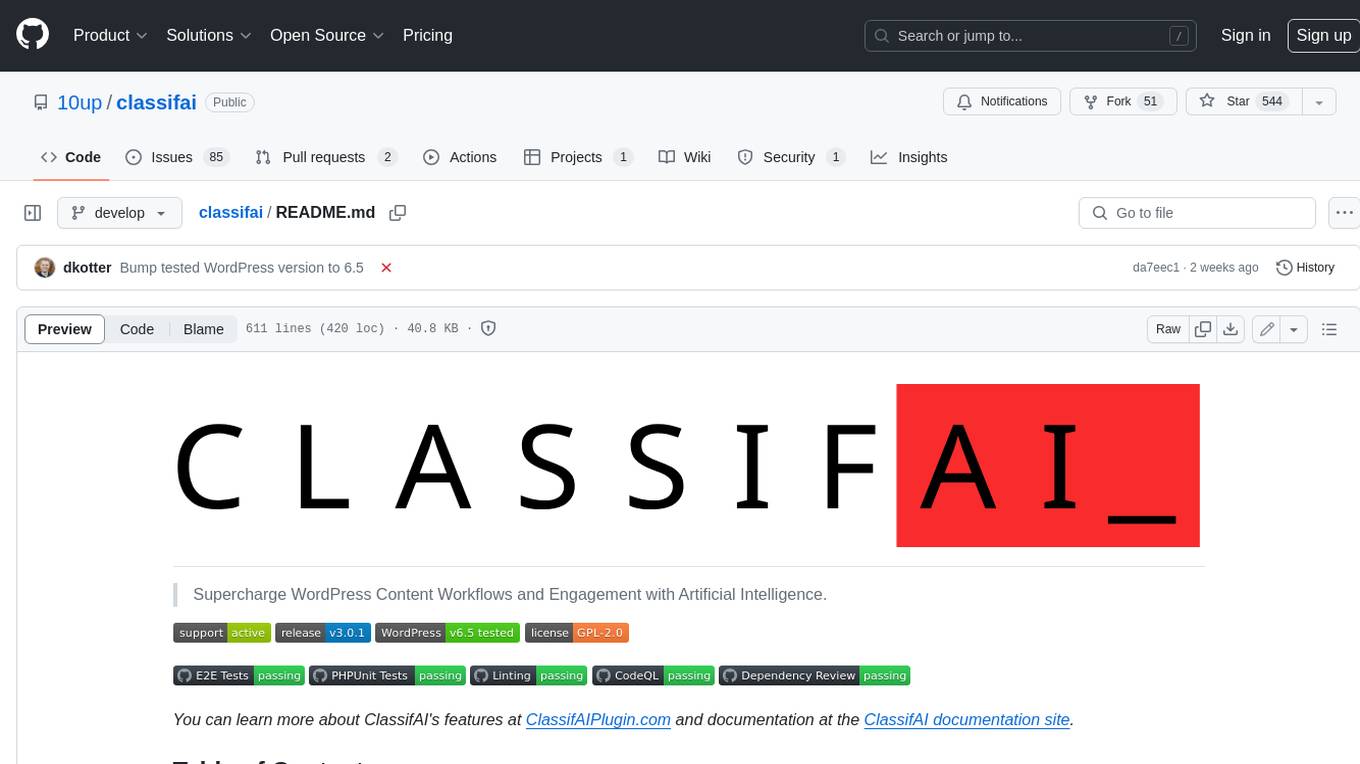
classifai
Supercharge WordPress Content Workflows and Engagement with Artificial Intelligence. Tap into leading cloud-based services like OpenAI, Microsoft Azure AI, Google Gemini and IBM Watson to augment your WordPress-powered websites. Publish content faster while improving SEO performance and increasing audience engagement. ClassifAI integrates Artificial Intelligence and Machine Learning technologies to lighten your workload and eliminate tedious tasks, giving you more time to create original content that matters.
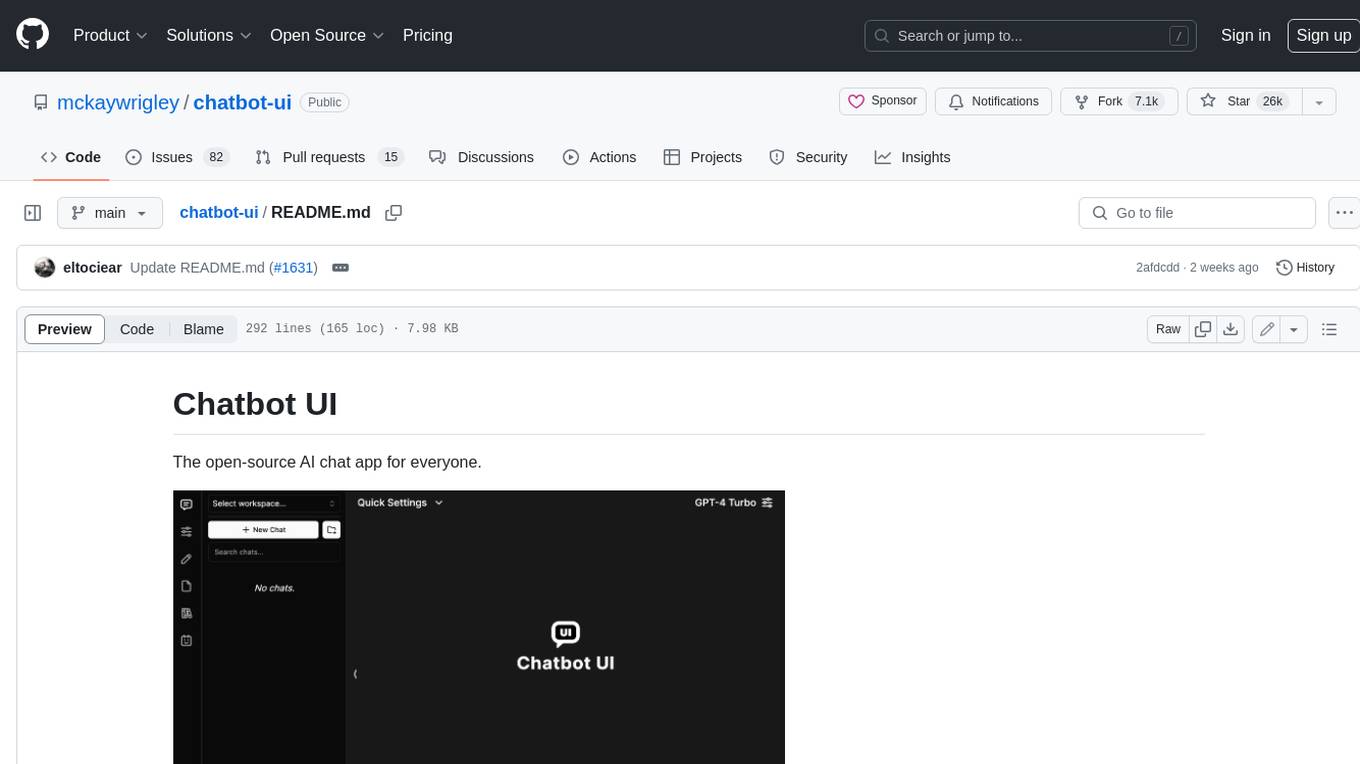
chatbot-ui
Chatbot UI is an open-source AI chat app that allows users to create and deploy their own AI chatbots. It is easy to use and can be customized to fit any need. Chatbot UI is perfect for businesses, developers, and anyone who wants to create a chatbot.
BricksLLM
BricksLLM is a cloud native AI gateway written in Go. Currently, it provides native support for OpenAI, Anthropic, Azure OpenAI and vLLM. BricksLLM aims to provide enterprise level infrastructure that can power any LLM production use cases. Here are some use cases for BricksLLM: * Set LLM usage limits for users on different pricing tiers * Track LLM usage on a per user and per organization basis * Block or redact requests containing PIIs * Improve LLM reliability with failovers, retries and caching * Distribute API keys with rate limits and cost limits for internal development/production use cases * Distribute API keys with rate limits and cost limits for students
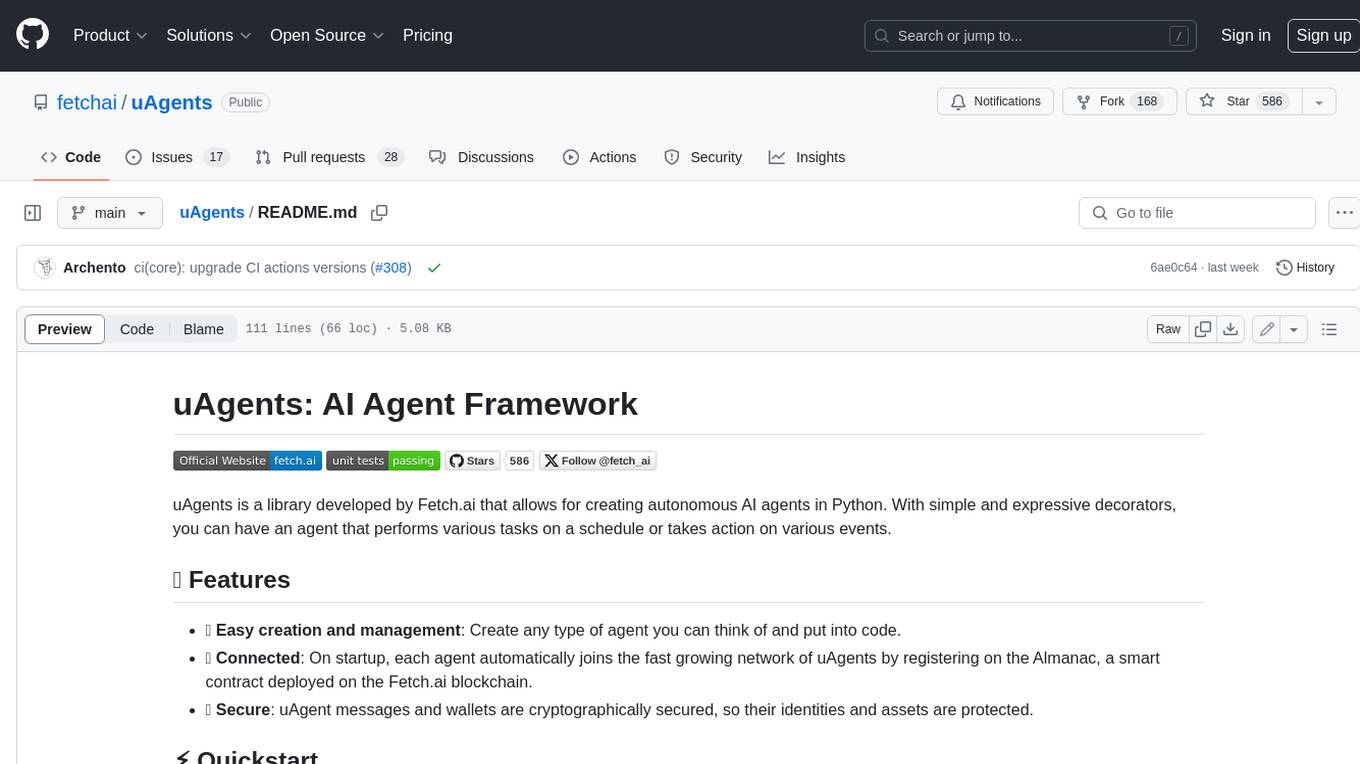
uAgents
uAgents is a Python library developed by Fetch.ai that allows for the creation of autonomous AI agents. These agents can perform various tasks on a schedule or take action on various events. uAgents are easy to create and manage, and they are connected to a fast-growing network of other uAgents. They are also secure, with cryptographically secured messages and wallets.
griptape
Griptape is a modular Python framework for building AI-powered applications that securely connect to your enterprise data and APIs. It offers developers the ability to maintain control and flexibility at every step. Griptape's core components include Structures (Agents, Pipelines, and Workflows), Tasks, Tools, Memory (Conversation Memory, Task Memory, and Meta Memory), Drivers (Prompt and Embedding Drivers, Vector Store Drivers, Image Generation Drivers, Image Query Drivers, SQL Drivers, Web Scraper Drivers, and Conversation Memory Drivers), Engines (Query Engines, Extraction Engines, Summary Engines, Image Generation Engines, and Image Query Engines), and additional components (Rulesets, Loaders, Artifacts, Chunkers, and Tokenizers). Griptape enables developers to create AI-powered applications with ease and efficiency.