


sample-ai-powered-sdlc-patterns-with-aws
This repo contains AI-powered software development patterns showing how to integrate generative AI in different stages of software development lifecycle using Amazon Q Developer, Amazon Q Business and Amazon Bedrock. This collection of patterns demonstrates practical approaches for leveraging AWS's generative AI capabilities across the software dev
Stars: 57
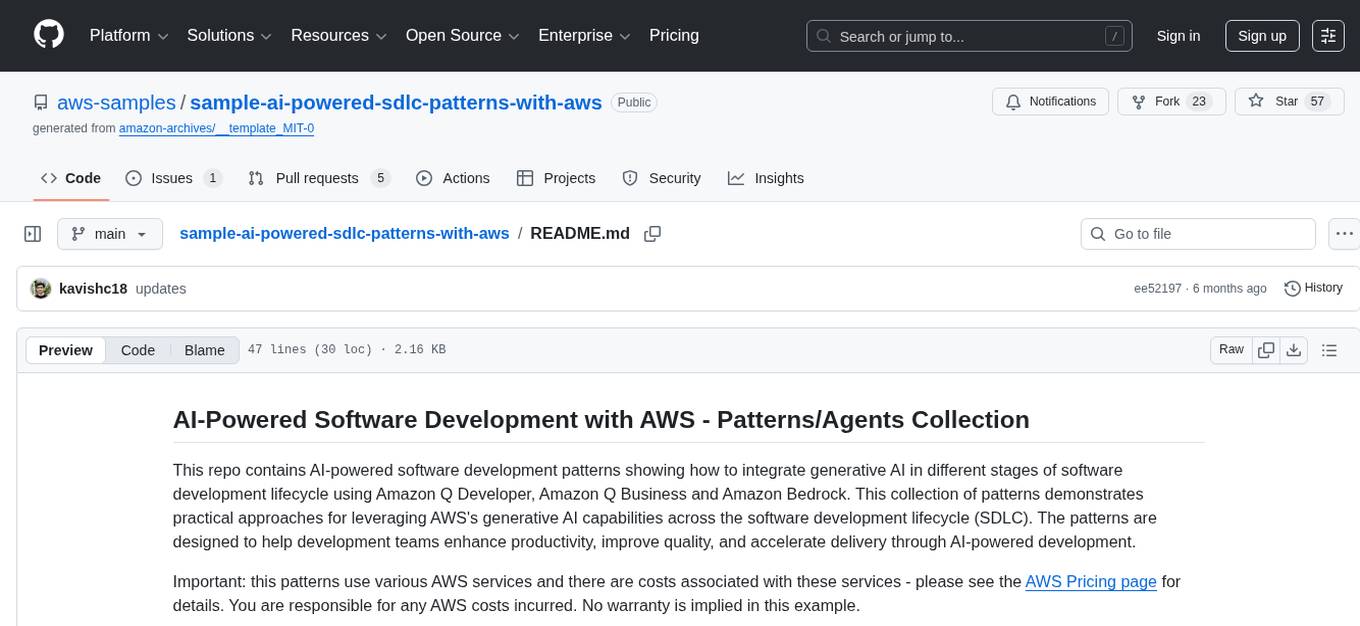
This repository showcases AI-powered software development patterns that demonstrate how to integrate generative AI in different stages of the software development lifecycle using Amazon Q Developer, Amazon Q Business, and Amazon Bedrock. The patterns aim to enhance productivity, improve quality, and accelerate delivery through AI-powered development. Users can explore practical approaches for leveraging AWS's generative AI capabilities across various SDLC phases, such as Requirement & Planning, Design & Architecture, Implementation, Testing, Deployment, and Operation & Maintenance. Please note that the patterns use various AWS services, and users are responsible for any associated costs.
README:
This repo contains AI-powered software development patterns showing how to integrate generative AI in different stages of software development lifecycle using Amazon Q Developer, Amazon Q Business and Amazon Bedrock. This collection of patterns demonstrates practical approaches for leveraging AWS's generative AI capabilities across the software development lifecycle (SDLC). The patterns are designed to help development teams enhance productivity, improve quality, and accelerate delivery through AI-powered development.
Important: this patterns use various AWS services and there are costs associated with these services - please see the AWS Pricing page for details. You are responsible for any AWS costs incurred. No warranty is implied in this example.
Amazon Q Developer Amazon Q Business Amazon Bedrock
-
Create an AWS account if you do not already have one and login.
-
Install Git on your local machine.
-
Create a new directory and navigate to that directory in a terminal.
-
Clone this repo.
git clone https://github.com/aws-samples/sample-ai-powered-sdlc-patterns-with-aws
Each subdirectory contains additional installation and usage instructions.
This repository organizes patterns by SDLC phases.
- Requirement & Planning
- Design & Architecture
- Implementation
- Testing
- Deployment
- Operation & Maintenance
See CONTRIBUTING for more information.
This library is licensed under the MIT-0 License. See the LICENSE file.
The sample code is provided without any guarantees, and you're not recommended to use it for production-grade workloads. The intention is to provide content to build and learn. Be sure of reading the licensing terms.
For Tasks:
Click tags to check more tools for each tasksFor Jobs:
Alternative AI tools for sample-ai-powered-sdlc-patterns-with-aws
Similar Open Source Tools
sample-ai-powered-sdlc-patterns-with-aws
This repository showcases AI-powered software development patterns that demonstrate how to integrate generative AI in different stages of the software development lifecycle using Amazon Q Developer, Amazon Q Business, and Amazon Bedrock. The patterns aim to enhance productivity, improve quality, and accelerate delivery through AI-powered development. Users can explore practical approaches for leveraging AWS's generative AI capabilities across various SDLC phases, such as Requirement & Planning, Design & Architecture, Implementation, Testing, Deployment, and Operation & Maintenance. Please note that the patterns use various AWS services, and users are responsible for any associated costs.
Build-Modern-AI-Apps
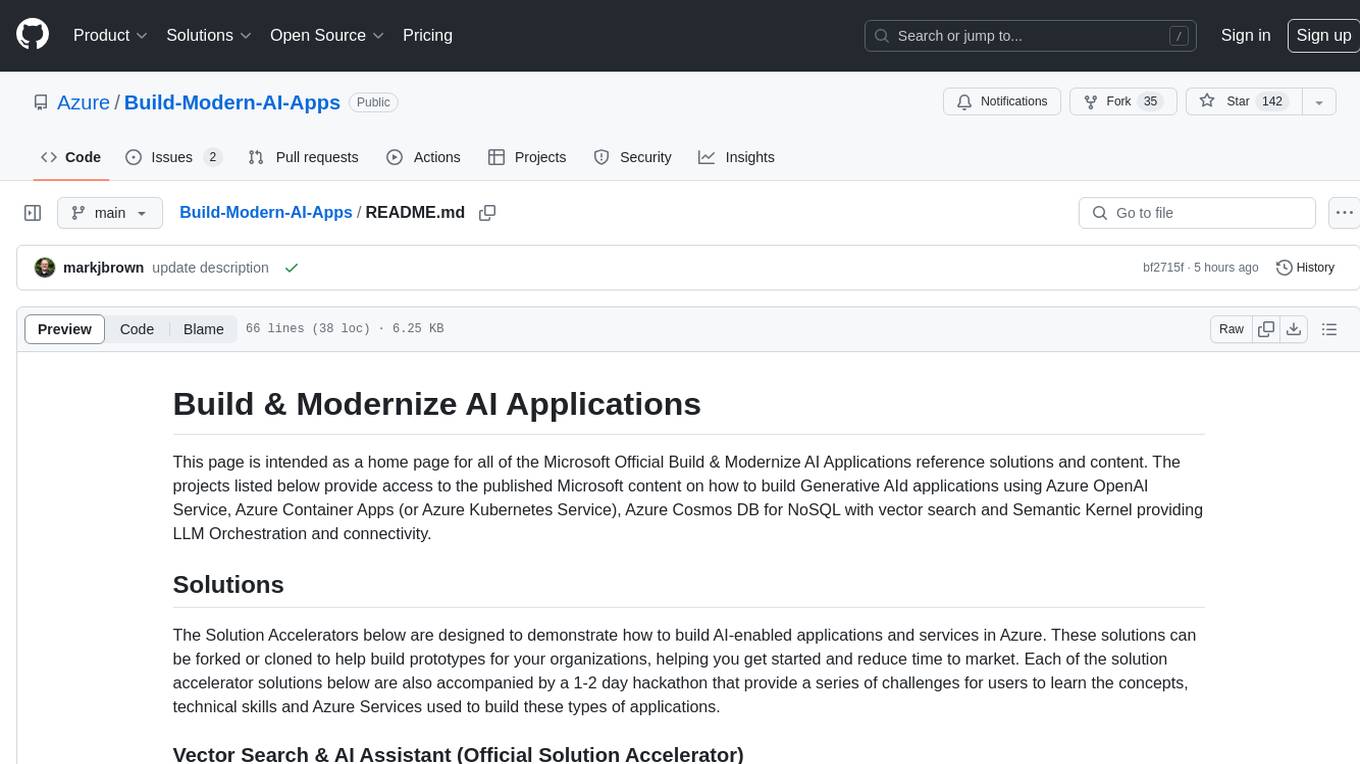
This repository serves as a hub for Microsoft Official Build & Modernize AI Applications reference solutions and content. It provides access to projects demonstrating how to build Generative AI applications using Azure services like Azure OpenAI, Azure Container Apps, Azure Kubernetes, and Azure Cosmos DB. The solutions include Vector Search & AI Assistant, Real-Time Payment and Transaction Processing, and Medical Claims Processing. Additionally, there are workshops like the Intelligent App Workshop for Microsoft Copilot Stack, focusing on infusing intelligence into traditional software systems using foundation models and design thinking.
DevOpsGPT
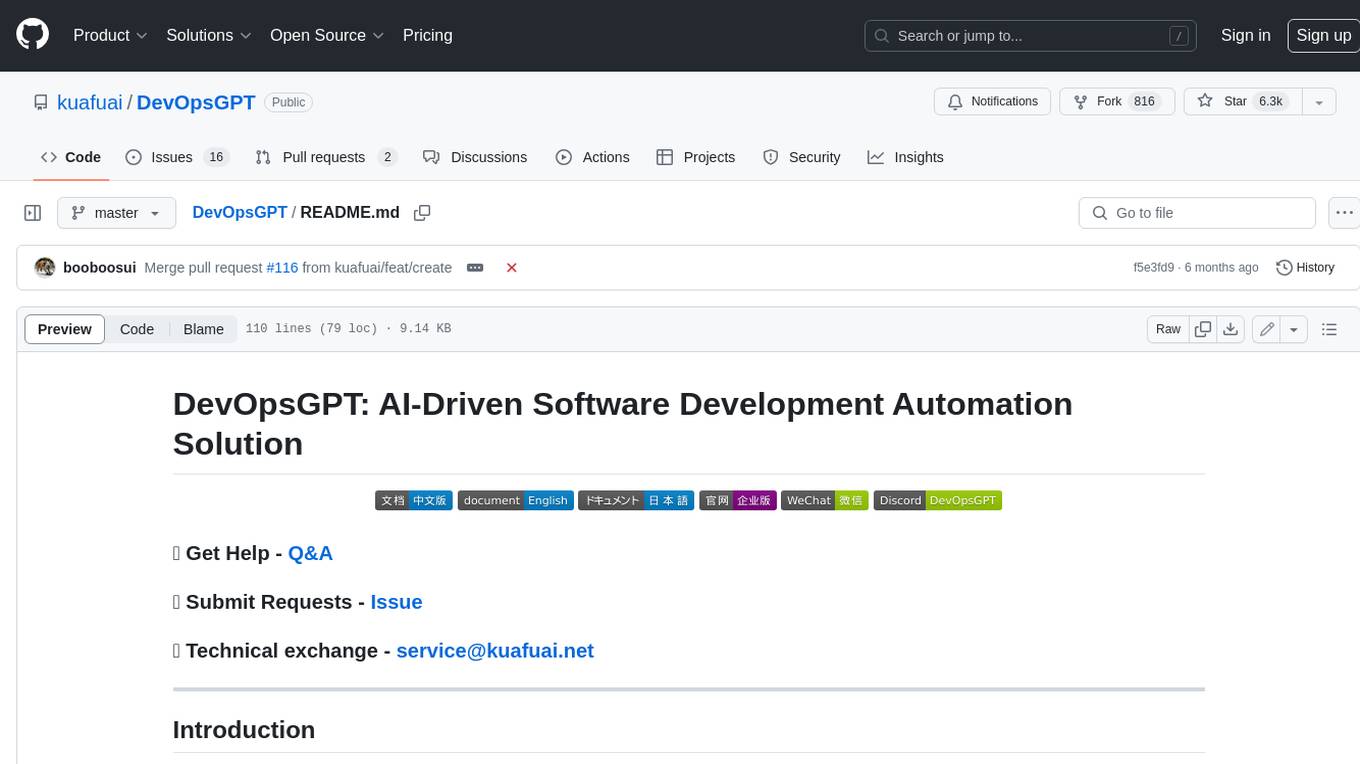
DevOpsGPT is an AI-driven software development automation solution that combines Large Language Models (LLM) with DevOps tools to convert natural language requirements into working software. It improves development efficiency by eliminating the need for tedious requirement documentation, shortens development cycles, reduces communication costs, and ensures high-quality deliverables. The Enterprise Edition offers features like existing project analysis, professional model selection, and support for more DevOps platforms. The tool automates requirement development, generates interface documentation, provides pseudocode based on existing projects, facilitates code refinement, enables continuous integration, and supports software version release. Users can run DevOpsGPT with source code or Docker, and the tool comes with limitations in precise documentation generation and understanding existing project code. The product roadmap includes accurate requirement decomposition, rapid import of development requirements, and integration of more software engineering and professional tools for efficient software development tasks under AI planning and execution.
intelligent-app-workshop
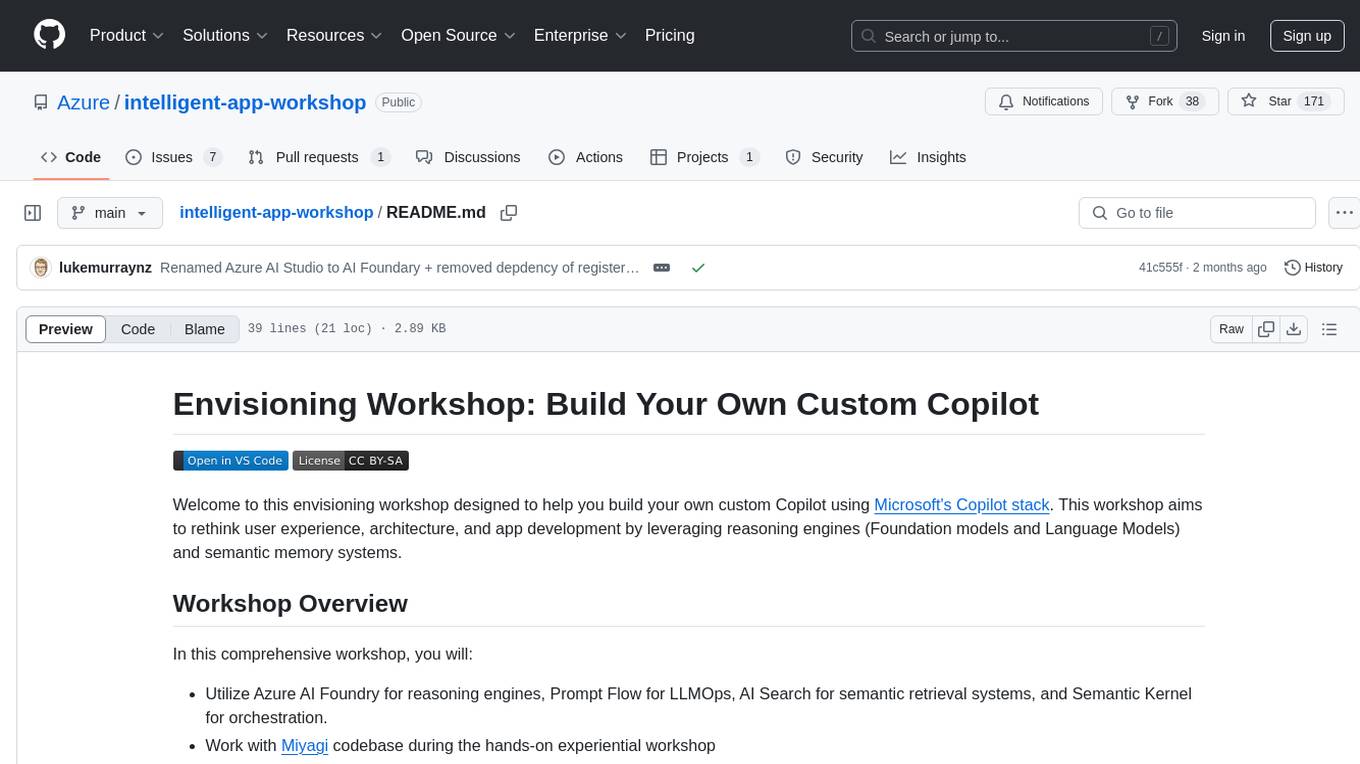
Welcome to the envisioning workshop designed to help you build your own custom Copilot using Microsoft's Copilot stack. This workshop aims to rethink user experience, architecture, and app development by leveraging reasoning engines and semantic memory systems. You will utilize Azure AI Foundry, Prompt Flow, AI Search, and Semantic Kernel. Work with Miyagi codebase, explore advanced capabilities like AutoGen and GraphRag. This workshop guides you through the entire lifecycle of app development, including identifying user needs, developing a production-grade app, and deploying on Azure with advanced capabilities. By the end, you will have a deeper understanding of leveraging Microsoft's tools to create intelligent applications.
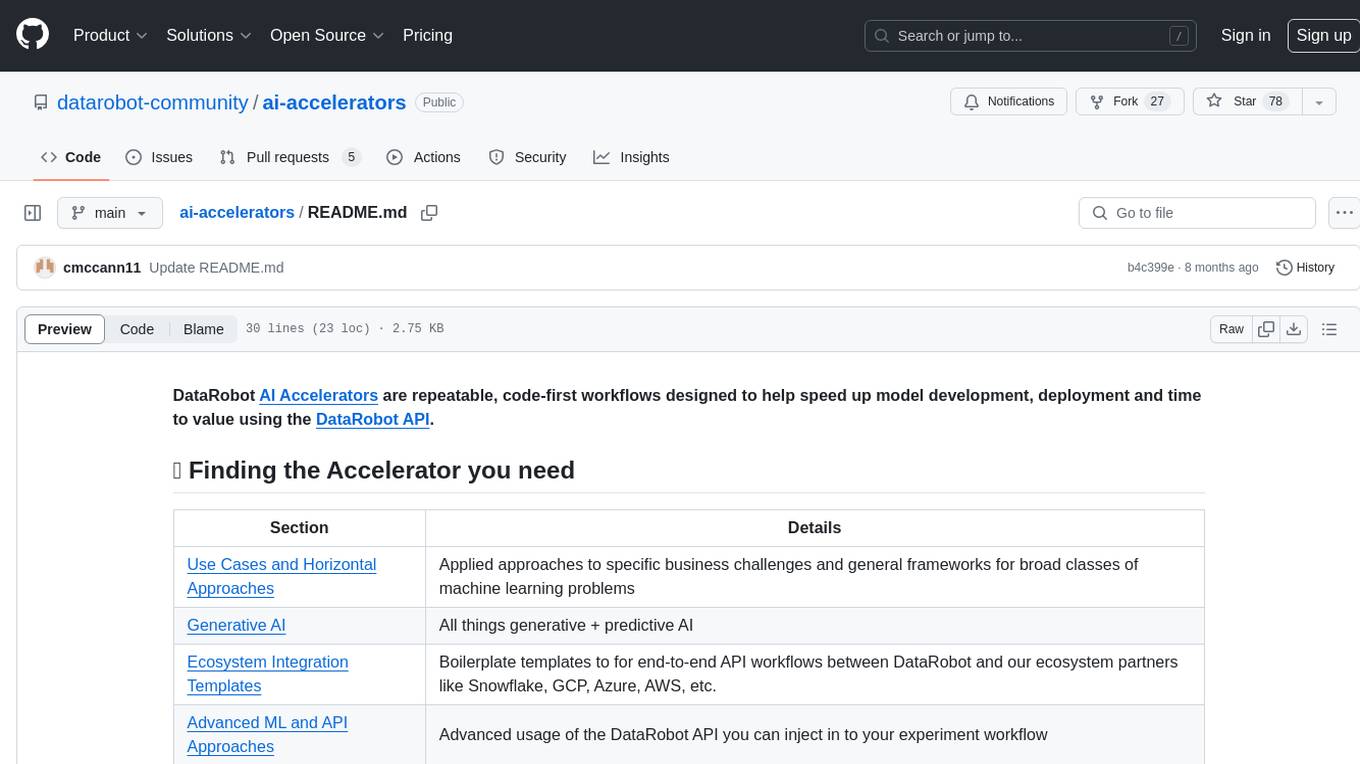
ai-accelerators
DataRobot AI Accelerators are code-first workflows to speed up model development, deployment, and time to value using the DataRobot API. The accelerators include approaches for specific business challenges, generative AI, ecosystem integration templates, and advanced ML and API usage. Users can clone the repo, import desired accelerators into notebooks, execute them, learn and modify content to solve their own problems.
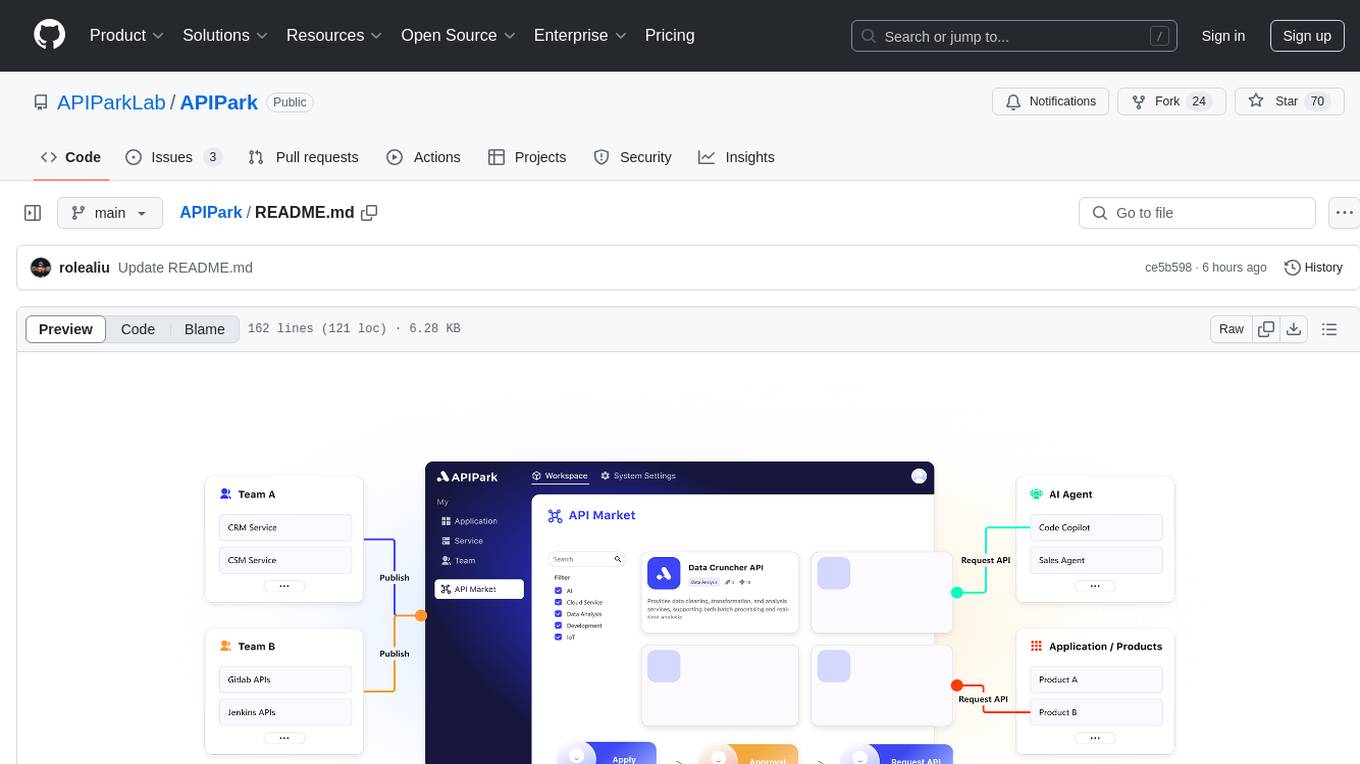
APIPark
APIPark is an open-source AI Gateway and Developer Portal that enables users to easily manage, integrate, and deploy AI and API services. It provides robust API management features, including creation, monitoring, and access control, to help developers efficiently and securely develop and manage their APIs. The platform aims to solve challenges such as connecting to powerful AI models, managing complex AI & API call relationships, overseeing API creation and security, simplifying fault detection and troubleshooting, and enhancing the visibility and valuation of data assets.
OpenAIWorkshop
Azure OpenAI Service provides REST API access to OpenAI's powerful language models including GPT-3, Codex and Embeddings. Users can easily adapt models for content generation, summarization, semantic search, and natural language to code translation. The workshop covers basics, prompt engineering, common NLP tasks, generative tasks, conversational dialog, and learning methods. It guides users to build applications with PowerApp, query SQL data, create data pipelines, and work with proprietary datasets. Target audience includes Power Users, Software Engineers, Data Scientists, and AI architects and Managers.
oci-data-science-ai-samples
The Oracle Cloud Infrastructure Data Science and AI services Examples repository provides demos, tutorials, and code examples showcasing various features of the OCI Data Science service and AI services. It offers tools for data scientists to develop and deploy machine learning models efficiently, with features like Accelerated Data Science SDK, distributed training, batch processing, and machine learning pipelines. Whether you're a beginner or an experienced practitioner, OCI Data Science Services provide the resources needed to build, train, and deploy models easily.
aily-blockly
Aily Blockly is a blockly IDE under the Aily Project, providing AI-assisted programming capabilities for non-professional users. It aims to integrate numerous AI capabilities to help hardware developers develop more smoothly, ultimately achieving natural language programming. The software offers features like Engineering Project Management, Library Manager, Serial Debug Tool, AI Project Generation, AI Code Generation, AI Library Conversion, Development Board Configuration Generation, and Lightning Compilation Tool. It is currently in the alpha stage, suitable for prototype verification and educational teaching.
SuperKnowa
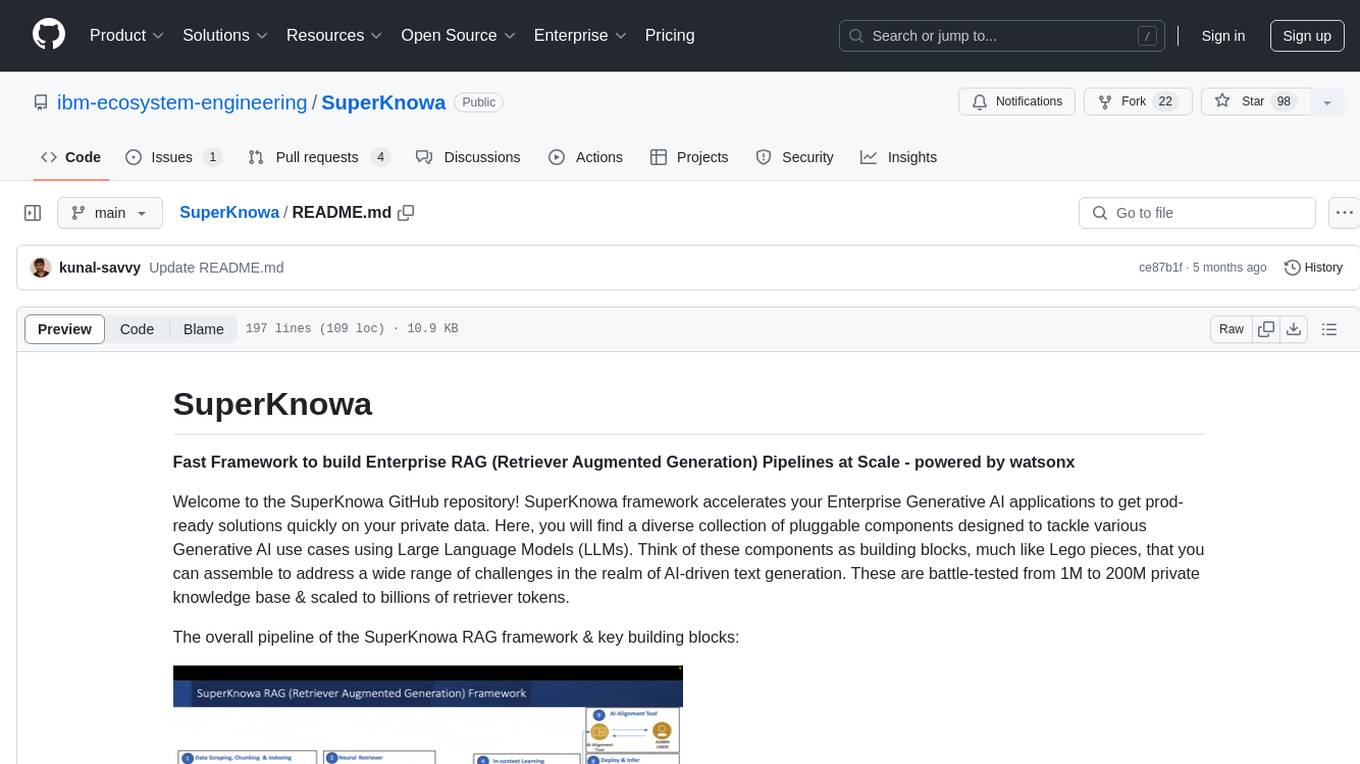
SuperKnowa is a fast framework to build Enterprise RAG (Retriever Augmented Generation) Pipelines at Scale, powered by watsonx. It accelerates Enterprise Generative AI applications to get prod-ready solutions quickly on private data. The framework provides pluggable components for tackling various Generative AI use cases using Large Language Models (LLMs), allowing users to assemble building blocks to address challenges in AI-driven text generation. SuperKnowa is battle-tested from 1M to 200M private knowledge base & scaled to billions of retriever tokens.
interaqt
Interaqt is a project that aims to separate application business logic from its specific implementation by providing a structured data model and tools to automatically decide and implement software architecture. It liberates individuals and teams from implementation specifics, performance requirements, and cost demands, allowing them to focus on articulating business logic. The approach is considered optimal in the era of large language models (LLMs) as it eliminates uncertainty in generated systems and enables independence from engineering involvement unless specific capabilities are required.
yao
YAO is an open-source application engine written in Golang, suitable for developing business systems, website/APP API, admin panel, and self-built low-code platforms. It adopts a flow-based programming model to implement functions by writing YAO DSL or using JavaScript. Yao allows developers to create web services by processes, creating a database model, writing API services, and describing dashboard interfaces just by JSON for web & hardware, and 10x productivity. It is based on the flow-based programming idea, developed in Go language, and supports multiple ways to expand the data stream processor. Yao has a built-in data management system, making it suitable for quickly making various management backgrounds, CRM, ERP, and other internal enterprise systems. It is highly versatile, efficient, and performs better than PHP, JAVA, and other languages.
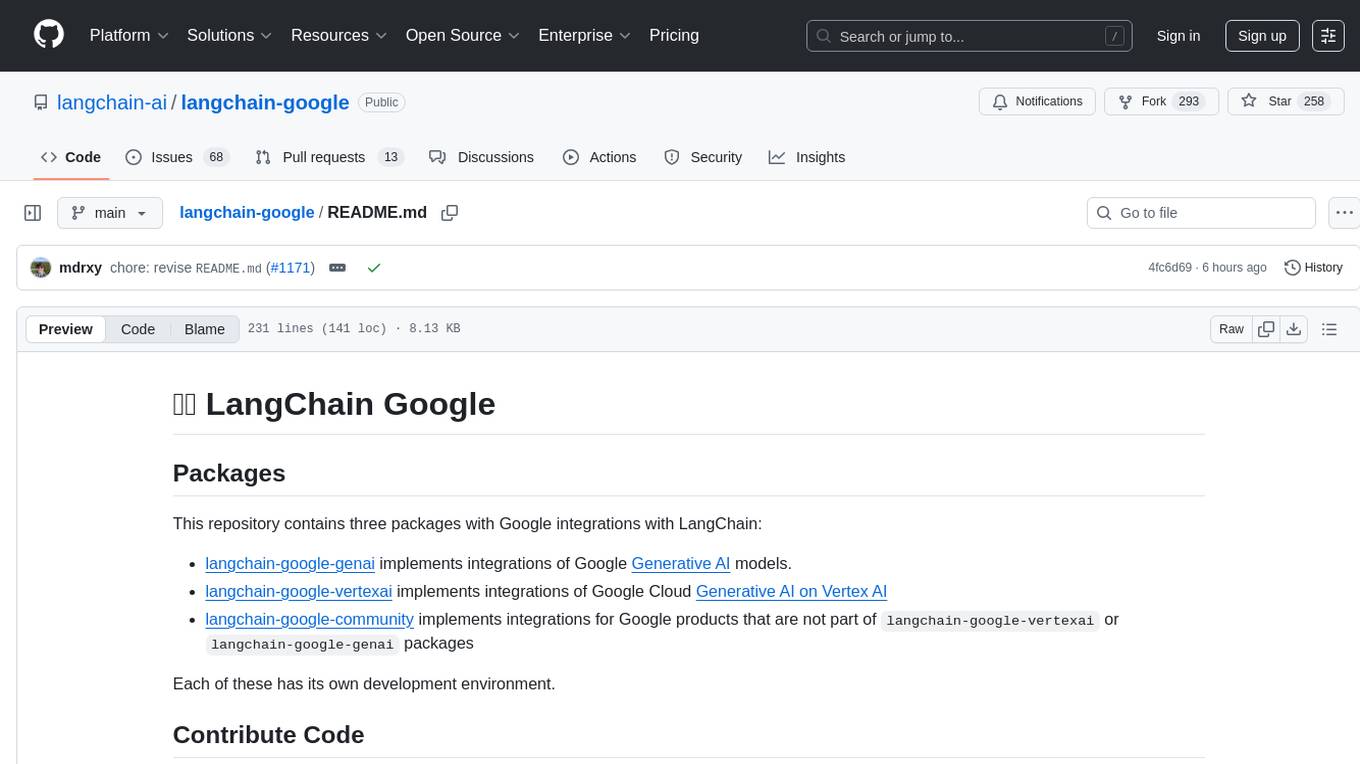
langchain-google
LangChain Google is a repository containing three packages with Google integrations: langchain-google-genai for Google Generative AI models, langchain-google-vertexai for Google Cloud Generative AI on Vertex AI, and langchain-google-community for other Google product integrations. The repository is organized as a monorepo with a structure including libs for different packages, and files like pyproject.toml and Makefile for building, linting, and testing. It provides guidelines for contributing, local development dependencies installation, formatting, linting, working with optional dependencies, and testing with unit and integration tests. The focus is on maintaining unit test coverage and avoiding excessive integration tests, with annotations for GCP infrastructure-dependent tests.
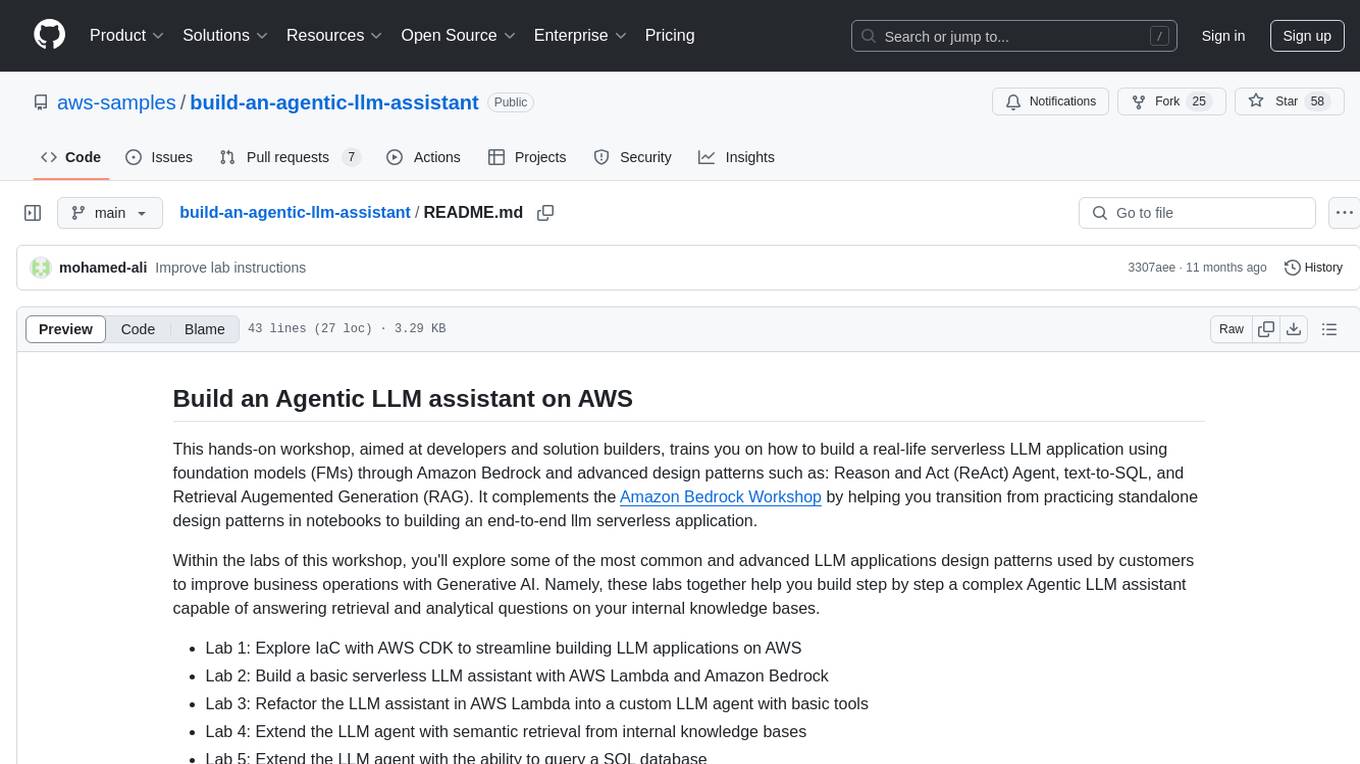
build-an-agentic-llm-assistant
This repository provides a hands-on workshop for developers and solution builders to build a real-life serverless LLM application using foundation models (FMs) through Amazon Bedrock and advanced design patterns such as Reason and Act (ReAct) Agent, text-to-SQL, and Retrieval Augmented Generation (RAG). It guides users through labs to explore common and advanced LLM application design patterns, helping them build a complex Agentic LLM assistant capable of answering retrieval and analytical questions on internal knowledge bases. The repository includes labs on IaC with AWS CDK, building serverless LLM assistants with AWS Lambda and Amazon Bedrock, refactoring LLM assistants into custom agents, extending agents with semantic retrieval, and querying SQL databases. Users need to set up AWS Cloud9, configure model access on Amazon Bedrock, and use Amazon SageMaker Studio environment to run data-pipelines notebooks.
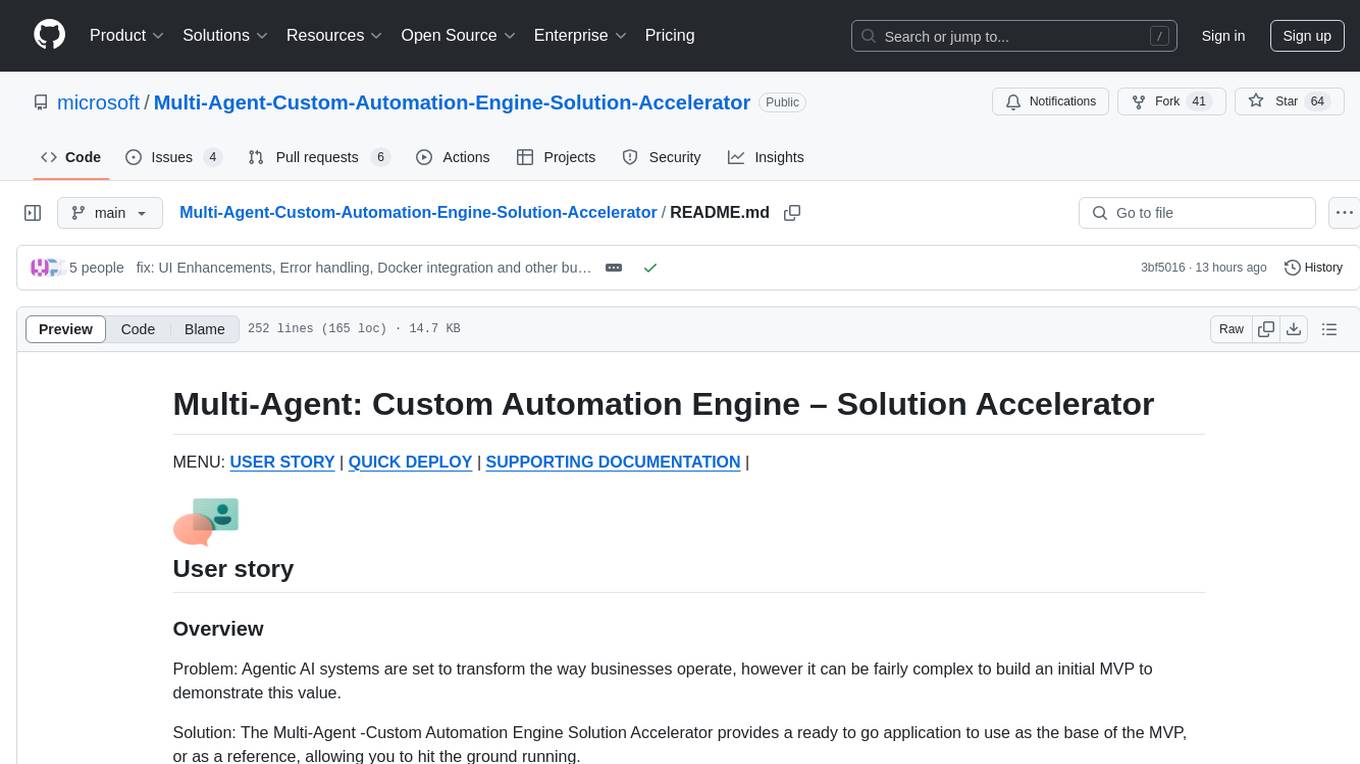
Multi-Agent-Custom-Automation-Engine-Solution-Accelerator
The Multi-Agent -Custom Automation Engine Solution Accelerator is an AI-driven orchestration system that manages a group of AI agents to accomplish tasks based on user input. It uses a FastAPI backend to handle HTTP requests, processes them through various specialized agents, and stores stateful information using Azure Cosmos DB. The system allows users to focus on what matters by coordinating activities across an organization, enabling GenAI to scale, and is applicable to most industries. It is intended for developing and deploying custom AI solutions for specific customers, providing a foundation to accelerate building out multi-agent systems.
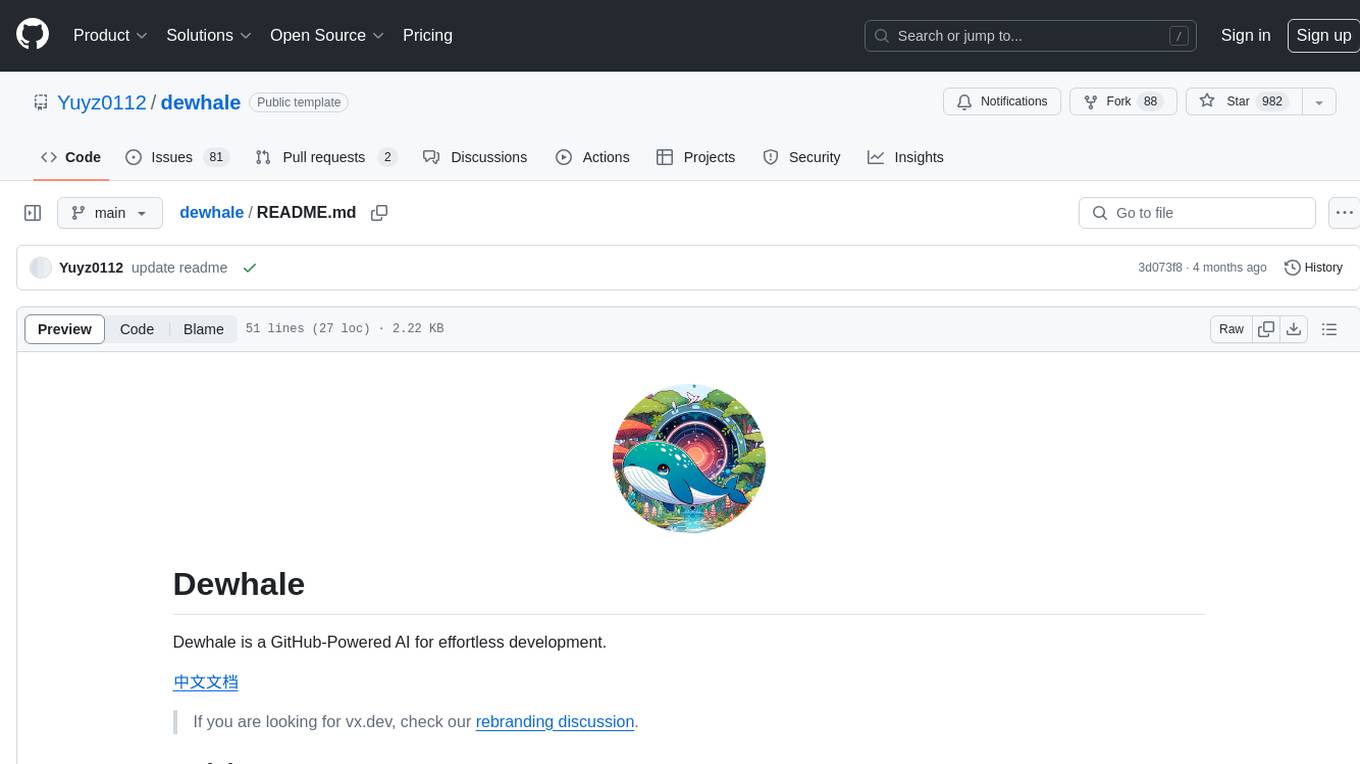
dewhale
Dewhale is a GitHub-Powered AI tool designed for effortless development. It utilizes prompt engineering techniques under the GPT-4 model to issue commands, allowing users to generate code with lower usage costs and easy customization. The tool seamlessly integrates with GitHub, providing version control, code review, and collaborative features. Users can join discussions on the design philosophy of Dewhale and explore detailed instructions and examples for setting up and using the tool.
For similar tasks
db2rest
DB2Rest is a modern low code REST DATA API platform that enables the rapid development of intelligent applications by combining databases, language models, and vector stores. It facilitates context-aware, reasoning applications without vendor lock-in. The tool accelerates application delivery, fosters faster innovation with AI, serves as a secure database gateway, and simplifies integration. It supports various databases like PostgreSQL, MySQL, MS SQL Server, Oracle, MongoDB, and more, with planned support for additional databases. Users can connect on Discord for support and contact [email protected] for inquiries.
sample-ai-powered-sdlc-patterns-with-aws
This repository showcases AI-powered software development patterns that demonstrate how to integrate generative AI in different stages of the software development lifecycle using Amazon Q Developer, Amazon Q Business, and Amazon Bedrock. The patterns aim to enhance productivity, improve quality, and accelerate delivery through AI-powered development. Users can explore practical approaches for leveraging AWS's generative AI capabilities across various SDLC phases, such as Requirement & Planning, Design & Architecture, Implementation, Testing, Deployment, and Operation & Maintenance. Please note that the patterns use various AWS services, and users are responsible for any associated costs.
devchat
DevChat is an open-source workflow engine that enables developers to create intelligent, automated workflows for engaging with users through a chat panel within their IDEs. It combines script writing flexibility, latest AI models, and an intuitive chat GUI to enhance user experience and productivity. DevChat simplifies the integration of AI in software development, unlocking new possibilities for developers.
lowcode-vscode
This repository is a low-code tool that supports ChatGPT and other LLM models. It provides functionalities such as OCR translation, generating specified format JSON, translating Chinese to camel case, translating current directory to English, and quickly creating code templates. Users can also generate CURD operations for managing backend list pages. The tool allows users to select templates, initialize query form configurations using OCR, initialize table configurations using OCR, translate Chinese fields using ChatGPT, and generate code without writing a single line. It aims to enhance productivity by simplifying code generation and development processes.
AI-Prompt-Genius
AI Prompt Genius is a Chrome extension that allows you to curate a custom library of AI prompts. It is built using React web app and Tailwind CSS with DaisyUI components. The extension enables users to create and manage AI prompts for various purposes. It provides a user-friendly interface for organizing and accessing AI prompts efficiently. AI Prompt Genius is designed to enhance productivity and creativity by offering a personalized collection of prompts tailored to individual needs. Users can easily install the extension from the Chrome Web Store and start using it to generate AI prompts for different tasks.
second-brain-agent
The Second Brain AI Agent Project is a tool designed to empower personal knowledge management by automatically indexing markdown files and links, providing a smart search engine powered by OpenAI, integrating seamlessly with different note-taking methods, and enhancing productivity by accessing information efficiently. The system is built on LangChain framework and ChromaDB vector store, utilizing a pipeline to process markdown files and extract text and links for indexing. It employs a Retrieval-augmented generation (RAG) process to provide context for asking questions to the large language model. The tool is beneficial for professionals, students, researchers, and creatives looking to streamline workflows, improve study sessions, delve deep into research, and organize thoughts and ideas effortlessly.
AI-scripts
AI-scripts is a repository containing various AI scripts used for daily tasks. It includes tools like 'holefill' for filling code snippets in VIM, 'aiemu' for emulation purposes, and 'chatsh [model]' for terminal-based ChatGPT functionality. The repository aims to streamline AI-related workflows and enhance productivity by providing convenient scripts for common tasks.
magic-cli
Magic CLI is a command line utility that leverages Large Language Models (LLMs) to enhance command line efficiency. It is inspired by projects like Amazon Q and GitHub Copilot for CLI. The tool allows users to suggest commands, search across command history, and generate commands for specific tasks using local or remote LLM providers. Magic CLI also provides configuration options for LLM selection and response generation. The project is still in early development, so users should expect breaking changes and bugs.
For similar jobs
sweep
Sweep is an AI junior developer that turns bugs and feature requests into code changes. It automatically handles developer experience improvements like adding type hints and improving test coverage.
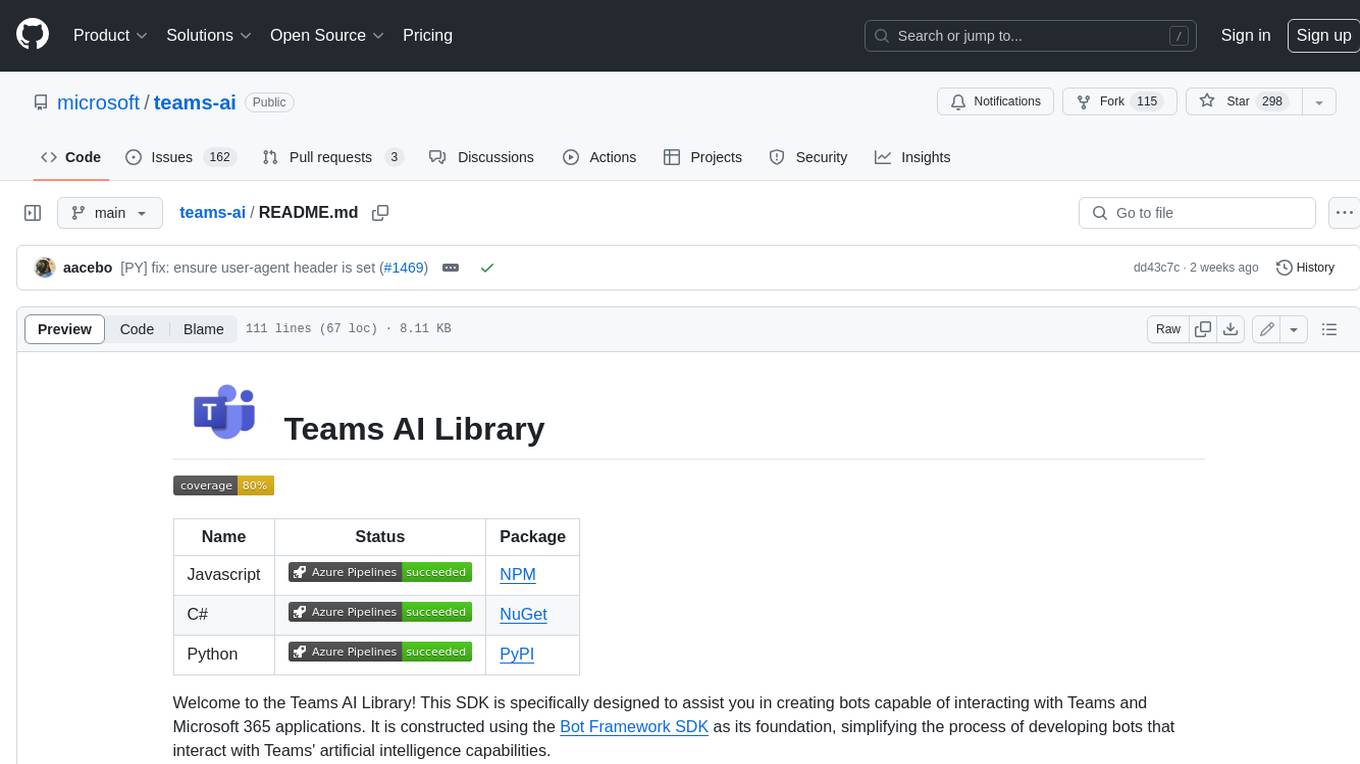
teams-ai
The Teams AI Library is a software development kit (SDK) that helps developers create bots that can interact with Teams and Microsoft 365 applications. It is built on top of the Bot Framework SDK and simplifies the process of developing bots that interact with Teams' artificial intelligence capabilities. The SDK is available for JavaScript/TypeScript, .NET, and Python.
ai-guide
This guide is dedicated to Large Language Models (LLMs) that you can run on your home computer. It assumes your PC is a lower-end, non-gaming setup.
classifai
Supercharge WordPress Content Workflows and Engagement with Artificial Intelligence. Tap into leading cloud-based services like OpenAI, Microsoft Azure AI, Google Gemini and IBM Watson to augment your WordPress-powered websites. Publish content faster while improving SEO performance and increasing audience engagement. ClassifAI integrates Artificial Intelligence and Machine Learning technologies to lighten your workload and eliminate tedious tasks, giving you more time to create original content that matters.
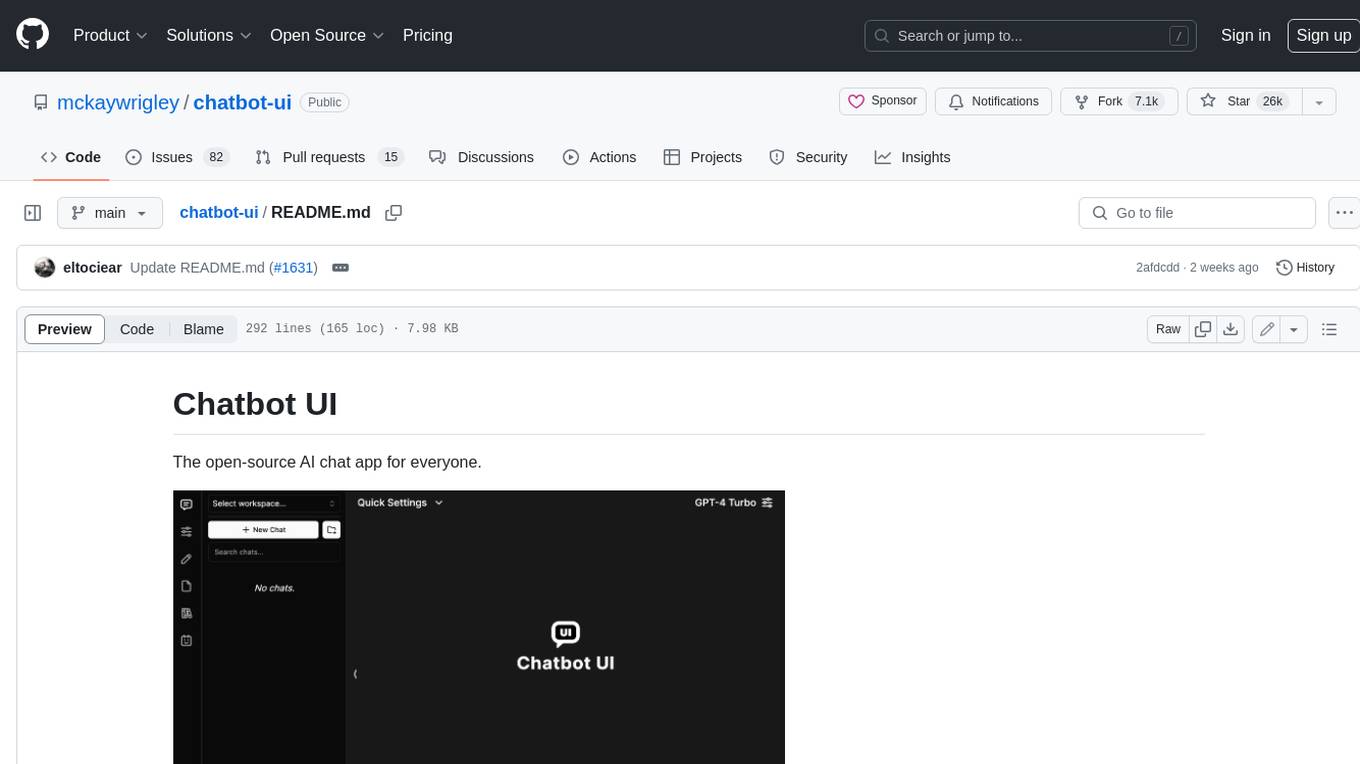
chatbot-ui
Chatbot UI is an open-source AI chat app that allows users to create and deploy their own AI chatbots. It is easy to use and can be customized to fit any need. Chatbot UI is perfect for businesses, developers, and anyone who wants to create a chatbot.
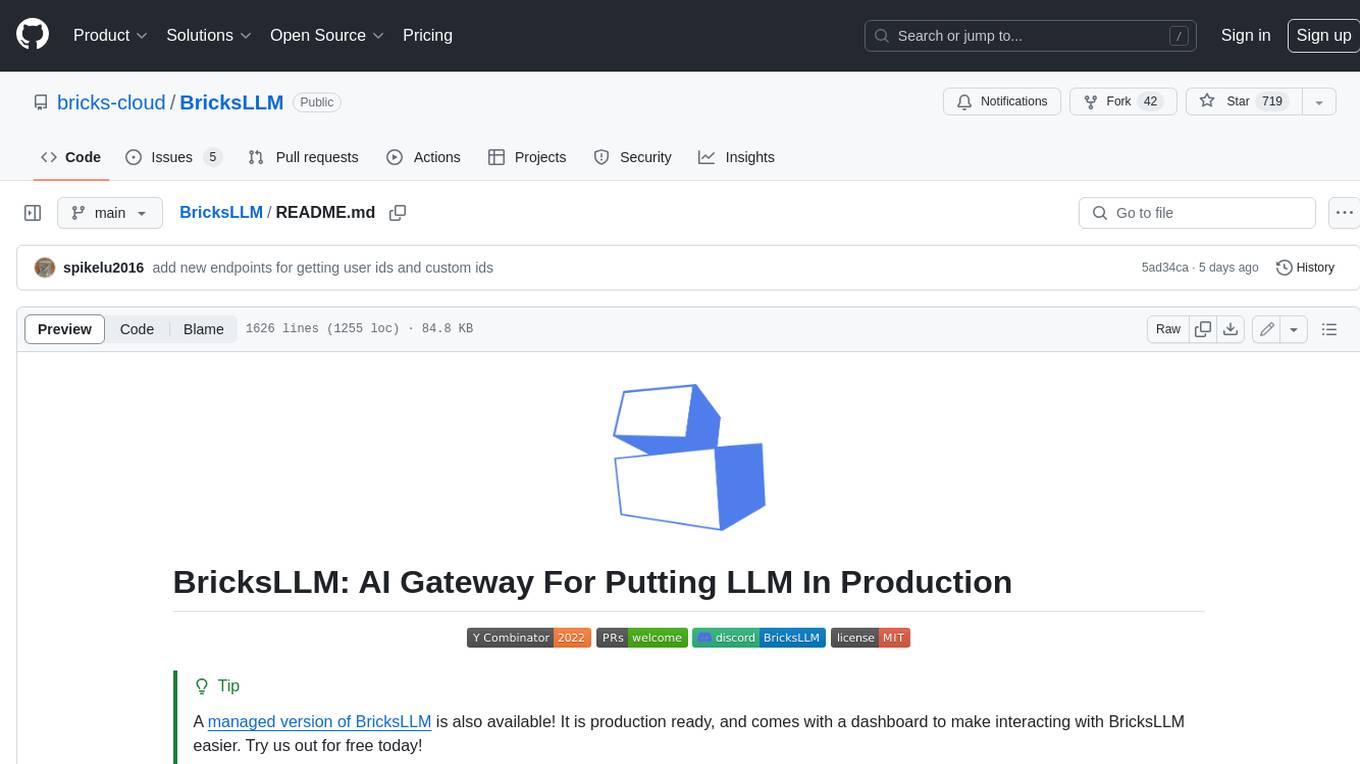
BricksLLM
BricksLLM is a cloud native AI gateway written in Go. Currently, it provides native support for OpenAI, Anthropic, Azure OpenAI and vLLM. BricksLLM aims to provide enterprise level infrastructure that can power any LLM production use cases. Here are some use cases for BricksLLM: * Set LLM usage limits for users on different pricing tiers * Track LLM usage on a per user and per organization basis * Block or redact requests containing PIIs * Improve LLM reliability with failovers, retries and caching * Distribute API keys with rate limits and cost limits for internal development/production use cases * Distribute API keys with rate limits and cost limits for students
uAgents
uAgents is a Python library developed by Fetch.ai that allows for the creation of autonomous AI agents. These agents can perform various tasks on a schedule or take action on various events. uAgents are easy to create and manage, and they are connected to a fast-growing network of other uAgents. They are also secure, with cryptographically secured messages and wallets.
griptape
Griptape is a modular Python framework for building AI-powered applications that securely connect to your enterprise data and APIs. It offers developers the ability to maintain control and flexibility at every step. Griptape's core components include Structures (Agents, Pipelines, and Workflows), Tasks, Tools, Memory (Conversation Memory, Task Memory, and Meta Memory), Drivers (Prompt and Embedding Drivers, Vector Store Drivers, Image Generation Drivers, Image Query Drivers, SQL Drivers, Web Scraper Drivers, and Conversation Memory Drivers), Engines (Query Engines, Extraction Engines, Summary Engines, Image Generation Engines, and Image Query Engines), and additional components (Rulesets, Loaders, Artifacts, Chunkers, and Tokenizers). Griptape enables developers to create AI-powered applications with ease and efficiency.