


aily-blockly
Integrated AI assistant, Blockly IDE for Arduino, MicroPython, ESP32, STM32, RP2040. 集成AI助手,支持Arduino、ESP32、STM32、RP2040的Blockly IDE
Stars: 169
Aily Blockly is a blockly IDE under the Aily Project, providing AI-assisted programming capabilities for non-professional users. It aims to integrate numerous AI capabilities to help hardware developers develop more smoothly, ultimately achieving natural language programming. The software offers features like Engineering Project Management, Library Manager, Serial Debug Tool, AI Project Generation, AI Code Generation, AI Library Conversion, Development Board Configuration Generation, and Lightning Compilation Tool. It is currently in the alpha stage, suitable for prototype verification and educational teaching.
README:
中文 | English
Aily Project is a hardware development integrated environment that plans to integrate numerous AI capabilities to help hardware developers develop more smoothly.
Aily Blockly is a blockly IDE under the aily Project. In the early stage, it provides AI-assisted programming capabilities for non-professional users. The long-term goal is to break the boundary between professional development and non-professional development, and ultimately achieve natural language programming.

We aim to design and develop this project as industrial-grade software, but the project is currently in the alpha stage and is not recommended for mass production device firmware development. However, the current version is perfectly suitable for prototype verification and educational teaching.
-
Engineering Project Management Uses npm for project management, achieving board and library management on a per-project basis. This solves many engineering deficiencies in traditional embedded development environments. For example, using Arduino IDE may result in board package, library, and current project mismatches, causing compilation failures and runtime errors. In this software, the board versions and library versions in each project are independent and do not affect each other.
-
Library Manager Although we have prepared many libraries (covering almost all commonly used modules), these libraries are actually generated by AI and we have not verified them in detail. We need beta testers to verify and improve them together with us.
-
Powerful and Compact Serial Debug Tool Attempts to create an all-purpose serial tool. Welcome everyone to test, provide feedback, and propose new ideas.
-
AI Project Generation According to user requirements, automatically analyzes projects, recommends development boards, modules, and libraries, generates project architecture diagrams and pin connection diagrams, and creates projects for users.
-
AI Code Generation According to user requirements, automatically writes programs.
-
AI Library Conversion Native C/C++ libraries can be easily converted to libraries used by this software. Based on large model configuration generation, during development, if you want to use an Arduino library but don't have the corresponding blockly library, just provide the Arduino library to AI, and AI will automatically analyze and generate the corresponding blockly library. With this feature, this software can become the blockly platform with the most libraries.
-
AI Development Board Configuration Generation (Under improvement) Based on large model configuration generation, when adding development boards, you no longer need to write new configurations purely by hand. Just provide the development board documentation (md format), and AI will automatically analyze and help you generate development board configuration files. (Only supports development boards with esp32, avr, renesas, rp2040, stm32 as the core, because compilers and core SDKs still need to be prepared by us in advance to the repository)
-
Lightning Compilation Tool (Phase 1 online, Phase 2 coming soon!) Edge-cloud collaboration, lightning compilation. Reduces the original 1-hour compilation work to 1 minute!
This alpha version for testing only guarantees the minimum usability, and many planned highlight features have not yet been designed and developed. The current version is not recommended for actual work use, as many adjustments we make later may cause incompatibility between versions.
· Hardware simulation
· microPython support (mode added, but no library support yet)
User Documentation
Library Adaptation Documentation
Software Development Documentation
Development Boards
Block Libraries
Compilers
Related Tools
This project is sponsored by the following companies and individuals


Tao Dong (Tianwei Electronics)
Xia Qing (Mushroom Cloud Maker Space)
Du Zhongzhong Dzz (Community Partner)
Li Duan (Yixuehui)
Sun Junjie (Community Partner)
electron This project uses electron to build desktop applications
angular This project uses angular as the rendering end to build main UI logic
node This project uses npm and node for package management and executing necessary scripts
7z This project uses 7z to reduce the size of some packages (such as the huge ESP32 compiler)
Other content can be found in package.json
- This software is free software under the GPL license. Without authorization, the sale of this software or derivative software based on this software is prohibited.
- Hardware works developed using this software are not restricted by the GPL, and users may decide on their own release and usage methods.
- For derivatives based on this software, information about relevant rights holders and sponsors of this project must not be removed, and such information must appear on the software startup page.
- The online service content attached to this project must not be removed.
For Tasks:
Click tags to check more tools for each tasksFor Jobs:
Alternative AI tools for aily-blockly
Similar Open Source Tools
aily-blockly
Aily Blockly is a blockly IDE under the Aily Project, providing AI-assisted programming capabilities for non-professional users. It aims to integrate numerous AI capabilities to help hardware developers develop more smoothly, ultimately achieving natural language programming. The software offers features like Engineering Project Management, Library Manager, Serial Debug Tool, AI Project Generation, AI Code Generation, AI Library Conversion, Development Board Configuration Generation, and Lightning Compilation Tool. It is currently in the alpha stage, suitable for prototype verification and educational teaching.
DevOpsGPT
DevOpsGPT is an AI-driven software development automation solution that combines Large Language Models (LLM) with DevOps tools to convert natural language requirements into working software. It improves development efficiency by eliminating the need for tedious requirement documentation, shortens development cycles, reduces communication costs, and ensures high-quality deliverables. The Enterprise Edition offers features like existing project analysis, professional model selection, and support for more DevOps platforms. The tool automates requirement development, generates interface documentation, provides pseudocode based on existing projects, facilitates code refinement, enables continuous integration, and supports software version release. Users can run DevOpsGPT with source code or Docker, and the tool comes with limitations in precise documentation generation and understanding existing project code. The product roadmap includes accurate requirement decomposition, rapid import of development requirements, and integration of more software engineering and professional tools for efficient software development tasks under AI planning and execution.
coze-studio
Coze Studio is an all-in-one AI agent development tool that offers the most convenient AI agent development environment, from development to deployment. It provides core technologies for AI agent development, complete app templates, and build frameworks. Coze Studio aims to simplify creating, debugging, and deploying AI agents through visual design and build tools, enabling powerful AI app development and customized business logic. The tool is developed using Golang for the backend, React + TypeScript for the frontend, and follows microservices architecture based on domain-driven design principles.
CSGHub
CSGHub is an open source, trustworthy large model asset management platform that can assist users in governing the assets involved in the lifecycle of LLM and LLM applications (datasets, model files, codes, etc). With CSGHub, users can perform operations on LLM assets, including uploading, downloading, storing, verifying, and distributing, through Web interface, Git command line, or natural language Chatbot. Meanwhile, the platform provides microservice submodules and standardized OpenAPIs, which could be easily integrated with users' own systems. CSGHub is committed to bringing users an asset management platform that is natively designed for large models and can be deployed On-Premise for fully offline operation. CSGHub offers functionalities similar to a privatized Huggingface(on-premise Huggingface), managing LLM assets in a manner akin to how OpenStack Glance manages virtual machine images, Harbor manages container images, and Sonatype Nexus manages artifacts.
ai_gallery
AI Gallery is a showcase site built using React and Nextjs for static site generation, featuring interactive visualizations of classic algorithms, classic games implementation, and various interesting widgets. The project utilizes AI assistance from Claude 3.5 and GPT-4 to create components and enhance the development process. It aims to continually add more components with AI assistance, providing a platform for contributors to leverage AI in frontend development.
interaqt
Interaqt is a project that aims to separate application business logic from its specific implementation by providing a structured data model and tools to automatically decide and implement software architecture. It liberates individuals and teams from implementation specifics, performance requirements, and cost demands, allowing them to focus on articulating business logic. The approach is considered optimal in the era of large language models (LLMs) as it eliminates uncertainty in generated systems and enables independence from engineering involvement unless specific capabilities are required.
nocobase
NocoBase is an extensible AI-powered no-code platform that offers total control, infinite extensibility, and AI collaboration. It enables teams to adapt quickly and reduce costs without the need for years of development or wasted resources. With NocoBase, users can deploy the platform in minutes and have complete control over their projects. The platform is data model-driven, allowing for unlimited possibilities by decoupling UI and data structure. It integrates AI capabilities seamlessly into business systems, enabling roles such as translator, analyst, researcher, or assistant. NocoBase provides a simple and intuitive user experience with a 'what you see is what you get' approach. It is designed for extension through its plugin-based architecture, allowing users to customize and extend functionalities easily.
CodeFuse-muAgent
CodeFuse-muAgent is a Multi-Agent framework designed to streamline Standard Operating Procedure (SOP) orchestration for agents. It integrates toolkits, code libraries, knowledge bases, and sandbox environments for rapid construction of complex Multi-Agent interactive applications. The framework enables efficient execution and handling of multi-layered and multi-dimensional tasks.
ai-accelerator
The AI Accelerator project source code is designed to initialize an OpenShift cluster with a recommended set of operators and components for training, deploying, serving, and monitoring Machine Learning models. It provides core OpenShift features for Data Science environments and can be customized for specific scenarios. The project automates IT infrastructure using GitOps practices, including Git, code review, and CI/CD. ArgoCD Application objects are used to manage the installation of operators on the cluster.
langchain4j
LangChain for Java simplifies integrating Large Language Models (LLMs) into Java applications by offering unified APIs for various LLM providers and embedding stores. It provides a comprehensive toolbox with tools for prompt templating, chat memory management, function calling, and high-level patterns like Agents and RAG. The library supports 15+ popular LLM providers and 15+ embedding stores, offering numerous examples to help users quickly start building LLM-powered applications. LangChain4j is a fusion of ideas from various projects and actively incorporates new techniques and integrations to keep users up-to-date. The project is under active development, with core functionality already in place for users to start building LLM-powered apps.
NeMo
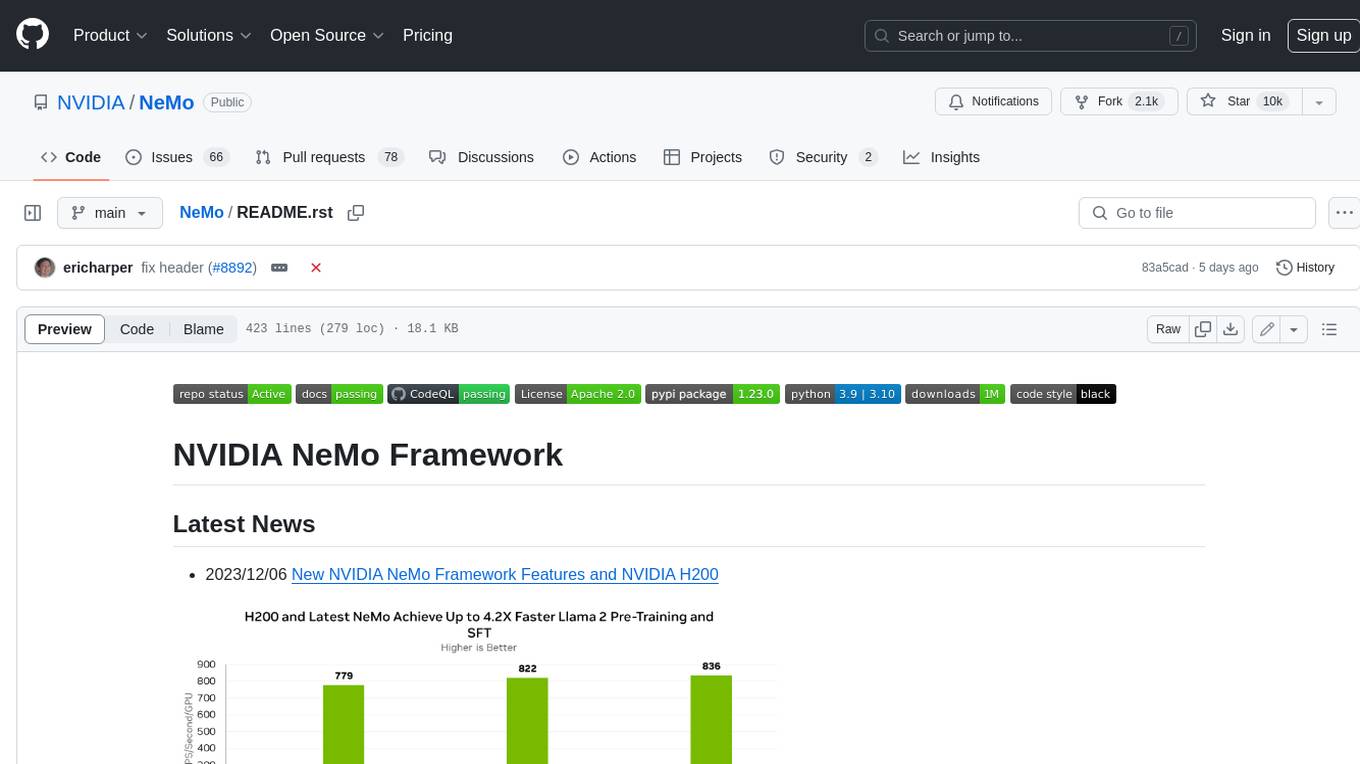
NeMo Framework is a generative AI framework built for researchers and pytorch developers working on large language models (LLMs), multimodal models (MM), automatic speech recognition (ASR), and text-to-speech synthesis (TTS). The primary objective of NeMo is to provide a scalable framework for researchers and developers from industry and academia to more easily implement and design new generative AI models by being able to leverage existing code and pretrained models.
agentUniverse
agentUniverse is a framework for developing applications powered by multi-agent based on large language model. It provides essential components for building single agent and multi-agent collaboration mechanism for customizing collaboration patterns. Developers can easily construct multi-agent applications and share pattern practices from different fields. The framework includes pre-installed collaboration patterns like PEER and DOE for complex task breakdown and data-intensive tasks.
awesome-openvino
Awesome OpenVINO is a curated list of AI projects based on the OpenVINO toolkit, offering a rich assortment of projects, libraries, and tutorials covering various topics like model optimization, deployment, and real-world applications across industries. It serves as a valuable resource continuously updated to maximize the potential of OpenVINO in projects, featuring projects like Stable Diffusion web UI, Visioncom, FastSD CPU, OpenVINO AI Plugins for GIMP, and more.
NeMo
NVIDIA NeMo Framework is a scalable and cloud-native generative AI framework built for researchers and PyTorch developers working on Large Language Models (LLMs), Multimodal Models (MMs), Automatic Speech Recognition (ASR), Text to Speech (TTS), and Computer Vision (CV) domains. It is designed to help you efficiently create, customize, and deploy new generative AI models by leveraging existing code and pre-trained model checkpoints.
AgentUp
AgentUp is an active development tool that provides a developer-first agent framework for creating AI agents with enterprise-grade infrastructure. It allows developers to define agents with configuration, ensuring consistent behavior across environments. The tool offers secure design, configuration-driven architecture, extensible ecosystem for customizations, agent-to-agent discovery, asynchronous task architecture, deterministic routing, and MCP support. It supports multiple agent types like reactive agents and iterative agents, making it suitable for chatbots, interactive applications, research tasks, and more. AgentUp is built by experienced engineers from top tech companies and is designed to make AI agents production-ready, secure, and reliable.
ck
Collective Mind (CM) is a collection of portable, extensible, technology-agnostic and ready-to-use automation recipes with a human-friendly interface (aka CM scripts) to unify and automate all the manual steps required to compose, run, benchmark and optimize complex ML/AI applications on any platform with any software and hardware: see online catalog and source code. CM scripts require Python 3.7+ with minimal dependencies and are continuously extended by the community and MLCommons members to run natively on Ubuntu, MacOS, Windows, RHEL, Debian, Amazon Linux and any other operating system, in a cloud or inside automatically generated containers while keeping backward compatibility - please don't hesitate to report encountered issues here and contact us via public Discord Server to help this collaborative engineering effort! CM scripts were originally developed based on the following requirements from the MLCommons members to help them automatically compose and optimize complex MLPerf benchmarks, applications and systems across diverse and continuously changing models, data sets, software and hardware from Nvidia, Intel, AMD, Google, Qualcomm, Amazon and other vendors: * must work out of the box with the default options and without the need to edit some paths, environment variables and configuration files; * must be non-intrusive, easy to debug and must reuse existing user scripts and automation tools (such as cmake, make, ML workflows, python poetry and containers) rather than substituting them; * must have a very simple and human-friendly command line with a Python API and minimal dependencies; * must require minimal or zero learning curve by using plain Python, native scripts, environment variables and simple JSON/YAML descriptions instead of inventing new workflow languages; * must have the same interface to run all automations natively, in a cloud or inside containers. CM scripts were successfully validated by MLCommons to modularize MLPerf inference benchmarks and help the community automate more than 95% of all performance and power submissions in the v3.1 round across more than 120 system configurations (models, frameworks, hardware) while reducing development and maintenance costs.
For similar tasks
awesome-code-ai
A curated list of AI coding tools, including code completion, refactoring, and assistants. This list includes both open-source and commercial tools, as well as tools that are still in development. Some of the most popular AI coding tools include GitHub Copilot, CodiumAI, Codeium, Tabnine, and Replit Ghostwriter.
mlir-air
This repository contains tools and libraries for building AIR platforms, runtimes and compilers.
llvm-aie
This repository extends the LLVM framework to generate code for use with AMD/Xilinx AI Engine processors. AI Engine processors are in-order, exposed-pipeline VLIW processors focused on application acceleration for AI, Machine Learning, and DSP applications. The repository adds LLVM support for specific features like non-power of 2 pointers, operand latencies, resource conflicts, negative operand latencies, slot assignment, relocations, code alignment restrictions, and register allocation. It includes support for Clang, LLD, binutils, Compiler-RT, and LLVM-LIBC.
labs-ai-tools-vscode
AI Prompt Runner for VSCode is a research prototype project that provides a VSCode extension to run prompts. Users can install the extension, set a secret key, and run prompts to get results for any project. The tool is designed for developers and researchers to experiment with AI prompts within the VSCode environment.
aily-blockly
Aily Blockly is a blockly IDE under the Aily Project, providing AI-assisted programming capabilities for non-professional users. It aims to integrate numerous AI capabilities to help hardware developers develop more smoothly, ultimately achieving natural language programming. The software offers features like Engineering Project Management, Library Manager, Serial Debug Tool, AI Project Generation, AI Code Generation, AI Library Conversion, Development Board Configuration Generation, and Lightning Compilation Tool. It is currently in the alpha stage, suitable for prototype verification and educational teaching.
oneAPI-samples
The oneAPI-samples repository contains a collection of samples for the Intel oneAPI Toolkits. These samples cover various topics such as AI and analytics, end-to-end workloads, features and functionality, getting started samples, Jupyter notebooks, direct programming, C++, Fortran, libraries, publications, rendering toolkit, and tools. Users can find samples based on expertise, programming language, and target device. The repository structure is organized by high-level categories, and platform validation includes Ubuntu 22.04, Windows 11, and macOS. The repository provides instructions for getting samples, including cloning the repository or downloading specific tagged versions. Users can also use integrated development environments (IDEs) like Visual Studio Code. The code samples are licensed under the MIT license.
azure-openai-service-proxy
The Azure OpenAI Proxy service aims to simplify access to an Azure OpenAI `Playground-like` experience by supporting Azure OpenAI SDKs, LangChain, and REST endpoints for developer events, workshops, and hackathons. Users can access the service using a timebound `event code`. The solution documentation is available for reference.
spring-ai-examples
This repository contains various examples of using Spring AI. Users can clone the entire project or use SpringCLI to select individual projects and create them locally. It includes a project-catalog.yml for adding as a project catalog to Spring CLI. Users can create projects locally using 'spring boot new' or mix a project's functionality into an existing project using 'spring boot add'. Be cautious about building against newer versions of Spring Boot than your project, as it may lead to build or test errors.
For similar jobs
DotRecast
DotRecast is a C# port of Recast & Detour, a navigation library used in many AAA and indie games and engines. It provides automatic navmesh generation, fast turnaround times, detailed customization options, and is dependency-free. Recast Navigation is divided into multiple modules, each contained in its own folder: - DotRecast.Core: Core utils - DotRecast.Recast: Navmesh generation - DotRecast.Detour: Runtime loading of navmesh data, pathfinding, navmesh queries - DotRecast.Detour.TileCache: Navmesh streaming. Useful for large levels and open-world games - DotRecast.Detour.Crowd: Agent movement, collision avoidance, and crowd simulation - DotRecast.Detour.Dynamic: Robust support for dynamic nav meshes combining pre-built voxels with dynamic objects which can be freely added and removed - DotRecast.Detour.Extras: Simple tool to import navmeshes created with A* Pathfinding Project - DotRecast.Recast.Toolset: All modules - DotRecast.Recast.Demo: Standalone, comprehensive demo app showcasing all aspects of Recast & Detour's functionality - Tests: Unit tests Recast constructs a navmesh through a multi-step mesh rasterization process: 1. First Recast rasterizes the input triangle meshes into voxels. 2. Voxels in areas where agents would not be able to move are filtered and removed. 3. The walkable areas described by the voxel grid are then divided into sets of polygonal regions. 4. The navigation polygons are generated by re-triangulating the generated polygonal regions into a navmesh. You can use Recast to build a single navmesh, or a tiled navmesh. Single meshes are suitable for many simple, static cases and are easy to work with. Tiled navmeshes are more complex to work with but better support larger, more dynamic environments. Tiled meshes enable advanced Detour features like re-baking, hierarchical path-planning, and navmesh data-streaming.
bots
The 'bots' repository is a collection of guides, tools, and example bots for programming bots to play video games. It provides resources on running bots live, installing the BotLab client, debugging bots, testing bots in simulated environments, and more. The repository also includes example bots for games like EVE Online, Tribal Wars 2, and Elvenar. Users can learn about developing bots for specific games, syntax of the Elm programming language, and tools for memory reading development. Additionally, there are guides on bot programming, contributing to BotLab, and exploring Elm syntax and core library.

Half-Life-Resurgence
Half-Life-Resurgence is a recreation and expansion project that brings NPCs, entities, and weapons from the Half-Life series into Garry's Mod. The goal is to faithfully recreate original content while also introducing new features and custom content envisioned by the community. Users can expect a wide range of NPCs with new abilities, AI behaviors, and weapons, as well as support for playing as any character and replacing NPCs in Half-Life 1 & 2 campaigns.
SwordCoastStratagems
Sword Coast Stratagems (SCS) is a mod that enhances Baldur's Gate games by adding over 130 optional components focused on improving monster AI, encounter difficulties, cosmetic enhancements, and ease-of-use tweaks. This repository serves as an archive for the project, with updates pushed only when new releases are made. It is not a collaborative project, and bug reports or suggestions should be made at the Gibberlings 3 forums. The mod is designed for offline workflow and should be downloaded from official releases.
LambsDanger
LAMBS Danger FSM is an open-source mod developed for Arma3, aimed at enhancing the AI behavior by integrating buildings into the tactical landscape, creating distinct AI states, and ensuring seamless compatibility with vanilla, ACE3, and modded assets. Originally created for the Norwegian gaming community, it is now available on Steam Workshop and GitHub for wider use. Users are allowed to customize and redistribute the mod according to their requirements. The project is licensed under the GNU General Public License (GPLv2) with additional amendments.

beehave
Beehave is a powerful addon for Godot Engine that enables users to create robust AI systems using behavior trees. It simplifies the design of complex NPC behaviors, challenging boss battles, and other advanced setups. Beehave allows for the creation of highly adaptive AI that responds to changes in the game world and overcomes unexpected obstacles, catering to both beginners and experienced developers. The tool is currently in development for version 3.0.
thinker
Thinker is an AI improvement mod for Alpha Centauri: Alien Crossfire that enhances single player challenge and gameplay with features like improved production/movement AI, visual changes on map rendering, more config options, resolution settings, and automation features. It includes Scient's patches and requires the GOG version of Alpha Centauri with the official Alien Crossfire patch version 2.0 installed. The mod provides additional DLL features developed in C++ for a richer gaming experience.
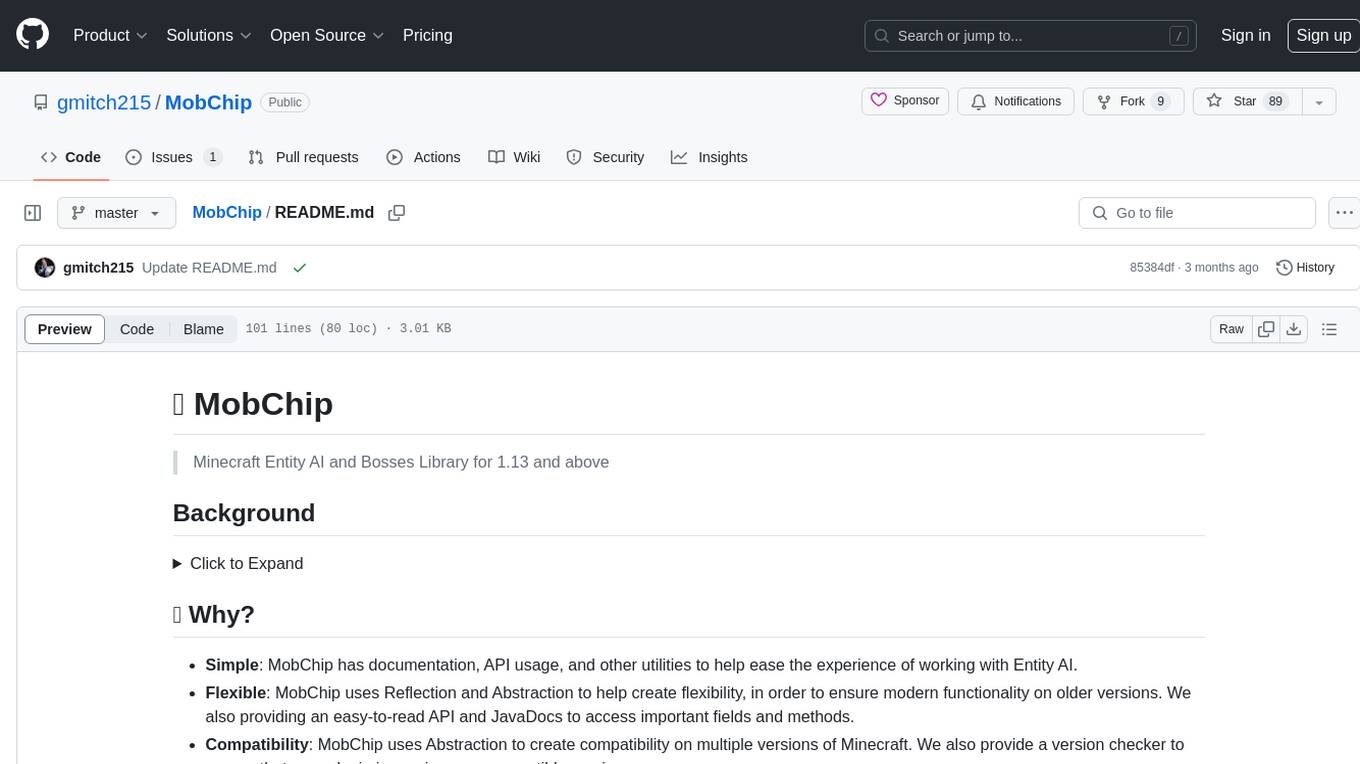
MobChip
MobChip is an all-in-one Entity AI and Bosses Library for Minecraft 1.13 and above. It simplifies the implementation of Minecraft's native entity AI into plugins, offering documentation, API usage, and utilities for ease of use. The library is flexible, using Reflection and Abstraction for modern functionality on older versions, and ensuring compatibility across multiple Minecraft versions. MobChip is open source, providing features like Bosses Library, Pathfinder Goals, Behaviors, Villager Gossip, Ender Dragon Phases, and more.