


agentregistry
Fast-track AI innovation with a centralized, trusted, curated registry
Stars: 182
A centralized registry providing governance and control to AI artifacts and infrastructure. Empowers developers to build and deploy AI applications confidently. Securely curates, discovers, deploys, and manages agentic infrastructure from MCP servers, agents to skills. Features centralized registry, control and governance, data enrichment, and unification of AI infrastructure. Allows creating Anthropic Skills, publishing to agentregistry, and using in Claude Code. Offers architecture for operators and developers. Requires Docker Desktop with Docker Compose v2+ and Go 1.25+ for installation. Core concepts include MCP Servers, Agent Gateway, and IDE Configuration. Users can contribute, report bugs, suggest features, submit pull requests, star the repository, and join the Discord server. Related projects include Model Context Protocol, kagent, MCP Go SDK, and FastMCP.
README:



Agent Registry brings governance and control to AI artifacts and infrastructure, empowering developers to quickly build and deploy AI applications with confidence. It provides a secure, centralized registry where teams can publish, discover, and share AI artifacts, including MCP servers, agents, and skills, and deploy them seamlessly to any environment.
- 📦 Centralized Registry: Package, discover and curate AI artifacts from a central source
- 🔒 Control and Governance: Selectively and control custom collection of artifacts
- 📊 Data Enrichment: Automatically validate and score ingested data for insights
- 🌐 Unify AI Infrastructure: Deploy and access artifacts anywhere
Learn how to create an Anthropic Skill, publish it to agentregistry, and use it in Claude Code


See DEVELOPMENT.md for detailed architecture information.
- Docker Desktop with Docker Compose v2+
- Go 1.25+ (for building from source)
# Install via script (recommended)
curl -fsSL https://raw.githubusercontent.com/agentregistry-dev/agentregistry/main/scripts/get-arctl | bash

# Or download binary directly from releases
# https://github.com/agentregistry-dev/agentregistry/releases# Start the registry server and look for available MCP servers
arctl mcp list
# The first time the CLI runs, it will automatically start the registry server daemon and import the built-in seed data.To access the UI, open http://localhost:12121 in your browser.
MCP (Model Context Protocol) servers provide tools, resources, and prompts to AI agents. They're the building blocks of agent capabilities.
The Agent Gateway is a reverse proxy that provides a single MCP endpoint for all deployed servers:
sequenceDiagram
    participant IDE as AI IDE/Client
    participant GW as Agent Gateway
    participant FS as filesystem MCP
    participant GH as github MCP

    IDE->>GW: Connect (MCP over HTTP)
    GW-->>IDE: Available tools from all servers

    IDE->>GW: Call read_file()
    GW->>FS: Forward to filesystem
    FS-->>GW: File contents
    GW-->>IDE: Return result

    IDE->>GW: Call create_issue()
    GW->>GH: Forward to github
    GH-->>GW: Issue created
GW-->>IDE: Return resultConfigure your AI-powered IDEs to use the Agent Gateway:
# Generate Claude Desktop config
arctl configure claude-desktop

# Generate Cursor config
arctl configure cursor

# Generate VS Code config
arctl configure vscodeWe welcome contributions! Please see CONTRIBUTING.md for guidelines.
- 🐛 Report bugs and issues: GitHub Issues
- 💡 Suggest new features: GitHub Discussions
- 🔧 Submit pull requests: GitHub Repository
- ⭐ Star the repository: Show your support on GitHub
- 💬 Join the Conversation: Join our Discord Server
- 📖 [Documentation] Coming Soon!
- 💬 GitHub Discussions
- 🐛 Issue Tracker
Apache V2 License - see LICENSE for details.
For Tasks:
Click tags to check more tools for each tasksFor Jobs:
Alternative AI tools for agentregistry
Similar Open Source Tools
agentregistry
A centralized registry providing governance and control to AI artifacts and infrastructure. Empowers developers to build and deploy AI applications confidently. Securely curates, discovers, deploys, and manages agentic infrastructure from MCP servers, agents to skills. Features centralized registry, control and governance, data enrichment, and unification of AI infrastructure. Allows creating Anthropic Skills, publishing to agentregistry, and using in Claude Code. Offers architecture for operators and developers. Requires Docker Desktop with Docker Compose v2+ and Go 1.25+ for installation. Core concepts include MCP Servers, Agent Gateway, and IDE Configuration. Users can contribute, report bugs, suggest features, submit pull requests, star the repository, and join the Discord server. Related projects include Model Context Protocol, kagent, MCP Go SDK, and FastMCP.
better-chatbot
Better Chatbot is an open-source AI chatbot designed for individuals and teams, inspired by various AI models. It integrates major LLMs, offers powerful tools like MCP protocol and data visualization, supports automation with custom agents and visual workflows, enables collaboration by sharing configurations, provides a voice assistant feature, and ensures an intuitive user experience. The platform is built with Vercel AI SDK and Next.js, combining leading AI services into one platform for enhanced chatbot capabilities.
actionbook
Actionbook is a browser action engine designed for AI agents, providing up-to-date action manuals and DOM structure to enable instant website operations without guesswork. It offers faster execution, token savings, resilient automation, and universal compatibility, making it ideal for building reliable browser agents. Actionbook integrates seamlessly with AI coding assistants and offers three integration methods: CLI, MCP Server, and JavaScript SDK. The tool is well-documented and actively developed in a monorepo setup using pnpm workspaces and Turborepo.
eliza
Eliza is a versatile AI agent operating system designed to support various models and connectors, enabling users to create chatbots, autonomous agents, handle business processes, create video game NPCs, and engage in trading. It offers multi-agent and room support, document ingestion and interaction, retrievable memory and document store, and extensibility to create custom actions and clients. Eliza is easy to use and provides a comprehensive solution for AI agent development.
koog
Koog is a Kotlin-based framework for building and running AI agents entirely in idiomatic Kotlin. It allows users to create agents that interact with tools, handle complex workflows, and communicate with users. Key features include pure Kotlin implementation, MCP integration, embedding capabilities, custom tool creation, ready-to-use components, intelligent history compression, powerful streaming API, persistent agent memory, comprehensive tracing, flexible graph workflows, modular feature system, scalable architecture, and multiplatform support.
gateway
CentralMind Gateway is an AI-first data gateway that securely connects any data source and automatically generates secure, LLM-optimized APIs. It filters out sensitive data, adds traceability, and optimizes for AI workloads. Suitable for companies deploying AI agents for customer support and analytics.
ApeRAG
ApeRAG is a production-ready platform for Retrieval-Augmented Generation (RAG) that combines Graph RAG, vector search, and full-text search with advanced AI agents. It is ideal for building Knowledge Graphs, Context Engineering, and deploying intelligent AI agents for autonomous search and reasoning across knowledge bases. The platform offers features like advanced index types, intelligent AI agents with MCP support, enhanced Graph RAG with entity normalization, multimodal processing, hybrid retrieval engine, MinerU integration for document parsing, production-grade deployment with Kubernetes, enterprise management features, MCP integration, and developer-friendly tools for customization and contribution.
solace-agent-mesh
Solace Agent Mesh is an open-source framework designed for building event-driven multi-agent AI systems. It enables the creation of teams of AI agents with distinct skills and tools, facilitating communication and task delegation among agents. The framework is built on top of Solace AI Connector and Google's Agent Development Kit, providing a standardized communication layer for asynchronous, event-driven AI agent architecture. Solace Agent Mesh supports agent orchestration, flexible interfaces, extensibility, agent-to-agent communication, and dynamic embeds, making it suitable for developing complex AI applications with scalability and reliability.
flock
Flock is a workflow-based low-code platform that enables rapid development of chatbots, RAG applications, and coordination of multi-agent teams. It offers a flexible, low-code solution for orchestrating collaborative agents, supporting various node types for specific tasks, such as input processing, text generation, knowledge retrieval, tool execution, intent recognition, answer generation, and more. Flock integrates LangChain and LangGraph to provide offline operation capabilities and supports future nodes like Conditional Branch, File Upload, and Parameter Extraction for creating complex workflows. Inspired by StreetLamb, Lobe-chat, Dify, and fastgpt projects, Flock introduces new features and directions while leveraging open-source models and multi-tenancy support.
morphic
Morphic is an AI-powered answer engine with a generative UI. It utilizes a stack of Next.js, Vercel AI SDK, OpenAI, Tavily AI, shadcn/ui, Radix UI, and Tailwind CSS. To get started, fork and clone the repo, install dependencies, fill out secrets in the .env.local file, and run the app locally using 'bun dev'. You can also deploy your own live version of Morphic with Vercel. Verified models that can be specified to writers include Groq, LLaMA3 8b, and LLaMA3 70b.
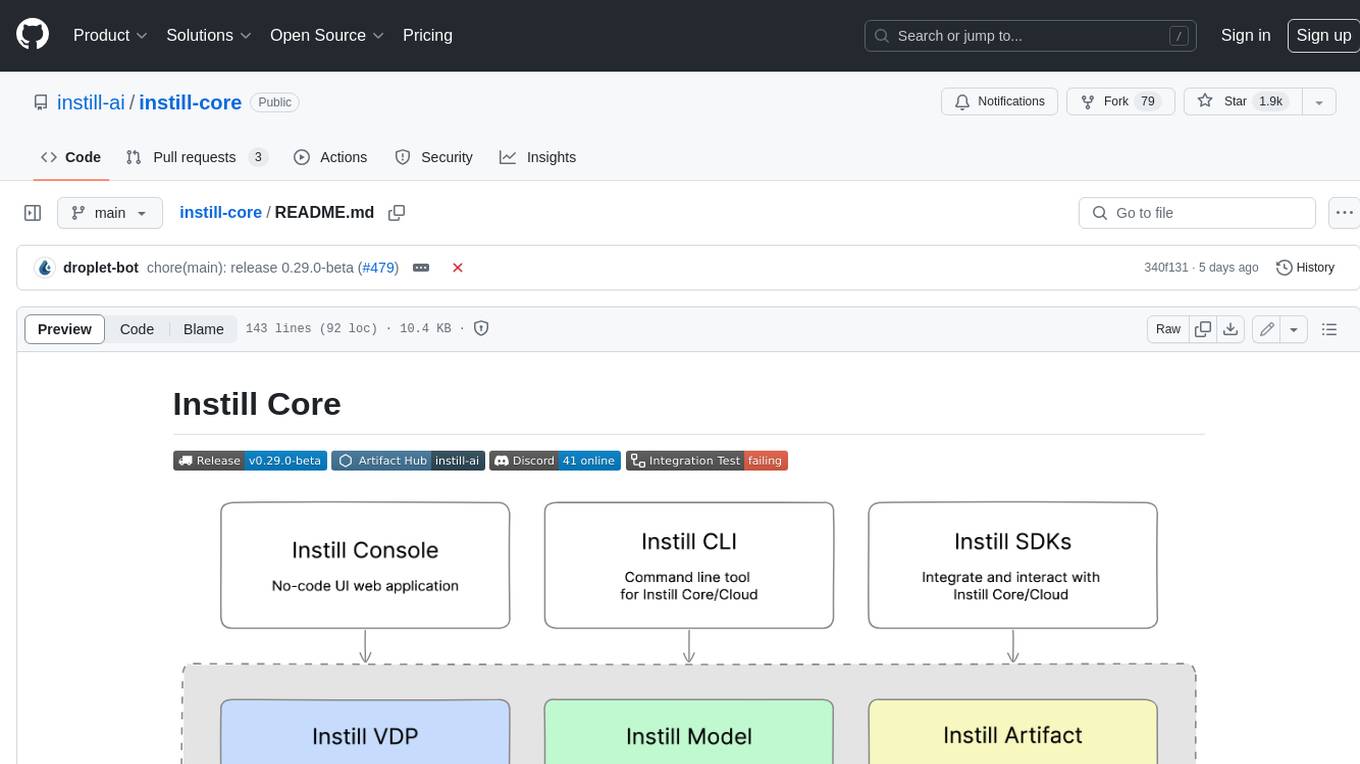
instill-core
Instill Core is an open-source orchestrator comprising a collection of source-available projects designed to streamline every aspect of building versatile AI features with unstructured data. It includes Instill VDP (Versatile Data Pipeline) for unstructured data, AI, and pipeline orchestration, Instill Model for scalable MLOps and LLMOps for open-source or custom AI models, and Instill Artifact for unified unstructured data management. Instill Core can be used for tasks such as building, testing, and sharing pipelines, importing, serving, fine-tuning, and monitoring ML models, and transforming documents, images, audio, and video into a unified AI-ready format.
adk-js
Agent Development Kit (ADK) for TypeScript is an open-source toolkit designed for developers to build, evaluate, and deploy sophisticated AI agents with flexibility and control. It allows defining agent behavior, orchestration, and tool use directly in code for robust debugging, versioning, and deployment. With rich tool ecosystem, code-first development, and modular multi-agent systems, ADK offers tight integration with the Google ecosystem and enables the creation of scalable applications by composing multiple specialized agents into flexible hierarchies.
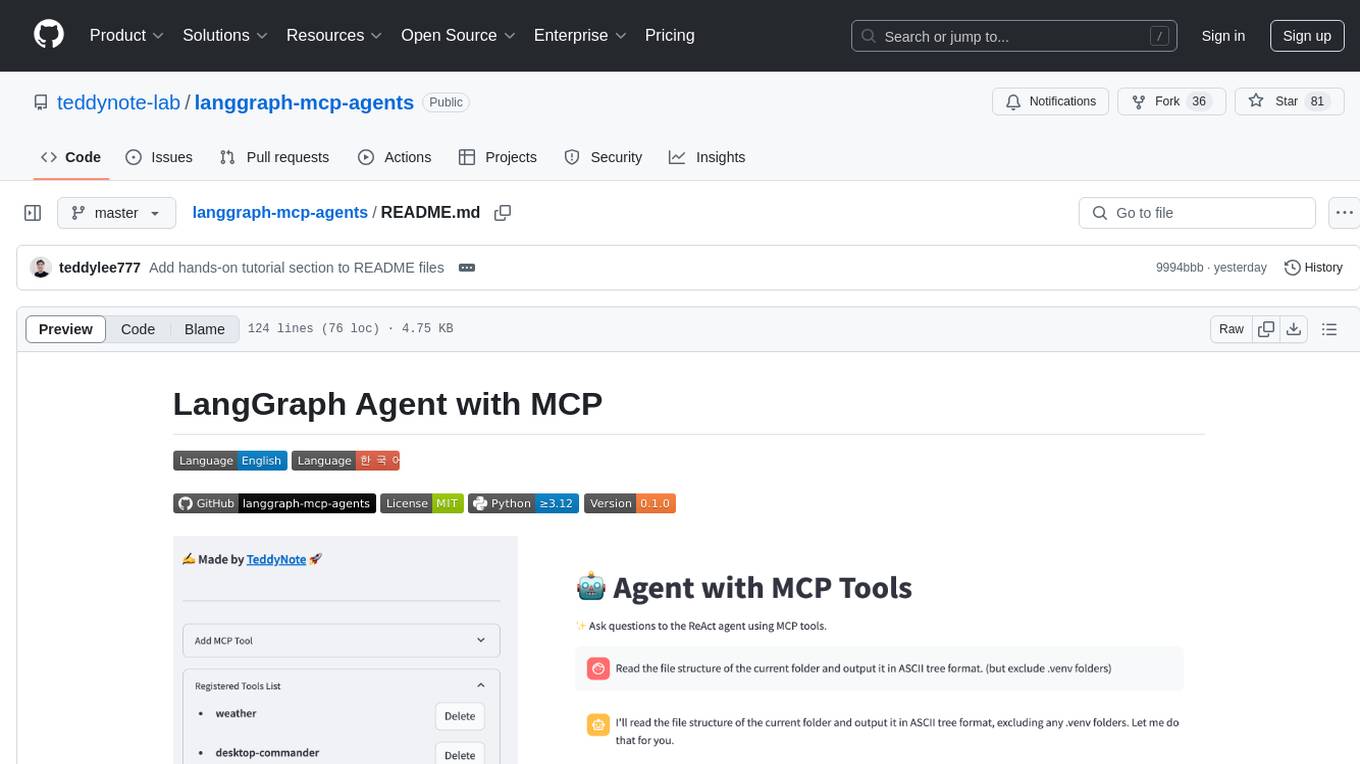
langgraph-mcp-agents
LangGraph Agent with MCP is a toolkit provided by LangChain AI that enables AI agents to interact with external tools and data sources through the Model Context Protocol (MCP). It offers a user-friendly interface for deploying ReAct agents to access various data sources and APIs through MCP tools. The toolkit includes features such as a Streamlit Interface for interaction, Tool Management for adding and configuring MCP tools dynamically, Streaming Responses in real-time, and Conversation History tracking.
cossistant
Cossistant is an open source chat support widget tailored for the React ecosystem. It offers headless components for building customizable chat interfaces, real-time messaging with WebSocket technology, and tools for managing customer conversations. The tool is API-first, self-hosted, developer-friendly with TypeScript support, and provides complete integration flexibility. It uses technologies like Next.js, TailwindCSS, and WebSockets, and supports databases like PlanetScale for production and DBgin for local development. Cossistant is ideal for developers seeking a versatile chat solution that can be easily integrated into their applications.
minimal-chat
MinimalChat is a minimal and lightweight open-source chat application with full mobile PWA support that allows users to interact with various language models, including GPT-4 Omni, Claude Opus, and various Local/Custom Model Endpoints. It focuses on simplicity in setup and usage while being fully featured and highly responsive. The application supports features like fully voiced conversational interactions, multiple language models, markdown support, code syntax highlighting, DALL-E 3 integration, conversation importing/exporting, and responsive layout for mobile use.
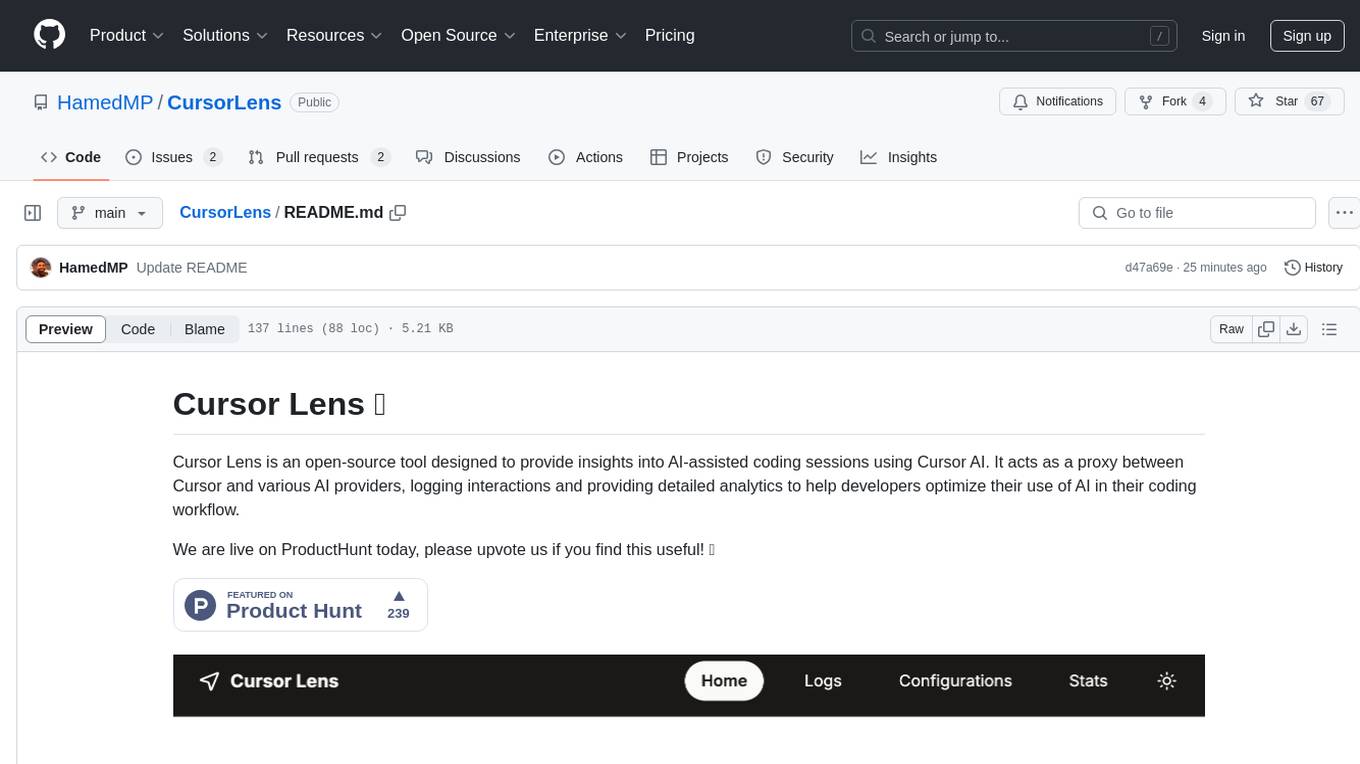
CursorLens
Cursor Lens is an open-source tool that acts as a proxy between Cursor and various AI providers, logging interactions and providing detailed analytics to help developers optimize their use of AI in their coding workflow. It supports multiple AI providers, captures and logs all requests, provides visual analytics on AI usage, allows users to set up and switch between different AI configurations, offers real-time monitoring of AI interactions, tracks token usage, estimates costs based on token usage and model pricing. Built with Next.js, React, PostgreSQL, Prisma ORM, Vercel AI SDK, Tailwind CSS, and shadcn/ui components.
For similar tasks
agentregistry
A centralized registry providing governance and control to AI artifacts and infrastructure. Empowers developers to build and deploy AI applications confidently. Securely curates, discovers, deploys, and manages agentic infrastructure from MCP servers, agents to skills. Features centralized registry, control and governance, data enrichment, and unification of AI infrastructure. Allows creating Anthropic Skills, publishing to agentregistry, and using in Claude Code. Offers architecture for operators and developers. Requires Docker Desktop with Docker Compose v2+ and Go 1.25+ for installation. Core concepts include MCP Servers, Agent Gateway, and IDE Configuration. Users can contribute, report bugs, suggest features, submit pull requests, star the repository, and join the Discord server. Related projects include Model Context Protocol, kagent, MCP Go SDK, and FastMCP.
python-tutorial-notebooks
This repository contains Jupyter-based tutorials for NLP, ML, AI in Python for classes in Computational Linguistics, Natural Language Processing (NLP), Machine Learning (ML), and Artificial Intelligence (AI) at Indiana University.
open-parse
Open Parse is a Python library for visually discerning document layouts and chunking them effectively. It is designed to fill the gap in open-source libraries for handling complex documents. Unlike text splitting, which converts a file to raw text and slices it up, Open Parse visually analyzes documents for superior LLM input. It also supports basic markdown for parsing headings, bold, and italics, and has high-precision table support, extracting tables into clean Markdown formats with accuracy that surpasses traditional tools. Open Parse is extensible, allowing users to easily implement their own post-processing steps. It is also intuitive, with great editor support and completion everywhere, making it easy to use and learn.
MoonshotAI-Cookbook
The MoonshotAI-Cookbook provides example code and guides for accomplishing common tasks with the MoonshotAI API. To run these examples, you'll need an MoonshotAI account and associated API key. Most code examples are written in Python, though the concepts can be applied in any language.
AHU-AI-Repository
This repository is dedicated to the learning and exchange of resources for the School of Artificial Intelligence at Anhui University. Notes will be published on this website first: https://www.aoaoaoao.cn and will be synchronized to the repository regularly. You can also contact me at [email protected].
modern_ai_for_beginners
This repository provides a comprehensive guide to modern AI for beginners, covering both theoretical foundations and practical implementation. It emphasizes the importance of understanding both the mathematical principles and the code implementation of AI models. The repository includes resources on PyTorch, deep learning fundamentals, mathematical foundations, transformer-based LLMs, diffusion models, software engineering, and full-stack development. It also features tutorials on natural language processing with transformers, reinforcement learning, and practical deep learning for coders.
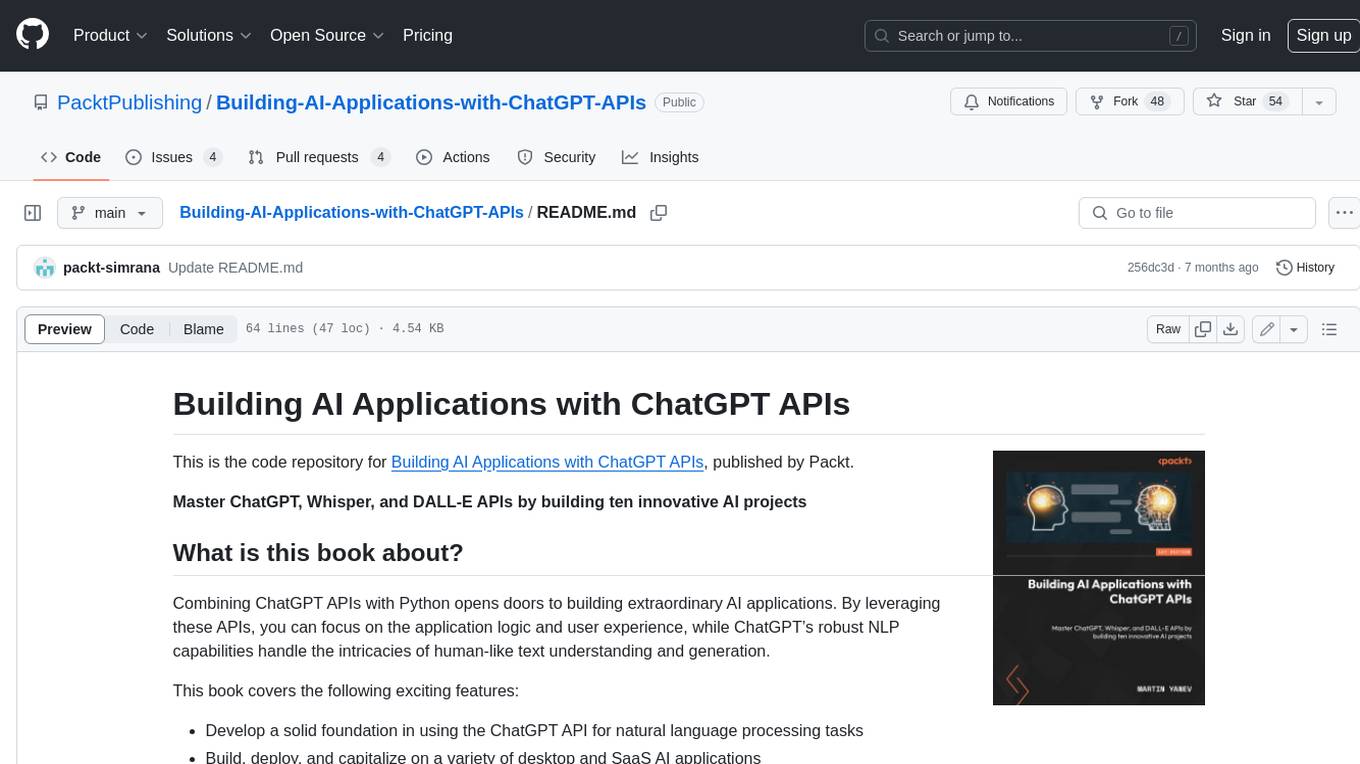
Building-AI-Applications-with-ChatGPT-APIs
This repository is for the book 'Building AI Applications with ChatGPT APIs' published by Packt. It provides code examples and instructions for mastering ChatGPT, Whisper, and DALL-E APIs through building innovative AI projects. Readers will learn to develop AI applications using ChatGPT APIs, integrate them with frameworks like Flask and Django, create AI-generated art with DALL-E APIs, and optimize ChatGPT models through fine-tuning.
examples
This repository contains a collection of sample applications and Jupyter Notebooks for hands-on experience with Pinecone vector databases and common AI patterns, tools, and algorithms. It includes production-ready examples for review and support, as well as learning-optimized examples for exploring AI techniques and building applications. Users can contribute, provide feedback, and collaborate to improve the resource.
For similar jobs
promptflow
**Prompt flow** is a suite of development tools designed to streamline the end-to-end development cycle of LLM-based AI applications, from ideation, prototyping, testing, evaluation to production deployment and monitoring. It makes prompt engineering much easier and enables you to build LLM apps with production quality.
deepeval
DeepEval is a simple-to-use, open-source LLM evaluation framework specialized for unit testing LLM outputs. It incorporates various metrics such as G-Eval, hallucination, answer relevancy, RAGAS, etc., and runs locally on your machine for evaluation. It provides a wide range of ready-to-use evaluation metrics, allows for creating custom metrics, integrates with any CI/CD environment, and enables benchmarking LLMs on popular benchmarks. DeepEval is designed for evaluating RAG and fine-tuning applications, helping users optimize hyperparameters, prevent prompt drifting, and transition from OpenAI to hosting their own Llama2 with confidence.
MegaDetector
MegaDetector is an AI model that identifies animals, people, and vehicles in camera trap images (which also makes it useful for eliminating blank images). This model is trained on several million images from a variety of ecosystems. MegaDetector is just one of many tools that aims to make conservation biologists more efficient with AI. If you want to learn about other ways to use AI to accelerate camera trap workflows, check out our of the field, affectionately titled "Everything I know about machine learning and camera traps".
leapfrogai
LeapfrogAI is a self-hosted AI platform designed to be deployed in air-gapped resource-constrained environments. It brings sophisticated AI solutions to these environments by hosting all the necessary components of an AI stack, including vector databases, model backends, API, and UI. LeapfrogAI's API closely matches that of OpenAI, allowing tools built for OpenAI/ChatGPT to function seamlessly with a LeapfrogAI backend. It provides several backends for various use cases, including llama-cpp-python, whisper, text-embeddings, and vllm. LeapfrogAI leverages Chainguard's apko to harden base python images, ensuring the latest supported Python versions are used by the other components of the stack. The LeapfrogAI SDK provides a standard set of protobuffs and python utilities for implementing backends and gRPC. LeapfrogAI offers UI options for common use-cases like chat, summarization, and transcription. It can be deployed and run locally via UDS and Kubernetes, built out using Zarf packages. LeapfrogAI is supported by a community of users and contributors, including Defense Unicorns, Beast Code, Chainguard, Exovera, Hypergiant, Pulze, SOSi, United States Navy, United States Air Force, and United States Space Force.
llava-docker
This Docker image for LLaVA (Large Language and Vision Assistant) provides a convenient way to run LLaVA locally or on RunPod. LLaVA is a powerful AI tool that combines natural language processing and computer vision capabilities. With this Docker image, you can easily access LLaVA's functionalities for various tasks, including image captioning, visual question answering, text summarization, and more. The image comes pre-installed with LLaVA v1.2.0, Torch 2.1.2, xformers 0.0.23.post1, and other necessary dependencies. You can customize the model used by setting the MODEL environment variable. The image also includes a Jupyter Lab environment for interactive development and exploration. Overall, this Docker image offers a comprehensive and user-friendly platform for leveraging LLaVA's capabilities.

carrot
The 'carrot' repository on GitHub provides a list of free and user-friendly ChatGPT mirror sites for easy access. The repository includes sponsored sites offering various GPT models and services. Users can find and share sites, report errors, and access stable and recommended sites for ChatGPT usage. The repository also includes a detailed list of ChatGPT sites, their features, and accessibility options, making it a valuable resource for ChatGPT users seeking free and unlimited GPT services.
TrustLLM
TrustLLM is a comprehensive study of trustworthiness in LLMs, including principles for different dimensions of trustworthiness, established benchmark, evaluation, and analysis of trustworthiness for mainstream LLMs, and discussion of open challenges and future directions. Specifically, we first propose a set of principles for trustworthy LLMs that span eight different dimensions. Based on these principles, we further establish a benchmark across six dimensions including truthfulness, safety, fairness, robustness, privacy, and machine ethics. We then present a study evaluating 16 mainstream LLMs in TrustLLM, consisting of over 30 datasets. The document explains how to use the trustllm python package to help you assess the performance of your LLM in trustworthiness more quickly. For more details about TrustLLM, please refer to project website.
AI-YinMei
AI-YinMei is an AI virtual anchor Vtuber development tool (N card version). It supports fastgpt knowledge base chat dialogue, a complete set of solutions for LLM large language models: [fastgpt] + [one-api] + [Xinference], supports docking bilibili live broadcast barrage reply and entering live broadcast welcome speech, supports Microsoft edge-tts speech synthesis, supports Bert-VITS2 speech synthesis, supports GPT-SoVITS speech synthesis, supports expression control Vtuber Studio, supports painting stable-diffusion-webui output OBS live broadcast room, supports painting picture pornography public-NSFW-y-distinguish, supports search and image search service duckduckgo (requires magic Internet access), supports image search service Baidu image search (no magic Internet access), supports AI reply chat box [html plug-in], supports AI singing Auto-Convert-Music, supports playlist [html plug-in], supports dancing function, supports expression video playback, supports head touching action, supports gift smashing action, supports singing automatic start dancing function, chat and singing automatic cycle swing action, supports multi scene switching, background music switching, day and night automatic switching scene, supports open singing and painting, let AI automatically judge the content.