


clawd-control
🏰 Real-time dashboard for monitoring and managing Clawdbot AI agents
Stars: 98
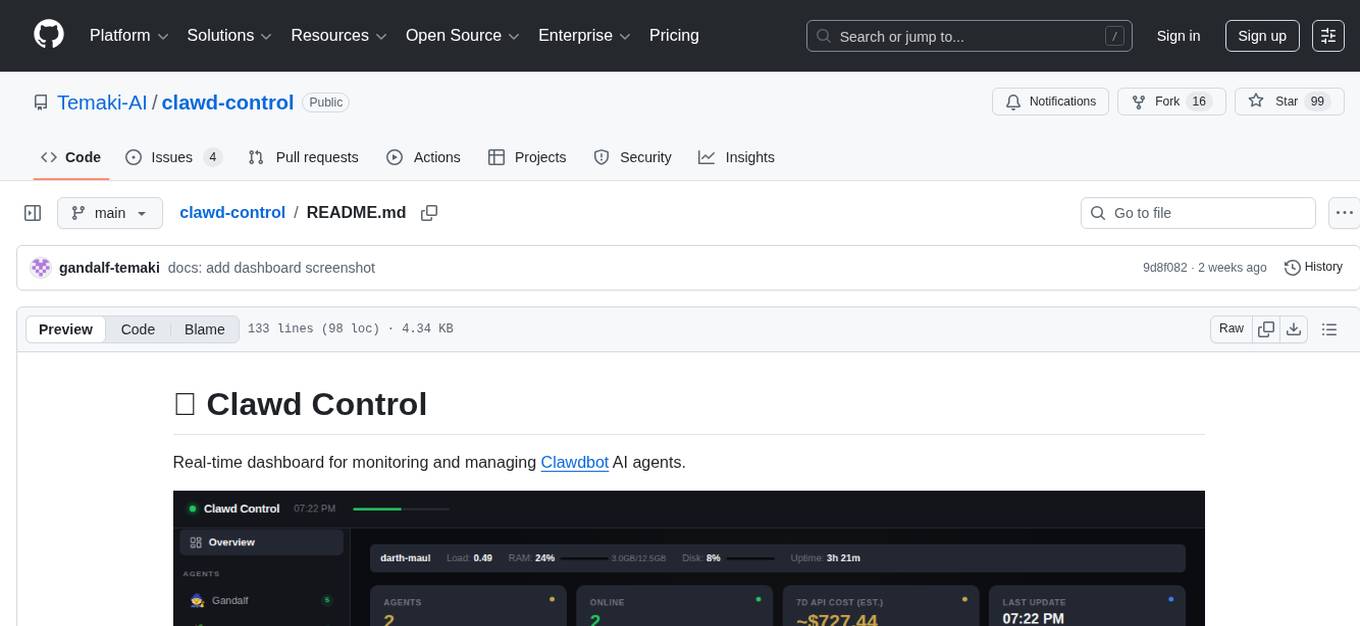
Clawd Control is a real-time dashboard designed for monitoring and managing Clawdbot AI agents. It provides live monitoring, fleet overview, agent detail views, agent creation wizard, host metrics, auto-discovery, SPA navigation, dark/light theme, password authentication, and keyboard shortcuts. The tool is deliberately simple, using a single Node.js server with no build step or framework, and a frontend with vanilla HTML/JS. Users can configure agents manually if auto-discovery fails, and the tool requires Node.js 18+ and Clawdbot agents running locally or on the network. Clawd Control is a standalone open-source project that pairs well with Temaki.ai, offering a collaborative workspace for humans and AI agents to work together.
README:
Real-time dashboard for monitoring and managing Clawdbot AI agents.
 -->
-->
Clawd Control gives you a single-screen view of your entire AI agent fleet. If you run Clawdbot agents, this is your mission control.
- Live monitoring — Real-time status, health, and metrics via SSE
- Fleet overview — See all agents at a glance with health indicators
- Agent detail views — Deep dive into any agent's sessions, channels, config
- Agent creation wizard — Spin up new agents with guided setup
- Host metrics — CPU, RAM, disk usage for your machine
- Auto-discovery — Finds local Clawdbot agents automatically
- SPA navigation — Instant page transitions, no reloads
-
Dark/light theme — Toggle with
T, or follows system preference - Password auth — Simple session-based authentication
-
Keyboard shortcuts —
Btoggle sidebar,Ttoggle theme,?for help
# Clone
git clone https://github.com/Temaki-AI/clawd-control.git
cd clawd-control
npm install

# Run — auto-discovers local Clawdbot agents
npm start
Open http://localhost:3100 and log in with the generated password (printed to console on first run).
If auto-discovery doesn't find your agents (remote hosts, custom ports):
cp agents.example.json agents.jsonEdit agents.json:
{
  "agents": [
    {
      "id": "my-agent",
      "gatewayAgentId": "main",
      "name": "My Agent",
      "emoji": "🤖",
      "host": "127.0.0.1",
      "port": 18789,
      "token": "YOUR_GATEWAY_TOKEN",
      "workspace": "/path/to/agent/workspace"
    }
  ],
  "pollIntervalMs": 15000,
  "hostMetricsIntervalMs": 30000
}| Option | Default | Description |
|---|---|---|
--port |
3100 |
HTTP port |
--bind |
0.0.0.0 |
Bind address (use 127.0.0.1 for local-only) |
On first run, a random password is generated and saved to auth.json. You'll see it in the console output. To set your own:
{
  "password": "your-password-here",
  "sessionTtlHours": 24
}Clawd Control is deliberately simple — a single Node.js server with no build step, no framework, no bundler. The frontend is vanilla HTML/JS with a shared layout module.
server.mjs          → HTTP server, SSE, auth, API proxy
layout.js           → Shared sidebar, topbar, theme, navigation
dashboard.html      → Fleet overview (main page)
agent-detail.html   → Individual agent deep dive
create.html         → Agent creation wizard
collector.mjs       → Background data collector (polls agents)
discover.mjs        → Auto-discovers local Clawdbot agents
create-agent.mjs    → Agent provisioning logic
security-lib/       → Auth, rate limiting, security headers
- Node.js 18+ (uses native fetch)
- Clawdbot agents running locally or on your network
- One dependency:
ws(WebSocket client for agent communication)
Q: Do I need Clawdbot installed?
Yes — Clawd Control is a dashboard for Clawdbot agents. Install Clawdbot first: npm install -g clawdbot
Q: Can I monitor remote agents?
Yes — add them to agents.json with their host/port/token. The agents need to be network-reachable.
Q: Is this related to Temaki? Clawd Control is a standalone open-source project. It pairs well with Temaki.ai — a collaborative workspace where humans and AI agents work together. Think of Clawd Control as your agent ops dashboard, and Temaki as where agents actually collaborate with your team.
- 🌐 clawdcontrol.com — Landing page & waitlist
- 💬 Discord — Join the community
- 📖 Clawdbot Docs — Full documentation
- 🐛 Issues — Bug reports and feature requests
Contributions welcome! This project favors simplicity — no build tools, no frameworks, vanilla everything. If your PR adds a node_modules folder the size of a small country, we need to talk.
MIT — do whatever you want with it.
For Tasks:
Click tags to check more tools for each tasksFor Jobs:
Alternative AI tools for clawd-control
Similar Open Source Tools
clawd-control
Clawd Control is a real-time dashboard designed for monitoring and managing Clawdbot AI agents. It provides live monitoring, fleet overview, agent detail views, agent creation wizard, host metrics, auto-discovery, SPA navigation, dark/light theme, password authentication, and keyboard shortcuts. The tool is deliberately simple, using a single Node.js server with no build step or framework, and a frontend with vanilla HTML/JS. Users can configure agents manually if auto-discovery fails, and the tool requires Node.js 18+ and Clawdbot agents running locally or on the network. Clawd Control is a standalone open-source project that pairs well with Temaki.ai, offering a collaborative workspace for humans and AI agents to work together.
Agentarium
Agentarium is a powerful Python framework for managing and orchestrating AI agents with ease. It provides a flexible and intuitive way to create, manage, and coordinate interactions between multiple AI agents in various environments. The framework offers advanced agent management, robust interaction management, a checkpoint system for saving and restoring agent states, data generation through agent interactions, performance optimization, flexible environment configuration, and an extensible architecture for customization.
eliza
Eliza is a versatile AI agent operating system designed to support various models and connectors, enabling users to create chatbots, autonomous agents, handle business processes, create video game NPCs, and engage in trading. It offers multi-agent and room support, document ingestion and interaction, retrievable memory and document store, and extensibility to create custom actions and clients. Eliza is easy to use and provides a comprehensive solution for AI agent development.
agent-squad
Agent Squad is a flexible, lightweight open-source framework for orchestrating multiple AI agents to handle complex conversations. It intelligently routes queries, maintains context across interactions, and offers pre-built components for quick deployment. The system allows easy integration of custom agents and conversation messages storage solutions, making it suitable for various applications from simple chatbots to sophisticated AI systems, scaling efficiently.
DesktopCommanderMCP
Desktop Commander MCP is a server that allows the Claude desktop app to execute long-running terminal commands on your computer and manage processes through Model Context Protocol (MCP). It is built on top of MCP Filesystem Server to provide additional search and replace file editing capabilities. The tool enables users to execute terminal commands with output streaming, manage processes, perform full filesystem operations, and edit code with surgical text replacements or full file rewrites. It also supports vscode-ripgrep based recursive code or text search in folders.
vision-agent
AskUI Vision Agent is a powerful automation framework that enables you and AI agents to control your desktop, mobile, and HMI devices and automate tasks. It supports multiple AI models, multi-platform compatibility, and enterprise-ready features. The tool provides support for Windows, Linux, MacOS, Android, and iOS device automation, single-step UI automation commands, in-background automation on Windows machines, flexible model use, and secure deployment of agents in enterprise environments.
gpt-computer-assistant
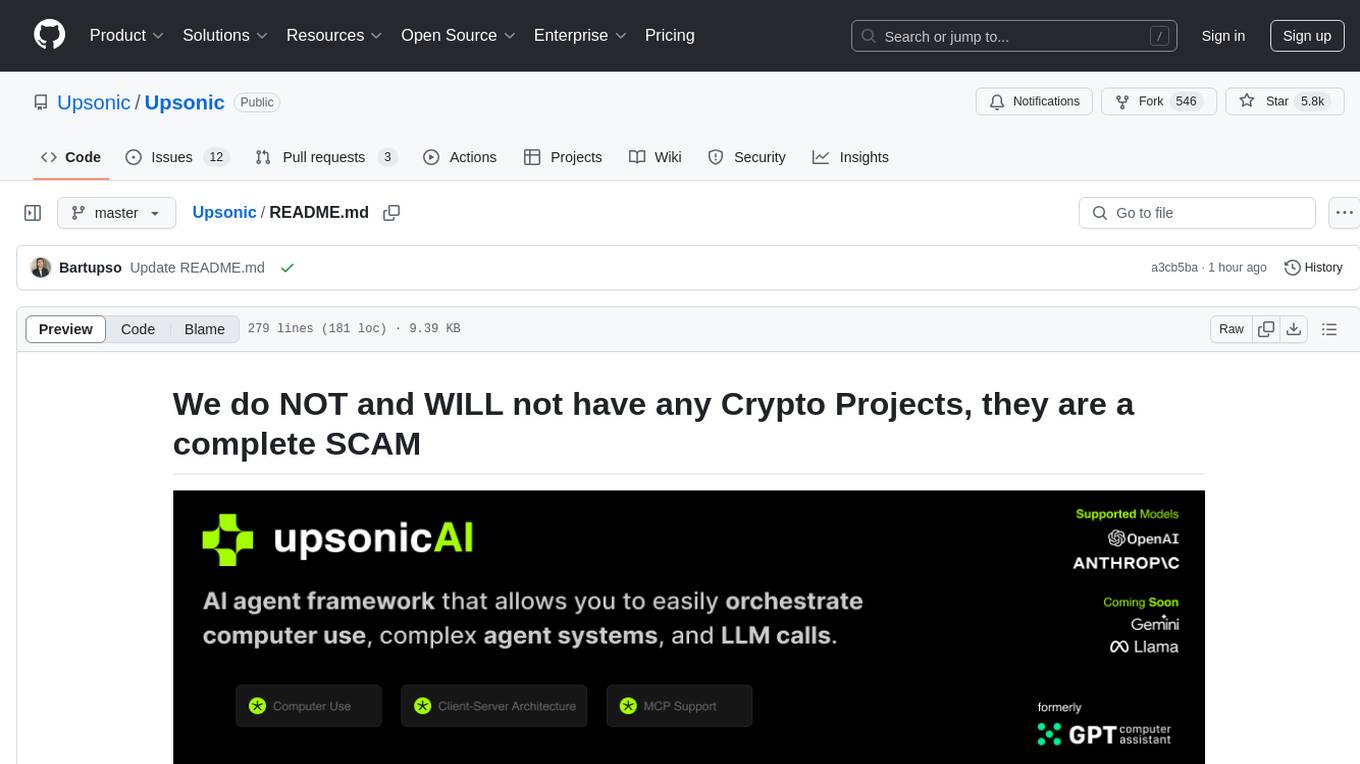
GPT Computer Assistant (GCA) is an open-source framework designed to build vertical AI agents that can automate tasks on Windows, macOS, and Ubuntu systems. It leverages the Model Context Protocol (MCP) and its own modules to mimic human-like actions and achieve advanced capabilities. With GCA, users can empower themselves to accomplish more in less time by automating tasks like updating dependencies, analyzing databases, and configuring cloud security settings.
agents
The LiveKit Agent Framework is designed for building real-time, programmable participants that run on servers. Easily tap into LiveKit WebRTC sessions and process or generate audio, video, and data streams. The framework includes plugins for common workflows, such as voice activity detection and speech-to-text. Agents integrates seamlessly with LiveKit server, offloading job queuing and scheduling responsibilities to it. This eliminates the need for additional queuing infrastructure. Agent code developed on your local machine can scale to support thousands of concurrent sessions when deployed to a server in production.
pocketpaw
PocketPaw is a lightweight and user-friendly tool designed for managing and organizing your digital assets. It provides a simple interface for users to easily categorize, tag, and search for files across different platforms. With PocketPaw, you can efficiently organize your photos, documents, and other files in a centralized location, making it easier to access and share them. Whether you are a student looking to organize your study materials, a professional managing project files, or a casual user wanting to declutter your digital space, PocketPaw is the perfect solution for all your file management needs.
golf
Golf is a simple command-line tool for calculating the distance between two geographic coordinates. It uses the Haversine formula to accurately determine the distance between two points on the Earth's surface. This tool is useful for developers working on location-based applications or projects that require distance calculations. With Golf, users can easily input latitude and longitude coordinates and get the precise distance in kilometers or miles. The tool is lightweight, easy to use, and can be integrated into various programming workflows.
AutoAgent
AutoAgent is a fully-automated and zero-code framework that enables users to create and deploy LLM agents through natural language alone. It is a top performer on the GAIA Benchmark, equipped with a native self-managing vector database, and allows for easy creation of tools, agents, and workflows without any coding. AutoAgent seamlessly integrates with a wide range of LLMs and supports both function-calling and ReAct interaction modes. It is designed to be dynamic, extensible, customized, and lightweight, serving as a personal AI assistant.
sandbox-agent
Sandbox Agent is a server that runs inside sandboxes to control coding agents remotely over HTTP. It provides a universal API to interact with coding agents like Claude Code, Codex, OpenCode, and Amp, allowing users to manage sessions, handle permissions, and stream events. The tool solves the challenges of executing coding agents remotely, standardizes APIs for different agents, and persists session data for later replay and auditing. It offers features like streaming events, human-in-the-loop interactions, automatic agent installation, and runs inside any sandbox environment.
VibeSurf
VibeSurf is an open-source AI agentic browser that combines workflow automation with intelligent AI agents, offering faster, cheaper, and smarter browser automation. It allows users to create revolutionary browser workflows, run multiple AI agents in parallel, perform intelligent AI automation tasks, maintain privacy with local LLM support, and seamlessly integrate as a Chrome extension. Users can save on token costs, achieve efficiency gains, and enjoy deterministic workflows for consistent and accurate results. VibeSurf also provides a Docker image for easy deployment and offers pre-built workflow templates for common tasks.
preswald
Preswald is a full-stack platform for building, deploying, and managing interactive data applications in Python. It simplifies the process by combining ingestion, storage, transformation, and visualization into one lightweight SDK. With Preswald, users can connect to various data sources, customize app themes, and easily deploy apps locally. The platform focuses on code-first simplicity, end-to-end coverage, and efficiency by design, making it suitable for prototyping internal tools or deploying production-grade apps with reduced complexity and cost.
fast-mcp
Fast MCP is a Ruby gem that simplifies the integration of AI models with your Ruby applications. It provides a clean implementation of the Model Context Protocol, eliminating complex communication protocols, integration challenges, and compatibility issues. With Fast MCP, you can easily connect AI models to your servers, share data resources, choose from multiple transports, integrate with frameworks like Rails and Sinatra, and secure your AI-powered endpoints. The gem also offers real-time updates and authentication support, making AI integration a seamless experience for developers.
gptme
Personal AI assistant/agent in your terminal, with tools for using the terminal, running code, editing files, browsing the web, using vision, and more. A great coding agent that is general-purpose to assist in all kinds of knowledge work, from a simple but powerful CLI. An unconstrained local alternative to ChatGPT with 'Code Interpreter', Cursor Agent, etc. Not limited by lack of software, internet access, timeouts, or privacy concerns if using local models.
For similar tasks
clawd-control
Clawd Control is a real-time dashboard designed for monitoring and managing Clawdbot AI agents. It provides live monitoring, fleet overview, agent detail views, agent creation wizard, host metrics, auto-discovery, SPA navigation, dark/light theme, password authentication, and keyboard shortcuts. The tool is deliberately simple, using a single Node.js server with no build step or framework, and a frontend with vanilla HTML/JS. Users can configure agents manually if auto-discovery fails, and the tool requires Node.js 18+ and Clawdbot agents running locally or on the network. Clawd Control is a standalone open-source project that pairs well with Temaki.ai, offering a collaborative workspace for humans and AI agents to work together.
For similar jobs

pezzo
Pezzo is a fully cloud-native and open-source LLMOps platform that allows users to observe and monitor AI operations, troubleshoot issues, save costs and latency, collaborate, manage prompts, and deliver AI changes instantly. It supports various clients for prompt management, observability, and caching. Users can run the full Pezzo stack locally using Docker Compose, with prerequisites including Node.js 18+, Docker, and a GraphQL Language Feature Support VSCode Extension. Contributions are welcome, and the source code is available under the Apache 2.0 License.
clawd-control
Clawd Control is a real-time dashboard designed for monitoring and managing Clawdbot AI agents. It provides live monitoring, fleet overview, agent detail views, agent creation wizard, host metrics, auto-discovery, SPA navigation, dark/light theme, password authentication, and keyboard shortcuts. The tool is deliberately simple, using a single Node.js server with no build step or framework, and a frontend with vanilla HTML/JS. Users can configure agents manually if auto-discovery fails, and the tool requires Node.js 18+ and Clawdbot agents running locally or on the network. Clawd Control is a standalone open-source project that pairs well with Temaki.ai, offering a collaborative workspace for humans and AI agents to work together.
weave
Weave is a toolkit for developing Generative AI applications, built by Weights & Biases. With Weave, you can log and debug language model inputs, outputs, and traces; build rigorous, apples-to-apples evaluations for language model use cases; and organize all the information generated across the LLM workflow, from experimentation to evaluations to production. Weave aims to bring rigor, best-practices, and composability to the inherently experimental process of developing Generative AI software, without introducing cognitive overhead.
agentcloud
AgentCloud is an open-source platform that enables companies to build and deploy private LLM chat apps, empowering teams to securely interact with their data. It comprises three main components: Agent Backend, Webapp, and Vector Proxy. To run this project locally, clone the repository, install Docker, and start the services. The project is licensed under the GNU Affero General Public License, version 3 only. Contributions and feedback are welcome from the community.
oss-fuzz-gen
This framework generates fuzz targets for real-world `C`/`C++` projects with various Large Language Models (LLM) and benchmarks them via the `OSS-Fuzz` platform. It manages to successfully leverage LLMs to generate valid fuzz targets (which generate non-zero coverage increase) for 160 C/C++ projects. The maximum line coverage increase is 29% from the existing human-written targets.
LLMStack
LLMStack is a no-code platform for building generative AI agents, workflows, and chatbots. It allows users to connect their own data, internal tools, and GPT-powered models without any coding experience. LLMStack can be deployed to the cloud or on-premise and can be accessed via HTTP API or triggered from Slack or Discord.
VisionCraft
The VisionCraft API is a free API for using over 100 different AI models. From images to sound.
kaito
Kaito is an operator that automates the AI/ML inference model deployment in a Kubernetes cluster. It manages large model files using container images, avoids tuning deployment parameters to fit GPU hardware by providing preset configurations, auto-provisions GPU nodes based on model requirements, and hosts large model images in the public Microsoft Container Registry (MCR) if the license allows. Using Kaito, the workflow of onboarding large AI inference models in Kubernetes is largely simplified.