


loras-dev
An AI image generator w/ Flux LoRAs
Stars: 132
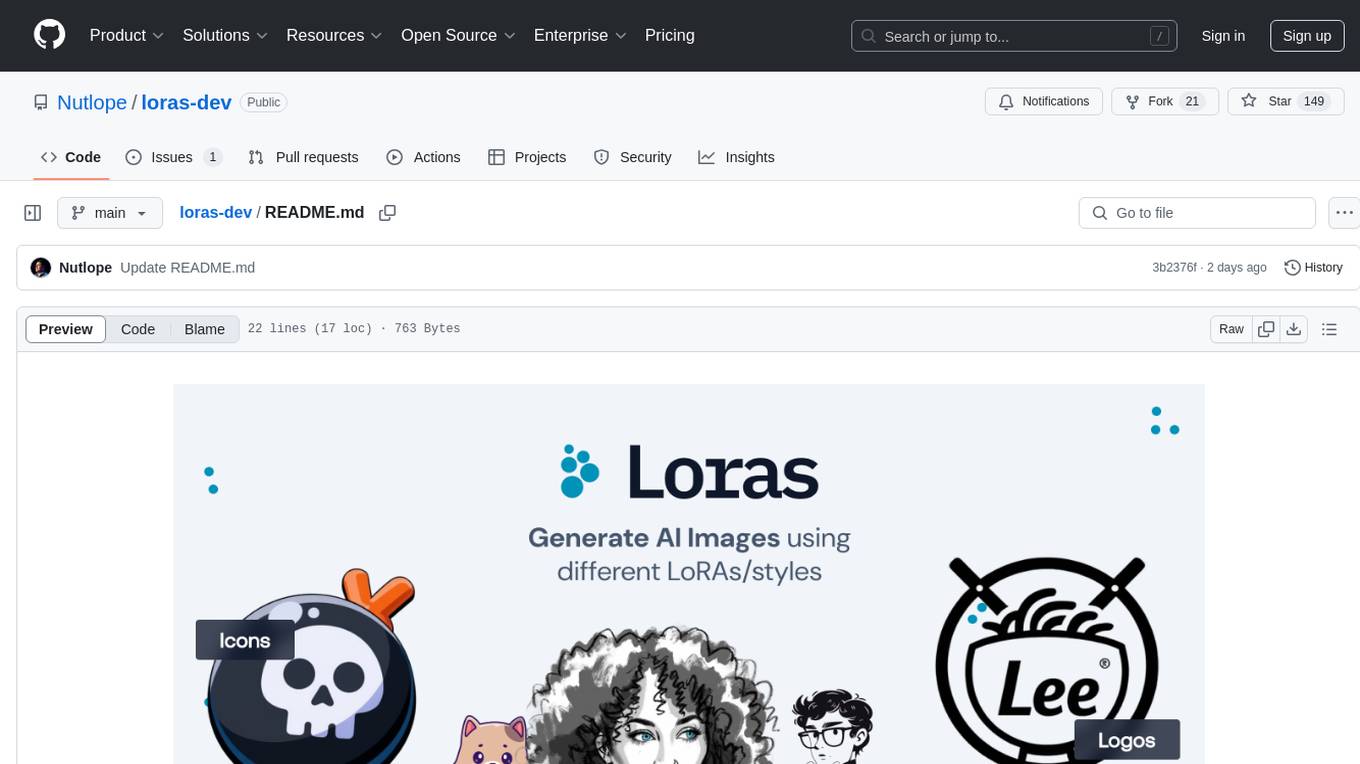
Loras is an open source real-time AI image generator powered by Flux through Together.ai. It utilizes Flux Dev from BFL for the image model, Together AI for inference, Next.js app router with Tailwind, Helicone for observability, and Plausible for website analytics. Users can clone the repository, add their Together AI API key to a .env.local file, install dependencies, and run the tool locally to generate AI images in real-time.
README:

An open source real-time AI image generator. Powered by Flux through Together.ai.
- Flux Dev from BFL for the image model
- Together AI for inference
- Next.js app router with Tailwind
- Helicone for observability
- Plausible for website analytics
- Clone the repo:
git clone https://github.com/Nutlope/loras-dev - Create a
.env.localfile and add your Together AI API key:TOGETHER_API_KEY= - Run
npm installandnpm run devto install dependencies and run locally
For Tasks:
Click tags to check more tools for each tasksFor Jobs:
Alternative AI tools for loras-dev
Similar Open Source Tools
loras-dev
Loras is an open source real-time AI image generator powered by Flux through Together.ai. It utilizes Flux Dev from BFL for the image model, Together AI for inference, Next.js app router with Tailwind, Helicone for observability, and Plausible for website analytics. Users can clone the repository, add their Together AI API key to a .env.local file, install dependencies, and run the tool locally to generate AI images in real-time.
blinkshot
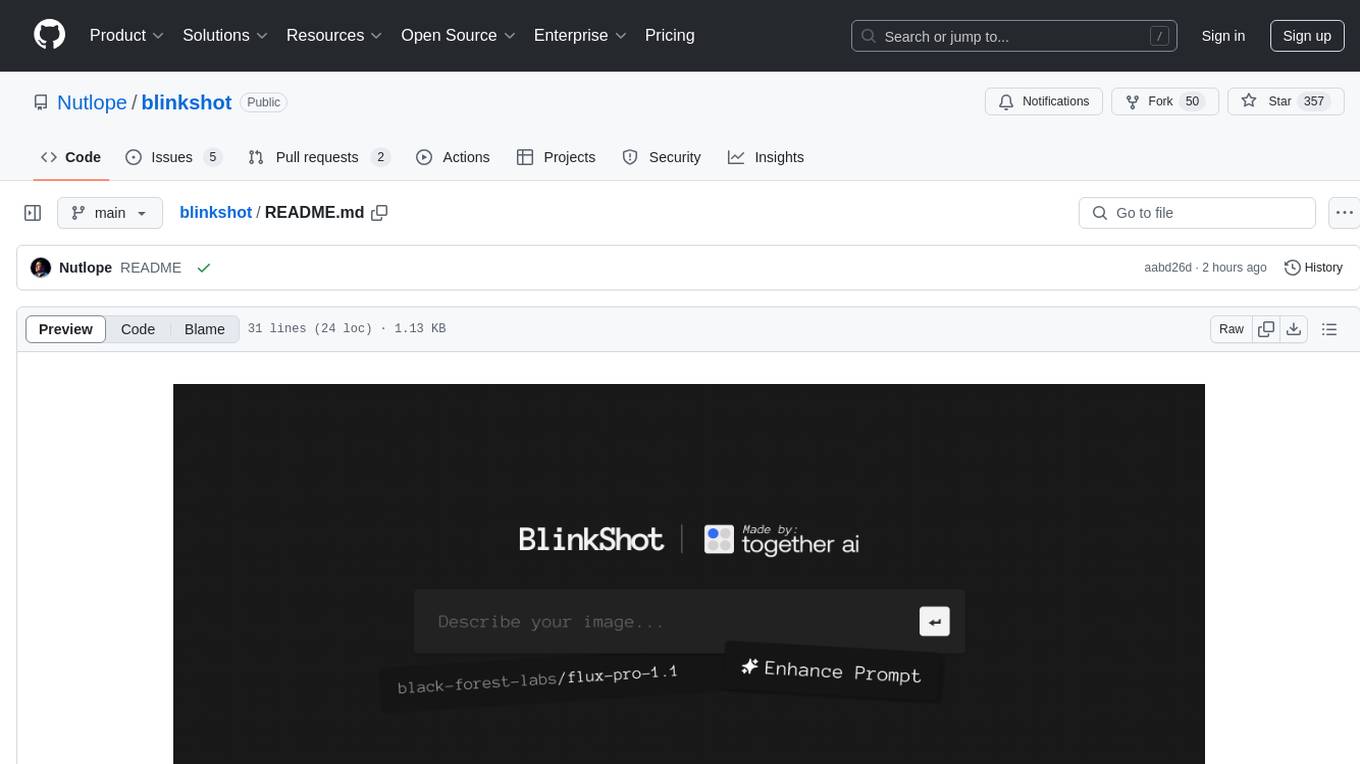
BlinkShot is an open source real-time AI image generator powered by Flux through Together.ai. It utilizes Flux Schnell from BFL for the image model, Together AI for inference, Next.js app router with Tailwind for the frontend, Helicone for observability, and Plausible for website analytics. Users can clone the repository, add their Together AI API key, and run the app locally to generate AI images. Future tasks include adding a call-to-action to fork the code on GitHub, implementing a download button on hover, allowing users to adjust resolutions and steps, adding an app description to the footer, and introducing themes.
ai-chatbot-svelte
SvelteKit AI Chatbot is an open-source template built with SvelteKit and the AI SDK by Vercel. It provides a unified API for generating text, structured objects, and tool calls with LLMs. The template includes hooks for building dynamic chat and generative user interfaces, supports various model providers, and offers styling with Tailwind CSS. Data persistence is ensured with Vercel Postgres and Blob for saving chat history and user data. Users can easily deploy their own version of the chatbot to Vercel with one click and run it locally using the provided environment variables.
generative-ai-js
Generative AI JS is a JavaScript library that provides tools for creating generative art and music using artificial intelligence techniques. It allows users to generate unique and creative content by leveraging machine learning models. The library includes functions for generating images, music, and text based on user input and preferences. With Generative AI JS, users can explore the intersection of art and technology, experiment with different creative processes, and create dynamic and interactive content for various applications.
sdxl-lightning-demo-app
This repository contains a demo application showcasing the usage of the SDXL Lightning API by fal.ai. The application also demonstrates the functionality of the fal.realtime client. To get started, users need to have a Fal AI API key for model access. The setup involves adding the API key to the .env.local file, installing dependencies using 'npm install', and running the application with 'npm run dev'.
spring-ai
The Spring AI project provides a Spring-friendly API and abstractions for developing AI applications. It offers a portable client API for interacting with generative AI models, enabling developers to easily swap out implementations and access various models like OpenAI, Azure OpenAI, and HuggingFace. Spring AI also supports prompt engineering, providing classes and interfaces for creating and parsing prompts, as well as incorporating proprietary data into generative AI without retraining the model. This is achieved through Retrieval Augmented Generation (RAG), which involves extracting, transforming, and loading data into a vector database for use by AI models. Spring AI's VectorStore abstraction allows for seamless transitions between different vector database implementations.
ai-chatbot
Next.js AI Chatbot is an open-source app template for building AI chatbots using Next.js, Vercel AI SDK, OpenAI, and Vercel KV. It includes features like Next.js App Router, React Server Components, Vercel AI SDK for streaming chat UI, support for various AI models, Tailwind CSS styling, Radix UI for headless components, chat history management, rate limiting, session storage with Vercel KV, and authentication with NextAuth.js. The template allows easy deployment to Vercel and customization of AI model providers.
todoist-ai
Library for connecting AI agents to Todoist, enabling them to access and modify a Todoist account on the user's behalf. Tools can be used through an MCP server or integrated into other projects for AI conversational interfaces. Reusable tools allow for complete workflows, balancing flexibility and efficiency for LLMs. Early-stage project with more tools planned. Designed to provide a small set of tools for various AI interfaces.
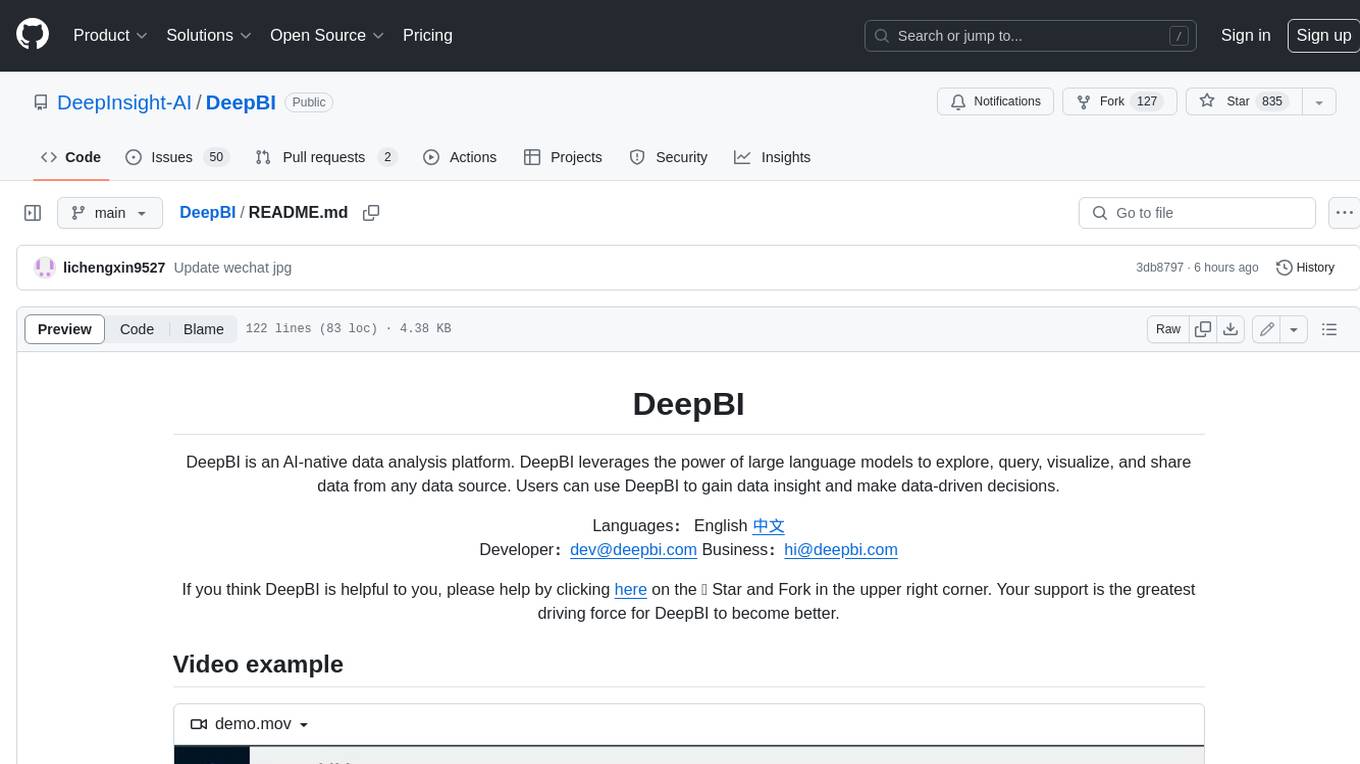
DeepBI
DeepBI is an AI-native data analysis platform that leverages the power of large language models to explore, query, visualize, and share data from any data source. Users can use DeepBI to gain data insight and make data-driven decisions.
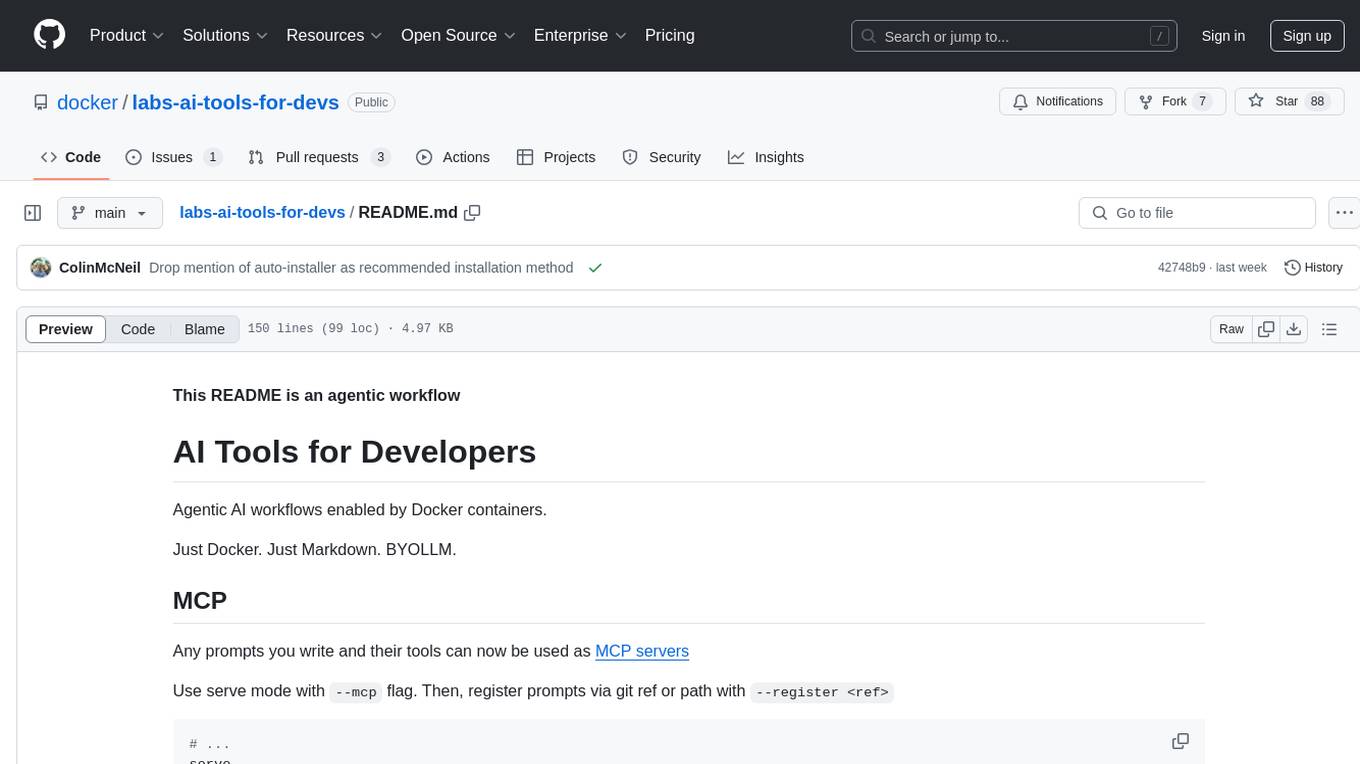
labs-ai-tools-for-devs
This repository provides AI tools for developers through Docker containers, enabling agentic workflows. It allows users to create complex workflows using Dockerized tools and Markdown, leveraging various LLM models. The core features include Dockerized tools, conversation loops, multi-model agents, project-first design, and trackable prompts stored in a git repo.
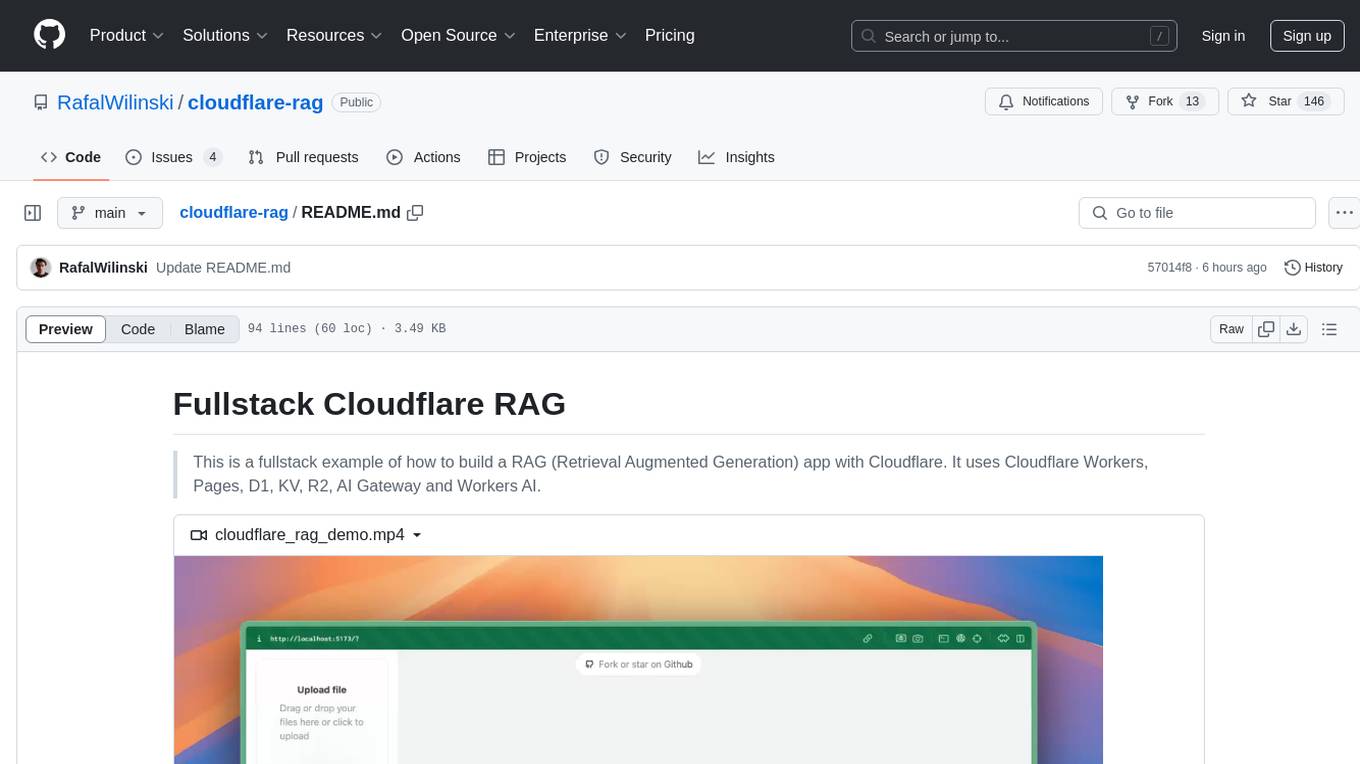
cloudflare-rag
This repository provides a fullstack example of building a Retrieval Augmented Generation (RAG) app with Cloudflare. It utilizes Cloudflare Workers, Pages, D1, KV, R2, AI Gateway, and Workers AI. The app features streaming interactions to the UI, hybrid RAG with Full-Text Search and Vector Search, switchable providers using AI Gateway, per-IP rate limiting with Cloudflare's KV, OCR within Cloudflare Worker, and Smart Placement for workload optimization. The development setup requires Node, pnpm, and wrangler CLI, along with setting up necessary primitives and API keys. Deployment involves setting up secrets and deploying the app to Cloudflare Pages. The project implements a Hybrid Search RAG approach combining Full Text Search against D1 and Hybrid Search with embeddings against Vectorize to enhance context for the LLM.
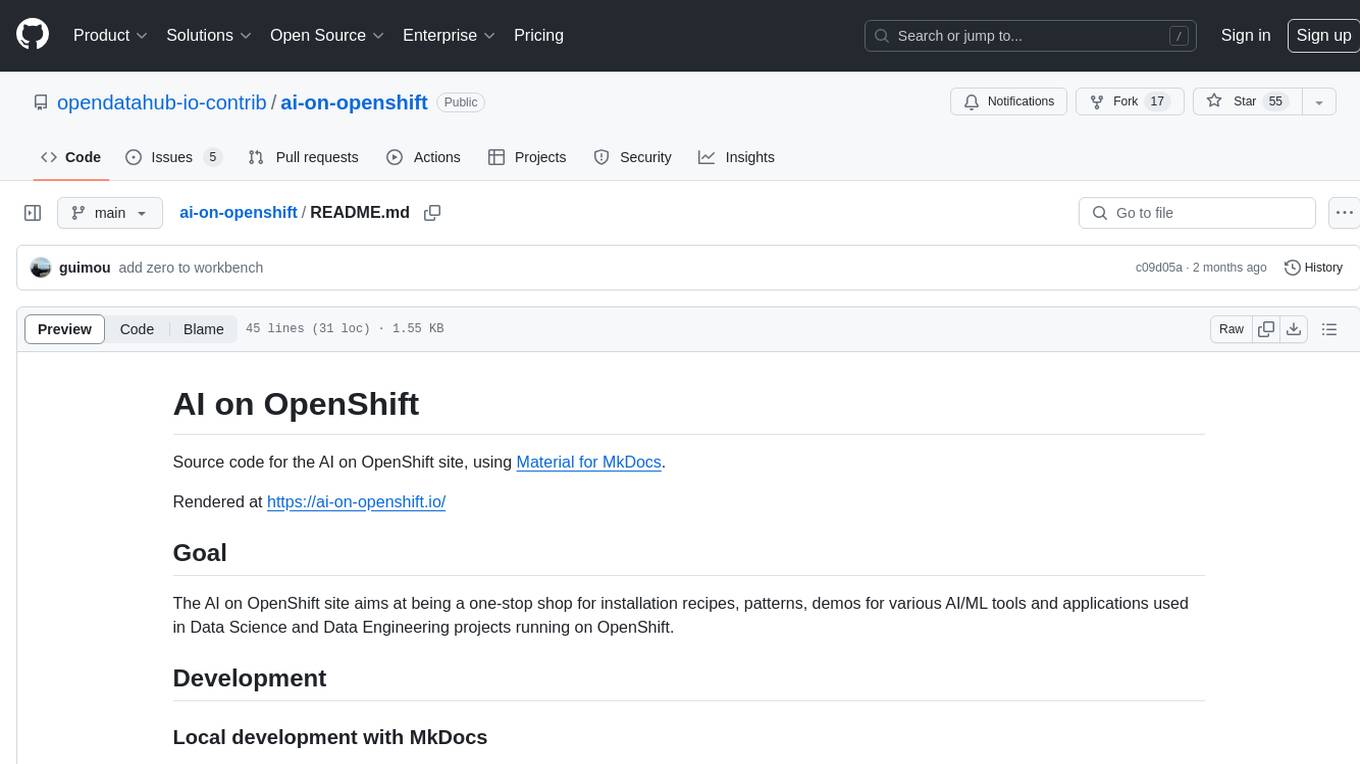
ai-on-openshift
AI on OpenShift is a site providing installation recipes, patterns, and demos for AI/ML tools and applications used in Data Science and Data Engineering projects running on OpenShift. It serves as a comprehensive resource for developers looking to deploy AI solutions on the OpenShift platform.
ainodes-engine
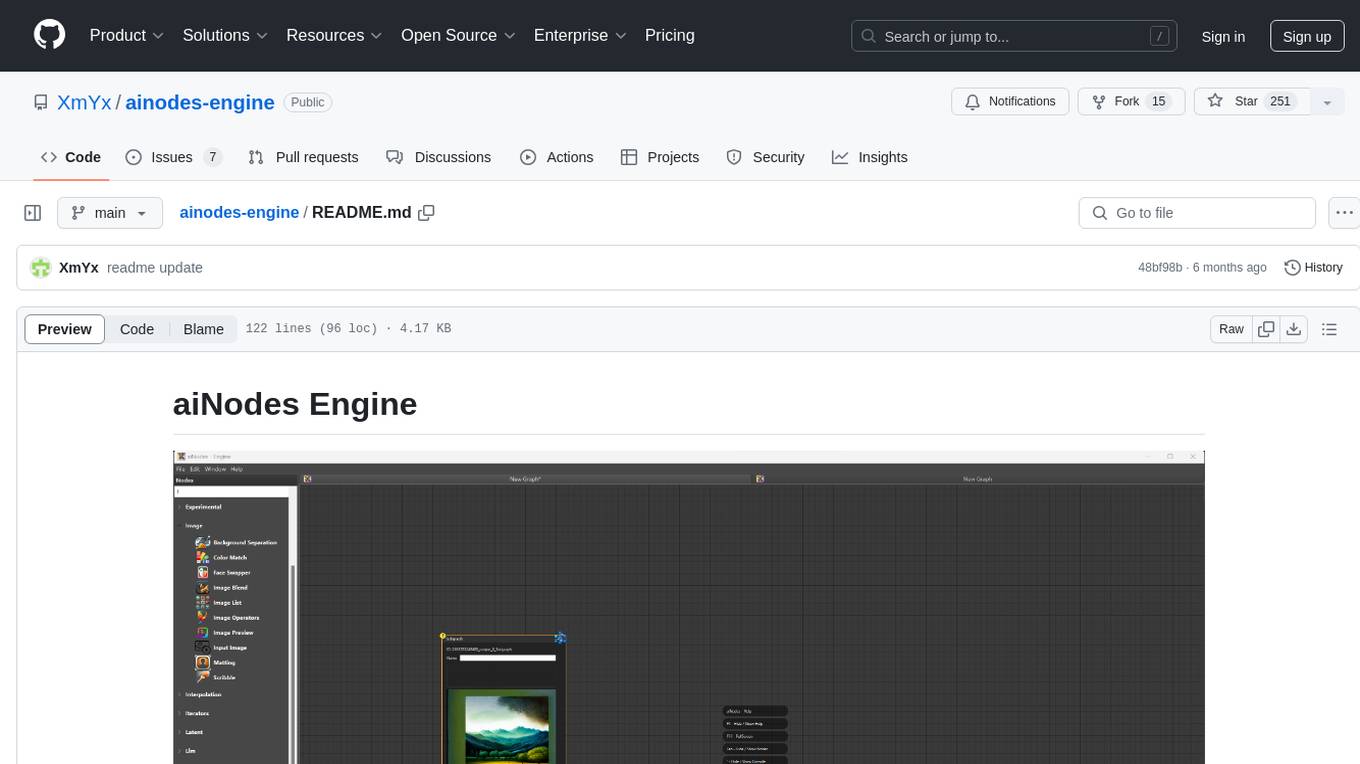
aiNodes Engine is a Python-based AI image/motion picture generator node engine with a live execution chain, python code editor node, and plug-in support. It offers full modularity, colored background drop, and easy node creation with IDE annotations. The project is officially supported by Deforum and incorporates various open-source projects like ComfyUI. It is designed to be flexible, with an Unreal-like execution chain, supporting features such as Deforum, Stable Diffusion, Upscalers, Kandinsky, ControlNet, and more. The engine allows for background separation, human matting/masking, compositing, drag and drop, subgraphs, and graph saving/loading from image metadata. It aims to provide a unique, controllable manner of working with a strict user-declared execution chain.
writer-framework
Writer Framework is an open-source framework for creating AI applications. It allows users to build user interfaces using a visual editor and write the backend code in Python. The framework is fast, flexible, and provides separation of concerns between UI and business logic. It is reactive and state-driven, highly customizable without requiring CSS, fast in event handling, developer-friendly with easy installation and quick start options, and contains full documentation for using its AI module and deployment options.
whisplay-ai-chatbot
Whisplay-AI-Chatbot is a pocket-sized AI chatbot device built using a Raspberry Pi Zero 2w. It features a PiSugar Whisplay HAT with an LCD screen, on-board speaker, and microphone. Users can interact with the chatbot by pressing a button, speaking, and receiving responses, similar to a futuristic walkie-talkie. The tool supports various functionalities such as adjusting volume autonomously, resetting conversation history, local ASR and TTS capabilities, image generation, and integration with APIs like Google Gemini and Grok. It also offers support for LLM8850 AI Accelerator for offline capabilities like ASR, TTS, and LLM API. The chatbot saves conversation history and generated images in a data folder, and users can customize the tool with different enclosure cases available for Pi02 and Pi5 models.
writer-framework
Writer Framework is an open-source framework for creating AI applications. It allows users to build user interfaces using a visual editor and write the backend code in Python. The framework is fast, flexible, and developer-friendly, providing separation of concerns between UI and business logic. It is reactive and state-driven, allowing for highly customizable elements without the need for CSS. Writer Framework is designed to be fast, with minimal overhead on Python code, and uses WebSockets for synchronization. It is contained in a standard Python package, supports local code editing with instant refreshes, and enables editing the UI while the app is running.
For similar tasks
Azure-Analytics-and-AI-Engagement
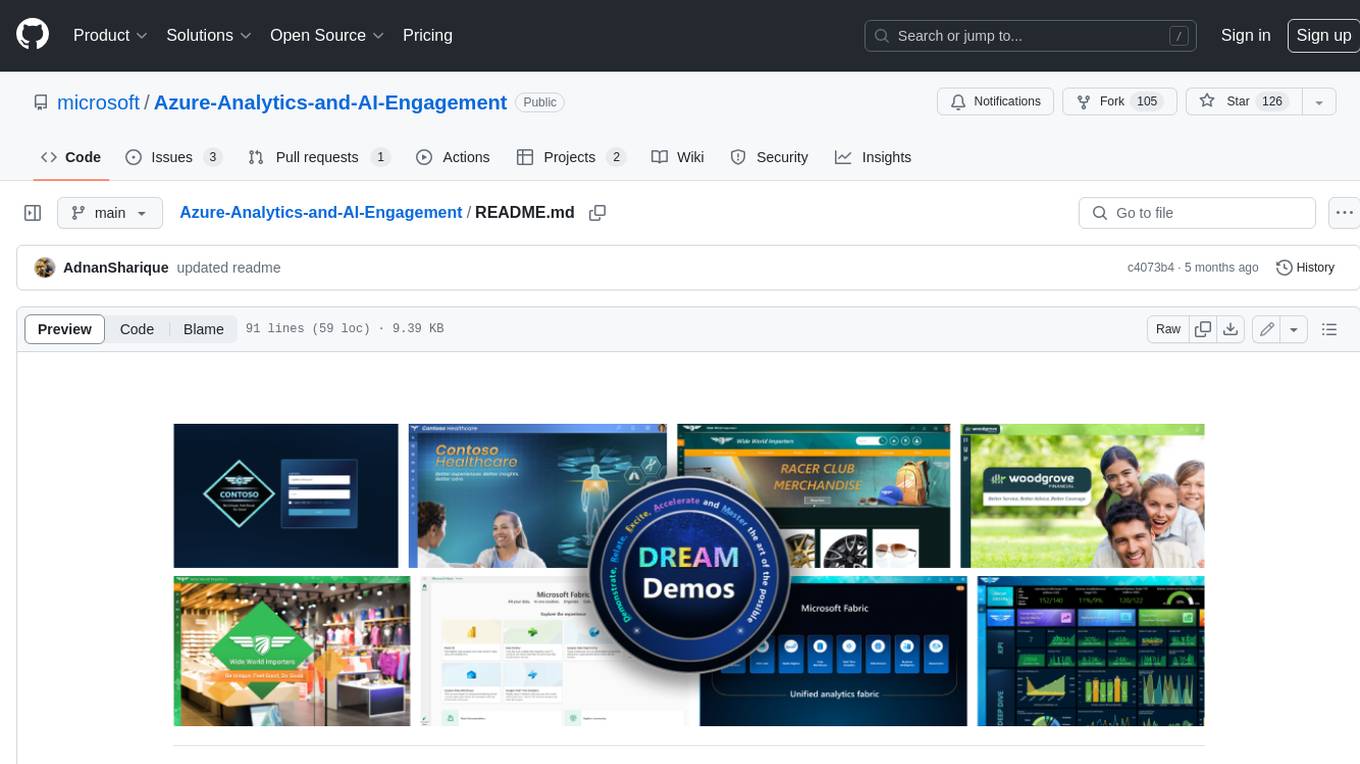
The Azure-Analytics-and-AI-Engagement repository provides packaged Industry Scenario DREAM Demos with ARM templates (Containing a demo web application, Power BI reports, Synapse resources, AML Notebooks etc.) that can be deployed in a customer’s subscription using the CAPE tool within a matter of few hours. Partners can also deploy DREAM Demos in their own subscriptions using DPoC.
sorrentum
Sorrentum is an open-source project that aims to combine open-source development, startups, and brilliant students to build machine learning, AI, and Web3 / DeFi protocols geared towards finance and economics. The project provides opportunities for internships, research assistantships, and development grants, as well as the chance to work on cutting-edge problems, learn about startups, write academic papers, and get internships and full-time positions at companies working on Sorrentum applications.
tidb
TiDB is an open-source distributed SQL database that supports Hybrid Transactional and Analytical Processing (HTAP) workloads. It is MySQL compatible and features horizontal scalability, strong consistency, and high availability.

zep-python
Zep is an open-source platform for building and deploying large language model (LLM) applications. It provides a suite of tools and services that make it easy to integrate LLMs into your applications, including chat history memory, embedding, vector search, and data enrichment. Zep is designed to be scalable, reliable, and easy to use, making it a great choice for developers who want to build LLM-powered applications quickly and easily.
telemetry-airflow
This repository codifies the Airflow cluster that is deployed at workflow.telemetry.mozilla.org (behind SSO) and commonly referred to as "WTMO" or simply "Airflow". Some links relevant to users and developers of WTMO: * The `dags` directory in this repository contains some custom DAG definitions * Many of the DAGs registered with WTMO don't live in this repository, but are instead generated from ETL task definitions in bigquery-etl * The Data SRE team maintains a WTMO Developer Guide (behind SSO)
mojo
Mojo is a new programming language that bridges the gap between research and production by combining Python syntax and ecosystem with systems programming and metaprogramming features. Mojo is still young, but it is designed to become a superset of Python over time.
pandas-ai
PandasAI is a Python library that makes it easy to ask questions to your data in natural language. It helps you to explore, clean, and analyze your data using generative AI.
databend
Databend is an open-source cloud data warehouse that serves as a cost-effective alternative to Snowflake. With its focus on fast query execution and data ingestion, it's designed for complex analysis of the world's largest datasets.
For similar jobs
sweep
Sweep is an AI junior developer that turns bugs and feature requests into code changes. It automatically handles developer experience improvements like adding type hints and improving test coverage.
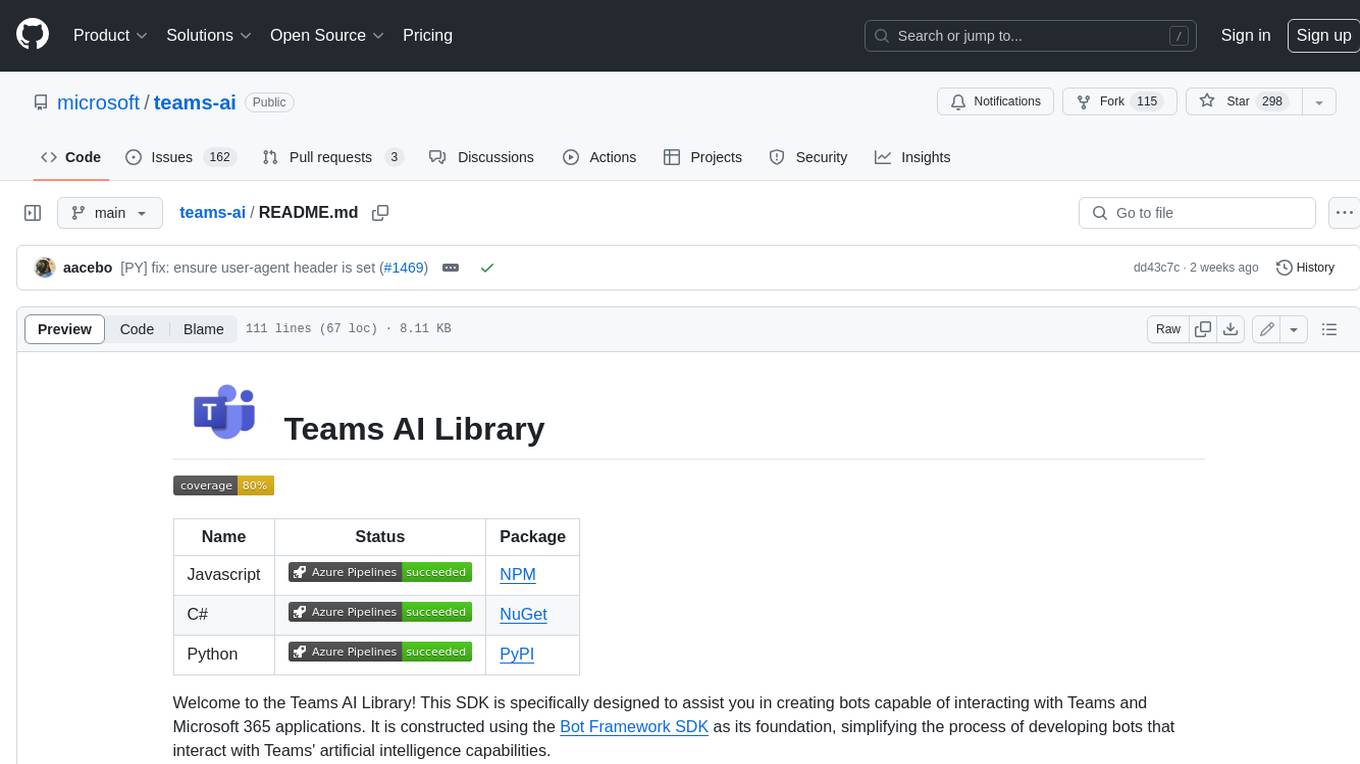
teams-ai
The Teams AI Library is a software development kit (SDK) that helps developers create bots that can interact with Teams and Microsoft 365 applications. It is built on top of the Bot Framework SDK and simplifies the process of developing bots that interact with Teams' artificial intelligence capabilities. The SDK is available for JavaScript/TypeScript, .NET, and Python.
ai-guide
This guide is dedicated to Large Language Models (LLMs) that you can run on your home computer. It assumes your PC is a lower-end, non-gaming setup.
classifai
Supercharge WordPress Content Workflows and Engagement with Artificial Intelligence. Tap into leading cloud-based services like OpenAI, Microsoft Azure AI, Google Gemini and IBM Watson to augment your WordPress-powered websites. Publish content faster while improving SEO performance and increasing audience engagement. ClassifAI integrates Artificial Intelligence and Machine Learning technologies to lighten your workload and eliminate tedious tasks, giving you more time to create original content that matters.
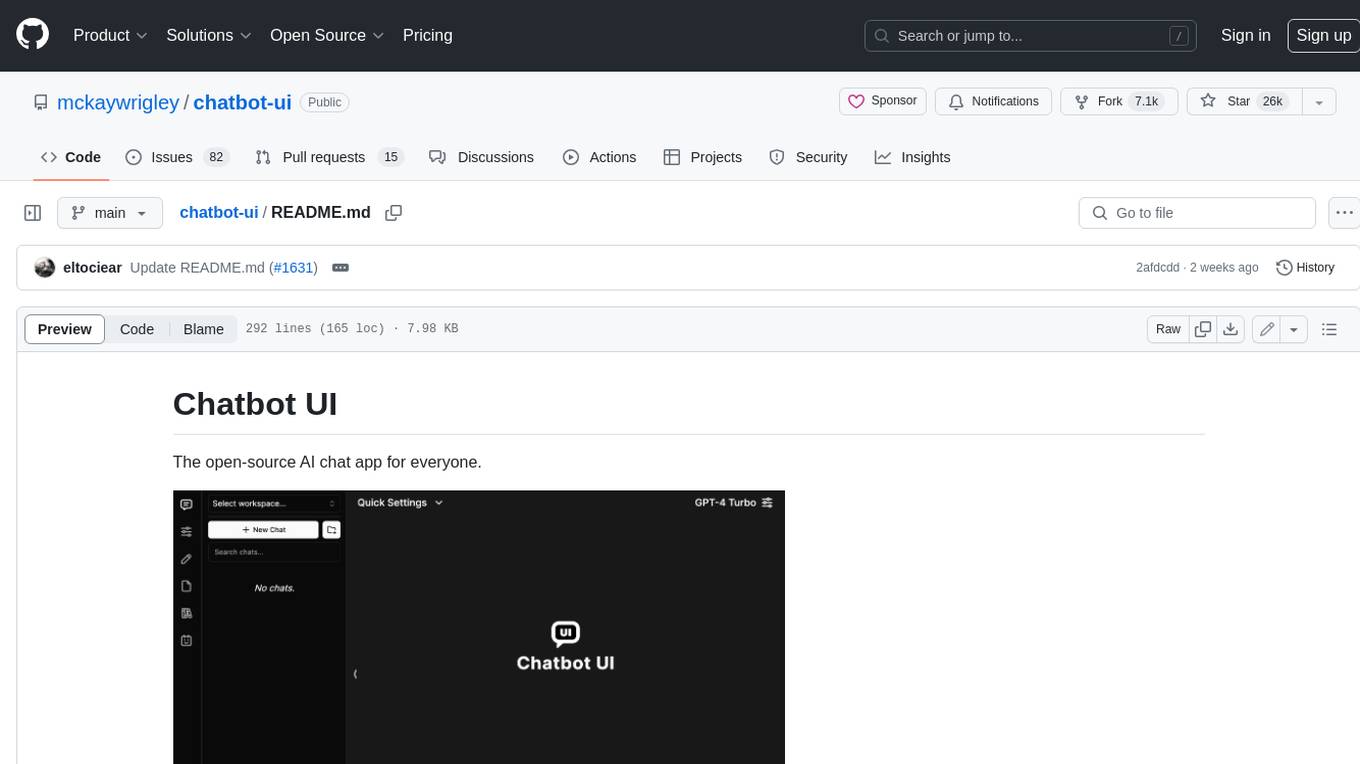
chatbot-ui
Chatbot UI is an open-source AI chat app that allows users to create and deploy their own AI chatbots. It is easy to use and can be customized to fit any need. Chatbot UI is perfect for businesses, developers, and anyone who wants to create a chatbot.
BricksLLM
BricksLLM is a cloud native AI gateway written in Go. Currently, it provides native support for OpenAI, Anthropic, Azure OpenAI and vLLM. BricksLLM aims to provide enterprise level infrastructure that can power any LLM production use cases. Here are some use cases for BricksLLM: * Set LLM usage limits for users on different pricing tiers * Track LLM usage on a per user and per organization basis * Block or redact requests containing PIIs * Improve LLM reliability with failovers, retries and caching * Distribute API keys with rate limits and cost limits for internal development/production use cases * Distribute API keys with rate limits and cost limits for students
uAgents
uAgents is a Python library developed by Fetch.ai that allows for the creation of autonomous AI agents. These agents can perform various tasks on a schedule or take action on various events. uAgents are easy to create and manage, and they are connected to a fast-growing network of other uAgents. They are also secure, with cryptographically secured messages and wallets.
griptape
Griptape is a modular Python framework for building AI-powered applications that securely connect to your enterprise data and APIs. It offers developers the ability to maintain control and flexibility at every step. Griptape's core components include Structures (Agents, Pipelines, and Workflows), Tasks, Tools, Memory (Conversation Memory, Task Memory, and Meta Memory), Drivers (Prompt and Embedding Drivers, Vector Store Drivers, Image Generation Drivers, Image Query Drivers, SQL Drivers, Web Scraper Drivers, and Conversation Memory Drivers), Engines (Query Engines, Extraction Engines, Summary Engines, Image Generation Engines, and Image Query Engines), and additional components (Rulesets, Loaders, Artifacts, Chunkers, and Tokenizers). Griptape enables developers to create AI-powered applications with ease and efficiency.