


ai-news-radar
None
Stars: 66
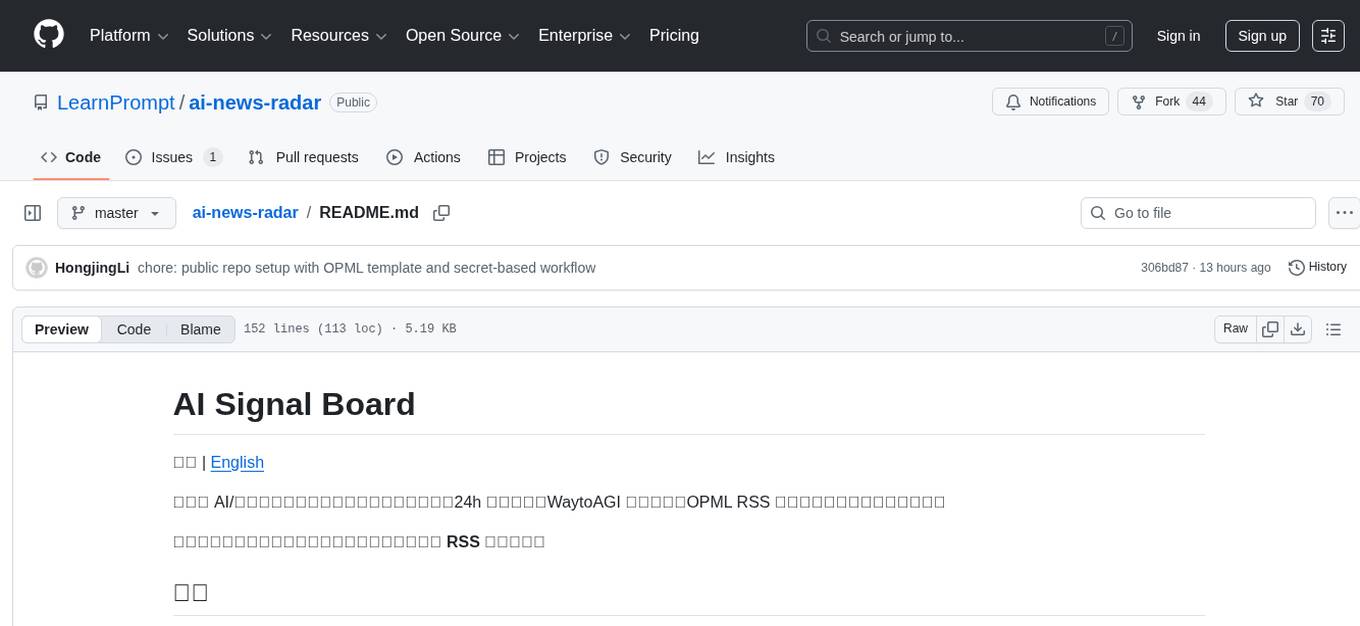
AI Signal Board is a high-quality AI/tech news aggregation project that supports static web page display, 24-hour incremental updates, WaytoAGI update logs, OPML RSS batch access, and failure source replacement and alerts. The project includes features such as multi-source web aggregation, OPML RSS ingestion, 24-hour two-mode UI, deduplication functionality, bilingual title rendering, WaytoAGI timeline, and RSS resilience. Users can easily update news data, view aggregated news from various sources, and customize their RSS subscriptions. The project does not require any API keys for core functionality and provides detailed instructions for configuration and usage.
README:
中文 | English
高质量 AI/科技新闻聚合项目,支持静态网页展示、24h 增量更新、WaytoAGI 更新日志、OPML RSS 批量接入、失败源替换与告警。
说明:本仓库已适配公开发布,不会包含作者私有 RSS 订阅文件。
不需要。
你只要执行一个命令,或者直接用 GitHub Actions 定时运行即可。
- 本地命令(一次):
python scripts/update_news.py --output-dir data --window-hours 24 --rss-opml feeds/follow.opml
- 自动化(推荐):
-
.github/workflows/update-news.yml已配置定时任务,默认每 30 分钟自动更新并提交数据。
-
- 10 个网页源聚合(TechURLs / Buzzing / Info Flow / BestBlogs / TopHub / Zeli / AI HubToday / AIbase / AI今日热榜 / NewsNow)
- OPML RSS 批量接入(私有文件
feeds/follow.opml,仓库提供模板feeds/follow.example.opml) - 24h 双视图:
AI强相关/全量 - 全量模式去重开关
- AI 模式默认去重
- 站点与分区聚合展示
- 中英双语标题显示
- WaytoAGI:
当天/近7日切换 - RSS 失败源自动处理:
- 能替换官方源则自动替换
- 无官方 RSS 的源自动跳过,避免浪费抓取时间
- 告警数据输出:
-
failed_feeds/zero_item_feeds/skipped_feeds/replaced_feeds
-
data/latest-24h.jsondata/archive.jsondata/source-status.jsondata/waytoagi-7d.jsondata/title-zh-cache.json
cd /Users/carl/Downloads/10_项目代码/01_内容自动化与发布/ai-news-radar
python3 -m venv .venv
source .venv/bin/activate
pip install -r requirements.txt
cp feeds/follow.example.opml feeds/follow.opml
# 把你自己的 OPML 内容替换到 feeds/follow.opml(不要提交到仓库)
python scripts/update_news.py --output-dir data --window-hours 24 --rss-opml feeds/follow.opml
python -m http.server 8080
打开:http://localhost:8080
默认情况下,本项目 不需要任何 API Key 才能运行核心抓取流程。
你目前没有提供 API 密钥,仓库中也不会写入任何密钥信息。
推荐仅在运行环境中配置(不要提交到仓库):
- 代理(可选):
HTTP_PROXYHTTPS_PROXY
- 如果你未来接入私有 API/私有 RSS:
- 把密钥放到 GitHub Secrets(Actions)或本地环境变量
- 不要写入代码、README、日志、
.env示例中的真实值
- 私有 RSS OPML(推荐):
- GitHub Actions Secret:
FOLLOW_OPML_B64 - 生成方式(macOS/Linux):
-
base64 < feeds/follow.opml | pbcopy(macOS) - 然后把内容粘贴到 GitHub 仓库的 Secrets
-
- GitHub Actions Secret:
工作流:.github/workflows/update-news.yml
- 定时:每 30 分钟
- 任务:执行抓取命令并提交
data/* - RSS OPML:若设置了
FOLLOW_OPML_B64,工作流会自动解码为feeds/follow.opml - 推送权限:使用
GITHUB_TOKEN(workflow 内)
Production-grade AI/tech news aggregator with a static web UI, 24h updates, WaytoAGI timeline, and OPML RSS ingestion.
This repo is safe for public release and does not include the maintainer's private RSS subscription file.
No.
You only need to run one command, or let GitHub Actions run it on schedule.
- One-shot local command:
python scripts/update_news.py --output-dir data --window-hours 24 --rss-opml feeds/follow.opml
- Scheduled automation:
-
.github/workflows/update-news.ymlruns every 30 minutes and commits updated data.
-
- Multi-source web aggregation
- OPML RSS ingestion (private
feeds/follow.opml; template provided asfeeds/follow.example.opml) - 24h two-mode UI (
AI-focused/All) - Dedup toggle in All mode, dedup-by-default in AI mode
- Site + section grouping
- Bilingual title rendering
- WaytoAGI toggle (
Today/Last 7 Days) - RSS resilience:
- Auto-replace failed feeds with official sources when available
- Auto-skip unsupported source types (to save crawl time)
- Alert-friendly status output (
failed_feeds,zero_item_feeds,skipped_feeds,replaced_feeds)
data/latest-24h.jsondata/archive.jsondata/source-status.jsondata/waytoagi-7d.jsondata/title-zh-cache.json
cd /Users/carl/Downloads/10_项目代码/01_内容自动化与发布/ai-news-radar
python3 -m venv .venv
source .venv/bin/activate
pip install -r requirements.txt
cp feeds/follow.example.opml feeds/follow.opml
# Replace with your own OPML subscriptions (do not commit this file)
python scripts/update_news.py --output-dir data --window-hours 24 --rss-opml feeds/follow.opml
python -m http.server 8080
Open: http://localhost:8080
By default, this project needs no API keys for the core pipeline.
No secrets are stored in this repo.
If you later add private APIs/feeds:
- Use environment variables or GitHub Secrets
- Never commit real tokens/keys
- For private RSS OPML in GitHub Actions, store
base64content in secretFOLLOW_OPML_B64
For Tasks:
Click tags to check more tools for each tasksFor Jobs:
Alternative AI tools for ai-news-radar
Similar Open Source Tools
ai-news-radar
AI Signal Board is a high-quality AI/tech news aggregation project that supports static web page display, 24-hour incremental updates, WaytoAGI update logs, OPML RSS batch access, and failure source replacement and alerts. The project includes features such as multi-source web aggregation, OPML RSS ingestion, 24-hour two-mode UI, deduplication functionality, bilingual title rendering, WaytoAGI timeline, and RSS resilience. Users can easily update news data, view aggregated news from various sources, and customize their RSS subscriptions. The project does not require any API keys for core functionality and provides detailed instructions for configuration and usage.
9router
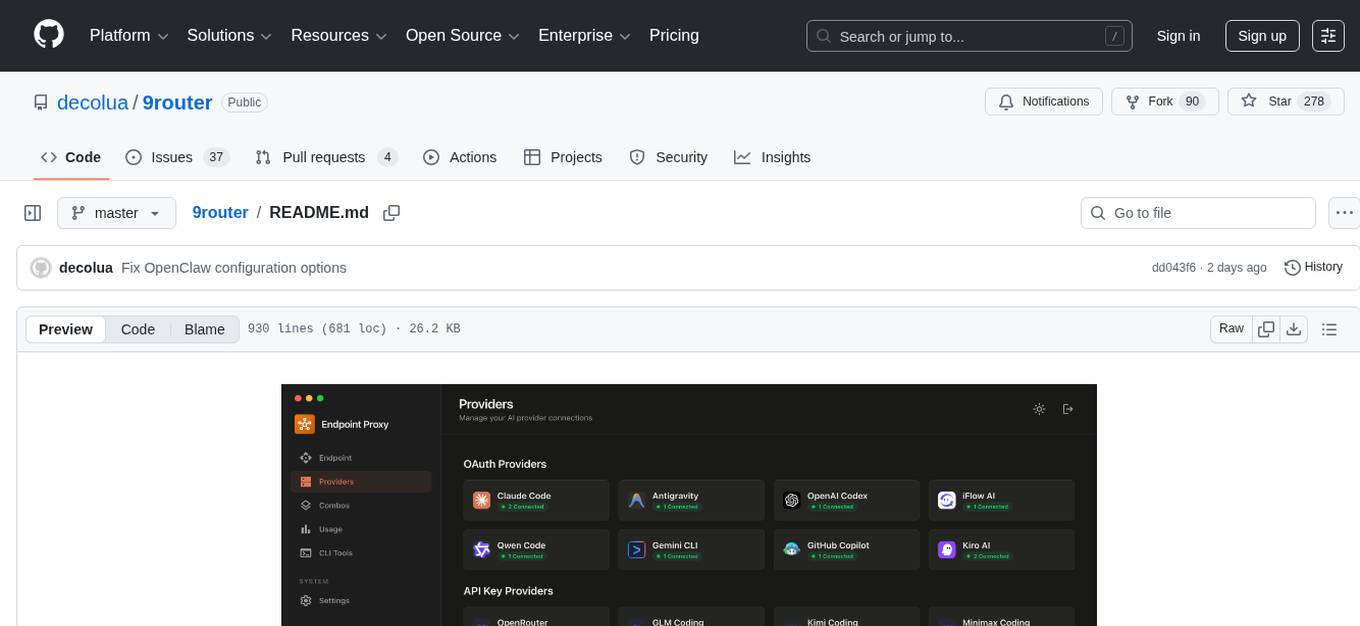
9Router is a free AI router tool designed to help developers maximize their AI subscriptions, auto-route to free and cheap AI models with smart fallback, and avoid hitting limits and wasting money. It offers features like real-time quota tracking, format translation between OpenAI, Claude, and Gemini, multi-account support, auto token refresh, custom model combinations, request logging, cloud sync, usage analytics, and flexible deployment options. The tool supports various providers like Claude Code, Codex, Gemini CLI, GitHub Copilot, GLM, MiniMax, iFlow, Qwen, and Kiro, and allows users to create combos for different scenarios. Users can connect to the tool via CLI tools like Cursor, Claude Code, Codex, OpenClaw, and Cline, and deploy it on VPS, Docker, or Cloudflare Workers.
readme-ai
README-AI is a developer tool that auto-generates README.md files using a combination of data extraction and generative AI. It streamlines documentation creation and maintenance, enhancing developer productivity. This project aims to enable all skill levels, across all domains, to better understand, use, and contribute to open-source software. It offers flexible README generation, supports multiple large language models (LLMs), provides customizable output options, works with various programming languages and project types, and includes an offline mode for generating boilerplate README files without external API calls.
video2blog
video2blog is an open-source project aimed at converting videos into textual notes. The tool follows a process of extracting video information using yt-dlp, downloading the video, downloading subtitles if available, translating subtitles if not in Chinese, generating Chinese subtitles using whisper if no subtitles exist, converting subtitles to articles using gemini, and manually inserting images from the video into the article. The tool provides a solution for creating blog content from video resources, enhancing accessibility and content creation efficiency.
oh-my-pi
oh-my-pi is an AI coding agent for the terminal, providing tools for interactive coding, AI-powered git commits, Python code execution, LSP integration, time-traveling streamed rules, interactive code review, task management, interactive questioning, custom TypeScript slash commands, universal config discovery, MCP & plugin system, web search & fetch, SSH tool, Cursor provider integration, multi-credential support, image generation, TUI overhaul, edit fuzzy matching, and more. It offers a modern terminal interface with smart session management, supports multiple AI providers, and includes various tools for coding, task management, code review, and interactive questioning.
tokscale
Tokscale is a high-performance CLI tool and visualization dashboard for tracking token usage and costs across multiple AI coding agents. It helps monitor and analyze token consumption from various AI coding tools, providing real-time pricing calculations using LiteLLM's pricing data. Inspired by the Kardashev scale, Tokscale measures token consumption as users scale the ranks of AI-augmented development. It offers interactive TUI mode, multi-platform support, real-time pricing, detailed breakdowns, web visualization, flexible filtering, and social platform features.
ai-real-estate-assistant
AI Real Estate Assistant is a modern platform that uses AI to assist real estate agencies in helping buyers and renters find their ideal properties. It features multiple AI model providers, intelligent query processing, advanced search and retrieval capabilities, and enhanced user experience. The tool is built with a FastAPI backend and Next.js frontend, offering semantic search, hybrid agent routing, and real-time analytics.
mcp-context-forge
MCP Context Forge is a powerful tool for generating context-aware data for machine learning models. It provides functionalities to create diverse datasets with contextual information, enhancing the performance of AI algorithms. The tool supports various data formats and allows users to customize the context generation process easily. With MCP Context Forge, users can efficiently prepare training data for tasks requiring contextual understanding, such as sentiment analysis, recommendation systems, and natural language processing.
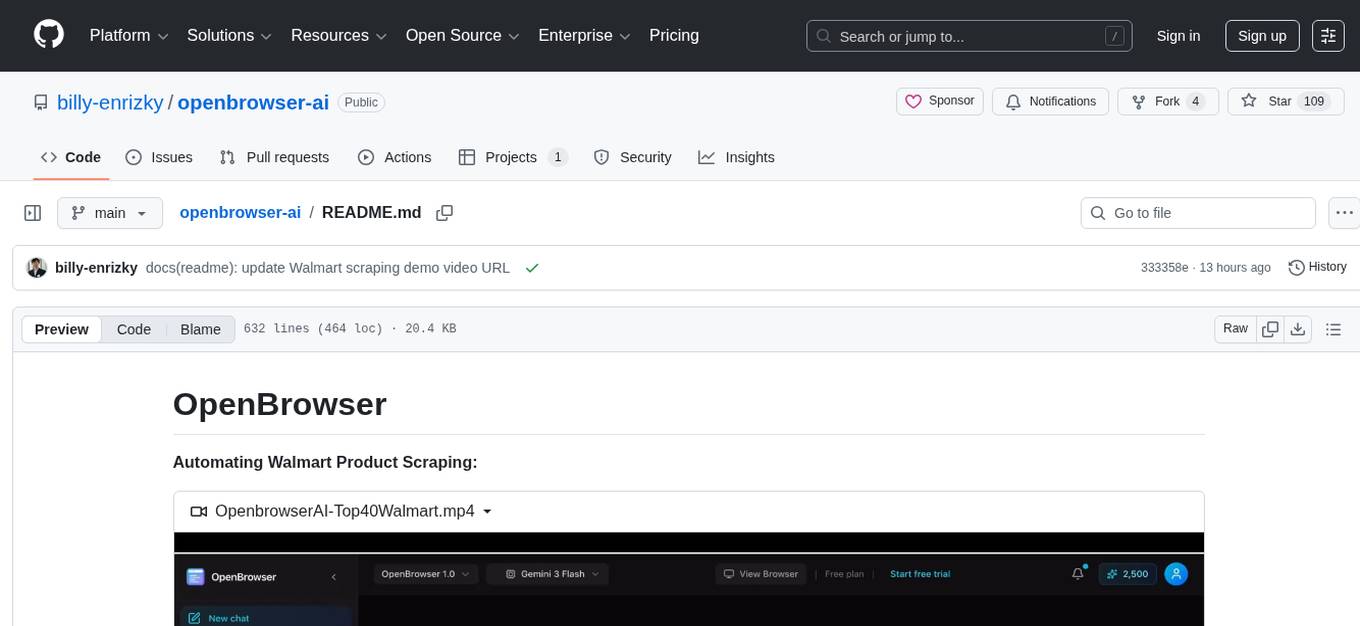
openbrowser-ai
OpenBrowser is a framework for intelligent browser automation that combines direct CDP communication with a CodeAgent architecture. It allows users to navigate, interact with, and extract information from web pages autonomously. The tool supports various LLM providers, offers vision support for screenshot analysis, and includes a MCP server for Model Context Protocol support. Users can record browser sessions as video files and benefit from features like video recording and full documentation available at docs.openbrowser.me.
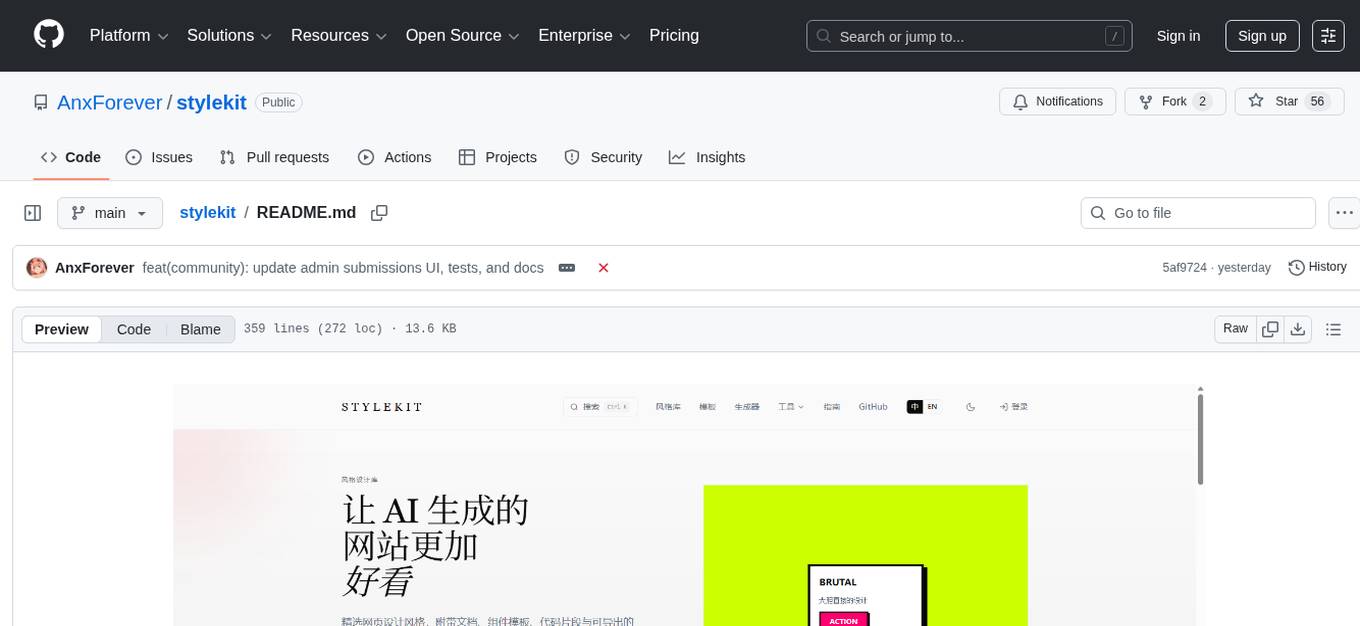
stylekit
StyleKit is a comprehensive design system toolkit that helps both humans and AI generate consistent, high-quality UI code. It provides structured style specifications, design tokens, component recipes, prompt templates, and export tools — everything needed to go from 'I want a glassmorphism SaaS dashboard' to production-ready frontend code. With 90+ visual styles, 20+ page templates, 25+ UI components, and AI-powered tools like Prompt Builder, Smart Recommender, Style Linter, Style Analyzer, and Style Blender, StyleKit offers a platform with GitHub OAuth, ratings & comments, style submissions, instant community availability, favorites, bilingual support, PWA, and dark/light mode themes.
Lumina-Note
Lumina Note is a local-first AI note-taking app designed to help users write, connect, and evolve knowledge with AI capabilities while ensuring data ownership. It offers a knowledge-centered workflow with features like Markdown editor, WikiLinks, and graph view. The app includes AI workspace modes such as Chat, Agent, Deep Research, and Codex, along with support for multiple model providers. Users can benefit from bidirectional links, LaTeX support, graph visualization, PDF reader with annotations, real-time voice input, and plugin ecosystem for extended functionalities. Lumina Note is built on Tauri v2 framework with a tech stack including React 18, TypeScript, Tailwind CSS, and SQLite for vector storage.
ChatPilot
ChatPilot is a chat agent tool that enables AgentChat conversations, supports Google search, URL conversation (RAG), and code interpreter functionality, replicates Kimi Chat (file, drag and drop; URL, send out), and supports OpenAI/Azure API. It is based on LangChain and implements ReAct and OpenAI Function Call for agent Q&A dialogue. The tool supports various automatic tools such as online search using Google Search API, URL parsing tool, Python code interpreter, and enhanced RAG file Q&A with query rewriting support. It also allows front-end and back-end service separation using Svelte and FastAPI, respectively. Additionally, it supports voice input/output, image generation, user management, permission control, and chat record import/export.
zeroclaw
ZeroClaw is a fast, small, and fully autonomous AI assistant infrastructure built with Rust. It features a lean runtime, cost-efficient deployment, fast cold starts, and a portable architecture. It is secure by design, fully swappable, and supports OpenAI-compatible provider support. The tool is designed for low-cost boards and small cloud instances, with a memory footprint of less than 5MB. It is suitable for tasks like deploying AI assistants, swapping providers/channels/tools, and pluggable everything.
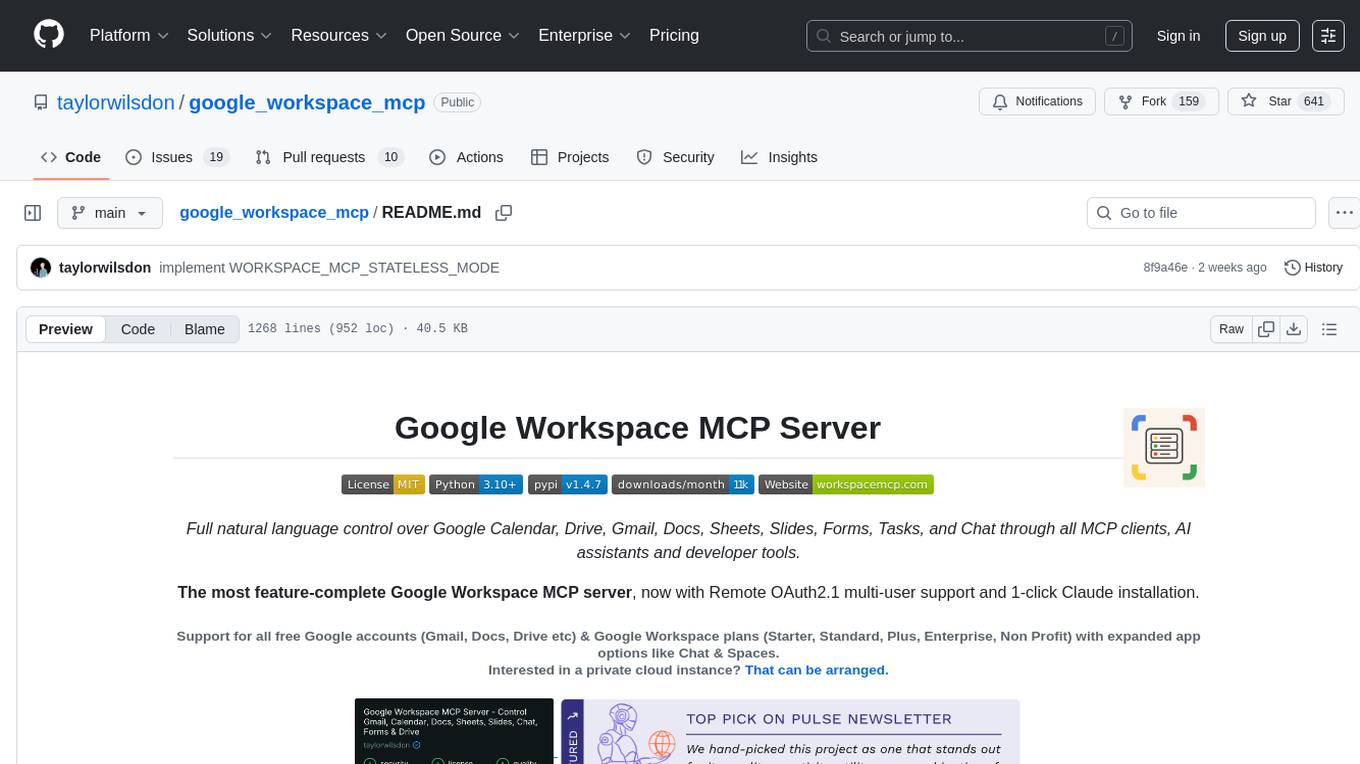
google_workspace_mcp
The Google Workspace MCP Server is a production-ready server that integrates major Google Workspace services with AI assistants. It supports single-user and multi-user authentication via OAuth 2.1, making it a powerful backend for custom applications. Built with FastMCP for optimal performance, it features advanced authentication handling, service caching, and streamlined development patterns. The server provides full natural language control over Google Calendar, Drive, Gmail, Docs, Sheets, Slides, Forms, Tasks, and Chat through all MCP clients, AI assistants, and developer tools. It supports free Google accounts and Google Workspace plans with expanded app options like Chat & Spaces. The server also offers private cloud instance options.
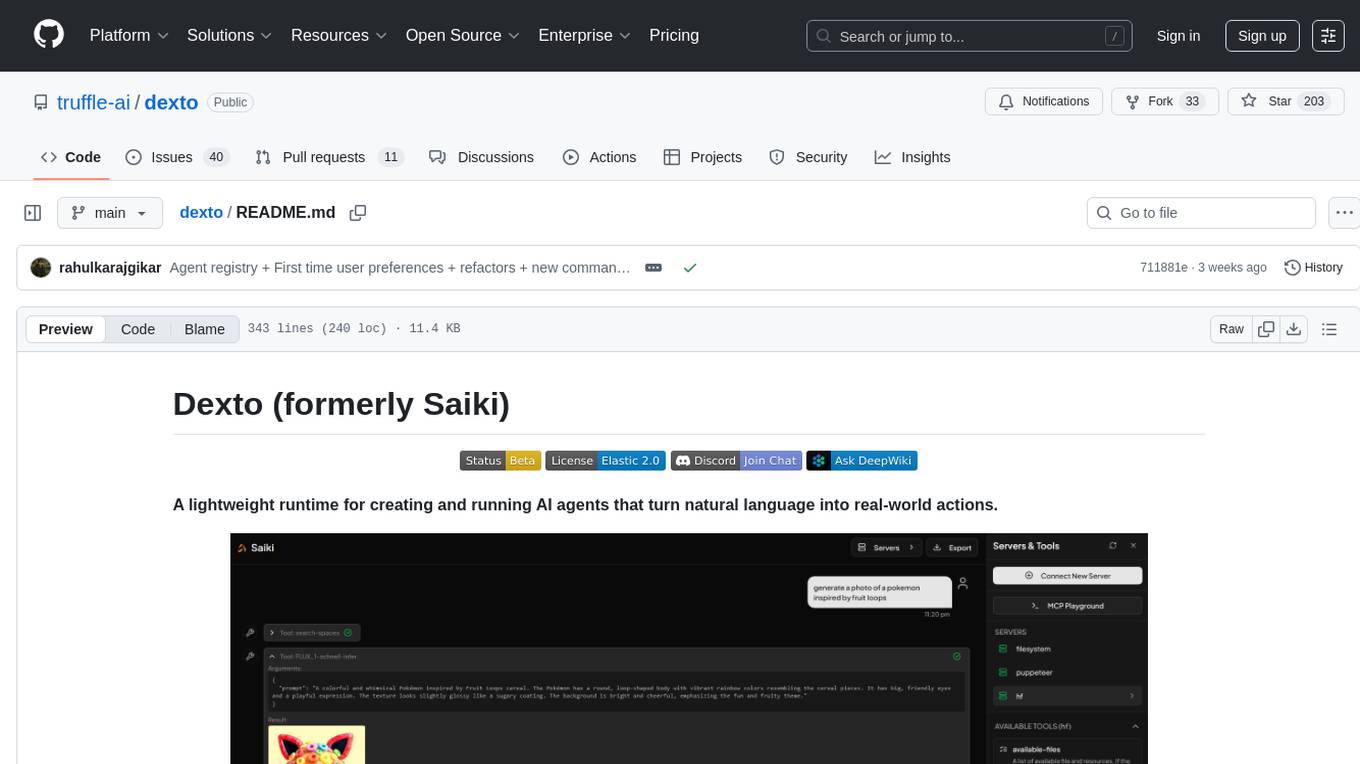
dexto
Dexto is a lightweight runtime for creating and running AI agents that turn natural language into real-world actions. It serves as the missing intelligence layer for building AI applications, standalone chatbots, or as the reasoning engine inside larger products. Dexto features a powerful CLI and Web UI for running AI agents, supports multiple interfaces, allows hot-swapping of LLMs from various providers, connects to remote tool servers via the Model Context Protocol, is config-driven with version-controlled YAML, offers production-ready core features, extensibility for custom services, and enables multi-agent collaboration via MCP and A2A.
inspector
A developer tool for testing and debugging Model Context Protocol (MCP) servers. It allows users to test the compliance of their MCP servers with the latest MCP specs, supports various transports like STDIO, SSE, and Streamable HTTP, features an LLM Playground for testing server behavior against different models, provides comprehensive logging and error reporting for MCP server development, and offers a modern developer experience with multiple server connections and saved configurations. The tool is built using Next.js and integrates MCP capabilities, AI SDKs from OpenAI, Anthropic, and Ollama, and various technologies like Node.js, TypeScript, and Next.js.
For similar tasks
ai-news-radar
AI Signal Board is a high-quality AI/tech news aggregation project that supports static web page display, 24-hour incremental updates, WaytoAGI update logs, OPML RSS batch access, and failure source replacement and alerts. The project includes features such as multi-source web aggregation, OPML RSS ingestion, 24-hour two-mode UI, deduplication functionality, bilingual title rendering, WaytoAGI timeline, and RSS resilience. Users can easily update news data, view aggregated news from various sources, and customize their RSS subscriptions. The project does not require any API keys for core functionality and provides detailed instructions for configuration and usage.
For similar jobs
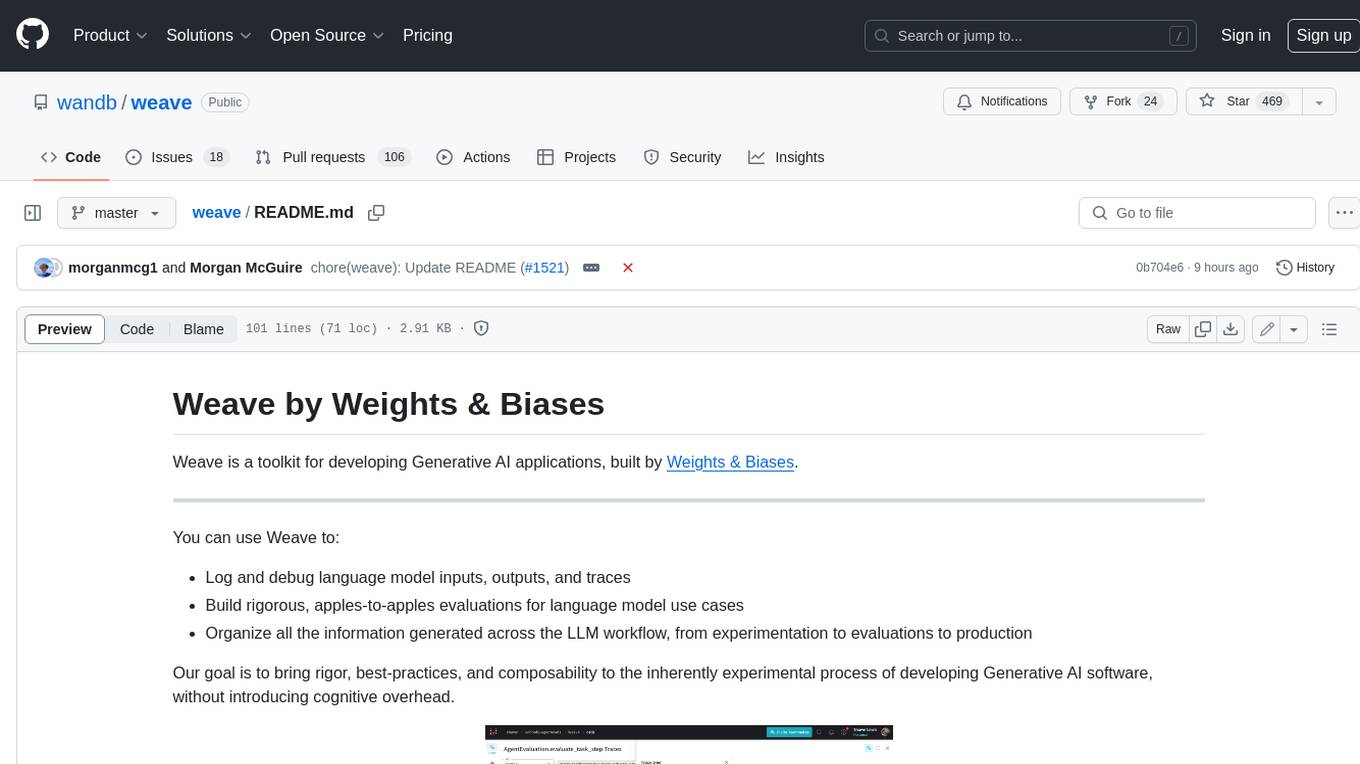
weave
Weave is a toolkit for developing Generative AI applications, built by Weights & Biases. With Weave, you can log and debug language model inputs, outputs, and traces; build rigorous, apples-to-apples evaluations for language model use cases; and organize all the information generated across the LLM workflow, from experimentation to evaluations to production. Weave aims to bring rigor, best-practices, and composability to the inherently experimental process of developing Generative AI software, without introducing cognitive overhead.
LLMStack
LLMStack is a no-code platform for building generative AI agents, workflows, and chatbots. It allows users to connect their own data, internal tools, and GPT-powered models without any coding experience. LLMStack can be deployed to the cloud or on-premise and can be accessed via HTTP API or triggered from Slack or Discord.
VisionCraft
The VisionCraft API is a free API for using over 100 different AI models. From images to sound.
kaito
Kaito is an operator that automates the AI/ML inference model deployment in a Kubernetes cluster. It manages large model files using container images, avoids tuning deployment parameters to fit GPU hardware by providing preset configurations, auto-provisions GPU nodes based on model requirements, and hosts large model images in the public Microsoft Container Registry (MCR) if the license allows. Using Kaito, the workflow of onboarding large AI inference models in Kubernetes is largely simplified.
PyRIT
PyRIT is an open access automation framework designed to empower security professionals and ML engineers to red team foundation models and their applications. It automates AI Red Teaming tasks to allow operators to focus on more complicated and time-consuming tasks and can also identify security harms such as misuse (e.g., malware generation, jailbreaking), and privacy harms (e.g., identity theft). The goal is to allow researchers to have a baseline of how well their model and entire inference pipeline is doing against different harm categories and to be able to compare that baseline to future iterations of their model. This allows them to have empirical data on how well their model is doing today, and detect any degradation of performance based on future improvements.
tabby
Tabby is a self-hosted AI coding assistant, offering an open-source and on-premises alternative to GitHub Copilot. It boasts several key features: * Self-contained, with no need for a DBMS or cloud service. * OpenAPI interface, easy to integrate with existing infrastructure (e.g Cloud IDE). * Supports consumer-grade GPUs.
spear
SPEAR (Simulator for Photorealistic Embodied AI Research) is a powerful tool for training embodied agents. It features 300 unique virtual indoor environments with 2,566 unique rooms and 17,234 unique objects that can be manipulated individually. Each environment is designed by a professional artist and features detailed geometry, photorealistic materials, and a unique floor plan and object layout. SPEAR is implemented as Unreal Engine assets and provides an OpenAI Gym interface for interacting with the environments via Python.
Magick
Magick is a groundbreaking visual AIDE (Artificial Intelligence Development Environment) for no-code data pipelines and multimodal agents. Magick can connect to other services and comes with nodes and templates well-suited for intelligent agents, chatbots, complex reasoning systems and realistic characters.