


AINO
None
Stars: 221
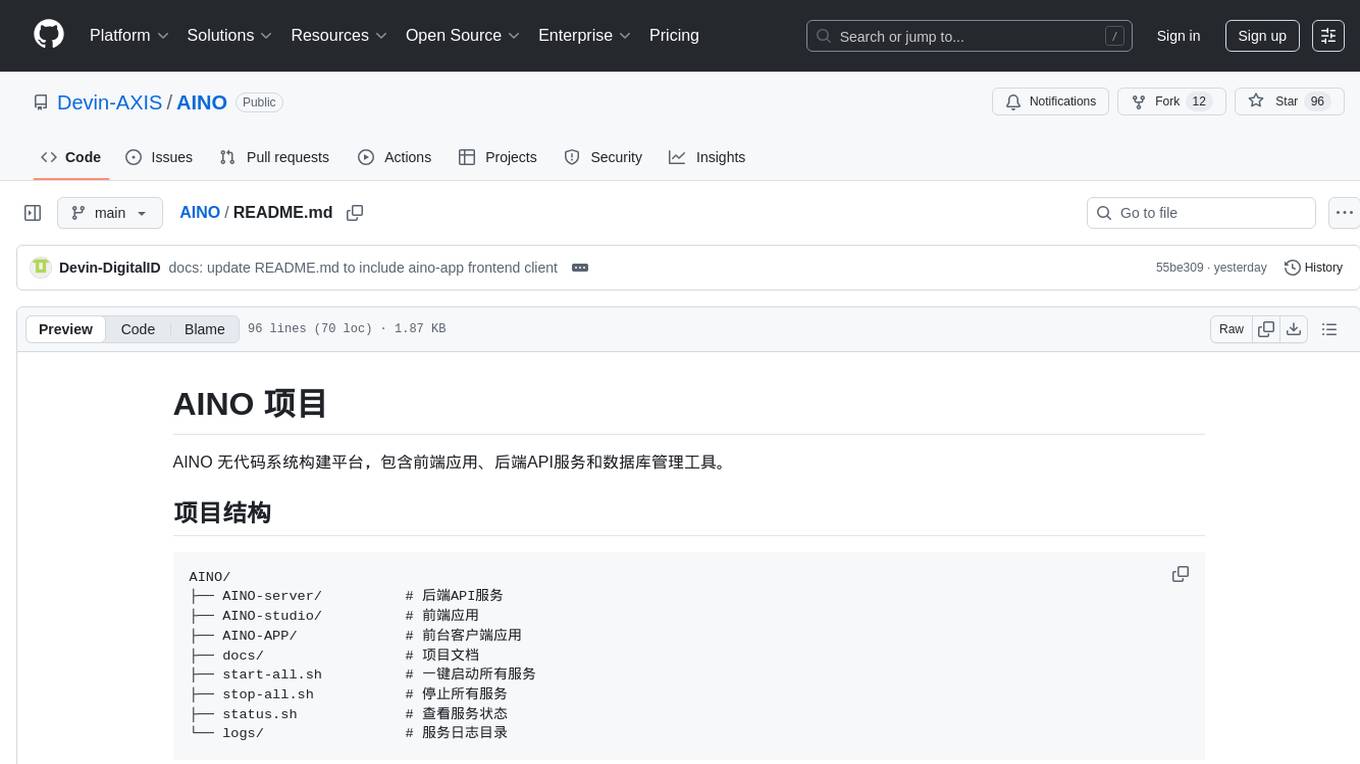
AINO is a no-code system construction platform that includes front-end applications, back-end API services, and database management tools. The project structure consists of AINO-server for back-end API services, AINO-studio for front-end applications, AINO-APP for front-end client applications, docs for project documentation, start-all.sh for one-click starting of all services, stop-all.sh for stopping all services, status.sh for checking service status, and logs for service logs. AINO utilizes Hono + TypeScript + Drizzle ORM for the back-end, Next.js + React + TypeScript for the front-end, PostgreSQL for the database, and pnpm as the package manager.
README:
AINO 无代码系统构建平台,包含前端应用、后端API服务和数据库管理工具。
AINO/
├── AINO-server/          # 后端API服务
├── AINO-studio/          # 前端应用
├── AINO-APP/             # 前台客户端应用
├── docs/                 # 项目文档
├── start-all.sh          # 一键启动所有服务
├── stop-all.sh           # 停止所有服务
├── status.sh             # 查看服务状态
└── logs/                 # 服务日志目录
./start-all.sh这将启动:
- 🎨 前端应用 (AINO-studio): http://localhost:3000
- 📱 前台客户端 (AINO-APP): http://localhost:3002
- 📡 后端API (AINO-server): http://localhost:3001
- 🗄️ 数据库管理 (Drizzle Studio): https://local.drizzle.studio
./status.sh./stop-all.shcd AINO-server
pnpm devcd AINO-studio
pnpm devcd AINO-APP
pnpm devcd AINO-server
pnpm studio- 前端应用 (AINO-studio): http://localhost:3000
- 前台客户端 (AINO-APP): http://localhost:3002
- 后端API: http://localhost:3001
- 健康检查: http://localhost:3001/health
- 数据库管理: https://local.drizzle.studio
服务日志保存在 logs/ 目录:
-
backend.log- 后端服务日志 -
frontend.log- 前端服务日志 -
aino-app.log- 前台客户端日志 -
drizzle.log- Drizzle Studio 日志
- 后端使用 Hono + TypeScript + Drizzle ORM
- 前端使用 Next.js + React + TypeScript
- 数据库使用 PostgreSQL
- 包管理器使用 pnpm
For Tasks:
Click tags to check more tools for each tasksFor Jobs:
Alternative AI tools for AINO
Similar Open Source Tools
AINO
AINO is a no-code system construction platform that includes front-end applications, back-end API services, and database management tools. The project structure consists of AINO-server for back-end API services, AINO-studio for front-end applications, AINO-APP for front-end client applications, docs for project documentation, start-all.sh for one-click starting of all services, stop-all.sh for stopping all services, status.sh for checking service status, and logs for service logs. AINO utilizes Hono + TypeScript + Drizzle ORM for the back-end, Next.js + React + TypeScript for the front-end, PostgreSQL for the database, and pnpm as the package manager.
Call
Call is an open-source AI-native alternative to Google Meet and Zoom, offering video calling, team collaboration, contact management, meeting scheduling, AI-powered features, security, and privacy. It is cross-platform, web-based, mobile responsive, and supports offline capabilities. The tech stack includes Next.js, TypeScript, Tailwind CSS, Mediasoup-SFU, React Query, Zustand, Hono, PostgreSQL, Drizzle ORM, Better Auth, Turborepo, Docker, Vercel, and Rate Limiting.
claude-code-mastery
Claude Code Mastery is a comprehensive tool for maximizing Claude Code, offering a production-ready project template with 16 slash commands, deterministic hook enforcement, MongoDB wrapper, live AI monitoring, and three-layer security. It provides a security gatekeeper, project scaffolding blueprint, MCP server integration, workflow automation through custom commands, and emphasizes the importance of single-purpose chats to avoid performance degradation.
AI-Translation-Assistant-Pro
AI Translation Assistant Pro is a powerful AI-driven platform for multilingual translation and content processing. It offers features such as text translation, image recognition, PDF processing, speech recognition, and video processing. The platform includes a subscription system with different membership levels, user management functionalities, quota management, and real-time usage statistics. It utilizes technologies like Next.js, React, TypeScript for the frontend, Node.js, PostgreSQL for the backend, NextAuth.js for authentication, Stripe for payments, and integrates with cloud services like Aliyun OSS and Tencent Cloud for AI services.

azooKey-Desktop
azooKey-Desktop is an open-source Japanese input system for macOS that incorporates the high-precision neural kana-kanji conversion engine 'Zenzai'. It offers features such as neural kana-kanji conversion, profile prompt, history learning, user dictionary, integration with personal optimization system 'Tuner', 'nice feeling conversion' with LLM, live conversion, and native support for AZIK. The tool is currently in alpha version, and its operation is not guaranteed. Users can install it via `.pkg` file or Homebrew. Development contributions are welcome, and the project has received support from the Information-technology Promotion Agency, Japan (IPA) for the 2024 fiscal year's untapped IT human resources discovery and nurturing project.
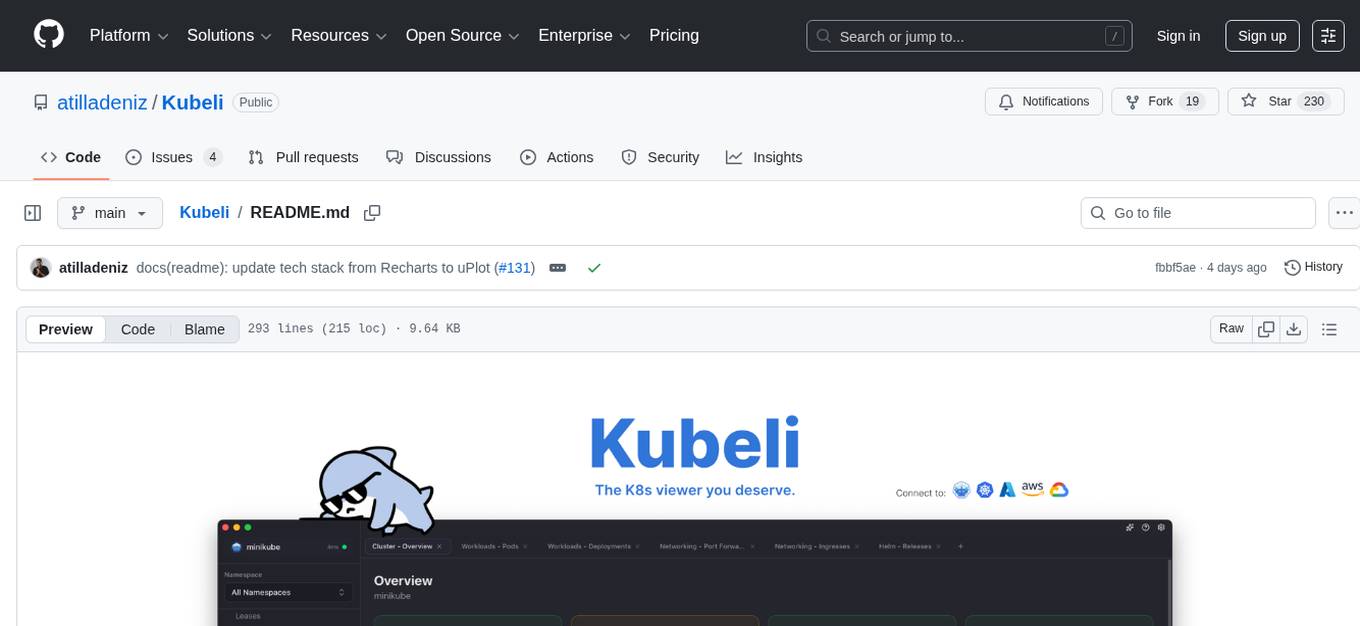
Kubeli
Kubeli is a modern, beautiful Kubernetes management desktop application with real-time monitoring, terminal access, and a polished user experience. It offers features like multi-cluster support, real-time updates, resource browser, pod logs streaming, terminal access, port forwarding, metrics dashboard, YAML editor, AI assistant, MCP server, Helm releases management, proxy support, internationalization, and dark/light mode. The tech stack includes Vite, React 19, TypeScript, Tailwind CSS 4 for frontend, Tauri 2.0 (Rust) for desktop, kube-rs with k8s-openapi v1.32 for K8s client, Zustand for state management, Radix UI and Lucide Icons for UI components, Monaco Editor for editing, XTerm.js for terminal, and uPlot for charts.
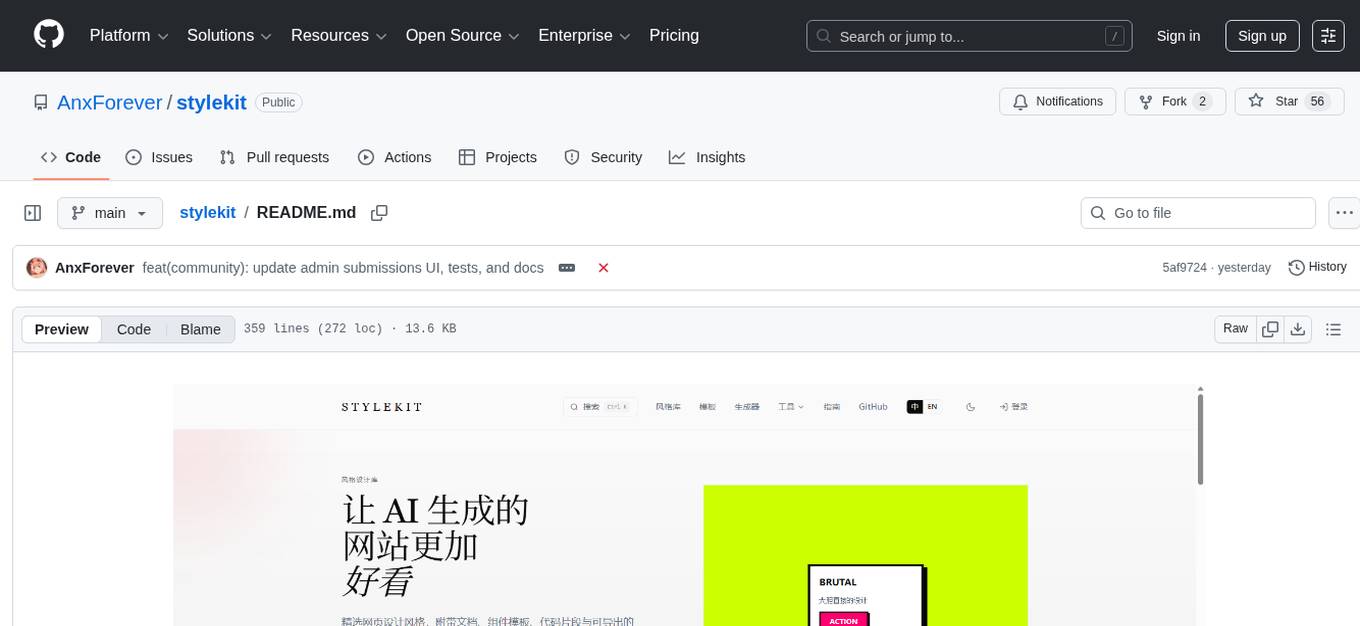
stylekit
StyleKit is a comprehensive design system toolkit that helps both humans and AI generate consistent, high-quality UI code. It provides structured style specifications, design tokens, component recipes, prompt templates, and export tools — everything needed to go from 'I want a glassmorphism SaaS dashboard' to production-ready frontend code. With 90+ visual styles, 20+ page templates, 25+ UI components, and AI-powered tools like Prompt Builder, Smart Recommender, Style Linter, Style Analyzer, and Style Blender, StyleKit offers a platform with GitHub OAuth, ratings & comments, style submissions, instant community availability, favorites, bilingual support, PWA, and dark/light mode themes.
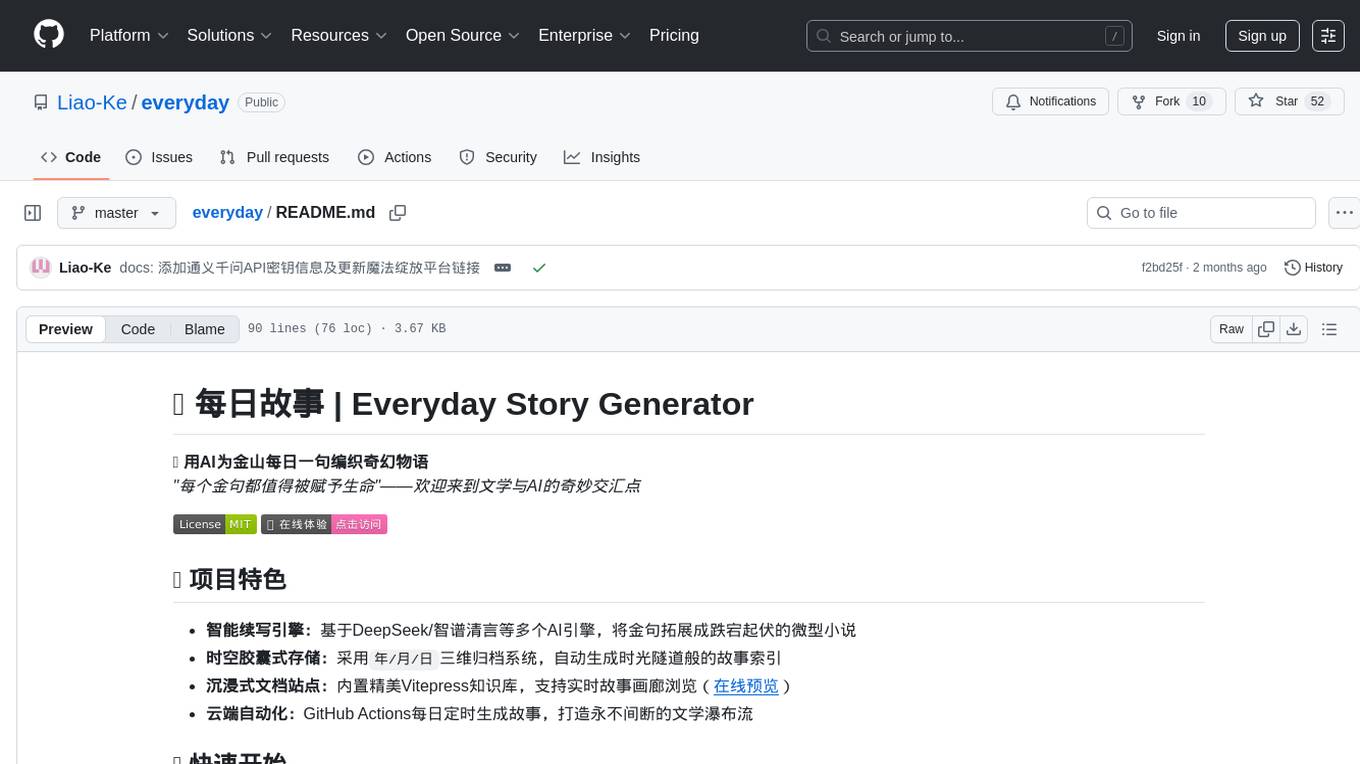
everyday
Everyday is a story generator tool that uses AI to weave fantasy stories based on daily quotes. It features an intelligent writing engine that expands quotes into captivating short stories, a time capsule storage system for story archiving, an immersive document site with a real-time story gallery, and cloud automation for daily story generation. Users can clone the repository, activate the Python environment, configure AI keys, and start the story furnace to witness quotes transform into complete stories. The project follows the MIT open convention, allowing users to freely use, modify, and share the generated stories while preserving the original magic touch.
buster
Buster is a modern analytics platform designed with AI in mind, focusing on self-serve experiences powered by Large Language Models. It addresses pain points in existing tools by advocating for AI-centric app development, cost-effective data warehousing, improved CI/CD processes, and empowering data teams to create powerful, user-friendly data experiences. The platform aims to revolutionize AI analytics by enabling data teams to build deep integrations and own their entire analytics stack.
interview-coder-cn
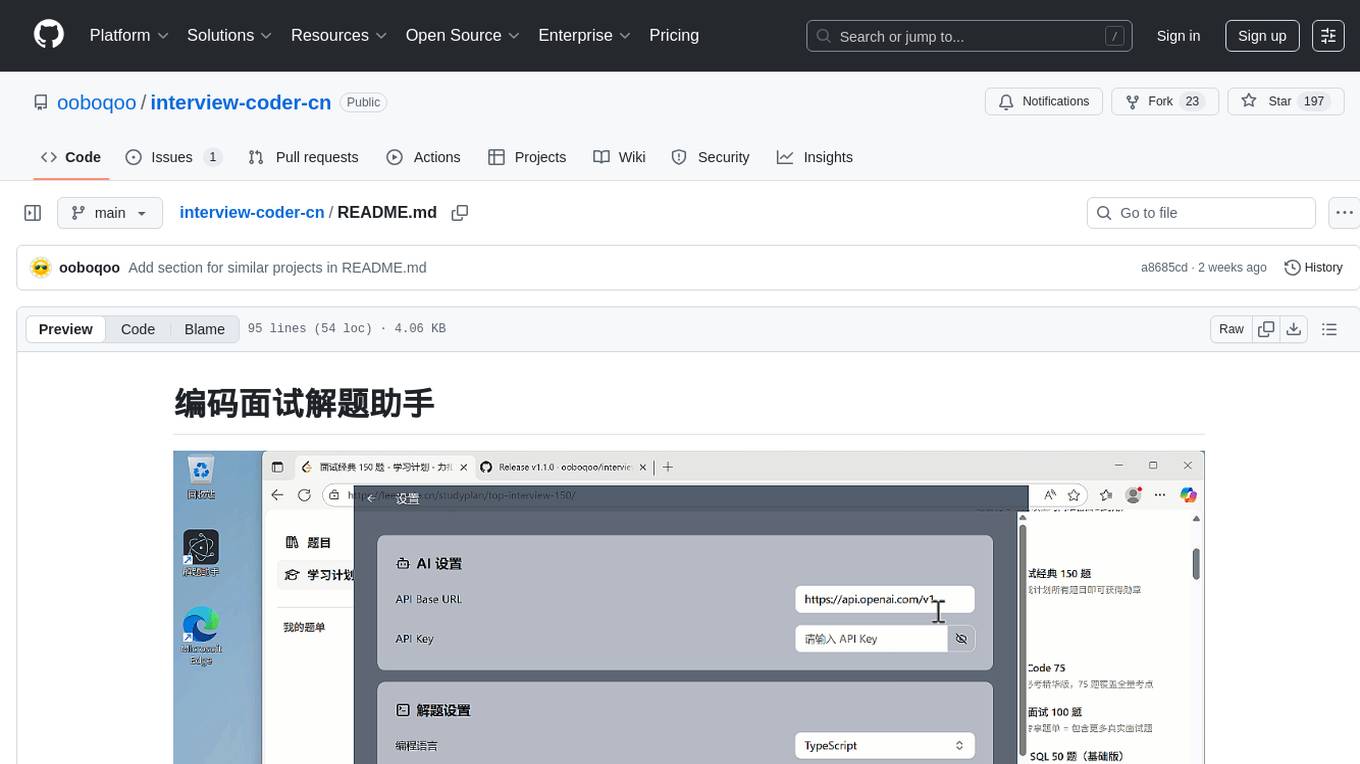
This is a coding problem-solving assistant for Chinese users, tailored to the domestic AI ecosystem, simple and easy to use. It provides real-time problem-solving ideas and code analysis for coding interviews, avoiding detection during screen sharing. Users can also extend its functionality for other scenarios by customizing prompt words. The tool supports various programming languages and has stealth capabilities to hide its interface from interviewers even when screen sharing.
promptMinder
PromptMinder is a professional prompt word management platform that simplifies and enhances AI prompt word management. It features prompt word version control with support for version tracking and history viewing, diff comparison similar to Git for quick identification of prompt word updates, customizable tagging for quick categorization and retrieval, support for private and public prompt words, integration of AI models for intelligent prompt word generation, team collaboration with team creation, member management, and permission control, community contribution feature with audit and publishing process. The platform also offers a responsive design for mobile devices, internationalization support for Chinese and English languages, modern interface based on Shadcn UI, intelligent search and filtering functionality, and convenient copy and share features. It is built for high performance using Next.js 16 + React 19, with security authentication provided by Clerk, reliable storage using Supabase + PostgreSQL database, and easy deployment supporting Vercel and Zeabur one-click deployment.
conduit
Conduit is an open-source, cross-platform mobile application for Open-WebUI, providing a native mobile experience for interacting with your self-hosted AI infrastructure. It supports real-time chat, model selection, conversation management, markdown rendering, theme support, voice input, file uploads, multi-modal support, secure storage, folder management, and tools invocation. Conduit offers multiple authentication flows and follows a clean architecture pattern with Riverpod for state management, Dio for HTTP networking, WebSocket for real-time streaming, and Flutter Secure Storage for credential management.
ChatGPT-API-Faucet
ChatGPT API Faucet is a frontend project for the public platform ChatGPT API Faucet, inspired by the crypto project MultiFaucet. It allows developers in the AI ecosystem to claim $1.00 for free every 24 hours. The program is developed using the Next.js framework and React library, with key components like _app.tsx for initializing pages, index.tsx for main modifications, and Layout.tsx for defining layout components. Users can deploy the project by installing dependencies, building the project, starting the project, configuring reverse proxies or using port:IP access, and running a development server. The tool also supports token balance queries and is related to projects like one-api, ChatGPT-Cost-Calculator, and Poe.Monster. It is licensed under the MIT license.
shadcn-ui-mcp-server
A Model Context Protocol (MCP) server that provides AI assistants with comprehensive access to shadcn/ui v4 components, blocks, demos, and metadata. It allows users to seamlessly retrieve React, Svelte, Vue, and React Native implementations for AI-powered development workflows. The server supports multi-frameworks, component source code, demos, blocks, metadata access, directory browsing, smart caching, SSE transport, and Docker containerization. Users can quickly start the server, integrate with Claude Desktop, deploy with SSE transport or Docker, and access documentation for installation, configuration, integration, usage, frameworks, troubleshooting, and API reference. The server supports React, Svelte, Vue, and React Native implementations, with options for UI library selection. It enables AI-powered development, multi-client deployments, production environments, component discovery, multi-framework learning, rapid prototyping, and code generation.
PAI
PAI is an open-source personal AI infrastructure designed to orchestrate personal and professional lives. It provides a scaffolding framework with real-world examples for life management, professional tasks, and personal goals. The core mission is to augment humans with AI capabilities to thrive in a world full of AI. PAI features UFC Context Architecture for persistent memory, specialized digital assistants for various tasks, an integrated tool ecosystem with MCP Servers, voice system, browser automation, and API integrations. The philosophy of PAI focuses on augmenting human capability rather than replacing it. The tool is MIT licensed and encourages contributions from the open-source community.
botserver
General Bots is a self-hosted AI automation platform and LLM conversational platform focused on convention over configuration and code-less approaches. It serves as the core API server handling LLM orchestration, business logic, database operations, and multi-channel communication. The platform offers features like multi-vendor LLM API, MCP + LLM Tools Generation, Semantic Caching, Web Automation Engine, Enterprise Data Connectors, and Git-like Version Control. It enforces a ZERO TOLERANCE POLICY for code quality and security, with strict guidelines for error handling, performance optimization, and code patterns. The project structure includes modules for core functionalities like Rhai BASIC interpreter, security, shared types, tasks, auto task system, file operations, learning system, and LLM assistance.
For similar tasks
AINO
AINO is a no-code system construction platform that includes front-end applications, back-end API services, and database management tools. The project structure consists of AINO-server for back-end API services, AINO-studio for front-end applications, AINO-APP for front-end client applications, docs for project documentation, start-all.sh for one-click starting of all services, stop-all.sh for stopping all services, status.sh for checking service status, and logs for service logs. AINO utilizes Hono + TypeScript + Drizzle ORM for the back-end, Next.js + React + TypeScript for the front-end, PostgreSQL for the database, and pnpm as the package manager.
terraform-provider-aiven
The Terraform provider for Aiven.io, an open source data platform as a service. See the official documentation to learn about all the possible services and resources.
aiogram_bot_template
Aiogram bot template is a boilerplate for creating Telegram bots using Aiogram framework. It provides a solid foundation for building robust and scalable bots with a focus on code organization, database integration, and localization.
honcho
Honcho is a platform for creating personalized AI agents and LLM powered applications for end users. The repository is a monorepo containing the server/API for managing database interactions and storing application state, along with a Python SDK. It utilizes FastAPI for user context management and Poetry for dependency management. The API can be run using Docker or manually by setting environment variables. The client SDK can be installed using pip or Poetry. The project is open source and welcomes contributions, following a fork and PR workflow. Honcho is licensed under the AGPL-3.0 License.
supabase
Supabase is an open source Firebase alternative that provides a wide range of features including a hosted Postgres database, authentication and authorization, auto-generated APIs, REST and GraphQL support, realtime subscriptions, functions, file storage, AI and vector/embeddings toolkit, and a dashboard. It aims to offer developers a Firebase-like experience using enterprise-grade open source tools.
superduper
superduper.io is a Python framework that integrates AI models, APIs, and vector search engines directly with existing databases. It allows hosting of models, streaming inference, and scalable model training/fine-tuning. Key features include integration of AI with data infrastructure, inference via change-data-capture, scalable model training, model chaining, simple Python interface, Python-first approach, working with difficult data types, feature storing, and vector search capabilities. The tool enables users to turn their existing databases into centralized repositories for managing AI model inputs and outputs, as well as conducting vector searches without the need for specialized databases.
MISSING-PERSONS-DATABASE-2024-KENYA-FINANCE-BILL-PROTESTS-
This repository contains a tool for managing a missing persons database in Kenya. It provides instructions for setting up a PostgreSQL database and a Flask application using Docker containers. Users can access the UI through a web browser to interact with the database and perform various tasks related to missing persons.
opencharacter
OpenCharacter is an open-source tool that allows users to create and run characters locally with local models or use the hosted version. The stack includes Next.js for frontend, TailwindCSS for styling, Drizzle ORM for database access, NextAuth for authentication, Cloudflare D1 for serverless databases, Cloudflare Pages for hosting, and ShadcnUI as the component library. Users can integrate OpenCharacter with OpenRouter by configuring the OpenRouter API key. The tool is fully scalable, composable, and cost-effective, with powerful tools like Wrangler for database management and migrations. No environment variables are needed, making it easy to use and deploy.
For similar jobs
db2rest
DB2Rest is a modern low-code REST DATA API platform that simplifies the development of intelligent applications. It seamlessly integrates existing and new databases with language models (LMs/LLMs) and vector stores, enabling the rapid delivery of context-aware, reasoning applications without vendor lock-in.
tidb
TiDB is an open-source distributed SQL database that supports Hybrid Transactional and Analytical Processing (HTAP) workloads. It is MySQL compatible and features horizontal scalability, strong consistency, and high availability.

infinity
Infinity is an AI-native database designed for LLM applications, providing incredibly fast full-text and vector search capabilities. It supports a wide range of data types, including vectors, full-text, and structured data, and offers a fused search feature that combines multiple embeddings and full text. Infinity is easy to use, with an intuitive Python API and a single-binary architecture that simplifies deployment. It achieves high performance, with 0.1 milliseconds query latency on million-scale vector datasets and up to 15K QPS.
postgresml
PostgresML is a powerful Postgres extension that seamlessly combines data storage and machine learning inference within your database. It enables running machine learning and AI operations directly within PostgreSQL, leveraging GPU acceleration for faster computations, integrating state-of-the-art large language models, providing built-in functions for text processing, enabling efficient similarity search, offering diverse ML algorithms, ensuring high performance, scalability, and security, supporting a wide range of NLP tasks, and seamlessly integrating with existing PostgreSQL tools and client libraries.
lancedb
LanceDB is an open-source database for vector-search built with persistent storage, which greatly simplifies retrieval, filtering, and management of embeddings. The key features of LanceDB include: Production-scale vector search with no servers to manage. Store, query, and filter vectors, metadata, and multi-modal data (text, images, videos, point clouds, and more). Support for vector similarity search, full-text search, and SQL. Native Python and Javascript/Typescript support. Zero-copy, automatic versioning, manage versions of your data without needing extra infrastructure. GPU support in building vector index(*). Ecosystem integrations with LangChain 🦜️🔗, LlamaIndex 🦙, Apache-Arrow, Pandas, Polars, DuckDB, and more on the way. LanceDB's core is written in Rust 🦀 and is built using Lance, an open-source columnar format designed for performant ML workloads.
Nucleoid
Nucleoid is a declarative (logic) runtime environment that manages both data and logic under the same runtime. It uses a declarative programming paradigm, which allows developers to focus on the business logic of the application, while the runtime manages the technical details. This allows for faster development and reduces the amount of code that needs to be written. Additionally, the sharding feature can help to distribute the load across multiple instances, which can further improve the performance of the system.
DB-GPT
DB-GPT is an open source AI native data app development framework with AWEL(Agentic Workflow Expression Language) and agents. It aims to build infrastructure in the field of large models, through the development of multiple technical capabilities such as multi-model management (SMMF), Text2SQL effect optimization, RAG framework and optimization, Multi-Agents framework collaboration, AWEL (agent workflow orchestration), etc. Which makes large model applications with data simpler and more convenient.
superduperdb
SuperDuperDB is a Python framework for integrating AI models, APIs, and vector search engines directly with your existing databases, including hosting of your own models, streaming inference and scalable model training/fine-tuning. Build, deploy and manage any AI application without the need for complex pipelines, infrastructure as well as specialized vector databases, and moving our data there, by integrating AI at your data's source: - Generative AI, LLMs, RAG, vector search - Standard machine learning use-cases (classification, segmentation, regression, forecasting recommendation etc.) - Custom AI use-cases involving specialized models - Even the most complex applications/workflows in which different models work together SuperDuperDB is **not** a database. Think `db = superduper(db)`: SuperDuperDB transforms your databases into an intelligent platform that allows you to leverage the full AI and Python ecosystem. A single development and deployment environment for all your AI applications in one place, fully scalable and easy to manage.