


Open-Docs
Open AI Document is a project for public interest. It's powered by Gemini that tracks and translates docs of popular open-source libraries into Simplified/Traditional Chinese, Japanese, Korean, etc.
Stars: 52
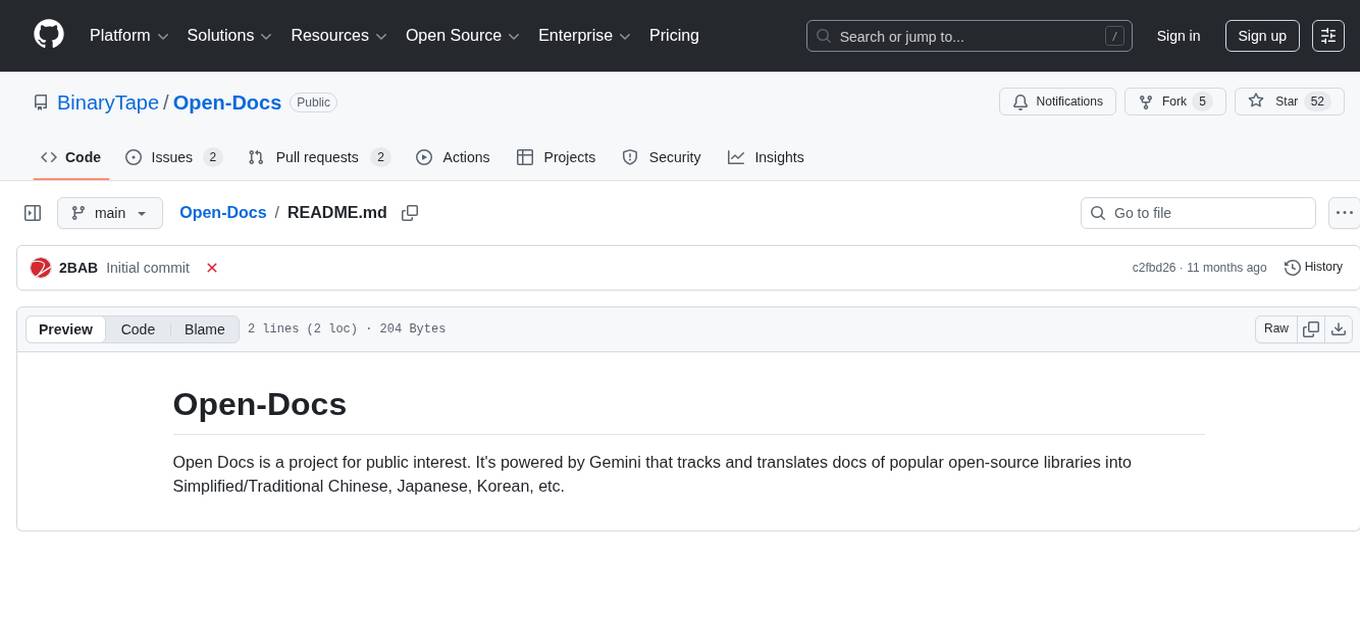
Open-Docs is a project for public interest powered by Gemini to track and translate documentation of popular open-source libraries into various languages such as Simplified/Traditional Chinese, Japanese, and Korean.
README:
Open Docs is a project for public interest. It's powered by Gemini that tracks and translates docs of popular open-source libraries into Simplified/Traditional Chinese, Japanese, Korean, etc.
For Tasks:
Click tags to check more tools for each tasksFor Jobs:
Alternative AI tools for Open-Docs
Similar Open Source Tools
Open-Docs
Open-Docs is a project for public interest powered by Gemini to track and translate documentation of popular open-source libraries into various languages such as Simplified/Traditional Chinese, Japanese, and Korean.
LocalAI
LocalAI is a free and open-source OpenAI alternative that acts as a drop-in replacement REST API compatible with OpenAI (Elevenlabs, Anthropic, etc.) API specifications for local AI inferencing. It allows users to run LLMs, generate images, audio, and more locally or on-premises with consumer-grade hardware, supporting multiple model families and not requiring a GPU. LocalAI offers features such as text generation with GPTs, text-to-audio, audio-to-text transcription, image generation with stable diffusion, OpenAI functions, embeddings generation for vector databases, constrained grammars, downloading models directly from Huggingface, and a Vision API. It provides a detailed step-by-step introduction in its Getting Started guide and supports community integrations such as custom containers, WebUIs, model galleries, and various bots for Discord, Slack, and Telegram. LocalAI also offers resources like an LLM fine-tuning guide, instructions for local building and Kubernetes installation, projects integrating LocalAI, and a how-tos section curated by the community. It encourages users to cite the repository when utilizing it in downstream projects and acknowledges the contributions of various software from the community.
free-threaded-compatibility
This repository serves as a platform for coordinating ecosystem-wide work related to free-threading topics in Python. It aims to track, understand, and provide documentation for common issues across multiple libraries. Specific project-related issues should be reported in the respective project's issue tracker. For detailed documentation on free-threading topics, visit py-free-threading.github.io.

DocsGPT
DocsGPT is an open-source documentation assistant powered by GPT models. It simplifies the process of searching for information in project documentation by allowing developers to ask questions and receive accurate answers. With DocsGPT, users can say goodbye to manual searches and quickly find the information they need. The tool aims to revolutionize project documentation experiences and offers features like live previews, Discord community, guides, and contribution opportunities. It consists of a Flask app, Chrome extension, similarity search index creation script, and a frontend built with Vite and React. Users can quickly get started with DocsGPT by following the provided setup instructions and can contribute to its development by following the guidelines in the CONTRIBUTING.md file. The project follows a Code of Conduct to ensure a harassment-free community environment for all participants. DocsGPT is licensed under MIT and is built with LangChain.
foundry-samples
The 'foundry-samples' repository serves as the main directory for official Azure AI Foundry documentation sample code and examples. It contains notebooks and code snippets for various developer tasks, offering both end-to-end examples and smaller snippets. The repository is open source, encouraging contributions and providing guidance on how to contribute.
Bert-VITS2
Bert-VITS2 is a repository that provides a backbone with multilingual BERT for text-to-speech (TTS) applications. It offers an alternative to BV2/GSV projects and is inspired by the MassTTS project. Users can refer to the code to learn how to train models for TTS. The project is not maintained actively in the short term. It is not to be used for any purposes that violate the laws of the People's Republic of China, and strictly prohibits any political-related use.
llamafile
llamafile is a project by Mozilla Builders that aims to simplify the distribution and running of Language Model Models (LLMs) by combining llama.cpp with Cosmopolitan Libc into a single-file executable called a 'llamafile'. This executable can run locally on most computers without the need for installation, making open LLMs more accessible to developers and end users.
LLMs-playground
LLMs-playground is a repository containing code examples and tutorials for learning and experimenting with Large Language Models (LLMs). It provides a hands-on approach to understanding how LLMs work and how to fine-tune them for specific tasks. The repository covers various LLM architectures, pre-training techniques, and fine-tuning strategies, making it a valuable resource for researchers, students, and practitioners interested in natural language processing and machine learning. By exploring the code and following the tutorials, users can gain practical insights into working with LLMs and apply their knowledge to real-world projects.
OpenAIWorkshop
Azure OpenAI Service provides REST API access to OpenAI's powerful language models including GPT-3, Codex and Embeddings. Users can easily adapt models for content generation, summarization, semantic search, and natural language to code translation. The workshop covers basics, prompt engineering, common NLP tasks, generative tasks, conversational dialog, and learning methods. It guides users to build applications with PowerApp, query SQL data, create data pipelines, and work with proprietary datasets. Target audience includes Power Users, Software Engineers, Data Scientists, and AI architects and Managers.
reflex-llm-examples
A curated repository of AI Apps showcasing practical use cases of Large Language Models (LLMs) from various providers like Google, Anthropic, Open AI, and self-hosted open-source models. The collection features AI agents, RAG (Retrieval-Augmented Generation) implementations, and best practices for building scalable AI-powered solutions.
langchain-google
LangChain Google is a repository containing three packages with Google integrations: langchain-google-genai for Google Generative AI models, langchain-google-vertexai for Google Cloud Generative AI on Vertex AI, and langchain-google-community for other Google product integrations. The repository is organized as a monorepo with a structure including libs for different packages, and files like pyproject.toml and Makefile for building, linting, and testing. It provides guidelines for contributing, local development dependencies installation, formatting, linting, working with optional dependencies, and testing with unit and integration tests. The focus is on maintaining unit test coverage and avoiding excessive integration tests, with annotations for GCP infrastructure-dependent tests.
PowerApps-Samples
PowerApps-Samples is a repository containing sample code for Power Apps, covering various aspects such as Dataverse, model-driven apps, canvas apps, Power Apps component framework, portals, and AI Builder. It serves as a valuable resource for developers looking to explore and learn about different functionalities within Power Apps ecosystem.
MoonshotAI-Cookbook
The MoonshotAI-Cookbook provides example code and guides for accomplishing common tasks with the MoonshotAI API. To run these examples, you'll need an MoonshotAI account and associated API key. Most code examples are written in Python, though the concepts can be applied in any language.
awesome-VLLMs
This repository contains a collection of pre-trained Very Large Language Models (VLLMs) that can be used for various natural language processing tasks. The models are fine-tuned on large text corpora and can be easily integrated into existing NLP pipelines for tasks such as text generation, sentiment analysis, and language translation. The repository also provides code examples and tutorials to help users get started with using these powerful language models in their projects.
naas
Naas (Notebooks as a service) is an open source platform that enables users to create powerful data engines combining automation, analytics, and AI from Jupyter notebooks. It offers features like templates for automated data jobs and reports, drivers for data connectivity, and production-ready environment with scheduling and notifications. Naas aims to provide an alternative to Google Colab with enhanced low-code layers.
open-ai
Open AI is a powerful tool for artificial intelligence research and development. It provides a wide range of machine learning models and algorithms, making it easier for developers to create innovative AI applications. With Open AI, users can explore cutting-edge technologies such as natural language processing, computer vision, and reinforcement learning. The platform offers a user-friendly interface and comprehensive documentation to support users in building and deploying AI solutions. Whether you are a beginner or an experienced AI practitioner, Open AI offers the tools and resources you need to accelerate your AI projects and stay ahead in the rapidly evolving field of artificial intelligence.
For similar tasks
Open-Docs
Open-Docs is a project for public interest powered by Gemini to track and translate documentation of popular open-source libraries into various languages such as Simplified/Traditional Chinese, Japanese, and Korean.

only_train_once
Only Train Once (OTO) is an automatic, architecture-agnostic DNN training and compression framework that allows users to train a general DNN from scratch or a pretrained checkpoint to achieve high performance and slimmer architecture simultaneously in a one-shot manner without fine-tuning. The framework includes features for automatic structured pruning and erasing operators, as well as hybrid structured sparse optimizers for efficient model compression. OTO provides tools for pruning zero-invariant group partitioning, constructing pruned models, and visualizing pruning and erasing dependency graphs. It supports the HESSO optimizer and offers a sanity check for compliance testing on various DNNs. The repository also includes publications, installation instructions, quick start guides, and a roadmap for future enhancements and collaborations.
ChaKt-KMP
ChaKt is a multiplatform app built using Kotlin and Compose Multiplatform to demonstrate the use of Generative AI SDK for Kotlin Multiplatform to generate content using Google's Generative AI models. It features a simple chat based user interface and experience to interact with AI. The app supports mobile, desktop, and web platforms, and is built with Kotlin Multiplatform, Kotlin Coroutines, Compose Multiplatform, Generative AI SDK, Calf - File picker, and BuildKonfig. Users can contribute to the project by following the guidelines in CONTRIBUTING.md. The app is licensed under the MIT License.
crawl4ai
Crawl4AI is a powerful and free web crawling service that extracts valuable data from websites and provides LLM-friendly output formats. It supports crawling multiple URLs simultaneously, replaces media tags with ALT, and is completely free to use and open-source. Users can integrate Crawl4AI into Python projects as a library or run it as a standalone local server. The tool allows users to crawl and extract data from specified URLs using different providers and models, with options to include raw HTML content, force fresh crawls, and extract meaningful text blocks. Configuration settings can be adjusted in the `crawler/config.py` file to customize providers, API keys, chunk processing, and word thresholds. Contributions to Crawl4AI are welcome from the open-source community to enhance its value for AI enthusiasts and developers.
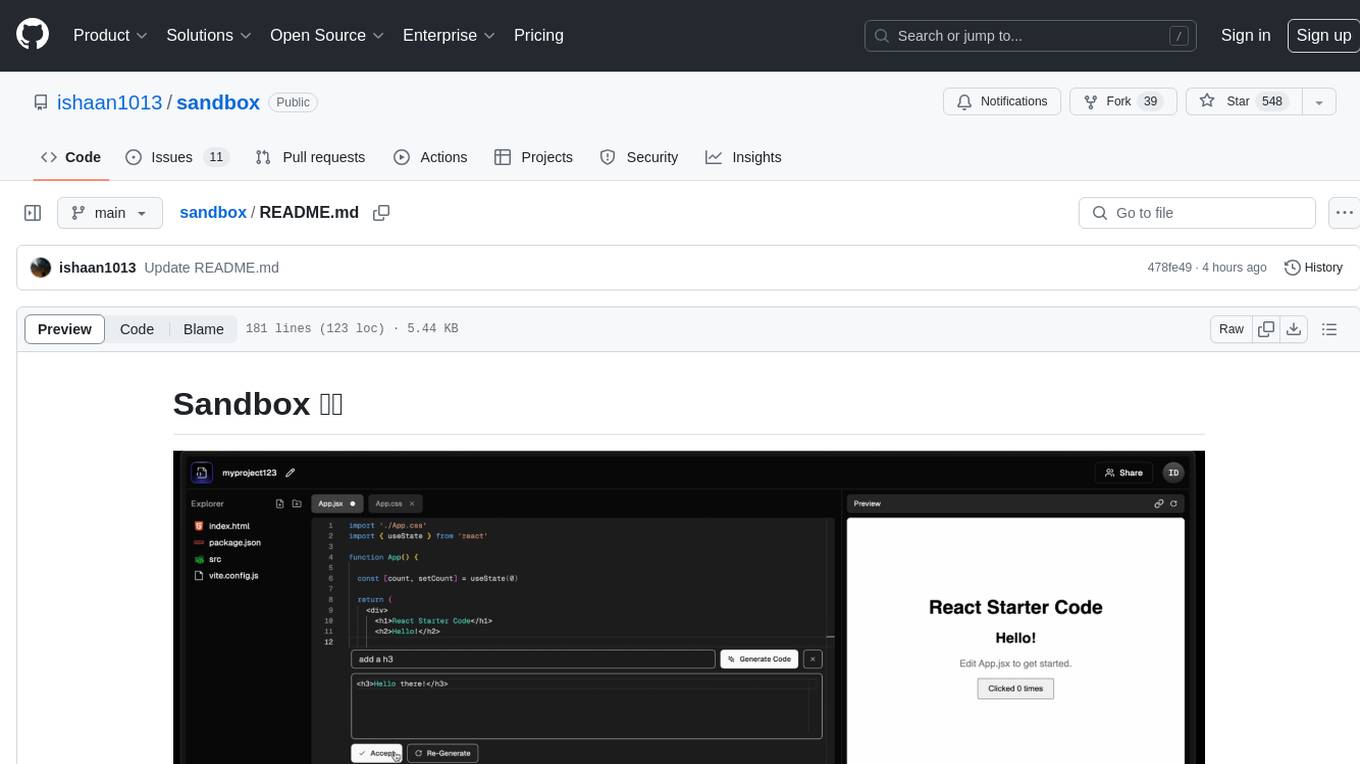
sandbox
Sandbox is an open-source cloud-based code editing environment with custom AI code autocompletion and real-time collaboration. It consists of a frontend built with Next.js, TailwindCSS, Shadcn UI, Clerk, Monaco, and Liveblocks, and a backend with Express, Socket.io, Cloudflare Workers, D1 database, R2 storage, Workers AI, and Drizzle ORM. The backend includes microservices for database, storage, and AI functionalities. Users can run the project locally by setting up environment variables and deploying the containers. Contributions are welcome following the commit convention and structure provided in the repository.
void
Void is an open-source Cursor alternative, providing a full source code for users to build and develop. It is a fork of the vscode repository, offering a waitlist for the official release. Users can contribute by checking the Project board and following the guidelines in CONTRIBUTING.md. Support is available through Discord or email.
aphrodite-engine
Aphrodite is an inference engine optimized for serving HuggingFace-compatible models at scale. It leverages vLLM's Paged Attention technology to deliver high-performance model inference for multiple concurrent users. The engine supports continuous batching, efficient key/value management, optimized CUDA kernels, quantization support, distributed inference, and modern samplers. It can be easily installed and launched, with Docker support for deployment. Aphrodite requires Linux or Windows OS, Python 3.8 to 3.12, and CUDA >= 11. It is designed to utilize 90% of GPU VRAM but offers options to limit memory usage. Contributors are welcome to enhance the engine.
cua
Cua is a tool for creating and running high-performance macOS and Linux virtual machines on Apple Silicon, with built-in support for AI agents. It provides libraries like Lume for running VMs with near-native performance, Computer for interacting with sandboxes, and Agent for running agentic workflows. Users can refer to the documentation for onboarding, explore demos showcasing AI-Gradio and GitHub issue fixing, and utilize accessory libraries like Core, PyLume, Computer Server, and SOM. Contributions are welcome, and the tool is open-sourced under the MIT License.
For similar jobs
DocsGPT
DocsGPT is an open-source documentation assistant powered by GPT models. It simplifies the process of searching for information in project documentation by allowing developers to ask questions and receive accurate answers. With DocsGPT, users can say goodbye to manual searches and quickly find the information they need. The tool aims to revolutionize project documentation experiences and offers features like live previews, Discord community, guides, and contribution opportunities. It consists of a Flask app, Chrome extension, similarity search index creation script, and a frontend built with Vite and React. Users can quickly get started with DocsGPT by following the provided setup instructions and can contribute to its development by following the guidelines in the CONTRIBUTING.md file. The project follows a Code of Conduct to ensure a harassment-free community environment for all participants. DocsGPT is licensed under MIT and is built with LangChain.
airflow-site
This repository contains the source code for the Apache Airflow website, including directories for archived documentation versions, landing pages, license templates, and the Sphinx theme. To work on the site locally, users need to install coreutils, Node.js, NPM, and HUGO, and run specific scripts provided in the repository. Contributors can refer to the contributor's guide for detailed instructions on how to contribute to the website.
lumentis
Lumentis is a tool that allows users to generate beautiful and comprehensive documentation from meeting transcripts and large documents with a single command. It reads transcripts, asks questions to understand themes and audience, generates an outline, and creates detailed pages with visual variety and styles. Users can switch models for different tasks, control the process, and deploy the generated docs to Vercel. The tool is designed to be open, clean, fast, and easy to use, with upcoming features including folders, PDFs, auto-transcription, website scraping, scientific papers handling, summarization, and continuous updates.
dify-docs
Dify Docs is a repository that houses the documentation website code and Markdown source files for docs.dify.ai. It contains assets, content, and data folders that are licensed under a CC-BY license.
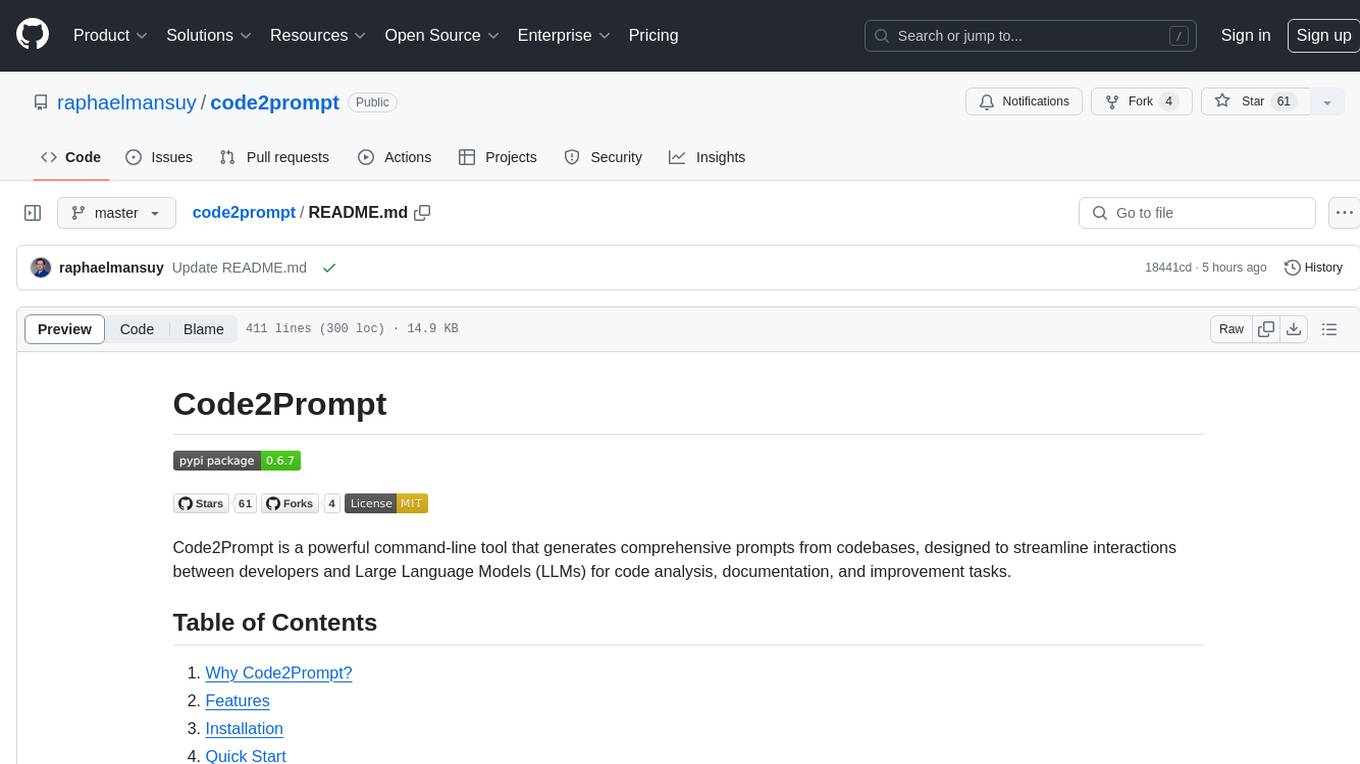
code2prompt
Code2Prompt is a powerful command-line tool that generates comprehensive prompts from codebases, designed to streamline interactions between developers and Large Language Models (LLMs) for code analysis, documentation, and improvement tasks. It bridges the gap between codebases and LLMs by converting projects into AI-friendly prompts, enabling users to leverage AI for various software development tasks. The tool offers features like holistic codebase representation, intelligent source tree generation, customizable prompt templates, smart token management, Gitignore integration, flexible file handling, clipboard-ready output, multiple output options, and enhanced code readability.
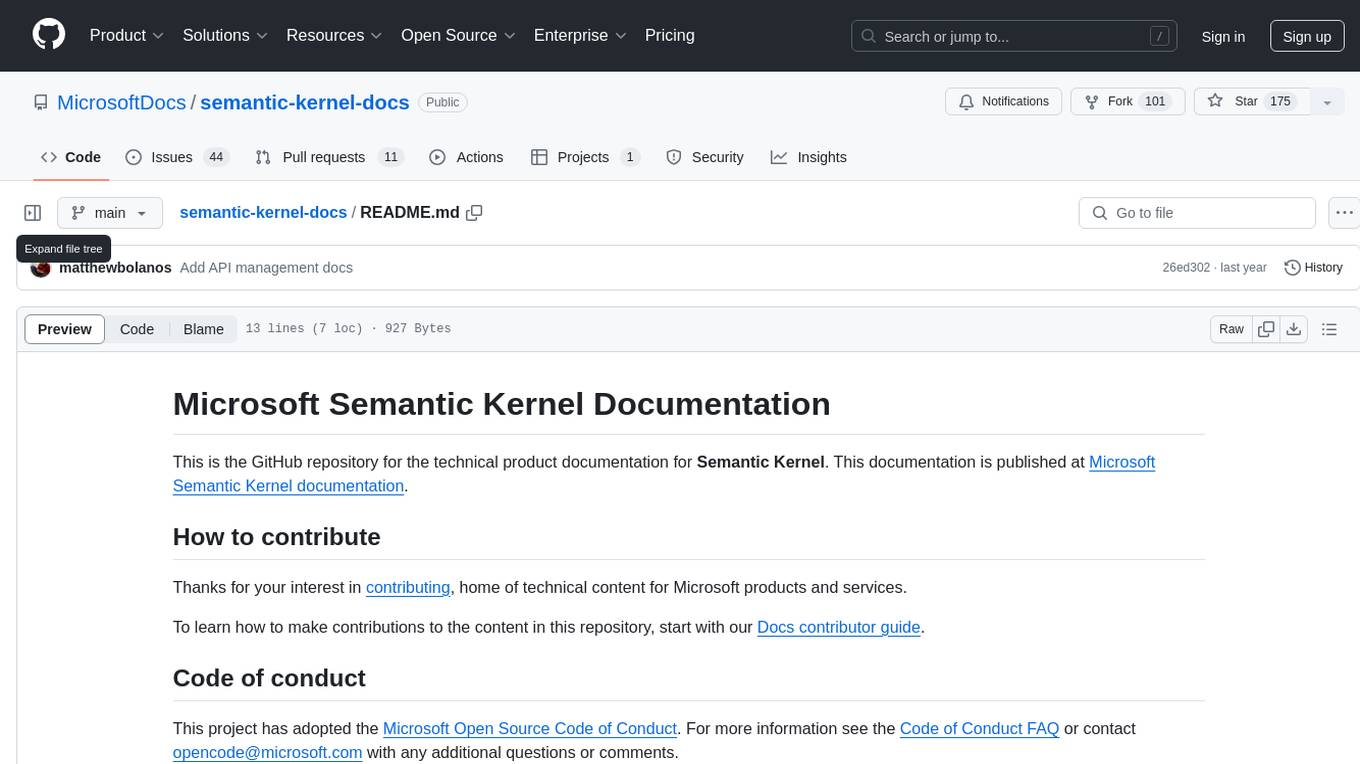
semantic-kernel-docs
The Microsoft Semantic Kernel Documentation GitHub repository contains technical product documentation for Semantic Kernel. It serves as the home of technical content for Microsoft products and services. Contributors can learn how to make contributions by following the Docs contributor guide. The project follows the Microsoft Open Source Code of Conduct.
anythingllm-docs
anythingllm-docs is a documentation repository for the AnythingLLM project. It contains detailed guides, setup instructions, and information on features and legal aspects of the project. The repository structure is organized into public, pages, components, and configuration files. Users can contribute by creating issues and pull requests following specific guidelines. The project is licensed under the MIT License and has been migrated to NextJS with the help of @ShadowArcanist.
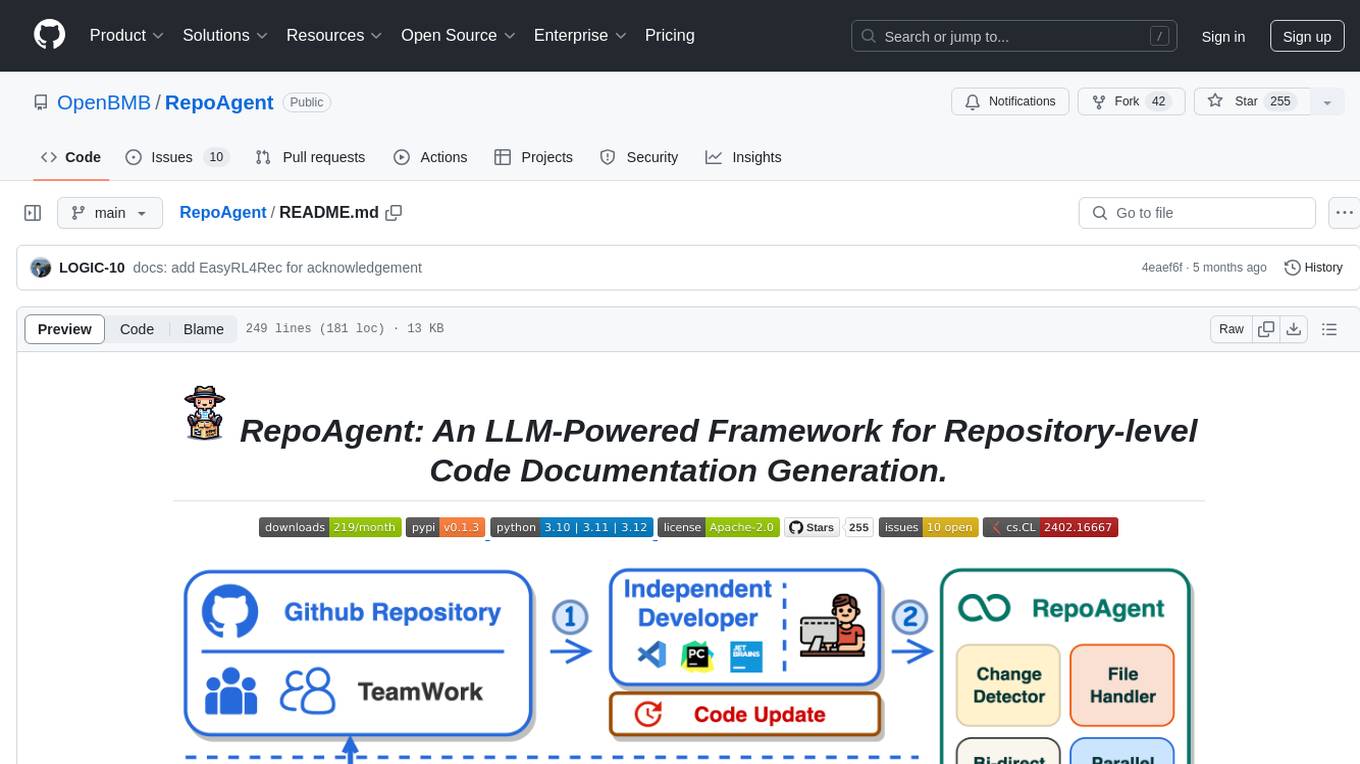
RepoAgent
RepoAgent is an LLM-powered framework designed for repository-level code documentation generation. It automates the process of detecting changes in Git repositories, analyzing code structure through AST, identifying inter-object relationships, replacing Markdown content, and executing multi-threaded operations. The tool aims to assist developers in understanding and maintaining codebases by providing comprehensive documentation, ultimately improving efficiency and saving time.