


ophel
Turn AI conversations into organized, reusable workflows — across major AI platforms. | 把 AI 对话转化为可组织、可复用的工作流,适用于主流 AI 平台
Stars: 246
Ophel Atlas is a tool that transforms AI conversations into readable, navigable, and reusable documents. It organizes conversations into a structured workflow, allowing users to easily navigate and reuse valuable insights. It offers features such as intelligent outlining, conversation management, prompt libraries, theme customization, interface optimization, reading experience enhancements, efficiency tools, and privacy-focused data storage. Ophel Atlas is designed for various use cases including learning and research, daily work tasks, development and technical writing, content creation, and frequent AI users seeking structured and reusable capabilities.
README:
让 AI 对话如文档般可阅读、导航、复用

告别无限滚动带来的信息迷航 用实时大纲厘清脉络, 用会话文件夹构筑体系, 用 Prompt 词库沉淀经验, 让那些闪光的思考在秩序中自由流动
👇 Demo: 从“无限滚动的聊天记录”,到“可导航的 AI 文档”

它让 AI 对话第一次成为可组织的工作流










📣
Help promote Ophel Atlas / 帮忙宣传 Ophel Atlas

功能演示 • 核心功能 • 快速开始 • 技术架构 • 支持项目
🌐 English | 简体中文 | 繁體中文 | 日本語 | 한국어 | Deutsch | Français | Español | Português | Русский
| 大纲 Outline | 会话 Conversations | 功能 Features |
|---|---|---|
- 学习与研究:长对话推理、整理知识点、复盘结论、提炼笔记
- 日常工作:需求拆解、方案撰写、竞品分析、会议纪要、咨询与管理工作流
- 开发与技术写作:长代码讨论、Bug 排查、架构推演、文档/博客写作
- 内容创作:脚本/大纲/润色反复迭代,快速回到关键段落并导出再加工
- 高频使用 AI 的用户:需要“结构、秩序、复用能力”,而不只是临时聊天
- 🧠 智能大纲 — 自动解析用户问题与 AI 回复,生成可导航的目录结构
- 💬 会话管理 — 文件夹分类、标签、搜索、批量操作
- ⌨️ 提示词库 — 变量支持、Markdown 预览、分类管理、一键填充
- 🎨 主题定制 — 20+ 深色/浅色主题,自定义 CSS
- 🔧 界面优化 — 宽屏模式、页面与用户问题宽度调整、侧边栏布局控制
- 📖 阅读体验 — 滚动锁定、阅读历史恢复、Markdown 渲染优化
- ⚡ 效率工具 — 快捷键、模型锁定、标签页自动命名、完成通知
- 🎭 Claude 增强 — Session Key 管理、多账号切换
- 🔒 隐私优先 — 本地存储、WebDAV 同步、无数据收集
隐私与数据(展开说明)
Ophel Atlas 以隐私优先为原则:默认本地存储,你的数据由你掌控。
- 默认本地存储: 配置、Prompt、会话管理数据等默认保存在浏览器本地
- 无需注册账号: 不需要创建任何账号即可使用
- 按需授权: 可选权限在需要时再授权,并可随时撤销(见扩展内 Permissions 页面)
- 可选 WebDAV 同步: 如果你需要多设备一致,可选择使用你自己的 WebDAV 服务进行同步(可控、可迁移)
- 可导出备份: 支持导出与迁移,避免被平台绑定
提示:扩展对具体 AI 站点的支持取决于站点匹配与页面结构变化
[!tip]
推荐使用浏览器扩展(Extension)版本,功能更全、体验更佳、兼容性更好,油猴脚本版本功能受限。
- 从 Releases 下载并解压安装包
- 打开浏览器扩展管理页面,开启 开发者模式
- 点击 加载已解压的扩展程序,选择解压的文件夹
- 安装 Tampermonkey 插件
- 从 Releases 下载
.user.js文件 - 拖入浏览器或点击链接即可安装
展开查看构建步骤
环境要求:Node.js >= 20.x, pnpm >= 9.x
git clone https://github.com/urzeye/ophel.git
cd ophel

pnpm install
pnpm dev              # 开发模式
pnpm build            # Chrome/Edge 生产构建
pnpm build:firefox    # Firefox 生产构建
pnpm build:userscript # 油猴脚本生产构建
技术栈:Plasmo + React + TypeScript + Zustand
📐 架构图(点击展开)
%%{init: {'theme': 'base', 'themeVariables': { 'primaryColor': '#6366f1', 'primaryTextColor': '#fff', 'primaryBorderColor': '#4f46e5', 'lineColor': '#94a3b8', 'secondaryColor': '#f1f5f9', 'tertiaryColor': '#e2e8f0', 'background': '#ffffff'}}}%%
flowchart TB
    subgraph Platforms["🚀 双平台构建"]
        direction LR
        EXT["🧩 浏览器扩展<br/><small>Plasmo + Manifest V3</small>"]
        US["🛢️ 油猴脚本<br/><small>Vite + vite-plugin-monkey</small>"]
    end

    subgraph Entry["📦 入口层"]
        direction LR
        CE["Content Script<br/><small>ui-entry.tsx</small>"]
        BG["Background<br/><small>background.ts</small>"]
        OPT["Options Page<br/><small>tabs/options.tsx</small>"]
        USE["Userscript Entry<br/><small>platform/userscript/entry.tsx</small>"]
    end

    subgraph Adapters["🔌 站点适配器"]
        direction LR
        GEM["Gemini"]
        GPT["ChatGPT"]
        CLA["Claude"]
        GRK["Grok"]
        AIS["AI Studio"]
        GEE["Gemini<br/>Enterprise"]
    end

    subgraph Core["⚙️ 核心模块"]
        direction TB
        TM["🎨 Theme Manager<br/><small>主题切换 · View Transitions</small>"]
        OM["📑 Outline Manager<br/><small>大纲生成 · 导航定位</small>"]
        RH["📖 Reading History<br/><small>阅读位置恢复</small>"]
        ML["🔒 Model Lock<br/><small>模型锁定</small>"]
        NM["📡 Network Monitor<br/><small>请求拦截 · 状态检测</small>"]
    end

    subgraph State["💾 状态管理"]
        direction LR
        ZS["Zustand Stores<br/><small>settings · prompts · conversations</small>"]
        CS["Chrome Storage<br/><small>local · sync</small>"]
        GM["GM_* Storage<br/><small>油猴 API</small>"]
    end

    subgraph UI["🎯 UI 组件"]
        direction TB
        APP["App.tsx"]
        MP["MainPanel<br/><small>侧边面板</small>"]
        SM["SettingsModal<br/><small>设置弹窗</small>"]
        TABS["Tabs<br/><small>大纲 · 会话 · 提示词</small>"]
    end

    subgraph CSS["🎨 样式系统"]
        direction LR
        SD["Shadow DOM<br/><small>样式隔离</small>"]
        TV["CSS Variables<br/><small>主题变量</small>"]
        TH["Theme Presets<br/><small>20+ 预设主题</small>"]
    end

    %% 连接关系
    EXT --> CE & BG & OPT
    US --> USE

    CE --> Adapters
    USE --> Adapters

    Adapters --> Core
    Core --> State

    CE --> UI
    USE --> UI
    UI --> CSS

    ZS <--> CS
    ZS <-.-> GM

    %% 样式
    classDef platform fill:#818cf8,stroke:#6366f1,color:#fff
    classDef entry fill:#34d399,stroke:#10b981,color:#fff
    classDef adapter fill:#fbbf24,stroke:#f59e0b,color:#1f2937
    classDef core fill:#60a5fa,stroke:#3b82f6,color:#fff
    classDef state fill:#f472b6,stroke:#ec4899,color:#fff
    classDef ui fill:#a78bfa,stroke:#8b5cf6,color:#fff
    classDef css fill:#fb923c,stroke:#f97316,color:#fff

    class EXT,US platform
    class CE,BG,OPT,USE entry
    class GEM,GPT,CLA,GRK,AIS,GEE adapter
    class TM,OM,RH,ML,NM core
    class ZS,CS,GM state
    class APP,MP,SM,TABS ui
    class SD,TV,TH css
如有问题或建议,欢迎在 GitHub Issues 反馈。
"一个人可以走得很快,但一群人可以走得更远。"
如果这款工具对你的工作/学习流程带来提升,欢迎以 Star、Sponsor 的方式支持我们,让 Ophel 变得更好。
Made with ❤️ by urzeye
本项目采用 GNU GPLv3 协议。详情请参阅 LICENSE。
For Tasks:
Click tags to check more tools for each tasksFor Jobs:
Alternative AI tools for ophel
Similar Open Source Tools
ophel
Ophel Atlas is a tool that transforms AI conversations into readable, navigable, and reusable documents. It organizes conversations into a structured workflow, allowing users to easily navigate and reuse valuable insights. It offers features such as intelligent outlining, conversation management, prompt libraries, theme customization, interface optimization, reading experience enhancements, efficiency tools, and privacy-focused data storage. Ophel Atlas is designed for various use cases including learning and research, daily work tasks, development and technical writing, content creation, and frequent AI users seeking structured and reusable capabilities.
celeste-python
Celeste AI is a type-safe, modality/provider-agnostic tool that offers unified interface for various providers like OpenAI, Anthropic, Gemini, Mistral, and more. It supports multiple modalities including text, image, audio, video, and embeddings, with full Pydantic validation and IDE autocomplete. Users can switch providers instantly, ensuring zero lock-in and a lightweight architecture. The tool provides primitives, not frameworks, for clean I/O operations.
bce-qianfan-sdk
The Qianfan SDK provides best practices for large model toolchains, allowing AI workflows and AI-native applications to access the Qianfan large model platform elegantly and conveniently. The core capabilities of the SDK include three parts: large model reasoning, large model training, and general and extension: * `Large model reasoning`: Implements interface encapsulation for reasoning of Yuyan (ERNIE-Bot) series, open source large models, etc., supporting dialogue, completion, Embedding, etc. * `Large model training`: Based on platform capabilities, it supports end-to-end large model training process, including training data, fine-tuning/pre-training, and model services. * `General and extension`: General capabilities include common AI development tools such as Prompt/Debug/Client. The extension capability is based on the characteristics of Qianfan to adapt to common middleware frameworks.
EduChat
EduChat is a large-scale language model-based chatbot system designed for intelligent education by the EduNLP team at East China Normal University. The project focuses on developing a dialogue-based language model for the education vertical domain, integrating diverse education vertical domain data, and providing functions such as automatic question generation, homework correction, emotional support, course guidance, and college entrance examination consultation. The tool aims to serve teachers, students, and parents to achieve personalized, fair, and warm intelligent education.
herc.ai
Herc.ai is a powerful library for interacting with the Herc.ai API. It offers free access to users and supports all languages. Users can benefit from Herc.ai's features unlimitedly with a one-time subscription and API key. The tool provides functionalities for question answering and text-to-image generation, with support for various models and customization options. Herc.ai can be easily integrated into CLI, CommonJS, TypeScript, and supports beta models for advanced usage. Developed by FiveSoBes and Luppux Development.
goodsKill
The 'goodsKill' project aims to build a complete project framework integrating good technologies and development techniques, mainly focusing on backend technologies. It provides a simulated flash sale project with unified flash sale simulation request interface. The project uses SpringMVC + Mybatis for the overall technology stack, Dubbo3.x for service intercommunication, Nacos for service registration and discovery, and Spring State Machine for data state transitions. It also integrates Spring AI service for simulating flash sale actions.
Avalonia-Assistant
Avalonia-Assistant is an open-source desktop intelligent assistant that aims to provide a user-friendly interactive experience based on the Avalonia UI framework and the integration of Semantic Kernel with OpenAI or other large LLM models. By utilizing Avalonia-Assistant, you can perform various desktop operations through text or voice commands, enhancing your productivity and daily office experience.
meet-libai
The 'meet-libai' project aims to promote and popularize the cultural heritage of the Chinese poet Li Bai by constructing a knowledge graph of Li Bai and training a professional AI intelligent body using large models. The project includes features such as data preprocessing, knowledge graph construction, question-answering system development, and visualization exploration of the graph structure. It also provides code implementations for large models and RAG retrieval enhancement.
Streamer-Sales
Streamer-Sales is a large model for live streamers that can explain products based on their characteristics and inspire users to make purchases. It is designed to enhance sales efficiency and user experience, whether for online live sales or offline store promotions. The model can deeply understand product features and create tailored explanations in vivid and precise language, sparking user's desire to purchase. It aims to revolutionize the shopping experience by providing detailed and unique product descriptions to engage users effectively.
langchain4j-aideepin
LangChain4j-AIDeepin is an open-source, offline deployable retrieval enhancement generation (RAG) project based on large language models such as ChatGPT and Langchain4j application framework. It offers features like registration & login, multi-session support, image generation, prompt words, quota control, knowledge base, model-based search, model switching, and search engine switching. The project integrates models like ChatGPT 3.5, Tongyi Qianwen, Wenxin Yiyuan, Ollama, and DALL-E 2. The backend uses technologies like JDK 17, Spring Boot 3.0.5, Langchain4j, and PostgreSQL with pgvector extension, while the frontend is built with Vue3, TypeScript, and PNPM.
VoAPI
VoAPI is a new high-value/high-performance AI model interface management and distribution system. It is a closed-source tool for personal learning use only, not for commercial purposes. Users must comply with upstream AI model service providers and legal regulations. The system offers a visually appealing interface, independent development documentation page support, service monitoring page configuration support, and third-party login support. It also optimizes interface elements, user registration time support, data operation button positioning, and more.
llm_model_hub
Model Hub V2 is a one-stop platform for model fine-tuning, deployment, and debugging without code, providing users with a visual interface to quickly validate the effects of fine-tuning various open-source models, facilitating rapid experimentation and decision-making, and lowering the threshold for users to fine-tune large models. For detailed instructions, please refer to the Feishu documentation.
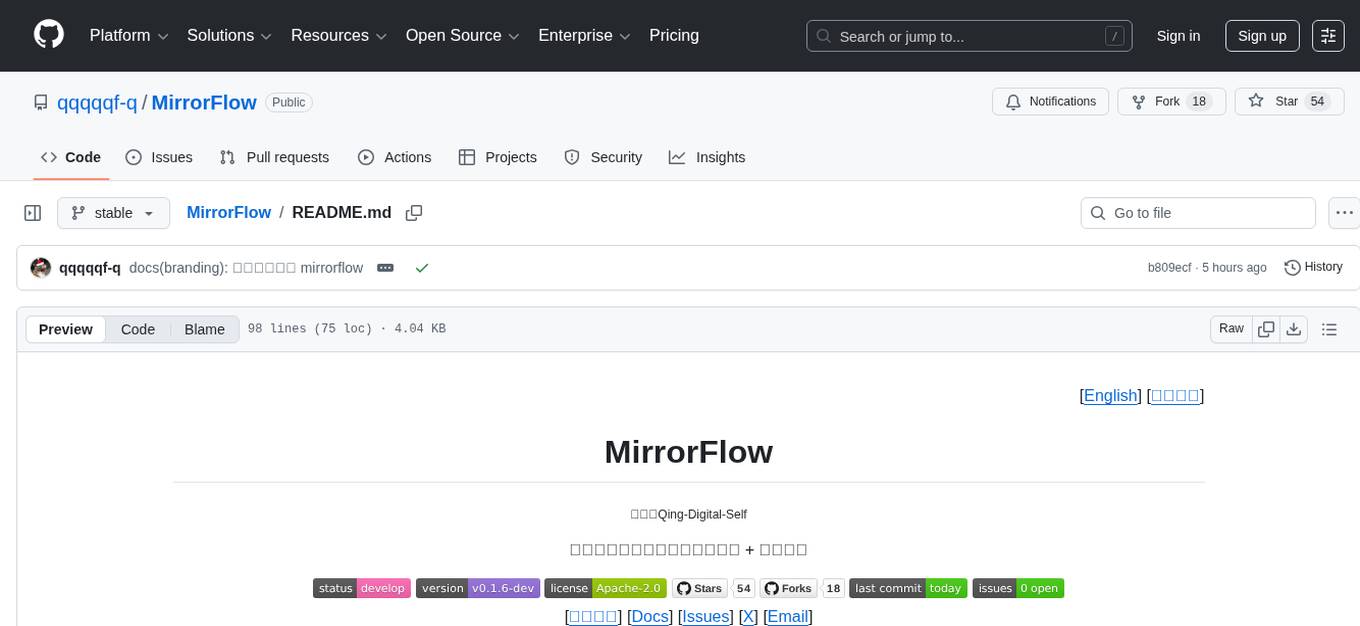
MirrorFlow
MirrorFlow is an end-to-end toolchain for dialogue data processing, cleaning/extraction, trainable samples generation, fine-tuning/distillation, and usage with evaluation. It supports two main routes: 'Digital Self' for fine-tuning chat records to mimic user expression habits and 'GPT-4o Style Alignment' for aligning output structures, clarification methods, refusal habits, and tool invocation behavior.
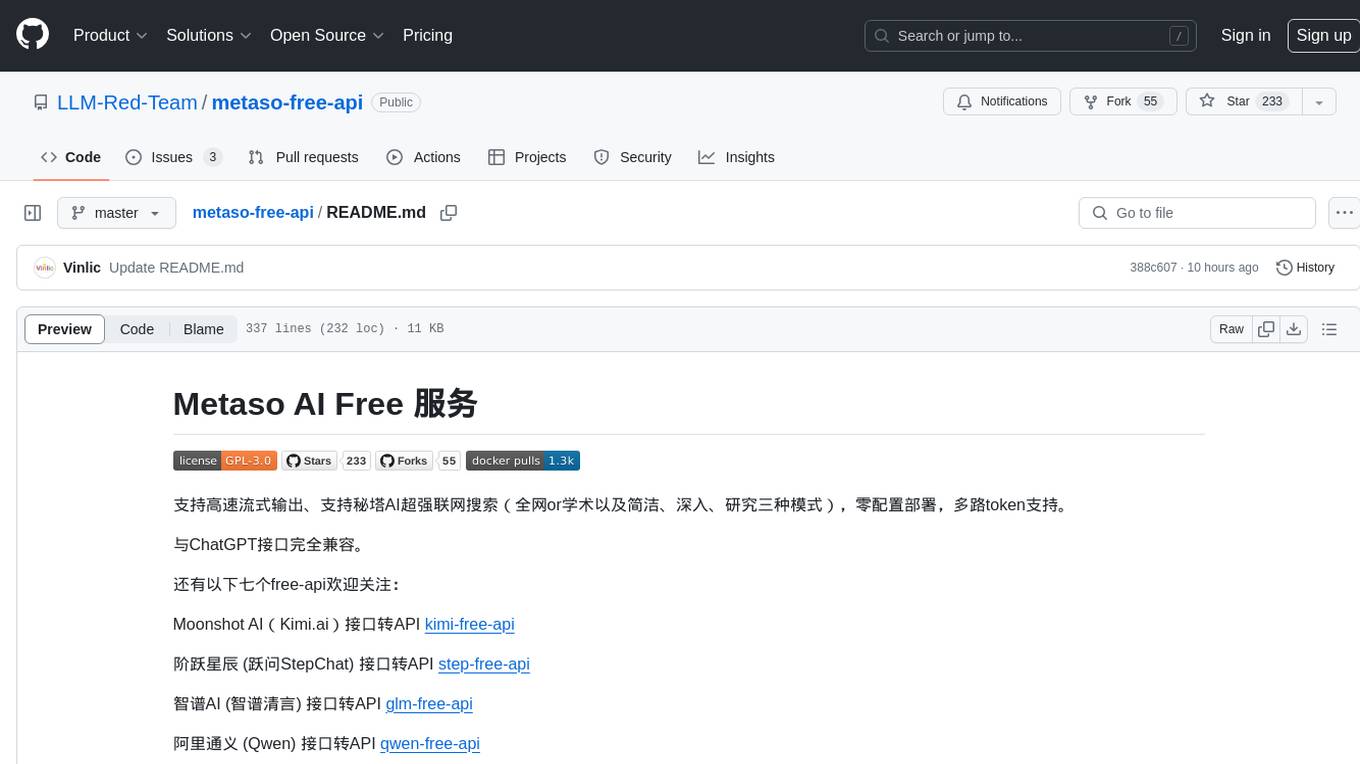
metaso-free-api
Metaso AI Free service supports high-speed streaming output, secret tower AI super network search (full network or academic as well as concise, in-depth, research three modes), zero-configuration deployment, multi-token support. Fully compatible with ChatGPT interface. It also has seven other free APIs available for use. The tool provides various deployment options such as Docker, Docker-compose, Render, Vercel, and native deployment. Users can access the tool for chat completions and token live checks. Note: Reverse API is unstable, it is recommended to use the official Metaso AI website to avoid the risk of banning. This project is for research and learning purposes only, not for commercial use.
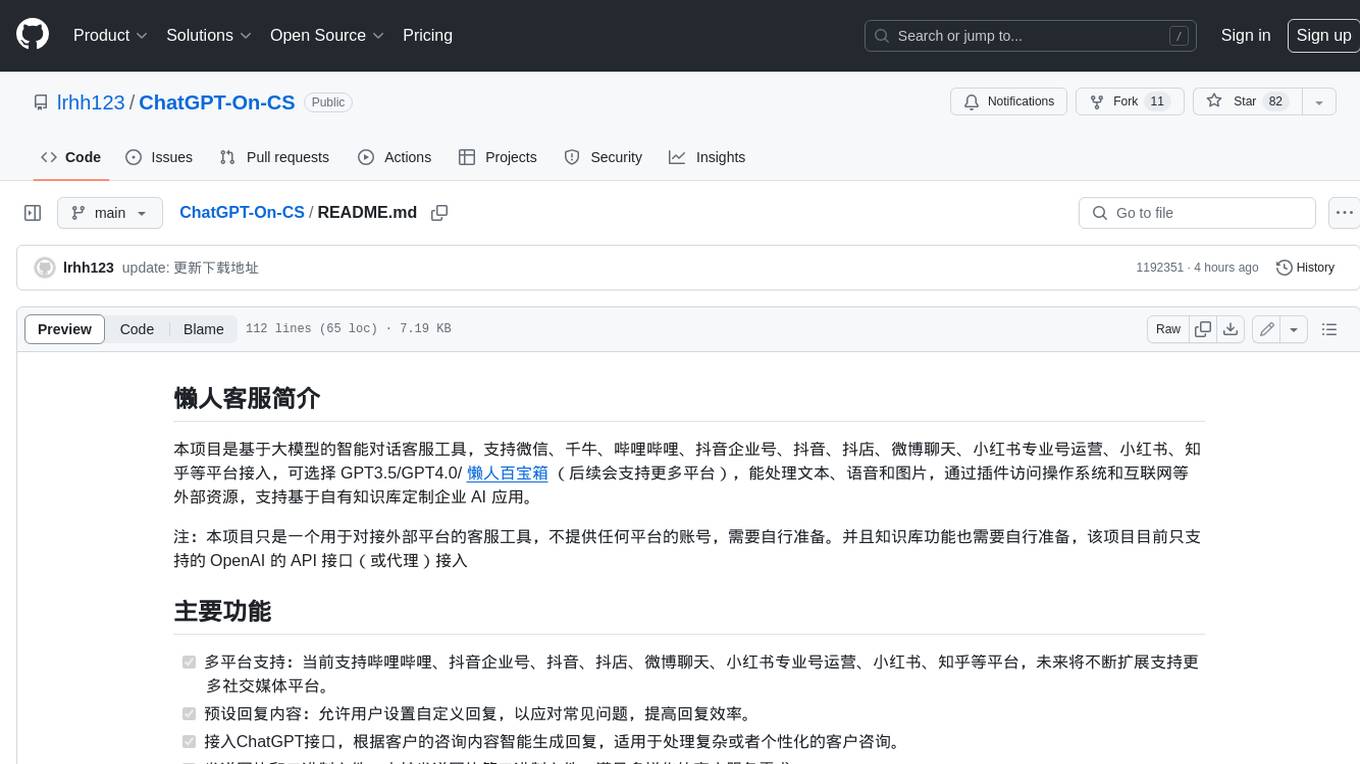
ChatGPT-On-CS
This project is an intelligent dialogue customer service tool based on a large model, which supports access to platforms such as WeChat, Qianniu, Bilibili, Douyin Enterprise, Douyin, Doudian, Weibo chat, Xiaohongshu professional account operation, Xiaohongshu, Zhihu, etc. You can choose GPT3.5/GPT4.0/ Lazy Treasure Box (more platforms will be supported in the future), which can process text, voice and pictures, and access external resources such as operating systems and the Internet through plug-ins, and support enterprise AI applications customized based on their own knowledge base.
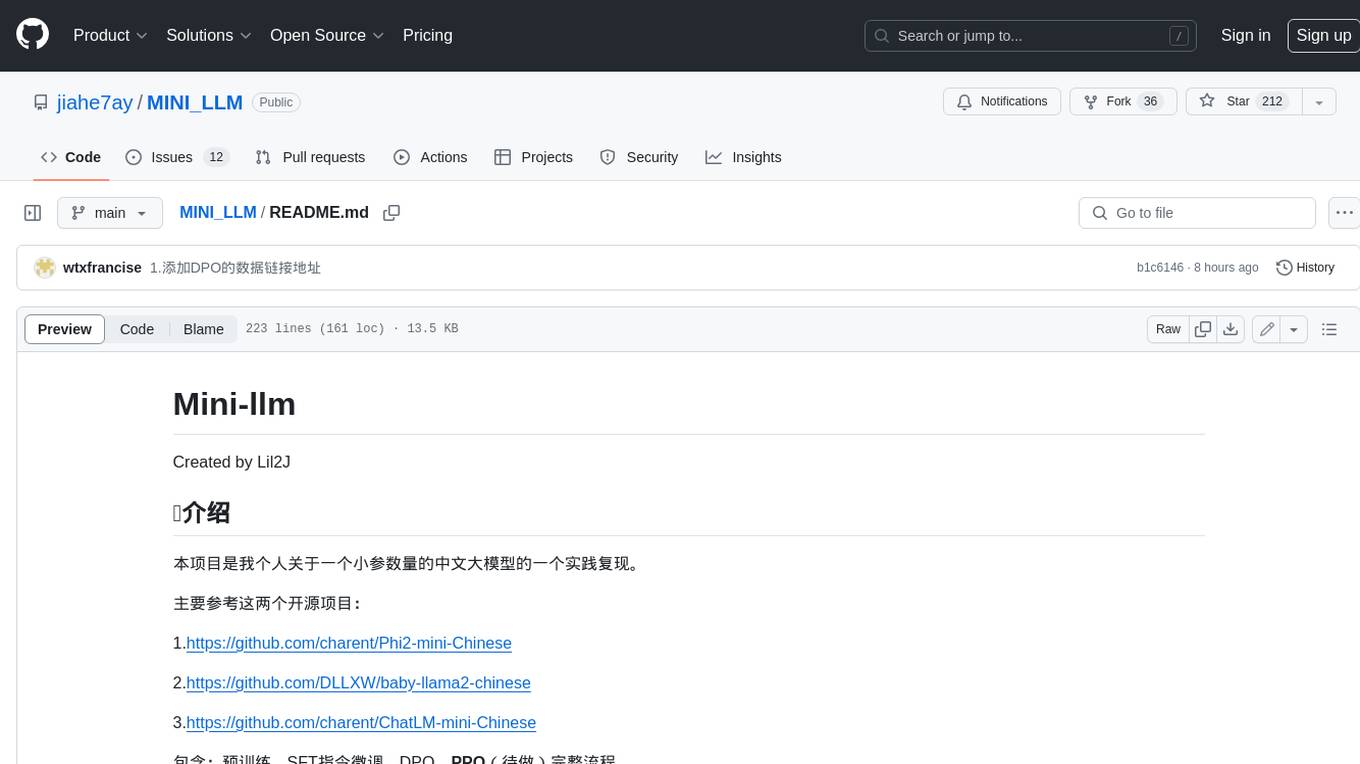
MINI_LLM
This project is a personal implementation and reproduction of a small-parameter Chinese LLM. It mainly refers to these two open source projects: https://github.com/charent/Phi2-mini-Chinese and https://github.com/DLLXW/baby-llama2-chinese. It includes the complete process of pre-training, SFT instruction fine-tuning, DPO, and PPO (to be done). I hope to share it with everyone and hope that everyone can work together to improve it!
For similar tasks
video2blog
video2blog is an open-source project aimed at converting videos into textual notes. The tool follows a process of extracting video information using yt-dlp, downloading the video, downloading subtitles if available, translating subtitles if not in Chinese, generating Chinese subtitles using whisper if no subtitles exist, converting subtitles to articles using gemini, and manually inserting images from the video into the article. The tool provides a solution for creating blog content from video resources, enhancing accessibility and content creation efficiency.
ophel
Ophel Atlas is a tool that transforms AI conversations into readable, navigable, and reusable documents. It organizes conversations into a structured workflow, allowing users to easily navigate and reuse valuable insights. It offers features such as intelligent outlining, conversation management, prompt libraries, theme customization, interface optimization, reading experience enhancements, efficiency tools, and privacy-focused data storage. Ophel Atlas is designed for various use cases including learning and research, daily work tasks, development and technical writing, content creation, and frequent AI users seeking structured and reusable capabilities.
rocketnotes
Rocketnotes is a web-based Markdown note taking app with LLM-powered text completion, chat and semantic search. It utilizes a 100% serverless RAG pipeline build with langchain, sentence-transformers, faiss and OpenAI or Anthropic API.
obsidian-smart-connections
Smart Connections is an AI-powered plugin for Obsidian that helps you discover hidden connections and insights in your notes. With features like Smart View for real-time relevant note suggestions and Smart Chat for chatting with your notes, Smart Connections makes it easier than ever to stay organized and uncover hidden connections between your notes. Its intuitive interface and customizable settings ensure a seamless experience, tailored to your unique needs and preferences.
reor
Reor is an AI-powered desktop note-taking app that automatically links related notes, answers questions on your notes, and provides semantic search. Everything is stored locally and you can edit your notes with an Obsidian-like markdown editor. The hypothesis of the project is that AI tools for thought should run models locally by default. Reor stands on the shoulders of the giants Ollama, Transformers.js & LanceDB to enable both LLMs and embedding models to run locally. Connecting to OpenAI or OpenAI-compatible APIs like Oobabooga is also supported.
second-brain-agent
The Second Brain AI Agent Project is a tool designed to empower personal knowledge management by automatically indexing markdown files and links, providing a smart search engine powered by OpenAI, integrating seamlessly with different note-taking methods, and enhancing productivity by accessing information efficiently. The system is built on LangChain framework and ChromaDB vector store, utilizing a pipeline to process markdown files and extract text and links for indexing. It employs a Retrieval-augmented generation (RAG) process to provide context for asking questions to the large language model. The tool is beneficial for professionals, students, researchers, and creatives looking to streamline workflows, improve study sessions, delve deep into research, and organize thoughts and ideas effortlessly.
AudioNotes
AudioNotes is a system built on FunASR and Qwen2 that can quickly extract content from audio and video, and organize it using large models into structured markdown notes for easy reading. Users can interact with the audio and video content, install Ollama, pull models, and deploy services using Docker or locally with a PostgreSQL database. The system provides a seamless way to convert audio and video into structured notes for efficient consumption.
tiddlywiki-starter-kit
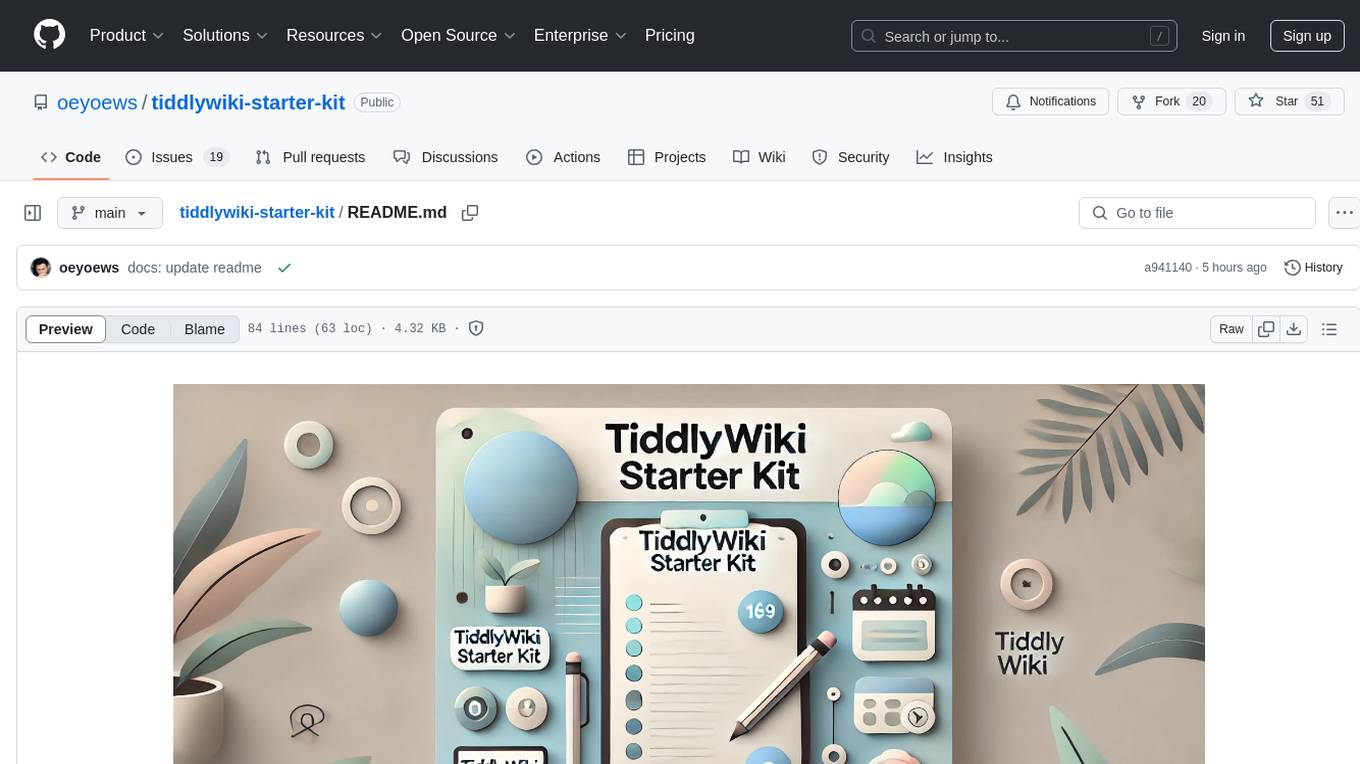
TiddlyWiki Starter Kit is a pre-configured setup for TiddlyWiki, utilizing Tailwind CSS for responsive design and providing multiple wiki support for different purposes. It offers quick operations with keyboard shortcuts, simplified configuration through editing the .env file, and one-click installation using npm create command.
For similar jobs
weave
Weave is a toolkit for developing Generative AI applications, built by Weights & Biases. With Weave, you can log and debug language model inputs, outputs, and traces; build rigorous, apples-to-apples evaluations for language model use cases; and organize all the information generated across the LLM workflow, from experimentation to evaluations to production. Weave aims to bring rigor, best-practices, and composability to the inherently experimental process of developing Generative AI software, without introducing cognitive overhead.
LLMStack
LLMStack is a no-code platform for building generative AI agents, workflows, and chatbots. It allows users to connect their own data, internal tools, and GPT-powered models without any coding experience. LLMStack can be deployed to the cloud or on-premise and can be accessed via HTTP API or triggered from Slack or Discord.
VisionCraft
The VisionCraft API is a free API for using over 100 different AI models. From images to sound.
kaito
Kaito is an operator that automates the AI/ML inference model deployment in a Kubernetes cluster. It manages large model files using container images, avoids tuning deployment parameters to fit GPU hardware by providing preset configurations, auto-provisions GPU nodes based on model requirements, and hosts large model images in the public Microsoft Container Registry (MCR) if the license allows. Using Kaito, the workflow of onboarding large AI inference models in Kubernetes is largely simplified.
PyRIT
PyRIT is an open access automation framework designed to empower security professionals and ML engineers to red team foundation models and their applications. It automates AI Red Teaming tasks to allow operators to focus on more complicated and time-consuming tasks and can also identify security harms such as misuse (e.g., malware generation, jailbreaking), and privacy harms (e.g., identity theft). The goal is to allow researchers to have a baseline of how well their model and entire inference pipeline is doing against different harm categories and to be able to compare that baseline to future iterations of their model. This allows them to have empirical data on how well their model is doing today, and detect any degradation of performance based on future improvements.
tabby
Tabby is a self-hosted AI coding assistant, offering an open-source and on-premises alternative to GitHub Copilot. It boasts several key features: * Self-contained, with no need for a DBMS or cloud service. * OpenAPI interface, easy to integrate with existing infrastructure (e.g Cloud IDE). * Supports consumer-grade GPUs.
spear
SPEAR (Simulator for Photorealistic Embodied AI Research) is a powerful tool for training embodied agents. It features 300 unique virtual indoor environments with 2,566 unique rooms and 17,234 unique objects that can be manipulated individually. Each environment is designed by a professional artist and features detailed geometry, photorealistic materials, and a unique floor plan and object layout. SPEAR is implemented as Unreal Engine assets and provides an OpenAI Gym interface for interacting with the environments via Python.
Magick
Magick is a groundbreaking visual AIDE (Artificial Intelligence Development Environment) for no-code data pipelines and multimodal agents. Magick can connect to other services and comes with nodes and templates well-suited for intelligent agents, chatbots, complex reasoning systems and realistic characters.