


MirrorFlow
对话数据到训练闭环:数字分身 + 模型蒸馏From Dialogue Data to Training Closed-Loop: Digital Twin + Model Distillation
Stars: 54
MirrorFlow is an end-to-end toolchain for dialogue data processing, cleaning/extraction, trainable samples generation, fine-tuning/distillation, and usage with evaluation. It supports two main routes: 'Digital Self' for fine-tuning chat records to mimic user expression habits and 'GPT-4o Style Alignment' for aligning output structures, clarification methods, refusal habits, and tool invocation behavior.
README:


MirrorFlow 提供一套端到端工具链:
对话数据 -> 清洗/提取 -> 可训练样本 -> 微调/蒸馏 -> 使用与评测。
当前主要支持两条路线:
- 数字分身:用你的聊天记录微调,尽量还原你的表达习惯(请看 Readme 的下端)
- GPT-4o 风格对齐:对齐输出结构、澄清方式、拒答习惯、工具调用行为
大家很喜欢4o的高情商
但OpenAI将下架GPT-4o
我希望通过蒸馏的方式'复刻'4o
让他'活着'
- 由于数据的缺少和资金的缺少,再次我希望各位可以通过这些联系方式来联系到我
- 我们需要更多的数据和更多的GPU来
KEEP4o - 仅需在OpenAI官网点击
导出数据并将压缩包发送给我
X: @qqqqqf5
Telegram: 点击此处添加我的双向聊天
以下是使用Qwen2.5 1.5b Instruct + 我自己的数据训练的Lora + 修改过的System Prompt的训练结果


如果你想参与 Keep4o:
- 贡献数据:在 OpenAI 官网点击
导出数据,把导出压缩包发给我
X: @qqqqqf5
Telegram: 点击此处添加我的双向聊天 - 本地训练: Docs: https://qqqqqf-q.github.io/MirrorFlow/
仓库也包含一套完整的数字分身教程与流程,包括:
- QQ/TG 数据提取
- 聊天数据清洗与转换
- LlamaFactory 微调流程
- 微调模型的测试与使用
点击此处快速开始
部分代码参考自 Weclone。
欢迎通过 Issues/PR 参与贡献。
若你想贡献数据,请只提交你有权分享的数据,并避免任何隐私/敏感信息。
租 GPU 成本很高。如果你愿意支持算力开销,可以先开 Issue 留言你偏好的方式(我会把它整理成稳定的赞助入口)。
Apache-2.0
For Tasks:
Click tags to check more tools for each tasksFor Jobs:
Alternative AI tools for MirrorFlow
Similar Open Source Tools
MirrorFlow
MirrorFlow is an end-to-end toolchain for dialogue data processing, cleaning/extraction, trainable samples generation, fine-tuning/distillation, and usage with evaluation. It supports two main routes: 'Digital Self' for fine-tuning chat records to mimic user expression habits and 'GPT-4o Style Alignment' for aligning output structures, clarification methods, refusal habits, and tool invocation behavior.
NarratoAI
NarratoAI is an automated video narration tool that provides an all-in-one solution for script writing, automated video editing, voice-over, and subtitle generation. It is powered by LLM to enhance efficient content creation. The tool aims to simplify the process of creating film commentary and editing videos by automating various tasks such as script writing and voice-over generation. NarratoAI offers a user-friendly interface for users to easily generate video scripts, edit videos, and customize video parameters. With future plans to optimize story generation processes and support additional large models, NarratoAI is a versatile tool for content creators looking to streamline their video production workflow.
chatgpt-plus
ChatGPT-PLUS is an open-source AI assistant solution based on AI large language model API, with a built-in operational management backend for easy deployment. It integrates multiple large language models from platforms like OpenAI, Azure, ChatGLM, Xunfei Xinghuo, and Wenxin Yanyan. Additionally, it includes MidJourney and Stable Diffusion AI drawing features. The system offers a complete open-source solution with ready-to-use frontend and backend applications, providing a seamless typing experience via Websocket. It comes with various pre-trained role applications such as Xiaohongshu writer, English translation master, Socrates, Confucius, Steve Jobs, and weekly report assistant to meet various chat and application needs. Users can enjoy features like Suno Wensheng music, integration with MidJourney/Stable Diffusion AI drawing, personal WeChat QR code for payment, built-in Alipay and WeChat payment functions, support for various membership packages and point card purchases, and plugin API integration for developing powerful plugins using large language model functions.
easyAi
EasyAi is a lightweight, beginner-friendly Java artificial intelligence algorithm framework. It can be seamlessly integrated into Java projects with Maven, requiring no additional environment configuration or dependencies. The framework provides pre-packaged modules for image object detection and AI customer service, as well as various low-level algorithm tools for deep learning, machine learning, reinforcement learning, heuristic learning, and matrix operations. Developers can easily develop custom micro-models tailored to their business needs.
geekai
GeekAI is an open-source AI assistant solution based on AI large language model API, featuring a complete system with ready-to-use front-end and back-end management, providing a seamless typing experience via Websocket. It integrates various pre-trained character applications like Xiaohongshu writing assistant, English translation master, Socrates, Confucius, Steve Jobs, and weekly report assistant. The tool supports multiple large language models from platforms like OpenAI, Azure, Wenxin Yanyan, Xunfei Xinghuo, and Tsinghua ChatGLM. Additionally, it includes MidJourney and Stable Diffusion AI drawing functionalities for creating various artworks such as text-based images, face swapping, and blending images. Users can utilize personal WeChat QR codes for payment without the need for enterprise payment channels, and the tool offers integrated payment options like Alipay and WeChat Pay with support for multiple membership packages and point card purchases. It also features a plugin API for developing powerful plugins using large language model functions, including built-in plugins for Weibo hot search, today's headlines, morning news, and AI drawing functions.
Juggle
Juggle is a low-code tool for interface orchestration, which can quickly orchestrate simple APIs into a complex interface. The orchestrated interface can be directly used by the front end, greatly improving development efficiency and reducing development costs.
aituber-kit
AITuber-Kit is a tool that enables users to interact with AI characters, conduct AITuber live streams, and engage in external integration modes. Users can easily converse with AI characters using various LLM APIs, stream on YouTube with AI character reactions, and send messages to server apps via WebSocket. The tool provides settings for API keys, character configurations, voice synthesis engines, and more. It supports multiple languages and allows customization of VRM models and background images. AITuber-Kit follows the MIT license and offers guidelines for adding new languages to the project.
KouriChat
KouriChat is a project that seamlessly integrates virtual and real interactions, providing eternal gentle bonds. It offers features like WeChat integration, immersive role-playing, intelligent conversation segmentation, emotion-based emojis, image generation, image recognition, voice messages, and more. The project is focused on technical research and learning exchanges, with a strong emphasis on ethical and legal guidelines. Users are required to take full responsibility for their actions, especially minors who should use the tool under supervision. The project architecture includes avatar configurations, data storage, handlers, AI service interfaces, a web UI, and utility libraries.
AIBotPublic
AIBotPublic is an open-source version of AIBotPro, a comprehensive AI tool that provides various features such as knowledge base construction, AI drawing, API hosting, and more. It supports custom plugins and parallel processing of multiple files. The tool is built using bootstrap4 for the frontend, .NET6.0 for the backend, and utilizes technologies like SqlServer, Redis, and Milvus for database and vector database functionalities. It integrates third-party dependencies like Baidu AI OCR, Milvus C# SDK, Google Search, and more to enhance its capabilities.
langchat
LangChat is an enterprise AIGC project solution in the Java ecosystem. It integrates AIGC large model functionality on top of the RBAC permission system to help enterprises quickly customize AI knowledge bases and enterprise AI robots. It supports integration with various large models such as OpenAI, Gemini, Ollama, Azure, Zhifu, Alibaba Tongyi, Baidu Qianfan, etc. The project is developed solely by TyCoding and is continuously evolving. It features multi-modality, dynamic configuration, knowledge base support, advanced RAG capabilities, function call customization, multi-channel deployment, workflows visualization, AIGC client application, and more.
xiaozhi-esp32
The xiaozhi-esp32 repository is the first hardware project by Xia Ge, focusing on creating an AI chatbot using ESP32, SenseVoice, and Qwen72B. The project aims to help beginners in AI hardware development understand how to apply language models to hardware devices. It supports various functionalities such as Wi-Fi configuration, offline voice wake-up, multilingual speech recognition, voiceprint recognition, TTS using large models, and more. The project encourages participation for learning and improvement, providing resources for hardware and firmware development.
my-neuro
The project aims to create a personalized AI character, a lifelike AI companion - shaping the ideal image of TA in your mind through your data imprint. The project is inspired by neuro sama, hence named my-neuro. The project can train voice, personality, and replace images. It serves as a workspace where you can use packaged tools to step by step draw and realize the ideal AI image in your mind. The deployment of the current document requires less than 6GB of VRAM, compatible with Windows systems, and requires an API-KEY. The project offers features like low latency, real-time interruption, emotion simulation, visual capabilities integration, voice model training support, desktop control, live streaming on platforms like Bilibili, and more. It aims to provide a comprehensive AI experience with features like long-term memory, AI customization, and emotional interactions.
FeedCraft
FeedCraft is a powerful tool to process your rss feeds as a middleware. Use it to translate your feed, extract fulltext, emulate browser to render js-heavy page, use llm such as google gemini to generate brief for your rss article, use natural language to filter your rss feed, and more! It is an open-source tool that can be self-deployed and used with any RSS reader. It supports AI-powered processing using Open AI compatible LLMs, custom prompt, saving rules to apply to different RSS sources, portable mode for on-the-go usage, and dock mode for advanced customization of RSS sources and processing parameters.
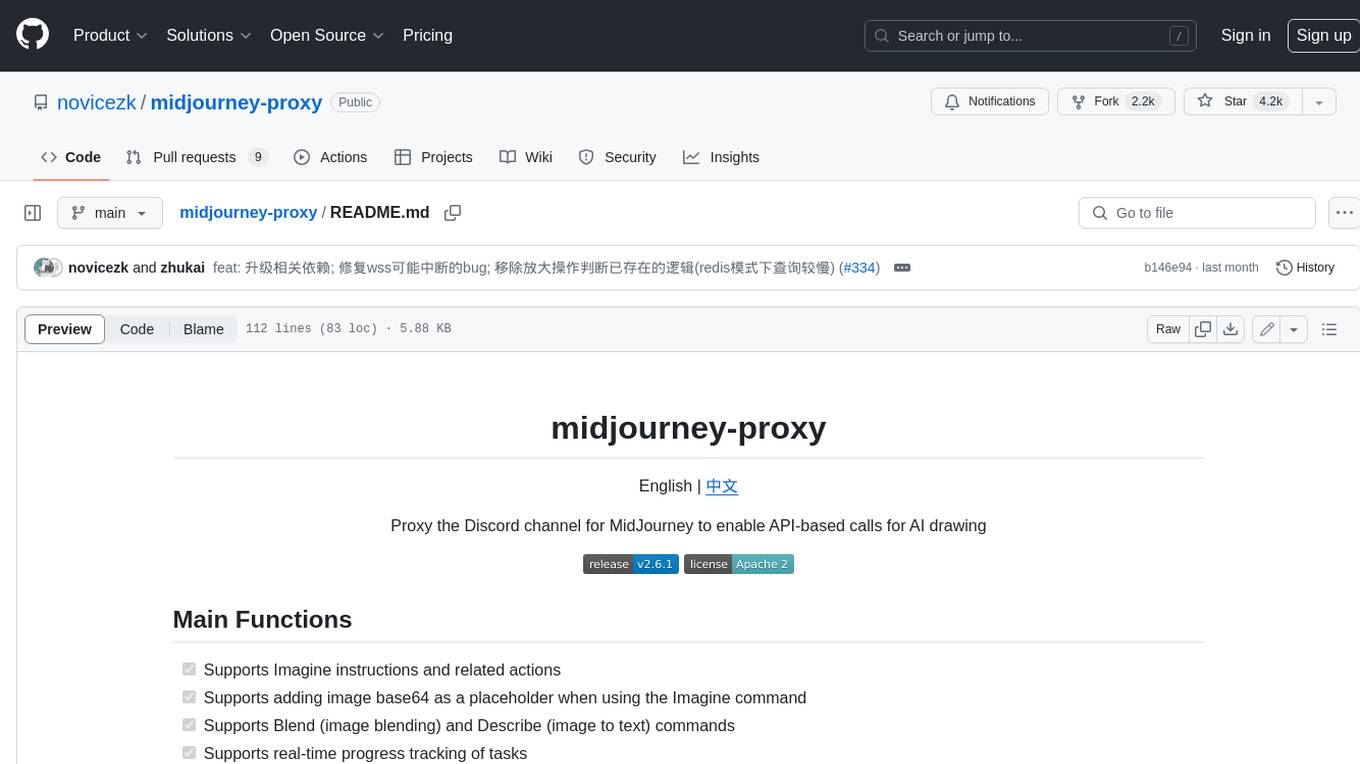
midjourney-proxy
Midjourney-proxy is a proxy for the Discord channel of MidJourney, enabling API-based calls for AI drawing. It supports Imagine instructions, adding image base64 as a placeholder, Blend and Describe commands, real-time progress tracking, Chinese prompt translation, prompt sensitive word pre-detection, user-token connection to WSS, multi-account configuration, and more. For more advanced features, consider using midjourney-proxy-plus, which includes Shorten, focus shifting, image zooming, local redrawing, nearly all associated button actions, Remix mode, seed value retrieval, account pool persistence, dynamic maintenance, /info and /settings retrieval, account settings configuration, Niji bot robot, InsightFace face replacement robot, and an embedded management dashboard.
Code-Review-GPT-Gitlab
A project that utilizes large models to help with Code Review on Gitlab, aimed at improving development efficiency. The project is customized for Gitlab and is developing a Multi-Agent plugin for collaborative review. It integrates various large models for code security issues and stays updated with the latest Code Review trends. The project architecture is designed to be powerful, flexible, and efficient, with easy integration of different models and high customization for developers.
MathModelAgent
MathModelAgent is an agent designed specifically for mathematical modeling tasks. It automates the process of mathematical modeling and generates a complete paper that can be directly submitted. The tool features automatic problem analysis, code writing, error correction, and paper writing. It supports various models, offers low costs, and allows customization through prompt inject. The tool is ideal for individuals or teams working on mathematical modeling projects.
For similar tasks
Qing-Digital-Self
Qing-Digital-Self is a project that creates a personal digital twin by fine-tuning a large language model on your chat history. The aim is to replicate your unique style of expression and conversational behavior accurately. The project includes bilingual support and comprehensive tutorials covering data extraction, chat data cleaning and conversion, LlamaFactory fine-tuning process, and testing and usage of the fine-tuned model. It offers a different perspective and assistance compared to similar projects. The project is currently in development with version v0.1.6, and welcomes contributions and issue reports from developers.
MirrorFlow
MirrorFlow is an end-to-end toolchain for dialogue data processing, cleaning/extraction, trainable samples generation, fine-tuning/distillation, and usage with evaluation. It supports two main routes: 'Digital Self' for fine-tuning chat records to mimic user expression habits and 'GPT-4o Style Alignment' for aligning output structures, clarification methods, refusal habits, and tool invocation behavior.
lighteval
LightEval is a lightweight LLM evaluation suite that Hugging Face has been using internally with the recently released LLM data processing library datatrove and LLM training library nanotron. We're releasing it with the community in the spirit of building in the open. Note that it is still very much early so don't expect 100% stability ^^' In case of problems or question, feel free to open an issue!
Firefly
Firefly is an open-source large model training project that supports pre-training, fine-tuning, and DPO of mainstream large models. It includes models like Llama3, Gemma, Qwen1.5, MiniCPM, Llama, InternLM, Baichuan, ChatGLM, Yi, Deepseek, Qwen, Orion, Ziya, Xverse, Mistral, Mixtral-8x7B, Zephyr, Vicuna, Bloom, etc. The project supports full-parameter training, LoRA, QLoRA efficient training, and various tasks such as pre-training, SFT, and DPO. Suitable for users with limited training resources, QLoRA is recommended for fine-tuning instructions. The project has achieved good results on the Open LLM Leaderboard with QLoRA training process validation. The latest version has significant updates and adaptations for different chat model templates.
Awesome-Text2SQL
Awesome Text2SQL is a curated repository containing tutorials and resources for Large Language Models, Text2SQL, Text2DSL, Text2API, Text2Vis, and more. It provides guidelines on converting natural language questions into structured SQL queries, with a focus on NL2SQL. The repository includes information on various models, datasets, evaluation metrics, fine-tuning methods, libraries, and practice projects related to Text2SQL. It serves as a comprehensive resource for individuals interested in working with Text2SQL and related technologies.
create-million-parameter-llm-from-scratch
The 'create-million-parameter-llm-from-scratch' repository provides a detailed guide on creating a Large Language Model (LLM) with 2.3 million parameters from scratch. The blog replicates the LLaMA approach, incorporating concepts like RMSNorm for pre-normalization, SwiGLU activation function, and Rotary Embeddings. The model is trained on a basic dataset to demonstrate the ease of creating a million-parameter LLM without the need for a high-end GPU.
StableToolBench
StableToolBench is a new benchmark developed to address the instability of Tool Learning benchmarks. It aims to balance stability and reality by introducing features such as a Virtual API System with caching and API simulators, a new set of solvable queries determined by LLMs, and a Stable Evaluation System using GPT-4. The Virtual API Server can be set up either by building from source or using a prebuilt Docker image. Users can test the server using provided scripts and evaluate models with Solvable Pass Rate and Solvable Win Rate metrics. The tool also includes model experiments results comparing different models' performance.
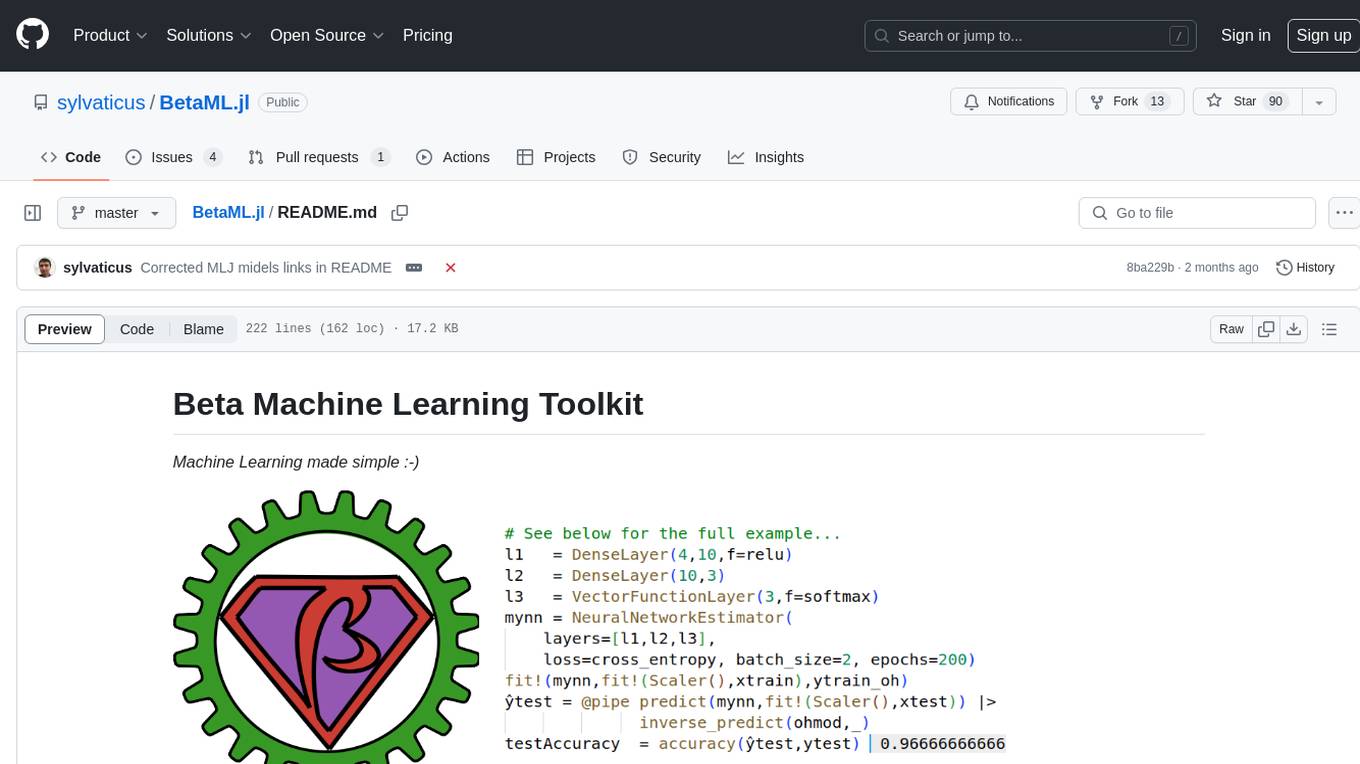
BetaML.jl
The Beta Machine Learning Toolkit is a package containing various algorithms and utilities for implementing machine learning workflows in multiple languages, including Julia, Python, and R. It offers a range of supervised and unsupervised models, data transformers, and assessment tools. The models are implemented entirely in Julia and are not wrappers for third-party models. Users can easily contribute new models or request implementations. The focus is on user-friendliness rather than computational efficiency, making it suitable for educational and research purposes.
For similar jobs
weave
Weave is a toolkit for developing Generative AI applications, built by Weights & Biases. With Weave, you can log and debug language model inputs, outputs, and traces; build rigorous, apples-to-apples evaluations for language model use cases; and organize all the information generated across the LLM workflow, from experimentation to evaluations to production. Weave aims to bring rigor, best-practices, and composability to the inherently experimental process of developing Generative AI software, without introducing cognitive overhead.
LLMStack
LLMStack is a no-code platform for building generative AI agents, workflows, and chatbots. It allows users to connect their own data, internal tools, and GPT-powered models without any coding experience. LLMStack can be deployed to the cloud or on-premise and can be accessed via HTTP API or triggered from Slack or Discord.
VisionCraft
The VisionCraft API is a free API for using over 100 different AI models. From images to sound.
kaito
Kaito is an operator that automates the AI/ML inference model deployment in a Kubernetes cluster. It manages large model files using container images, avoids tuning deployment parameters to fit GPU hardware by providing preset configurations, auto-provisions GPU nodes based on model requirements, and hosts large model images in the public Microsoft Container Registry (MCR) if the license allows. Using Kaito, the workflow of onboarding large AI inference models in Kubernetes is largely simplified.
PyRIT
PyRIT is an open access automation framework designed to empower security professionals and ML engineers to red team foundation models and their applications. It automates AI Red Teaming tasks to allow operators to focus on more complicated and time-consuming tasks and can also identify security harms such as misuse (e.g., malware generation, jailbreaking), and privacy harms (e.g., identity theft). The goal is to allow researchers to have a baseline of how well their model and entire inference pipeline is doing against different harm categories and to be able to compare that baseline to future iterations of their model. This allows them to have empirical data on how well their model is doing today, and detect any degradation of performance based on future improvements.
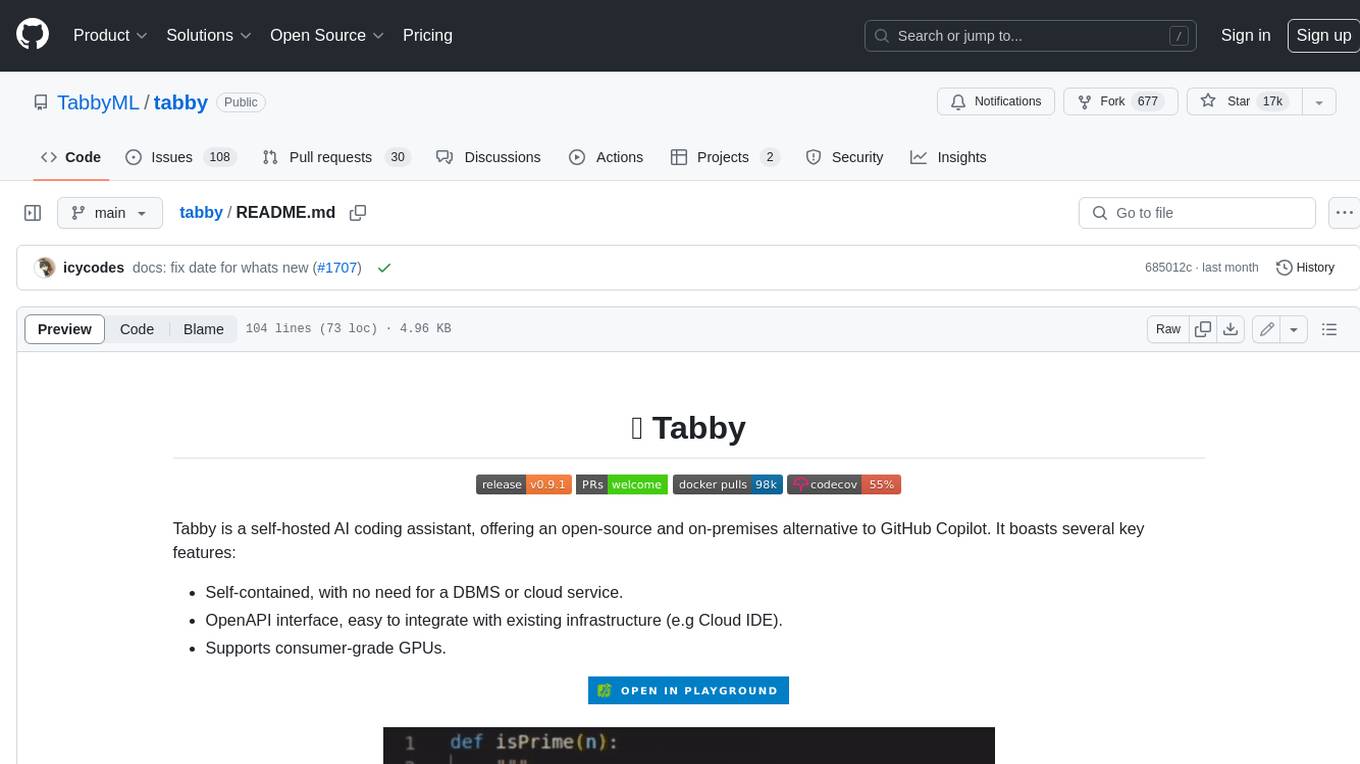
tabby
Tabby is a self-hosted AI coding assistant, offering an open-source and on-premises alternative to GitHub Copilot. It boasts several key features: * Self-contained, with no need for a DBMS or cloud service. * OpenAPI interface, easy to integrate with existing infrastructure (e.g Cloud IDE). * Supports consumer-grade GPUs.
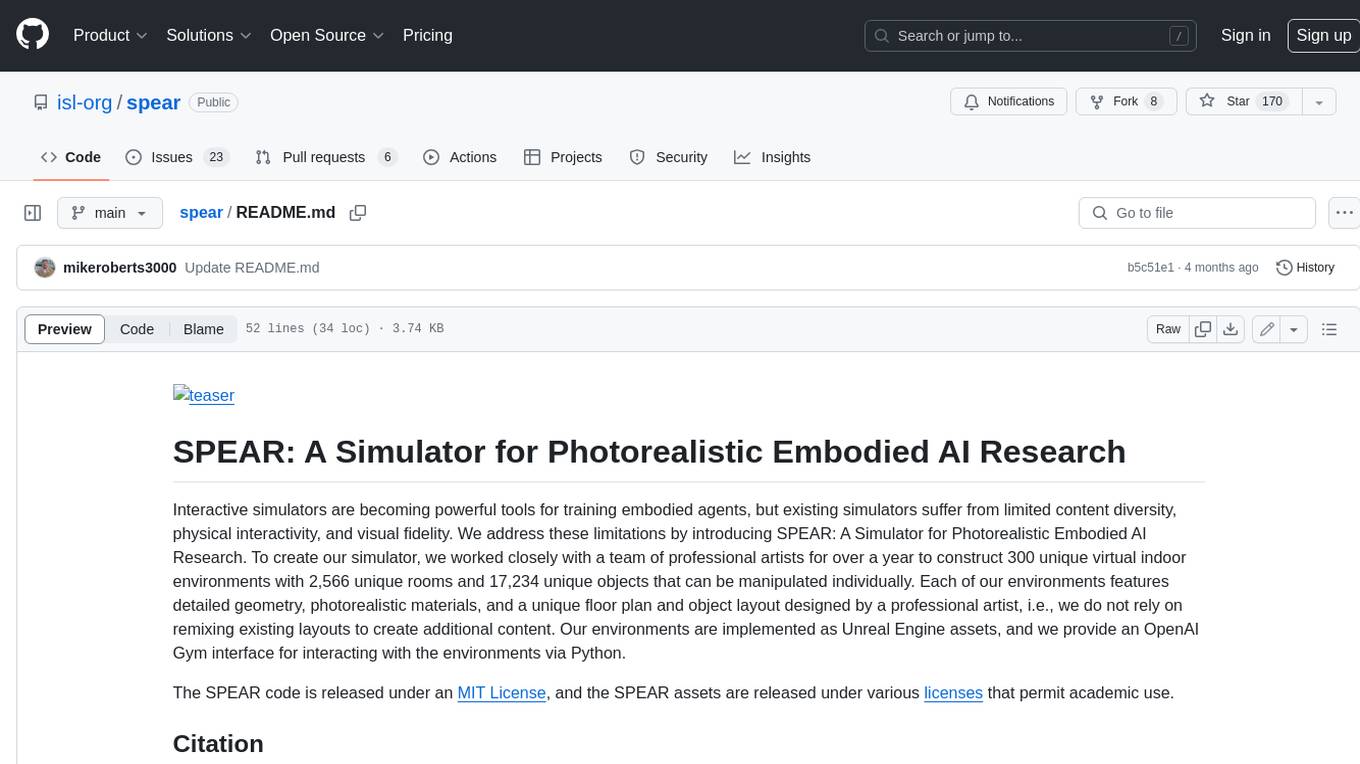
spear
SPEAR (Simulator for Photorealistic Embodied AI Research) is a powerful tool for training embodied agents. It features 300 unique virtual indoor environments with 2,566 unique rooms and 17,234 unique objects that can be manipulated individually. Each environment is designed by a professional artist and features detailed geometry, photorealistic materials, and a unique floor plan and object layout. SPEAR is implemented as Unreal Engine assets and provides an OpenAI Gym interface for interacting with the environments via Python.
Magick
Magick is a groundbreaking visual AIDE (Artificial Intelligence Development Environment) for no-code data pipelines and multimodal agents. Magick can connect to other services and comes with nodes and templates well-suited for intelligent agents, chatbots, complex reasoning systems and realistic characters.